Ruth Rooks loves to share her passion for art

Ruth Rooks in her painting studio./SHELLEY A. SACKETT

By Shelley A. Sackett

Artist and art teacher Ruth Rooks has always portrayed whatever caught her interest at that moment. In the first grade, it was beets. In 1996, it was the external pageantry of the Big Dig and the internal world of hospitals. Lately, she has been experimenting with two totally different subjects: the view from her studio window and faces.

Along the way, the Swampscott resident and president of the Swampscott Arts Association has garnered a “drawer full” of prizes, including two from the Copley Society of Boston and many from the Marblehead Festival of the Arts and SAA.

“Every time I submit a piece of my work, I hope it will be well-received and am thrilled when it is publicly recognized,” she said.

Rooks grew up in Brighton in a three-story apartment complex, attended Sunday school in a one-room schoolhouse and played with her neighborhood friends on the wide sidewalk in front of the building and in the large backyard behind it. Although she had few toys as a child, she always had a box of crayons.

Her first encouragement came from her father, Harry Kemelman (author of the Rabbi Small detective series) and his writer friend, who conspired to send her three-year-old drawings to Life magazine after it published an article on modern art. Art in the Brighton public schools was uninspiring, limited in medium to crayons and in subject to classroom holiday decorations.

Moving to Marblehead in the seventh grade was a double-edged sword. On the one hand, Rooks was thrust into a small-town environment where most of the other kids knew each other since kindergarten. On top of that, her father drove her to school and she was late “EVERY. SINGLE. DAY!”

On the other hand, Marblehead schools championed the arts, and Rooks encountered media other than crayons along with encouraging teachers. In high school, Marion Brown, “famous as an artist and by ancestry,” introduced Rooks to watercolors, a medium (along with oil paints and gouache) she favors to this day.

At 15, she “stretched the truth” and applied as a 16-year-old to be arts and crafts director at Camp Columbia day camp. She got the job and stayed for eight years, loving every minute, even the rainy days when she had an hour to dream up a project for the more than 50 campers who would show up in her shop.

It was then she knew she wanted to teach art. “I always liked to make things,” she explained. “If I saw something in a store, I would try to make it with whatever was in the house. I don’t throw away anything that sparkles and seizes my attention.”

Ruth Rooks with one of her “Big Dig” paintings./SHELLEY A. SACKETT

Years later, while her husband, George, attended Columbia University Graduate School of Business, Rooks attended the university’s Teachers College to complete the coursework needed for Massachusetts certification. Her first job was at Revere Junior High School and she never stopped teaching art, from a juvenile court-ordered program in Boston, to the Jewish Community Center of the North Shore, the Marblehead Arts Association, and private classes in her home. Under the direction of Bennett Solomon, she started the art program at (now) Epstein Hillel School.

These part-time jobs afforded her flexibility to mother three children – Nina, Jennifer, and Jared – and to take classes with a variety of artists. Then, in 1993, she was diagnosed with lung cancer and her teaching career ground to a halt.

She recovered after two surgeries, but was “antsy. I needed a schedule,” she said, so she enrolled in three classes at DeCordova Sculpture Park and Museum in Lincoln: silversmithing, silver jewelry, and painting critique. Silversmithing hurt her wrist and she had more jewelry than she would ever wear. The painting class, taught by Tim Harvey (“one of the best painters I know and one of the harshest critics”), resonated in a way that would set her life’s creative agenda.

When her family moved to Swampscott in 1996, Rooks had room to set up a dedicated studio. Her first inspiration came from Boston’s Big Dig, the largest public works project in the country. “I loved everything about it – the cranes, the sand barrels, the colors of the equipment, the huge building structures. So I painted them!” she exclaimed.

Her paintings were included in many shows and won many prizes. “It was heady stuff,” she admitted.

But the restless Rooks soon tired of construction scenes and moved on to whimsical but undeniably hospital scenes based on another medical stay (“I can’t think of anyone who would buy one!”) and her current interests in landscapes and faces.

Although her father – whose “Friday the Rabbi Slept Late” won the Edgar Award for Best First Novel in 1964 and starred Art Carney in a made-for-TV adaptation – always wrote, Rooks was unaware of it as a child. What she does remember is his lecturing to her and her siblings. “We were his audience and he liked to expound. All that you read and learn in the Rabbi Small books, we heard one way or another,” she said. A creative writing teacher, he brought his work home and encouraged his children to “write a million words,” a lesson Rooks took seriously and enjoyed as a nightly exercise.

Rooks also takes the Swampscott Arts Association (swampscottarts.org) and her role as president seriously. To add some challenge for the more experienced artist, SAA holds one or two juried shows per year. It also sponsors two social events: an annual meeting/picnic at Rooks’ home, and a December holiday party.

The most special aspect for Rooks? “This is an organization where everyone seems to like each other!” she said with a smile. 
In DTF’s ‘Misery,’ Writing Like Your Life Depends on It Takes On New Meaning

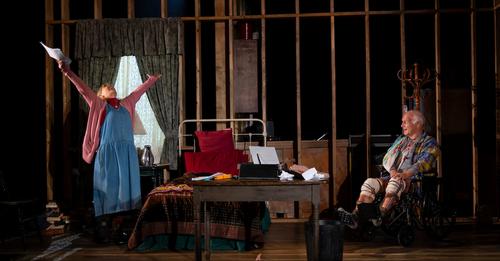
Kelly McAndrew and Dan Butler in ‘Misery’ at Dorset Theatre

By Shelley A. Sackett

Fans of Stephen King’s 1987 novel or Rob Reiner’s 1990 award-winning film, Misery, should not expect more of the same from Dorset Theatre Festival’s season opener, Misery. Playwright William Goldman has transformed the nail-biter of a scary suspense thriller into a lukewarm reminder of its prodigal self.

The excellent cast, director, and production team make the most of the script and gift the audience with an enjoyable evening of theater, but it was hard not to wonder what the same team might have cooked up had they had better-quality raw ingredients.

The plot remains pretty much the same. Annie Wilkes (a convincing and scene-chewing Kelly McAndrew) lives alone in her gothic family home in the remote backcountry of Silver Creek, Colorado. In one of her guest bedrooms lies the shattered body of best-selling romance novelist Paul Sheldon (Dan Butler), whose car went off the road in a snowstorm a few days ago. It seems Annie, his “number one fan,” just happened to be driving behind him when his car plunged into a ravine. Somehow, she managed to wrest his mangled body from the wreckage and bring it home to convalesce.

Paul awakens from the crash to Annie’s chirping chatter as she fills him in on the last few days. His two legs are badly fractured. She has set them to the best of her ability (Isn’t he lucky she’s a nurse!) and plied him with just enough drugs to ebb his pain while increasing his dependence on her.

Annie is more than an obsessed fan of Paul’s Misery series, about an orphaned 19th-century waif named Misery. She is also a lonely, middle-aged homicidal psychopath who talks to God, is divorced, wanders through her house surrounded by photos of dead relatives, and is an expert at lying and stalking.

As she slowly exposes the levels of her derangement and fixation on the Misery character, it becomes clear she intends to do more than just heal Paul. She intends to imprison him. Until death do them part.

Or at least until he writes another novel, which may just spare his life. Or, toys with Annie in this cat-and-mouse game in which she is recast as a lioness and he as a crippled cricket; then again, it may not.

In any case, write he must, as Paul’s life indeed does depend on it. Unbeknownst to Annie, his most recent installment in the Misery series kills off her beloved heroine. Coincidentally, the book’s release overlapped with Paul’s stay at Annie’s.

As his Number One Fan, Annie, of course, has her local bookstore save her all the new Paul Sheldon books. One day, she bursts into his room, triumphantly brandishing her copy.

Annie is excited beyond her wildest dreams. To be reading her idol’s latest Misery book while he is living in her house brings a creepy Little Bo Peep lilt to her gait. Paul knows (as do we) that Little Miss Sunshine will morph into Chucky the moment she reaches the end of the book. Exactly when that will happen is uncertain, but when it does, Annie’s rage will be of force majeure quality.

For his part, Paul is at first grateful, then wary, and finally determined to escape this real-life misery. His pithy, New York sophisticated banter turns less glib as he realizes the peril he is in and plots his escape, no easy feat for a man with two broken legs and an antique wheelchair for a getaway vehicle.

Goldman has provided Annie’s character with the best lines and the grisliest of backstories, and McAndrew milks it for all it’s worth. When Paul pretends to court her, luring her to a romantic dinner as part of his escape plan, Annie sheds her overalls and boots and shows up in a dress befitting Laura Ingalls from “Little House on the Prairie.”. It would be a touching scene if it weren’t for the sheen of Bette Davis’s Baby Jane character with which Annie powdered her nose.

Butler, a talented actor with star-studded credits, does the best he can with the cardboard Paul. Riw Rakkulchon’s revolving set creates a folksy, cozy country home that would be at the top of anyone’s Airbnb list. Thanks to dramatic lighting and sound design, the scenes come to creepy life. Kudos, too, for a system that allows the actors’ words to be easily heard and, more importantly, understood, something increasingly and annoyingly rare in too many Boston theaters.

It’s hard not to miss the intensity and tension generated by the Misery novel and film, but for those in the mood for a Misery-lite summer version that recasts the horror tale as a more whimsical melodrama, Dorset Theatre Festival has just the ticket.

‘Misery’ –Written by William Goldman based on the novel by Stephen King. Directed by Jason Gay. Scenic Design by Riw Rakkulchon; Costume Design by Fabian Fidel Aguilar; Lighting Design by Joey Moro; Sound Design by Daniel Baker/Broken Chord. Presented by Dorset Theatre Festival, Dorset, Vermont, through July 8.

For more information and to buy tickets, visit https://dorsettheatrefestival.org

A.R.T.’s Spectacular ‘Evita’ Raises the Bar on the Term, “Production Values”

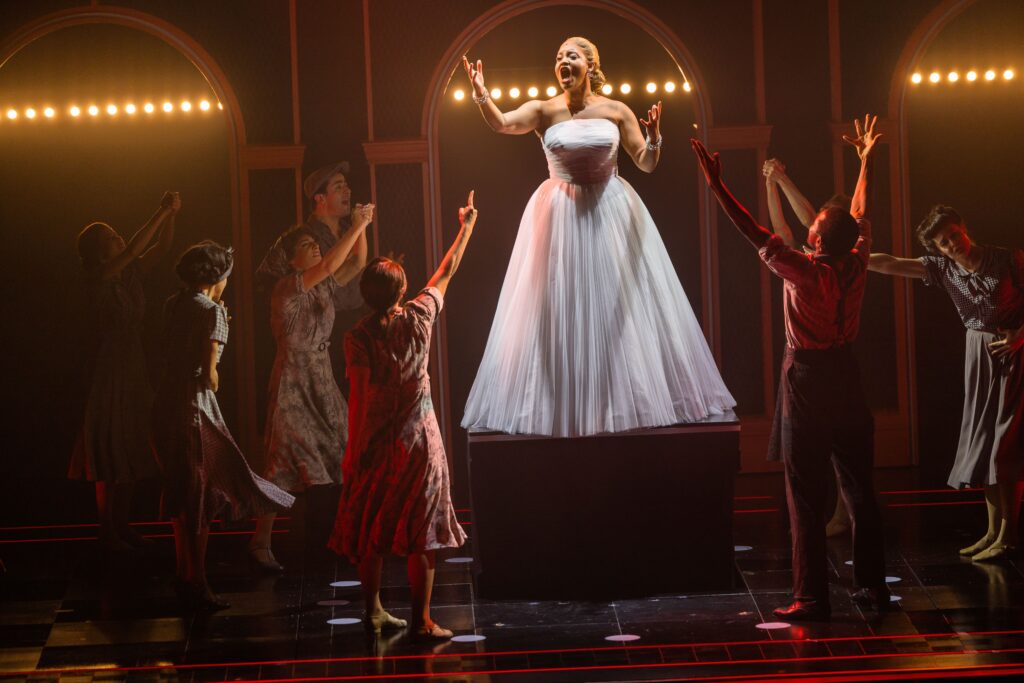
Shereen Pimentel (Eva) in Evita at American Repertory Theater. Photo Credits: Emilio Madrid.

by Shelley A. Sackett

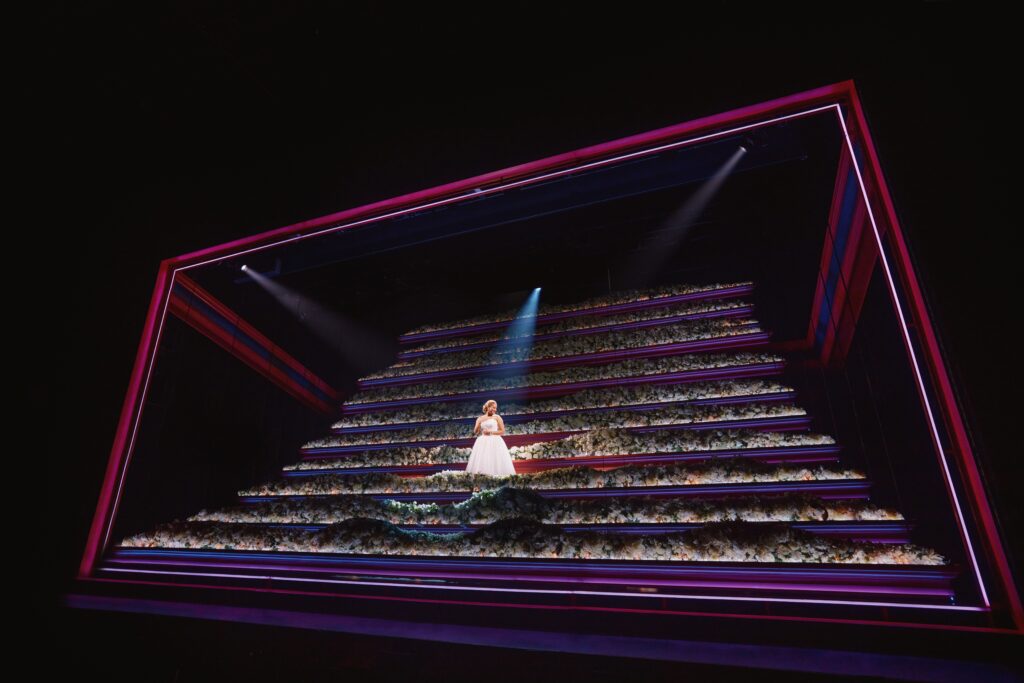
A cross between an iron maiden and a fairy princess gown, the replica of Eva Peron’s famous Dior strapless gown hangs suspended over a neon-framed stage. Like a mummified 3-dimensional diorama, the white bejeweled dress takes on a life of its own, its bodice both unsettling and beckoning, warning the audience: look but do not touch.

This riveting image, with its promise of an evening of highly stylized art and mixed messages, is the perfect introduction to the spectacularly staged ‘Evita’ now at the A.R.T.’s Loeb theater. Its production values — from exquisite costumes, choreography, scenic design, and lighting to orchestration and cast talent — can’t be overpraised. The most striking evening of theater to hit Boston stages in a while is, luckily and uncharacteristically, in town for a good, long run (through July 30), so there is plenty of time to snag a ticket and enjoy.

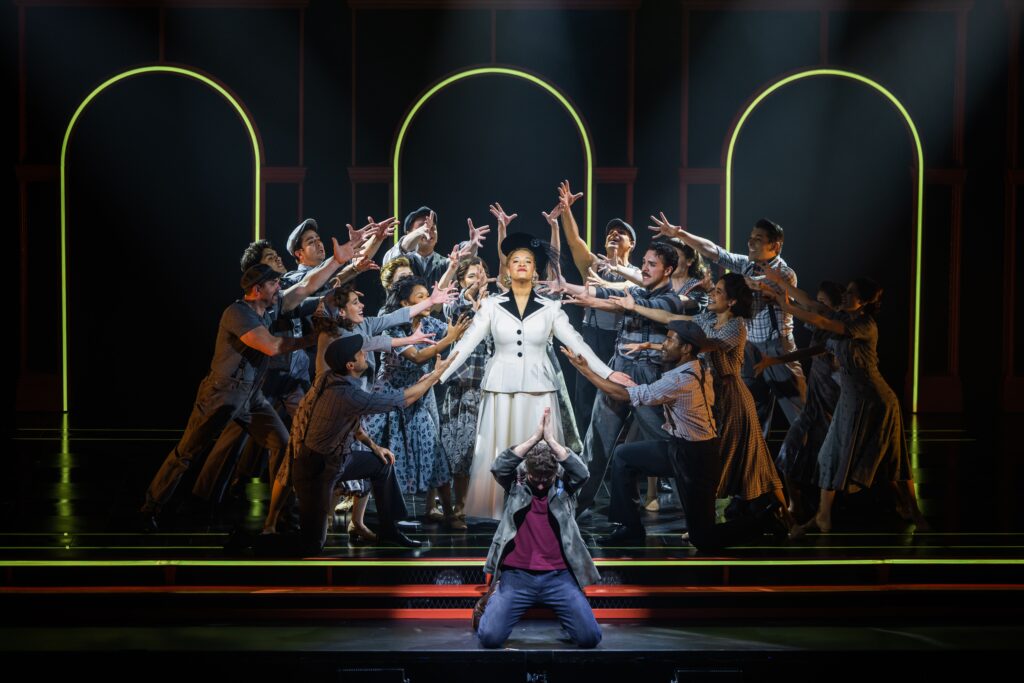
When the scrim lifts and the real show begins, the visuals only get better. A backdrop of silhouetted men and women in gorgeous haute couture hats and heels suddenly breaks into song and dance, like a painting come to life. Cinematic and magical, the effect is thrilling.

Told in vignettes, the storyline is anchored by Eva Duarte Perón and her rise from poverty in rural Argentina to reigning first lady and beloved titular patron saint. Eva’s journey is complicated and full of contradictions. While shamelessly sleeping her way to the top and ruthlessly trampling anyone who gets in her way, she also champions the poor, the disenfranchised, and the everyday working class. Voracious in her personal ambition and an original “mean girl,” she also cares deeply for her beloved country and its people.

Critical observer and cynic Che (the standout Omar Lopez-Cepero) narrates this legend, filling in the fairytale with unflattering morsels of on-the-ground reporting. In his opposing version, Eva’s deceitfulness and egomaniacal greed overshadow her legacy of charisma and beneficence.

Shereen Pimental soars as the larger-than-life Eva, transfixing the audience with her vocal range and regal presence. She commands attention every moment she is on stage, whether as a naïve 15-year-old in search of an acting breakthrough or the haughty, bejeweled dictator of fashion bullying all who don’t kowtow to her. We may feel ambivalent about her, but we can’t take our eyes off her either.

Under Sammi Cannold’s savvy direction, Emily Maltby and Valeria Solomonoff’s sassy, authentic tango choreography, and the exceptional performances by Pimentel and Lopez-Cepero, it’s almost possible to overlook the major drawback of the evening — namely, the play itself, which is more disjointed abstraction than linear storytelling. Spawned from a 1976 concept album by composer Andrew Lloyd Webber and lyricist Time Rice, the musical is short on character development and plot and long on untuneful, long-winded operatic numbers (many overamplified and difficult to decipher). Other than “Don’t Cry for Me, Argentina,” the songs blend, leaving behind no choral snippets that loop in one’s memory banks after the show’s end. Yet “Evita” is not meant to be about traditional dramaturgy. Like its namesake, it is about splash and sparkle and smoke and mirrors, and from the moment the audience lays eyes on the suspended disembodied gown until the orchestra sounds its final note, A.R.T.’s production is an unapologetic feast for all the senses. Highly recommended for anyone looking for an evening of pure epic entertainment.

Lyrics by Tim Rice. Music by Andrew Lloyd Webber. Directed by Sammi Cannold. Choreography by Emily Maltby, Valeria Solomonoff; Music Direction by Mona Seyed-Bolorforosh; Scenic Design by Jason Sherwood; Costume Design by Bradley King; Lighting Design by Bradley King. Presented by the American Repertory Theater in Association with Shakespeare Theatre Company at the Loeb Drama Center, 64 Brattle St., Cambridge through July 30.

For information and tickets, go to: https://americanrepertorytheater.org/