‘Library Lion’ Is As Much a Delight for Grownups as It Is For Kids

Ken Crossman as Kevin and Jayden Declet as Michelle play with the lion (puppeteer Amy Liou). Photo by Nile Scott Studios

By Shelley A. Sackett

Last Sunday, I was probably the only adult at the noon performance of Library Lion unaccompanied by kids and/or grandkids. For 70 uninterrupted minutes, I was treated to an uplifting, high quality production of one of the most delightful musical shows I’ve seen in a while. Plus, I had the dual luxuries of watching a room full of youngsters and eavesdropping on their comments without having to be “in charge” of any of them.

Before the curtain even comes up, there is enchantment in the air. Three “agents of magic” wearing khaki jumpsuits and matching hats mount the stairs to the stage and stand in front of the curtain. (They later double as puppeteers). One flicks her wrist and the music comes up (clarinet, cello, piano); another’s gesture turns down houselights and the third cups her hand and lifts it, raising the curtain on the most glorious library this side of Hogwarts.

The audience responds with squeals and applause — and those were the adults!

Mr. McBee (played with charm and a dose of OCD by Robert Saoud), the librarian, sings his introduction to the library and the all-important rules that must be obeyed while visiting — no shouting , no eating/drinking and no running. When he breaks the fourth wall and points to a child in the second row (“This means you — no candy”), he has the crowd eating out of his hand.

“Oh, library,” he rhapsodizes, “you are my shrine.”

The plot is fairly straightforward. Kevin (Aaron Mancaniello is a riot) and Michelle (Jayden Declet) have come to the library to work on an assignment. They are to find fables and report on them in their classrooms. Mr. McBee is all rules and stuffiness, reminding the youngsters that the library is a serious place. Kevin, exasperated, finally asks “But where’s the fun?”

On cue, head librarian Miss Merriweather (lithe and lovely Janis Hudson) arrives. She is as ethereal and playful as Mr. McBee is grumpy and earthbound. The most surprising thing about the stuffy Mr. McBee, in fact, is the passion igniting the flaming torch he carries for her.

With Miss Merriweather at the helm, the library takes on a different pallor. Books let you travel the world without leaving your chair, she tells them. Storybooks come to life, thanks to stagecraft special touches. Blue silk doubles as an ocean and books mounted on sticks open and shut like umbrellas. “Extraordinary things really happen when you read,” she explains.

Janis Hudson as Mrs. Merriweather confronts the Lion in Adam Theater’s 2025 production of LIBRARY LION.

Soon it’s story time with Storyteller (Clara Hevia), and the three puppeteers reappear with the star of the show — the lion. And what a lion it is.

Jim Henson Creature Shop has created a magnificent creature, all mane, tail and emotion. The slightest angle of head, the tilting of eyelids or the placement of paw or tail reveals a range of emotion that is deeper and more varied than Mr. McBee’s. Everyone is delighted — everyone except Mr. McBee, of course.

Miss Merriweather prevails when he complains, asking if the lion has broken any rules. Caught in his own web, he has to admit the lion is blameless. “Then let him be,” she chides.

Eventually, Mr. McBee finds a reason to banish the lion, but when he realizes he was wrong, he makes amends and counsels the children that “even adults can make mistakes.” Other life lessons follow. First impressions are not be trusted because fear of the unfamiliar might color them an incorrect hue. You can’t tell a book by its cover. Forgiveness and apologies are important for children and adults and sometimes, it’s O.K. to bend or even break rules depending on the situation.

Although the Adam Theater is a contemporary theater for young audiences, dedicated to making high quality theater accessible to all youngsters, Library Lion is a top-notch production as suitable for adults as their progeny. Skilled musicians, a perky score, a libretto full of rhyming couplets and double entendres, charming song and dance numbers, and a talented cast make for a thoroughly enjoyable and refreshing theatrical experience. Treat yourself to a vacation from the news and the weather and hi-tail it to see Library Lion while you still have time. You won’t regret it.

Library Lion’ —Adapted from the book “Library Lion” by Michelle Knudsen and illustrated by Kevin Hawkes. Directed by Ran Bechor. Book and Lyrics by Eli Bejaoui; Music by Yoni Rechter and Roy Friedman; Songs composed by Yoni Rechter; Puppet Design & Build by Jim Henson Creature Shop. Scenic Design by Cameron Anderson; Costume Design by Ula Shebchuv; Lighting Design by Daniel H. Jentzen; Sound Design by Irene Wang. Presented by Adam Theater at The Calderwood Pavilion, 527 Tremont St., Boston through Jan. 25.

For more information, visit adamtheater.org/library-lion
A Therapy Session Becomes a Cat-and-Mouse Thriller in SpeakEasy’s ‘Job’

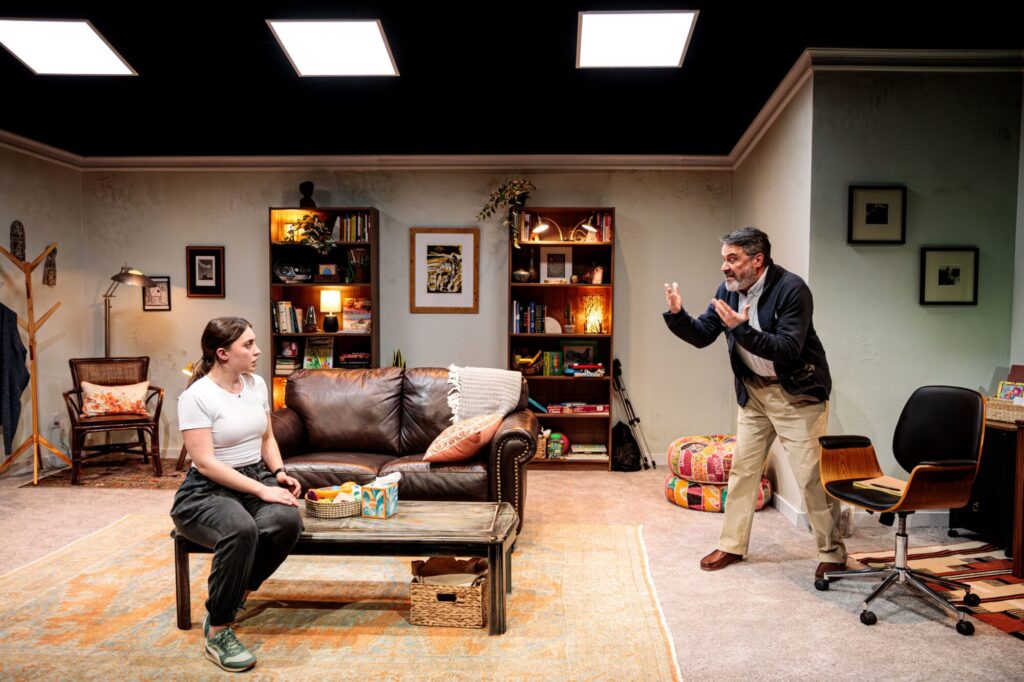
Josephine Moshiri Elwood and Dennis Trainor Jr. in Speakeasy Stage’s ‘JOB’
Photos by Benjamin Rose Photography

By Shelley A. Sackett

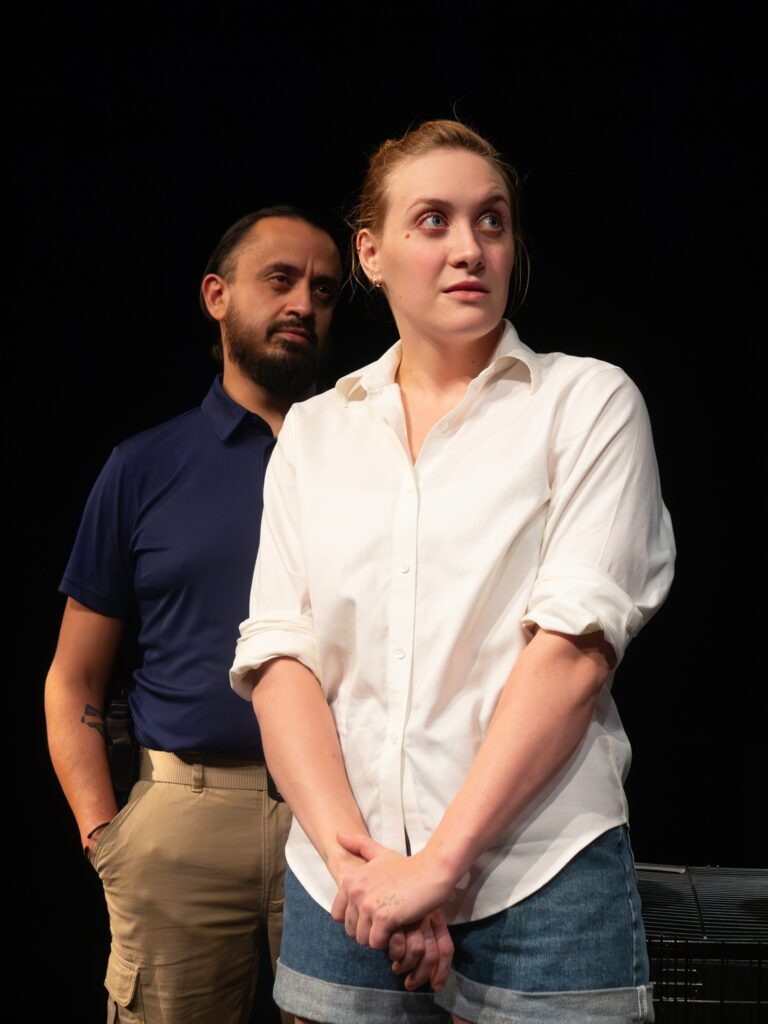
Playwright Max Wolf Friedlich wastes no time establishing the life-or-death stakes in his two-person thriller, Job. The lights come up in media res. A woman holds a gun pointed directly at a man’s head. Jane (Josephine Moshiri Elwood) is shaking, enraged and desperate. Lloyd (Dennis Trainor, Jr.), clearly shaken, holds a clipboard and a pen. “Let’s just talk this through,” Lloyd entreats, right before the first of many, many abrupt blackouts, flashes and eerie sounds.

Seconds later, in the next tableau, Jane still holds the gun to Lloyd’s head, but he wears a cocky smirk. “You did it,” he spits at her. “You were right about everything.” Another blackout.

These staccato scenes repeat until the set and scene settle and hints at who/what/where and why are revealed. “… and whatever is happening in your life, I promise, we can talk about it, I will listen,” Lloyd coos. Jane, at last, relaxes and lowers her gun, seeming to come to her senses. In a flash, chameleon-like, she is terrified. “This is not who I am, I would never like -FUCK! Are you going to call the police?!” she shouts, followed soon by a compliant, “Can we keep going?”

All of this occurs within the first five minutes.

Lloyd, it turns out, is a therapist who specializes in work crises. He has been assigned to evaluate Jane’s mental fitness to return to work at a Bay Area tech company where she is a content moderator (which she calls “user care”). She spends all day watching and searching for violent, sexually perverse videos so she can report and block them. When she describes in graphic detail the ugliness she encounters, she drives home the toxic fungus of humanity that can thrive undetected in the dark underbelly of the Internet.

Like Jeanne d’Arc, she is a crusader, keeping the world safe for the billions who spend as much time in the virtual world as they do in the physical. “The internet isn’t some fringe ‘young people’ thing anymore – it’s where we live. It’s our home and I am the front line of defense − there’s nobody else,” she tells Lloyd.

What brought her to this mandated session was an in-office mental breakdown that included a screaming fit atop furniture, which a heartless co-worker recorded and posted to, ironically, the Internet. Unsurprisingly, the video went viral, reaching meme status. She is a one-woman Millennial vigilante, intelligent, combative, edgy, obsessed with the responsibility and power of her job, willing to “extract the darkness” of the online hellish landscape by sponging it. “It’s a privilege to suffer as much as I do,” she states. Her mission is ordained — to expose and root out Evil, “the kind God warns about.”

She’s also more than a little scary, even more so when holding a gun pointed at Lloyd’s head.

Lloyd, by contrast, is a sixty-something Boomer, an ex-hippie who hates big corporations and the type of technology Jane’s generation has foisted onto his previously crunchier environment. His office is a realistic hodge-podge of plants, posters and shabby chic. He is as calm as she is manic, as resentful of the Gen Z generation and how they have changed the global landscape as Jane is of his generation’s hypocrisy and the NIMBYism that created a housing shortage blamed on tech workers.

He is also earnest and patronizing (“My only job is to help you”), manipulative and judgmental. And, like Jane, he believes no one can do his job as well as he can. “I was destined to be your doctor,” he says matter-of-factly.

They are well-matched intellectually, their conversations sometimes morphing into a strange recasting of My Dinner with André. You can almost imagine them, under other circumstances, calmly and deftly debating the merits and demerits attributable to Boomer and Millennial/Gen Z generations.

To describe Elwood’s portrayal of Jane as flawless is an understatement. She doesn’t just play the part; she embodies it. Likewise, Trainor, Jr. is splendid as the slippery Lloyd, shifting gears with finesse and competence. Bassham’s direction is crisp and well-paced. The scripted abrupt blackouts and flashes, while effective at revealing Jane’s overstimulated mind, unfortunately become increasingly ineffective as their use increases.

Friedlich has peppered his taut, edge-of-your-seat adventure with punchy dialogue and hard-hitting questions. When does a job take on the attributes of a divine summons? How much evil can one person absorb before succumbing to its toxicity? At what point does self-sacrifice become self-preservation, and is it worth it?

Describing the details of the plot any further would risk tripping the spoiler alert buzzer, but suffice it say that Job is hardly an 80-minute therapy session. Rather, the play has more in common with a hostage situation and generational duel (and the ending is indeed a quintessential — and literal — showstopper). Highly recommended for those looking for a timely production with stellar performances and a smart, edgy script.

‘Job’ — Written by Max Wolf Friedlich. Directed by Marianna Bassham. Scenic Design by Peyton Tavares; Lighting Design by Amanda E. Fallon; Sound Design by Lee Schuna; Costume Design by E. Rosser. Presented by SpeakEasy Stage Co., Calderwood Pavilion, Boston, through Feb. 7.

For more information, visit https://speakeasystage.com/

Theater Mirror Reviewers ‘Best Of’ Lists for 2025

Theater Mirror

Shelley A. Sackett

Caleb Levin, Odin Vega, Lyla Randall in ‘Fun Home’ at the Huntington. Photos by Marc J Franklin

While 2025 had its theatrical hits and misses, there was much to celebrate, especially among some smaller theaters presenting edgier and more provocative works. It was a varied year, with big, splashy musicals; sharp, intimate family dramas; and risk-taking, inventive productions that pushed the envelope on what we label “theater.” Once again, the vibrant greater Boston theater scene, with its stellar stable of directors, actors and creative production teams, blessed its patrons (and reviewers!) with an abundance of riches, for which we all should give thanks.

In descending order, my list is:

  1. Hamilton (Broadway in Boston)

A flawless production of the play that just keeps giving. Broadway in Boston’s production at Citizens Opera House was as good as it gets, from set design to actors to choreography and musical direction.

Adapted from Alison Bechdel’s graphic novel memoir, the storyline follows a family’s journey through sexual orientation, gender roles, suicide, emotional abuse, grief, loss, and lesbian Bechdel’s complicated relationship with her tightly closeted father. A brilliant script and score and superb production elevated this potentially gloomy tale to one of the year’s top performances.

Gloucester Stage effectively took the road less traveled in its presentation of the 80-year-old classic with an interesting and thought-provoking production that allowed the audience to experience Williams’ script anew through an exciting, hyper-focused and refractive lens.

There is so much to praise about SpeakEasy Stage Company’s ‘A Man of No Importance,’ director Paul Daigneault’s swansong production after leading the company he founded for 33 years, it’s hard to know where to begin. The ensemble of first-rate actors, musicians, choreography, set design, 20 songs, and brilliant directing were the shining constellation at the epicenter of this production that ends on an uplifting note, one that is as relevant and helpful today as it might have been in Oscar Wilde’s day..

No one can take his audience on an emotional and artistic roller coaster like Igor Golyak, founder and artistic director of Arlekin Players Theatre & Zero Gravity (Zero-G) Theater Lab. With Our Class, he introduced us to characters we initially relate to and bond with, spun an artistically ingenious cocoon, and then told a tale that ripped our heart to shreds and left us too overwhelmed to even speak. The acting was indescribably sublime, each actor both a searing individual and a perfect ensemble member.

In substance, Life and Times of Michael K tells the extraordinary story of an ordinary man. Adapted from the 1983 Booker Prize winner, written by South African novelist J. M. Coetzee, it details the life of the eponymous Michael K and his ailing mother during a fictional civil war in South Africa.

As adapted and directed by Lara Foot in collaboration with the Tony award-winning Handspring Puppet Company, this simple tale becomes the captivating and transportive production. Michael K. (and a cast of many) also happens to be a three-foot-tall puppet made of wood, cane, and carbon. “Must see” hardly does it justice; this is a groundbreaking pilgrimage into the multisensorial world of out-of-the-box theater.

This sunny, upbeat two-hander musical romantic comedy was as beguiling as it was impeccably acted, directed and produced. Unlike too many musicals these days, Two Strangers has a complicated plot and fetching music with lyrics that are Sondheim-esque in their conversational fluency and relevance. Add to that a smart, slick set, superb band, impeccable direction, and perfectly matched and equally talented actors for a full-blown fabulous evening of musical theater at its finest.

  • Rent (North Shore Music Theatre)

NSMT is tailor-made for musicals with its theatre-in-the-round, signature creative set designs and talented casts. With Rent, the Pulitzer Prize and Tony Award-winning musical set in New York City’s East Village from 1989 to 1990, it managed to pay homage to a classic that defined an era while also spotlighting its relevance to today.

Pulitzer Prize-winning playwright Hall spun his magic, culminating in a monologue set against a rapid montage of people, movements and events from 1968 to 2024. The effect was as spellbinding as the magical 90 minutes we just spent in the presence of greatness, from the acting, writing, and direction to witnessing the final hours in the life of a man whose legacy is deservedly legendary.

300 Paintings (A.R.T.)

In 2021, Aussie comedian Sam Kissajukian quit stand-up, rented an abandoned cake factory, and became a painter. Over the course of what turned out to be a six-month manic episode, he created three hundred large-scale paintings, documenting his mental state through the process. His Drama Desk Award-nominated solo performance brought the audience on an original and poignant ride exposing his most intimate moments. The opportunity to graze among the real art was after show icing on a delicious cake.

    Runners Up:

    1.  Is This A Room (Apollinaire Theater Company)

    A stunning production based on the F.B.I. interrogation of whistleblower Reality Winner.

    2. The 4th Witch (Manual Cinema)

    Hands down, the most wildly exciting and inventive production of the year. Manual Cinema pulled out all the stops, with shadow puppetry, live music, and actors in silhouette who redefined and reimagined theater. Inspired by Shakespeare’s Macbeth, a girl escapes the ravages of war and flees into the dark forest where she is rescued by a witch who adopts her as an apprentice. As she becomes more skilled in witchcraft, her grief and rage draw her into a nightmarish quest for vengeance against the warlord who killed her parents: Macbeth. Timely, relevant, and edge-of-your-seat engaging.

    3. Sweeney Claus (Gold Dust Orphans)

    Ryan Landry’s brilliant, irreverent, laugh-out-loud mash-up of Sweeney Todd and reindeer-randy Santa Claus brought camp to a new level. Terrific talent, costumes and choreography.

    4. My Dinner with André (Harbor Stage Company)

    A corner booth, fancy fare and tasty conversation — who doesn’t remember the cult frenzy caused by Louis Malle’s 1981 110-minute film that enchanted audiences, defied pigeon-holing and raised the bar on the “art” referred to as conversation? For those who found the film charmingly quirky, the splendid production at BCA Plaza Black Box Theatre was right up your alley.

    5. The Piano Lesson (Actors’ Shakespeare Project)

    Only stiff competition and the shadow of the high bar set by Seven Guitars in 2023 prevented ASP’s excellent production of Wilson’s Pulitzer Prize-winning drama from being among this year’s top ten.

    Apollinaire’s Thriller ‘Is This a Room’ Asks, ‘Who Is The Real Patriot in Today’s Murky World?’

    Cristhian Mancinas-García, Bradley Belanger, Brooks Reeves, and Parker Jennings in Apollinaire Theatre Company’s “Is This a Room.”

    ‘Is This a Room” — Written by Tina Satter. Directed by Danielle Fauteux Jacques. Concept and Original Direction by Tina Satter. Presented by Apollinaire Theatre Company, 189 Winnisimmet St., Chelsea, through Jan. 18.

    By Shelley A. Sackett

    Whatever you do, do not under any circumstances listen to any of the excellent podcasts and interviews with Reality Winner, the subject of Apollinaire’s gripping Is This a Room, until after you’ve seen the play — and see it you must.

    For 70 minutes, the verbatim transcript of an F.B.I. interview of a 25-year-old woman suspected of violating the Espionage Act is the most unlikely script in this thrilling mystery that packs a wallop and imbues a by-the-books encounter with emotional and psychological depth and humanity.

    The play thrusts us into the moment of June 3, 2017, when Reality Winner (a riveting Parker Jennings), returning from doing Saturday chores, is met by F.B.I. agents waiting at her front door. In her cutoff jeans, white button-down shirt, and spunky hi-top sneakers, she looks more like a teenager than a woman who spent six years in the Air Force, speaks Farsi, Dari, and Pashto, and has top-secret clearance with a local military contractor.

    The men, Special Agent Justin Garrick (a sublime Brooks Reeves) and R. Wallace Taylor (Cristhian Mancinas-Garcia), introduce themselves and explain they are there to talk “about, uh, possible mishandling of classified information.”

    Winner, wide-eyed with innocence and trust, replies, “Oh my goodness. Okay.” The skeletal, abstract set (Joseph Lark-Riley), superb lighting (Danielle Fauteux Jacques, who also directs), and Black Box configuration create an atmosphere of such intimacy that it is as if the audience is watching a real-life proceeding happening in real time.

    At first, Winner claims she has no idea what the men are talking about, and Jennings digs deep to find the emotion and vulnerability in her character. We can imagine what she is feeling with each passing minute, and we want to believe her, even after we learn she has three military grade weapons in her house.

    Good cop Garrick and less good cop Taylor explain they have warrants (which they never show her) and will be searching her house and car. She doesn’t insist on a lawyer; they don’t read her her Miranda rights. It’s all low stakes and cordial in the beginning, with Winner apologizing and wanting to make it “as easy as possible for you guys,” and the agents making small talk and deflecting her questions with, “We’ll go over all of that…”

    The transcript tiptoes towards substance, punctuating the agents’ aw-shucks stammers and guffaws with open-ended but steely questions. Has she ever gone outside her need-to-know/clearance level? Has she ever taken anything outside the building? Has she discussed anything having to do with her job with anyone, ever? Has she ever copied anything?

    Suddenly, the atmosphere shifts, and Winner tries to make light of the line of questioning by defending her use of printer and paper. She’s “old-fashioned,” she claims, and uses a lot of paper. She finds it easier to navigate long documents in hard copies rather than online. “Is that what this is about? Fraud, waste and abuse?” she jokes.

    Mancinas-García and Jennings

    The agents, still acting as friends, offer her “the opportunity to tell the truth,” and an ominous beat, like the beeping in an ICU or the slow menace of low war drums, thrums. Every time the actual transcript was redacted (brilliantly referenced on the playbill and poster), a blue light glares and the beat intensifies, as if, by proxy, the audience is subjected to psychological torture.

    Fifty minutes in, everything changes. The agents say they have the goods on her. Winner’s story wiggles a little. Then it wiggles a lot. The agents straddle a delicate line between doing their job as law enforcers and trying not to overwhelm her. “IS there anything else we should be worried about?” Garrick asks. Not to worry, he implies, as he adds, ”We’ll figure it out.”

    Jennings brings credibility and stunning physical nuance to a role that held few clues about the character’s interiority. Her body literally crumbles, muscle by muscle, when she realizes the jig is up. As F.B.I. agents sent to do the bidding of one they may or may not agree with, they are a little nervous and a little lost, sharing details of their personal lives and asking about her CrossFit experiences. They may be doing the devil’s work, but they are neither demons nor demonized.

    It’s no secret that Reality Winner pled guilty to leaking documents that contained proof of Russian interference in the 2016 election to an online news source, The Intercept. She was sentenced to more than five years in prison, the longest sentence ever imposed in federal court for an unauthorized release of government information to the media, according to a Times report. She was granted early release, but is prohibited from publicly speaking about certain topics.

    In 2025, she released an audiobook, “I Am Not Your Enemy: A Memoir,” and has her own dedicated podcast series, “This Is Reality.” Even with a stiff gag order, the facts that emerge make it impossible not to question why Trump cracked down on the leak of this particular document, which contained proof of Russian interference in the 2016 election (which Trump has denied) and which the NSA, under someone’s orders, buried.

    Apollinaire Artistic Director Fauteux could not have chosen a riper moment in which to stage this play, as we round the bend towards a year of predicted mid-term election chaos and mayhem. We may not face the same situation Winner did, with her access to and knowledge of documents proving a possible unlawful official cover-up, but we are left with the same existential dilemma — Is it possible to live a law-abiding life in a world turned lawless, or will only the lawless survive?

    Recommended.

    For more information, visit: https://www.apollinairetheatre.com

    A.R.T.’s Uplifting ‘Wonder’ Wonders What Makes A Life Wonderful

    Nathan Salstone, Garrett McNally, and members of the cast of ‘Wonder’ at the A.R.T.
    Photos by Hawver and Hall

    ‘Wonder’ — Book by Sarah Ruhl. Music and lyrics by A Great Big World (Ian Axel and Chad King). Directed by Taibi Magar. Choreographed by Katie Spelman. Music supervision by Nadia DiGiallonardo. Presented by American Repertory Theater at Loeb Drama Center, 64 Brattle St., Cambridge, through Feb. 8.

    By Shelley A. Sackett

    Middle school is widely recognized as one of life’s toughest crucibles, a time of major physical, emotional and social change. A petri dish of hormonal upheaval, intense social pressures and increased academic demands, it has all the ingredients for an emotive perfect storm.

    Now imagine navigating these turbulent waters as a boy with facial differences facing transition from homeschooling to private school, where he will, for the first time, have to mix with other kids, and that perfect storm suddenly lurks as a tsunami of epic proportions.

    This is the premise of Wonder, the new coming-of-age musical drama débuting at American Repertory Theater. Based on R.J. Palacio’s best-selling 2012 young adult novel, Sarah Ruhl’s play tells the story of Auggie Pullman, a boy born with Treacher Collins syndrome, a rare genetic disorder that interferes with the development of facial features.

    Garrett McNally and Donovan Louis Bazemore

    Auggie (Garrett McNally last Friday night. He shares the role with Max Voehl) is a typical 12-year-old in many ways. He straddles childhood and adolescence. His bedroom is still that of a little boy with its bed shaped like a spaceship, and he has an imaginary friend, Moon Boy (Nathan Salstone, a talented standout), who provides protection and companionship.  

    Auggie also asks more grown-up, bigger picture questions, wondering, for example, why he was created as he was. He longs to be ordinary, yet by the play’s end, it is his extraordinariness that elevates both Auggie and everyone around him.

    Matt Saunders has created an elegant, simple set of moving panels with a patchwork quilt of lighted squares that reflect the mood as they change from celestial blues to red and yellow to shades of pastel mauves (Lighting by Bradley King). Songs by pop duo A Great Big World (Ian Axel and Chad King) are funny, catchy and upbeat with lyrics that reveal their characters’ inner lives and fill us in on important details. (Unfortunately, the band too often drowns them out).

    The splashy opening number, “3-2-1 Blast Off!” showcases the charismatic Salstone and introduces us to Auggie. “You Are Beautiful,” a song celebrating Auggie’s unique beauty and strength, recognizes his inspiring journey of 28 surgeries and the “scars tell a story of a boy who’s strong,” making him a “wonder.”

    Alison Luff and Garrett McNally

    Auggie’s parents, Nate (Javier Muñoz) and Isabel (Alison Luff) have decided it’s time to wean Auggie off homeschooling and shift to the private co-ed Beecher Prep. Isabel needs time to herself and Auggie’s intellectual capacity and needs exceed what she can provide. He needs to integrate with other kids (and, as importantly, they with him).

    Auggie is terrified. His experiences with other kids have been disastrous. They can’t get past how he looks, reacting with fear, disgust and ridicule. Eventually, he relents, but not until Moon Boy promises to accompany him and his parents agree to let him bring his space helmet.

    The Beecher Prep scenes are where the play shines, with a near-perfect blend of choreography (Katie Spelman), ensemble singing, and terrific performances by its peppy teachers (Pearl Sun and Raymond J. Lee). Director Taibi Magar elicits crisp performances and makes effective use of the concentric rotating circles on stage.

    All is not roses for Auggie, however, and bullying becomes a big part of the story. Middle school brings out meanness (aka insecurities) in some kids, and Auggie’s facial difference provides both a focal point and a bull’s eye.

    The play’s strength and interest lie in its exploration of other characters’ perspectives. Auggie’s sister Via (Kaylin Hedges) has played second fiddle to her brother since the day he was born. “Hospital waiting rooms were our playground,” she explains. Because her life is so much smaller than his, no one (especially not her parents) pays attention to her. Nonetheless, she is fiercely devoted to her little brother. There are two Auggies, in her opinion — “What I see. What others see.”

    As other characters take center stage, we see that everyone struggles, even the bullies. There are enough plot curves to provide interest without the need for heavy lifting, but the lifeblood of Wonder is its message of kindness, empathy and hope.

    Auggie’s mother gets the ball rolling, telling Auggie she sees only the wonder and beauty in him, even in his scars. Auggie takes that ball and runs with it, as do the school’s principal, Mr. Tushman and, eventually, all his classmates. They learn what it’s like to walk in another’s shoes, to choose being kind over being right, to value harmony and heart over war and might. Lyricists Axel and King are never preachy nor syrupy, and their lessons resonate all the more because of it. “Auggie can’t change how he looks,” the students are told, “but we can change how we look.”

    Magar, in the director’s notes, eloquently echoes the thoughts of many as we start the post-equinox ascent from our darkest to lightest days.

    “I hope Wonder meets you wherever you are—whether you’re searching for awe, for hope, for connection, or simply for a story that believes in the goodness we’re capable of. Theater may not change the world the way teachers and politicians do, but it can change us. It can open something. It can remind us of who we want to be. May this performance fill you with a little more wonder—and a little more hope.”

    Amen to that.

    For more information, visit https://americanrepertorytheater.org/

    The Huntington’s Superb Musical ‘Fun Home’ Plumbs Memories and Memoirs

    Caleb Levin, Odin Vega, Lyla Randall in ‘Fun Home’ at the Huntington. Photos by Marc J Franklin

    ‘Fun Home’ — Music by Jeanine Tesori. Book and Lyrics by Lisa Kron. Based on the graphic novel by Alison Bechdel. Directed by Logan Ellis. At the Huntington Theatre, Huntington Ave., Boston through Dec. 14.

    By Shelley A. Sackett

    In less capable hands, the multiple Tony Award-winning Fun Home, at the Huntington through Dec. 14, could have been a disaster. Adapted from Alison Bechdel’s graphic novel memoir, the storyline follows a family’s journey through sexual orientation, gender roles, suicide, emotional abuse, grief, loss, and lesbian Bechdel’s complicated relationship with her tightly closeted father. To boot, the title refers to the family funeral parlor, where her father worked and she and her siblings played.

    Doesn’t sound like the raw material for one of the year’s outstanding Boston area productions? Think again.

    Jeanine Tesori, a two-time Tony Award recipient and two-time Pulitzer Prize finalist for drama, has created gorgeous, melodic music for Fun Home. Award-winning playwright and lyricist Lisa Kron hits all the right tones with a masterpiece of storytelling musical numbers overlayed with a balanced, nuanced script that manages to be funny, poignant, clever, wise, and heartbreaking. These two talented women breathe life into Bechdel’s memories, turning what might have been maudlin into a dense and complex story of one family’s journey as narrated by one of its travelers.

    Add to the mix a stellar cast, meticulous direction (Logan Ellis), a sumptuous set (Tanya Orellana), effective lighting (Philip Rosenberg), and a superb orchestra (music direction by Jessie Rosso), and you have all the ingredients for one very special evening of theater.

    Bockel, Nick Duckart

    The play opens with Alison (Sarah Bockel), a 42-year-old successful cartoonist, center stage, huddled over her drafting table. She crumples one sheet of paper after another, throwing them onto the floor. She recalls two other periods in her life: one when she was 10 (Small Alison, played by the showstopping Lyla Randall) and another when she was a freshman at Oberlin College (Medium Alison, played by Maya Jacobson).

    Suddenly, Small Alison’s head pops up out of the drafting table. Kron’s narrative lyrics both highlight Bockel and clue us in about her character. Alison is trying to make sense of her childhood and the larger-than-life role her father, Bruce (a knockout Nick Duckart), played in it. At the center is Alison’s joy at discovering she is a lesbian, her first year in college, and Bruce’s tortured and shamed existence as a closeted gay man living as an outwardly “normal,” heterosexual, family man. His suicide (he stepped in front of a truck) only elevated his importance in Alison’s pursuit of answers to the question, “What happened to us?” If she could only unlock the mysteries surrounding his life, perhaps she could understand those surrounding her own.

    The problem is, she doesn’t trust her memory. She needs “real things,” both to draw and to rely on. She needs eyewitnesses. She needs Small and Medium Alisons. Told in a series of nonlinear vignettes connected by narration from the adult Alison character, the Bechdel family saga unfolds.

    Her childhood in rural Pennsylvania was anchored by the ornate Victorian house her father obsessively and compulsively restores (two traits he also brings to his homosexuality and cruising). She and her siblings played games, including performing an imaginary advertisement for the family funeral home (Randall, as Small Alison, brings down the house in the hysterical and arresting Jackson Five-style “Come to the Fun Home”). Juxtaposed with Partridge Family scenes are their opposites. Bruce, for example, invites Roy, a young man whom he has hired to do yard work, into the house and begins to seduce him in the library while his wife, Helen (the gifted Jennifer Ellis), plays the piano upstairs, trying her best to ignore it (“Helen’s Etude”).

    Sushma Saha, Maya Jacobson

    Medium Alison (Jacobson is terrific) enacts Alison’s memories of her first lesbian affair with Joan (Sushma Saha) and gushes with delirious post-sexual froth that she is “changing my major to Joan.” She shares that news with her parents and is forever haunted by suspicions that her coming out led to her father’s death. “I leapt out of the closet — and four months later my father killed himself by stepping in front of a truck,” the overhead caption reads.

    Many of the musical numbers are more than plot devices; they are emotional powder kegs and stand-alone gems. “Telephone Wire” documents the moment where Alison and her dad try to get into a gay bar but end up defeated, even when she is carded. The tragedy of the missed opportunity for connection, and of the unspoken yearning and loss both feel but can’t acknowledge, is heartbreaking. In “Ring of Keys,” Small Alison (Randall) again brings down the house as a tiny girl transfixed by a butch delivery woman whose uniform and ring of keys open up doors she didn’t even know were locked.

    “Days and Days,” Helen’s cri de Coeur, stands out as a vehicle for Ellis’ prodigious vocal power and a showcase for Kron’s Tony-nominated lyrics. As Bruce’s long-suffering wife, humiliated and abused by the homosexual husband she just as fiercely protects and stands by, Helen admits to Alison that she has sacrificed her life to keep the family together. She wants better for her daughter and warns her not to follow in her mother’s footsteps. “I didn’t raise you to give away your days like me,” she says introspectively.

    Jennifer Ellis

    Fun Home is as complicated as it is simple. It is about a family, its underlying anguish, and the balance between fitting in and being true to oneself. Honest, moving and hilarious, the play never becomes mawkish or angry (though it has every reason to). Each character stands upright, for better and worse, owning their authentic selves.

    In the finale, Alison finally realizes the moment when she felt a perfect balance in her life: when her 10-year-old self and her father played “Airplane.” In “Flying Away,” Small Alison duets with her two older selves, a melding at last of past and present that paves a clearer way to the future. The caption above them reads, “Every so often, there was a rare moment of perfect balance when I soared above him.” There wasn’t a dry eye in the house.

    Highly recommended.

    For more information, visit https://www.huntingtontheatre.org.


    Saul Rubinek recasts Shakespeare in the provocative ‘Playing Shylock’

    Saul Rubinek in “Playing Shylock.” | DAHLIA KATZ

    By Shelley A. Sackett

    Ask a Jewish audience what their first reaction is when they think about Shakespeare’s “The Merchant of Venice,” and chances are they will mention the negative portrayal of Jews by the Venetian moneylender and play’s principal villain, Shylock. Long considered a slur against Jews, the very term was condemned by the Anti-Defamation League as antisemitic as recently as last July, when Trump described bankers as “shylocks and bad people” during a rally in Iowa.

    Saul Rubinek flips that ingrained stereotype on its head in “Playing Shylock,” the provocative and powerful solo play he stars in and helped develop with playwright Mark Leiren-Young and director Martin Kinch. The play premieres in New York at Polonsky Shakespeare Center and runs through Dec. 7.

    Rubinek plays a fictionalized version of himself. The actor is forced to stop “The Merchant of Venice” because his portrayal of Shylock – as Rubinek, a Jewish man – has angered members of the Jewish community, who have successfully petitioned for the production to be shuttered because it “endangers the well-being of some in our community.”

    During the play, Rubinek uses the show’s cancellation as a launching pad from which to engage the audience on thorny issues like antisemitism, institutional self-censorship and cultural appropriation, and stereotyping. He challenges the audience to wrestle with whether the theater might be right to consider the current climate of antisemitism or whether it’s more dangerous to censor a play than to stage it.

    “Isn’t Shylock part of the history of antisemitism? The most famous Jewish character in theater? And isn’t it important to own it, talk about it and show it?” Rubinek rhetorically asked the Journal over Zoom from his California home. Contrary to popular perception, he posits that “Shylock is not a caricature. He is the first three-dimensional Jew in the history of English literature.”

    He details how in 1595, when Shakespeare’s play was first produced, there had been no Jews in England in the 300 years since King Edward I issued the Edict of Expulsion in 1290 (ironically on Tisha B’Av). Jews were portrayed as clowns, puppets with horns, or a devil in religious pageants. Audiences threw figs and oyster shells at them. “They were used to thinking of Jews as not being people because they had never actually met one,” Rubinek said.

    Christopher Marlowe’s “The Jew of Malta,” first produced in 1592 (three years before Shakespeare), “sold tickets like Taylor Swift” and was the first antisemitic play where a Jew was played by a living actor. Its Jewish character was a one-dimensional Machiavellian villain. Shakespeare, on the other hand, was the first playwright to humanize his Jewish character.

    Although Shylock only appears in five scenes, the character and his lines are synonymous with the play, even though he is not the star (the Italian Antonio is the eponymous merchant) and is deemed vile for demanding the pound of flesh he is owed on a defaulted loan.

    Rubinek points to Shylock’s most famous speech: “Hath not a Jew eyes? Hath not a Jew hands, organs, dimensions, senses, affections, passions? Fed with the same food, hurt with the same weapons, subject to the same diseases, healed by the same means, warmed and cooled by the same winter and summer, as a Christian is? … And if you wrong us, shall we not revenge? If we are like you in the rest, we will resemble you in that … The villainy you teach me, I will execute, … but I will better the instruction.”

    “The point of that speech,” he said, “is not a plea for humanity;” rather, it is a declaration of a right. “We are human, just like a Christian. And if we are like you in other ways, are we not like you in villainy? Whatever you do to me, I will do back to you tenfold. That is what the character is about. That is what the speech is about. And that is why it’s ageless and relevant.”

    In other words, according to Rubinek, Shylock is telling his Christian audience, “If you don’t like what you see in me, look in the mirror to see where it comes from.”

    The 77-year old actor, best known for television (“Frasier,” “Billions,” “Mrs. Maisel,” “Schitt’s Creek,” “Hunters”) and films (“Unforgiven,” “True Romance,” “The Battle of Buster Scruggs” and over 60 other features), co-founded and was actor/writer/director at the Toronto Free Theatre (now Canadian Stage). He has continued his work in theater in Canada, the U.S. and Europe.

    Rubinek’s love for the theater and storytelling is deeply rooted in his heritage. His parents survived the Holocaust by hiding in a Polish farmhouse for 2 1/2 years. (In 1986, he took his parents back to Poland for a reunion with these farmers and created a book, play and documentary film about the experience). He was born in a refugee camp in Germany after World War II. His father, who was a Yiddish theater actor before the war in Lodz, ran a Yiddish repertory company in Germany before the family immigrated to Canada when Rubinek was 9 months old. He spoke Yiddish and French before learning English, and at age 8 started acting in English on the stage.

    Though he attended Talmud Torah and Jewish summer camp and grew up in a world of Talmudic discussion, his Jewish upbringing was secular. “I have never been fond of any organized religion, but I love the Jewish traditions. They matter to me on a deep level even though I don’t go to synagogue,” he shared. He, his wife and his children, who are half Scottish/English, celebrate the Jewish holidays and participate in, for example, tashlich. “I grew up without any grandparents, but with these rituals. They are very meaningful to me,” he added.

    Rubinek recalled that his father always wanted to portray Shylock on the stage, but “Hitler stopped him. I always wanted to play my father playing Shylock in his heavy Jewish accent,” he said. One of the play’s most moving scenes is when the Rubinek character, clad in traditional Hassidic garb and channeling his father, recites Shylock’s famous “Does a Jew not bleed?” speech in Yiddish.

    In the play (and during this interview), Rubinek tells the story of his 16-year-old father confronted by his father (Rubinek’s Zayde) after he had cut off his payos (sidelocks) so he could continue in the Lodz Yiddish theater he so loved. “My Zayde asked, ‘How could you go so far away from God? How can you betray your family, your people, like this?”’ Rubinek said.

    His father explained that he was doing a Yiddish play by a great writer about a Jewish family and their hopes for their children. Rubinek continued, “My father said to his father, ‘Theater – if it’s good – the audience sees themselves on the stage. They laugh. They cry. And for a few minutes each night, they don’t feel so alone.’ And my Zayde said, ‘Maybe it’s not so far from God after all.’

    “That’s why I wrote the play,” Rubinek said, with an emotional catch in his voice and the glimmer of a tear in his eye.

    For more information, visit https://tfana.org/about/polonsky-shakespeare-center

    Muggles Marvel At Magic Tricks in Emerson Colonial’s ‘Harry Potter and the Cursed Child’

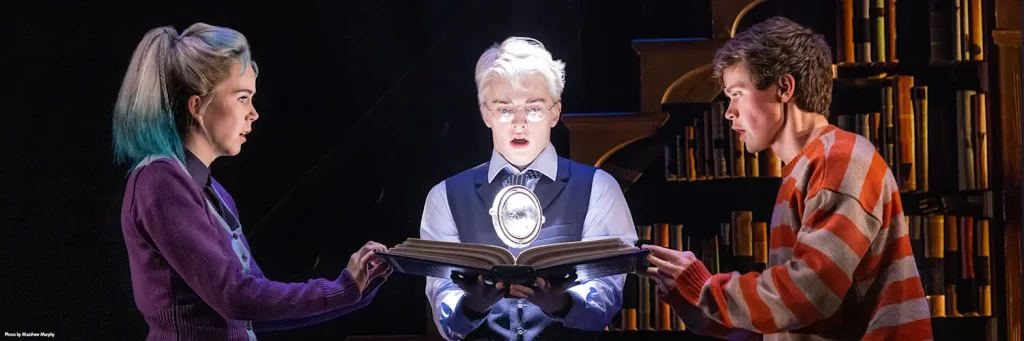
    Cast of ‘Harry Potter and the Cursed Child’ at Emerson Colonial Theatre
    Photo Credit: Matthew Murphy

    By Shelley A. Sackett

    Harry Potter and the Cursed Child is handicapped before the curtain even rises. It is based on the Harry Potter series, a seven-book global phenomenon created by J.K. Rowling. The novels chronicle the lives of a young wizard, Harry Potter, and his friends, Ron Weasley and Hermione Granger, all of whom are students at Hogwarts School of Witchcraft and Wizardry. The main story arc concerns Harry’s conflict with a dark wizard (Lord Voldemort) who intends to become immortal, overthrow the wizard governing body, and subjugate all wizards and Muggles (non-magical people).

    The books were responsible for getting millions of children to start reading chapter books and were engaging and cheeky enough to lure their parents to join them. The eight movies the books spawned were even more popular and brought the world of Harry Potter to life on the big screen.

    Alas, those same characters appear in Harry Potter and the Cursed Child, but they have not aged well in the 19 years since the last Harry Potter book. Neither has the plot, which, aside from one major twist, is muddled and tedious. At three hours, this ship might have sunk in harbor were it not for one gigantic rabbit it (thankfully) pulls out of its oversized sorting hat — STAGECRAFT MAGIC!!!!

    With a stunning set by Christine Jones, illusions and magic by Jamie Harrison, and movement direction by Steven Hoggert, it was easier to ignore the baffling script, uneven accents and uneven miking. Lighting (Neil Austin), sound (Gareth Fry) and costume (Katrina Lindsay) designs enhanced the special effects. This was one production where a seat with good sight lines mattered.

    Julia Nightingale, Aidan Close and Emmet Smith 

    Right out of the gate, the showmanship elicited oohs and ahhs of wonder and amazement, as characters change costumes mid-sentence, chairs fly, capes whirl and suitcases have minds of their own. Characters slump in their oversize capes and within seconds transform into each other as if by, well, magic.

    Later, when the evil dementors descend from the sky, with their unraveling mummy-like bandages and menacing flailing, it is a moment of staging perfection, a trifecta of spot-on music, lights, and sound effects.

    It’s all jolly good fun and a lot of visual stimulation. Not since a recent Cirque-de-Soleil have I heard an audience murmur in unison, “How did they do that?”

    Which brings us to the story line.

    Harry Potter (Nick Dillenburg), the headstrong, brave Boy Who Lived, is now a middle-aged administrator in the Ministry of Magic, a job that bores and depresses him. He married Ginny Weasley (Erica Sweany) and they have two boys, James and Albus Severus (Adam Grant Morrison), and a daughter, Lily.

    Following in Harry’s footsteps, Albus is off to Hogwarts, where Harry is mythic. Albus is also an unruly and insubordinate teenager who, like Harry, struggles with the burden of his father’s legacy. “I didn’t ask to be his son,” he retorts when people marvel that Harry Potter’s son is in their midst.

    He befriends Scorpius Malfoy (a fine David Fine), son of his father’s nemesis, Draco Malfoy (Ryan Hallahan). The two team up to prove they are more than their fathers’ sons by saving the life of a Hogwarts student who died 20 years ago. There are colorful characters they meet along the way (Mackenzie Lesser-Roy is a scene stealer as quirky, spirited Moaning Myrtle), including their fathers’ teachers (Katherine Leask is a delight, channeling the Maggie Smith and Imelda Staunton characters, Professors McGonagall and Umbridge, and Larry Yando is equally splendid as Albus Dumbledore, Severus Snape and Amos Diggory). There is even a “Time Turner” machine. There is not, however, a life line to save the audience from drowning in a sea of untethered and disconnected actions that make little sense.

    While the staging gimmickry, swirling capes, strobes and undulating time travel effects are cool the first, second and maybe even third times, by the umpteenth time (and as the clock marches towards the end of the third hour), they are as tired as some of the audience.

    Nonetheless, judging by the raucous standing ovation of the majority of theatergoers, the yawners in the crowd were clearly in the minority.

    ‘Harry Potter and the Cursed Child.’ Based on an original new story by J.K. Rowling, Jack Thorne, and John Tiffany. A new play by Jack Thorne. Directed by John Tiffany. Presented by Emerson Colonial Theatre at 106 Boylston St., Boston through Dec. 20.

    For more information, visit: https://www.emersoncolonialtheatre.com/

    Boston Ballet’s ‘Jewels’ Is A Real Gem

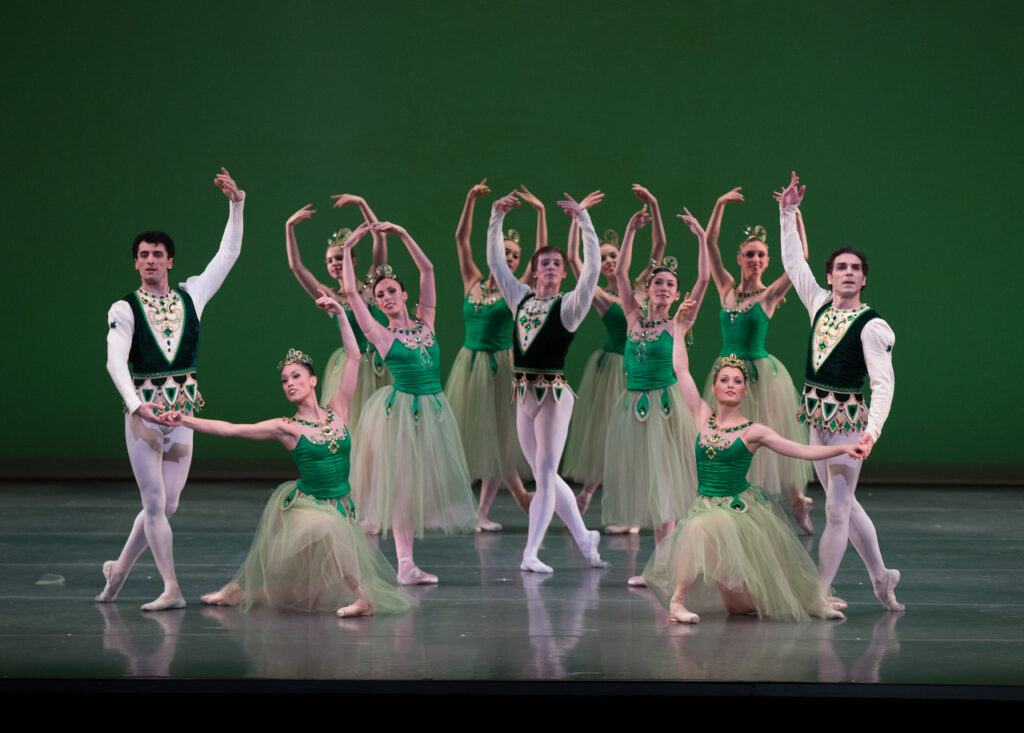
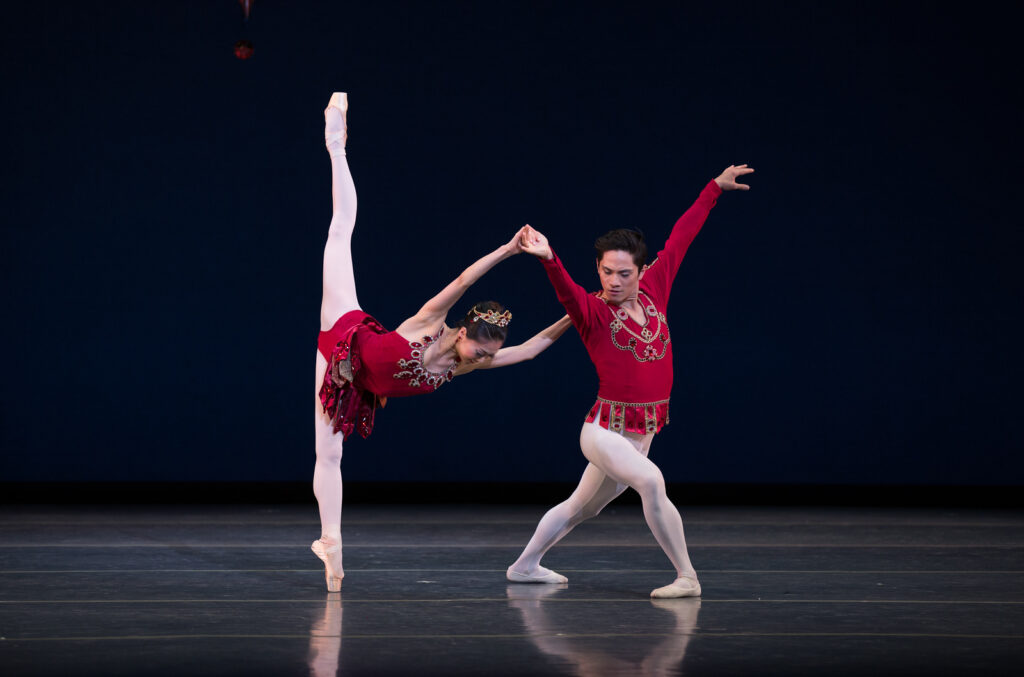
    Boston Ballet in George Balanchine’s ‘Jewels’ ©The George Balanchine Trust, photo by Rosalie O’Connor courtesy of Boston Ballet

    By Shelley A. Sackett

    It’s easy to understand why George Balanchine’s Jewels has endured for more than 50 years. An abstract work, the triptych is not shackled to the narrative constraints of traditional ballet. Rather, each of its three pieces — “Emeralds,” “Rubies,” and “Diamonds” — is a pure sensorial feast of luscious music and stunning choreography. The work is easily appreciated by audiences new to the genre, yet also presents challenges for experienced dancers and critical aficionados.

    The first Friday evening performance opened with the dreamy and poetic “Emeralds.” Featuring “Pélléas et Mélisande” and “Shylock” by the French composer, Gabriel Fauré, the piece is meant to evoke Paris. The curtain raised on ten members of the corps, bejeweled in crowns and regal necklaces and dressed in a lime green chiffon that you could almost taste. Like porcelain figures in a French masterpiece oil painting, the figures seem momentarily frozen, and then suddenly the stillness is broken and the dancers spring to life.

    With its green backdrop and even greener costumes, “Emeralds” evokes the pastoral enchantment of forests, hunting scenes, courtships, and a tapestry of youthful magic. Balanchine mixes it up enough to keep the audience engaged (pas de deux, staccato hand movements and playful, joyful solos) without demanding overthinking. Oboes, French horns, and flutes present the perfect shading for the elegant partnering of standouts Lia Cirio and Patrick Yocum and the perfect lush background for the final piece, where the full corps strikes a tableau that mirrors and bookends the piece’s opening scene.

    After a 20-minute intermission (the show runs 2 hours, 10 minutes total), the evening shifts gears with “Rubies,” Balanchine’s jazzy, modern and saucy piece set to Stravinsky’s “Capriccio for Piano and Orchestra.” Witty, playful and athletic, the dancers emote and engage with the audience, winking, nodding and sharing a sly smile. Karinska’s flapper-inspired ruby red costumes are perfect companions.

    Roman Rykine and Larissa Ponomarenko

    Balanchine clearly wanted everyone to have fun with this bold, American neoclassical piece. Influenced by Broadway and sexually charged, its emphasis on communication and merriment contrasts sharply with the preceding arms-length, performative “Emeralds.” The dancers jump rope, ride stick ponies and flirt shamelessly. Chyrstyn Mariah Fentroy is a cheeky breath of fresh air and Chisako Oga and Sun Woo Lee are evanescent as a seductive Adam and Eve couple who tango their way (among other feats) through Ruoting Li’s brilliant rendition of Stravinsky’s piano solo.

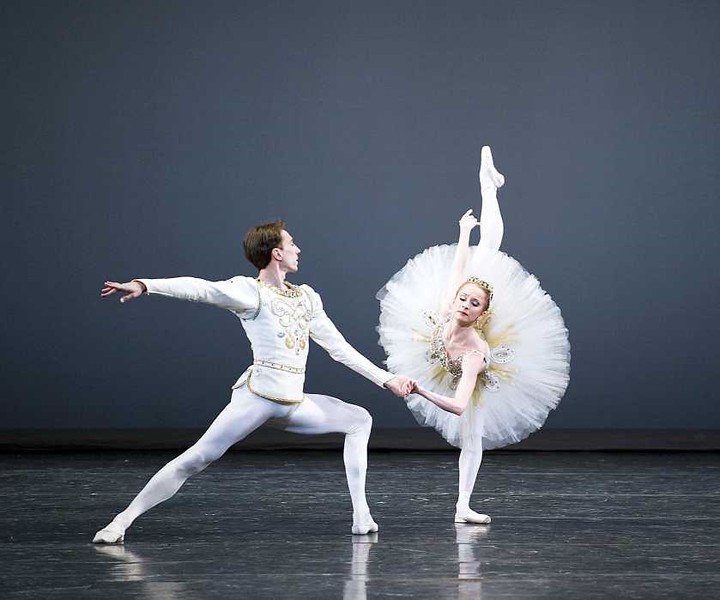
    Balanchine circles back to his Russian roots with “Diamonds,” set in St. Petersburg to Tchaikovsky’s “Symphony No. 3, Op. 29, D major.” A tribute to Russian classicism, costumes are glittering white tutus and the set includes a glistening chandelier and generous pleated layers of thick satin draped and tiered along the stage’s sides and across the front. The effect is of an ice castle filled with sugar plum fairies until the dancers begin to prance like reindeer and engage in exuberant couplings.

    Grand and imperial, the dancers exhibit disciplined symmetry, creating patterns and shapes. A pas de deux, long and undulating as it unfolds, features the marvelous Viktorina Kapitonova (and talented Sangmin Lee) who steal each other’s — and the audience’s — hearts as their movements reflect the music’s building crescendos and ascending scales, only to resolve harmonically and melodically. There is only grace and beauty in their dance, although the music could have been equally served by more urgent and fitful movements. Fortunately, Balanchine opted for the former approach.

    Misa Kuranaga and Jeffrey Cirio

    Jewels premiered in 1967 at New York Ballet, where Balanchine was Ballet Master and Principal Choreographer. The full length ballet, one of the world’s first “abstract” ballets, was inspired by a visit to the renown jeweler, Van Cleef & Arpels. Struck by the shimmering contents of the store’s cases, he decided to create dances that would emulate those shimmers with distinctive moods, styles and musical voices.

    Boston Ballet is off to a spectacular start in its 2025-2026 season. Be sure to visit their site for more information and to purchase tickets at https://www.bostonballet.org/

    ‘Jewels’ — Choreography by George Balanchine. Music by Gabriel Fauré, Igor Stravinsky, and Peter Tchaikovsky. Costumes by Karinska. Lighting by Brandon Stirling Baker. Presented by Boston Ballet. With the Boston Ballet Orchestra conducted by Mischa Santora. Run has ended.

    ‘Murder for Two’ Is A Goofy, Musical Valentine to Classic Whodunits.

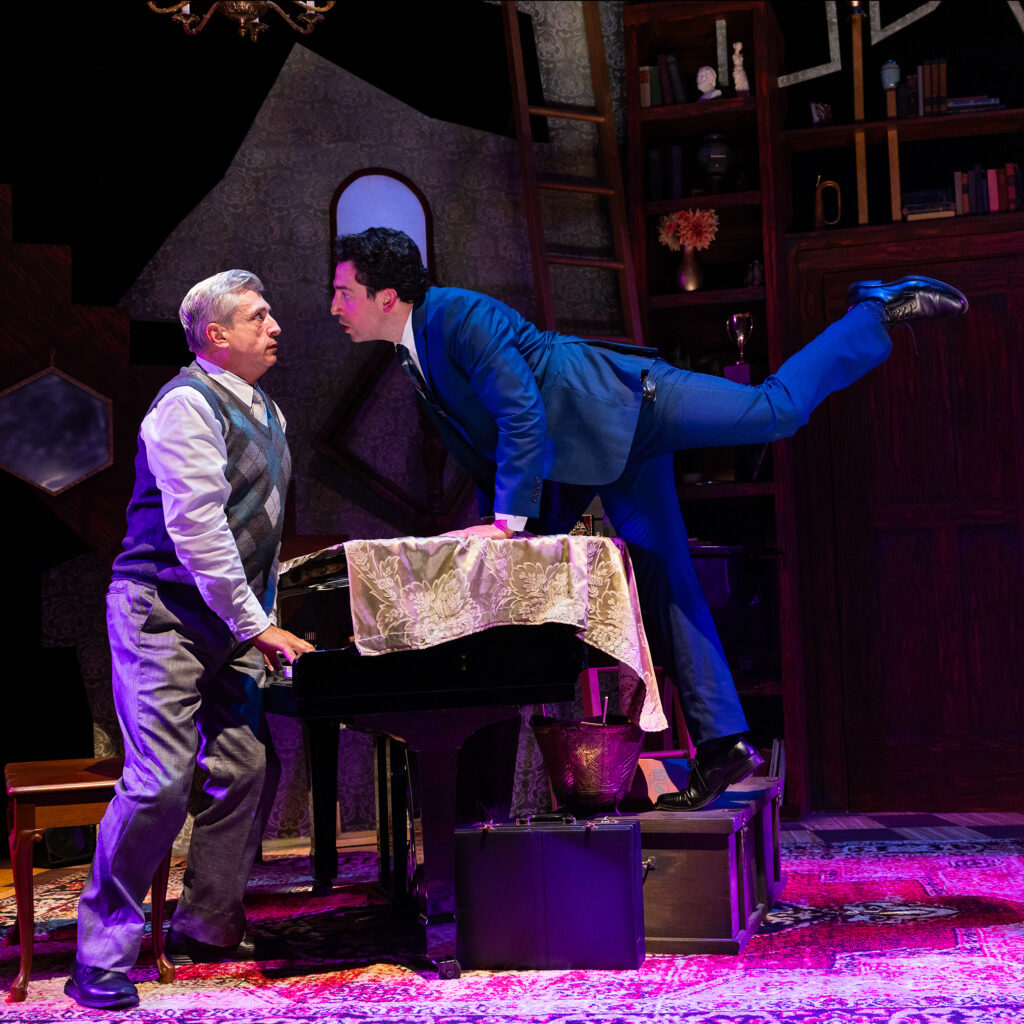
    Will McGarrahan and Jared Troilo in “Murder for Two” at Greater Boston Stage
    Photos: Niles Scott Studios

    ‘Murder for Two’ — Book and Music by Joe Kinosian. Book and Lyrics by Kellen Blair. Directed by Tyler Rosati. Music Direction by Bethany Aiken; Scenic Design by Katy Monthei; Lighting Design by Matt Cost; Sound Design by Adam Smith. Presented by Greater Boston Stage Company, 395 Main St., Stoneham, MA through Nov. 9.

    By Shelley A. Sackett

    Murder for Two is a loving parody of classic murder mysteries. A two-person musical, the 100-minute (no intermission) production is more vaudevillian revue than its genre’s prototypes, relying on gimmicks, songs, and quick changes to tell a familiar story in a new way.

    The plot is fairly straightforward and as formulaic as it gets.

    In the opening moments, Arthur Whitney, a famous author, is murdered in his mansion on the eve of his own surprise party. It is, of course, a stormy and dark night and the suspects are many — 13, in fact. From the widow, to the niece, psychiatrist, ballerina, town doctor, neighbors and local fireman, each is quirky and none lacks motive.

    The only thing that keeps Murder for Two from being a total cliché is that all 13 suspects are played by Will McGarrahan, a virtuoso with a supple face and talent for impersonation. A simple hand gesture, distinctive gait, snooty scowl, tutu or pair of cat’s eyeglasses, and he becomes a different character, capturing their essence in the blink of an eye.

    Jared Troilo is the small-town cop named Marcus Moscowicz who jumps at the chance to solve the case (and advance his stagnant career) when the real detective can’t be located. A by-the-books kind of guy, he has his work cut out for him dealing with this motley crew.

    Troilo

    The focal point of the small but expertly designed and lighted set is an upright piano, where the two actors show off their piano playing and vocal chops. Their musical rapport and interaction is delightful. They finish each other’s phrases, take turns singing and accompanying, and shine during four-handed duets. Unfortunately, the songs lack lyrics of substance and tunes with catchy melodies, but the actors’ comfort, confidence, and camaraderie (almost) make up for it.

    The play also relies heavily on shtick and, like all shtick, some is laugh-out-loud funny, and some is corny and cutesy, landing with a thud.

    At the Saturday evening performance on opening weekend, McGarrahan’s microphone malfunctioned and, despite an unscheduled intermission (which provided fertile fodder and opportunity for the actors to break the fourth wall and ad lib to the audience’s delight), still didn’t work properly. Given the show’s fast pace and McGarrahan’s pivotal role, it made the first half of the show even harder to follow.

    McGarrahan 

    Following the plot and figuring out who done it, however, is not the point of attending this production. The real reason is the physical comedy and musical showmanship of two actors who are so comfortable with each other and their performances that, at one point, McGarrahan goes off script and shakes a tambourine in Troilo’s face until he cracks up. After an hour of scripted unevenness, the audience applauded in appreciation and relief.

    Despite working with such unexceptional material, McGarrahan and Troilo seem to be having the time of their lives on stage. Would that the audience could have shared in some of that.

    For more information, visit https://www.greaterbostonstage.org/