Gloucester Stage Serves Up More Than Good Food in ‘Stew’

By Shelley A. Sackett 

Stew is any dish that is prepared by “stewing” — that is, submerging the ingredients with just enough liquid to cook them through on a low flame in a covered pot for a longtime. It is also a synonym for brooding. One who is in an extreme state of worry and agitation is said to be “stewing.” 

Playwright Zora Howard has captured the richness of the dish and the simmering state of its emotional namesake in her 90-minute intermission-less play, “Stew,” now in production at Gloucester Stage. A 2021 Pulitzer Prize in Drama finalist, it is the story of three generations of Black women who gather at the family home in Mount Vernon, N.Y. 

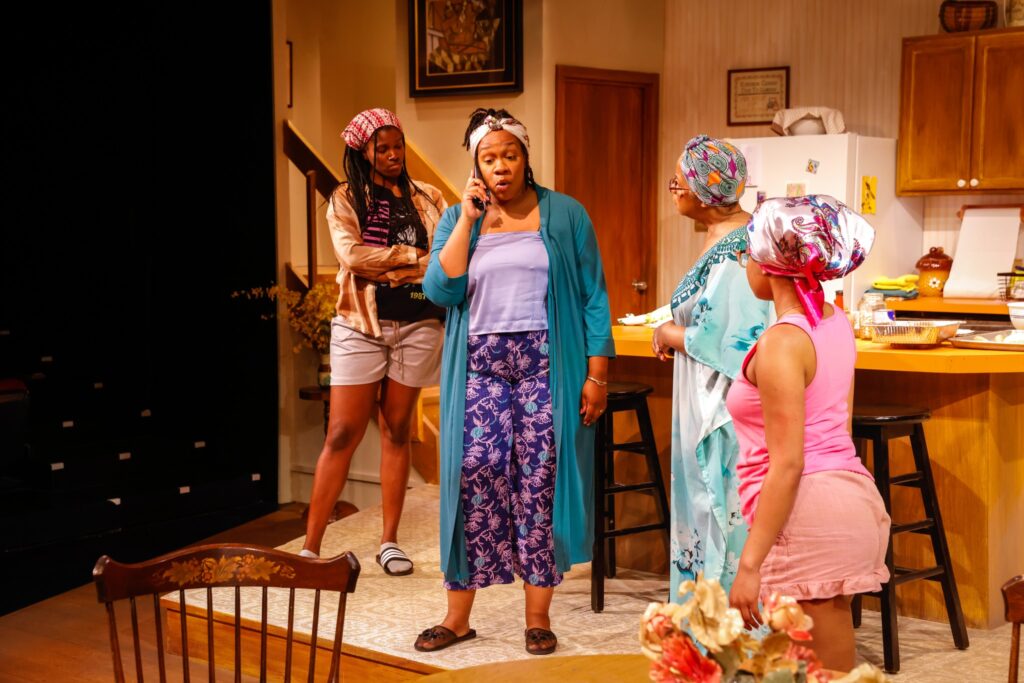
The show opens in the Turner’s comfortable kitchen with Mama (the magnificent Cheryl D. Singleton in a role that fits her like a glove) alone in her slippers and robe, singing, dancing, and grooving to the gospel song,”“Rejoice.” She sashays over to the pot bubbling on the stove, stirring it with the finesse and timing of a backup singer. This is a woman in her element. Unobserved, undisturbed, she is in her happy place. 
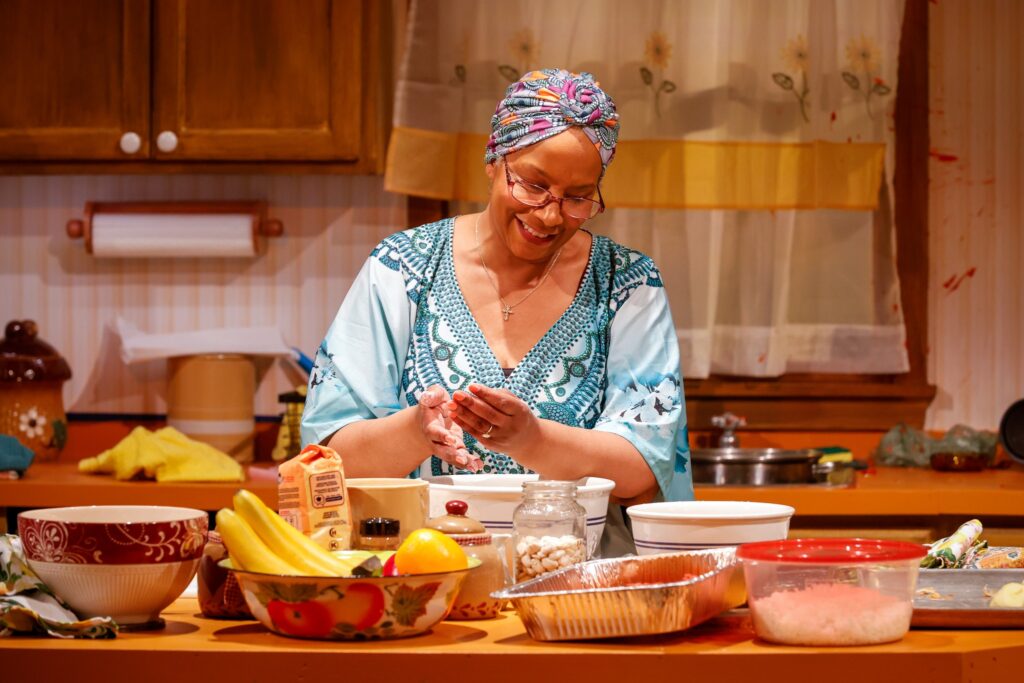
That spell is quickly shattered by a dog barking and the boisterous arrival of the rest of theclan. Mama’s two daughters, Lillian (Breezy Leigh) and Nelly (Janelle Grace), burst into the room, and the atmosphere shifts from private sanctuary to multi-generational chaos. Lillian, in her 30s, is visiting with her 12-year-old daughter, Lil Mama (Sadiyah Dyce Janai Stephens), and younger son Junior, who is already up and outside playing. Lillian’s sister, 17-year-old high schooler Nelly, lives with Mama, although not for long if she has her way and her temporary boyfriend turns out to be her forever man. 

The titular plot revolves around Mama cooking for 50 for an event after church. The stew that has been brewing on the stove has burned, and Mama dumps it into the trash. Similarly, the relationships among these four Turner women get an overhaul during the course of the day as their banter and bickering reveal their secrets, fears, resentments, and hopes, the ingredients they bring to the familial stew that has been quietly simmering on the Turner family back burner for many years. 

Mama has just been to the doctor, and although she won’t admit it, is starting to slow down. “Are you dyin’?” Lillian asks with both accusation and terror in her voice. “It’s certainly the direction I’m heading,” Mama quips. For her part, Lillian has returned home to do more than just check in on Mama’s well-being. Her marriage is stuck in an awkward gear, and, although it will take her another hour to voice it, she is home because she needs her mother’s support and advice. 
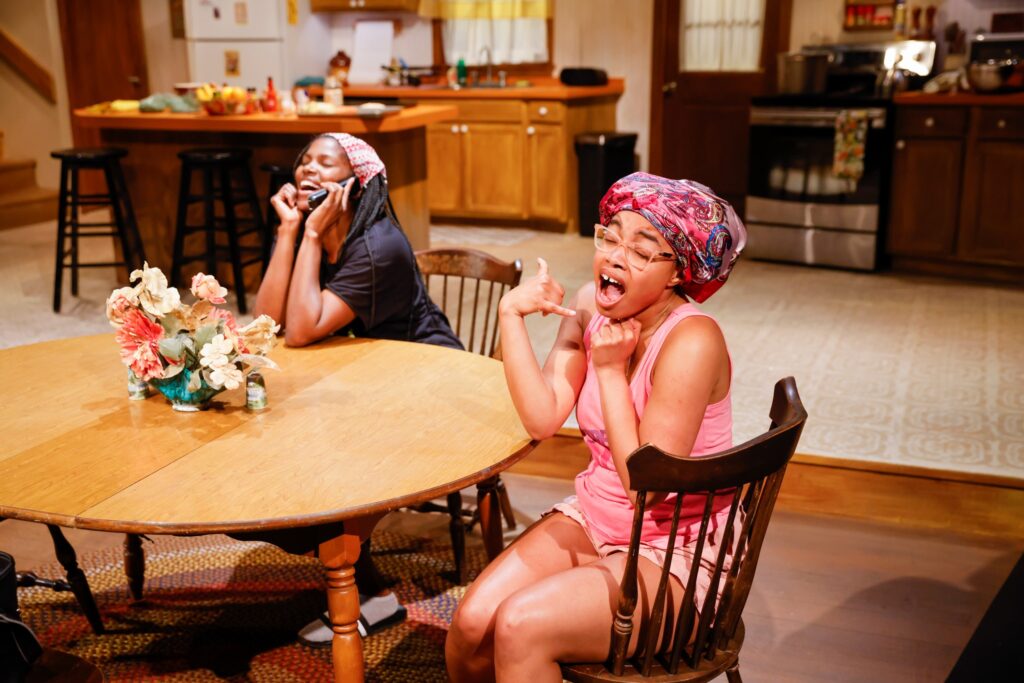
Nelly has her first real boyfriend and confides to Lil Mama that she’s sure she has found the real thing. She can’t wait to get on with her life with him. Lil Mama is a free-spirited pre-teen, equal parts silly and earnest, anxious to be taken seriously but still needing to be coddled. She is preparing to audition for the role of Queen Elizabeth in Shakespeare’s Richard III.  

Just as Mama takes charge of her brood in directing them to create her stew, so she commands the troops in helping Lil Mama practice her lines. Mama was, after all, the founder and director emeritus of the Mt. Vernon High Dramatic League as well as the first soloist at the Greater Centennial A.M.E. Zion Church, a fact her children know so well they lip sync the oft-repeated line. 

Howard has a keen ear for writing compelling and laugh-out-loud dialogue that blends the authentic, intimate, and emotional. She manages to keep the rapid-fire pace of the women’s feisty verbal thrusts and parries while subtly defining each character’s individual traits and issues. More than once, she injects thought-provoking subtext into a moment that was teetering dangerously close to TV sit-com banality. 

In her Director’s Notes, Rosalind Bevan hits the nail on the head in describing “Stew’s” message. “All families are woven from a multi-generational fabric spun with joy, pain, celebration, misunderstanding, regrets, and triumphs. If we’re lucky, we can feel and see that the thread holding all of these things together is love. If we’re honest with ourselves, in those moments when that love is less felt or harder to see, we know it’s still there.” 

Bevan’s direction shines a spotlight on the splendid set (Jenna McFarland Lord) while allowing her ensemble cast enough breathing room to create strong individual presences. Leigh’s Lillian is believable and complicated, her pain and uncertainty barely perceptible beneath her bubbly veneer. As the teenage rebel looking for a cause, Grace manages to bring a childish innocence to Nelly’s most churlish tantrum. And who could resist Stephens’s gap-toothed Lil Mama, even when she is screeching at the top of her lungs? 

But it is Singleton as Mama who grounds the show and the family, seasoning her loved ones with the same care and compassion she brings to her cooking. “You’ve got to season your food, talk to your food. Keep it going. You gotta laugh and eat together. It’s the nourishment of life,” she tells her daughters and granddaughter.  

Although uneven and sporting a questionable ending, “Stew” paints a timeless and universal picture of family life, with all its messiness and serendipity. Like the flavors of the secret ingredients in Mama’s special stew, Howard has written a play that will continue to roll around in your thoughts long after the curtain has fallen.

‘STEW’ – Written by Zora Howard. Directed by Rosalind Bevan. Scenic Design by JennaMcFarland Lord. Costume Design by KJ Gilmer. Lighting Design by Kat C. Zhou. SoundDesign by Aubrey Dube. Presented by Gloucester Stage, 267 E Main St, Gloucester, MAthrough July 23. 

For tickets and information, go to: https://gloucesterstage.com/
It’s All in the Family in Huntington’s Spectacular ‘The Lehman Trilogy’

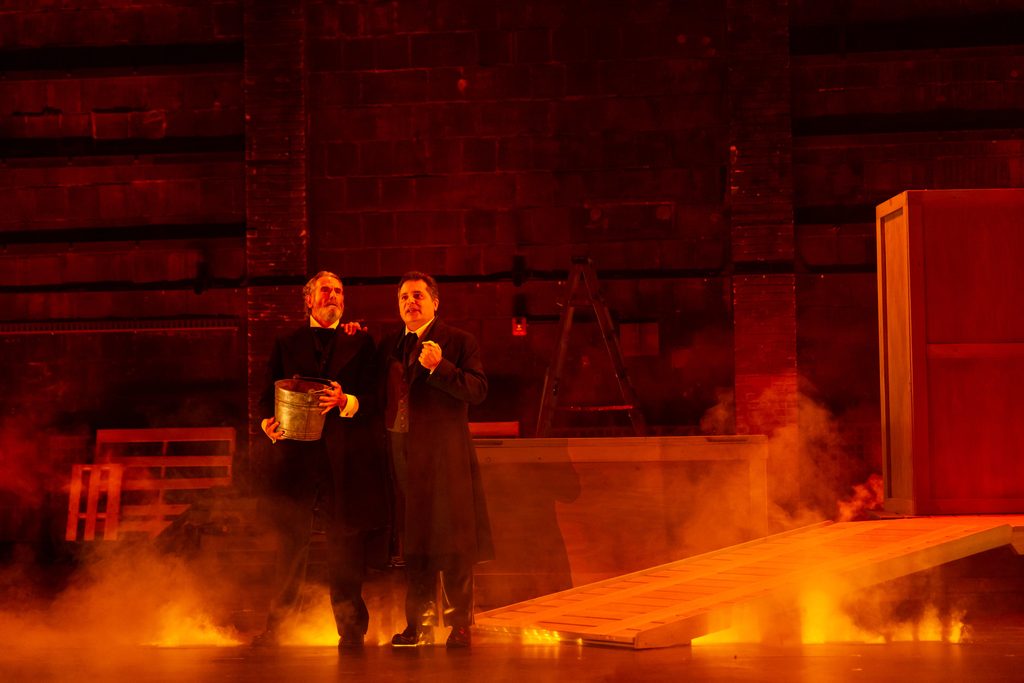
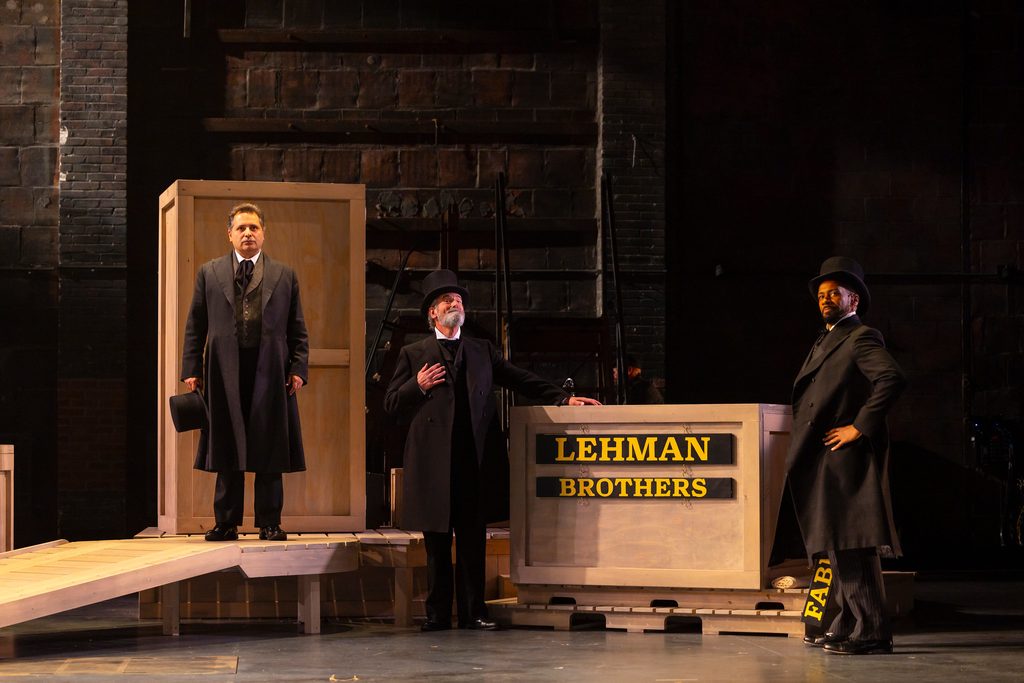
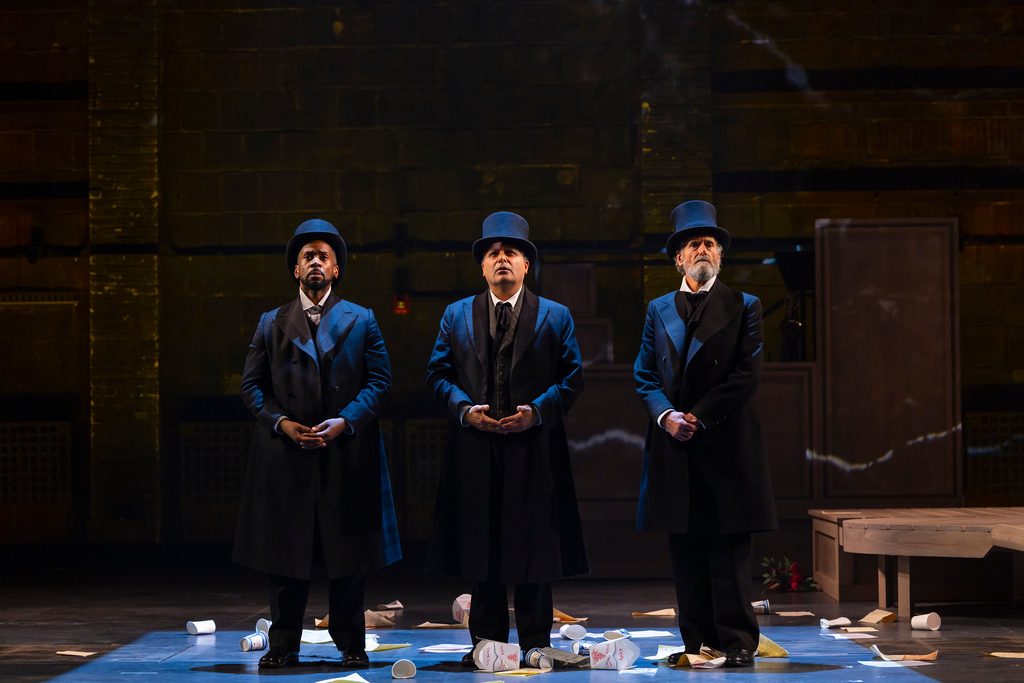
Joshua David Robinson, Firdous Bamji, and Steven Skybell in ‘The Lehman Trilogy’ at the Huntington. Photos by T. Charles Erickson

By Shelley A. Sackett

A lone and mournful clarinetist (Joe LaRocca) wanders across the stage of the Huntington’s theatrically astonishing “The Lehman Trilogy,” inviting comparisons in tone and content to the spirited drama “Fiddler on the Roof.” Steeped in ritual and Judaism, both stories trace what happens to a family when political oppression forces it to leave home, leading most of its members to emigrate to America.

For the dairyman Tevye ben Shneur Zalman, tradition and God are immutable and one; he will walk the straight and narrow walk wherever he wanders. For the Lehman brothers — and especially for their American progeny — tradition and God are moving targets, luxuries that morph with the exigencies of assimilation.

Yet the unobtrusive but ever-present LaRocca and his plaintive clarinet, saxophone, and flute melodies (original music by Mark Bennett) are constant reminders of the Lehmans’ past and the threads that, though frayed and denied, they share with Tevye and his ancestors.

“The Lehman Trilogy,” winner of the 2022 Tony Award for Best Play, assumes the 2008 demise of Lehman Brothers, the colossal bank whose collapse helped trigger the global Great Recession, is well known. Instead of rehashing that final piece of the story in detail, it wisely spends the bulk of its three and a half hours (two intermissions) chronicling the lesser-known details of the enterprise’s birth and extraordinary upward trajectory. 

The action opens on 9/11/1844 with the New York arrival of 21-year-old Henry (Steven Skybell, the standout in a cast of standouts) from Rimpar, Bavaria. He immediately sets sail for Mobile, Alabama, with little but his experience in trade and finance and his skill with cloth. Buoyed to be in the American South, where Jews are allowed to own land and where the caste system is built on race rather than religion, Henry quickly makes enough money as a peddler to fund his move inland to Montgomery, where he settles down and opens a dry goods store. Younger brothers Emanuel (Joshua David Robinson) and Mayer (Firdous Bamji) soon follow to this promised land of milk and honey and cotton where “a man can live to work, not work to live.”

Absent the violence, restrictions, and family restraints of Rimpar, the brothers create their own American version of the Lehman myth, tradition, and legacy. Their unbridled ambition, ingenuity, and taste for fortune lead them to adapt to the times and fill any gap they spot. 

The first Lehman Brothers sign is hung on a dry goods storefront that starts out selling fabrics and cotton and ends up as a powerful monopoly that buys raw cotton from antebellum plantations and resells it to factories in the North. The brothers ingeniously invent the profession of being a middleman, making their first fortune off the back of an economy dependent on slavery.

They also dip their toes into the business that will fuel their rise and fall. By offering credit to planters short of funds, they become cotton brokers, the first stage in their eventually becoming an investment bank.

Only after the cotton economy’s collapse in the wake of the Civil War do we hear a word of admonition or conscience about their connection to slavery (word is the lines were only added in response to criticism), and those are spoken by only one character, a local doctor.

“Everything that was built here was built on a crime,” he tells the brooding Mayer. “The roots run so deep you cannot see them, but the ground beneath our feet is poisoned. It had to end this way.”

Like a phoenix rising from the ashes, Lehman Brothers transforms and reinvents itself, helping the South as it reconstructs. Over the decades, it will survive two world wars, the 1929 stock market crash and the Great Depression, mutating from a brokerage house to an investment bank and finally to architects of subprime mortgages. The brothers relocate to New York and create the Cotton Exchange, Coffee Exchange, and Stock Exchange, all admirable strokes of business genius which pad their own pockets handsomely.

Structured in three parts, the play follows the Lehman family through 164 years of successive generations. We ride shotgun on the journey that proves even more tragic for the fabric and integrity of the heritage the three brothers so revered. Along the way, ethics, decency, and loyalty are qualities that vanish from the Lehman family tree, especially in the wake of the 1960s creation of a trading division run by non-family members. From boardroom savagery to talk of how to get people to buy things they don’t want with money they don’t have, the apples fall far, far from the ancestral tree.

And therein lie the bones of the play and the attraction of its world. At heart, this is a very human story about real, complicated people living real, messy lives. The story’s true tragedy and greater lesson is to be found in the degradation and demise of their familial — rather than financial — legacy.

When we first meet Henry, Emanuel, and Mayer in the 1840s, they are untarnished, wide-eyed boychiks, still tethered to their religious and family values. We bond with them. We root for them. Most all of, we care about them.

Henry is funny and sympathetic, his guilelessness rendering him accessible and charming. Mayer and Emanuel elicit similar reactions. When their children and grandchildren become characters from “Succession,” we cut them a little slack because we knew their parents and grandparents. Although we’re glad they’re not around to witness the havoc they wrought, we miss them.

Fleshing out this compelling story is the real reason “The Lehman Trilogy” is in that rare not-to-be-missed category: the breathtaking three actors (the entire cast!) who switch genders and ages to portray a score of characters. Starting out as the engaging Henry, Skybell is a delight as a tightrope walker, a crusty, old rabbi, a flirty divorcée, and others. Bamji is no less extraordinary as the youngest (and patronized) brother Mayer. His acting chops are on full display as the ruthless Bobbie, a blushing bride, a pouty toddler, and more. As the steady, stalwart middle brother Emanuel, Robinson clearly enjoys the looser reins when playing the later Lehman clan members and their gang of motley plunderers.

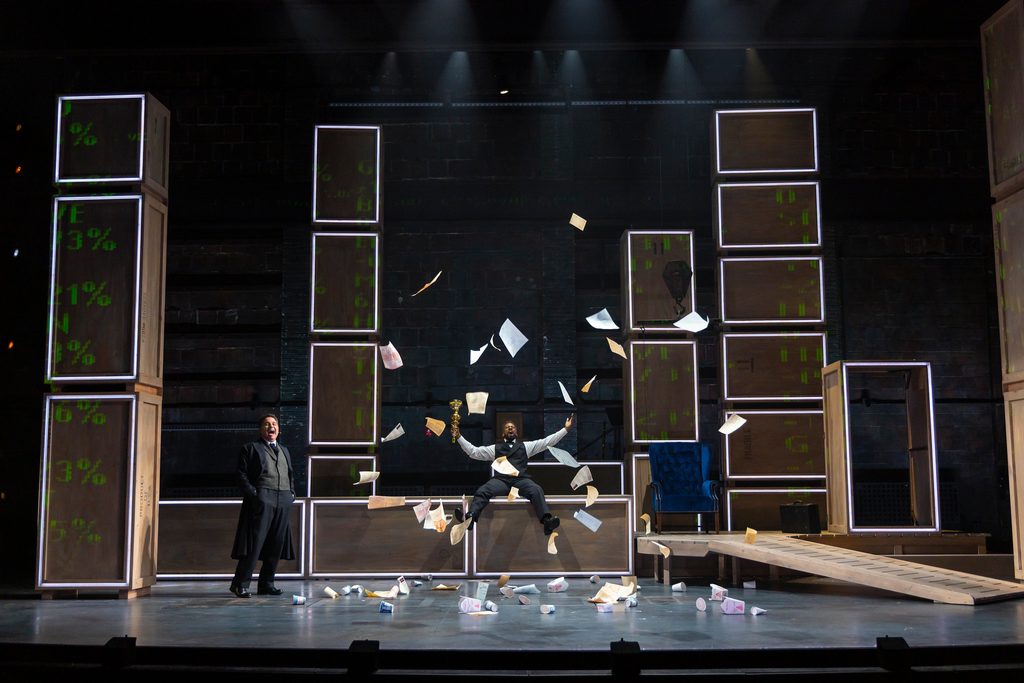
Equally praiseworthy are Perloff’s razor-sharp direction (the wrecking ball pendulum as 2008 draws nigh is brilliant), Brown’s efficient yet thrilling set, and Oi-Suk Yew’s use of projected images.

Much has been penned complaining about the play’s underemphasis on the role slavery played in the Lehmans’ initial success and the short shrift given to the firm’s 2008 nosedive crash and burn finale. My take is that these were not intended as deliberate snubs. Rather, they were omitted because they were peripheral to playwright Massini’s core purpose: to allow us a peek through the keyhole at the tale of three German Jewish brothers from Bavaria and the way they took America by storm.

The resulting epic — intimate and engaging — is a nonjudgmental study of the personalities, relationships, and events that shaped this one family’s shifting definition of the American dream.

Don’t be put off by the play’s length. The story is so engrossing, the production (and acting!) so remarkable that more than one patron was overheard commenting that they wished it had been even longer!

‘The Lehman Trilogy’ – Written by Stephano Massini and Adapted by Ben Power. Directed by Carey Perloff. Scenic Design by Sara Brown; Projection Design by Jeanette Oi Suk-Yew; Costume Design by Dede Ayite; Lighting Design by Robert Wierzel; Original Music by Mark Bennett; Co-Sound Design by Mark Bennett and Charles Does. Presented by the Huntington Theatre, 264 Huntington Ave., through July 23.

For tickets and information, go to: https://www.huntingtontheatre.org/whats-on/lehman-trilogy/