Exotic “Grupo Corpo” Troupe Combines Exceptional Dancing with Brazilian and African Rhythm for a Spectacular Evening of Excitement and Adventure

“Grupo Corpo” Artistic Director – Paulo Pederneiras; Choreographer – Rodrigo Pederneiras; Presented by Celebrity Series at Boch Center Shubert Theatre. Run has ended.

By Shelley A. Sackett

Founded in 1975 by Paulo and Rodrigo Pederneiras, the Brazilian dance company Grupo Corpo (meaning “Body Group” in Portuguese) is renowned for its unparalleled blend of popular Brazilian culture, African rhythms, and classical technique.

At last Saturday night’s performance, the troupe treated its audience to a mesmerizing evening of ingenious choreography, tireless, virtuoso dancers, inventive lighting and stage design, and pulsating, tribal-tinged music by Bahian songwriter Gilberto Gil and the Brazilian jazz band, Metà Metà.

The concert was as thrilling, riveting and entertaining as it gets.

In the first piece, “Gil Refazendi (Gil Remaking),” a subtly shifting abstract image of unfolding sunflowers is background to a stage lit by simple, single white light spots. (Scenography and lighting by the talented Paulo Pederneiras). The jazzy, infectious beat of ancestral drums, electronic distortions, African percussion gourds, and woodwinds sets the mood.

Known as the godfather of Brazilian music, Gilberto Gil’s compositions are high energy and uplifting, impossible not to sway and toe tap to. Conceived and then, post-pandemic, fully reconceived by choreographer Rodrigo Pederneiras, “Gil Refazendi” contains themes of renewal, rebuilding, and revitalization.

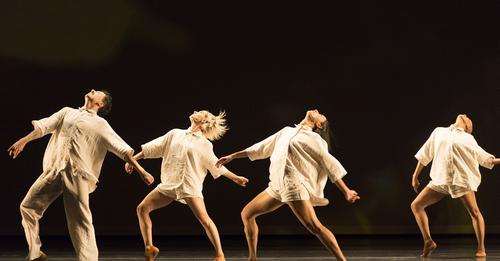
Female dancers explode onto the stage, alighting like beams of Tinkerbell magic clad in oversized white raw linen shirts and scanty shorts. The male dancers follow, dressed in the same breezy material cast as casual shirts over billowing pants (Costumes by Freusa Zechmeister). The effect is smooth, graceful, and playfully sexy.

Under Pederneiras’s mind-boggling choreography, the dancers stretch, pirouette, leap and undulate to the varying strains of samba, bossa nova and rock. They dance solo, as couples and in various groupings.

Although each dancer has their moment in the spotlight, what resonates most is the awe-inspiring synchronicity of the twenty-member troupe. When on stage as an ensemble, they move as a single organic whole. Not one wrist flicks out of tempo; not one back arches higher than another. That degree of skill and discipline is nothing short of astonishing and a rare pleasure to behold.

The second piece, “Gira,” is less abstract and more somber in tone. It is based on the rites of “Umbanda,” one of the most widely practiced Brazil-born religions that pulls on traditions from West African practices, Candomblé, Catholicism and others. In some Umbanda rituals, participants release control of their bodies to the spirits of ancestors or deities in what’s described as an altered state of consciousness.

Pederneiras’s choreography reflects gestures and movements he witnessed during actual ceremonies. There is a hint of menace in the air, particularly during the male/female couplings, which frequently teeter on the edge of violence before withdrawing back to more tender territory.

Male and female dancers are dressed identically, with naked torsos and white skirts of raw linen. Red paint on their necks adds a formal, sacramental touch. Again, the dancers are impossibly lithesome, transitioning from jolts of electric voltage to supple melting seamlessly. That they are dressed identically further blurs the edges between solo and troupe, between the individual and the collective.

Pederneiras started to choreograph in 1978 and has become known for the way in which he constructs sophisticated dialogues between music and dance using the bodies of his dancers as his interpreters. His work is a thrill to behold and one-of-a kind, a genuine reimagining of the ways in which humans can harness, express and appreciate the magic of creative energy.
Huntington’s “Fat Ham” Is A Raucous and Resonant Reinvention of Shakespeare’s Masterpiece, “Hamlet”

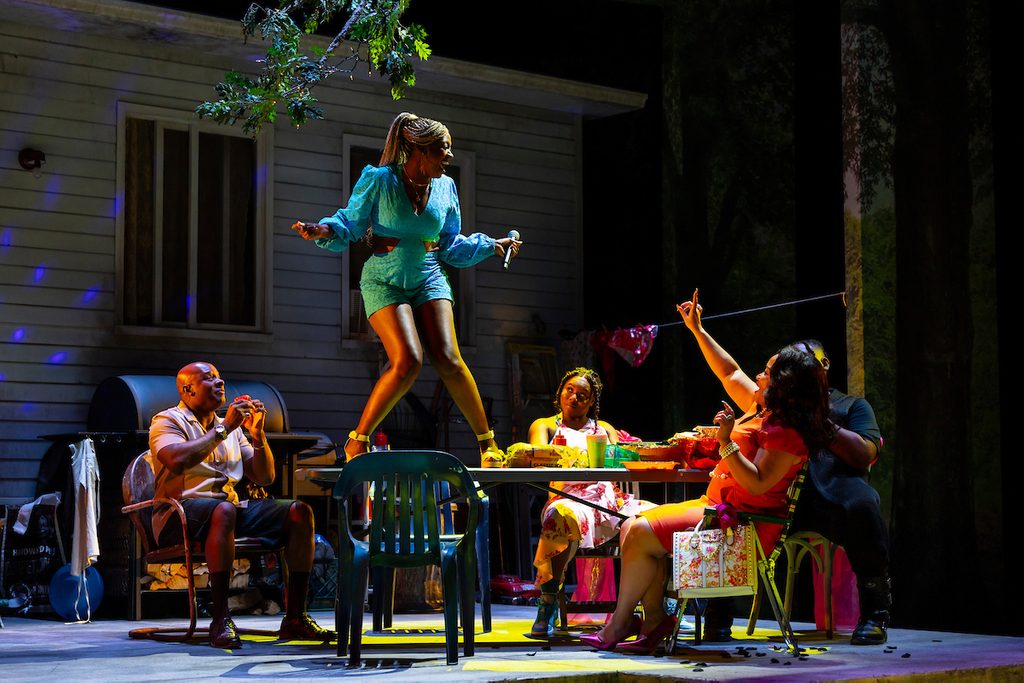
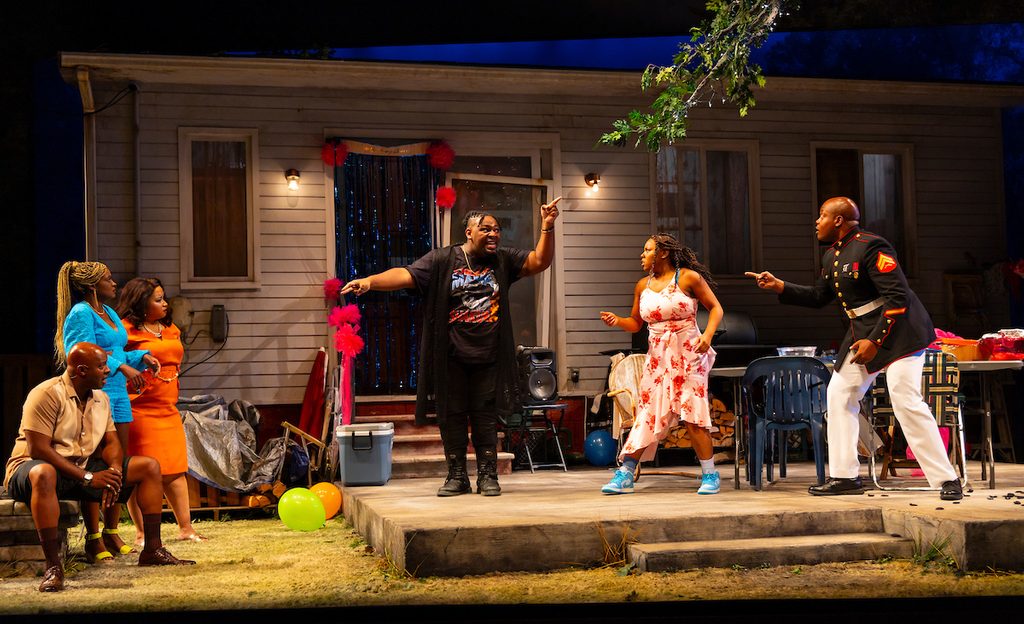
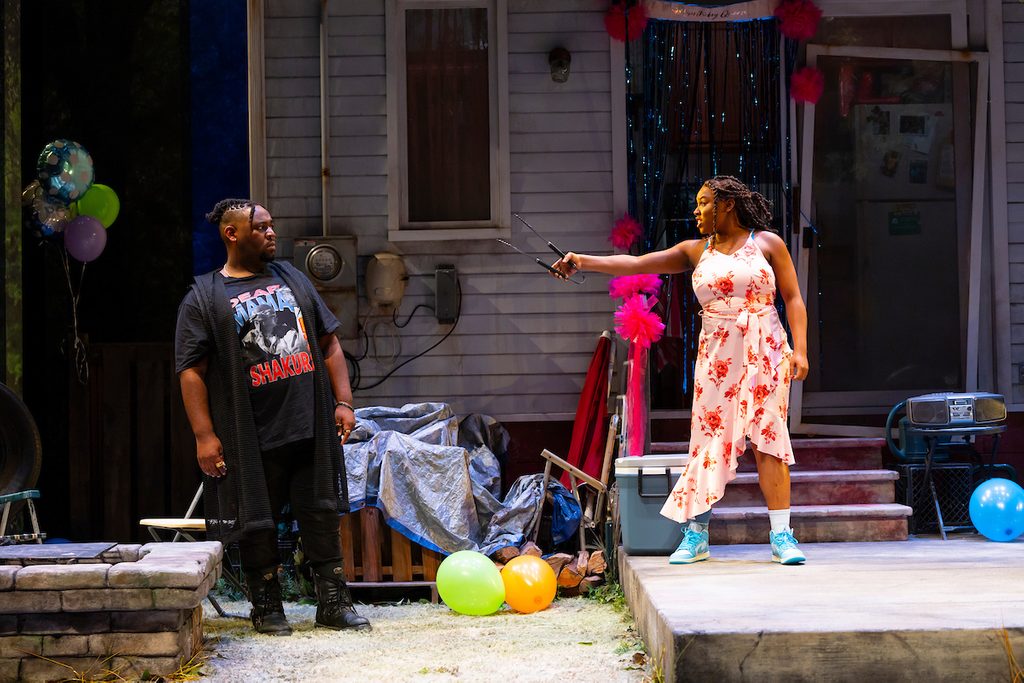
Cast of ‘Fat Ham’ The Huntington Theatre. Photos by T Charles Erickson

By Shelley A. Sackett

“Fat Ham,” winner of the 2022 Pulitzer Prize Award for best drama, is much more than a modern-day riff on “Hamlet,” one of Shakepeare’s most quoted, performed and adapted plays. Using the bones of the Bard’s tragedy as a structural anchor, the exceptionally talented playwright, James Ijames, has fleshed it out with analogous characters whose feet are firmly planted in the here and now and whose modern-day nightmares and dreams reflect both the mundane and the existential.

Like Shakespeare’s “Hamlet,” “Fat Ham” asks the question, “How do we cope in a belligerent world untethered?” and answers it simply: “To thine own self be true.” But instead of engaging in a bloody palace battle over his wearing his father’s coveted crown, this Hamlet wants only to prove his father’s murderer’s guilt and then high tail it to greener, less legacy-laden pastures where he can let down his guard and live an authentic and happy life.

Although full of allusions to the original tragedy about the Danish king (a splendid one-page graphic summary of “Hamlet” by Mya Lixian Gosling is a welcome inclusion in the program), “Fat Ham” stands on its own. Its story is told through the eyes of Juicy/Hamlet (a spot-on Marshall W. Mabry IV), a young, queer Black man marooned in no man’s land with no lifeboat in sight.

The play opens in Juicy’s backyard as Tio/Horatio (the stand-out, gifted Lau’rie Roach), his best friend and greatest advocate, tries to get his buddy to address and snap out of his melancholy. Juicy’s father, Pap, was recently killed in jail, where he was serving time for slitting a man’s throat because he couldn’t stand the smell of his breath.

Tio, more laid back than Juicy, diagnoses Juicy’s problem as more than a reaction to his recent domestic woes. According to Tito (who sees a therapist, so he has cred in this department), Juicy isn’t suffering from individual filial grief. Rather, his is the inescapable condition of Black “inherited trauma.” “Your Pop went to jail; his Pop went to jail. His Pop went to jail. His Pop went to jail, and what’s before that?” he asks. “Slavery.”

As if that weren’t heavy enough, Juicy (like Hamlet) has much more on his plate. His mother, Tedra (a slinky Ebony Marshall-Oliver), married Pap’s brother Rev (James T. Alfred, who also plays Pap) while Pap’s body was still warm. Then, just as the backyard bar-b-q wedding celebration is about to begin, Pap appears to Juicy as a ghost.

Pap is one mean son-of-a-bitch, cursing Juicy for being soft and trying unsuccessfully (he is, after all, a noncorporeal ghost) to beat him to a pulp. Yet, he has a message and directive that Juicy can’t ignore.

Rev was behind Pap’s murder, he tells his son. He insists Juicy man up and avenge his death.

“It’s amazing what fathers think they own just because they share the same name as their son,” Juicy tells Tito, who couldn’t see Pap’s ghost but knows exactly what Juicy means.

Mirroring the relationship he had/has with his father, there is also no love lost between Juicy and Rev, who treats his nephew/son with contempt and one-upmanship, calling him a pansy and stealing his college tuition money to remodel a bathroom worthy of a new man of the house.

What should Juicy do? Be a man, embrace violence and follow in his father’s footsteps? Or take the road advocated by the laidback, don’t-worry-be-happy Tito and reimagine what it means to be a man?

If this sounds solemn and heavy, it is. (Just read the original “Hamlet.”) Yet, in Ijames’ magical hands (and under Stevie Walker-Webb’s razor-sharp direction), such profound topics as: the unending cycle and generational trauma of male violence; sexual and racial inequity, and freedom of identity become manageable because they arrive wrapped in the gift of comedy.

Ijames’s true genius (and no doubt a reason for his well-deserved Pulitzer Prize) is his ability to infuse this story of tragedy and violence with laugh-out-loud jokes, songs, sight gags and such modern props as a karaoke machine. His troupe of lively, original and (other than Rev) compassionate people each literally vibrate to their own rhythm.

Opal/Ophelia (a perfectly cast Victoria Omoregie) is a pouty teenager, chafing at her mother’s heavy-handed directive to be ladylike and wear a dress when all she wants is to join the military and scream at the top of her lungs that she likes girls. Rabby, her rabid liquor-loving, church-lady mother and a stand-in for the equally judgmental Polonious, is played by scene-stealer Thomika Marie Bridwell. Larry/Laertes (the splendid Amar Atkins), Opal’s Marine brother who is also a closet gay, rounds out the cast.

Ijames has many tricks up his sleeve to keep the fast-paced, 90-minute (no intermission) play moving effortlessly. He manages to combine an unlikely list of ingredients (serious soliloquies, characters who break the fourth wall, slapstick, stoner raps, MTV-worthy musical song-and-dance numbers and internal monologues) to create a satisfying, hearty four-course meal.

Luciana Stecconi’s set brings the audience squarely into a lower-middle-class, well-loved, and much-used backyard. Her keen eye and attention to countless details, such as a screen door off its hinge, shows.

The one criticism (and this production is not alone in this department, unfortunately) is that the actors need to have better mics, and their lines frequently need better pacing. Nothing is more frustrating to an audience than when the end of a line is swallowed or a new one begun before laughter from the previous one has died down. Ijames’s writing is too delicious not to savor.

Some have complained that the end is a facile cop-out meant to offer an easy out for the current feel-good streaming culture. Ijames deserves more credit than that. His ending may be upbeat (and a delectable dessert), but it is deliberate and message-laden.

The playwright challenges us to answer Tito’s rhetorical question: What would life be like if we chose pleasure over harm? Judging from the audience’s reaction to the finale, it would be pretty darn good indeed.

Fat Ham’ — Written by James Ijames. Directed by Stevie Walker-Webb, Scenic Design by Luciana Stecconni, Costume Design by Celeste Jennings, Sound Design by Aubrey Dube, Lighting Design by Xiangfu Xiao. Presented by The Huntington Theatre in association with Alliance Theatre and Front Porch Arts Collective at the Calderwood Pavilion at the BCA, 527 Tremont St., through Sunday, October 29, 2023.

For tickets and information, go to: https://www.huntingtontheatre.org/whats-on/fat-ham/

‘Prayer for the French Republic’ chronicles generations of antisemitism

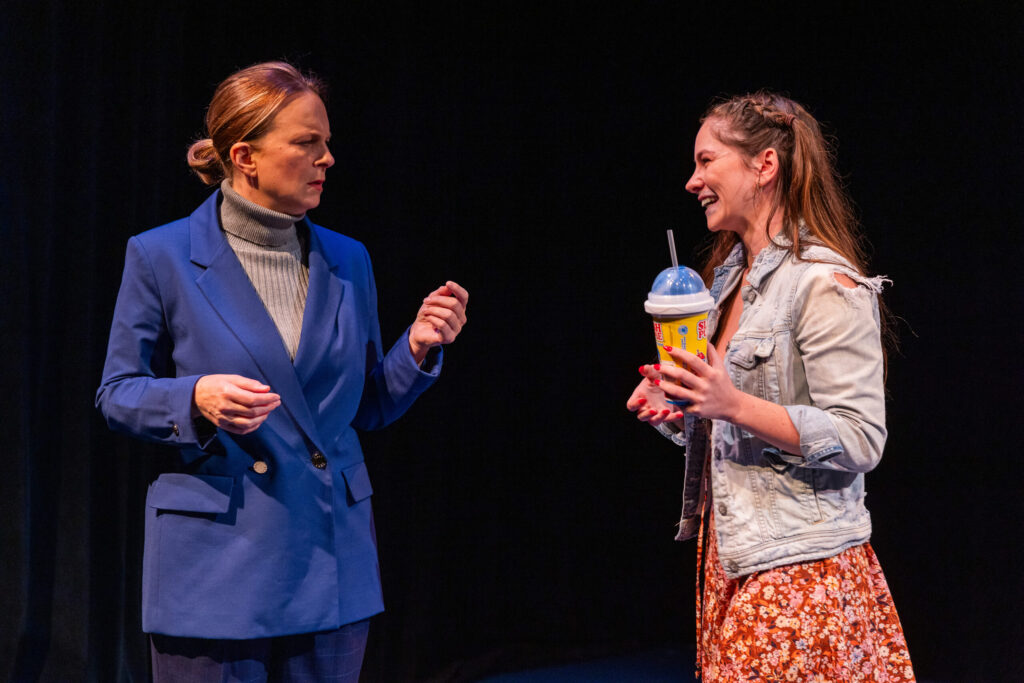
Carly Zien, Amy Resnick, Will Lyman and Joshua Chessin-Yudin. | PHOTO T Charles Erickson

By Shelley A. Sackett

Nothing crystallizes millennia of antisemitism like the Martyrology Service during Yom Kippur afternoon service. “Why are we so hated?” “Can anyplace ever be truly safe?” and “Where will be next on this list?” we can’t help wondering.

As if on cue, the Huntington Theatre’s season opener speaks to these questions and more with Joshua Harmon’s exceptional “Prayer for the French Republic,” winner of the 2022 Drama Desk Outstanding Play Award. Under Loretta Greco’s razor-sharp direction, Harmon’s themes of antisemitism, assimilation, family, freedom, identity, and fear come to life.

Set in Paris in 2016-17 and 1944-46, “Prayer” follows five generations of Jewish piano sellers. Marcelle Salomon Benhamou, the current matriarch, her husband Charles, and their children, Daniel, 26, and Elodie, 28, are the limbs of the original Salomon family tree.
The play opens with house lights up as Patrick, the play’s narrator and Marcelle’s brother, addresses the audience. His eye-contact and hands-in-trousers-pockets ease establish rapport and immediacy. “What is the beginning of a family?” he asks as he strolls across a set that will represent both 1944 and 2016. “And what,” he doesn’t ask but seems about to, “is its end?”

Abruptly, the calm evaporates. We are in the Benhamou apartment, where Marcelle (the sublimely talented Amy Resnick) is mid-sentence, explaining her convoluted genealogy to Molly, an American cousin who has just arrived to spend her junior year abroad. Only one thing seems clear: Marcelle’s Ashkenazi family has been rooted in French soil for centuries.

Just as Molly sort of gets it, Charles (the always amazing Nael Nacer) bursts through the front door with Daniel, who has been attacked by a gang of antisemitic thugs. Daniel’s face is bloodied, but he is nonplussed. His parents are apoplectic.

“How many times have I begged you to wear a baseball cap?” Marcelle pleads. Daniel teaches at a Jewish school and wears a kippah. She urges her son to acknowledge and adapt to the danger he invites by advertising his religion in a world where antisemitism and fascism are on the rise. What she doesn’t do is entertain any thought of leaving France.

Charles’ reaction is more flight and fright than fight. He has walked this walk and knows where it can lead. He and his North African Sephardic Jewish family have lived in diaspora since antisemitism forced them to flee Algeria in the 1960s.

“It’s the suitcase or the coffin,” he says. “I’m scared. Something is happening.” This wandering Jew is tired of living at the whim of host countries. He wants to go “home.” He wants to move to Israel.

Harmon quietly relocates us to 1944 (Andrew Boyce’s set makes this seamless), where we meet Marcelle and Patrick’s great-grandparents. They sit in their comfortable apartment, wondering what has happened to the rest of their family. Miraculously, they were able to remain in Paris during the war after the Nazi sent to deport them took pity on their age and left them alone. They even kept their piano store.

The rest of the play vaults between these two time periods, connecting them with the overarching question: When is the tipping point between suitcase and coffin? When is it best to leave, even if one’s family has been there for centuries and no other place will ever feel like home?

“You have to trust your instincts,” Charles implores. “It’s all you have.”

Writing cutting, funny, fast-paced, and well-researched dialogue that tackles difficult, uncomfortable topics is one of Harmon’s many attributes. His humor is often dark and our laughter is tainted with discomfort, but he wields his pen judiciously and always hits his introspective mark. He expertly uses Elodie (an electrifying Carly Zien) as his trademark firebrand mouthpiece, and her show-stopping monologue deserves a standing ovation.

Harmon doesn’t ignore the question of whether Israel’s politics have changed our feelings about it being a home for all Jews. Conflating Israel and Judaism has become painfully unavoidable. When Charles expresses his discomfort at reciting “A Prayer for the French Republic” during services, it’s hard not to relate.

Harmon is not pessimistic. We don’t pray to what is, he implies, but for what is not. “What is a prayer but speaking out loud to hope?” a character asks. Yet, can we really call a country whose politics marginalize who we are “home?” By ending “Prayer” with the cast belting out the French anthem, “La Marseillaise,” instead of Israel’s “Hatikvah,” Harmon’s answer, at least for now, seems to be yes.

The play runs through Oct. 8 at the Huntington Theatre, 264 Huntington Ave. Visit huntingtontheatre.org.

SpeakEasy’s “POTUS” Soothes Our Distressed Political Souls With the Balm of Humor

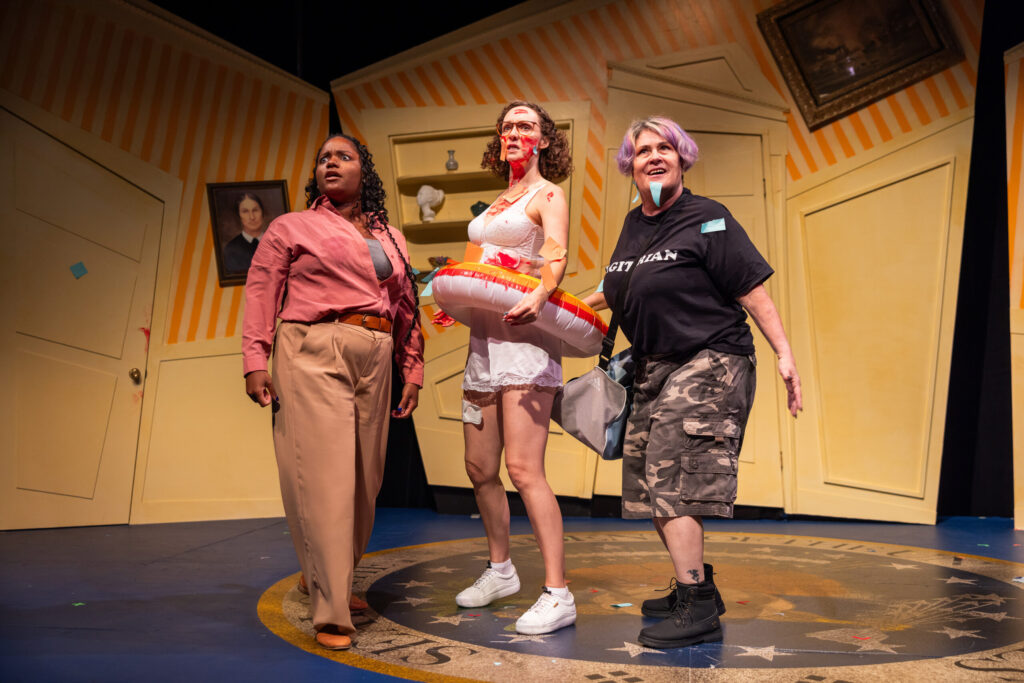
Cast of SpeakEasy Stage’s production of “POTUS” (Courtesy Nile Scott Studios)

“POTUS: Or, Behind Every Great Dumbass are Seven Women Trying to Keep Him Alive” by Selina Fillinger. Directed by Paula Plum. Scenic Design by Jenna McFarland Lord. Sound Design by Aubrey Dube. Lighting Design by Karen Perlow. Costume Design by Rebecca Glick. Fight Choreography by Angie Jepson. Presented by Speakeasy Stage at the Calderwood Pavilion, Boston, through October 15.

By Shelley A. Sackett

Hands down, “POTUS” takes the prize for the most winning opening scene currently on stage in Boston. It is shriek-out-loud funny, clever, pithy, lightning-paced, and uncompromisingly no-nonsense.

The setting is The White House, not exactly the Trump administration, but also not exactly not the Trump administration. Two pantsuit-clad women are in mid-conversation when the audience joins them.

Chief of Staff Harriet (Lisa Yuen) is filling in Press Secretary Jean (Laura Latreille) on the morning’s diplomatic meeting and on what POTUS did that she, as press liaison, will have to spin at the press briefing that is about to start.

The play’s first line sets the tone for the rest of the evening. “Cunt,” says Harriet, lassoing Jean’s and the audience’s attention. Apparently, POTUS excused his wife Margaret’s absence by saying she was having a “cunty” day. Beyond the use of the “C” word, the even bigger trouble is that Margaret was in the room. The whole time. Sitting (obscured) right in front of POTUS.

Not to worry. Jean’s job, after all, is to support and protect POTUS and, despite his worst instincts and basest actions, keep him (and herself) in power. She is used to donning rubber gloves and cleaning up the mess. “That’s not so bad. We can contain that,” she says, brightening. “We all have cunty mornings sometimes. My son has them every week.”

Playwright Selina Fillinger’s “POTUS” is aptly subtitled, “Or, Behind Every Great Dumbass Are Seven Women Trying to Keep Him Alive.” She has populated her farce/satire with seven strong behind-the-scenes women whose sole purpose is to keep a dangerous and inept man in office, not because they believe in him, but because the only way they are allowed near the epicenter of power is by clinging to his coattails.

Catia, Marianna Bassham, and Johanna Carlisle-Zepeda

In addition to Harriet and Jean, the other women in the president’s inner circle are his savvy, earthy, and jaded wife Margaret (Crystin Gilmore) and his neurotic, perfectionist personal secretary Stephanie (Marianna Bassham). Clearly, these women are the only reason he has a job. They are brilliant, dedicated, and gifted at damage control. What they aren’t is respected, acknowledged, or valued by anyone except each other.

“Why isn’t SHE president?” is the common refrain as each rises to the next challenge and douses the next blaze. The answer boils down to one word — patriarchy. “People don’t love him,” one character explains. They’re just afraid of the alternative — US!”

Add to the mix his cocky, queer, convicted-felon sister Bernadette (Johanna Carlisle-Zepeda), Chris, the recently post-partum reporter whose attire includes breast pump attachments (Catia), and the president’s pregnant girlfriend Dusty (the impossibly flexible Monique Ward Lonergan), and you have all the ingredients for a no-holds-barred satirical farce. There is a little of everything, from door slamming, slapstick, sight gags to dramatic anarchy, comic invective, and mistaken identity.

There’s even a bottle of psychedelic tabs masquerading as Tums.

Yet beneath all this droll merriment are serious messages for these serious times. According to Fillinger, those messages may be political, but they are hardly partisan. The pain and rage that underpin the biting humor in her words are aimed squarely at the White Patriarchy that keeps women in their places and men like POTUS in his.

Director Paula Plum has plumbed the sizeable talents of her extraordinary cast to create an ensemble where each individual performer shines, and the whole is even greater than the sum of its parts, no small feat with these remarkably gifted women.

Laura Latreille, Monique Ward Lonergan

Jenna McFarland Lord has created the perfect set, part “Laugh-In,” with lots of doors to open and slam, and part Pee Wee’s Playhouse, where even the pictures are askew. The result is a dizzying, unhinged quasi-reality, mirroring the conditions our heroines face daily.

Despite her use of potty language, piercing wit, and crude jokes (most of which hit their mark), Fillinger has a serious point to make. What would it be like if these skillful, thoughtful women were able to spend their time actually running the world instead of covering and cleaning up after the inept dumbass who was elected to perform that duty but can’t? Is that idea really that scary?

Asked what she hopes audiences take away from seeing “POTUS,” Fillinger said, “I hope they wake up the next day and put their money, time and votes towards equity and freedom for all,” to which we add, “Amen.” For tix and information, go to: https://speakeasystage.com/