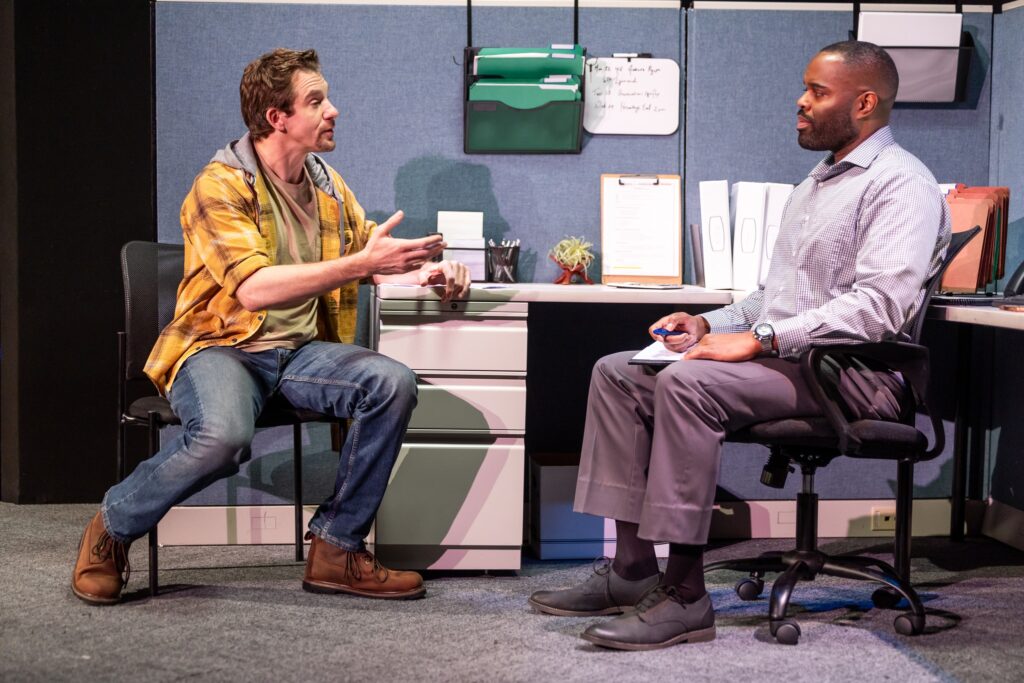
Jesse Hinson and De’Lon Grant in Speakeasy Stage’s “A Case for the Existence of God”.
Photos: Nile Scott Studios
“A Case for the Existence of God” — Written by Samuel D. Hunter. Directed by Melinda Lopez. Presented by SpeakEasy Stage Company at the Calderwood Pavilion, 527 Tremont Street, Boston, through February 17.
By Shelley A. Sackett
Once upon a time, there were two men who seemed to have little in common except their geographic histories in Twin Falls, Idaho, and the fact that their toddler daughters attend the same daycare.
Keith, a Black, gay mortgage broker, grew up living in a “nice house” in an intact family. His father, a lawyer, shared his love of travel with his children, exposing them to exotic places like Estonia at a young age. Keith is clearly in Twin Falls by choice. He even went away to college, earning a dual degree in Early Music and English, and returned. To Twin Falls. To be a mortgage broker.
Ryan, one of the popular kids in high school, grew up the son of two addicts with mental health issues who needed more parenting than they could offer. The only trip he remembers his father taking him on was to the edge of a cliff, where he literally told his young son he wanted to catapult them both off the edge to their deaths. He has never been out of the country, not even to Canada, which is a day’s round-trip car ride away. He barely ekes out a blue-collar existence working at the town’s yogurt factory.
The two strike up a conversation when picking up their daughters at daycare, and Ryan ends up in Keith’s office, a soulless cubicle, seeking his professional help in securing a loan to buy twelve acres of land that his grandfather originally homesteaded. He wants to build a house so he can have something of significance to leave his daughter, Krista.
It is in this claustrophobic yet intimate cubicle, mid-conversation, that playwright Samuel D. Hunter brings up the house lights on his tone-perfect two-hander and New York Drama Critics’ Circle 2021-22 Best Play, “A Case for the Existence of God.”
Keith, literally buttoned up in a collared and pressed Oxford shirt, is on a monologue roll explaining the difference between a mortgage broker and lender. Ryan, in a hoodie and work boots, is trying to wade through the papers he holds in his hands.
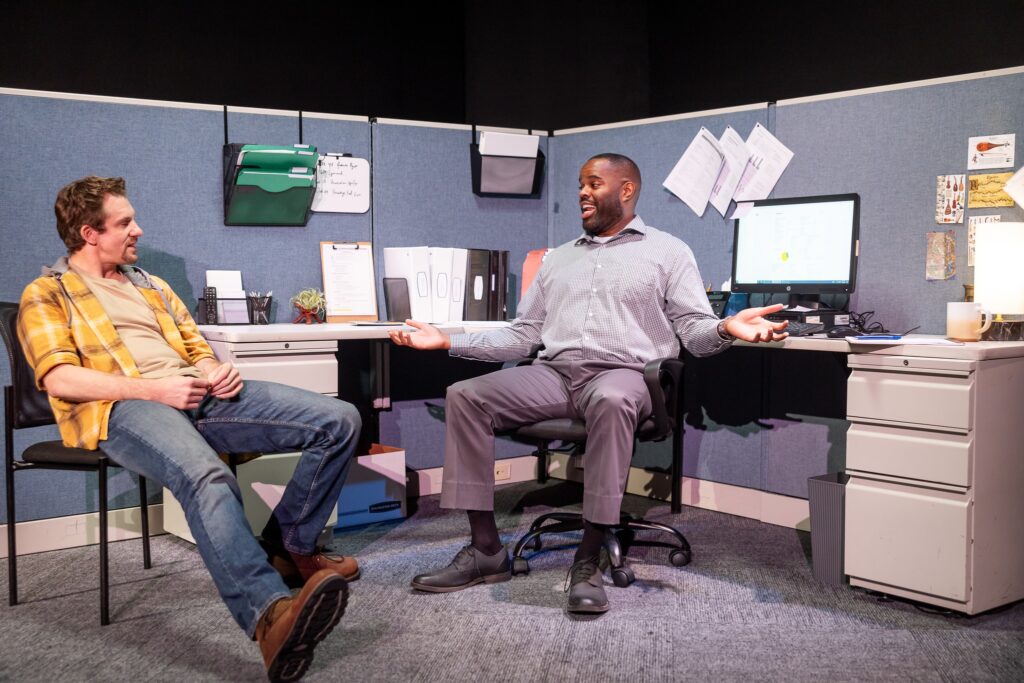
It’s as if they are protagonists in different plays. Yet, as the audience will discover over 90 delicious minutes of theatrical tour-de-force, these two not only share more common ground than not; they are actually the key to each other’s spiritual awakening and redemption.
Slowly and cautiously, they reveal details about their personal lives. Keith, after several false starts at adoption, is fostering Willa in the hope of adopting her when she turns 2 years old. He has raised her since infancy and is just two months shy of the finish line. He has just heard from his social worker that Willa’s aunt has suddenly surfaced as Willa’s next of kin and, upon learning he is both gay and Black, has voiced some concerns about the adoption.
Ryan is in the throes of a divorce and lives in a crummy cold water flat where his refrigerator is on the blink. He has terrible credit, no assets, and a delusionary dream of buying land and building a house so his 15-month-old daughter Krista will have the legacy and family home he so sorely missed out on.
Both are members of the marginalized class — Keith, by virtue of his race and sexual orientation, and Ryan, because of his poverty and lack of education. They are isolated, lonely, and deeply disoriented by a complex system that threatens to drown them in despair. All they want is what everyone wants — a home and a family — yet the stumbling blocks they face are as systemically engrained as they are emotionally debilitating.
Though they come from different worlds, they bond over their terror of the future and their helplessness in the face of such odds. As they connect over their reverence for fatherhood, a beautiful and genuine friendship evolves.
It turns out they attended the same high school, although the only time they interacted was when Ryan made fun of Keith’s T-shirt. Over time, they share much more — including a bottle of Johnnie Walker — peeling back the layers at the core of their dashed hopes and deferred dreams.
They are truly each other’s missing pieces.
Hunter’s masterful script and pitch-perfect direction by Melinda Lopez are solid arrows in this production’s quiver, but a two-hander is only as strong its actors, and in De’Lon Grant (Keith) and Jesse Hinson (Ryan), SpeakEasy Stage has hit the jackpot.
Grant brings a sweet openness to Keith, a quiet vulnerability and optimism. He is a bundle of nervous energy, a compulsive talker who wears his heart on his sleeve. Ryan is equally hopeful despite the insurmountable odds he has faced all his life. He, too, struggles to keep his head above the despair that threatens to drown him.
As this platonic male friendship blossoms, so does the duo’s conviction that they will, in the end, be OK. Whether they would have been able to embrace this positive outlook without each other’s support is an open question.
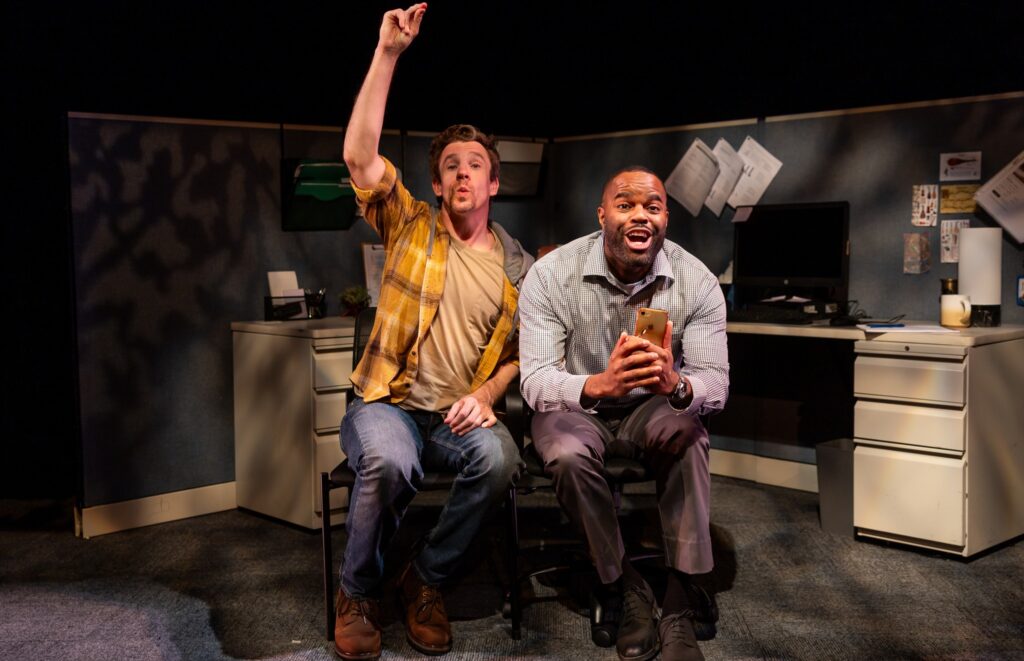
The play’s ending (no spoilers!) solidifies and elevates Hunter’s theme that the key to happiness and the point of God’s creating more than one human lies in the plan that they would find comfort and meaning in their relationships with one another. We need each other. What links us is what it’s all about. What separates us is a red herring meant to be overcome and ultimately ignored.
Ryan and Keith’s friendship is hard-won and deeply sowed, their true legacy to those who will follow in their footsteps. If that isn’t a case for the existence of God, then what is?
For tickets and more information, go to https://speakeasystage.com/

 InSights