P. Carl Invites the Audience on His Gender Transition Journey in the A.R.T.’s ‘Becoming a Man’

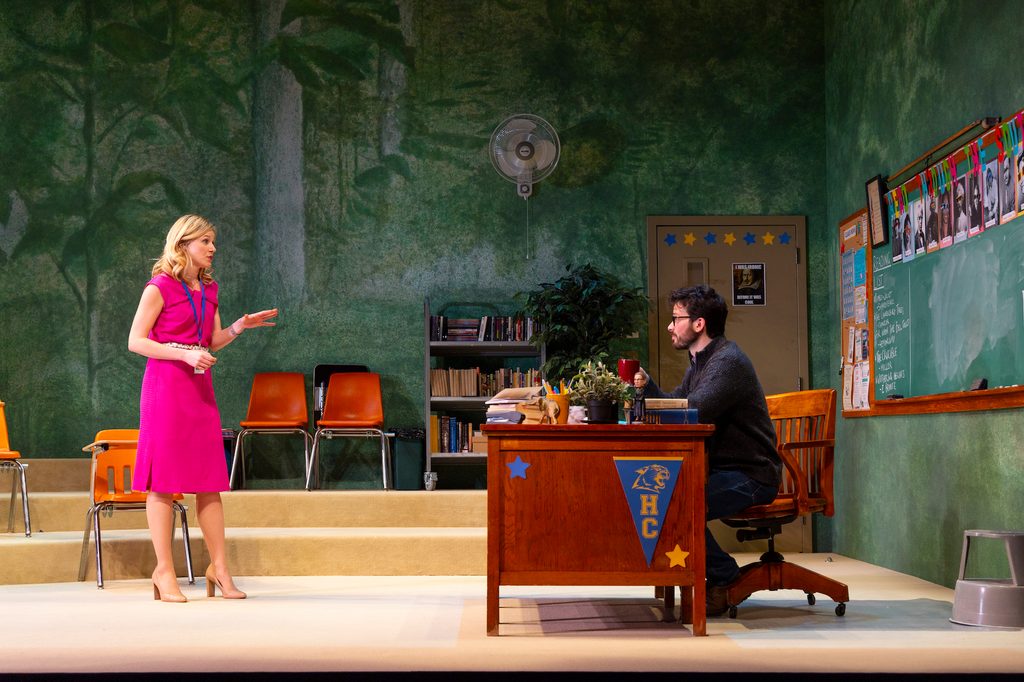
Stacey Raymond, Petey Gibson in A.R.T.’s ‘Becoming a Man’
Photos by Nile Scott Studios and Maggie Hall

By Shelley A. Sackett

P. Carl, an acclaimed educator, dramaturg, and writer, lived for 49 years as Polly, a woman who believed she had been born into the wrong body. The last 20 years were spent as a lesbian in a queer marriage to Lynette D’Amico, a writer and editor. Lynette had no idea the queer woman who was her wife suffered gender dysphoria, a condition that can — and in Polly’s case, did — lead to depression and anxiety and have a harmful impact on daily life.

So when, at age 50 and against the backdrop of America’s changing LGBTQ+ political and cultural backdrop, Polly decided to undergo gender transition and become Carl, it came as quite a surprise.

In 2020, P. Carl published a memoir, “Becoming A Man,” that detailed his life before, during, and after his transition, sharing details of what it was like to grow up in the Midwest as a girl, become a queer wife and successful career woman, and then transition to life as a man at the height of the Trump era.

A.R.T. Artistic Director Diane Paulus had read an early draft of the book and thought it would translate well as a play. P. Carl agreed. A commission of this new work for the A.R.T. and a several-years-long developmental process resulted in the dramatic version of “Becoming a Man,” in its world premiere production at Loeb Drama Center through March 10.

Elena Hurst, Gibson

Act II, a facilitated conversation with the audience about the play and its themes, immediately follows the play. Facilitators are chosen from a roster of local leaders, artists, or medical professionals, and activists who explore the production’s essential question, “When we change, can the people we love come with us?” 

“Becoming a Man” functions largely as a non-linear narrative of P. Carl’s journey and female-to-male transition from Polly Carl to Carl. It opens with a bearded Carl (Petey Gibson) catapulting onto a minimalist stage, declaring that his decision to transition from female to male was the best move of his 50-year-old life.

“The world shifted,” he explains. “I finally learned to swim,” a metaphor that pops up frequently for the euphoric freedom of finally feeling comfortable enough in one’s own skin to risk exposing it to others in very public places.

Carl also admits that now he is a man, he has become a bit of an uber-male. He enjoys men-only spaces, like sports bars, where he yells at the television and refers to his wife as the little woman. He hires a personal trainer and practically swoons in the men’s locker room. He even develops a sneaker fetish.

He also is clueless and blindsided when his lesbian wife Lynette (Elena Hurst) doesn’t react to his transition as the enthusiastic cheerleader he had assumed she would be. Myopic and self-reflective and -involved to a fault, Carl honestly doesn’t get it that Lynette could be traumatized by her female wife becoming a male and by hearing that during the entirety of their marriage, that wife felt like she was living in a body that was a lie.
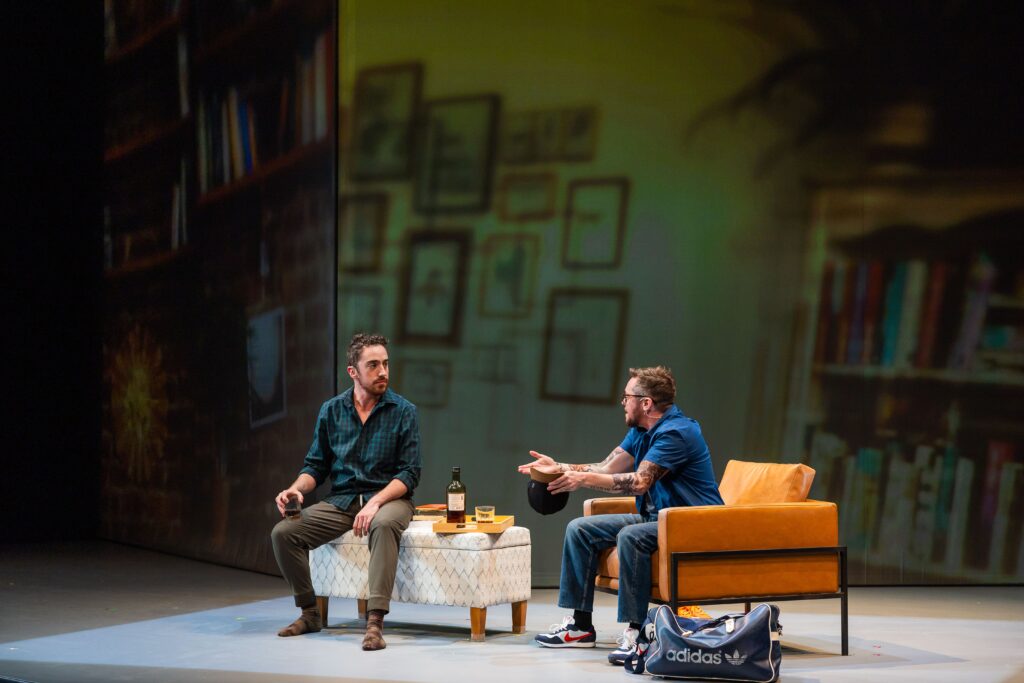
Cody Sloan, Gibson

Lynette, after all, fell in love with Polly and embraced their female queer personal and political status. She liked every aspect of being in a female-female marriage. Suddenly, to remain married to the person she loves, she has to do a 180 and adjust to the new reality that they will now present to the world as any other conventional heterosexual couple.

“What’s my part in your new life?” she asks. “I don’t know who you are. You obliterated my past,” she says, adding for emphasis, “I did not accidentally omit men from my life.”

“Transitioning for me was a breeze,” Carl says blithely. “She’s grieving and I’m celebrating.”

To his great credit and the audience’s edification and enjoyment, Carl presents his personal story in an honest, no-holds-barred way that is deeply touching in the level of trust and introspection it shares.

His pre-transition self, Polly (Stacey Raymond), is her own character, often shadowing Carl and reminding him of who he was as he navigates who he is. The moments when Polly, horrified by Carl’s macho behavior, scolds him are among the play’s best.
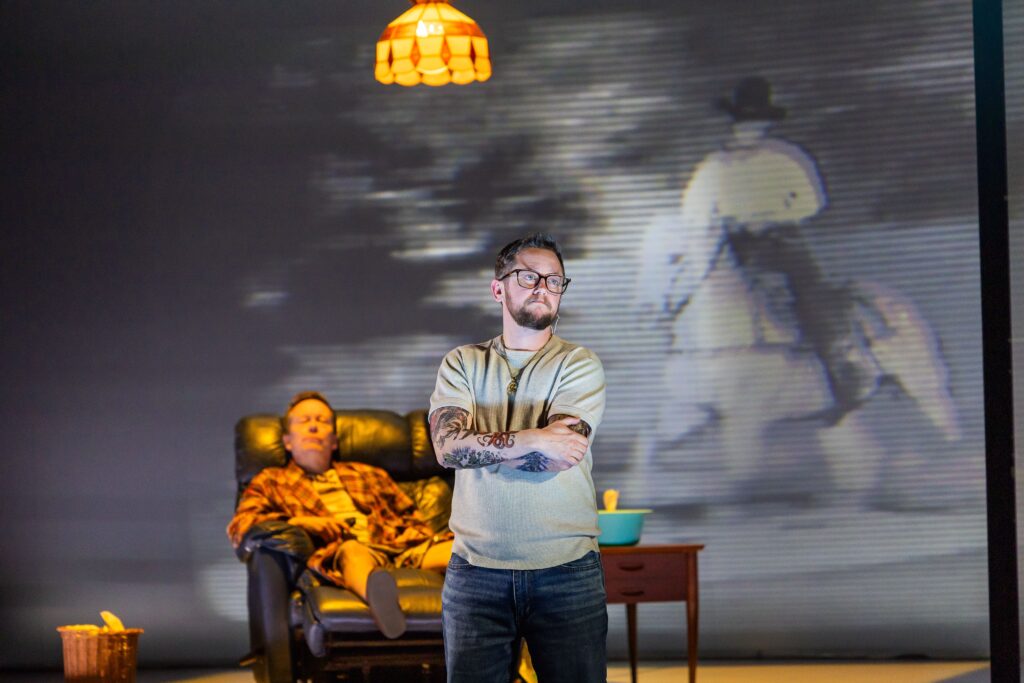
Christopher Liam Moore, Gibson

Raised in Elkhart, Indiana by an abusive father (Christopher Liam Moore) and loving but passive mother (Susan Rome), Polly is proof that the internal pain and trauma of a childhood spent in a small-minded Midwestern town as a girl feeling like she was a guy who was attracted to girls is as difficult to shed as the external signs of gender assignment.

Polly’s difficult relationship with her family is no less difficult as Carl, and the scenes when both visit their father in his waning years spotlight the point that inside, Carl really is also Polly, with all her assets and all her baggage.

“Becoming a Man” tries to cover a LOT of ground (to varying degrees of success), including friendship, gender, power, sexual identity, and inequality in America. Perhaps the most interesting and poignant topic is how the person who transitions and those with whom they shared relationships deal with all the memories and experiences that happened during pre-transition life.

Ironically, it’s the two women in Carl’s life who remind him that his actions have consequences that extend beyond his body.

“You don’t get to choose what to remember and what to forget,” Polly chides Carl. “I don’t know what to do with our history,” adds Lynette.

Becoming A Man’ — Written by P. Carl. Co-directed by Dianne Paulus and P. Carl. Scenic Design by Emmie Finckel; Costume Design by Qween Jean; Lighting Design by Cha See; Music and Sound Design by Paul James Prendergast; Video Design by Brittany Bland. Presented by the A.R.T. at the Loeb Drama Center, 64 Brattle St., through March 10.

For tickets go to https://americanrepertorytheater.org/
The Huntington’s Must-See ‘John Proctor Is the Villain’ Conjures Pure Theatrical Magic

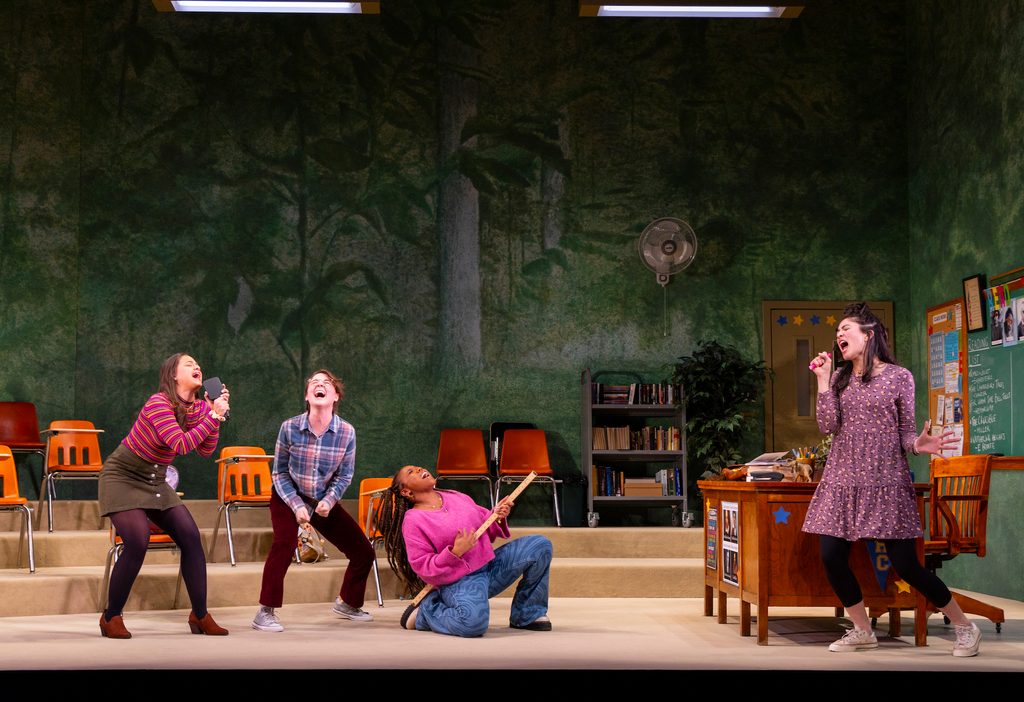
Isabel Van Natta, Jules Talbot, Victoria Omoregie, Haley Wong in ‘John Proctor is the Villain’ at The Huntington. Photo Credit: T Charles Erickson

By Shelley A. Sackett

In 1692, a witchcraft panic in Salem, Massachusetts, led to the conviction and execution of 19 innocent people (14 women and five men) for a crime that not only was never committed but that never happened in the first place.

A mixture of irrational fear, unchecked religious and patriarchal power, and a persecuting mentality led to the emergence of witch hunts and subsequent witch trials.

Arthur Miller fictionalized and immortalized this historical event in 1953 with The Crucible, a mainstay of most high school English Literature curricula. He intended it as an allegory for and indictment of the rabid McCarthyism of the 1950s, when the U. S. government blithely persecuted citizens accused of being communists based, often, on nothing more than innuendo and hearsay.

Fast forward to 2018 and an 11th-grade honors English literature class in rural Georgia, the time and place where “John Proctor Is the Villain,” Kimberly Belflower’s razor-sharp and timely play, is set. The opening scene finds Carter Smith (played by Japhet Balaban), the laid-back, I-could-be-your-buddy teacher, standing in front of a group of bored teenagers, each with their textbook open.

“Sex,” he says. In unison, the students robotically recite the administration and school board approved definition.

We get an inkling of the seven students’ (five girls and two boys) personalities and styles through the intimate banter that ensues. Beth (Jules Talbot), an eager, smart student, complains about squandering lit time for the ten minutes of sex education that the curriculum demands of each class.

Nell (Victoria Omoregie), a new transplant from Atlanta, says she had sex ed in fifth grade. Ivy (Brianna Martinez) is all business and practicality (“Doesn’t it make sense for sex ed to actually come like before people know about sex?”). Raelynn (Haley Wong) is a cheerleader type, scowling one minute and vamping the next. Lee (Benjamin Izaak) is the quintessential poster boy for teenage testosterone, and Mason (Maanav Aryan Goyal) is the class loafer.

We also get a glimpse of Carter and the adoration he culls and basks in. “I know it seems really lame, guys. Believe me, I remember being exactly where you are and feeling like, ‘Are you kidding me?’ but this is the curriculum. These are the facts.”

He is the teacher we all wanted to have in high school — smart, a little goofy, and universally appealing. He culls his students’ trust.

He also has a laundry list of issues, including ones respecting boundaries. Caught in the netherworld between being a teenager himself and entering the adult world of his student’s parents, he evokes both our affection and suspicion.

Olivia Hebert, Japhet Balaban

Following several more excruciatingly boring call-and-response sex ed definitions, Carter explains that the class’s next assignment will be to read and critique “The Crucible.” He teaches it in a fairly traditional way and proclaims John Proctor as the hero of the play.

Proctor, as a reminder for those who don’t remember the details of The Crucible, is the 35-year-old married man who has an affair with Abigail, a teenage girl in his employ. To save his honor, he lies about the affair up until the moment he is about to be hanged and only confesses because he thinks it will literally save his own neck.

Carter deems Abigail, who is disgraced and fired from her job, as the play’s true villainess because she starts the witch hunt that leads to the Salem Witch Trials. “Abigail is like really determined to get revenge. She becomes kind of a ringleader to everyone making these accusations and it gets pre-tty crazy,” Carter explains.

His five #MeToo generation female students don’t quite see it that way. After all, Proctor committed adultery with a teenager, lied about it, and let her take the blame for the affair. They maintain that Abigail’s acts of “revenge” — accusing citizens of consorting with the devil — was the only way for her to achieve empowerment in a theocratic, Puritanical patriarchal society that marginalized and demonized her.

Victoria Omoregie, Jules Talbot, Haley Wong

Shelby (Isabel Van Natta), who has returned to school after an unexplained absence, is particularly incensed. Where is the goodness, she asks, in a man who seduces a teenage girl and then throws her out when his wife finds out? A man who only had to lie to be able to put the whole mess behind him?

Adding to the caldron of budding feminism these five students are stirring is the fact that their request to start a Feminist Club (to “spread awareness, foster dialogue, and ignite change”) has been rejected by the school board. Their guidance counselor, Miss Gallagher (Olivia Hebert), delivers the bad news. When Carter steps up and offers to be its faculty advisor so it can go forward, the pieces are all in place for playwright Belflower to conjure her dramaturgical magic.

And make no mistake. Bridging eras of 17th-century Calvinist Puritanism, 20th-century McCarthyism, and the 21st-century #MeToo movement to create a cogent, insightful, accessible, and – most of all – funny commentary on the issues of male power and female vulnerability and agency is nothing short of miraculous.

The plot of John Proctor Is the Villain is so integral to its message and enjoyment that it would be a spoiler to detail what happens next in this theatrical gem. Suffice it to say that there are enough surprises, twists, and turns to make 100 intermission-less minutes fly by and a climactic finale that is guaranteed to leave you clapping furiously during a standing ovation.

Director Margot Bordelon squeezes every drop of theatrical juice out of this fast-paced, fabulous, must-see play. Under its comic overtones lie deep issues such as female friendship, gender dynamics, speaking truth to power, and patriarchal autocracy. Kudos to Bordelon for aiming equal beams on the light and dark elements of the play’s messages.

To be fair, Bordelon has a lot to work with. Belflower has an uncanny ear for dialogue, and she has penned spectacular characters. Her teenagers are articulate and insightful. They are also silly, petty, and childish. In short, they are believable adolescents, and the cast wears their roles as if they were made to order.

Isabel Van Natta, Jules Talbot, Victoria Omoregie, Haley Wong

Carter, as the John Proctor stand-in, is appropriately smarmy and endearing. He is like jello. He presents as solid but, in truth, is an eely mass of spineless gelatin, and Balaban taps into this duplicity with subtlety and self-assurance.

John Proctor Is the Villain is what good theater is all about. Its storyline is a dynamo of action and intrigue, of pathos and laugh-out-loud humor. Engaging and thought-provoking, its message is one that rings loud and true today. As Carter explains in his introductory lesson on The Crucible, “Later we found out that all those accusations were untrue. Innocent people died, and why? Largely mass hysteria, spurred on by … a bunch of people saying untrue things that could become dangerous if left unchecked.”

Highly recommended.

‘John Proctor Is the Villain’ — Written by Kimberly Belflower. Directed by Margot Bordelon. Scenic Design by Kristen Robinson; Costume Design by Zöe Sundra; Lighting Design by Aja M. Jackson; Sound Design by Sinan Reflik Zafar. Presented by The Huntington at Performing at the Calderwood Pavilion at the BCA, 527 Tremont Street, Boston, through March 10, 2024.

For tickets and information, go to https://www.huntingtontheatre.org/

Local Co-editors Trumpet Global Diversity with Stories of 100 Jewish Brides From 83 Countries

At their wedding, David Winer breaks the glass as Adena and her mother look on./INDIANA UNIVERSITY PRESS

By SHELLEY A. SACKETT

In Costa Rica, where it is customary to hand-deliver wedding invitations, most of San Jose’s Jewish community was invited to Karen and Michael Bourne’s 2003 wedding. Over 350 attended.

In Nicaragua, Veronica and Kurt Preiss married three times: first, in a civil ceremony, second in a Jewish ceremony not recognized by religious law, and third in conjunction with a conversion organized by Kulanu (“all of us” in Hebrew), an organization that supports isolated, returning and emerging Jewish communities all over the world.

Diana and Lev Pershtein-Lapkis were married by a reform rabbi in Latvia because traditional Orthodox and Conservative branches of Judaism don’t consider her to be Jewish. Hédi and Michael Fried survived Auschwitz and, despite all odds and an 18-year age difference, married in 1947 in Sweden.

And in Egypt, Esther and Léon Abécassis, the Chief Rabbi of Alexandria and their witnesses had to sign a “single status affidavit” (proof of celibacy) before their wedding at the Great Synagogue of Alexandria in 1934.

These are but five of the 100 stories in local co-editors Barbara Vinick’s and Shulamit Reinharz’s “100 Jewish Brides: Stories from Around the World.” Released on Feb. 6, the book features the first-hand stories of Jewish weddings from six continents that span almost a century.

Written by brides, their relatives, clergy and friends, this collection of personal stories from around the world offers readers a peek through the keyhole at the surprising variety of ways in which the Jewish wedding process can unfold, from the first meeting to the wedding ceremony and beyond.

“100 Brides” is the third cultural project celebrating Jewish womanhood that Vinick and Reinharz have co-edited. “Esther’s Legacy: Celebrating Purim around the World” (2002) examined how Queen Esther’s courage in saving the Jews is observed in different communities. “I Am a Woman: Stories of Bat Mitzvah around the World” (2012) looked at the wide range of ways in which a Jewish girl’s coming of age is marked.

With “100 Brides,” the co-editors turned their attention to Jewish weddings from the bride’s point of view in an effort to learn about how Jewish life was and is actually lived throughout the world. What they discovered was that although Jewish weddings may differ in detail depending on the era and international community, they share many commonalities too.

They found that some features of Jewish weddings – the ketubah (Jewish marriage contract), chuppah (wedding canopy), wine, rings and breaking of the glass – are almost universal. Others, such as a henna ceremony where groups of women apply temporary tattoos on the bride, are unique to Mizrahi (Sephardic Jews from the Middle East and North Africa), Indian and Pakistani weddings.

“Every religious community develops a culture over time,” Reinharz told the Journal. Even though Judaism has central texts which define “this is the way we do things,” everything has changed in the modern era where individualism prevails and the bride and her partner can decide how they want to structure their ceremony.

As a longtime board member and the current secretary of Kulanu, Vinick has had access to and knowledge about many far-flung and little known communities. She was part of the Kulanu group that traveled to Madagascar with a bet din (rabbinic court of three rabbis) to convert more than 100 people to Judaism. There, she attended the post-conversion remarriages of 12 couples, including Ahava, one of the brides whose story is in the book.

As engaging as these short narratives from different countries are, the last chapters give the book more heft, delving into the meatier, more macro- issues of arranged and forced marriages, intermarriage and interethnic Jewish marriage, and contemporary marriage issues in Israel. “One of my passions in life is using a sociological framework to understand things better,” Reinharz explained. “The Israel stories in particular are very important.”

She hopes readers will realize that there are alternatives to what they assume a Jewish wedding should look like. In America, for example, a particular emphasis has evolved to give the bride as much of a voice as the groom. “If I had had this book when I got married in 1967, I would have added all sorts of things that were not available at the time,” she said.

Reinharz and Vinick, who both have doctorates in sociology, have been friends for decades. In 1997, Reinharz founded the Hadassah-Brandeis Institute (HBI), a research center whose purpose is to develop new ideas about Jews and gender worldwide. Her HBI and Vinick’s Kulanu connections created a large network of Jewish scholars, rabbis and activists from across the globe for the co-editors to plumb.

Both acknowledge that their biggest challenge was not accumulating stories, but rather figuring out how to organize them into a coherent narrative. They toyed with the ideas of time-period or geography, but ultimately settled on the stages of marriages.

Vinick hopes the book might inspire readers to write the story of their own wedding. “These are really mini autobiographies and biographies,” she said. “A marriage is a good place to start.” Θ

Reinharz and Vinick will speak about “100 Jewish Brides: Stories from Around the World” at Congregation Shirat Hayam on Saturday, March 2 at 10 a.m.