Arts Emerson’s ‘Book of Mountains and Seas’ Brings Chinese Creation Myths to Life

“Book of Mountains and Seas” at ArtsEmerson

By Shelley A. Sackett

“Book of Mountains and Seas” is an artistically adventurous new work by award-winning composer Ruo Huang and MacArthur Fellow puppeteer/artist Basil Twist. Their collaboration is an inventive twist on ancient Chinese myths about creation and destruction that, in this perilous era of climate change, are especially relevant 2,500 years later.

The Chinese government released a series of stamps commemorating Chinese mythology, including the “Book of Mountain and Seas” stories, in the 1980s. Huang saw those stamps and never forgot the images. Four of them are the backbone of his production.

The vocal theater for 12 singers, two percussionists, and puppeteers is an abstract embroidery of sound, movement, and light. A troupe of puppets (handled by superb puppeteers) and the Ars Nova Copenhagen chorus turn Huang and Twist’s ingenuity into an unforgettable theatrical experience.

The performance is sung half in Mandarin and half in a language of the composer-conductor-librettist Huang’s invention, without English supertitles. Projected Chinese titles give the full text of the stories, but the English text is much briefer and its fade in much slower.

The 75-minute intermission-less oeuvre tells four timeless and abstract tales. The first myth, “The Legend of Pan Gu,” describes the creation of the planet. The program notes inform us that Earth is birthed from a cosmic egg that contains the hairy giant Pan Gu, who dies after 18,000 years of holding Earth and the sky apart. From his body spring the Sun, moon, mountains, rivers, animals, weather, and, finally, humans.
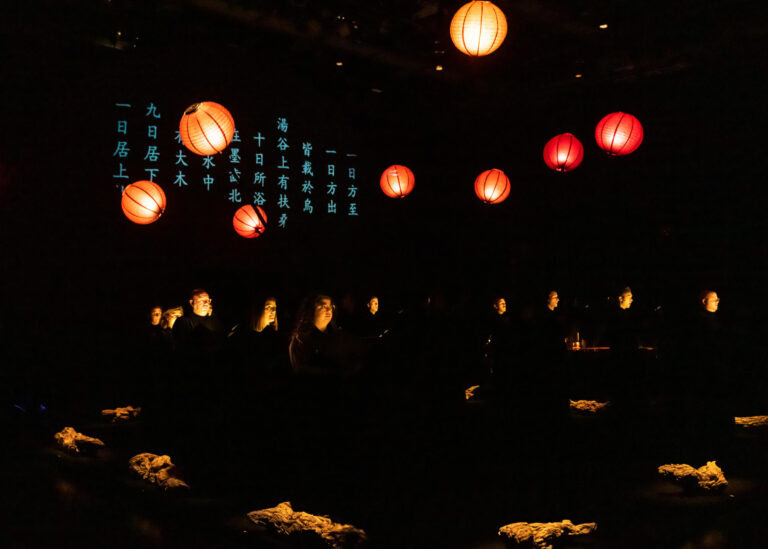
The show’s opening sets a spiritual tone, with a twelve-member choir with softly lit faces chanting an atonal primordial soup of notes that sound like church vespers. While there is little puppetry, the scene is set for the emergence of Kua Fu, whose face will be constructed from the pieces of bone-like driftwood scattered about the stage in the show’s final piece.

The ethereal, amorphous, and dissonant music matches the repetitive, slow movements on the background screen and on stage. Those who let go of expectations of linear storylines and dramatic action might enjoy entering a meditative state that is inspiring and nurturing. Others may find the experience boring and pretentious.

The second myth, “The Spirit Bird,” is about a princess who drowns at sea. Her spirit takes the form of a bird that spends the rest of eternity trying to take vengeance on the sea, filling it with pebbles and twigs.

The scene’s use of mottled lighting and undulating white silk for the sea and bird is simple and effective. Unfortunately, the scene is too long, and without the addition of any other imagery (other than a serpent who briefly swims by), the initial visual delight dwindles to the ho-hum.

In the third and fourth scenes, puppetry and drama replace repetition with excitement. “The Ten Suns” tells the tale of the ten Suns, children of heavenly gods. The ten siblings romp and play while taking turns lighting the Earth. When they decide to break this routine, and all go out together, their combined power dries up the Earth and wreaks climactic havoc. Only the intervention of the God of archery, who shoots and kills nine Suns, averts existential disaster. The lone remaining Sun, fearing his own demise, remains faithful to his duty, creating night and day.

With this tale, the show comes to life. Ten charming, anthropomorphic red rice-paper lanterns on slender stalks cavort their way across the sky. The music takes on a more harmonious quality, reminiscent more of early medieval music than a drone. As the Suns meet their fate one by one, sacrificed to save the Earth, the music marks the moment with a soulful but melodious elegy.

Finally, when the Sun-chasing giant Kua Fu appears in the fourth myth, even the most contemplative or somnambulant audience member will awaken and be utterly engrossed. “Kua Fu Chasing the Sun” is the story of a giant who sets out to chase and capture the Sun. Sadly, his quest ends in his dying from heat and exhaustion.

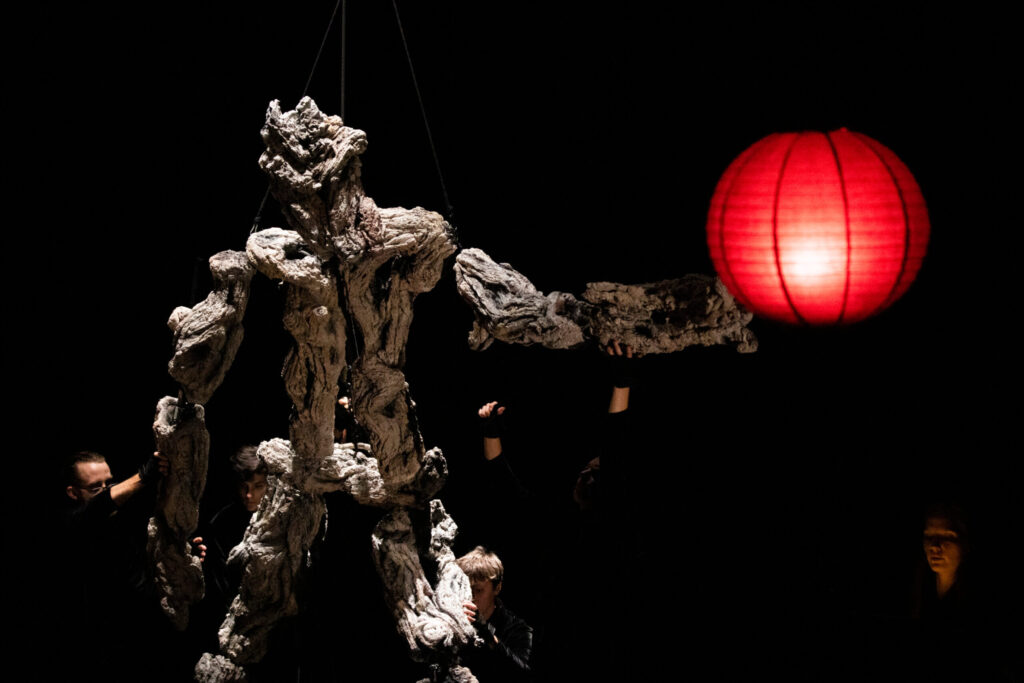
With the assemblage and appearance of the enormous puppet Kua Fu, it becomes apparent why there is a buzz about this show. Under the six puppeteers’ expert hands, the gnarly driftwood scattered across the stage comes to life with thrilling suddenness. Kua Fu’s head bobs, and his neck cranes. He acts and reacts. He runs and reaches. That this puppet exudes so much emotion while remaining abstract and clearly manipulated by humans is a testament to all involved in this show and worth the price of admission.

Lacking definable facial features, he can assume the persona of the gentlest giant or the meanest monster. Each audience member can call it as they see it, which is refreshing and fun.
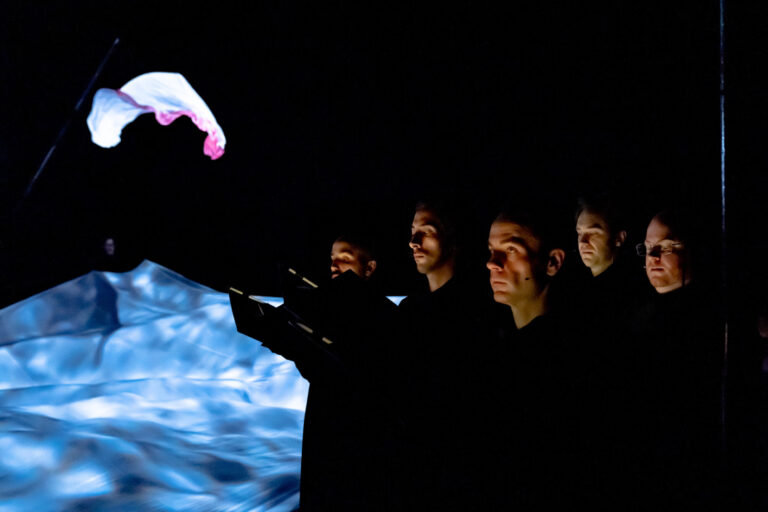
Alas, the creature’s chase after the sun leads to his no less dramatic demise. White silk cloth again doubles as the sea as Kua Fu crouches on hands and knees and drains it in an attempt to quench his unquenchable thirst. He is dissembled with the same grace and charm with which he was created, his parts scattered once again across the stage.

When he dies, his walking stick falls to the ground, transforming it into a grove of peach blossom trees. Like spinning origami fairies, delicate confetti falls from the sky as the background shifts to a soft orange glow. It is a beautiful moment and an uplifting ending.

The one caveat before seeing this show is that unless you are a totally go-with-the-flow om shanti kind of person, a little context will go a long way. There are some shows where reading the program notes or reviews before experiencing the performance is a mistake. ‘Book of Mountains and Seas’ is not one of them.

Rather than interfering with the joy of forming an opinion based on visceral, in-the-moment reactions, even a brief intro will shed welcome light and might make the evening more enjoyable. Trying to read the too-light and too-briefly-displayed English script was annoying and distracting. An unsolicited suggestion to the team behind future productions: make the program notes available on the venue’s website.

“Book of Mountains and Seas” — Composer and Librettist –Ruo Huang. Director and Production Designer – Basil Twist. Presented by Arts Emerson at the Emerson Paramount Center, 559 Washington St., Boston, through April 21.
Hub Theatre Company Revives Lanford Wilson’s ‘Burn This’

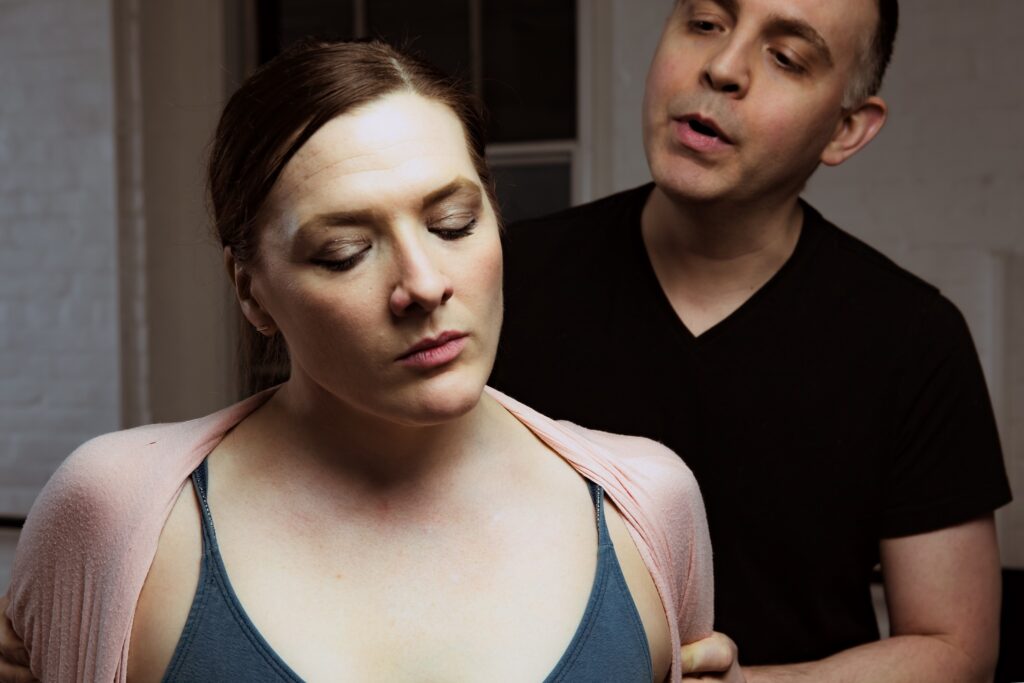
Kiki Samko, Victor Shopov in Hub Theater’s ‘Burn This’

By Shelley A. Sackett

Since Burn This arrived on Broadway in 1987, critics have lamented the same thing – at its core, the play itself is not great. Despite luminary-filled casts (including John Malkovich, Adam Driver, and Edward Norton), the play never garnered the kind of accolades awarded to Wilson’s other works, such as Talley’s Folly (Pulitzer Prize), Hot L Baltimore (Obie), and Fifth of July.

Unfortunately, despite very good direction and standout performances, the underlying over-150-minute play (one intermission) remains at the core of the problem with Hub Theatre Company’s new production.

This is not to say it isn’t worth seeing. Wilson is renowned as a playwright of unparalleled sensitivity, wisdom, and craftsmanship, and his signature style shines through. Just be prepared for a long evening with many pregnant pauses.

The premise is similar to many of Wilson’s other works that deal with family, homosexuality, estrangement, and friendship. The play begins in a Manhattan loft apartment shortly after the funeral of Robbie, a young, gay dancer who drowned in a boating accident with his lover Dom. Robbie’s roommates, his sensitive dance partner and choreographer Anna (played by a standout Kiki Samko) and wisecracking, gay advertising executive Larry (a wonderfully comedic and compassionate Steve Auger) are debriefing after attending the funeral in Robbie’s working-class hometown.

Both are disoriented by how little they knew about their friend, whom they clearly adored and miss. They are even more dismayed by how little his family knew about Robbie. “They never even saw him dance,” Anna repeatedly chants. The early, easy banter between these two is among the most enjoyable moments of the play. Their rapport, sharp irony, and honesty shape fast-paced and engaging dialogue. It’s as if we in the audience are flies on the wall of a very exclusive club.

Soon, rich boy and science-fiction screenwriter Burton, Anna’s longtime lover (Tim Hoover), arrives, and the conversation swings from Robbie to creating extraordinary works of art and “reaching beyond the sun.” The play’s title, in fact, comes from something he says about art: ”Make it personal, tell the truth and then write ‘Burn this’ on the bottom,” he says.

Burton, we learn, has proposed many times to Anna, who is happy to live in the netherworld between dating and commitment. Given the sparkles Anna emanates and Burton’s opacity, it’s hard to blame her. (It doesn’t help that there seems to be zero chemistry between Samko and Hoover).

All three characters claim to feel deeply, but their emotions smolder beneath a thick veneer of isolation, self-sufficiency, and snarky repartees.

With the second scene and the eruptive arrival of Pale, Robbie’s cocaine-snorting, hyperactive restaurant manager brother (a volatile and charismatic Victor L. Shopov), the atmosphere in the apartment quickly changes from defensive introspection to offensive self-preservation. Pale bears the match that will ignite the others and is on a mission to burn down the house.

He has shown up in the middle of the night, unannounced, to retrieve his brother’s things. He is high as a kite, with an air of danger and bad-boy sex appeal. He wields a pistol but worries about a crease in his Armani-style suit. He is Stanley Kowalski on steroids, and Anna, for all the dispassion she exhibits with Burton, responds like a ripe-for-the-picking Stella.

Pale, too, is grieving for his brother and himself. Caught between anger and guilt, he is a whirling dervish of uncontrolled and uncontrollable emotion and physicality. His primal scream unleashes a motherlode of emotion. Anna tells him that he scares her, but it’s clear he also thrills her. He has aroused something long deferred.

These four spend the rest of the play sorting out their relationships with themselves and each other while dealing with the fact that they didn’t really know the Robbie they all so desperately loved. What does that say about who they are? Who they aren’t? Does anyone ever really know another or really let another know them?

Larry is both the least and most stable, relying on the protection of his sense of humor but willing to open up when he feels safe. (The scene between him and Burton is one of the play’s most touching and intimate).

Anna and Pale are the most interesting dyad, circling each other and then zooming in and out of contact. They have awakened something deep and important in each other, something neither has ever felt before. Pale may be reckless, but he is no fool when it comes to love. He recognizes the gift he has been given and is willing to take a chance.

Anna may talk the independent talk, but when it comes to walking the walk, she retreats under the blanket. She goes so far as to acknowledge her feelings for Pale in her choreography but is unwilling to act on them. Sending him away preserves her bubble while nurturing a deep longing and regret that fuels her isolation and artistic career.

While the pacing could be nudged a bit, the production is true to the play, and the actors do a fine job. Samko is terrific as Anna. She embodies the character with a naturalness that belies her acting. Likewise, Auger does the best he can with Larry, who is written as such a stereotype as to become, from time to time, a two-dimensional stand-up comedic caricature. Auger brings a warmth and vulnerability that adds that third dimension.

Shopov is the magnetic center of the play’s motor. He personifies life lived large and is as unpolished and raw as the others are urbane and glib. Although he demands attention in every scene he’s in, Shopov isn’t showboating; he’s just playing Pale as Pale would play Pale.

Yet, he is most effective when he switches from tough guy Hyde to reveal his inner, softer Jekyll. Shopov changes more than his voice and gestures; his entire persona shifts from a nose-thumping, dangerous, tough guy to a sensitive little boy who craves approval and affection.

As in his other works, Wilson offers sociopolitical observation and commentary, which at times feel dated and like unnecessary padding in an already too-long work. Likewise, the repeated back-and-forth between Pale and Anna dilutes the gravitas of their coupling while also adding unneeded minutes.

Nonetheless, and despite its length, Burn This is worth seeing both for its excellent cast and intriguing ideas. Wilson was indeed a maestro of plumbing such subjects as disconnectedness, the purpose of life, and the pyrotechnics of relationships, and his audiences will always leave with their perspectives just a little broadened.

“Burn This” — Written by Lanford Wilson. Directed by Daniel Bourque. Presented by Hub Theatre Company of Boston at the BCA Plaza Black Box Theatre, 539 Tremont St., through April 21.

For more information and tickets, go to: http://www.hubtheatreboston.org/

The Israeli Dance Company Vertigo Hit It Out of the Park with ‘MAKOM.’

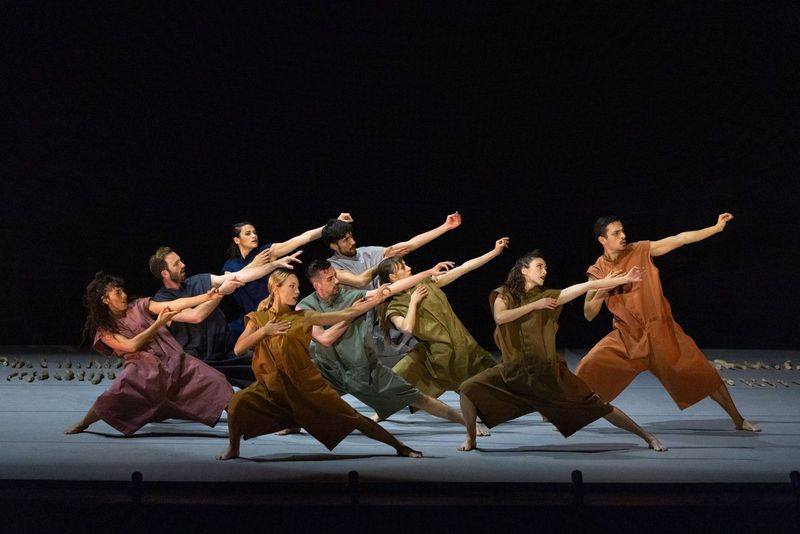
MAKOM – Vertigo Dance Company. Choreographed by Noa Wertheim and Rina Wertheim-Koren. Music by Ran Bagno; Lighting Design by Dani Fishof-Magenta; Costume Design by Sasson Kedem; Stage Design by Zohar Shoef. Presented by Celebrity Series of Boston at the Boch Center Shubert Theatre. Run has ended.

By Shelley A. Sackett

Renown Jerusalem-based contemporary dance company Vertigo does much more than its modest claim of “exploring the creative process.” Artistic Director and Co-Founder Noa Wertheim’s newest work, MAKOM (Hebrew for “place”), breaks new ground with its exciting blend of storyline, emotion, sound, and movement. The result is an evening-length journey that takes us to a deep place within and without ourselves, where language is more than words and meaning is more than content.

If that description sounds a little trippy, it’s because Wertheim and her spectacular troupe of nine dancers defy pigeonholing and quotidian dance performance vernacular. Wertheim listens to the movement of her body, watches her dancers improvise, and builds the choreographic narrative from that core out. Her overlying concept evolves from the movement, bottom-up rather than top-down.

She is keenly observant and deeply introspective, committed to earthly and spiritual elements, and the rich work she creates is nothing short of magic. Only after she has finished the choreography does she invite composer Ran Bagno to create musical accompaniment. The synchronicity of sound and movement that results is exceptional.

MAKOM can mean a real or imaginary place, and to Wertheim, it is a spiritual refuge, a home away from the fray of polarities and conflict where inner equilibrium opens the door to unity and collaboration. Connection, awareness, paying attention and the freedom to reject order are the main ingredients. Mysticism and meditation add intoxicating spice.

In MAKOM, wooden sticks are the only props. The backdrop is black matte and the dancers are clad in sack-like costumes of muted earth tones. Throughout the piece, they come together and then drift apart, undulating like water one moment and exploding like crackling flames the next.

There is joy, whimsey, and extraordinary talent in the choreography and its execution.

Thanks to spot-on lighting and sound, the dancers are the focus. Wertheim uses their bodies (especially the intertwining and draping of arms and hands) to create organic wholes out of many parts. Hers is a true company. While there are standout individuals (Sian Olles is impossible to look away from, even when hidden in the back, which — thankfully — she rarely is), there is no showboating or acrobatic theatricality. These nine dancers seem to share a single heartbeat.

Duets, in particular, focus on the push-pull fluidity of relationships as partners drift in and out of solos and various dyads. Dancers caress each other with tenderness one moment, then leap apart and drag one another across the floor.

Olles and Tommaso Zuchegna are particularly enthralling in a gorgeous pas de deux that is both simple and dramatic. Olles is like quicksilver, and she uses every molecule of her impossibly lithesome body to mesmerize and enchant. When she and Zuchegna interweave their arms and move in and out of the spotlight, the luminosity of their limbs creates a magical forest where humans and nature truly are one.

Towards the end, the captivating Olles sheds her outer garment and dances in a thin, delicate white slip. In a dramatic turn, other dancers collaborate to assemble a makeshift ladder out of the prop poles, which Olles balances atop and hinges over. The effect is simultaneously of calm and turmoil, togetherness and individuality, strength and weakness.

When the dancers dismantle the ladder, they construct the beginning of what becomes a bridge. Tentatively, some hold hands. Some explore the bridge, crawling up from opposite ends to meet in the middle and form a single, symbiotic unit. Some practice coupling, parting, and recoupling.

Finally, in a burst of hope, joy, and community, all nine join hands and dance together, encircling the bridge that will allow them to return to their makom, that place of balance and peace.

Wertheim has spoken eloquently about the need for humans to strive for the unity and wholeness that speaks to the fundamentals of the human condition. With MAKOM, through movement rather than words, she has shown us one path that can lead us to that place that brings us closer to ourselves by bringing us closer to ourselves.