Huntington’s “Toni Stone” Tells the Story of One of the Best Baseball Players You Never Heard of

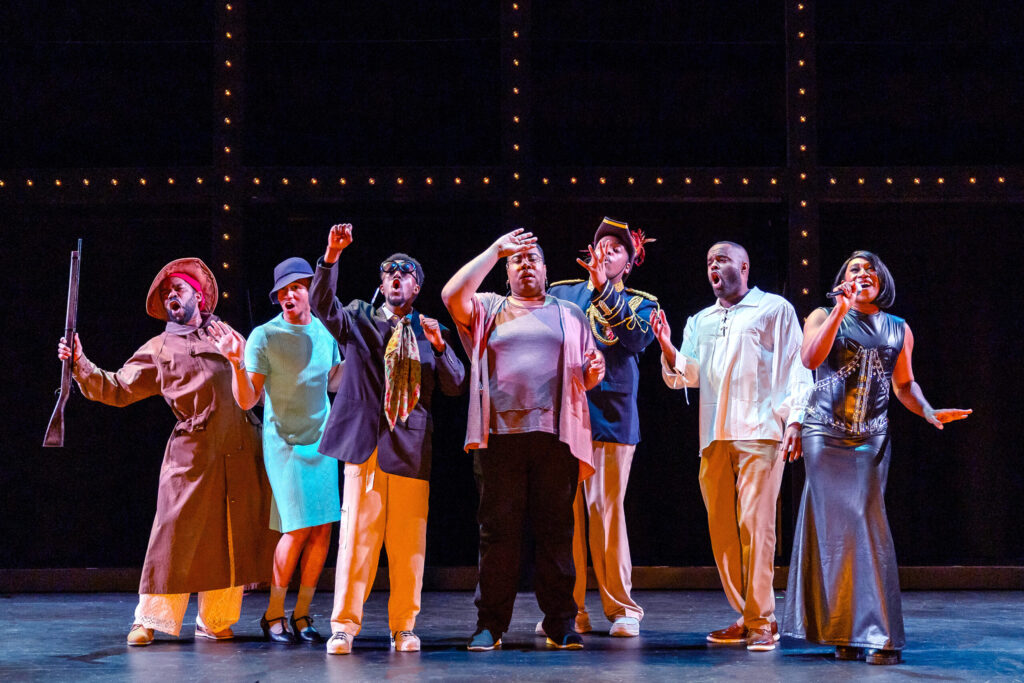
The cast of Toni Stone at The Huntington Theatre. Photos by T. Charles Erickson.

By Shelley A. Sackett

Toni Stone, the subject and title of playwright Lydia R. Diamond’s new drama, has one helluva story to tell. As played by the pitch-perfect Jennifer Mogbock, she is also one helluva terrific storyteller and more than up to the task of narrating the events of her remarkable life.

Which is a good thing, because “Toni Stone,” now at the Huntington, ran almost three hours (with a long intermission and delayed start) on opening night last Wednesday.

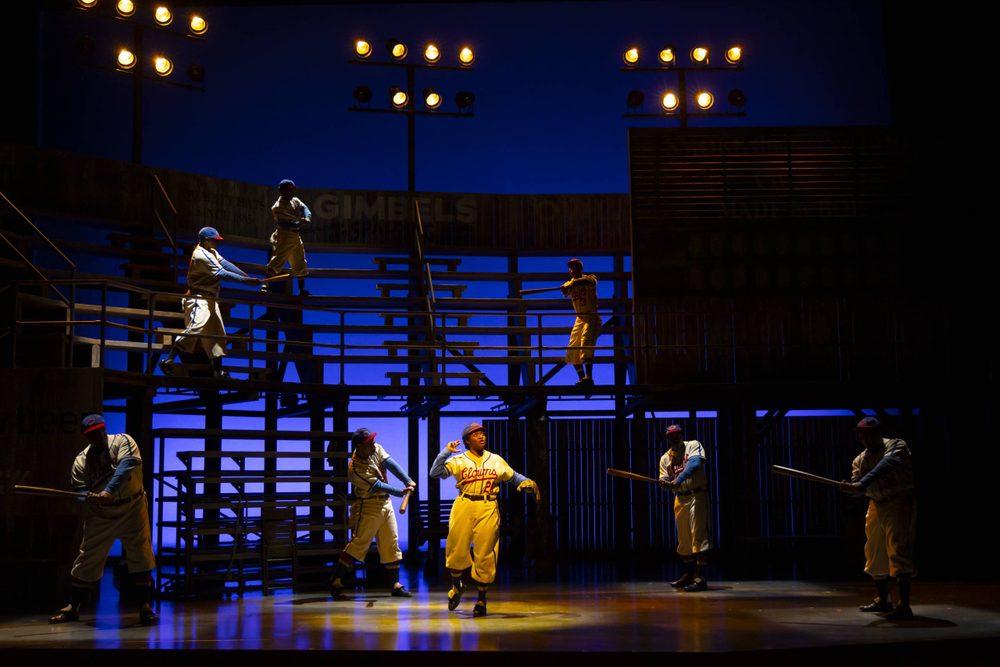
Even before the house lights have dimmed, Collette Pollard’s exciting set has placed us smack in the middle of a baseball field, surrounded by bleachers, scoreboards and night lights. Mogbock, a spitfire of energy and physicality, practically leaps onto the stage. A ball rolls slowly on the ground towards her, and she bends down to pick it up.

“The weight of the ball in the hand and the reach,” she announces matter-of-factly as she tosses it in the air. “What this is is what boys are to that girl. This is what I need.”

This — baseball in all its statistical, scientific, and athletic glory — is also what she knows, “maybe better than that girl knows boys.”

Disarming, genuine, and boundlessly enthusiastic, Stone shares her life’s highlights, from her birth in West Virginia to growing up in St. Paul, Minnesota, to becoming the first woman to play baseball in the Negro Leagues. Every step of the way, her single-minded determination to achieve her dream of playing professional baseball lit her path. Overcoming daunting racial and gender barriers, she landed the second base roster spot with the Indianapolis Clowns, taking Hank Aaron’s place when he moved up to the majors in 1953.
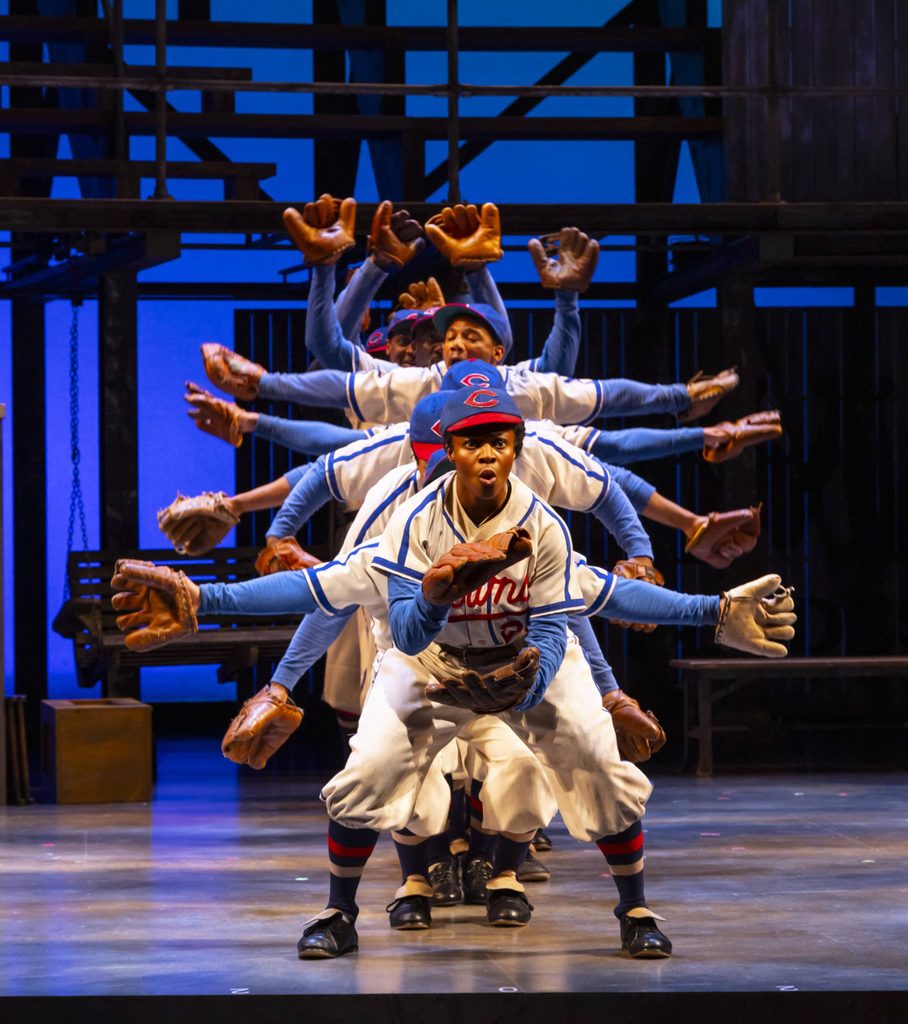
Mogbock (front) and team

Stone’s job, she tells the audience, is to tell her story so history doesn’t forget. The audience’s job, she implies, is to remember it. And to pass it on.

With that, the rest of the team bursts onto the stage. Stone introduces them one by one, and then they perform the first of several fabulous dance/acrobatic acts (choreographed by Ebony Williams with original music from Lucas Clopton). These top-notch numbers are a welcome break from the sometimes long stretches of dialogue and give the cast a chance to break loose and shine.

Mogbock is the only woman in the 11-member ensemble, and the ten actors take on individual characters as well as Clown teammates. As Millie, a prostitute who befriends Stone and tries to instill some femininity into the baseball-statistic-obsessed tomboy, Stanley Andrew Jackson is a sublime showstopper. Others play Stone’s parents, manager, coach, and husband. With a simple announcement (“He’s white”) and hand gestures, the all-Black cast also takes on white racist characters in subtle but dramatically powerful ways.
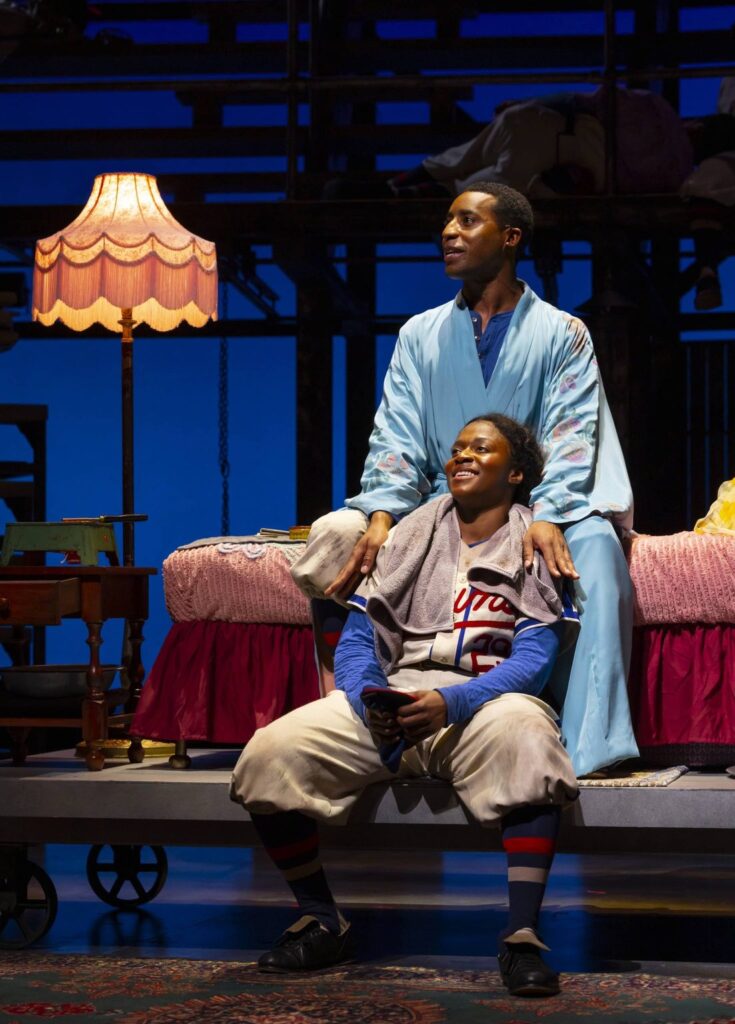
Stanley Andrew Jackson, Mogbock

Through sometimes chronologically disjointed scenes, Stone connects the dots of her personal timeline and, along the way, emotionally connects with the audience. By the end of the play, we don’t just know Stone; we adore her.

She is a complex character, as insecure and flighty socially and intellectually as she is confident and down to earth about her knowledge of and ability to excel at baseball.

As an athletically gifted kid in St. Paul, she excelled at every sport she tried. When her mother steers her towards more “ladylike” sports like figure skating (cute skirts), she easily wins the top city-wide competition and then begs to go back to the sport she really loves. She hated school both because she was bored and because the teachers pigeon-holed her as mentally impaired, misunderstanding her inability to process social cues and making her feel even more isolated and alone. (“When someone tells you there’s something wrong with your mind, you believe them,” she explains).

Yet, there’s nothing wrong with her mind when she’s thinking about a topic that interests her. As she argues with coaches about strategy, spouts baseball card statistics like an AI app, and describes baseball in terms that are poetic and metaphysical, she more than holds her own as confident, shrewd, and articulate.

While Diamond keeps the story light and focused on Stone’s journey, she by no means avoids the harsh realities of racism and misogyny in the 1950s. Stone was shunned and harassed by many of her teammates and was deliberately trampled when defending second base by opposing team members who wanted to “take out that woman.”

At the same time, she and her teammates share more than the same uniform. They are keenly aware that white team owners are using them both to make money and to make the white teams look superior by having them lose in rigged games. After all, and lest they forget their place, the team’s name, “Clowns,” is branded on their uniforms.

Like the Reconstructionist era blackface minstrel “entertainment,” they are supposed to, above all else, entertain. “They know we know what they’re doing to us,” Stone says just as Act I ends. “But we still make them laugh.”

Because that’s the only way a Black person or woman could play baseball in a white male world: by playing “their” game by “their” rules. And at the end of the day, the player’s desire to play ball is greater than their pride.
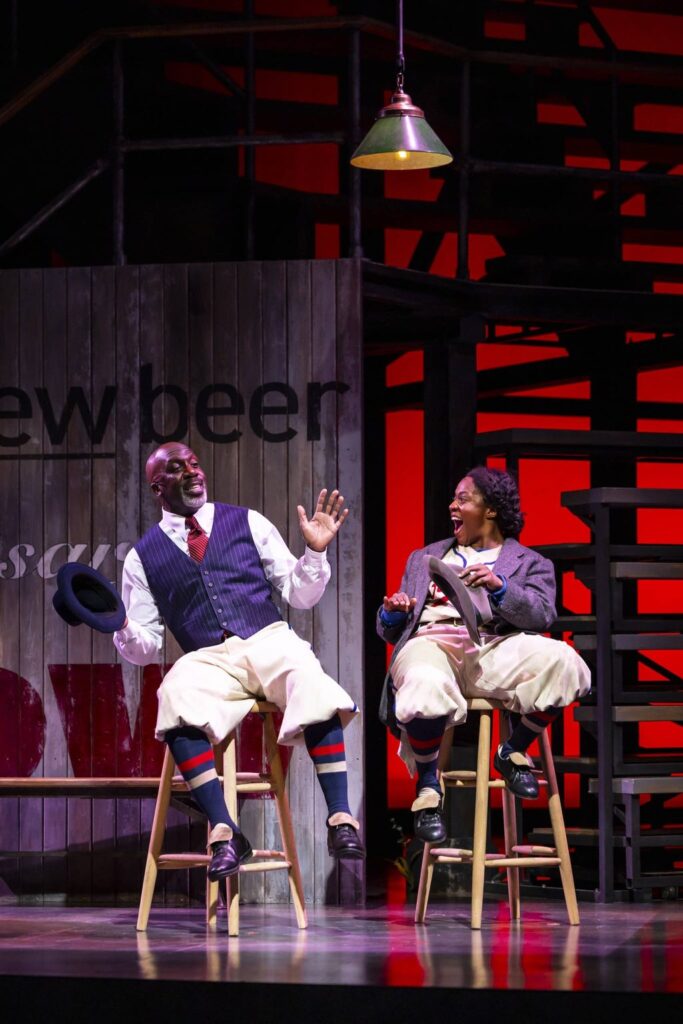
Jonathan Kitt, Mogbock

The second act (thankfully shorter and tighter) covers a lot of ground. Stone marries and retires from baseball when she ends up spending more time sitting on the bench than playing. She spends a year being a good housewife and then becomes a nurse. Although Diamond drops the ball on dramatic pacing and content at the end, Stone’s words (and Mogbock’s flawless performance) leave the audience with a semblance of closure. 

“There it is,” she says, summing up her life’s story. “I did a thing. Between the weight of a thing and the reach, there is breath. And in that breath is life.” She pauses, looking straight at the audience and melting the proverbial fourth wall. “I reached.”

‘Toni Stone’ — Written and Directed by Lydia R. Diamond. Inspired by “Curveball: The Remarkable True Story of Tony Stone” by Martha Ackmann. Presented by the Huntington, in an arrangement with Concord Theatricals on behalf of Samuel French. At the Huntington Theatre, 264 Huntington Ave., Boston, through June 16.

For more information and to buy tickets, visit https://www.huntingtontheatre.org/

‘Bluey’ Comes to Life in Boston

Bluey’s Big Play at the Boch Wang Center. Photo Credit: Darren Thomas

“Bluey’s Big Play” — Story by Joe Brumm. Music by Joff Bush. Presented by BBC Studios and Andrew Kay in association with Windmill Theatre Co. at the Boch Center Wang Theatre. Run has ended.

By Shelley A. Sackett

It’s true what they say about grandparenthood — there is nothing like it. There are so many things you didn’t even consider doing when childcare duties sucked your days dry of time and energy. But now that those children are grown and have children of their own (and are willing to drive them to meet you at the theater!), the opportunity to not just attend but actually enjoy such events as “Bluey’s Big Play” are the payoff.

Which I cashed in last Saturday with my Bluey-obsessed three-year-old grandson. We had a blast.

The theatrical adaptation of the Emmy® award-winning children’s television series follows the Heeler family through a full day from sunrise to bedtime. Bluey and Bingo work to keep their dad, Bandit, from reading on his phone. Bluey and his mom, Chilli, talk about his being a good example as a big sister to Bingo.

The 45-minute show is approximately as long as six regular “Bluey” episodes, which, although it seemed short by adult standards, was the perfect attention span bandwidth for the preschool crowd.

When the lights first went down, a short section set to the familiar music of “The Weekend” with marionette bird puppets was a delight. A family of three birds enchanted with their charming dances and interactions. It was, frankly, magnificent. The puppetry was terrific, and the ambiance was magical, especially when a flock of smaller birds swept across the stage, creating shadows in the sky and on the walls.

The audio track for “Bluey’s Big Play” was prerecorded by the voice actors from Bluey, and each character in the show was represented onstage by human-sized puppets. Each puppet requires at least one puppeteer to operate its facial expressions (eyes and eyebrows) and arms, while at times, a second puppeteer is needed for actions that control its legs and tail or to add and remove props from the puppet’s hands.

Unfortunately, the puppeteers were very obvious, unlike the recent Daniel Tiger live show, where adults donned life-sized costumes. My grandson’s first comment was, “They’re stuffies (stuffed animals).”

There was no mistaking this Bluey show for the real McCoy.

Nonetheless, the plotline was easy enough to follow, the lessons important ones to take away. And the swag and free pre-show ice cream added a special touch. But the most special treats came after the story ended. Giant balloons were tossed into the audience and they made their way from row to row as kids (and their parents and grandparents) did quick catch and releases. The final extravagance were bubble cannons that shot geysers of bubbles into the air. Not one child — or adult — left the theater without a wide smile on their face.

Apollinaire Theatre Company’s ‘Touching the Void’ Reaches for the Moon

Cast of Apollinaire Theatre Company’s ‘Touching the Void’

‘Touching the Void’  — Based on the book by Joe Simpson. Adapted by David Greig. Directed by Danielle Fauteux Jacques. Scenic and Sound Design by Joseph Lark-Riley; Lighting Design by Danielle Fauteux Jacques; Movement Choreography by Audrey Johnson. Presented by Apollinaire Theatre Company at Chelsea Theatre Works, 189 Winnisimmet St., Chelsea, through May 19.

By Shelley A. Sackett

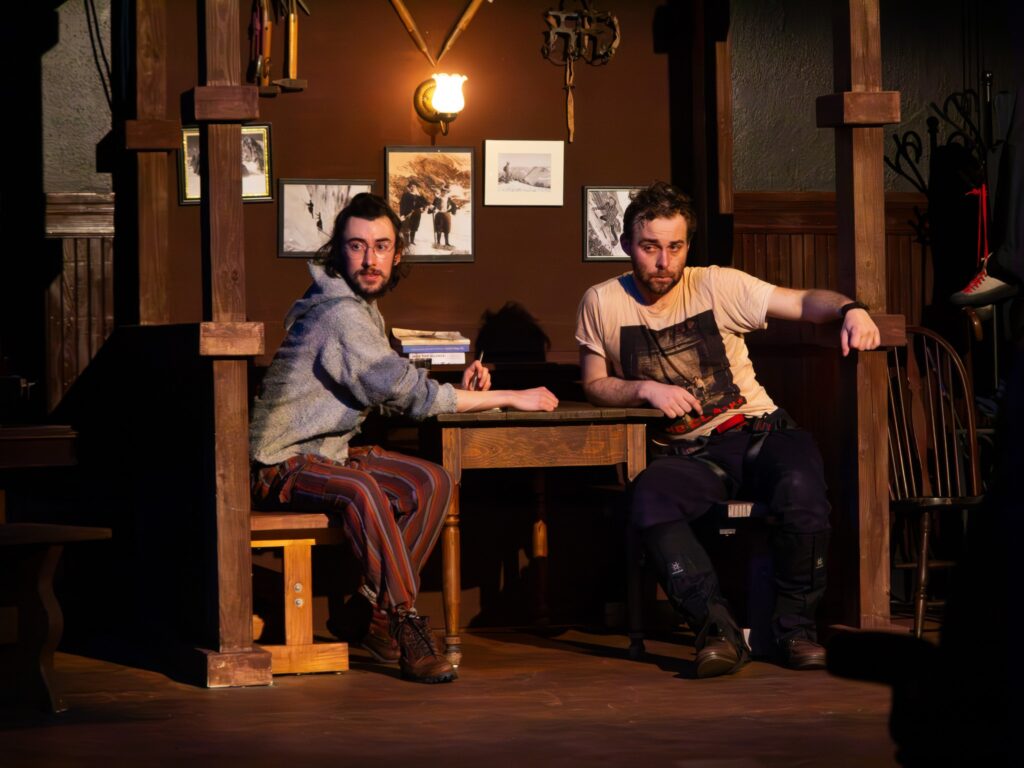
Touching the Void is special on so many levels. Presented in the intimate Chelsea Theatre Works theater, director Danielle Fauteux Jacques has done a brilliant job of creating multiple settings (including the side of a mountain in the Peruvian Andes!) with minimal fuss and to maximum effect. The four actors (Patrick O’Konis as Joe, Kody Grassett as Simon, Zach Fuller as Richard, and Parker Jennings as Sarah) are equally stellar, and David Grieg’s script is meaty and engaging.

The real star of the play, and an unfortunate rarity these days, is the plot-driven narrative. It is based on climber Joe Simpson’s memoir of his near-death climbing experience, a thrilling and engaging story. There is even a surprise twist ending, which Jacques reveals in a deliciously sly and clever fashion after the curtain falls when the audience least expects it.

Even before the play officially starts, the mood is set. A blond, sullen woman, clad in a leather jacket and boots strolls onto the stage. Her mouth is down-turned. She holds an unlit cigarette, sits alone at a booth in a casual pub, gets up to put a song on the jukebox, and sits down again. She nods, looks at the table, and sighs.

Jennings is captivating; it’s not easy to stay in character in a vacuum. The effect, thanks also to Jacques’ spot-on lighting, is like a Hopper painting come to life.

We learn she is Sarah, Joe’s sister. Joe, we also learn, is presumed dead. She has just come from his body-less wake.

Enter Simon, who survived the climb, and Richard, the base camp manager. She insists on hearing the entire story of the climb, from its planning phase in this very “climbers’ pub” to the moment when Simon cut Joe loose, leaving him to perish in a crevasse.

Kody Grassett, Patrick O’Konis


She wants to understand what drew her brother to take such a risk. She has to experience the climb as he did to do that because she doesn’t believe he is really dead.

Simon and Richard agree to relive the journey with her, and their story, relayed through Sarah’s non-climber eyes, is an enormous one, packed with insight, triumph and peril. It’s also a golden opportunity for director Jacques and sound designer Joseph Lark-Riley to strut their stuff by turning the small stage from the pub to an Andean peak — complete with crunching snow and howling winds that whip the climbers like flags— and back to the pub again.

We witness all this in hindsight and by the end, we share Sarah’s doubt about whether Joe really perished. (No spoilers, but the answer awaits over snacks and drinks in the lobby).

Simon accommodates Sarah’s need to know how her brother lived, not just how he died. He shows her how to climb, painstakingly using chairs and tipped tables to improvise the feeling and rush of the climb. Only after she can relate on a visceral level does the storytelling begin.

Back in 1985, Simon and Joe were experienced Alps climbing buddies who wanted to be the first to climb the West Face of the Andean Siula Grande mountain. Alpine style, which means without extra gear or yuppie brand name accoutrements. “Two men, a rope and the abyss. It’s beautiful, but it’s dangerous,” Joe explains.

Parker Jennings, O’Konis


Accompanied to base camp by their site manager, the amusing and irritating navel-gazer, Richard, the two set off on their impossibly low-tech journey. They make it up, but on the descent, Joe shatters his leg and then disappears over a cliff. With rescue an impossibility and faced with freezing winds and certain death if he didn’t immediately begin his own descent, Simon makes a gut-wrenching decision. Act I ends with him cutting the rope that tethers him to his partner.

Act II opens with Joe, alive, incredulously realizing his situation. He is as devastated by his physical problems of having a shattered leg and being at the bottom of a snow abyss as he is psychologically by the reality that his partner cut him loose to save himself.

Suddenly, Sarah is by his side, coaxing him on, helping him inch his way out of this Dante’s frozen circle of hell. Is Joe hallucinating? Is Sarah imagining herself by her brother’s side? While the agony of Joe’s navigating his slow descent sometimes feels tedious and overdrawn, trust me — it will all make sense in the end.

Touching the Void is an abundance of theatrical pleasures, most notably the performances by the four actors. As Joe and Sarah, Jennings and O’Konis are simply perfect. Fuller imbues Richard with just the right balance of goofiness and competence, and Grassett brings an arm’s length sang froid to Simon that leaves us guessing whether there might not be a few nefarious skeletons in his closet.

Zach Fuller, Patrick O’Konis

If you enjoy theater that makes you think and inspires post-show conversation and debate, then this play is a must. Besides marveling at an inspiring production, you are guaranteed to leave wondering how this story could possibly be true.

For more information, visit apollinairetheatre.com

Rejoice! Alvin Ailey Is Back in Town!!!

Alvin Ailey American Dance Theater at the Boch Center Wang Theatre
Photos by Paul Kolnik

By Shelley A. Sackett

There is always a special buzz in the air before the curtain rises on an Alvin Ailey American Dance Theater performance, but at Saturday’s matinee, the packed house was positively gaga with anticipation. They were not disappointed. For over two hours, the company thrilled its audience, leaving it enraptured and standing in a deafening ovation.

Presented by Celebrity Series of Boston at the queenly Boch Wang Theatre, five performances offered three programs: “Ailey Classics,” and two programs featuring new productions by other choreographers. All ended with the full production of Ailey’s signature work, Revelations.

“Ailey Classics,” Saturday afternoon’s three-act program, was a brilliant curation of excerpts from eight of Ailey’s jazzy pieces.

The first dance, Memoria, is elegant and delicate. Ailey composed it in 1979 as a tribute to his deceased colleague, Joyce Trisler, and there is an otherworldly translucent quality to his choreography. The curtain rises on a Tiffany blue background, a soloist in a flowing white dress flanked by two male companions in purple pants and billowing white shirts. Keith Jarrett’s abstract “Runes” (Charlie Haden’s bass is delicious) adds to the drama and flow as the ensemble encircles and wanders through the triangle of the three principal dancers. The ghostliness of the costumes, beauty of the movement, and entrancing emotiveness of the soloist leaves the audience tingling.

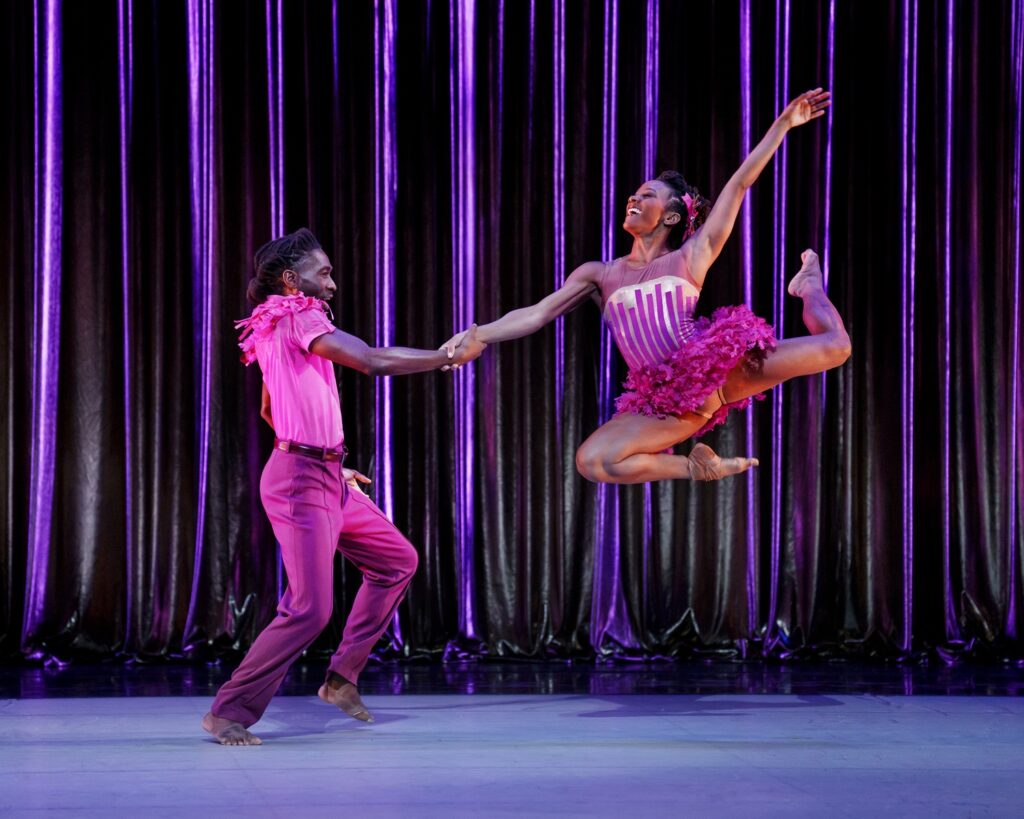
Movements II and III of Night Creature (1974) change the mood from ethereal to earthbound and earthy. Set to Duke Ellington’s snappy music, this piece featured Constance Stamatiou as a saucy, sexy flapper who sets the tone and commands our attention. Set in the night world of vintage jazz clubs, the piece is playful and steamy, a toe-tapping delight. A large ensemble struts, leaps and slinks through swing and jitterbug dance moves as they toy with each other and the audience. The star-burst finale is Ailey at his most brilliant.

After a brief intermission, a Pu Pu Platter of bite-sized Ailey excerpts maintains the crackle and pop. Pas De Duke (1976) showcases Ellington’s infectious melodies and a charismatic couple, she dressed in a black vest and tight pants, he in a Travolta-worthy white suit. They are synchronicity personified as they cavort in front of a backdrop of pop art bubbles reminiscent of a lava lamp.

The program continues with music that is conducive to narrative storytelling. Maskela Langage (1969; ‘Morolo’ by Hugh Maskela) is based on the music of the South African trumpeter Hugh Masekela. It is set in a bar—but the bar itself is in a kind of no men’s land. There is an element of sadness and despair in the way a hot mama dispassionately lures three men to dance with her. At the time he created the piece, Ailey apparently wanted to draw parallels between the era of South African apartheid and the race-induced violence of 1960s Chicago.

Love Songs (1972; ‘A Song for You’ by Leon Russell) offers an emotional journey through love and longing, set to a song recorded by Donny Hathaway. Side lit against a black screen, the solo dancer is lyrical and poignant.

With For ‘Bird’ — With Love- Excerpts 1 and 2 (1984), Ailey pays tribute to the great Charlie Parker, the now-legendary alto-saxophonist known familiarly as Bird and after whom the jazz club, Birdland, was named.

With a disco ball, a big crowd of exotic dancers clad in sparkling beaded costumes and feathered headdresses, and music by Coleridge-Taylor Perkinson, Ailey magnificently recreates the Harlem jazz scene. The dancers, like characters in a musical number from a vintage era film, seem to emulate Parker’s style, swinging and glamming with smooth ease.

Excerpt 2 is giddy pleasure, with costumes of red jumpsuits, tails and dancing stick, white suits and red dresses. It is color, joy, and the excitement of top-notch dancing.

When Alvin Ailey started in 1958, he envisioned a company dedicated to enriching the American modern dance heritage and preserving the uniqueness of the African American cultural experience. Since then, his troupe has continued for 66 years with only three artistic directors, the most recent (Robert Battle) since 2011. Of its 32-member ensemble, many have been with the company for more than ten years.

Stability and continuity are hallmarks of the Alvin Ailey company. So is ending its performances with Ailey’s 1960 masterpiece, Revelations.

Even before the second intermission was over, the audience was writhing in anticipation. Like concertgoers who want to hear their musical idols sing the hit song they know all the words to, these Alvin Ailey groupies were primed and ready. With the first notes of the hauntingly beautiful spiritual “I’ve Been ‘Buked,” they were clapping. By the time the curtain rose a few moments later, they were cheering loudly.

And for good reason.

Ailey’s classic is a wonderous tapestry of universal themes, emotion, symbolism and — of course — mind-bogglingly exquisite dancing. No matter how many times I have seen it, it never gets old and it never gets boring because I always notice something for the first time. Revelations somehow manages to combine the comfort of greeting an old friend with the delight of discovering something new about them.

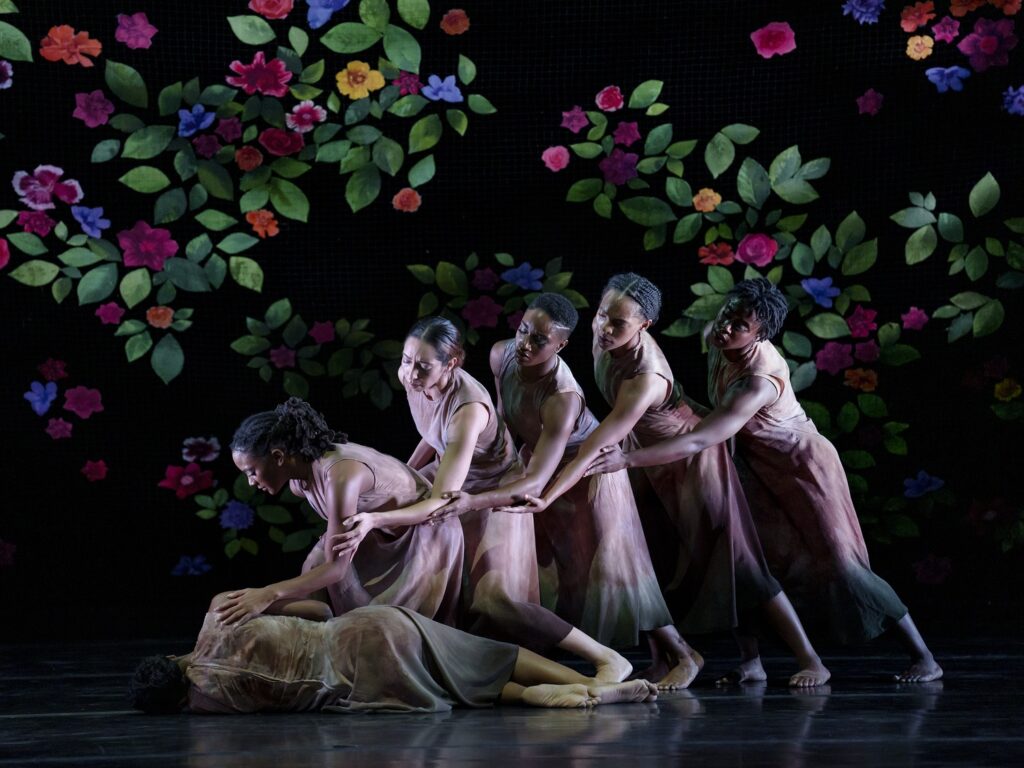
Divided into three sections, the 36-minute piece was inspired by Ailey’s “blood memories” of growing up in rural Texas during the American Civil Rights Movement of the 1960s. “Pilgrim of Sorrow” is an appeal to God for relief from sorrow and destitution; “Take Me to the Water” represents baptism and the welcoming to the church as a full member; and “Move, Members. Move” depicts a traditional Southern Baptist church service.

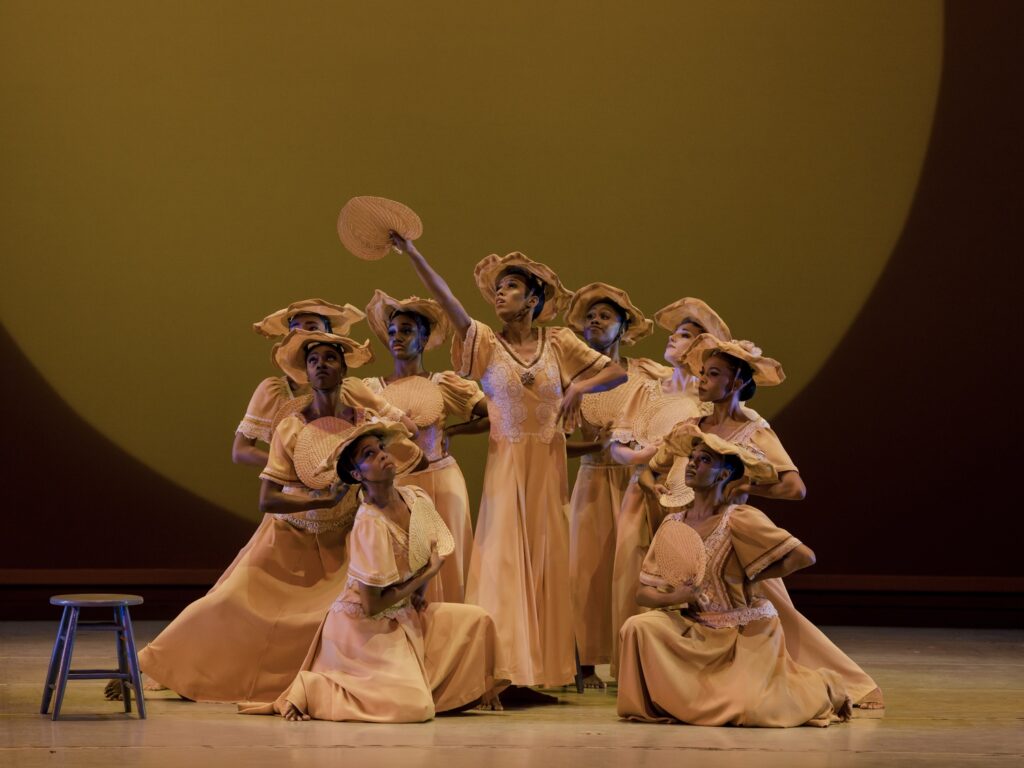
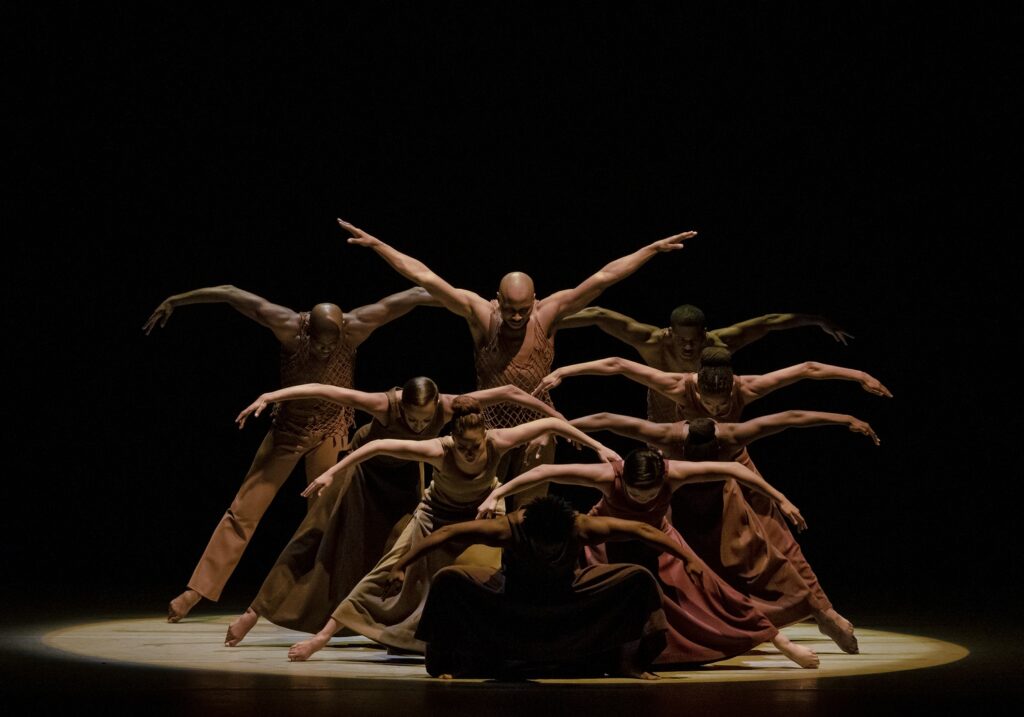
Four pieces in particular resonated on this most recent viewing. “I’ve Been ‘Buked” opens as a mass of dancers fitted together into a fluid triangle that rises and falls, a pulsating, breathing organism. I never cease to be amazed by the “wow” factor of this use of space and bodies and by the grace and plasticity of the dancers’ arms.

“Fix Me Jesus” is a gorgeous duet that ends in a breathtaking arabesque. Three men race around the stage in “Run Sinner Man.” Their muscular moves against a backdrop of pink and red satanic flames heighten the feeling of frenzied entrapment. In “You May Run On,” those delightful fan-flicking congregational women are a swarm of bees, gossiping and forming fluid cliques. Like hens coming home to roost, they carry their milking stools and fans, plopping themselves down whenever and wherever they please. The effect is charming.

Notwithstanding the above, Revelations really is a piece that must be experienced live to be understood and appreciated. Reading (and writing) about it is simply no substitute. Its passion and power are palpable. The choreography, with its thrilling athletic leaps, cheery jubilance and tender pas de deux, is peerless. Its ten individual dances, from “I Been ‘Buked” to “Rocka My Soul in the Bosom of Abraham,” are stand-alone masterworks. Strung together as a story that is both timeless and timely, it is a magnum opus that must be witnessed live — again and again. Just ask anyone who was at the Saturday matinee.

Thanks to the Celebrity Series of Boston, Alvin Ailey American Dance Theater makes an annual visit to Boston. If you missed it this year, promise yourself you won’t make the same mistake in 2025.

Alvin Ailey American Dance Theater. Presented by Celebrity Series of Boston. At Boch Center Wang Theatre through May 5.

For more information, go to www.celebrityseries.org/

Judaism Shares the Spotlight in PEM’s Stunning “Ethiopia at the Crossroads” Exhibit

Artist in Addis Ababa, Ethiopia, Queen of Sheba and King Solomon conceiving King Mǝnǝlik I, 20th century. Tempera paint on cotton canvas. Gift of Charles R. and Elizabeth C. Langmuir, after 1973. Peabody Essex Museum./KATHY TARANTOLA/PEM

By Shelley A. Sackett

SALEM – “Ethiopia at the Crossroads,” the impressive new exhibit at the Peabody Essex Museum through July 7, celebrates the extraordinary artistic traditions of Ethiopia from their origins to the present day.

Co-organized by the Walters Art Museum and the Toledo Museum of Art, the sensory-rich show presents a collection of over 200 objects, ranging from antique painted religious icons, illuminated manuscripts, gospel books, coins, metalwork, and carvings to modern photographic, textile, and multimedia works by contemporary artists.

As the first major touring exhibition to examine Ethiopian art in a global context, its curators wisely added many roadmaps that describe and illuminate this often-overlooked African nation’s contribution to the world.

Artist in the Beta Israel community, Ethiopia Necklace, 20th century. Silver, metal, and string. Minneapolis Institute of Art, The Ethel Morrison Van Derlip Fund./SHELLEY A. SACKETT

Seated in the Horn of Africa between Europe and the Middle East, Ethiopia has played a profound foundational role in the evolution of the region’s history, creativity, and cross-cultural exchanges over two millennia. It has the distinction – despite upheavals – of maintaining its independence as one of the only African nations to resist colonization. Religious art, in particular, emphasizes the outsized role Ethiopia played in the establishment and evolution of the three major Abrahamic religions: Judaism, Christianity, and Islam.

Most striking is the place Judaism played in this mix.

Prior to the arrival of Christianity, many people in Ethiopia practiced Judaism, perhaps linking back to the meeting of the Ethiopian Queen of Sheba and King Solomon of Israel in the 10th century B.C.E. Known as Beta Israel, the Jewish community in Ethiopia has persisted for over 2,000 years.

Most of the Beta Israel community immigrated to Israel in the 1980s and into the 1900s when political destabilization, famine, and religious persecution threatened the country. Operations Moses (1984), Sheba (1985), and Solomon (1991) airlifted over 80,000 Ethiopian Jews to Israel. Nonetheless, the union between Sheba and Solomon yielded a line of Ethiopian kings that lasted until its last emperor, Haile Selassie, was overthrown by a coup d’état in 1974.

In the 20th century, Jewish community members produced objects in diverse media that alluded to Ethiopia’s Jewish origins. Two large panels depict a graphic novel-type chronicle of the Queen of Sheba (known as the Ethopian Queen Makǝdda) and King Solomon conceiving King Mǝnilǝk I, the first ruler in a Solomonic line of Ethiopian kings.

These epic works (vibrant tempera paint on cotton canvas mounted on board) detail Mǝnilǝk’s journey as an adult to Israel in order to meet his father, King Solomon. His envoy returned to Israel two years later, with the Ark of Covenant, a sacred relic containing two stone tablets inscribed with the Ten Commandments. That ark is said to be located in Ethiopia today, at a church in Aksum. Nearby is a silver necklace crafted by a Beta Israel artist.

Aïda Muluneh, “Addis Neger,” from the Mirror of the Soul series, 2019. Inkjet print. Museum purchase by exchange. Peabody Essex Museum. Courtesy of the artist. ©AïdaMuluneh.

A stunning pillow sham, created by Yederesal Abuhay, depicts two rabbis and their students in front of a synagogue. In the 1990s through the 2010s, the North American Conference on Ethiopian Jewry created a work program for Ethiopian Jews living in Addis Ababa. With the support of this program, Jewish Ethiopian artists created basketry and textile objects, like this pillow sham that also can double as a Shabbat challah cover.

PEM is known for its groundbreaking approach to exhibits, and “Ethiopia at the Crossroads” is no exception. An introductory video provides a panorama of the country’s majestic geography and local inhabitants, including a Jewish man wearing tefillinkippah, and praying outdoors. A trio of scratch-and-sniff cards invites the visitor to inhale the scents of berbere, frankincense, and Ge’ez manuscripts representing the history and literature of the Ethiopian Orthodox Church. Audio-visual displays highlight Ethiopia’s unique sights and sounds and showcase members of the local Ethiopian diaspora community, which includes an estimated 12,000 people in the Greater Boston area alone.

Most striking are the contemporary artworks. Multidisciplinary mixed media collages by Helina Metaferia feature women adorned in elaborate headdresses with messages of resistance and change. Six exciting photographs by Aïda Muluneh combine thought-provoking observations on multigenerational traditions and transitions among Ethopia’s women with a keen sense of design, color, and technical acumen. The first African woman to serve as a commissioned artist for the Nobel Peace Prize, Muluneh’s work questions assumptions about spirituality, mortality, divisions, and community. She draws inspiration from folklore, religious icons, and memories of her grandmother.

“These photographs express what it is to be an African woman by encapsulating gender and identity as a celebration of contemporary self-expression. As the first contemporary Ethiopian artist to have her work acquired for PEM’s collection, Muluneh raises awareness of the impact of photography in shaping cultural perceptions,” said Karen Kramer, PEM’s Stuart and Elizabeth F. Pratt curator of Native American and oceanic art and culture. Θ

For more information and tickets, visit pem.org.

North Shore JCC’s annual film fest to bring panorama of Jewish life

The JCCNS’s 11th annual film festival runs from May 2-23.

By Shelley A. Sackett

MARBLEHEAD – Film fans of the North Shore and neighboring communities will be brought together once again by the International Jewish Film Festival and its carefully curated selection from around the world. Uniquely inspired by Jewish history, culture, and values, all films will be screened at Cinema Salem.

Sponsored by Sharon and Howard Rich and Leslie and Bob Ogan, the 11th annual festival runs from May 2-23. Opening night tickets are $20 (includes popcorn and a drink) and closing night is $25 (includes an ice cream reception). All other screenings are $15 with discounted ticket packages available.

Cochairs Izzi Abrams and Michelle Myerson and 14 committee members worked tirelessly to create a well-balanced lineup of 10 feature films. The lineup includes documentaries, a comedy, a political thriller, and several dramas set during the Holocaust. This year, there is also an evening of six short films.

Four documentaries offer unique glimpses of Jews and Jewish life. “Remembering Gene Wilder” pays affectionate homage to the extraordinary actor and his legacy both on screen and off. Director and cowriter Glenn Kirschbaum will introduce the film and facilitate a Q&A after the screening. The film is scheduled for May 2 at 7 p.m.

A humorous and nostalgic tribute to what became known as the Borscht Belt, “The Catskills” features interviews with former waiters, entertainers, and dance instructors, and the best shtick its renowned stand-up comedians can still offer. The film provides an historical overview of early 20th century Jewish immigration to New York and the development of this lavish vacation destination. (May 10, 1 p.m.)

“Children of Peace” follows the personal stories of a group of dreamers who embarked on a utopian experiment in the 1970s, giving birth to Neve Shalom – a village envisioned as a model of harmonious coexistence between Arabs and Jews. This film delves into the experiences of the children who came of age in this extraordinary setting, and how they now – as adults – grapple with the harsh realities of political turmoil, war, and societal segregation. (May 15, 7 p.m.)

Rounding out the doc category is “Call Me Dancer,” the story of Manish, a young Mumbai street performer who – despite the family and financial odds stacked against him – achieves his dream of becoming a professional dancer with the help of Yehuda Maor, an Israeli ballet teacher who takes him under his wing. (May 23, 7 p.m.)

Three films set during the Holocaust focus on personal stories of both Jews and non-Jews. The sublimely shot and scored “Zone of Interest,” winner of the 2024 Academy Awards for Best International Feature Film and Best Sound, is loosely based on the 2014 novel by Martin Amis. It follows the banal and privileged existence of Auschwitz commander Rudolf Höss and his wife Hedwig as they build an idyllic life for their family in the 1940s only yards away from the prison camp and crematoria where atrocities are heard but never seen. (May 5, 7 p.m.)

Based on the Cinderella folktale, “Stella. A Life.” is the story of a German-Jewish refugee who flees to Scotland in 1937 and, incognito, finds work at the country estate of a fascist noble, where she is accepted and even falls in love. Desperate to find her parents, Stella struggles with relationships, home, and identity. (May 17, 1 p.m.)

On a similar note, “Love Gets a Room,” inspired by true events during the 1942 Nazi occupation of Poland, is the romantic story of a Jewish stage actress who must decide between staying with her lover and escaping the Warsaw ghetto. (May 22, 7 p.m.)

On May 8 at 7 p.m., the festival switches gears with “A Night of Shorts,” a showcase of six exciting and thought-provoking short films from across the world, including the 2024 Academy Award nominated, “Letter to a Pig.”

The political thriller, “Shoshana,” is inspired by real events. Set in 1930s Tel Aviv – then a new European Jewish city being built on the shores of the Mediterranean – romance, espionage, and violence converge to create a suspenseful and personal time capsule of that dramatic time in Israel’s history. (May 19, 1 p.m.)

Finally, on lighter notes, two comedies complete the menu. “Yaniv” is a madcap and absurd tale that unpacks Jewish identity, male friendship, and public education – all in one lighthearted package. After funding is cut for the school musical, a high school teacher in the Bronx resolves to earn it back by recruiting a fellow statistics teacher (who is secretly a card counter and recovering gambling addict) to cheat at an underground card game run by the Hasidic Jewish community. Special guests Amnon Carmi (producer, director, and cowriter) and Benjamin Ducoff (producer, lead actor, and cowriter) will be joining live to introduce the film. (May 4, 1 p.m.)

“No Name Restaurant” chronicles a whimsical road trip. When ultra-Orthodox Ben, from Brooklyn, sets out to rescue Alexandria, Egypt’s dwindling Jewish community, he finds himself marooned in the Sinai Desert. His last glimmer of hope rests with Adel, a gruff Bedouin in search of his lost camel. At first, they clash over cultural misunderstandings, until Adel’s broken-down truck unites them in a fight for survival. (May 14, 1 p.m.) Θ

For more information and to buy tickets, visit jccns.org.

‘The Dybbuk’ showcases how throughout history, Jews have lived ‘Between Two Worlds’


By Shelley A. Sackett

‘The Dybbuk’ has been adapted from a 1914 play by Igor Golyak, founder and artistic director of Arlekin Players Theatre.

Igor Golyak, founder and artistic director of Arlekin Players Theatre, was an 8-year-old growing up in Kyiv – then part of the Soviet Union – when his family gave him news that would change the trajectory of his life.

They told him that he was Jewish.

Because the practice of Judaism was suppressed by the state, Golyak had never even heard of Jews. His family moved to Boston in 1990 when he was 11 and – other than returning to Moscow to study theater after graduating from high school – he has called the area home since.

In 2009, he founded Arlekin Players, a Needham-based company of mostly Jewish immigrants from the former USSR. It has risen to national and international acclaim, especially since the pandemic and the launch of its ground-breaking Virtual Theater Lab in 2020. The New York Times recently cited Golyak as “among the most inventive directors working in the United States.”

Although Golyak has said he never thought he would be a “Jewish theater director,” the company has increasingly presented works that underscore themes of immigration, antisemitism, displacement, and Jewish cultural and religious identity.

“It’s what’s happening in our world and in my community. I’m Jewish. These are things that I’m trying to understand. These ideas and questions have captured my attention, my imagination and, at least right now, is what’s compelling to me,” he told the Journal by email.

Right after the Oct. 7 Hamas attack, Arlekin Players launched its Jewish Plays Initiative with the goal of shedding light on voices and stories that aren’t being heard; on pain points that are misunderstood; on ideas that are silenced; and on the “beautiful culture of a people that needs to be shared and celebrated.”

“The Dybbuk,” its latest project, was adapted by Golyak and Rachel Merrill Moss and will celebrate its U.S. premiere in partnership with the Vilna Shul, Boston’s Center for Jewish Culture, from May 30 through June 23.

Steeped in Jewish tradition, folklore, and mysticism, “The Dybbuk” – also known as “Between Two Worlds” – is one of the most widely produced plays in the history of Jewish theater. It was written in 1914 by the Russian S. Ansky and is based on the mystical concept from Hassidic Jewish folklore of the dybbuk, a disembodied human spirit that wanders restlessly until it finds a haven in the body of a living person.

In Ansky’s work, a young girl’s father refuses to let her marry her lover, betrothing her to another more worthy suitor. The rejected suitor dies of heartbreak, and his spirit enters the body of his beloved. The two eventually reunite supernaturally.

It is the account of two suspended souls trapped between two worlds, tethered to each other yet also displaced. To Golyak, the tale of these disoriented young people is particularly pertinent.

“Isn’t this where we live? As Jews, as immigrants? It’s where we so often have lived as Jewish people for centuries: between worlds. It’s our story – ancient and mystical, the story of our ancestors, but also our story of living in America today,” he said.

While researching “The Dybbuk,” Golyak learned that its original production in Poland was performed by the Vilna Troupe. When he visited the Vilna Shul in Boston for the first time last fall, he was struck by its history, architectural details, and layers of paint, murals, and Judaica. He could feel the company of several generations, from those Eastern European immigrants who built the shul at the turn of the last century to those who use the space today.

As the only surviving landmark of Boston’s immigrant Jewish past, he knew it would be the perfect space to share “The Dybbuk.”

Elyse Winick, director of arts and culture at the Vilna, hopes the audience will gain a deeper sense of the 1919 shul that is both a performance venue and a living museum. “This is a rare opportunity to synthesize those two aspects of our identity, deepening both the power of seeing the play and the significance of this extraordinary piece of Boston’s Jewish history,” she said by email.

“For us, it is as if the souls of the Polish Vilna Troupe have taken refuge in the Vilna Shul and then come forward to share this tale,” Golyak added.

Golyak’s professional and personal lives overlap, his Jewish identity informing both. In an October 2023 article for WBUR, he wrote in support of Israel and expressed shock at the silence from others in the theater world. “I don’t know if I am an American, or a Ukrainian, or if I am somehow an Israeli, but I know that I am a Jew,” he wrote. “The more we are hated, the more I feel I am a Jew.”

He believes the theater is important as a place where people can experience others’ truths and wrestle with that exposure. “With war, brokenness, displacement, and a rise in antisemitism happening around us, I want to do plays that help us see each other and untangle how we do what we do as human beings,” he said.

In a world where unexplainable hatred exists, he is concerned about his children and the future they may face. “They should be proud of their identity. They are part of a people who feel deeply, think wisely, laugh abundantly, innovate and invent, and will always gather and share food, music and stories,” he said. “They belong wherever they are. And no matter what, they can survive and thrive.” Θ

For more information and to purchase tickets, visit arlekinplayers.com.

The Wheels Go ‘Round and ‘Round and ‘Round in SpeakEasy Stage/Front Porch’s ‘A Strange Loop.’


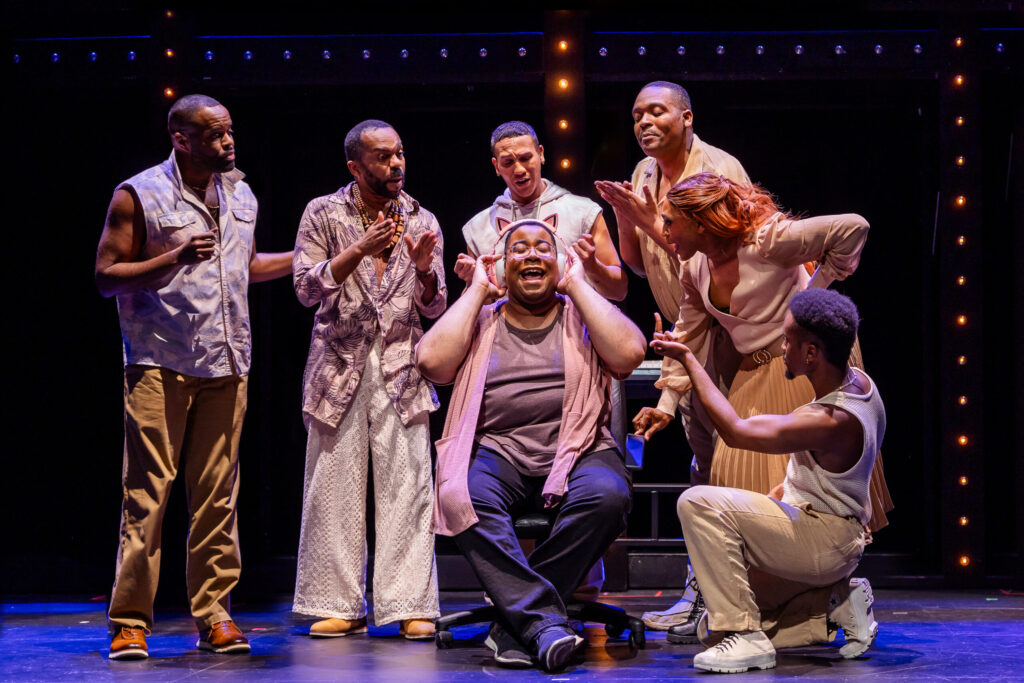
Kai Clifton (center) and the company of A STRANGE LOOP at Speakeasy Stage. From left: De’Lon Grant, Davron S. Monroe, Jonathan Melo, Aaron Michael Ray (background), Grant Evan, and Zion Middleton (kneeling). photos by Maggie Hall Photography.

By Shelley A. Sackett

Playwright Michael R. Jackson, a heavy-set Black queer man, has brought the concept of sharing to a new level in his Pulitzer Prize and Tony Award-winning musical, “A Strange Loop.” The compulsively introspective show, which runs at 100 intermission-less minutes, spelunks into the deepest crevices of the anguished mind of its hero, Usher, a fat, Black, queer man writing a musical called “A Strange Loop” about a fat, Black queer man who’s writing a musical about a fat Black queer man.

It’s a crawl through a wormhole rigged with armed psychological and emotional IEDs, self-loathing, and regrets. It’s also a raucous and playful musical, full of humor, harmony, colorful characters, and even more colorful (potty) language.

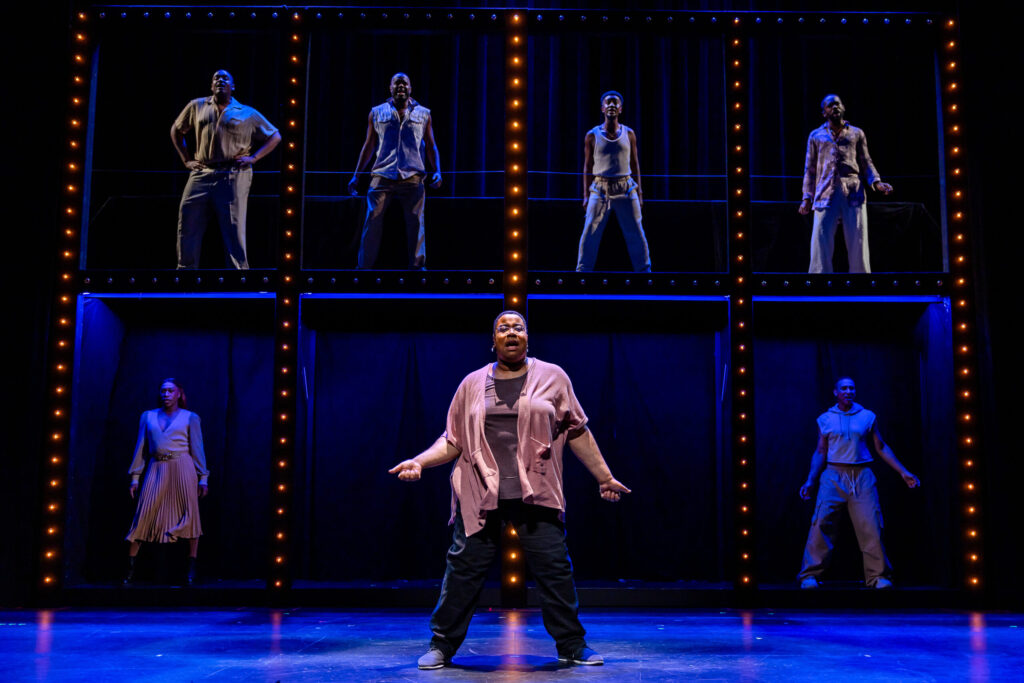
The play opens on Jon Savage’s effective, slick set of eight cubes lit in Broadway blue neon. (The only guidance Jackson’s script offers is to describe the setting as “A loop within a loop within a loop inside a perception of one man’s reality.”) Characters meant to represent Usher’s thoughts stand inside each cube. They dance. They sing. The effect is a cross between “Shindig” and “Hollywood Squares.”

We meet Usher (Kai Clifton) as the Thoughts dress him in his professional usher’s uniform. Usher works to make money in a theater where “The Lion King” reigns while he tries to write his play, a “big, Black, queer-ass, American Broadway show.” As he externally prepares to deal with the patrons who will soon flood the theater’s aisles, his mind is busy writing his play. He eagerly shares this work-in-progress with the audience.

““A Strange Loop” will have black shit! All thoughts. And white shit! It’ll give you uptown and downtown! With truth-telling and butt-fucking! There will be butt-fucking!” he belts out with gleeful forewarning.

It’s as if Jackson and Usher want to tip off their audience, “This ain’t no Disney musical, and make no mistake, we aim to deliver,” which they do, especially on the last item.

Usher leads a complicated inner life. His mind is a six-lane highway where Thoughts criticize, intimidate, denigrate, and insult his every move. Every time he resolves to dig himself out of his miserable routine, his thoughts disrupt and derail his plans.

The supporting cast of Thoughts #1-6, donning eye-catching costumes (Becca Jewett), are a vicious gang representing Usher’s agent (Fairweather), his inner cynic (Your Daily Self Loathing) and a host of other unhelpful characters, most notably Mom and Dad.

Through these inner/outer conversations between Usher and himself, Usher reveals his quest to peel back the layers of labels (Black, queer, etc.) and discover who he really is. We learn about all the issues he struggles with, including family pressures to ditch his sexual and professional preferences and embrace the Lord and style of Tyler Perry’s gospel melodramas; trying to figure out what it means to be a Black playwright writing a Black play; and struggling with what today’s world requires if one is to be “Black enough” and “gay enough.”

He also is coping with the bull’s eye homophobia, fatphobia, racism, and a white theater industry painted on his back.

All this should (and does) sound heartbreaking and overbearing. Yet, Jackson manages to pull off a musical that infuses humor and sincerity into a story replete with sadness, desolation, and rejection.

Through seventeen songs, Jackson’s lyrics tell a multilayered story of Usher’s angst-ridden life.

He longs for the unhampered freedom white girls have, yet also feels obligated to fulfill Black boy stereotypes (“Inner White Girl”). His doctor tells him he’s not gay enough because he’s only having sex once a year, but when Usher starts using dating apps, the result is predictably humiliating. He meets an engaging, flirtatious stranger only to discover he is a figment of his imagination.

The list of disappointments and rejections grows longer. His mother calls him on his birthday to remind him homosexuality is a sin, and his father asks if he’s contracted AIDS yet.

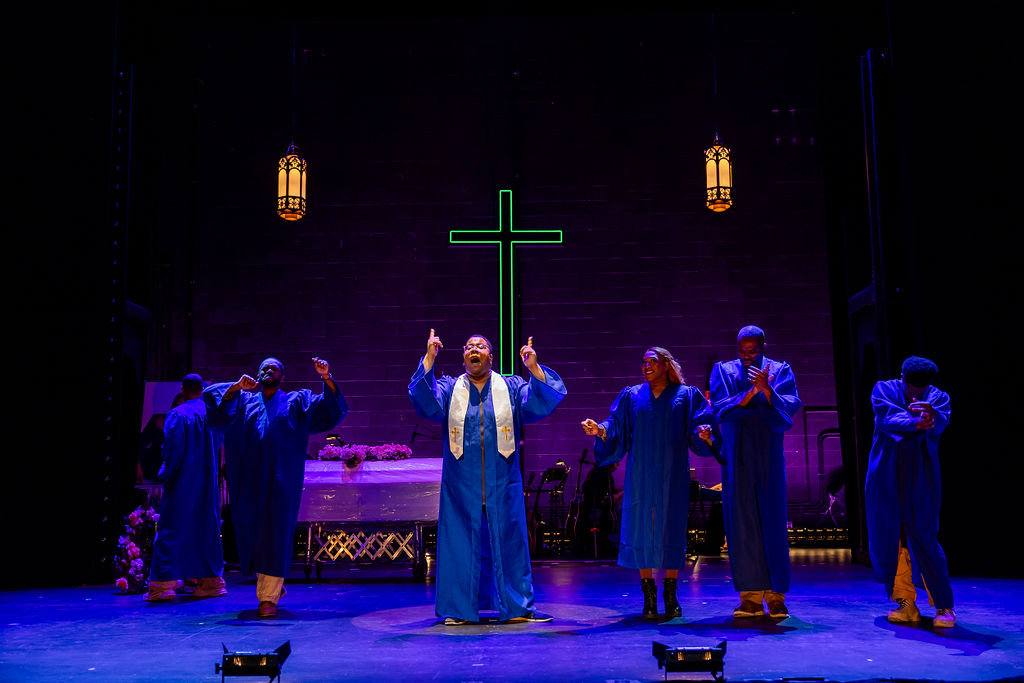
The best scenes, dramatically and musically, are those that have anything to do with Gospel music. When Usher’s agent tells him Tyler Perry is looking for a ghostwriter for his next gospel play, Usher turns up his nose in disgust. His Thoughts accuse him of being a “race traitor,” and in a hilarious scene, historical Black figures persuade him to take the job (“Tyler Perry Writes Real Life”). The full replication of a Tyler Perry set and lyrics that skewer Usher’s parents and parody Tyler (“Precious Little Dream/AIDS Is God’s Punishment”) are a welcome break. The actors’ voices (especially Clifton’s) awaken and strut their range and vibrancy. The lyrics are edgy and funny, the tune snappy and toe-tapping.

With the exception of distracting and annoying technical problems with the sound mixing (the actors’ voices were frequently not mic’d) and muffled lyrics, the production is effective, from Maurice Emmanuel Parent’s thoughtful direction to David Freeman Coleman’s music direction and conducting. The six Thoughts shine individually and blend seamlessly as an ensemble.

But it is Clifton as Usher who literally carries the weight of the show, and he is more than up to the task. Despite the temptation to wash our hands in frustration with this character who can’t seem to get out of his own way, his unfortunate circumstances notwithstanding), Clifton brings an underlying earnestness and likeability that make it impossible to abandon him. Plus, Clifton lets loose a powerful set of pipes during certain numbers (notably the gospel songs).

It’s hard to understand Jackson’s real purpose in writing “A Strange Loop.” It takes its title from a Liz Pfair song and from Douglas Hofstadter’s scientific concept that when a person only moves up or down, they’ll end up where they started. In other words, no matter how far or fast they think they’re going, they are essentially marching in place.

Jackson, now 43, said that although his play is not formally autobiographical, he began writing it as a monologue in his early 20s when he was experiencing himself as “nothing more than a mass of undesirable fat, Black gay molecules floating in space without purpose.”

He wrote Usher as a 26-year-old under unimaginable pressure. He is full of self-doubt and self-loathing, yet compulsively writes about himself in the belief it will magically change him. The more he plumbs his inner self, the more guilt and shame he dredges up. If writing “A Strange Loop” was meant to be Usher’s psychological catharsis, it misses its mark.

After all, Usher’s closing words are:

“Someone whose self-perception is based upon a lie,

Someone whose only problem is with the pronoun “I.”

Maybe I don’t need changing

Maybe I should regroup

’Cause change is just an illusion.

If thoughts are just an illusion, then what a strange, strange loop.”

And maybe that is Jackson’s point, after all. Inside his endless, strange loop of destructive thoughts and desperate hope that he can change who he is, Usher is his own worst enemy. Not only does he see himself as a failure, he assumes that everyone sees him as he sees himself.

His illusions are negative delusions.

It takes someone outside the loop—an impartial audience, for example—to appreciate that underneath this angsty, meek gay Black man beats the heart of a brave, creative person full of caustic wit and laser-sharp insight. We can only hope that Usher and all those suffering as he does can jump off the treadmill of self-doubt and fear, take a deep cleansing breath, and learn to love and accept themselves.

‘A Strange Loop’ — Book, Music and Lyrics by Michael R. Jackson. Directed by Maurice Emmanuel Parent. Music Direction by David Freeman Coleman. Choreographed by Taavon Gamble. Co-produced by SpeakEasy Stage and Front Porch Arts Collective at the Calderwood Pavilion, 527 Tremont Street, through May 25.

For more information and tickets, visit https://speakeasystage.com/