“Yellow Face” Raises Difficult Issues About Race at the Lyric Stage Company

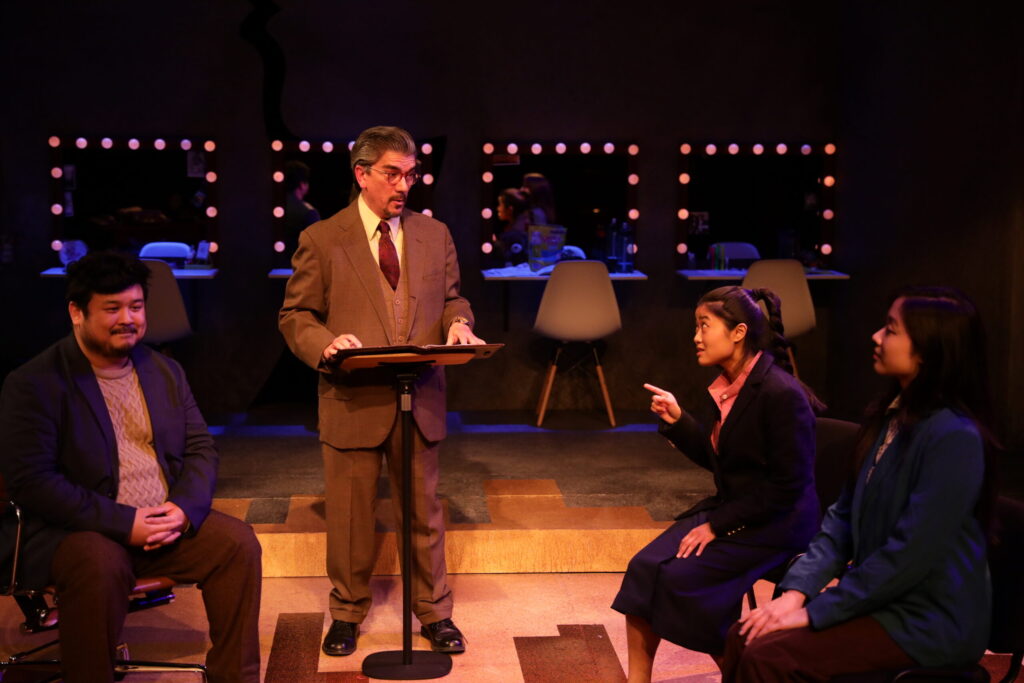
Cast of “Yellow Face” at Lyric Stage. Photos by Mark S. Howard

By Shelley A. Sackett

Some plays are just good for you. Like drinking a peanut butter, kale, bone meal, and flax seed smoothie, the benefits outweigh the temporary discomfort. With the smoothie, its promise of increased vigor and decreased ailments offset its taste and texture. With “Yellow Face,” David Henry Hwang’s Obie award-winning play presented by The Lyric Stage Company of Boston, its thought-provoking and post-theater-conversation-inducing messages outweigh the lackluster nature of its two-hour theatrical experience.

Hwang has a lot to share. Wading through the weeds of his self-deprecating, semi-autobiographical plot is a bit of a slog. It all started in 1990 when the white Welsh actor Jonathan Pryce was cast as the French-Vietnamese star of the smash Broadway hit, “Miss Saigon.” (Note: Hwang’s 1988 Tony award-winning hit, “M. Butterfly” was inspired by the same Puccini opera, “Madame Butterfly.”)

Hwang condemns this casting choice as a form of “yellowface.” He becomes the standard-bearer of the New York Asian-American theater community’s protest, demanding that Actors Equity join them. After much public waffling, Actors Equity backs the choice of Pryce and the play goes on to be a smash hit.

Outraged, Hwang pens the colossal flop, “Face Value,” a hard-edged comedy about casting white actors as Asians. In an oversized karmic boomerang twist, Hwang commits the ultimate ironic faux pas — he casts a white actor, Marcus G. Dahlman, to play its Asian lead.

Rather than admit his mistake, eat crow and move on, Hwang compounds the error by revisioning Dahlman’s ancestry and giving him the more Asian last name, Gee. In a fit of twitchy pique, Hwang then fires Gee, who earns praise and fortune playing other Asian roles, including the King in “The King and I.”

Hwang, a “real” Asian, is, by contrast, broke and eking out a tough existence as a playwright. To his later detriment, he even accepts a position on the board of directors at his father’s bank.

We witness a metamorphosis in Gee as he emerges from his “fake” Asian cocoon to spread his butterfly wings. Gee genuinely identifies as a member of the Asian American community and longs to be accepted as a full-fledged member. He becomes an activist and supporter of Asian American values. He even dates an Asian American (Hwang’s ex, no less). He wears his Asian identity so effectively that when the U.S. Department of Justice and various congressional committees charge Asian Americans with aiding the Chinese government in election interference, Gee is among those named.
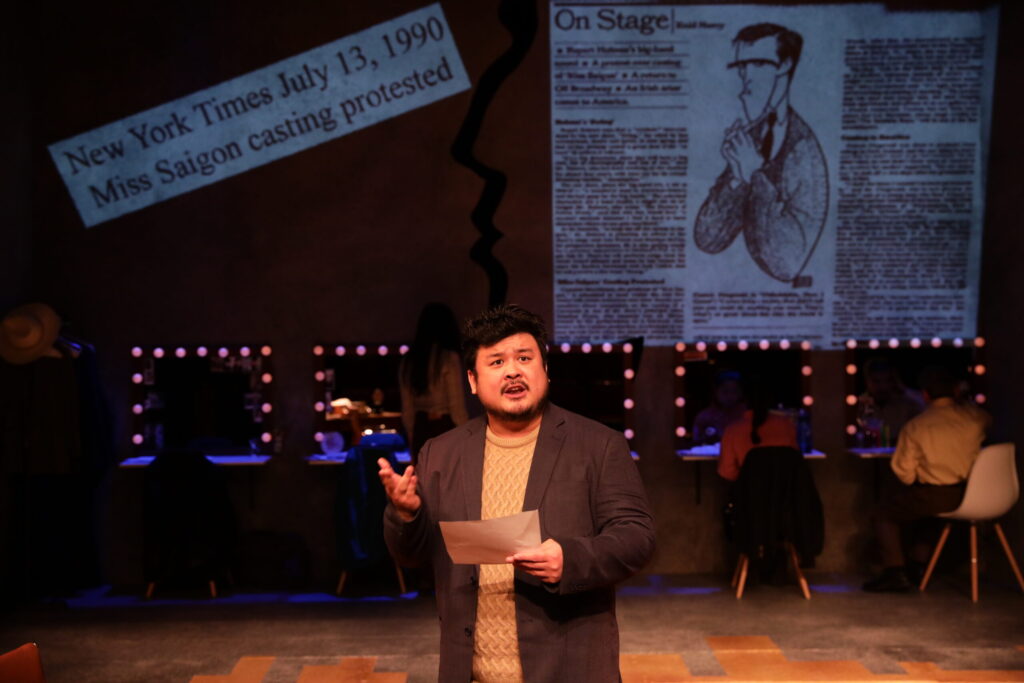
Michael Hisamoto

Act II is where Hwang exercises a little more self-discipline, honing in on the rabbit hole of weighty philosophical, political, moral, and semantic issues that surround discussions about race. He abandons Act I’s “poor me” tirades and tackles meatier topics. Like the health effects (vs the taste) of that muddy smoothie, it is worth the wait.

Hwang is unafraid to ask the big questions. What, for example, is “cultural authenticity?” What does it mean? More importantly, what does it matter? Is the very idea of cultural authenticity racist? Where exactly is that tipping point between artistic legitimacy and discrimination?

“The face you choose to show the world determines who you really are,” Gee says, quoting an ancient Chinese saying. Yet, when that face is Caucasian — no matter how much the heart beats as Asian — who are we looking at? Which is more ambiguous, the truth or the fiction?

Throughout the play, snippets of an American “ethnic tourist” are played on a screen above the stage. Turns out it is Gee, who Hwang sends to a remote Chinese village so he can have a first-hand immersion experience in the culture he so desperately wants to be part of. These villagers have never had Chinese outsiders visit, let alone a white American. Yet, after several months, they accept Gee into their community, sharing their most sacred treasure — music — with him.
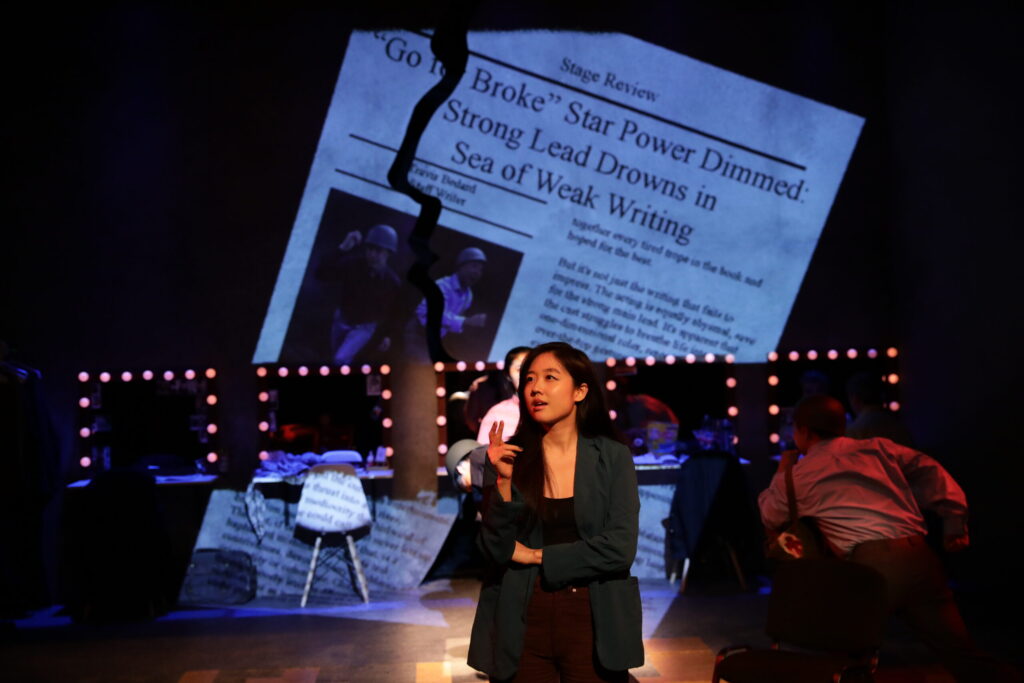
Jenny S. Lee

Is Gee now Asian “enough?” Hwang uses this question as a powerful platform from which to launch many ideas and the soul searching queries they inspire.

What is the true litmus test — DNA ancestry or community acceptance? Is it what’s on the outside or inside that really matters? Is it how you see yourself or how others see you?

And how does this compare to religion, where there is no definitive physical barrier to joining a community and where its members can look like anyone and everyone? Is the logical extension of Hwang’s point about cultural appropriation an argument that religious conversion is impossible too? Although “Yellow Face” has its dramatic problems (a script in need of editing, actors in need of crisper direction, and a set that almost, but not quite, works), when a theatrical experience leaves me with a head full of ideas that linger long past curtain call, that’s a play I’m glad I saw.

“Yellow Face.” Written by David Henry Hwang. Directed by Ted Hewlett. Scenic Design by Szu-Feng Chen; Projections Design by Megan Reilly; Lighting Design by Baron E. Pugh; Costume Design by Mikayla Reid; Sound Design by Arshan Gailus. Presented by The Lyric Stage Company of Boston, Clarendon St., Boston. Run has ended.
GBSC’s “Guys and Dolls” Is A Cool Glass of Summer Refreshment

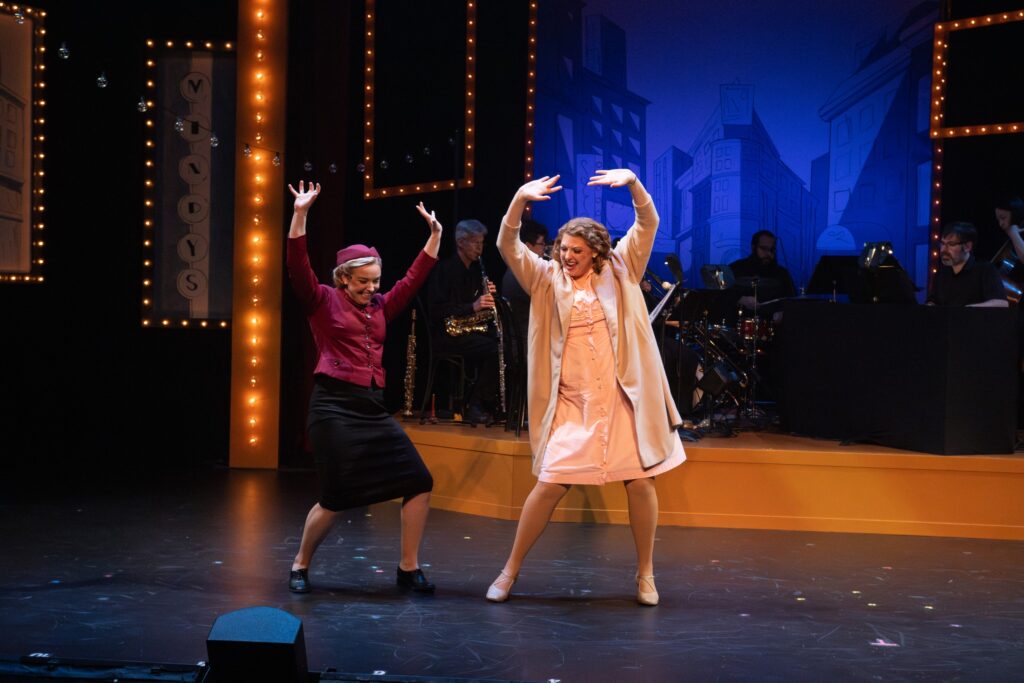
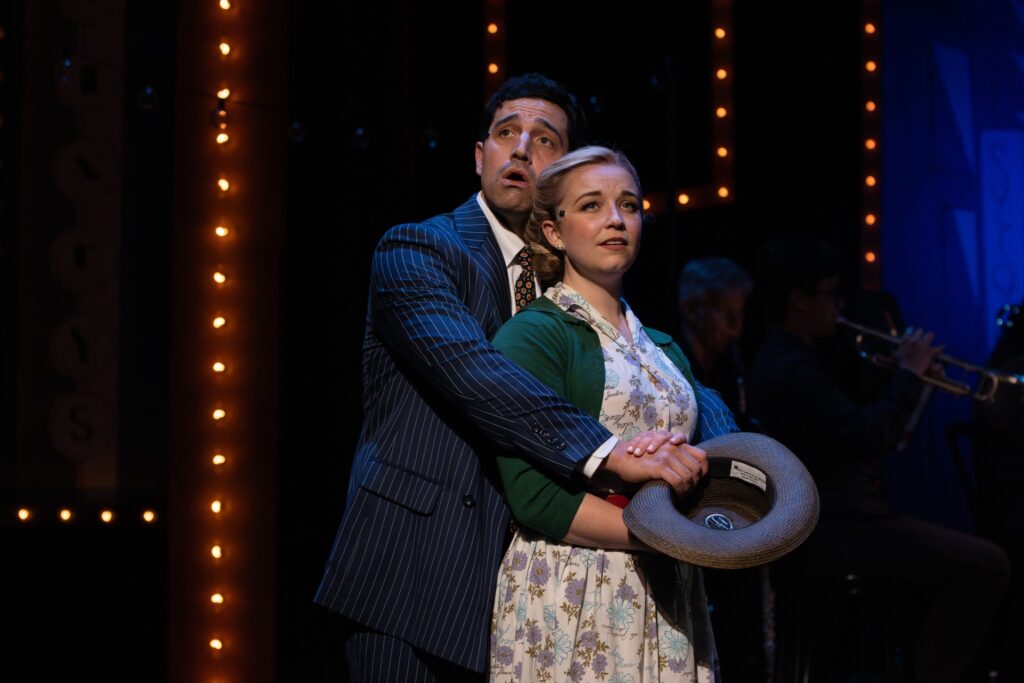
Jared Troilo, Lisa Kate Joyce in Greater Boston Stage Company’s ‘Guys and Dolls’
Photos by Gillian Gordon

“Guys and Dolls.” Book by Abe Burrows and Jo Swerling. Music and Lyrics by Frank Loesser. Directed/Choreographed by Ceit Zweil. Musical Direction by Dan Rodriguez. Presented by Greater Boston Stage Company, 395 Main Street, Stoneham, through June 30.

By Shelley A. Sackett

When it comes to bubbly, breezy, musical fare, Greater Boston Stage Company is as reliable as it gets and “Guys and Dolls,” in production through June 30, is further proof.

Even before the show starts, a usually boilerplate announcement is anything but. “Turn off your phone. It’s a small theater. Everyone will know it’s you,” a vintage radio announcer-type warns.

Hailed as the perfect musical romantic comedy, this award-winning classic is set in 1920s “Runyonland,” a mythical New York City. Based on Damon Runyon’s short stories, the two-and-one-half-hour play (one intermission) is a potpourri of slapstick, glamorous cabaret showgirls, gamblers, gangsters, and Salvation Army missionaries.

There’s even a quick trip to pre-revolutionary decadent Havana.

Twenty-four musical numbers, backed by a seven-piece orchestra, are the glue that connects the dots and provides both a vehicle to showcase the cast’s formidable talent and a layer of joyful merriment.

The story is fairly straightforward.

Gambler Nathan Detroit needs to find financing to set up the biggest craps game in town. He faces more than a few obstacles. First of all, the authorities are breathing down his neck, Lt. Brannigan of the local police force watching his every move. Second, the only place he can find to hold the game requires $1,000 security deposit. Third, Nathan is broke. And fourth (but hardly last), Adelaide, a nightclub performer and his fiancée of 14 years, has made him promise to give up running craps games. When she finds out he’s still at it, she kicks him out.

Undaunted, Nathan contrives a way to get the money by making a bet with fellow gambler Sky Masterson, known for deep pockets and an inability to resist any wager that crosses his path.

This one? That Sky can’t get Sarah Brown, one of the straight-laced missionaries, to have lunch with him in Havana.

The rest of the play revolves around con men conning and being conned, unrequited love being requited, and an unlikely group of missionaries who yield more influence than they could have prayed for. The plot twists and turns are cute, light, and hilarious — perfect summer fare.

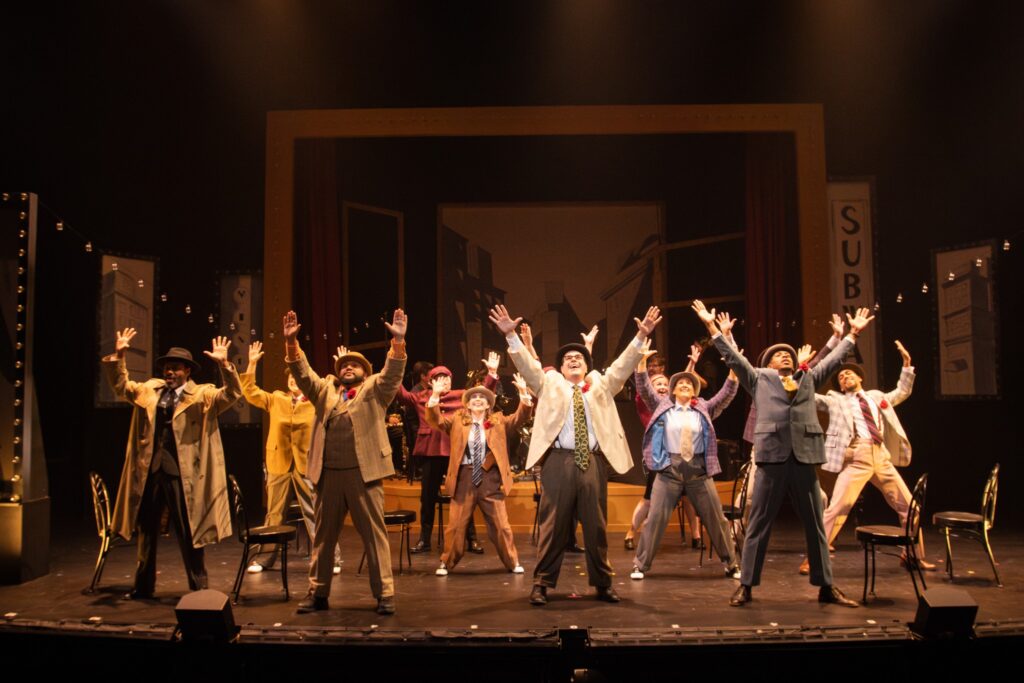
All this is told through top-tapping familiar songs (“Luck Be A Lady,” “A Bushel and a Peck,” and “Guys and Dolls” among them) and exuberant choreography performed with the caliber of singing and acting we have come to expect from GBSC.

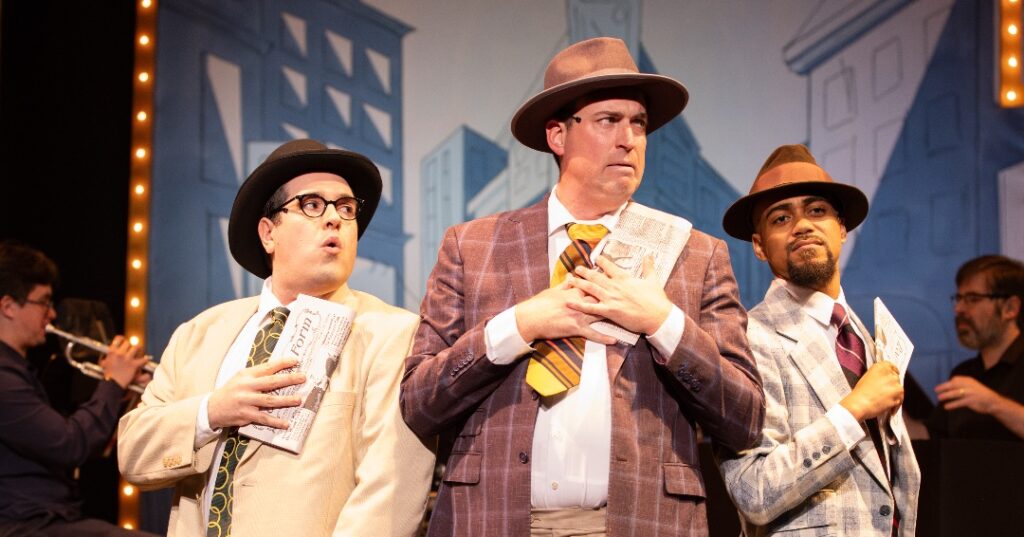
Stephen Markarian, Mark Linehan, Christian David

And —best of all!!! — the orchestra complements the actors rather than drowning them out. Kudos to Sound Designer John Stone and his engineers for ensuring that the audience can hear – and understand – the lyrics.

Jon Savage’s set makes efficient use of a compact stage. He has built a neon shadow box to house the orchestra, bringing them into the mix in an organic way. Unobtrusive props change the scene from mission meeting to street corner to cabaret to Havana club. Ceit Zweil’s direction and choreography keep the action flowing and interesting.

The play’s opening number (“Runyonland”) is upbeat and happy, setting the tone for what is to follow. “Fugue for Tinhorn,” about betting on the races, follows, introducing us to three loveable gamblers: Nicely-Nicely (Stephen Markarian), Benny Southstreet, and Rusty Charlie. Markarian is a standout, bringing warmth, physicality, and self-deprecating humor (and a great voice) to Nicely-Nicely.

Sara Coombs as Adelaide is an adorable knockout. Everything about her performance is impeccable, from her exaggerated facial expressions to her dancing to her fabulous voice. Plus, she has a terrific sense of timing and a comedic flair that is a true pleasure to behold.

Jared Troilo imbues Sky Masterson with sensitivity beneath his worldly criminal carapace. His dancing and singing are superb, and his duets with Sarah are among the show’s highlights.

Of which there are many. There are double entendres and double-crossers.

Joyce, Sarah Coombs

There are the corny, Henny Youngman-esque laugh-out-loud jokes (“I kinda like it when you forget to give me presents. It makes me feel like we’re married,” Adelaide tells Nathan). There are even a barbershop quartet, an a capella number, and an operatic aria (Lisa Kate Joyce has a voice that could shatter glass).

Most of all, there is a light, entertaining story that surprises us with a serious takeaway. As Nicely-Nicely succinctly puts it, “Life is one big crap game, and the Devil is using loaded dice.”

For more information and to buy tickets, visit https://www.greaterbostonstage.org/

The Vilna Shul and “The Dybbuk” Are A Match Made in Heaven in Arlekin Players’ Must-See Production

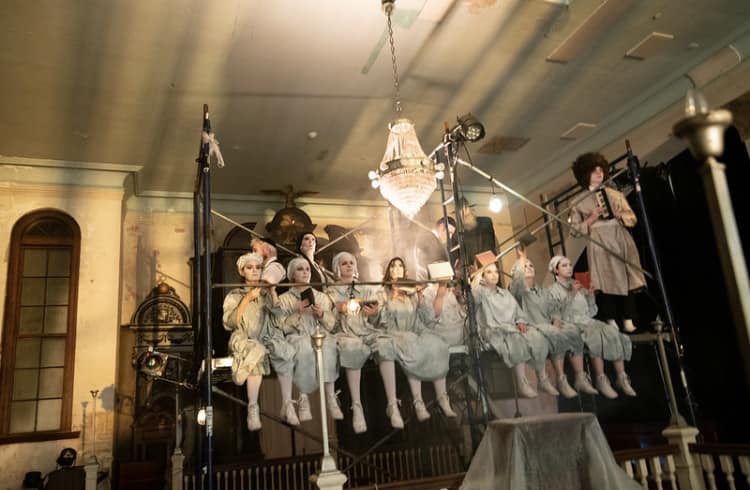
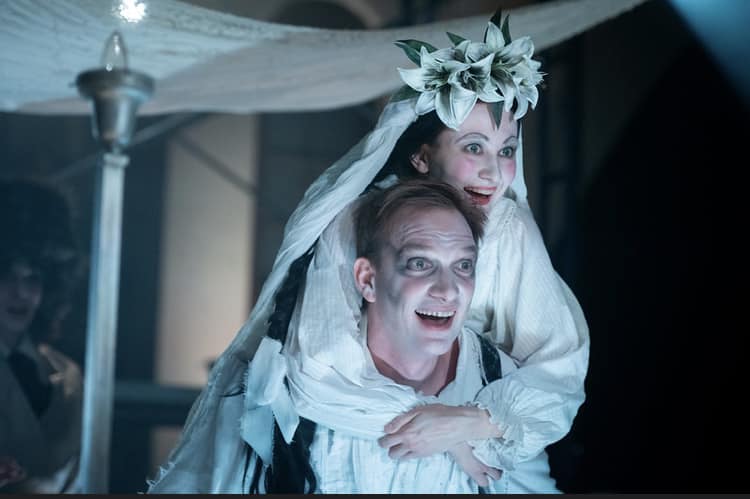
Cast of Arlekin Players’ “The Dybbuk” at the Vilna Shul. Photos: Irina Danilova

‘The Dybbuk, or Between Two Worlds’ — Written by Roy Chen. Based on the original play by S. Ansky. Adapted by Igor Golyak and Dr. Rachel Merrill Moss with additional material from the translation by Joachim Neugroschel. Directed by Igor Golyak. Scenic Design by Igor Golyak with Sasha Kuznetsova. Presented by Arlekin Players Theatre at The Vilna Shul, Boston’s Center for Jewish Culture, 18 Philips St., Boston, through June 23.

By Shelley A. Sackett

Igor Golyak, the peerlessly talented founder and award-winning artistic director of Arlekin Players Theatre, has done it again. Known for his innovative approaches to traditional and virtual theater, his production of “The Dybbuk, or Between Two Worlds” takes the audience on a magic carpet ride straight into the beating heart of a turn-of-the-century Eastern European shtetl.

Set in the iconic and authentic 105-year-old Vilna Shul, Boston’s only surviving synagogue built by and for late 19th/early 20th century immigrants, Golyak creates an otherworldly environment that sucks the audience right in. We are greeted by tiers of metal scaffolding that rise almost to the ceiling in the center of the building, towering above the pews, which have been pushed back along the perimeters. Animated sheets of opaque plastic hang from the frames, dancing ghost-like as strobes, disembodied voices and the sound of dripping water create a multi-sensorial microcosm.

Even if we’re not sure exactly where we are or exactly what is going on, one thing is clear: this will be an extraordinary evening.

The play’s plot is tricky for 21st-century theatergoers to intuit, yet it is essential background to fully appreciate Golyak’s extraordinary vision and interpretation.

In a nutshell, S. Ansky’s 1914 play relates the story of Leah, a young bride possessed by a dybbuk (a malicious spirit believed to be the soul of a dead person stuck between earth and heaven). Yet this dybbuk is anything but malicious; he is Khonen, a poor Yeshiva student who grew up with Leah and loves her.

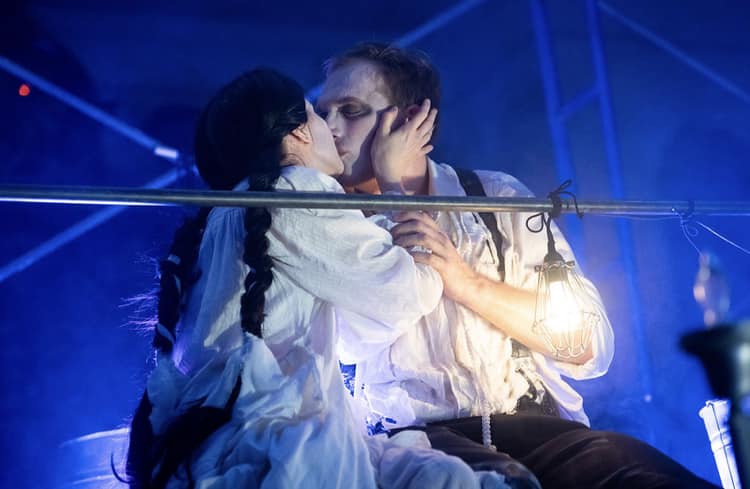
Yana Gladkikh, Andrey Burkovskiy

Only alluded to at the end of the play is a critical piece of backstory (the 1937 Yiddish-language Polish film adds this as an introductory scene). Sender, Leah’s father, and Nisan, Khonen’s father, were close friends whose wives gave birth on the same night. They made a pact that if one had a girl and the other a boy, the two would be betrothed. Nisan drowns shortly after his wife gives birth. Sender, whose wife dies during childbirth, goes on to become a wealthy rabbi.

Years later, Khonen shows up at Sender’s house as a poor yeshiva student, and Sender offers him hospitality. Neither is aware of their underlying connection. Leah and Khonen fall in love, but Sender rejects Khonen, betrothing Leah instead to Menashe, a wealthy nincompoop.

Beside himself, Khonen studies Jewish mysticism (Kabballah) in an effort to alter events by way of magic, even beseeching Satan to help him. He dies before the wedding, returning as a dybbuk who haunts and eventually embodies Leah, possessing her as she stands on the bimah (the altar from which the Torah is read) at her wedding. The ceremony is postponed, and Sender does everything in his power to repossess Leah and unite her with Menashe. After much drama (including a religious exorcism), the two are reunited.

Golyak uses every square inch of the Vilna to astonishing effect. The space behind the pulpit becomes a tiered choir where ghosts (interestingly, all female) act like a Greek chorus. The bulk of the action takes place on and around the Vilna’s bimah, as it does in Ansky’s original script. Strip lighting, handheld firefly-like mini lights, industrial hanging caged bulbs (lighting design by Jeff Adelberd), and spot-on costumes and makeup (Sasha Ageeva) add to the ethereal ethos.

Staging and site notwithstanding, however, it is the extraordinary cast — especially the two leads — who blow this production out of the water.

As Khonen, Andrey Burkovskiy, the expatriated Russian actor, is riveting. His lithe physicality belies his large size as he leaps and pirouettes across the scaffolding, barely but intentionally missing hitting his head on the hanging lights and metal beams. The Beetlejuice makeup is extremely effective at imbuing him with a heartbreakingly sad yet potentially menacing demeanor.

Yana Gladkikh, the Russian actress and film director, is equally spellbinding as Leah. A cross between Pierrot and a floppy ragdoll, she runs the gamut from Tinkerbell lissome to Princess Leia fierce. The chemistry and synchronicity between Burkovskiy and Gladkikh is delicate and subtle, and watching them together is a true theatrical treat.

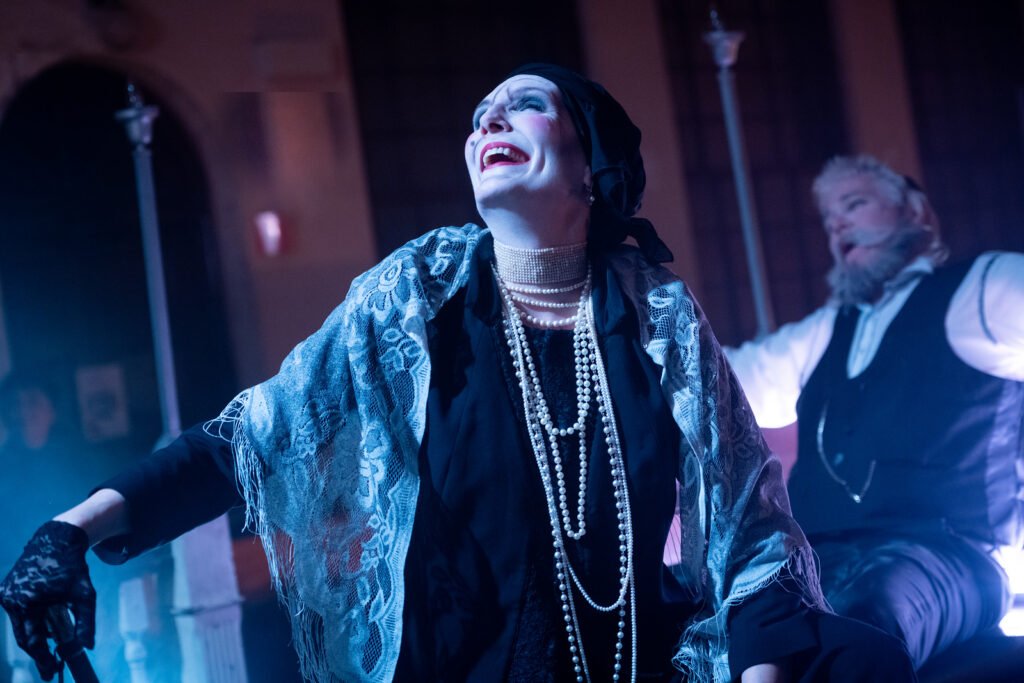
Deb Martin, as Frade, Leah’s paternal grandmother and caretaker, is as opposite an energy as possible. Screeching, cajoling and imperious, she dominates every scene she is in, bringing a countervailing element of melodramatic hysteria and humor to an often somber tale. Like the witch in Hansel and Gretel, she is hunch-backed, skeletal and a force to be reckoned with. You can actually hear her gnashing teeth as she literally chews up the scenery during the exorcism scene. Kudos to Golyak for letting Martin strut her stuff.

Deb Martin

The rest of the cast (especially Robert Walsh, the former artistic director of the Gloucester Stage Company, as the overbearing Sender) is splendid. 110 intermission-less minutes is an eternity at some productions; at “The Dybbuk,” they fly by.

“The Dybbuk” is considered a seminal play in the history of Jewish theater, and played an important role in the development of Yiddish theater and theater in Israel. Based on years of research by Ansky, who traveled between Jewish shtetls in Russia and Ukraine, it documents folk beliefs and stories of the 19th and early 20th century Hassidic Jews, who lived during a time of nonstop pogroms in specific areas, outside of which their residency was forbidden.

Ansky’s account of these times and the two suspended, displaced souls trapped between two worlds and tethered to each other and their community is as relevant today as it was over a century ago.

For Golyak, a Ukrainian refugee, the tale is particularly pertinent.

“Isn’t this where we live? As Jews, as immigrants? It’s where we so often have lived as Jewish people for centuries: between worlds. It’s our story – ancient and mystical, the story of our ancestors, but also our story of living in America today,” he said.

Burkovskiy, Gladkikh

It is impossible to recommend it highly enough! Don’t miss it!

For more information and to buy tickets, go to www.arlekinplayers.com

A.R.T.’s “Gatsby” Is This Summer’s Blockbuster

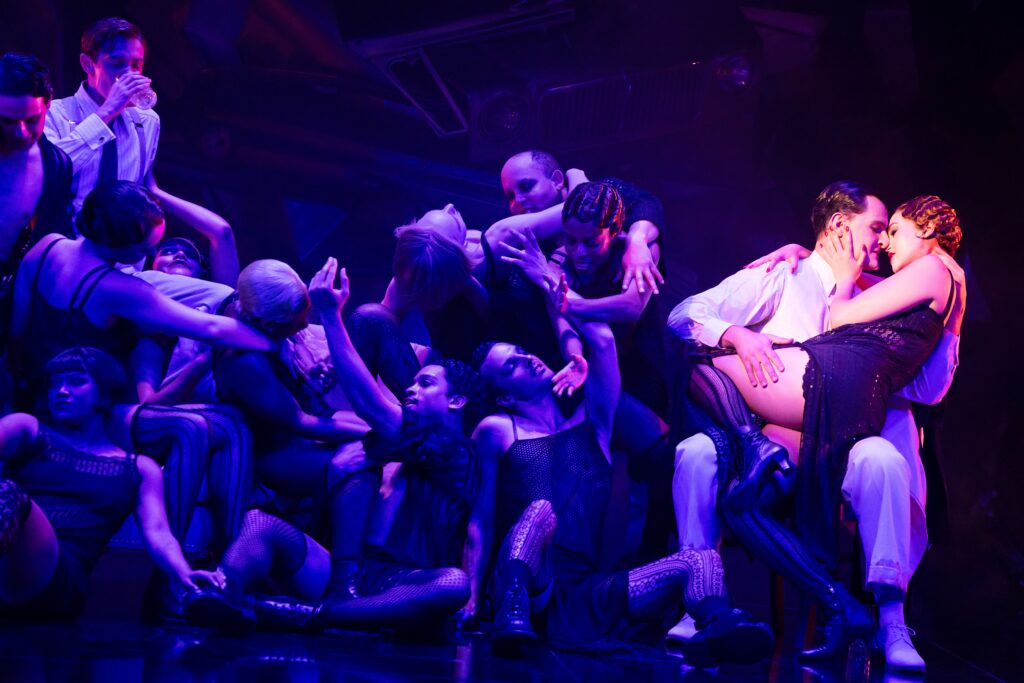
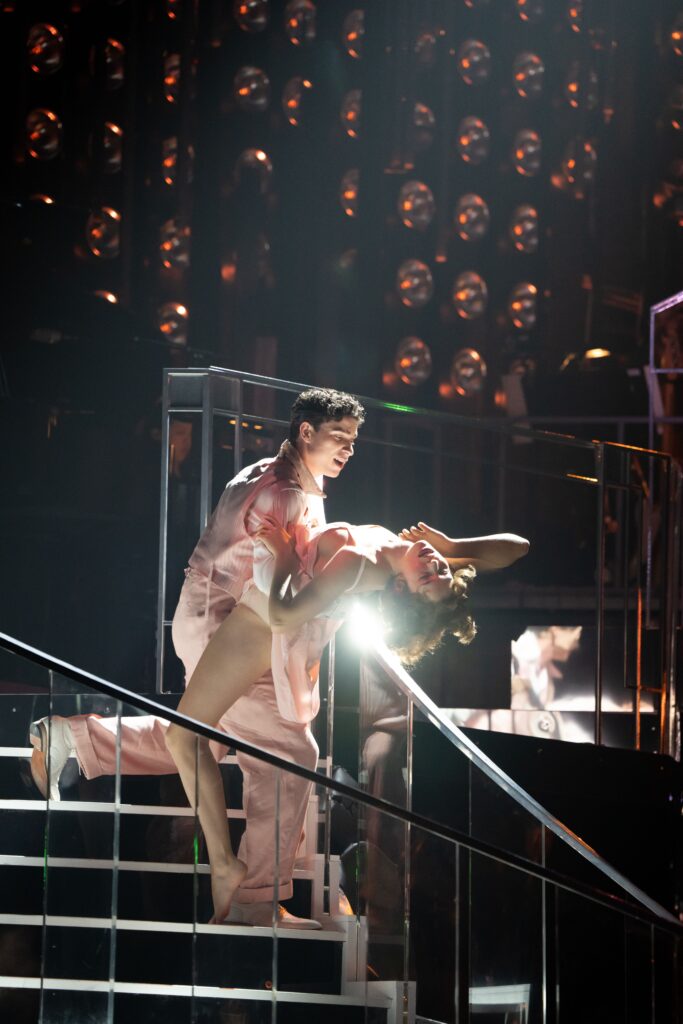
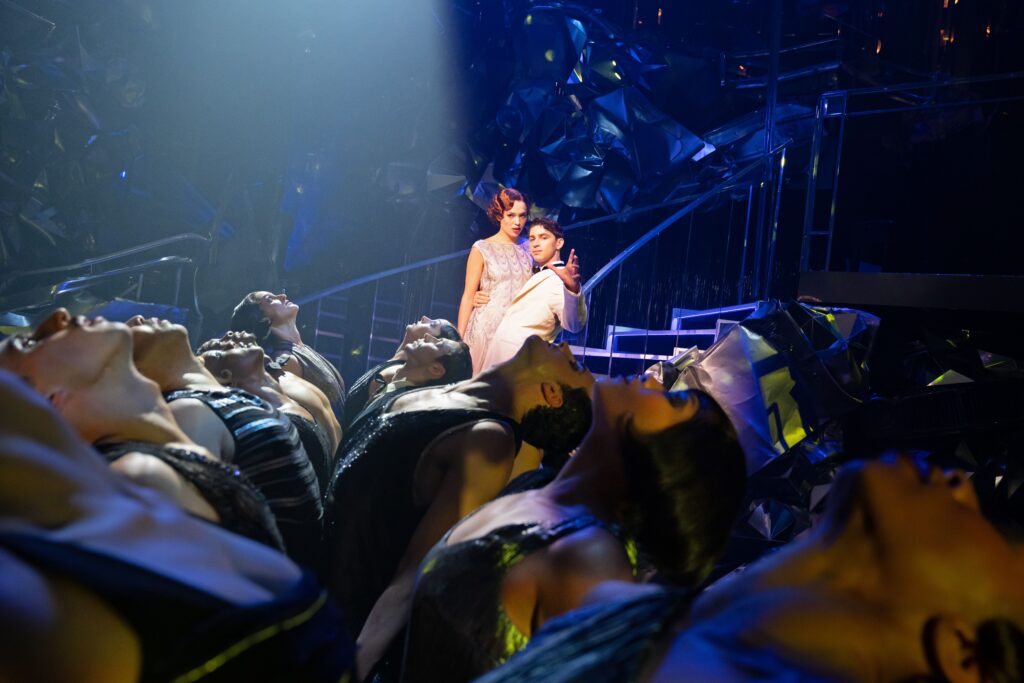
Cory Jeacoma, Solea Pfeiffer, and the cast of A.R.T.’s ‘Gatsby.’
Photo Credits: Julieta Cervantes

“Gatsby.” Book by Martyna Majok based on the novel, “The Great Gatsby” by F. Scott Fitzgerald. Directed by Rachel Chavkin. Music by Florence Welch and Thomas Bartlett. Lyrics by Florence Welch. Choreography by Sonya Tayeh. Orchestration and Arrangements by Thomas Barlett. Scenic Design by Mimi Lien. Lighting Design by Alan C. Edwards. Presented by American Repertory Theater at the Loeb Drama Center, 64 Brattle St., Cambridge, through August 3.

By Shelley A. Sackett

“Gatsby” is a tour-de-force chockful of bells and whistles. A.R.T. spares nothing for its world premiere of the musical adaptation of Fitzgerald’s Jazz Age chronicle. Two colossal heaps of metallic sculpture reminiscent of the infernal “Hadestown” underworld are a Jenga/“Where’s Waldo” of identifiable automobile parts and crumpled rubble (set by Mimi Lien). Draped in gleaming tinsel and expertly lighted by Alan C. Edwards, these gloomy twin towers are a continual reminder of the dangers of decadence and the debris it leaves in its wake.

Like “Moby Dick” and other inventive re-tellings of familiar tales, it’s clear from the get-go that A.R.T. will once again raise the bar on production values.

In preparation for seeing “Gatsby,” I reread the novel both to refresh my 9th-grade memory and to better understand where (and guess why) Martyna Majok had chosen to be faithful to and stray from the original in her adaptation. While hardly necessary – the storyline is short on subtlety – it was fun when I recognized a line that had struck us both as particularly poignant.

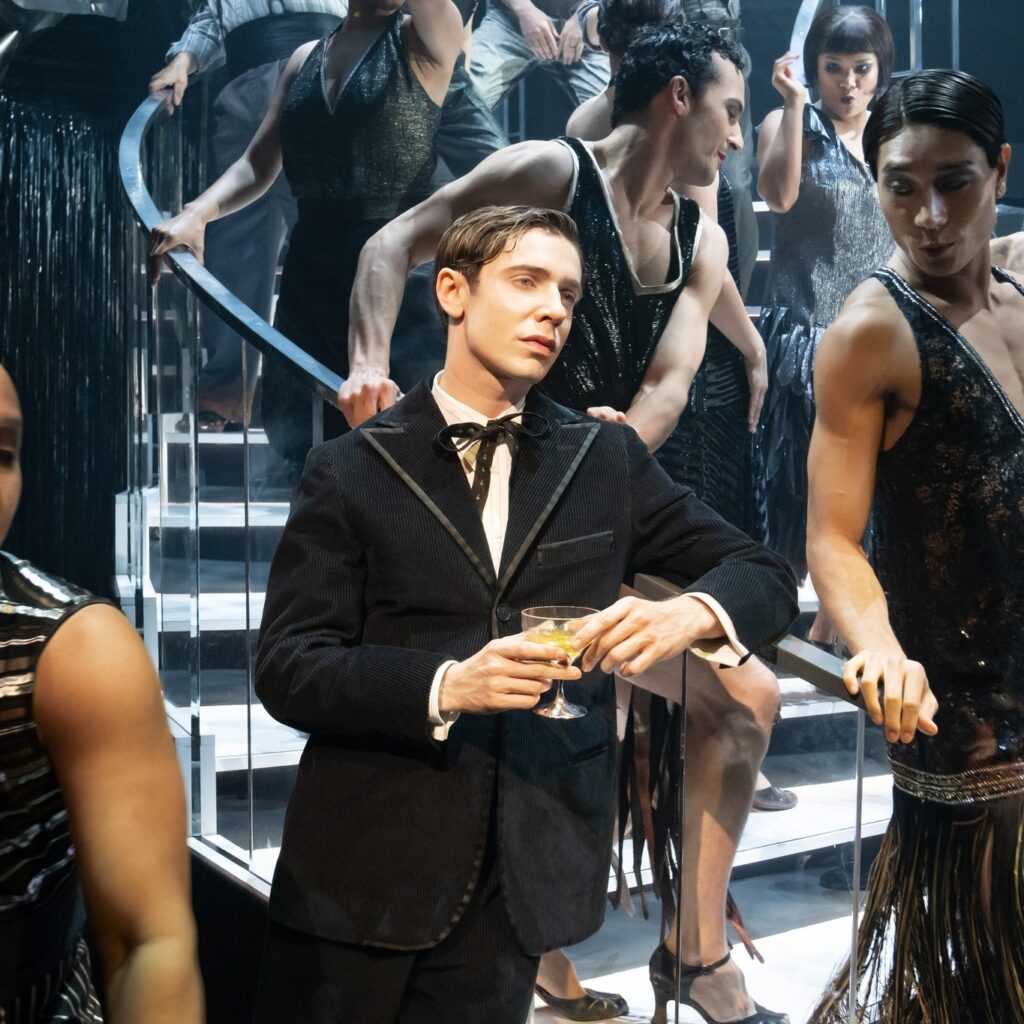
At its heart, however, this “Gatsby” is a musical, and the tale is told through its 25 musical numbers. (Unfortunately, the 13-piece orchestra often drowns out those lyrics, leaving the frustrated audience to fill in the blanks). In the exciting first number, “Welcome to the New World,” we meet our narrator, Nick Carraway (Ben Levi Ross), who fills us in on time, place, and tenor. It’s 1922, and the influenza plague and World War I, although in the rearview mirror, left emotional, physical, and financial wreckage in its wake. As if awakening from a nightmare, Jazz Age America has emerged, revving its engine and ready to roar.

Ben Levi Ross

Underscoring the headiness of the era, the 15-member ensemble bursts on the stage clad in flapper period and contemporary non-cis costumes. Costume designer Sandy Powell cleverly introduces us to the main characters by dressing them symbolically. George and Myrtle, the have-not couple, are dressed in hellish red. Daisy, Tom and their friend Jordan, the silver-spoon gentry, wear heavenly white. And Jay Gatsby, our eponymous protagonist, appropriately wears an in-between pink.

As the plot unfolds, so do these characters’ backstories. Each harbors longings, secrets and disappointments that propel them towards disaster while attracting and repulsing them to and from each other. Majok exercises editorial discretion (and keen perception) in adding a richly nuanced focus on these relationships that are lacking in Fitzgerald’s novel.

Nick is just back from the war. While he presents as the affable, “aw shucks” mid-Westerner, his baggage includes heavy loads of PTSD and grief. He has sought the diversion of Long Island high society and the company of his cousin Daisy to reset the trajectory of his life. He rents a cottage for the summer and is immediately invited to join the Fellini-esque world of ultra-rich navel-gazers.

Daisy (Charlotte MacInnes), a former Louisville belle, is married to scion Tom Buchanan (Cory Jeacoma) and lives in a fairytale mansion with her loutish, philandering husband. She and Gatsby had met and fallen in love years ago, right before he was shipped off to war. Her childhood friend and famous golf pro, Jordan Baker (Eleri Ward), provides the stability and affection so sorely lacking in her marriage. She is also the play’s flapper Pied Piper, flamboyantly hedonistic and desperate for everyone to follow her reckless lead.

Isaac Powell, Charlotte MacInnes

Tom is as spoiled and obnoxious as they come. He wears his entitlement as a badge of honor, helping himself to whatever suits his fleeting fancy, including Myrtle Wilson (Solea Pfeiffer), the blue-collar wife of a gas station owner who yearns for the sparkling trinkets Tom dangles before her. Her voracious appetite for excess and risk are sated in the short run, but the long-term damage is one of the play’s underlying themes.

George Wilson (Matthew Amira), Myrtle’s husband, is outnumbered and outmaneuvered. Honest, hard-working, decent, and loyal, he doesn’t stand a chance.

This brings us to Jay Gatsby (Isaac Powell), the mysterious epicenter of the action who throws parties reminiscent of the Rocky Horror Picture Show. Personifying a corrupted version of the “American Dream” where wealth is the sole solution to all of life’s challenges, his obsession with Daisy and maniacally detailed plan to win her back are the ill-fated coattails onto which every other character’s fate hangs.

To her great credit, playwright Majok has managed to both plumb the intricacies of these individuals and their various romantic liaisons and dalliances and create a rip-roaringly entertaining almost-three-hour evening of outstanding song and dance.

Under Rachel Chavkin’s talented direction, the cast hits that sweet spot between virtuoso solo and ensemble performances. There are ample opportunities for each to shine in words, song, and dance. MacInnis brings a needed self-awareness to Daisy, who could easily become a cardboard character. She is as disconsolate a victim in “I’ve Changed My Mind” as she is scheming perpetrator in the duet with Tom in “The Damage That You Do.” Both feature her amazing voice.

As Jordan, Ward adds a sophisticated cynicism and “been there, done that” breeziness to the unbridled frenzy that surrounds the other characters. Willowy and lithe, she is a pleasure to watch as she glides around the cabaret party settings.

Jeacoma (Tom), Powell (Gatsby), and Amira (Wilson) stay in character in less shaded roles. Ross brings a slightly tinted palette to Nick, making him more mysterious and less pathetic than he at times seemed in the novel.

It is Pfeiffer as Myrtle and Adam Grupper as Meyer Wolfsheim, Gatsby’s mentor and syndicate boss, who really stand out. In addition to her outstanding voice, Pfeiffer easily transitions between the grief, rage, and despair she feels in her trapped marriage to a gas jockey and the giddiness of being wildly out of control in the sybaritic world to which Tom gives her the key. I only wish the orchestra didn’t drown out half of her songs.

MacInnes, Powell

Grupper, a Sydney Greenstreet of a presence, could not be drowned out by a 20-piece brass band (thank goodness). “Feels Like Hell,” his solo, brings down the house.

Lien’s flexible set is a presence of its own. Spanning the entire proscenium, the wide staircase, balcony, and stage allow three small scenes to play simultaneously, adding interest and challenge. And last but hardly least, Welch’s music and lyrics turn Fitzgerald’s 200-page novel into an operatic dramatic feast. While there are no tunes that stick in your head after the curtain falls, the actors’ universally extraordinary voices and Welch’s spot-on lyrics (when we can hear them) are the backbone of this summer extravaganza.

For more information and to buy tickets, visit: https://americanrepertorytheater.org/