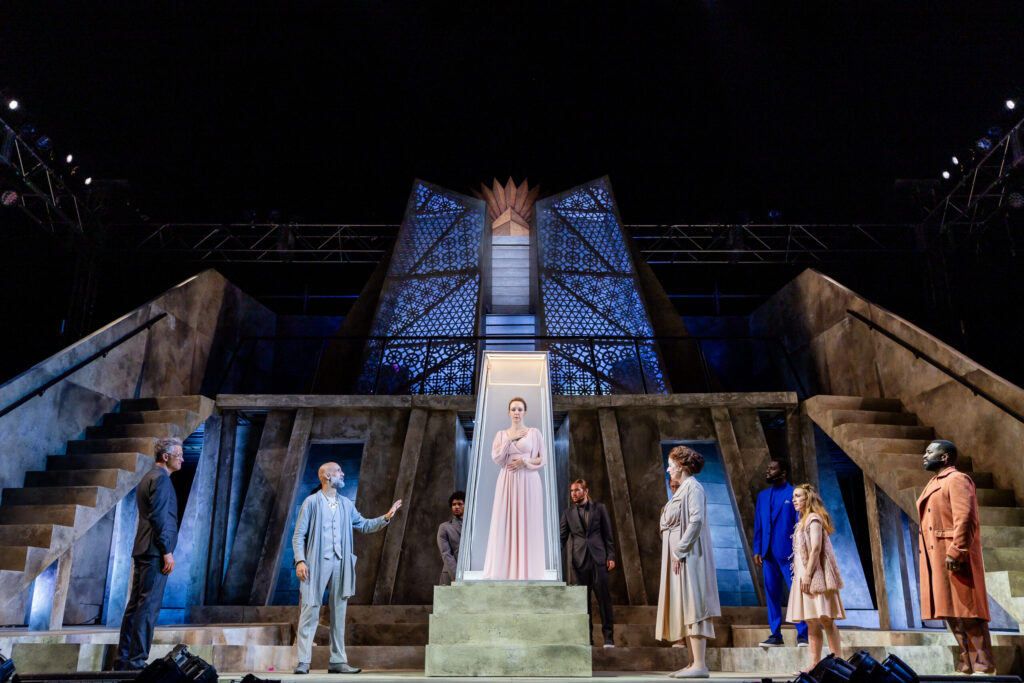
Commonwealth Shakespeare Co.’s “The Winter’s Tale” Sizzles on Boston Common

Cast of Commonwealth Shakespeare Co.’s “The Winter’s Tale”. Photo Credit: Nile Scott Studios.

“The Winter’s Tale.” Written by William Shakespeare. Directed by Bryn Boice. Scenic Design by James L. Fenton; Costume and Wig Design by Rachel Padula-Shufelt; Lighting Design by Maximo Grano De Oro; Sound Design by David Remedios; Original Music by Mackenzie Adamick. Presented by Commonwealth Shakespeare Company for Free Shakespeare on the Common, Parkman Bandstand, 139 Tremont St., Boston, through August 4.

By Shelley A. Sackett

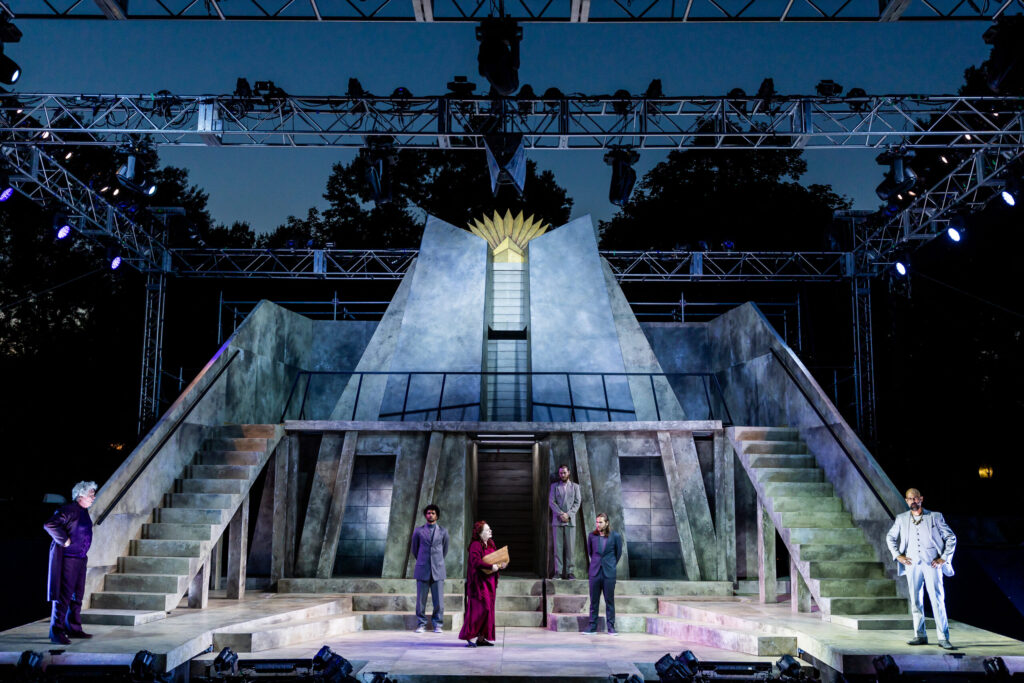
The drizzly chill overhead did nothing to dampen Commonwealth Shakespeare Company’s sizzling (and free!) production of Shakespeare’s The Winter’s Tale. From James J. Fenton’s spectacular set to director Bryn Boice’s nuanced yet spunky direction to the exceptional cast, the evening was an example of Boston’s cutting-edge theater scene at its most exciting.

Although the clear-as-bell sound (Sound Design by David Remedios) and colloquial cadence of the actors’ deliveries didn’t require them, two large screens with closed captions were an added bonus, enhancing our ability to really savor Shakespeare’s Elizabethan verse. (There are some truly great and rarely quoted lines in this play.)

The Winter’s Tale was dubbed one of Shakespeare’s four “problem plays” by English critic and scholar Frederick S. Boas because it doesn’t fit neatly into the silos of tragedy or comedy but rather straddles the two. According to Boas, Shakespeare’s problem plays set out to explore specific moral dilemmas and social problems through their central characters. Boas contends that the plays encourage the reader to analyze complex and neglected topics. Instead of providing pat answers and arousing simple joy or pain, the plays confuse, engross, and bewilder.

Boas certainly was spot on as far as The Winter’s Tale is concerned.
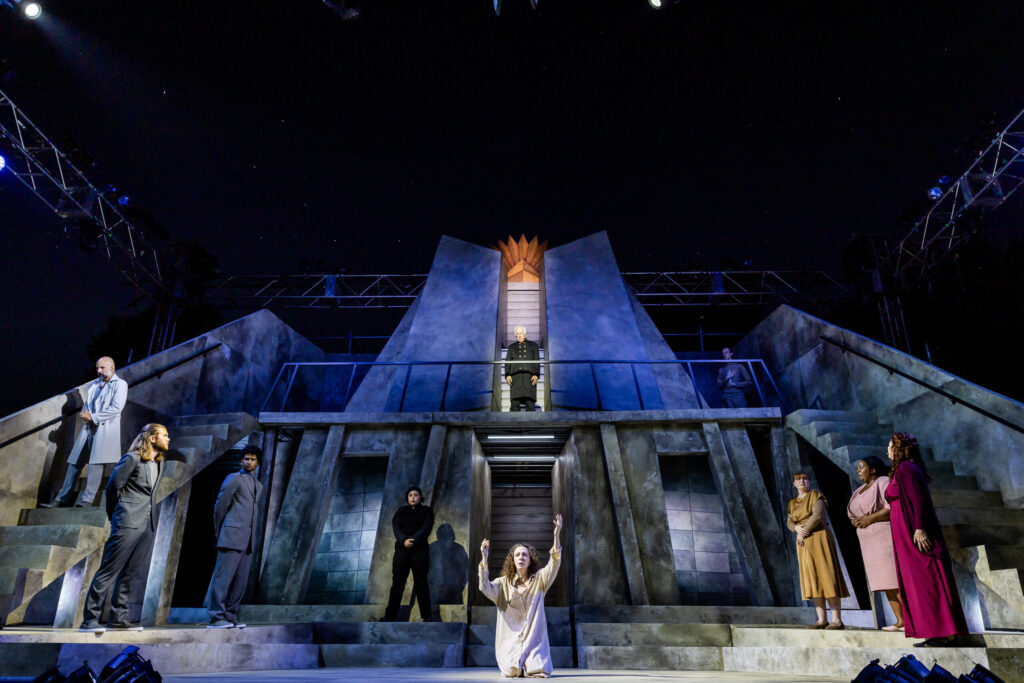
The action opens with a full head of steam as a large cast of well-dressed men and women cavort in the castle of Leontes, King of Sicilia (played by the always magnificent Nael Nacer). His pregnant wife Hermione (a radiant Marianna Bassham) and their son are surrounded by loved ones as they entertain King Polixenes (Omar Robinson, fresh from his success in “Toni Stone”), Leontes’ childhood best friend and king of Bohemia.

Polixenes is set to depart for Bohemia after a nine-month visit to Sicilia. When Leontes’ attempts to persuade him to stay longer are unsuccessful, Hermione playfully takes up the challenge. After some innocent and very public mock hanky-panky of hand-holding and cheek-pecking, she accomplishes what Leontes could not. Polixenes will stay one more day.

As the audience witnesses the lightness of Polixenes and Hermione jesting stage right, there are dark clouds gathering stage left, where Leontes is slowly going off the rails. Nacer brings the full force of his physical talent to bear as we swear we see Leontes grow antennae that crackle and hum with every word spoken and gesture exchanged between his wife and best friend.
By the end of the scene, Leontes has gone feral, descending into an all-consuming raging derangement of sexual jealousy. He convinces himself that Hermione has cheated on him with Polixenes and that the baby Hermione carries is the result of the affair.

Leontes plunges into a madness that makes MacBeth and Hamlet look like amateurs. He transforms from a benevolent king to a tyrannical despot, declaring that Hermione will be tried for her crime of adultery, the punishment for which is imprisonment and possibly death. Othello may have his Iago, but Leontes has no need for anyone to egg him on; he is both torturer and the tortured, “in rebellion with himself.”

He entreats Camillo (an engaging Tony Estrella), his cupbearer, to poison Polixenes, but Camillo instead warns Polixenes and flees to Bohemia with him. Not even Paulina (the fabulous scene-stealing Paula Plum), a loyal lady-in-waiting to Hermione and the voice of Leontes’ conscience, can persuade him he is wrong. He can’t see that rather than outraged victim, he is the outrageous culprit.

Hermione gives birth to a girl, Perdita (Clara Hevia), whom Leontes commands Paulina’s husband, Antigonus (Robert Walsh) to abandon in Bohemia. On that dark note, Act I closes as the madness of Leontes’ paranoid jealousy takes its toll, leaving him standing in the smoldering ashes of what once was the heart and hearth of his family and kingdom.

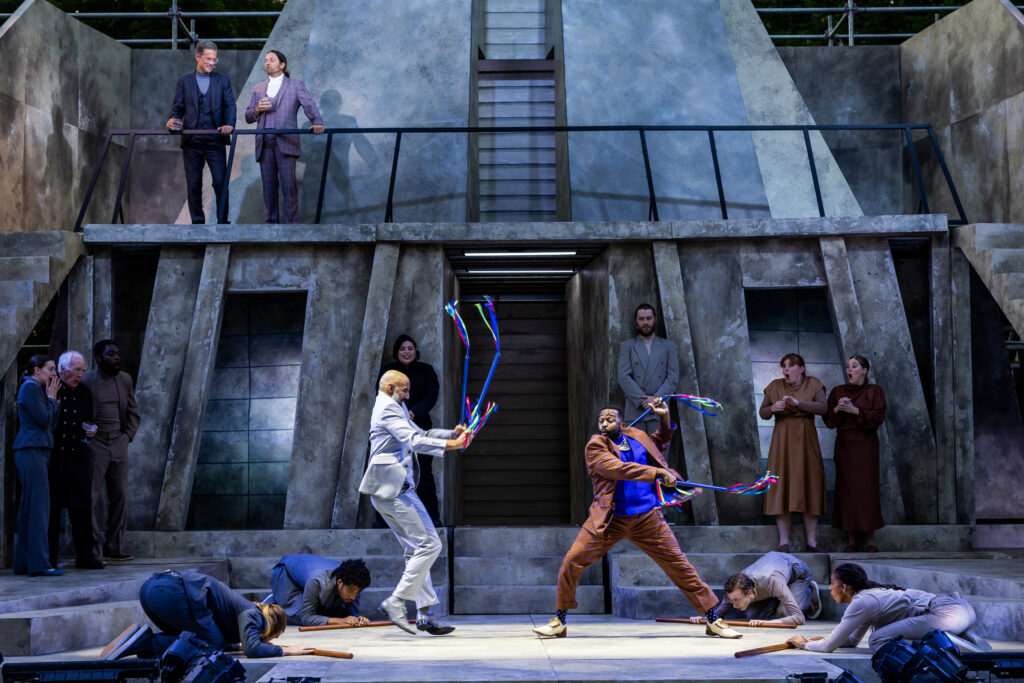
Act II opens in a 180 degree turnabout, the comic antidote to Act I’s tragedies. Both Shakespeare (with his clown and trickster characters) and Boice (with her 21st century spin) have some fun.

Sixteen years have passed. Shakespeare has created a Greek chorus of one in his character Time, gifting her with an explanatory monologue that no one but Plum could deliver with such grandeur and emotion. Boice’s staging is breathtakingly brilliant.
Perdita, who ended up in Bohemia and was found and raised by an old shepherd (the endearing Richard Snee), is throwing a sheep shearing party to end all sheep shearing parties. It is the equivalent of her sweet-16, coming out celebration. Techno music reverberates. Neon abounds (Lighting Design by Maximo Grano De Oro). The guests dress and behave like MTV extras (Costume and Wig Design by Rachel Padula-Shufelt).

Although (like many MTV routines) it goes on a little too long, the scene draws our attention to the stark contrasts between the doom and gloom of Act I’s despotic Leontes’ Sicilia and Act II’s kinder, gentler Bohemian landscape and lordship.

Perdita even has a boyfriend, King Polixenes’ son Florizel (Joshua Olumide). Their relationship is the balm that ultimately heals the rift between their fathers and their kingdoms, a testament to Virgil’s poetic phrase, “Love conquers all.”

Eventually, all ends well enough and Shakespeare manages to reunite friends, foes and family. Leontes repents for his misguided ways, reaping forgiveness and sympathy. As far as he is concerned, he is redeemed and pardoned for his brutal and abusive misuse of power of trust. The death and destruction he caused was collateral damage, water under the bridge. Even Hermione, trapped as a statue, is resigned and forgiving.

Yet, the Bard has left a bitter taste in our mouths.

Boas was right about problem plays. “The Winter’s Tale” certainly explores specific moral dilemmas and social problems through its central characters, leaving us indeed engrossed and bewildered, especially given the discordant nature of the nation as it faces yet another toxic election season.

It is hard to sweep aside the gravity of Leontes’ transgressions and the sleight of hand by which they vanish. He wrecked a world and is then put on a pedestal when he conveniently comes to his senses and rues his own loss. Where is the fairness in that? What moral, social messages are we meant to take away? Where, Mr. Shakespeare, are the eloquent railings against tyranny, toxic masculinity and falsehood? Where are the consequences for immoral and corrupt behavior? And, a few empowering monologues notwithstanding, where have you left your women?

Highly recommended.

For more information, visit commshakes.org/production/winterstale.
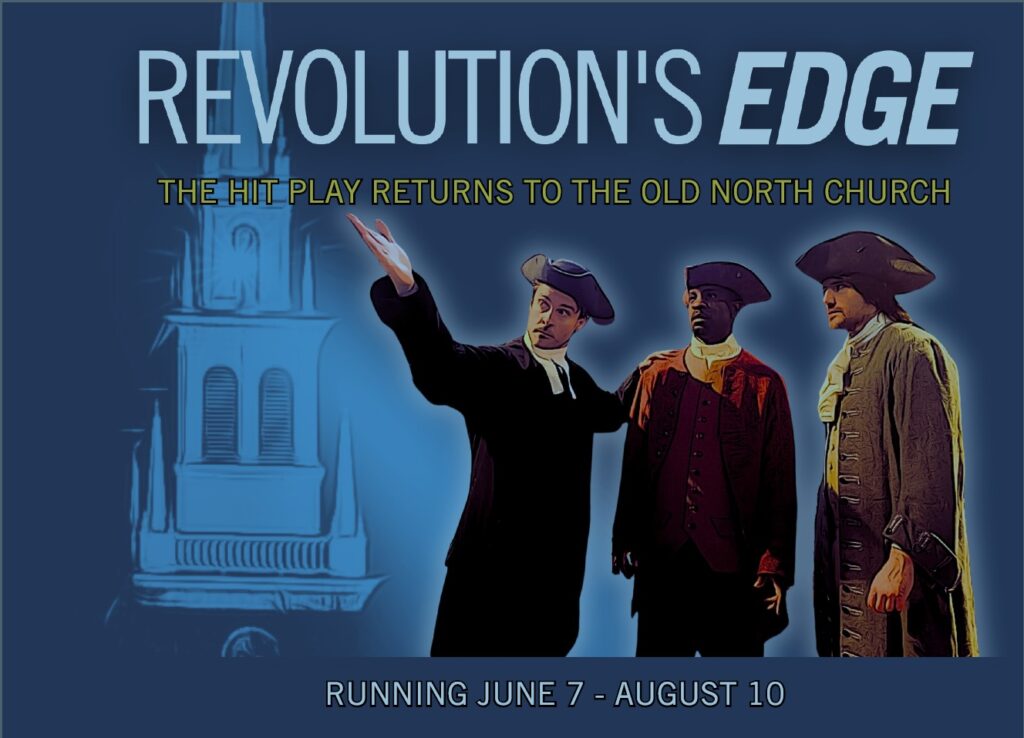
At Boston’s Old North Chuch, “Revolution’s Edge” Time Travels to the Start of the American Revolution

“Revolution’s Edge.” Written by Patrick Gabridge. Directed by Alexandra Smith. Produced by Plays in Place. Commissioned by Old North Illuminated. Staged at The Old North Church, 193 Salem St, Boston through August 10.

By Shelley A. Sackett

“Revolution’s Edge,” a site-specific play by the award-winning playwright, producer, novelist, and screenwriter Patrick Gabridge, packs a lot into 45 minutes.

It is set on the evening of April 18, 1775, a turning point in both the history of the Old North Church (then Christ Church) and the history of America. The church played a pivotal role in the nation’s fight for independence. It was in its steeple, after all, where two lanterns were hung on that very night to signal that British soldiers were heading across the Charles River.

The event has been immortalized by the line, “One if by land, and two if by sea,” in Henry Wadsworth Longfellow’s 1860 poem “Paul Revere’s Ride.”

Gabridge’s inspired drama is set in the North Church in real time during a moment that is almost invisible in history books. It was mere hours before the signals were hung. Three men whose lives intersect and diverge meet in the church’s vestry as altercations between British troops and American patriots threaten to boil over just outside its doors. The imagined conversation among three real people on that historic afternoon is the subject of the play.

Christ Church’s second rector, the Rev. Dr. Mather Byles, Jr., remains loyal to the British crown. Vestry member John Pulling, Jr. is a fervent Patriot and one of the men who will later hang the lanterns in the bell tower. The two have been friends for decades. Their children have grown up together; their families even share the same pew. (Be sure to look at the pew where both Byles’ and Pullings’ families have plaques).

Cato, a slave, has just been baptized by Byles, his owner. Fearing for his family’s safety, Byles recently resigned as minister and plans to move his family to Portsmouth, New Hampshire.

All three characters are based on real people, and thanks to Gabridge’s fastidious research, they are as historically accurate as archival materials permit. The dramatic and personal details that transform them into three-dimensional characters are all thanks to Gabridge’s uncanny ability to dig deeply beneath the surface of his research and plumb the hearts and minds of his characters. “Revolution’s Edge” is no mere reenactment; it pulls back the curtain and lets a modern audience witness what really made these men tick.

That that audience is also sitting in the very place where the events of the play took place is nothing short of sublime.

As the conversation unfolds that tense day in 1775, Gabridge first focuses our attention on the characters’ commonalities. All three are fathers who value family above all else. They want the best lives possible for their children and are willing to sacrifice their own happiness to achieve that goal. They have all suffered profound losses and setbacks in their lives. At their cores, they are decent, practical and honest men, strongly opinioned yet respectful and compassionate.

The playwright then teases out all the ways in which they differ. Byles is an ardent supporter of the King of England and may have been colluding with the British troops. Pulling is just as ardent a Patriot, ready and willing to launch the attack that will finally set America free from tyranny.

Byles has his blind spots. For example, he can’t see the inhumanity of his assumption that, because he owns Cato and because he and his wife have five children they can’t care for on their own, Cato not only must leave his own family in Boston and accompany them to New Hampshire, but he also should be grateful for the opportunity. He is tone-deaf in his paternalistic attitude toward Cato, whom he sees as needing (and wanting) his master’s protection.

Cato, who was kidnapped in Africa as a child and brought to America as a slave, just wants to raise his family among the friends he has made during his many years in Boston. When Pulling asks Cato whether he wants to accompany Byles to Portsmouth or stay in Boston, Cato is stunned. No one had ever asked him what he wanted before. Yet he is comfortable and confident enough to point out the absurdity of asking that moot question now.

Instead of answering Pulling’s question, he poses one of his own. “Did they ask if I wanted to come to this country when I was seven years old?” he counters.  

The play raises many thought-provoking issues in understated but effective ways. Pulling argues that he and his fellow Patriots refuse to be slaves to the King, yet he can’t make the connection that Cato might feel the same way about his enslavement. Byles insists that “all this” is God’s plan, but when pressed by Pulling, he can’t say which part he means. Is it taxation? Occupation? Slavery? “There’s not much subtle about the times we’re living in,” Pulling observes.

Finally, they address the elephant in the room: in a land where no one is native, who is a true American? Is it the English settler (and his fellow loyalists) who may live in New England but whose allegiance is to the original version across the pond? Or is it the colonists (and fellow Patriots) who have embraced their new homeland and no longer consider themselves English immigrants but full-blooded citizens of the autonomous and independent America?

The splendid cast of three last Thursday (two casts act in rotation) included Joshua Lee Robinson as Cato, Tim Hoover as Byles, and Kevin Paquette as Pulling. Most of the action takes place in the front of the pews, although the actors walk up and down the aisle from time to time. While they both bring style and authenticity to their characters, Hoover and Paquette might do well to temper their deliveries. Their rapid fire, loud, angry vocalizations rendered many of their lines incomprehensible, which is particularly unfortunate with such a dialogue-driven script.

As Cato, Robinson was much easier to understand. His even, clear, calm enunciation added much to the audience’s ability to relate to his character.

Gabridge is the founder and Producing Artistic Director of Plays in Place, which develops site-specific plays tailored to helping an audience find new meaning in the places, topics, and people at the heart of the piece. He hopes “Revolution’s Edge” enables its audience to appreciate that the people in our past were real people who led complicated lives that required them to make hard decisions.

“Sometimes we look back in history and we feel like it was easy for them to make their choices. You know, ‘It was so much simpler back then.’ But I think when we look at them as real complex humans, we realize that just like us today, they didn’t know what was going to happen next, just like we don’t,” he said.

For more information, go to www.oldnorth.com/revolutions-edge/