SpeakEasy’s “Pru Payne” Is A Must See for Fans of Fabulous Theater

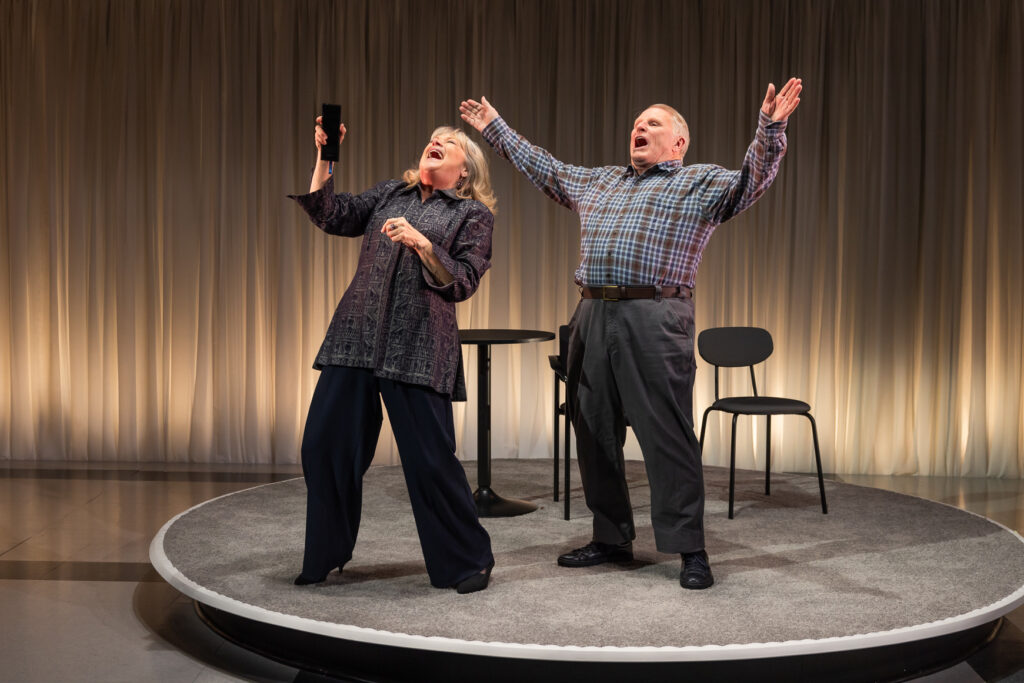
Karen MacDonald and Gordon Clapp in SpeakEasy Stage Company’s production of Pru Payne.
Photo: Nile Scott Studios

By Shelley A. Sackett

Karen MacDonald, recently introduced as “the empress of Boston,” adds another gem to her tiara with her portrayal of Prudence Payne, a Dorothy Parker-esque reviewer whose sharp wit, acid tongue and encyclopedic familiarity with minutiae of all things cultural have earned her many awards. We are introduced to her as she and her son, Thomas (De’Lon Grant) sit in the Brook Hollow clinic anteroom, awaiting a consultation with a doctor. The television is blaring pablum. Pru regally grabs the remote, waves it like a magic wand. She tries to turn the television set off, but can’t. She retakes her seat, slumping in confused defeat. Tommy reminds her that there are other people in the room who may want to continue watching. “Re. Member,” Pru says, enunciating each letter as if it were a syllable unto itself.

In a flash of a flashback, the music cues and we are transported to 1988 (kudos to Set Designers Christopher and Justin Swader, whose elegantly simple set easily morphs in our mind’s eye from medical waiting room to time travel “Beam Me Up Scotty” mode to grand ceremonial dais.) Pru is at the pinnacle of her career, about to become the first woman and first critic to receive the alliteratively laden AAAA’s (American Academy of Arts and Aesthetics) Abernathy Award.

We catch her as she mounts the podium amidst resounding applause. Her acceptance speech is impudent, provocative and riotously funny. She is brilliant and revels in peppering her monologue with fast-paced literary citations that showcase her sophisticated and seasoned palette while challenging her audience to guess their source. If there were a Mensa Jeopardy, Pru would be its host.
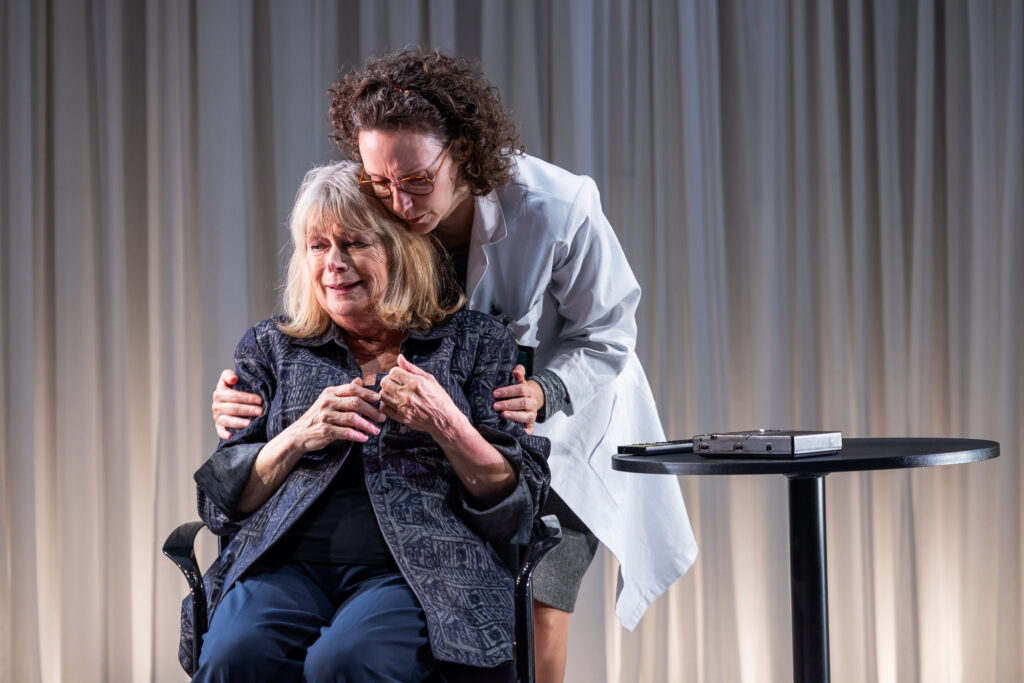
MacDonald, Marianna Bassham

But a sudden shift, almost imperceptible at first, indicates all is not quite right with Pru. She devolves into F-bombs, rectal references and borderline slander. Thomas approaches her, but she waves him away. When she loses her place and starts to panic on stage, MacDonald’s prodigious skills are on full display. In the blink of an eye, her Pru actually pales, her face sags, her shoulders droop and her speech falters. Thomas rescues her and escorts her to her seat. We are back in the waiting room, where the TV continues to blame.

Brook Hollow, it turns out, is a Massachusetts memory clinic where Thomas has brought Pru for evaluation following her speech and the uproar it causes. To smooth the turbulent wake Pru left with the AAAA, he has offered up her memoir as a peace offering, due the following fall. It is only two weeks later, yet we sense that Pru has deteriorated. She is still irreverent and acerbic, yet her confusion and slips are more frequent.

Thomas is desperate to thwart his mother’s memory loss. It is an irony lost to no one that a woman whose memory is galloping away is chasing her past before it is out of reach in order to write her memoir.

For the next 90 intermission-less minutes, we ride shotgun over two decades as Pru travels down the path of full-blown, irreversible dementia. If this sounds gut-wrenching and jarring, it is. Yet, in the skilled hands of master wordsmith and award-winning playwright Steven Drukman (and under Paul Daigneault’s flawless and sensitive direction), it is also rip-roaringly funny and brimming with empathy. The Newton native has married head and heart in a tightly crafted script that abounds in clever one-liners and zinger plays on words. (It also has tons of fun local references). Painful as the topic and Pru’s story are, Drukman’s humor and hopefulness dull the knife’s sharp blade just enough to prevent the play from circling the drain of utter despair.
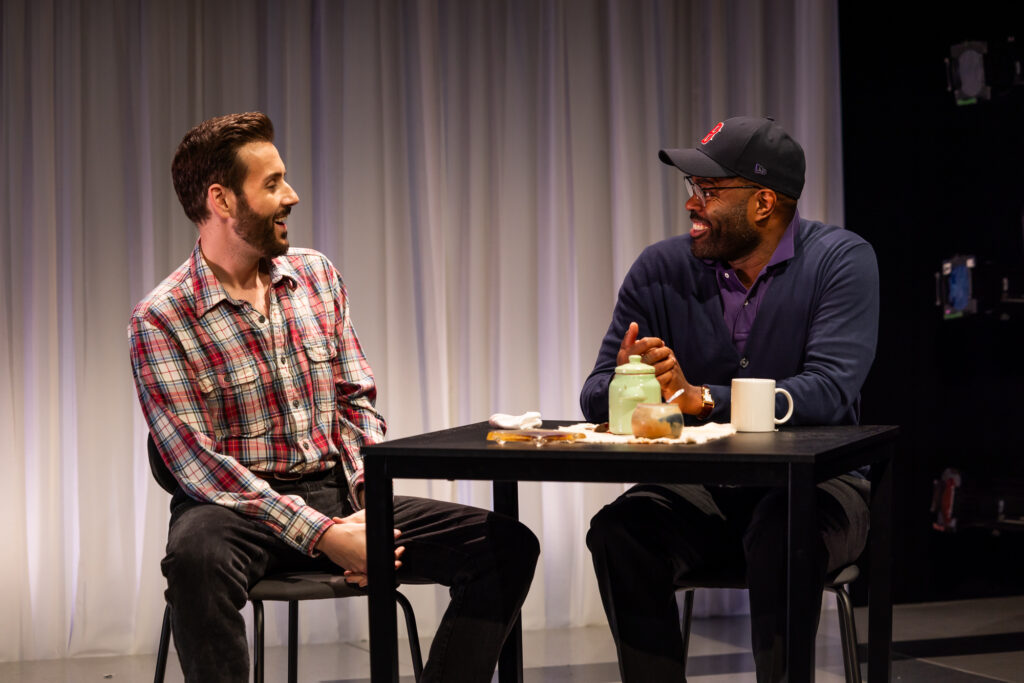
Greg Maraio, De’Lon Grant

He has also penned a group of supporting characters who each have independent agendas and stories, yet who interlace as an ensemble that embraces and supports the play’s eponymous Pru.

Pru and Thomas, an aspiring novelist, meet with Dr. Dolan (the magnificent Marianna Bassham in an unfortunately understated, somewhat unimaginative role), who, unsurprisingly, wants to admit Pru for observation. They start to protest when Pru spots Gus Cadahy (the quietly show-stopping Emmy, SAG and IRNE Awards winner Gordon Clapp), a custodial engineer who is accompanied by his son, Art (Greg Maraio). They, too, are at Brook Hollow so Gus can be evaluated for memory decline and associated behaviors.

Pru and Gus are yin and yang, opposite forces that form a whole in a balance that is always changing. He is lower middle class, uneducated, and speaks with a thick Boston accent. She is stratospherically wealthy, wears her pedigree on her sleeve, and effects a Brahmin patois. He is unapologetic, hilarious and down to earth, determined to squeeze every last drop of fun and pleasure out of life. He makes no excuses and accepts what comes his way.

She is calculated, driven and controlling. “Good enough” are two words meant to be spat, like a curse. Despite her sophistication and breeding, she is far crasser than the social mores minded Gus.

Their love affair at Brook Hollow opens the door to more than a delineation of their differences. Pru is Gus’ missing piece and vice versa. He softens and grounds her, whether playing gin, dancing, making love or reeling her back from memory’s steep precipice. Pru, for the first time in her life, is able to let go, let loose and let herself love and be loved.
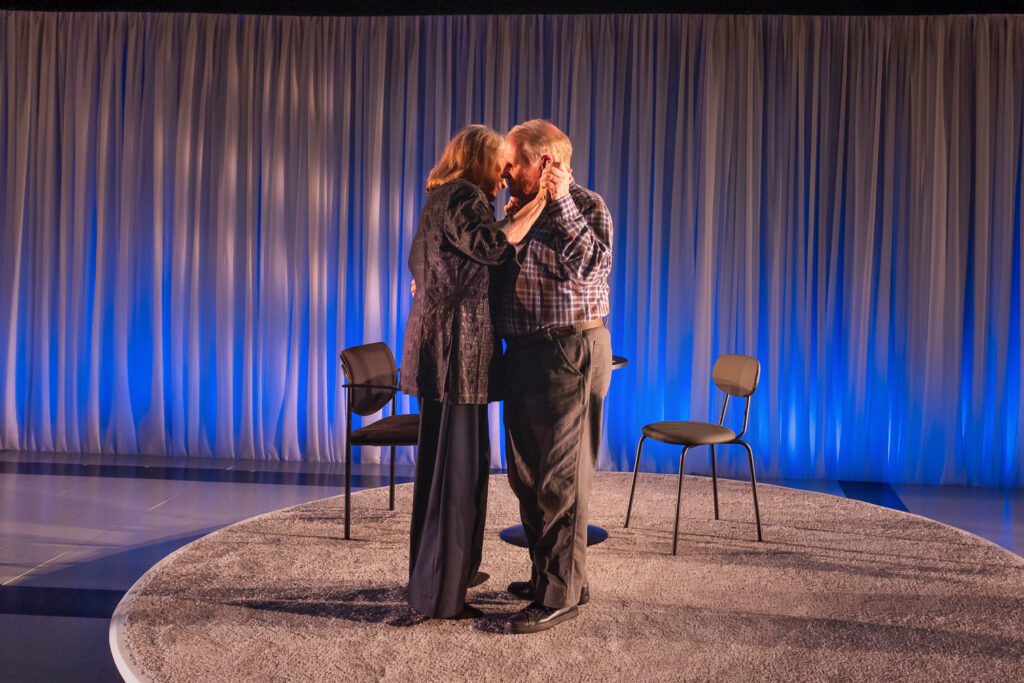
MacDonald, Clapp

Meanwhile, their sons have their own backstory, which would be a spoiler to divulge other than to let slip that, while their parents are creating new memories, their sons are revisiting old ones.

Boston native Maraio is terrific as Art, both in his interactions with his father and with Thomas, especially as concerns their parents’ relationship. He brings a nuanced vulnerability to his external impermeability. Grant, so wonderful as Keith in “A Case for the Existence of God,” brings that same sweet openness to Thomas, a quiet defenselessness and optimism.

Although Drukman meanders peripherally into timely topics of the 1990s and 2000s (AIDS, politics, and the demise of cultural standards, for example), he has the good sense to use this detour for context rather than theme. He has written an important and riveting play about a timely and difficult subject that is, in its own right, much more than just “good enough.”

We ache for Pru and her family, but covet our view through the keyhole at that in-between stage where one starts to become unglued. yet is still together enough to be aware of what is happening (and what is to come). We also come face to face with some heady and introspective queries.
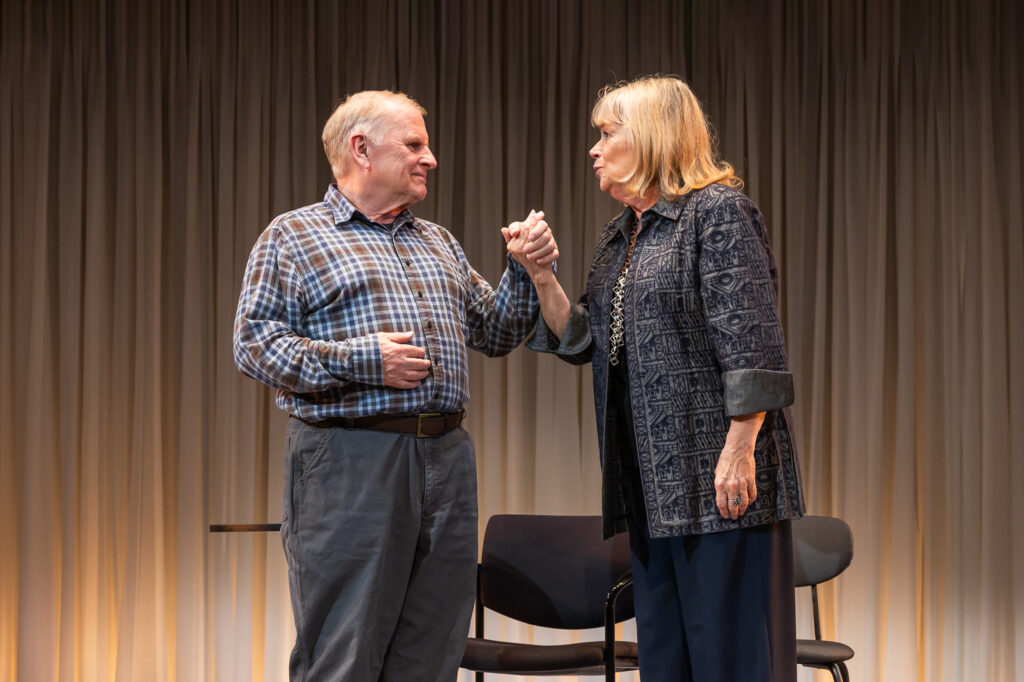
Clapp, MacDonald

How, for example, do you sum up a person, especially one whose life ends in the black hole of dementia and Alzheimer’s Disease? Who is the real Pru? How should she be remembered? Is it fair to her to remember her in her absolute decline or is it dishonest to remember her otherwise? Do we curate our own memories? Do others curate theirs of us? At the end of the day, does it really matter?

As her own memories dissolve and past human connections along with them, Pru has moments lucid enough to still contemplate Pru-worthy big picture questions. What if, she wonders, her entire life was just a memory trick?

What if, indeed.

“Pru Payne”— Written by Steven Drukman. Directed by Paul Daugneault. Presented by SpeakEasy Stage at Boston Center for the Arts, Calderwood Pavillion, 539 Tremont St., Boston, through Nov. 16.For tickets and more information, go to https://speakeasystage.com/
The Huntington’s “Nassim” Bridges Our Differences through Language, Gimmickry and Charm

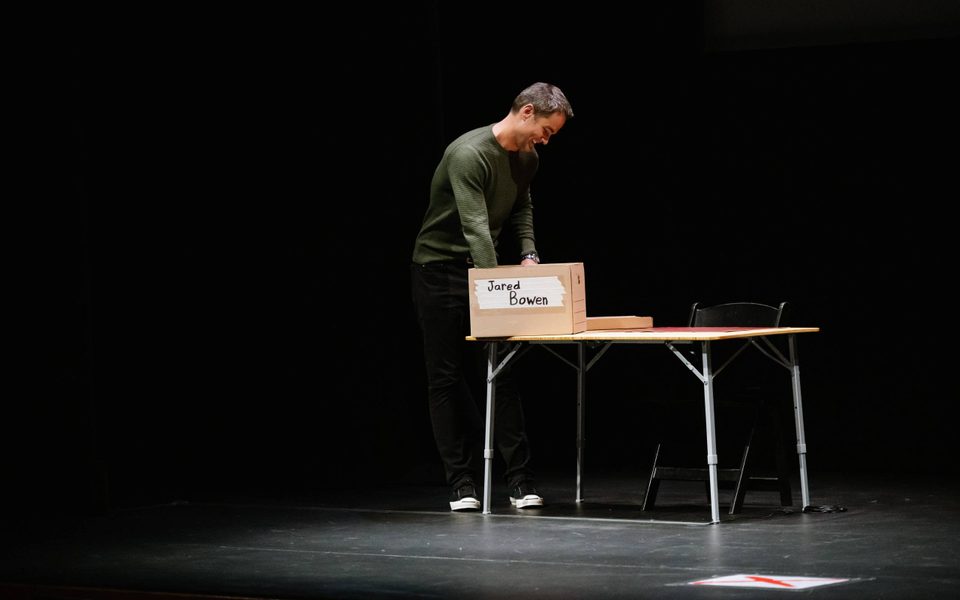
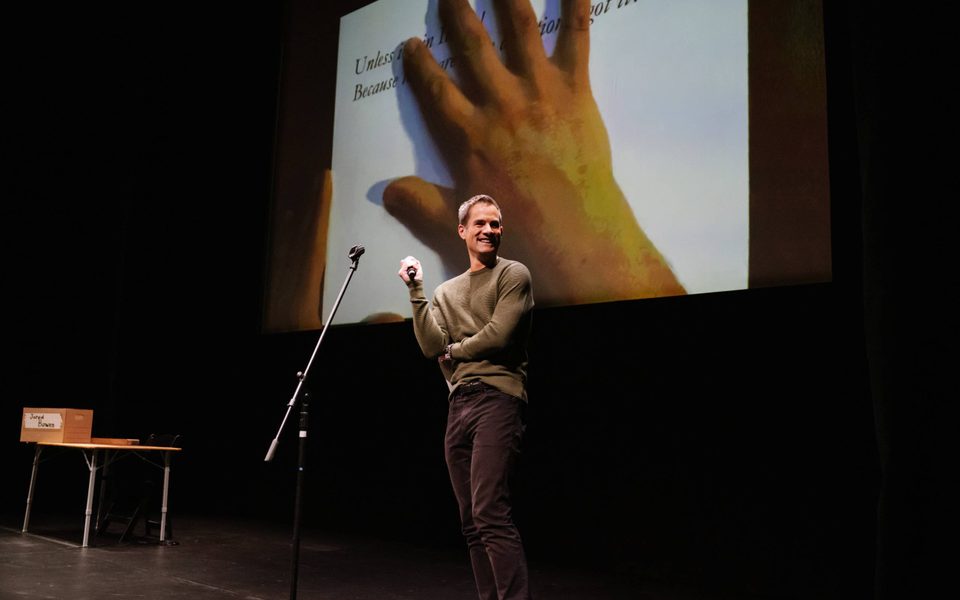
Jared Bowen in Nassim at the Calderwood Pavillion, BCA. Photos by © Mike Ritter

“Nassim” — Written by Nassim Soleimanpour. Directed by Omar Elerian. A new guest performer for every show. Presented by The Huntington through October 27.

By Shelley A. Sackett

“White Rabbit, Red Rabbit,” Iranian Nassim Soleimanpour’s absurdist adventure, which sits on the boundary of comedy and drama and burst into London’s West End in 20212, changed my opinion about audience participation in theater. Not a big fan of the genre, I left the 2016 performance at New York City’s Westside Theatre a convert.

Conceived while 29-year-old Soleimanpour was barred from leaving Iran for refusing military service, the play challenged its audience on issues of trust, obedience and complicity while demolishing the fourth wall and having a different actor read the script for the first time at each performance.

The words were Soleimanpour’s; the implicit messages were the idea of someone trying to speak through someone else and the question of what censorship means.

So when The Huntington announced it was producing the eponymous “Nassim,” I was on board. Originally commissioned and produced by London’s Bush Theatre in 2017, the drama, comedy and social experiment is even more timely today.

Fueled by curiosity, compassion and a longing for global community, Soleimanpour employs his trademark style of having a different actor cold read his script in front of a live audience. Karen MacDonald, the “empress of Boston theater,” had the honors the night I attended, and she rose to the task with her usual humor, flair and skill.

For 75 intermission-less minutes, MacDonald read from a script (minus the italicized stage directions) projected on a jumbo screen, as its pages were moved by disembodied hands. The play’s theme, a meditation on how foreign languages divide us, slowly comes into focus. While Soleimanpour’s plays have been performed in dozens of languages worldwide, they’ve never been performed in Farsi in his native country because of governmental repression. This situation particularly distresses him because his mother, who still lives in Iran, has never heard or seen one of her son’s plays performed in her (and his) mother tongue.

Although “Nassim” at times feels insubstantial and the gimmicky aspect often crosses over into banal cutesiness, its positive message of global community through communication and understanding prevails. Mimicking a language class, Soleimanpour’s script invites the audience (and especially MacDonald) to experience the beauty and magic of his native language, Farsi. We discover through the timeless and borderless device of fairytales.

Naheem Garcia

“Once upon a time” are our first Farsi words, along with “mom.” “You have to learn your mother tongue,” MacDonald reads.

In Act Two, Soleimanpour’s script turns more autobiographical, and we find out that he wrote the play in Farsi with words he wanted to learn in English. The play, which celebrated its 479th performance and has been staged all over the world, was intended as a means for its author to meet new people and be taught new words all over the world.

“A writer’s heart will always beat in his mother’s tongue,” Soleimanpour says through MacDonald. “But isn’t it amazing how languages work? They bring us together; they tear us apart.”

It would be too much of a spoiler to reveal all the surprises in store, but this charming and timely piece of experimental, experiential theater is a must for anyone curious about more than the shiny, big productions that often dominate conversation, reviews, and box office receipts. Take a chance with this little gem; you won’t be disappointed.

For more information, go to https://www.huntingtontheatre.org/

The escape from Mussolini’s antisemitic Italian fascism told in ‘Pack One Bag’ podcast

David and Sergio David Modigliani reviewing documents.

By Shelley A. Sackett

Heirlooms hold the keys that can unlock family histories. For many, these stories remain untold, preserved in artifacts that are passed from generation to generation and display case to display case. They sit silently on a shelf, admired and gathering dust.
Award-winning documentarian David Modigliani’s family was different.

When his grandfather, the Italian-born economist and Nobel Prize winner Franco Modigliani, died in 2003, David’s father Sergio inherited 19 boxes of documents. He kept them in a storage unit, where they remained taped up and unopened until COVID, when David decided to check out what was inside them.

He and documentary producer Willa Kaufman had begun dating just before the country went into lockdown during the pandemic. The boxes were a perfect diversion.

What they found inside was a treasure trove of family archives including letters, personal diaries, and fascist spy documents detailing his family’s harrowing times fighting to survive during the rising tide of antisemitism in 1930s Italy. That was the start of “Pack One Bag,” a 10-part podcast that traces his family’s escape to America.

In the boxes, there were scores of love letters between Franco, then a 19-year-old economics student, and Serena Calabi, the daughter of Jewish publishing baron, Giulio Calabi (known as “The King of the Books”) and the love of his life. Although David had grown up hearing the fairytale stories about his grandparents’ epic romance and their escape from fascist Italy for the United States in 1939, these letters did more than just preserve their love; they bore witness to the perils they confronted as Benito Mussolini and his Italian Racial Laws fueled antisemitism.

Most eye-opening was the 25-page letter that Giorgio, Franco’s brother who stayed behind in Rome, wrote and sent to David’s grandfather just after the war. It detailed, in “harrowing, page-turning prose,” his experience of navigating his family and shepherding them through a gauntlet of horror during the Mussolini regime.

“Reading this letter was chilling and opened up a much deeper understanding of the universe my grandfather could have experienced had he not been so fortunate to fall in love with my grandmother and escape fascist Italy with her family before the outbreak of war,” David told the Journal.

The professional storyteller in him knew he had to get to the bottom of his own family’s story. Toting his grandparents’ love letters, he and Kaufman went to Italy to speak to surviving family members, retrace his family’s steps in Rome and Bologna, and discover the answer to a question that haunted him: Why didn’t they all just flee Italy when they could?

The couple spent months piecing together a story that includes narratives of relatives left behind, recorded in their octogenarian voices. They plumbed state archives and even interviewed former Italian prime minister Mario Draghi, one of Franco’s students. They returned home knowing they had the raw material for a thrilling and timely story. But how to best tell it?

Film has been David’s medium ever since falling in love with the collaborative process of documentary storytelling while a graduate student at the University of Texas at Austin. He has won numerous awards for his feature films, which have run on Hulu, Netflix, PBS, and HBO.

But this time was different. There were no great visual assets and most of the main characters are no longer living. His coproducer reminded him that podcasts are at heart a visual medium. “A podcast is more akin to reading a novel than film. The audience must construct and build through their own imagination the world you are trying to create for them,” David said.

Actor/producer/writer Stanley Tucci signed on as executive producer and the featured voice of Giulio Calabi. David voices his Nonno Franco and Nonna Serena.

As a kid, he had done impersonations of his grandparents for his sisters and cousins, and when his collaborators heard them, they agreed that it would be an authentic way for him to bring his grandparents to life. David always meant to record them, and regretted that he didn’t prioritize that before they died. “I felt very close to them when I was recreating them for the podcast,” he said.

Episode 1 of the series David and his team created débuted at the 2023 Tribeca Festival as “Shalom, Amore.” It won the Jury Award for Nonfiction Audio, citing its “unexpectedly moving narrative that blends the personal, political, and comical” as it takes listeners “on a journey across generations and continents.”

Later, he changed the name to “Pack One Bag” to reflect the details of his family’s story. When his great-grandparents began illegally ferrying money across the border into Switzerland in the 1930s, they packed one bag so it would look like they were going on vacation. When the Nazis banged on doors in Rome’s Jewish ghetto in 1943, they instructed them to pack one bag.

“This story is about people who happened to be Jewish in the 1930s in Italy,” David said, “but it is a universal story. It applies to people in any environmental or political crisis who have to leave their homes. What do you take with you?”

David, 44, grew up as a “Reform Jewish kid in Brookline” and was especially connected to Judaism culturally and historically. He vividly understood how being Jewish had impacted the physical locations of his family. “My grandparents were in Belmont largely because of their Jewish identity and because they left Italy just in the nick of time,” he said.

He hopes that listeners can find some answers for the present moment from the way his family confronted their situation. “The question at the heart of ‘Pack One Bag’ is ‘when confronted with fascism, do you stay or flee? What if you can’t?’ ” David said.
Noting the upswing of nationalism, totalitarianism, and antisemitism at home and globally, he is reminded how fascism needs an “other” to survive and thrive, a subset of the population that the majority is motivated to antagonize, scapegoat, and persecute.

He cites his great-grandfather Giulio as advice to those being “othered.” “You resist as best you can for as long as you can, and then you flee,” David said.

“For those that have the privilege to exist inside a fascist society without being persecuted, the onus is on us to preserve democracy and to attempt to return society to a more inclusive and tolerant place.”

To listen to the podcast and for more information, visit packonebagshow.com.

Salem teen takes his talents to ‘Leopoldstadt’

Elias Wettengel

By Shelley A. Sackett

When her son was little, Liz Polay-Wettengel tried to get him interested in soccer, which his older brother had loved at that age. Instead, all three-year-old Elias wanted to do was memorize lines from the movie “Frozen” and perform them in the living room.

“We knew he needed to try the stage,” she told the Journal.

By the time he was four, Elias Wettengel was on his way to an acting career that would culminate with his casting in the role of young Jacob/Heini in the new production of Tom Stoppard’s award-winning “Leopoldstadt,” which runs at the Huntington Theatre through
Oct. 13.

The sprawling drama follows multiple generations of the fictional Jewish Merz-Jacobowitz family in Vienna in the 20th century. As it moves from 1899 to 1955, the play showcases everyday family dynamics against the ever-changing tides of revolution, war, antisemitism and assimilation.

Stoppard was inspired by the experiences of his own family; all four of his grandparents and three of his mother’s sisters lost their lives in the Holocaust. His stirring masterpiece takes a bold look at what it means to be Jewish for one’s self, in the eyes of others, and in the broader context of history.

“Leopoldstadt” won four Tony Awards in 2023, including Best Play, and two Laurence Olivier Awards, including Best New Play, when it débuted in London’s West End in 2020. The Huntington Theatre production is presented in association with the Shakespeare Theatre Company and features a cast of 15 adults and four children.

Elias, now a 13-year-old student at Collins Middle School in Salem, feels honored to play the roles of Jacob and Heini in such a meaningful play. “As a Jewish kid, the play has extra meaning for me. I sometimes get chills during the scenes,” he told the Journal.

“Leopoldstadt” is an emotionally intense and politically timely production, especially for American Jews. Elias and his mom handle the challenges of his role through open and honest conversations about what being Jewish means today and about how one’s ancestors can shape future generations.

It helps, according to Liz, that her brother-in-law Jason Stark teaches genocide studies. “We answer any questions that arise about death and the Holocaust. We don’t shy away from hard questions and encourage Elias to ask them,” she said.

For Elias, the resilience of family is an important message of the play. “I hope audiences see how generations of Jewish families relate, and the continuous impact they have on each other’s lives throughout time,” he said.

Family is also a major focus of his own religious practice. One of his favorite pieces of Judaism is that his family celebrates holidays like Sukkot by opening their home to everyone who wants to participate, “Being Jewish is always visible in our lives. I love sharing my Jewish culture with my family, friends and community,” he said. He is studying for his bar mitzvah, which his family will host in late 2025.

Elias’s theatrical journey began at the Salem YMCA, and he has since had featured roles in regional productions and in several film and television projects. He acknowledges that balancing the demands of school and performing is sometimes hard, but feels lucky to be a student in a district where his teachers assist him. “They come up with a plan to make sure I’m supported both as an actor and a student,” he said.

He is inspired by the actors he has the opportunity to work with, whether in community theater, films or the current play at the Huntington Theatre, which he hopes will serve as a stepping stone to appearances in additional professional productions. “I’d love to go on a tour or perform on Broadway!” he enthused.

As for advice to four-year-old youngsters who think they want to become actors? “Don’t be sad when you don’t get a role you want. Be happy to be part of theater in general. It isn’t about the role; it’s about the experience,” he said. Θ

For more information and to buy tickets, visit huntington­theatre.org.