100 Years Later, Martha Graham Remains the Gold Standard of Contemporary Dance

Cast of Martha Graham Dance Company

Martha Graham Dance Company’ — Presented by Celebrity Series of Boston at Emerson Cutler Majestic. Run has ended.

By Shelley A. Sackett

The last time I saw a Martha Graham piece performed was at the Metropolitan Museum of Art in October 2023, when I had the random good fortune to attend its exhibition, Art for the Millions: American Culture and Politics in the 1930s. As part of that exhibit, dancers from the Martha Graham Dance Company staged some of Graham’s most powerful ’30s solos in galleries throughout the museum.

I was lucky enough to catch “Lamentations” in the New Greek and Roman Galleries, the spectacular “museum-within-the-museum” built to display the Met’s extraordinary collection of Hellenistic, Etruscan, South Italian, and Roman sculpture.

Graham’s 1930 work, set to Hungarian Zoltàn Kodàly’s plaintive music, features a single dancer whose angular moves inside a stretchy fabric cocoon have long marked Graham’s trailblazing style. Over a mere four minutes, the dancer fights what feels like an eternal battle to get out of her encasement. Only her face, hands and feet are visible, yet the geometric shapes she creates epitomize her fruitless struggle. She pleads and prays, but there is no escape. Graham called the piece “the personification of grief.”

Seeing the timeless, sculptural piece in a sun-filled atrium with an audience of ancient statues was nothing short of sublime.

Its recent performance at the 1,200-seat beaux-art Emerson Cutler Majestic, though a less intimate setting, was no less astonishing.

Few dance companies have transfigured the art of contemporary dance quite like Martha Graham’s. Since the company’s founding in 1926, Graham’s signature style has remained a bedrock of American modern dance and continues to be taught worldwide.

In anticipation of the company’s 100th birthday celebration in 2026 (GRAHAM100), the Boston Celebrity Series brought the legendary troupe to Boston for three special appearances to kick off its own 2024/2025 Season Dance Series.

The Friday night capacity show illustrated why Graham remains the gold standard of contemporary dance choreography.

The program opened with “Dark Meadow Suite (1946), highlights from her longer “Dark Meadow.” The full ensemble (featuring Lloyd Knight and Anne Souder) performs an ancient mating ritual as part of Graham’s American homage to a mythological rite of spring.

The piece opens with a Greek chorus of five women who circle trancelike, stamping a primordial rhythm with their bare feet. Thick, rich music by Carlos Chávez sets the auditory stage for stunning, sensual, animal-like movements as dancers join, separate, and pulsate in perfect synchronicity. Playful lighting (Nick Hung) adds color and texture and black and orange flowing costumes (Martha Graham) are equal parts elegance and flirty frolic. Knight and Souder are the embodiment of grace as they perform their coupling ceremony, which Graham described as “a re-enactment of the mysteries which attend the eternal adventure of seeking.”
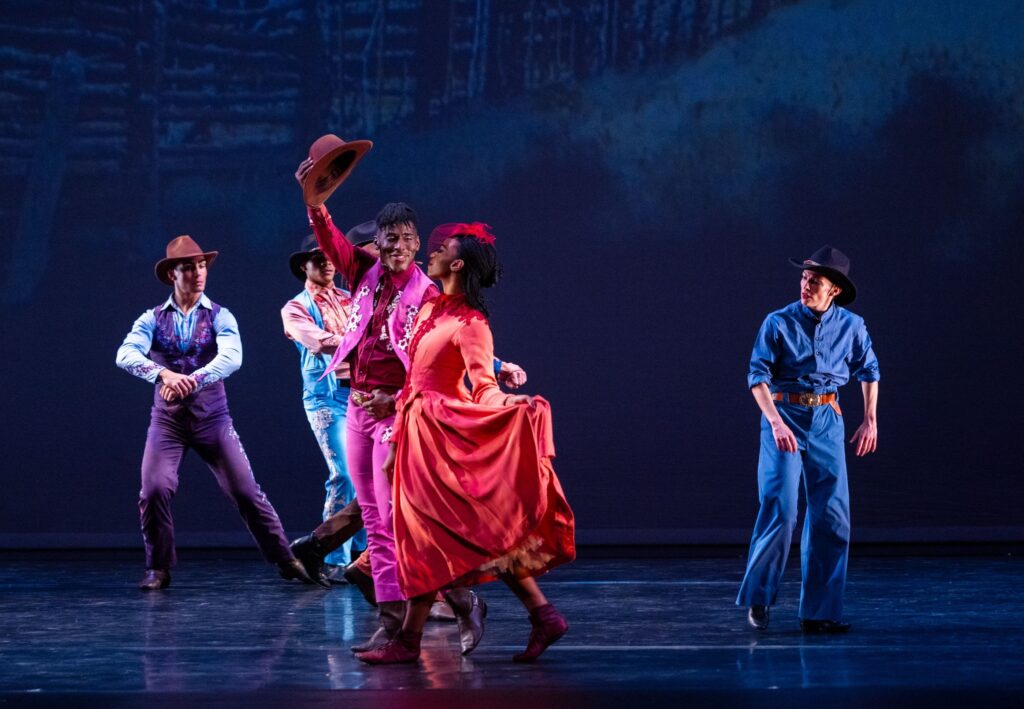
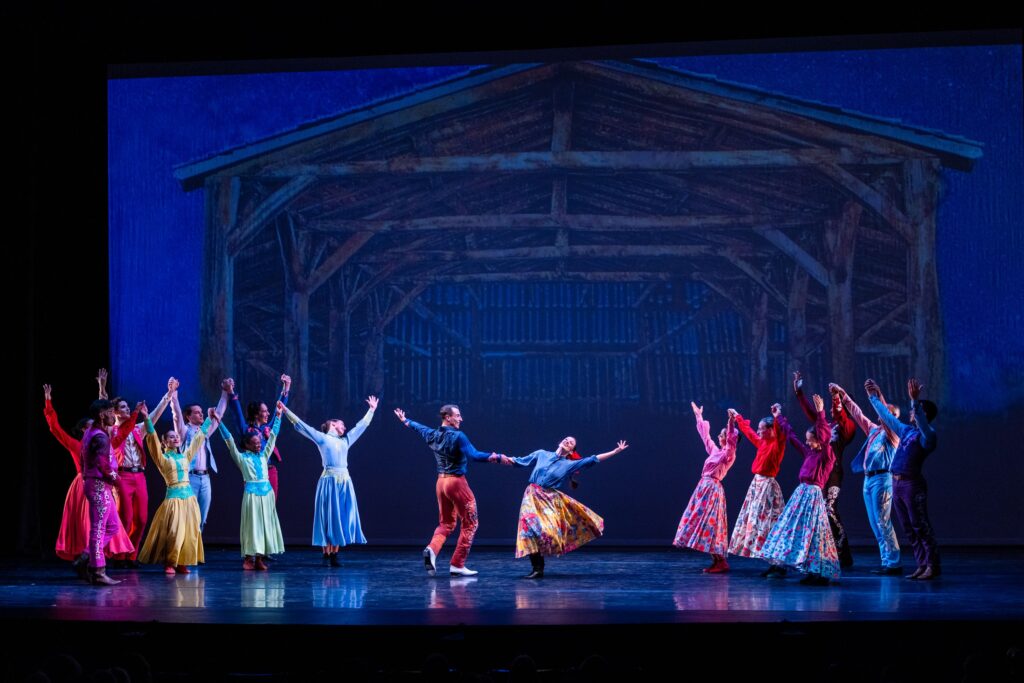
Close Graham friend and collaborator Agnes de Mille, the storyteller niece of filmmaker Cecil B. DeMille, choreographed the iconic “Rodeo or The Courting at Burnt Ranch.” For its GRAHAM100 3-year celebration, Gabriel Witcher rearranged Aaron Copeland’s trademark music for a six-piece bluegrass ensemble. Celebrating the diverse genesis of America, the piece is a series of humorous vignettes featuring dancers clad in full-blown cowpoke, cowgirl, and genteel pioneer women’s regalia.

Like a silent movie, the action takes place on a Saturday afternoon and evening on a ranch in the southwest. DeMille referred to her work as “a pastorale, a lyric joke,” and as The Cowgirl, Laurel Dalley Smith manages to be sassy and funny while displaying serious dancing talent. The piece flits from a Wyatt Earp TV set to a mariachi band to a barn dance, loving spoofs that straddle Broadway blockbuster musicals, classical ballet, and cowboy rodeo activities. In between are tastes of square dances, polkas, and couples pairing and unpairing. Screen projections that change from ranch to sunset to starry night to barn dance are effective without being hokey.

Post intermission, the afore-described “Lamentations” is even more stunning on the heels of the slapstick-like “Rodeo.” So Young An, the recipient of the International Arts Award and the Grand Prize at the Korea National Ballet Grand Prix, is a talent to be reckoned with.
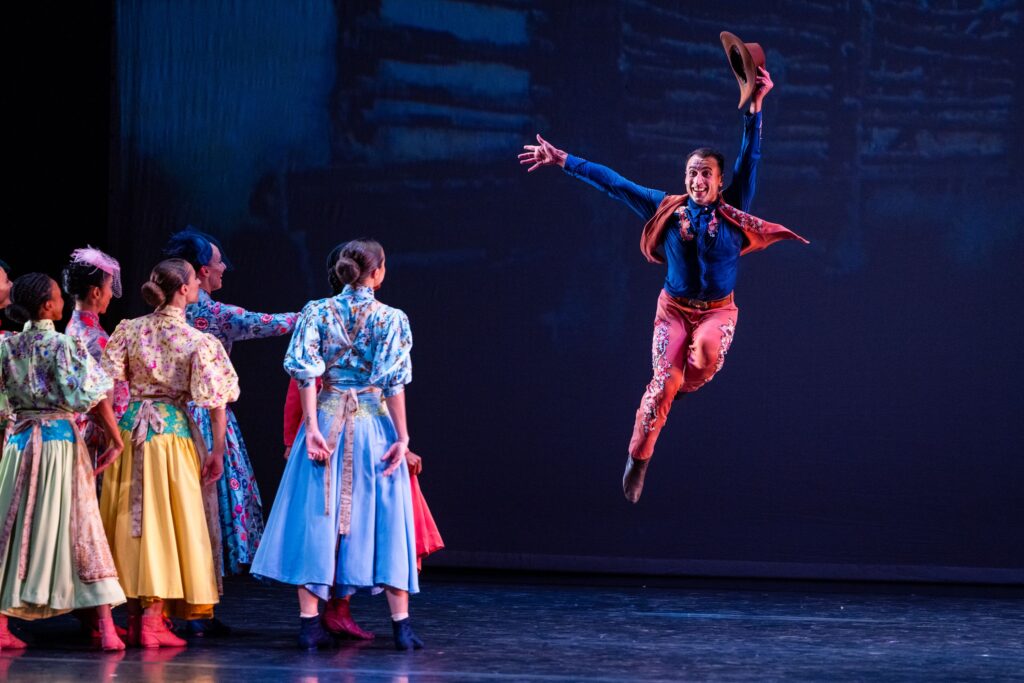
The evening ends with the 2024 piece, “The People.” Choreographed by Jamar Roberts, who describes his work as “part protest, part lament,” the piece resonates with references to American history. Dancers are both uplifting paeans to the hope and promise of American folk music and downtrodden, burdened examples of what can happen when America doesn’t live up to its promises. A new score by Pulitzer Prize-winning composer and American roots musician Rhiannon Giddens (arranged by Witcher) spotlights rich, throaty harmonies peppered with pockets of poignant silence.

The last time the Martha Graham Dance Company adorned Boston’s stage was in 2005. Judging from the exuberant standing ovation its 2024 audience bestowed last Friday evening, one can only hope they got the message that they have been away far too long.
ASP’s ‘Emma’ Is Deliciously Incisive, Ingenious and Impudent

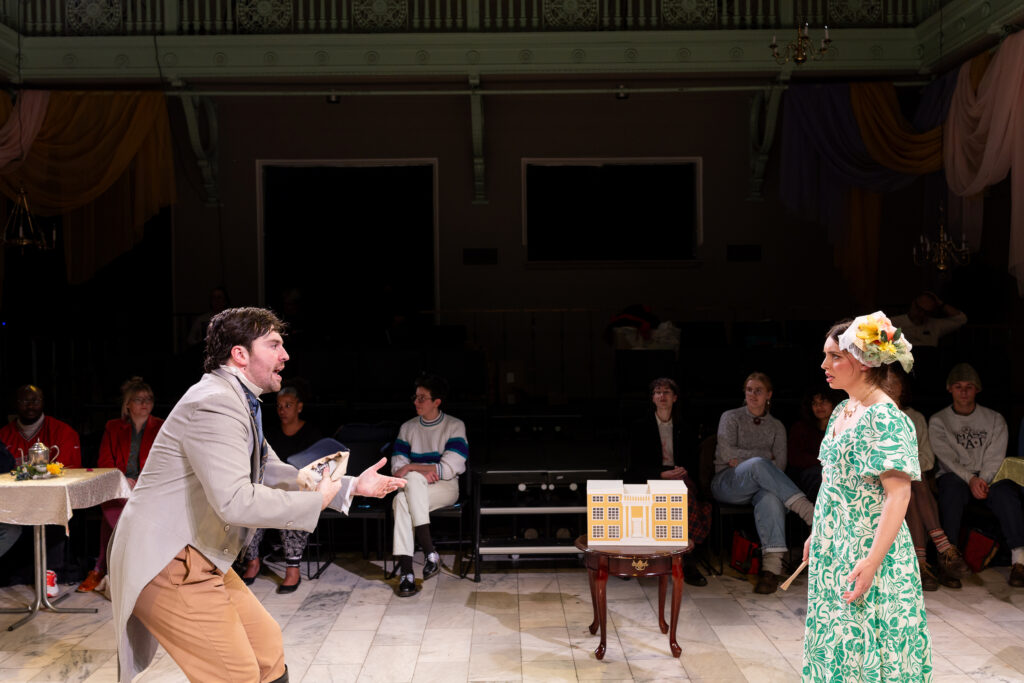
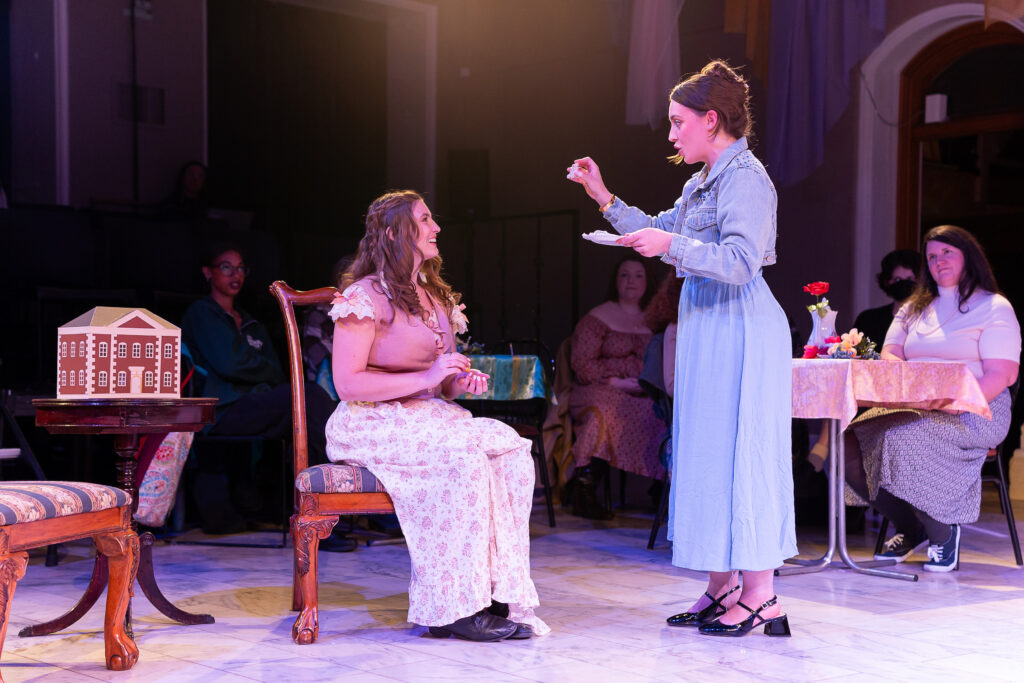
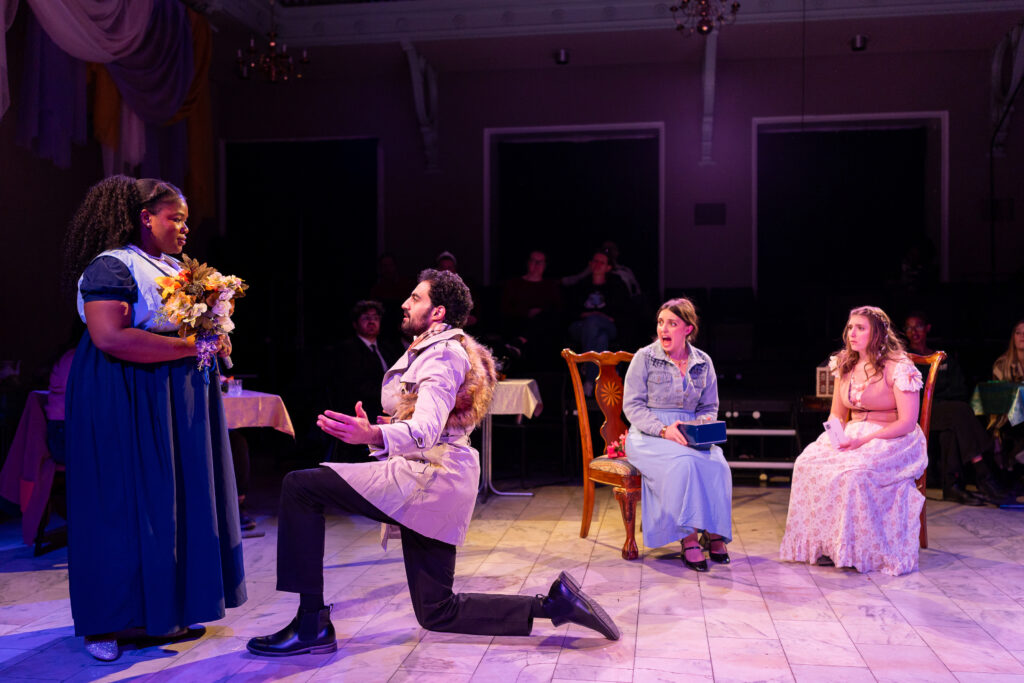
Lorraine Victoria Kanyike, Fady Demian, Josephine Elwood, and Liza Giangrande in Actors’ Shakespeare Project’s production of ‘Emma’. Photo by Nile Scott Studios.

‘Emma’ — Written by Kate Hamill. Based on the novel by Jane Austen. Directed by Regine Vital. Scenic Design by Saskia Martinez; Costume Design by Nia Safarr Banks; Lighting Design by Deb Sullivan; Sound Design by Anna Drummond. Presented by Actors’ Shakespeare Project at Multicultural Arts Center, 41 Second St., East Cambridge through December 15th.

By Shelley A. Sackett

Jane Austen’s 1815 novel “Emma,” like all her other novels, explores the concerns and difficulties of genteel women living in Georgian–Regency England. Her Emma Woodhouse is a bright, wealthy, and confident young woman who basically has it all — education, intelligence, beauty, and money. She also has a surplus of self-confidence, pride and time. She is as spoiled, meddlesome, and self-deluded as she is witty, charming, and pithy.

She lives in an age that prepares wealthy women like Emma for a life of the mind but permits them no occupational outlet. It is matrimony or nothing. It’s no wonder the poor girl nearly explodes with pent-up energy and resentment.

Bored with her own life, Emma turns to the challenge of meddling in the lives of others, manipulating them for sport. She doesn’t court friends; she undertakes assignments. Although she is as unskilled at reading others as she is at self-examination, she fashions herself a gifted matchmaker. Her delusional overconfidence as a marriage broker blinds her to her own romantic potential and leads to misunderstandings, mayhem and heartache.

To her credit, Kate Hammill has taken Austen’s borderline unsympathetic heroine and turned her into a likable rebel who rails against the cruel patriarchal system that imprisons her potential. “What is the purpose of educating women only to have them marry?” she asks. “I must have something to do, or I shall go mad.”

Hamill is no stranger to the genre (she adapted three other Austen works as well as “Little Women” and “Vanity Fair”), and her “Emma“ brims with a delicious melding of past and present, creating a heroine as at home at a lady’s afternoon tea as cutting up the disco dance floor in a white go-go jumper.

Elwood and Mara Sidmore

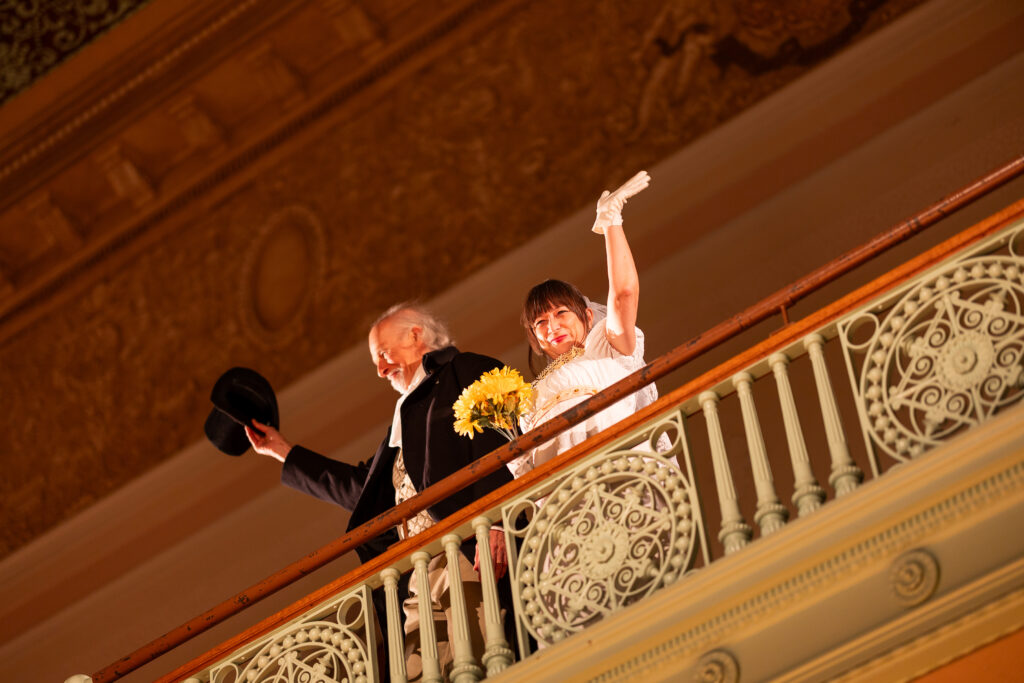
Over nearly 2 1/2 hours (one intermission), the plot unfolds. Emma (played with boundless joy and energy by Josephine Moshiri Elwood) and the cast are introduced to us at a party celebrating the wedding of her former governess, Anne (Mara Sidmore), and the widower Mr. Weston (Dev Luthra). Emma tells her father and her best friend since childhood, George Knightley (an outstanding Alex Bowden), that she practically arranged the marriage by introducing them. After such a clear “success,” Emma is determined to make another match. This time, she has set her sights on Mr. Elton, the village vicar. Both Emma’s father and Knightly caution her against interfering, but they ultimately fail to dissuade her.

“You can’t control everything, Emma,” Knightly warns her repeatedly, only to meet the same response: “But isn’t it fun to watch me try?”

In an act as dispassionate and calculating as Henry Higgins’ taking on Eliza Doolittle, Emma decides that for her next “project,” she will undertake the transformation of Harriet, a 17-year-old student of unknown parentage and inferior social status. Harriet is an eager beaver, as compliant and adoring as a lapdog.

Emma sets about improving (i.e., making her more like herself) her “friend,” starting with convincing her that the groundskeeper, Robert Martin (Fady Demian), the man she loves, is beneath her. When he proposes, Emma gets Harriet to refuse him. She is determined to get Mr. Elton to fall in love with Harriet, thereby elevating both Harriet’s social standing and her own reputation as an unmatched matchmaker.

Needless to say, all does not go according to Emma’s plan. The rest of the play is peppered with colorful characters and rotating liaisons that, owing to double and triple casting, are often hard to keep straight. Aloof, mysterious Jane Fairfax (Lorraine Victoria Kanyike) is Emma’s equal and rival, the only one able to ruffle Emma’s feathers. She is as cool as Emma is hot-blooded, as calm as Emma is kinetic.

Adding insult to Emma’s injured pride, she is also accomplished (as a governess) and intriguing (she left her most recent job under mysterious conditions). She is a thorn in Emma’s side, catapulting her best-laid plans into the abyss.

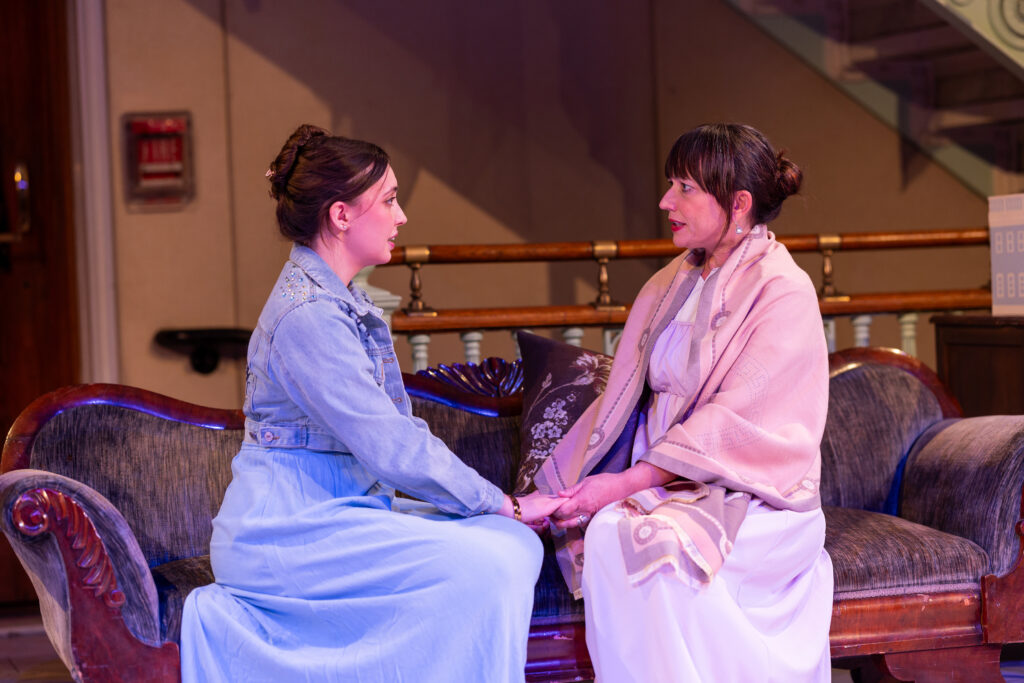
Although marriage doesn’t figure into Emma’s plans for herself, Knightly and Emma are a match made in heaven that is tediously obvious. They squabble and dance around each other until Emma’s former governess, a very pregnant Anne, practically knocks their heads together and tells them to “work it out!”

Emma must first be pushed off her narcissistic pedestal before this can happen. Ironically, it is meek, malleable Harriet who does the honors when she rejects Emma’s “help” and realizes she has been duped. “You think you control everything, but you don’t control me anymore,” she practically spits.

Like a deer caught in headlights, Emma has a major breakthrough of sudden self-examination. Breaking the fourth wall (which Hamill and Vital execute frequently and effectively), she addresses the audience with cartoonish naïveté. “I may not know everything,” she deadpans in the same stunned voice with which Dorothy announces, “Toto, I have a feeling we’re not in Kansas anymore.”

Liza Giangrande and Elwood

Subtlety is hardly this production’s strong suit.

What IS its strong suit is a stellar cast with unrivaled energy. Elwood IS Emma, with all her strengths and weaknesses. It is a pleasure witnessing an actor so comfortable in her own skin and in that of her character’s, and a joy to behold her joy in the role.

As Harriet, Liza Giangrande has to walk a fine line between hysterically funny and pathetically histrionic. Giangrande rises above the sometimes two-dimensionality of her character, embracing Harriet’s more accessible, loveable, trusting side.

Bowden’s Knightly centers the plot and grounds Emma. He also projects and articulates so effectively that even when his back is to the audience (a frequent and unfortunate feature of the staging, as is poor sight lines from most seats), his lines are easily understandable. Likewise for Mara Sidmore’s Anne Weston.

Although the play is fun, full of funny one-liners and Monty Python-esque routines, at the end of the day, it is Emma and the complicated times she lives through that resonate. As we wade through the sight gags, slapstick, and farce, her plaintive refrain rises above to ring clear as a bell: “What is the purpose of educating women if a lady is not allowed real employment?”

Yet Hamill ends on a hopeful note, planting the seeds of 20th-century feminism in 19th-century soil.

“If I teach my girls the best I can and they teach their girls the best THEY can and their girls and their girls, and so on – who knows what we could make? What power we could harness? What we could do? Can you imagine—someday—a whole world full of Emmas, working together?” Emma asks the half-stunned, half thrilled Knightly.

Dev Luthra and Mara Sidmore

“Now THAT, dear Emma,” Knightly should have said in response, ”is a cause indeed worthy of a rebel like you.”

For more information, visit https://www.actorsshakespeareproject.org/