Harbor Stage Brings the Cult Film ‘My Dinner with André’ to Life

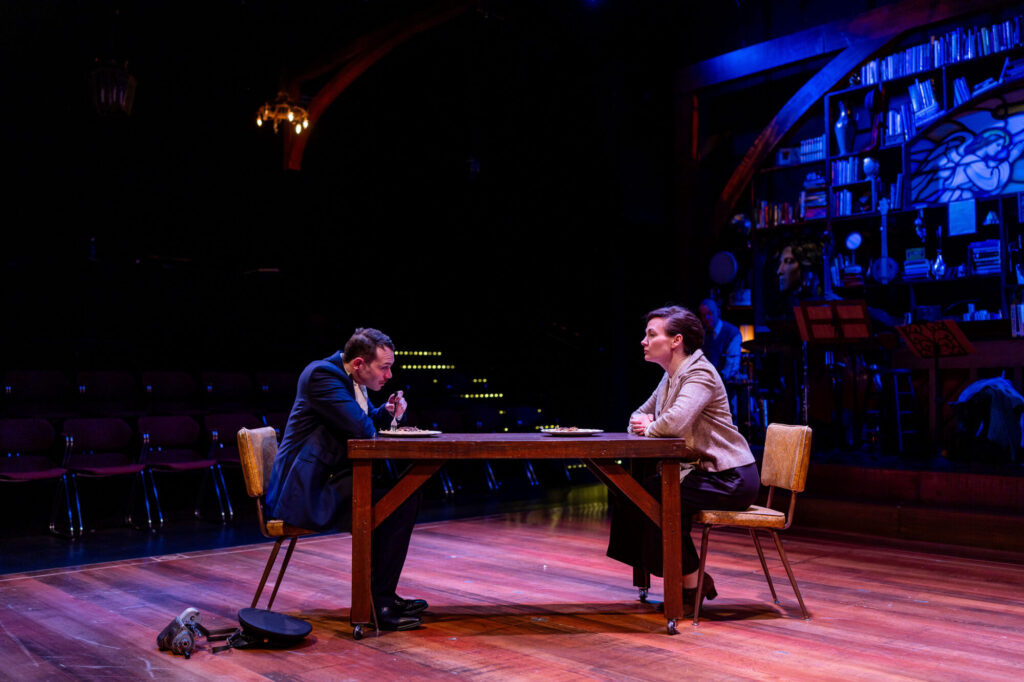
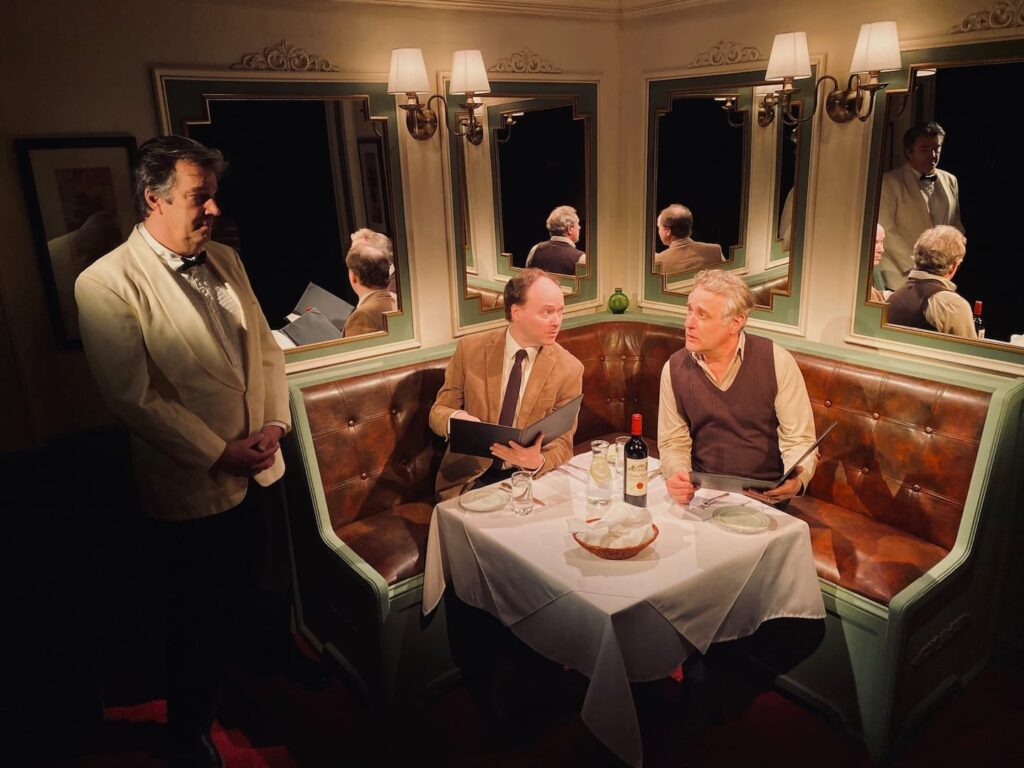
Robin Bloodworth, Jonathan Fielding, and Robert Kropf in Harbor Stage Company’s “My Dinner with Andre.” Photo: Joe Kenehan

By Shelley A. Sackett

A corner booth, fancy fare and tasty conversation — who doesn’t remember the cult frenzy caused by Louis Malle’s 1981 110-minute film that enchanted audiences, defied pigeon-holing and raised the bar on the “art” referred to as conversation?

This unconventional film should have been all but unwatchable. After all, it is simply a cinema verité version of a conversation between playwright Wallace Shawn and André Gregory, a well-known experimental theater director who seems to have dropped off the edge of the planet and whom Shawn has been trying to avoid for years.

For some, the film actually was unwatchable, and it is not to that audience that Harbor Stage’s theatrical version is geared. For those, however, who found the film charmingly quirky, the production at BCA Plaza Black Box Theatre is right up your alley.

Adapted by Jonathan Fielding (who plays – and looks like – Wally Shawn) and Robert Kropf (ditto for André Gregory), the play brings its audience through the celluloid keyhole right into the cozy, ritzy Manhattan restaurant. Evan Farley’s terrific scenic design channels the film’s setting with chandeliers, chic sconces and rich red leather upholstery. Four gilt-framed mirrors line the walls above the booth, a stroke of brilliance that allows the audience to witness the characters’ actions and reactions from multiple angles and perspectives.

Breaking the fourth wall from the get-go as narrator and soul bearer, Wally lets the audience eavesdrop on his internal monologue Woody Allen-style. “Asking questions always relaxes me,” he confides, setting the tone for the questions about life, death and everything in between that will occupy the next 90 intermission-less minutes.

The two meet at the restaurant and it is immediately clear that Wally is a fish out of water with the swanky menu (which, in an aside, he confesses he can’t translate) and even swankier server (a Lurch-like Robin Bloodworth). André is comfortably in his element and, with infinitesimal prodding, launches into an epic monologue that is as shocking in its length as in the fact that it is neither boring nor obnoxious, despite André’s obsessive fascination with all things André.

He tells Wally that he strives to lead his life as improvisational theater, and his journeys through the Sahara desert to Tibet to the forests of Poland are surreal and capture Wally’s attention. (In truth, Wally may be less captivated than relieved to be cast as the silent listener). Nonetheless, André’s insistence on waking himself to the true meaning of life and hurtling through the emotional cosmos contrasts perfectly with Wally’s grounded, simpler take on what it means to be a human being.

For André, a complacent life is a squandered life. Wally, on the other hand, not only sees nothing wrong with comfort but actively seeks it out. He’s just trying to survive, he admits, and unapologetically takes pleasure in such simple matters as errands, responsibilities, and Charlton Heston’s autobiography. He can’t understand why André is so wrapped up in figuring out what makes a hypothetical life worth living that he is unable to enjoy the details of his own life. Exasperated, Wally blurts out, “I don’t know what you’re talking about,” the truest words he’s uttered all evening.

When the two discuss theater and the responsibility of its creator to its consumer, things get more interesting and realer because Wally (finally) speaks up and disagrees with André. André insists that theater needs to show the audience a version of the world that is different from their reality, to take them to an extreme place that will shake and shock them into consciousness.

Wally believes that theater should connect people with reality and be enjoyable. People go to theater to be entertained and to relax, not to be confronted by existential crises. He is more perplexed by the challenge of eating quail (“God, I didn’t know they were so small”) than the quest for the answer to the meaning of life.

Even if all this verbosity, pompousness and navel-gazing turns you off, you might still consider seeing ‘My Dinner with André’ just to bask in the performances. Kropf is phenomenal as André, his cadence and gestures imbuing pages of monologue with simplicity and purposefulness. The tiniest flicker of an eye or tonal shift softens his character and exposes an interiority that prevents André from devolving into a shallow, two-dimensional showoff.

Fielding is the perfect foil. His Wally is a little nervous, a little frumpy and satisfied enough – for now. His facial reactions to André’s stories say more than pages of dialogue might; his slight self-conscious discomfort renders him all the more endearing. If the ordinary rules of life don’t seem to apply to André, Wally is only too happy to take up the slack, following the path of least resistance and most relief.

‘My Dinner With André’ – Based on the film by Wallace Shawn and André Gregory. Developed by Johnathan Fielding and Robert Kropf. Production Stage Management by D’Arcy Dersham. Scenic Design by Evan Farley. Lighting Design by John Malinowski. Produced by Harbor Stage Company, ‘My Dinner With André’ runs at BCA Plaza Black Box Theatre at 539 Tremont Street, Boston. Run has ended

For more information visit: https://www.harborstage.org/
In The Huntington’s ‘The Triumph of Love,’ All’s Fair in the War Between Reason and Romance

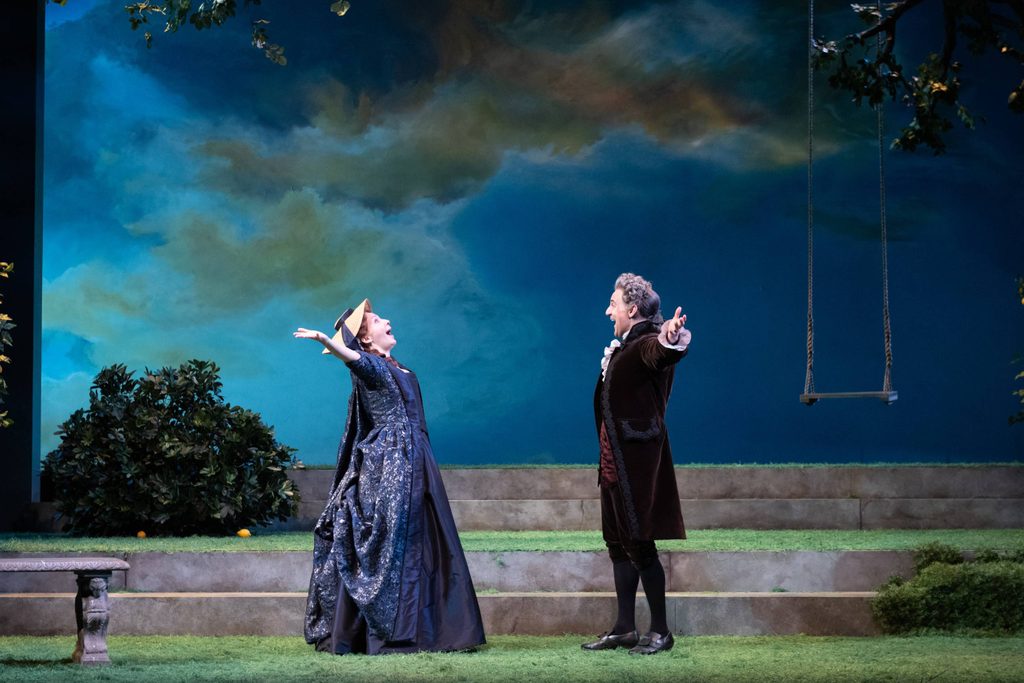
Marianna Bassham, Nael Nacer in Huntington’s ‘The Triumph of Love’. Photos by Liza Voll

By Shelley A. Sackett

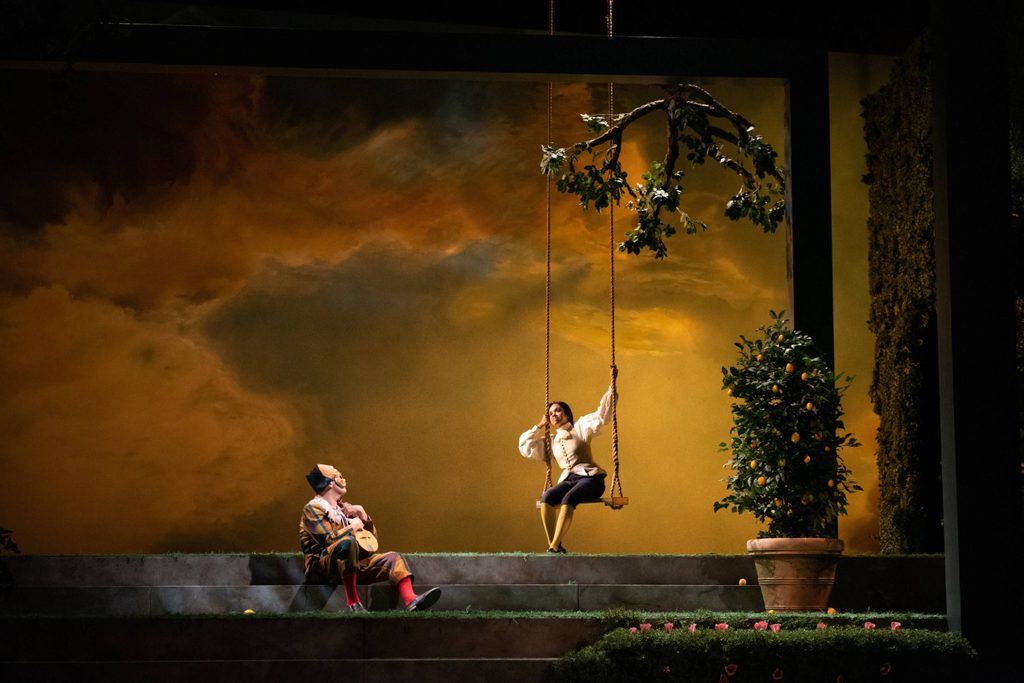
Pierre Carlet de Marivaux’s “The Triumph of Love,” which premiered in 1732 and is at The Huntington through April 6, is like a trifle dessert, with light spongey layers of raucously funny deceptions, disguises and mistaken identities soaked in a sherry-spiked pastoral period set design. Instead of the traditional alternating tiers of sweet jams and custard, however, Marivaux has substituted a bitter concoction of calculated cruelty and manipulation. The end result is a sugar-coated confection that leaves a very bitter taste in the mouth.

Stephen Wadsworth’s definitive and sparkling translation is chock-full of clever double entendres and contemporary plays on words that prevent Marivaux’s commedia dell’arte from getting stuck in 18th-century French linguistic mud.

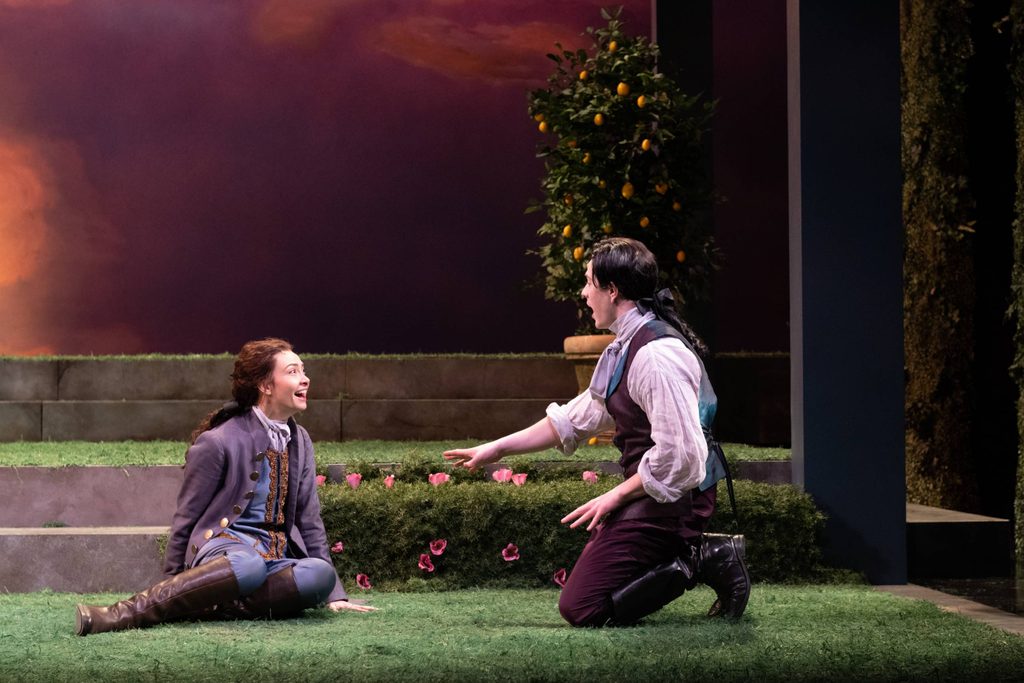
A hectic first scene gives the lay of the land. We meet two women, loosely disguised as men, in the country retreat setting of a manicured garden. Princess Léonide (an excellent Allison Altman) and her maid, Corine (Avanthika Srinivassan), quickly bring the audience up to speed on who they are, why they are there, and what they plan to accomplish.

Vincent Randazzo, Avanthika Srinivasan

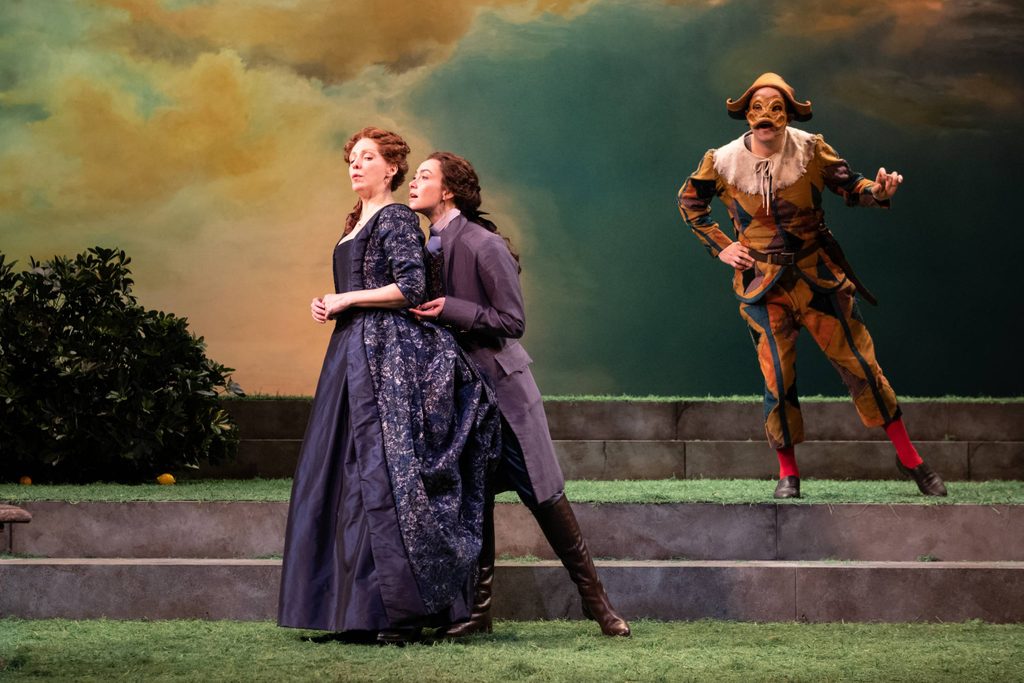
Léonide (incognito as the man Phocion) is the princess of Sparta, but only because her uncle stole the throne from the rightful king (who, to make matters more complicated, had kidnapped the rightful king’s mistress). While on a walk in the woods, Léonide spotted the young man Agis (Rob Kellogg), who lives in the household of the old philosopher Hermocrates (a terrific Nael Nacer) and his spinster sister, Léontine (Marianna Bassham, perfectly cast). It turns out that Agis is the true prince and rightful heir to the Spartan throne. Hermocrates, a strict follower of Enlightenment tenets, rescued him and raised him in seclusion to embrace the safety of rational reason and spurn the dangers of the kind of romantic love that destroyed his parents.

Undaunted, Léonide vows to win Agis’ heart and restore him to power. First, though, she has to get past the brother and sister team of Hermocrates and Léontine. No problem for our wily and ingenious princess; she will simply get them both to fall in love with her so she can then use them in her pursuit of her true love.

All of which, through a series of tricks, treacheries and outright cons, she accomplishes. Employing a variety of alter egos and all her charm and quick-tongued-ness, she turns the heads of the stuffy Hermocrates, his desiccated old maid sister, and his virginal charge.

Allison Altman, Rob B. Kellogg

On its surface, ‘A Triumph of Love’ explores and ridicules the sharp lines drawn between the Enlightenment’s Age of Reason and the subsequent Romanticism movement, which focused instead on emotion, individualism, and the sublime. There are some great supporting characters, including Hermocrates’ servant, Harlequin (a delightfully spry Vincent Randazzo), and gardener, Dimas (Patrick Kerr), and some corny, rim-shot humorous one-liners. (“They are dresspassers,” Harlequin says of Léonide and Corine, and “Digression is the better part of a valet.”) Harlequin and Dimas are breaths of fresh air, and Randazzo’s entr’acte solos are wonderful diversions.

There is also a lot of meaty, thought-provoking dialogue about the meaning of life, liberty and the pursuit of happiness, especially when it comes to love. Marivaux isn’t afraid of exposing his characters’ seamier sides, and he asks some tough, smart questions about complicated philosophical issues.

Bassham, Altman, Randazzo

Junghyun Georgia Lee’s classically elegant set and costume designs are spot on, as is Tom Watson’s hair, wig, and makeup design (special kudos for Nacer’s transformed pate!). Although the first act drags a bit, director Loretta Greco (and, therefore, her cast) find their footing in the second act, which flows more easily and naturally. As Léonide, Altman is a triumph, which is fortunate since she dominates nearly every scene during the production’s 135 minutes (one intermission). She never ceases to surprise and engage, no matter how contrived and repetitive the ruse, a masterly feat to be sure.

Yet, for all the romping and spoofing, there is an undeniable nastiness reminiscent of “Les Liaisons Dangereuses.” To try to change the minds of those stuck in the rigid rules of reason and logic, and advocating for a life of feeling and love by engaging in honest debate, is one thing. But proving your point that a life of passion is not only possible but preferable by tricking people to fall in love with you and then discarding them is just plain mean. Awakening a frozen heart to feeling and then condemning it to a life of philosophy without love not only proves the point that love is self-serving, hazardous and risky; it also raises an even bigger and more timely issue: can nefarious means ever justify the ends?

‘The Triumph of Love.’ Written by Pierre Carlet de Marivaux. Adapted by Stephen Wadsworth. Directed by Loretta Greco. Scenic and Costume Design by Junghyun Georgia Lee. Hair, Wig, and Makeup Design by Tom Watson. Lighting Design by Christopher Akerlind. Composer and Sound Design by Fan Zhang. Presented by The Huntington Theatre, 264 Huntington Ave., Boston through April 6, 2025.

For more information, visit https://www.huntingtontheatre.org/whats-on/the-triumph-of-love/

Don’t Let The Bleak Premise Of The First Rate Musical “Parade” Scare You Away

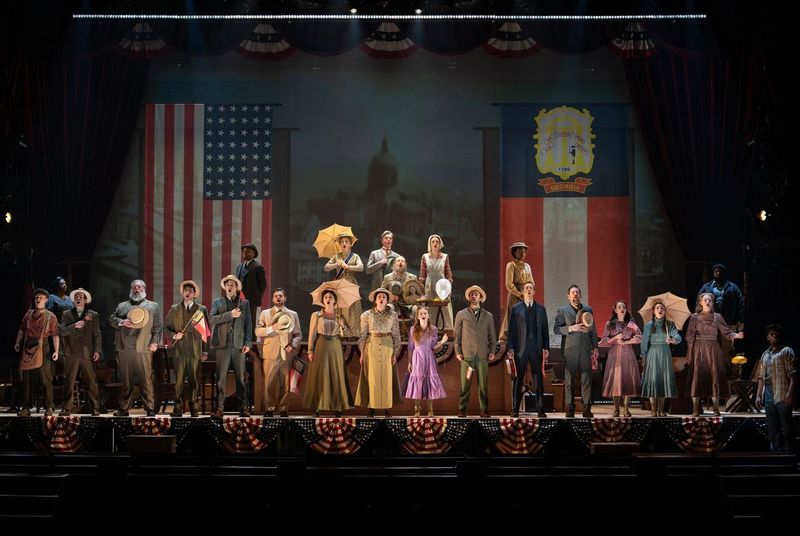
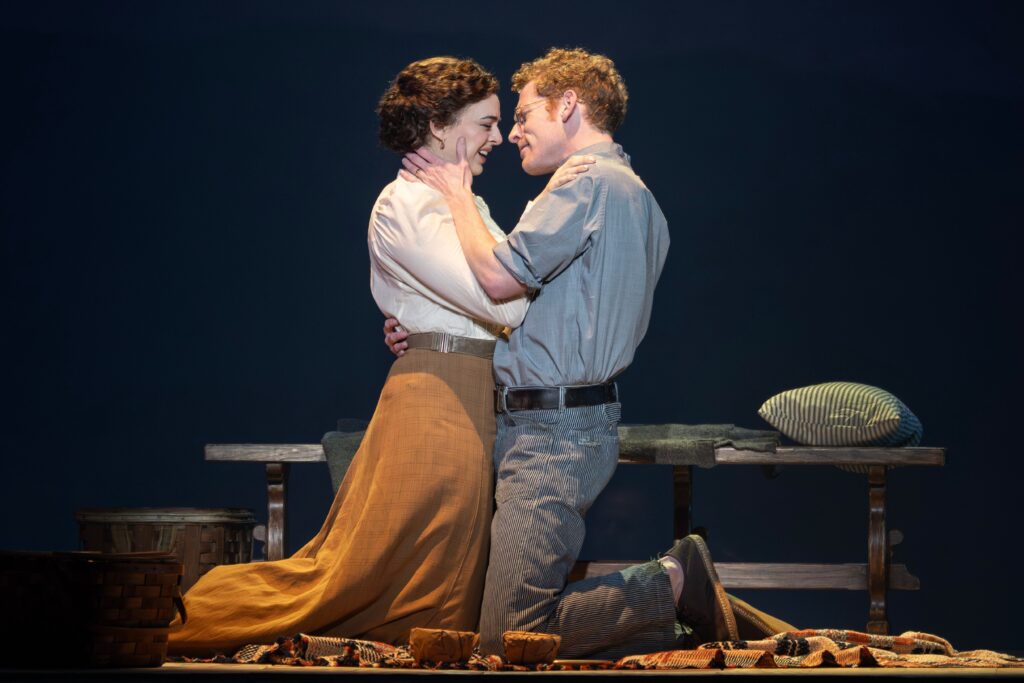
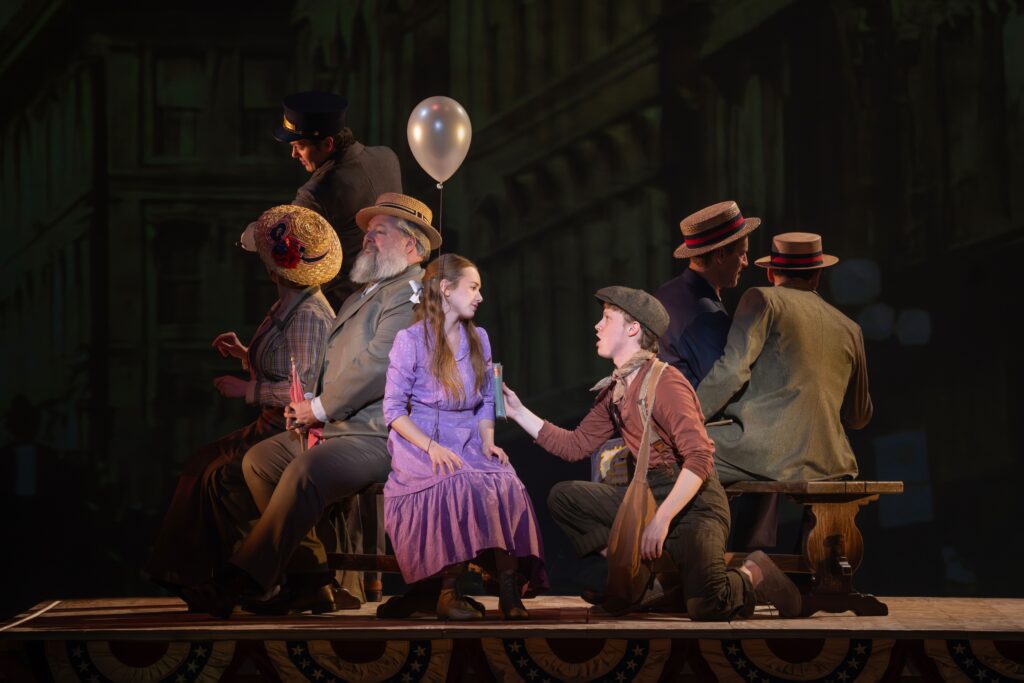
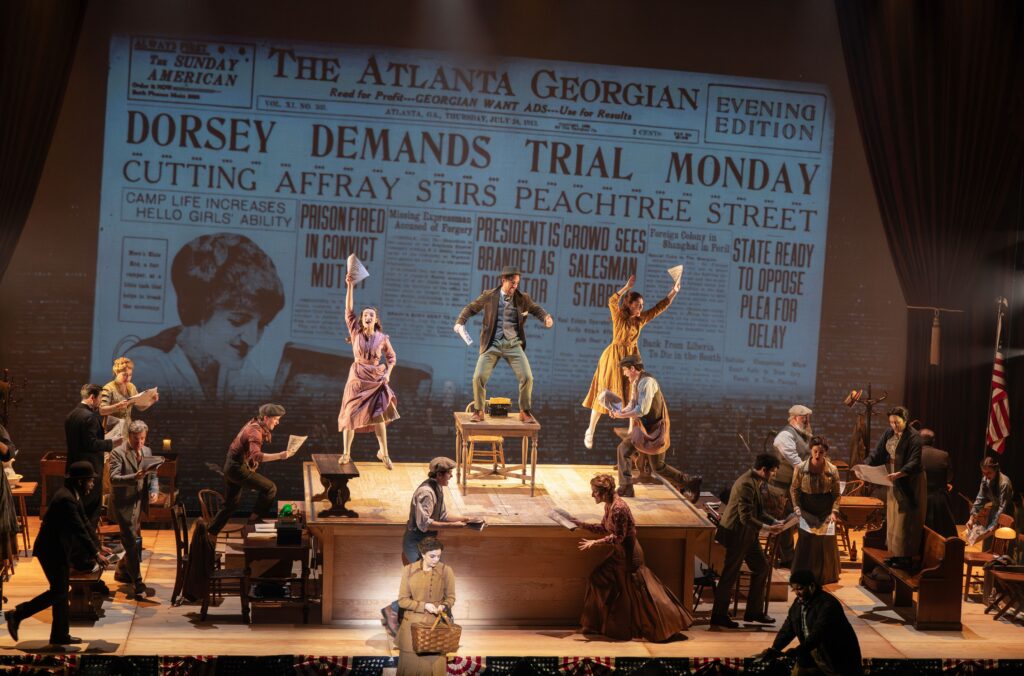
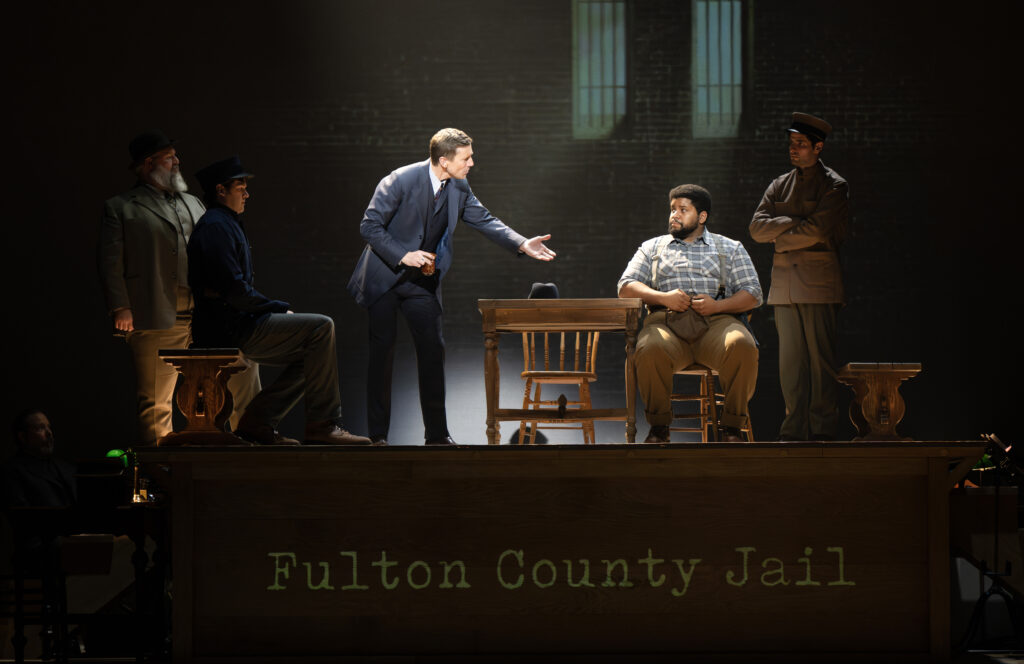
Cast of the National Tour of ‘Parade’ at the Emerson Colonial Theatre.
Photos by Joan Marcus

By Shelley A. Sackett

It was with trepidation that I attended opening night of “Parade,” now at the Emerson Colonial Theatre through March 23. After all, the premise of the 2023 multiple Tony Award-winning musical revival is hardly uplifting. The book by Alfred Uhry (author of “Driving Miss Daisy”) is set in 1913 Atlanta and tells the true story of Leo Frank, a transplanted Brooklyn Jew and pencil factory supervisor who is married to his Jewish boss’s daughter, Lucille. As the newlyweds struggle to carve out their lives in the red hills of Georgia, Leo is falsely scapegoated for the murder of a 13-year-old white girl in his employ. The rest of the play dramatizes his trial, imprisonment, and 1915 mob lynching.

In the current climate of rampant disinformation and antisemitism, it’s easy to understand why some might eschew entertainment that is grounded in both.

At no point does the 180-minute show (one intermission) shroud the wretched facts of the case and the ginned up hate, prejudice and calculated lies that fueled Atlanta’s judicial, political and journalistic engines. Yet, like alchemy, first-rate staging, talent and especially Jason Robert Brown’s rapturous Tony Award-winning score of 29 songs transform this cheerless tale into a riveting musical production that scratches well below the surface to examine just what made the Jim Crow South tick.

Max Chernin, Talia Suskauer

The stage is minimally set (design by Dane Laffrey) with a high and low platform that will magically evoke the Franks’ home, a witness box, a factory, a soapbox, a cell and a governor’s mansion. Throughout the show, background projections display real photographs, names and dates of the play’s characters as well as archival photos of 1910s Atlanta, newspaper stories and the “Leo Frank Lynching” memorial plaque in Marietta, Georgia. These both make the action easier to follow and remind us that “Parade” is based on truth.

The play opens in 1863 Marietta (“The Old Red Hills of Home”) as a young soldier leaves his lover for battle. Fifty years later, Atlantans still romanticize and mythologize the glories of the Civil War’s “Lost Cause” with Confederacy Day, which is when we first meet Leo and Lucille Frank.

“Why would anyone want to celebrate losing a war?” Leo (a pitch perfect, exceptional Max Chernin) asks his wife. Wiry, prickly and bespeckled, he struggles to fathom the mores of Atlantans. “For the life of me, I can’t understand how God could create people who are Jewish and Southern at the same time,” he bemoans.

Lucille (Talia Suskauer, whose voice seems directly wired to her emotions) doesn’t understand Leo’s Yankee manners any better than he grasps the ways of a Jewish southern belle. We are left wondering what drew these two to each other in the first place. Their singing selves couple in a soaring intimacy that their characters just can’t mirror.

Olivia Goosman, Jack Roden

Their marital conflict pales compared to the troubles that unfold when the body of Mary Phagan is discovered  in the factory. Two suspects are ripe for the picking: Newt Lee, the Black night watchman, and Leo Frank. That Leo is a self-absorbed workaholic who carries himself with a supercilious self-importance may make him hard to like, but his downfall is no less tragic.

District Attorney Hugh Dorsey (a believably slimy Andrew Samonsky) needs a conviction, and hanging another Black “ain’t enough.” The professional boost he seeks requires something more. This time, he’ll need to hang “the Jew.” He suborns testimony from many sources, threatening and cajoling even the Frank’s loyal maid, Minnie. Ex-con Jim Conley (Ramone Nelson in a barnstorming, show-stopper of a performance) fabricates eye witness evidence to save his own skin, yet ends up back on the chain gang when Donley double crosses him. Newspaperman Britt Craig (Michael Tacconi) hails the resurrection of his career as he stokes antisemitic hysteria and catches the eye of his editor.

Atlantans are only too happy to take the bait and, as Act I ends, Leo is swiftly convicted, sentenced to death and jailed.

Director Michael Arden’s staging at several critical moments expands “Parade’s” theatricality and our access to Leo’s opaque interiority. Now imprisoned, Leo spends the entire intermission sitting onstage with his head in his hands. Shed of his cocky, brittle skin, he presents as more grounded and relatable. Although jarring, having Leo mime the false testimony of others during his trial is another stroke of dramatic brilliance.

Act II shifts to Leo and Lucille’s marriage, which is strengthened by his imprisonment and their joint efforts to prove his innocence. Eventually, Governor Slaton (a solid Chris Shyer) heeds Lucille’s pleas and, after investigating, commutes Leo’s sentence to life. His fate has already been sealed in the book of public opinion, however, and he is kidnapped and hanged.

With this storyline fully established from the prologue, it is indeed a wonder that “Parade” feels as dynamic, affective and —yes — entertaining as it does. Make no mistake; this is a first rate Broadway production with a lot going for it.

The cast of vocal performers (particularly the leads and Nelson) is, with few exceptions, extraordinary, and they have a lot to work with in Brown’s marvelous score. Backed by a terrific orchestra, Brown’s Sousa-style marches, work songs, haunting duets and raw blues and efficient, targeted lyrics achieve more than a page of dialogue might. While injustice and inhumanity are ever present, they simmer and percolate rather than boil over. Granted, some of the actors’ accents need polishing and the characters’ unambiguous goodness/evil renders them somewhat two-dimensional, but the timeliness and relevance of this ongoing story is almost reason enough to see it.

(Foreground) Andrew Samonsky, Robert Knight

The wave of antisemitism that results in Leo’s conviction and lynching led to both the formation of the Anti-Defamation League and the resurgence of the Ku Klux Klan, both still significant forces. When the chorus of white Georgians chants, “hang ‘im, hang ‘im, make him pay,” it’s impossible not to hear the January 6 refrain and feel its aftershocks. As “Parade” points out, although Leo Frank’s death sentence was commuted, the case, reopened in 2019, is ongoing. Mary’s killer was never found. Unlike the more than 300 cases overturned thanks to the Innocence Project, he has never been exonerated.

As Leo is about to be hanged, right before chanting his final “Shema,” he states, “God chose me for a plan. I don’t know what it is.” Perhaps, at this time of thinking about who gets to write history’s story, one thread of that unknown plan is to broaden the inquiry and ask ourselves who had to pay for those stories we get to tell, and at what price? 

Parade – Book by Alfred Uhry; Music and lyrics by Jason Robert Brown; Co-conceived by Harold Prince; Directed by Michael Arden; Choreography by Lauren Yalango-Grant & Christopher Cree Grant; Music direction by Charlie Alterman. At the Emerson Colonial Theatre, Boston, through March 23rd.  

For tickets and more information, visit emersoncolonialtheatre.com/

SpeakEasy’s ‘A Man of No Importance’ Is Must-See, Feel-Good Theater at Its Absolute Finest

Theater Mirror

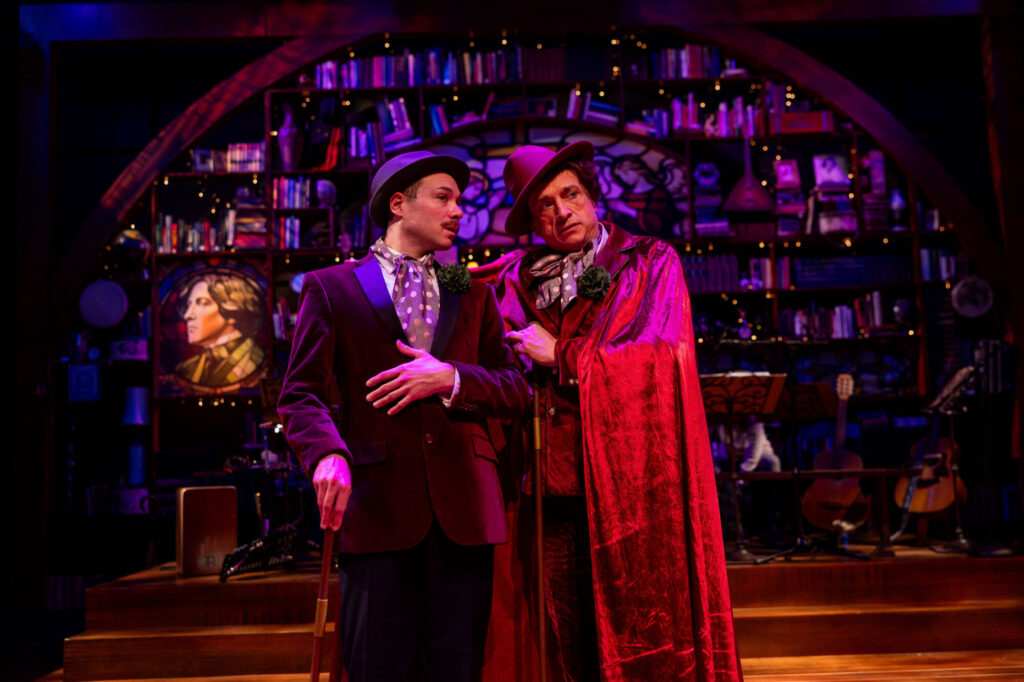
Eddie Shields and Will McGarrahan in Speakeasy’s ‘A Man of No Importance’
Photos by Nile Scott Studios

By Shelley A. Sackett

There is so much to praise about SpeakEasy Stage Company’s ‘A Man of No Importance,’ director Paul Daigneault’s swansong production after leading the company he founded for 33 years, it’s hard to know where to begin.

Terence McNally’s Tony Award-winning play, for starters, is a brilliant choice for any audience at any time, but its message is especially poignant today. A musical based on the 1994 film, it tells the story of an amateur theatre group in 1964 led by their queer, closeted bus driver leader who is determined to stage a version of “Salome” at his church, despite the objections of church authorities.

1960s Ireland had not yet progressed beyond the era of Oscar Wilde, who was jailed from 1895-7 after a criminal conviction for gross indecency for homosexual acts. Decades away from the days when “coming out” became acceptable, being gay was still a crime in Ireland. McNally, an ardent gay rights advocate, infuses his main character, Alfie Byrne, with his passion. Eddie Shields plays the charismatic character with a pitch-perfect blend of pathos, compassion, and zeal.

At the heart of the play is Alfie’s painful struggle to be his authentic self. He finds relief by channeling his energy and angst in the St. Imelda’s players, a group of local amateurs whom Alfie imbues with his own love for the magnetic magic of the theater.

Shields and cast

The rehearsal space and the camaraderie it engenders create a sanctuary where the community can gather and unapologetically be themselves. They are there for each other but most of all, they are there for Alfie and the life of the artistic world he has introduced them to.

The problem is he has audaciously chosen Wilde’s one-act tragedy, “Salome,” to stage in the Catholic church. The play-within-a-play, which depicts the attempted seduction of John the Baptist by Salome, goes too far. The Archbishop ordains the work as obscene and banishes the troupe from St. Imelda’s.

Alfie protests that the play is dramatic art at its finest, but to no avail. St. Imelda’s doors, Alfie’s sole conduit for emotional release from the loneliness and tension of leading a double life, are closed and bolted.

While Alfie is the eponymous man of no importance, it is the ensemble of first-rate supporting actors, musicians, choreography, set design, 20 songs, and brilliant directing that are the shining constellation at the epicenter of this production.

Keith Robinson and Shields

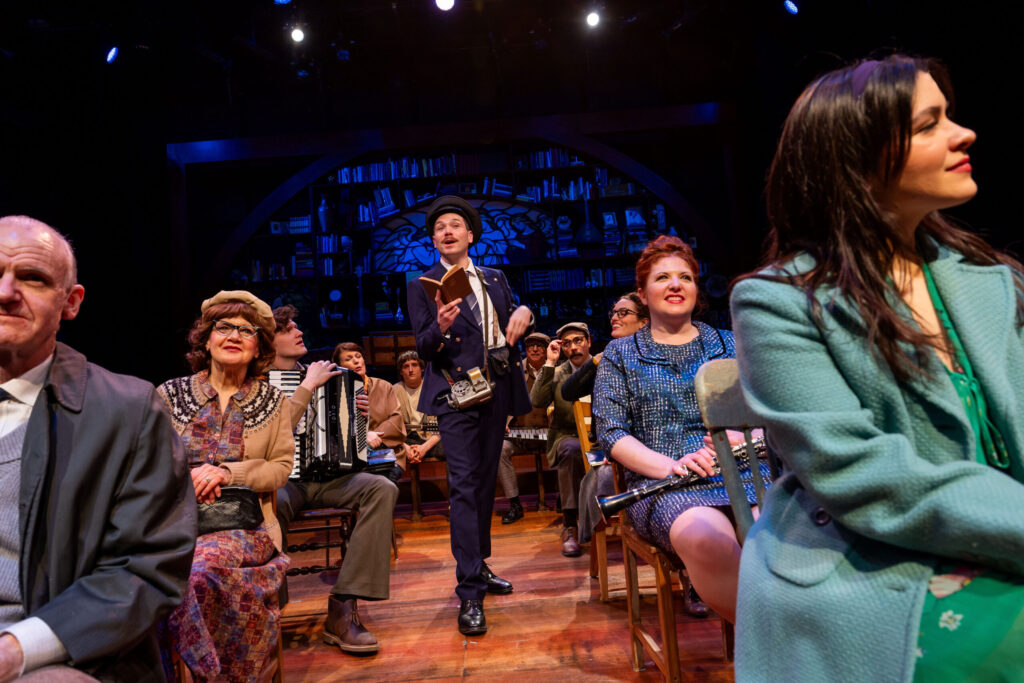
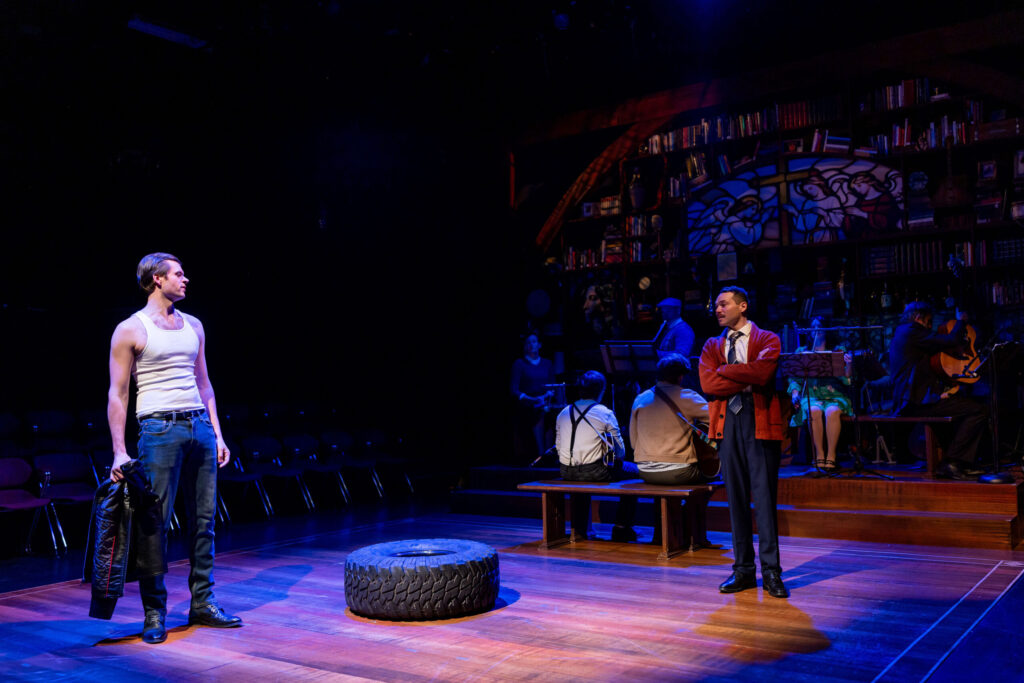
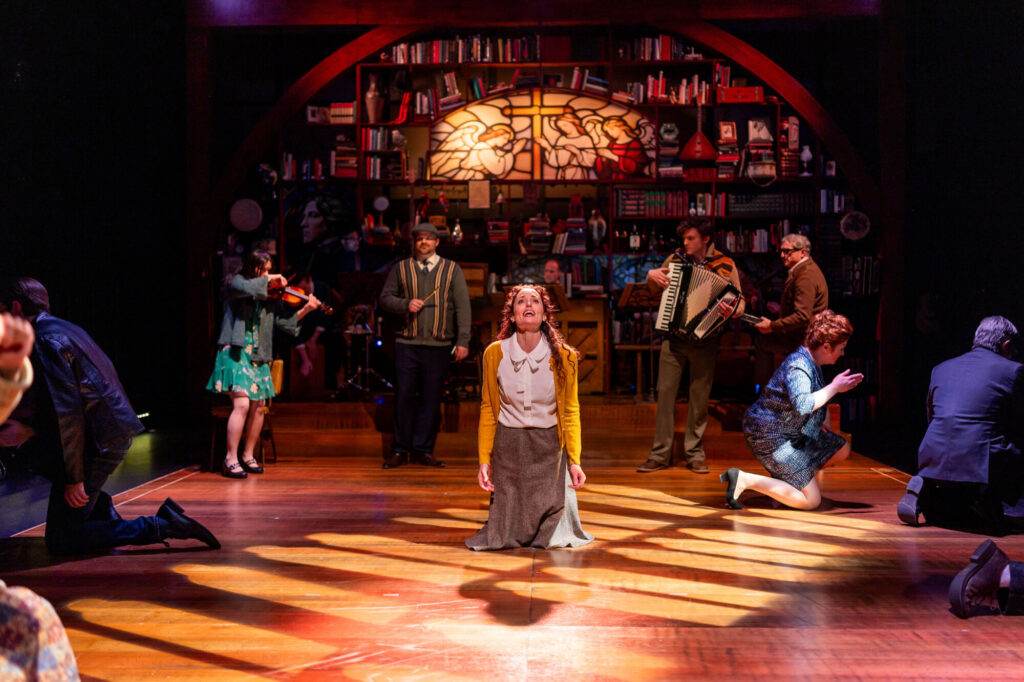
Jenna McFarland Lord’s set literally sets the stage and mood from the get-go. The audience is seated on three sides around a platform in the square. The fourth side holds a small stage with just enough room for musicians. Above them is an amalgam of Alfie’s book-stuffed bedroom, St. Imedlda’s stained glass window, and the rough-hewn wood that hints at a traditional Irish pub.

For 105 minutes (no intermission), live traditional Irish music accompanies the brilliantly poetic and funny songs (Lynn Ahrens’ lyrics and Stephen Flaherty’s music) and acts as a background. Actors double as musicians and enter, exit and linger in the aisles. The effect is live surround sound and the audience can’t stop smiling and tapping their feet in appreciation.

Master choreographer Ilyse Robbins has designed playful, effective moves for the nimble cast that are both functional (moving furniture, for example, to create a bus or pub) and wildly adorable (Kathy St. George’s tap dance is a show-stopping knockout).

Jennifer Ellis (center) and cast

As Lily, Alfie’s devoted sister who has put her life on hold until her brother finds a wife to take care of him, Aimee Doherty brings depth, humor and impeccable timing. Her duet with butcher Carney (a delightfully smarmy Sam Simahk), “Books,” is a storytelling first-rate number and a stand-alone hit.

Another storytelling marvel, “The Streets of Dublin,” takes the audience into the world of the workingman’s pub, capturing the characters’ everyday world of pints, traditional ballads and dancing. In adding the ghost of Oscar Wilde to his adaptation of the film, McNally gives Alfie the opportunity to express his true self to his idol and imaginary mentor. Will McGarrahan brings flourish and panache to red-caped Wilde, and Alfie takes his support and advice to heart. Encouraged by Wilde to “love who you love” and get rid of temptation by yielding to it, he braves the first step down the path of sexual authenticity to predictably disastrous results. Alfie is beaten up, outed, and publicly shamed.

This is, after all, still 1960, and the love that dare not speak its name has no place in a world that desperately clings to what it knows.

Despite setbacks and disappointments, the play ends on an uplifting note, one that is as relevant and helpful today as it might have been in Oscar Wilde’s day. Alfie’s theatrical community and sister don’t abandon him and he basks in a new understanding of what is of most importance in a world that thrives on conflict, humiliation and accusation.

Shields and Aimee Doherty

“I used to think the most thrilling words in the English language were ‘At Rise’ as we began a new project and opened our books to the first page of the playwright’s text,” he says.

After his ordeal and the rallying of his troupes, he has changed his mind. “The most thrilling words in the English language,” he amends, “are these: ‘Good morning, my dear friends.’”

‘A Man of No Importance’ – Based on the film, ‘A Man of No Importance.’ Lyrics by Lynn Ahrens; Music by Stephen Flaherty; Book by Terrence McNally; Directed by Paul Daigneault. Choreographed by Ilyse Robbins. Music Direction by Paul S. Katz. Scenic Design by Jenna McFarland Lord. Presented by SpeakEasy Stage Company. At the Roberts Studio Theatre, Calderwood Pavilion, Boston Center for the Arts, through March 22.

For more information and tickets, go to: https://speakeasystage.com/