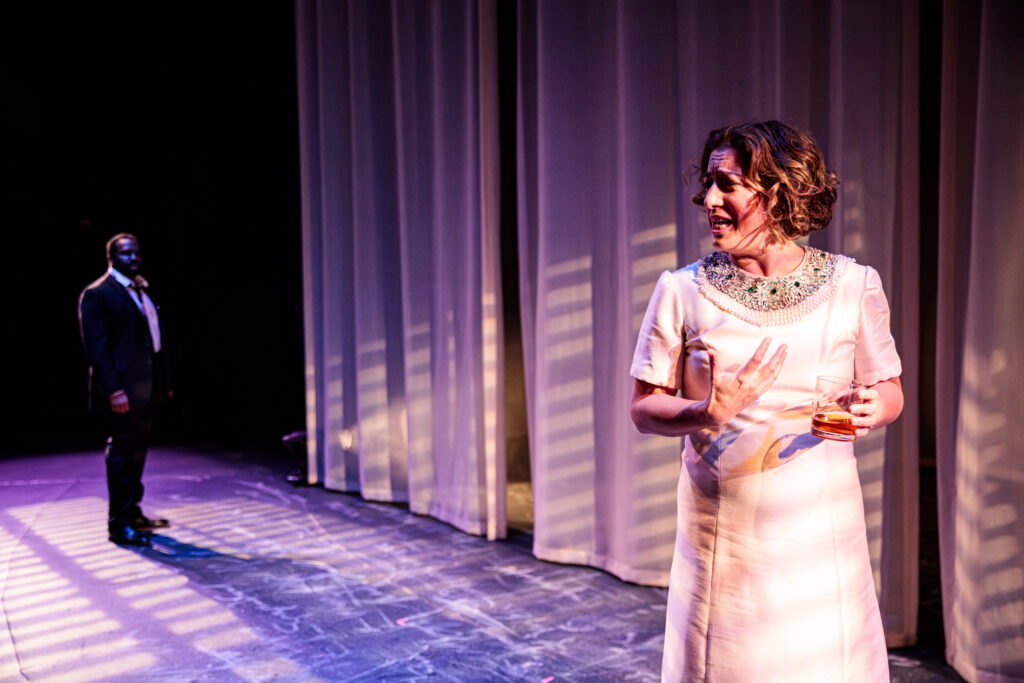
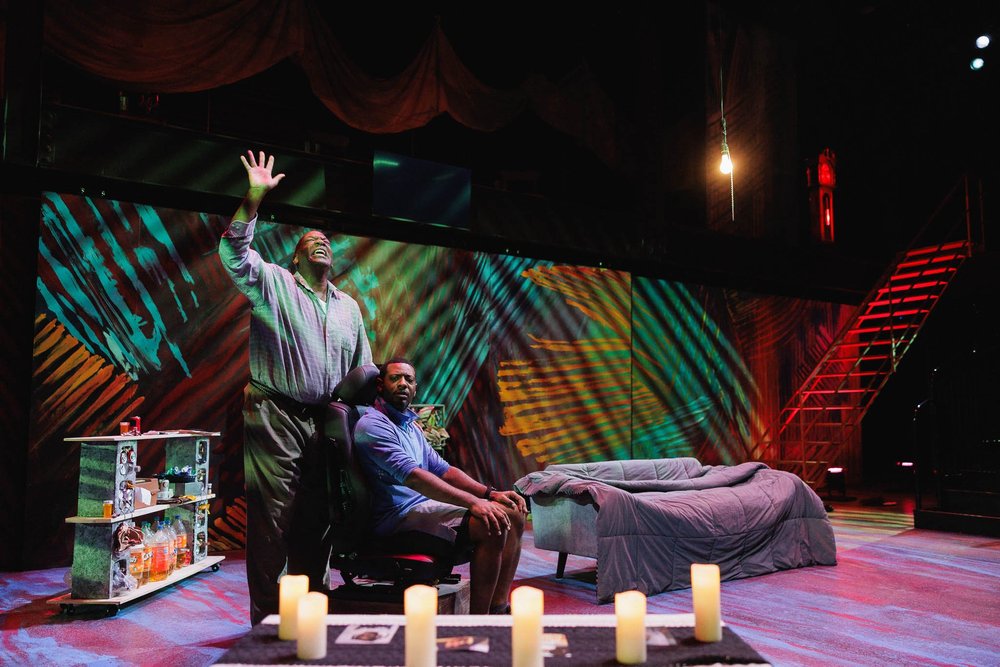
Omar Robinson, Brooke Hardman in Actors’ Shakespeare Project’s ‘Macbeth’ Photos by Benjamin Rose Photography.
‘Macbeth’ — Written by William Shakespeare. Directed by Christopher V. Edwards. Presented by Actors’ Shakespeare Project at Mosesian Center for the Arts, Watertown through October 26.
By Shelley A. Sackett
Ten minutes into ASP’s production of Macbeth, my friend leaned over and whispered, “I thought we were seeing Macbeth.”
He wasn’t being a smart aleck; he was astutely stating the obvious. While it seems au courant (at least in Boston) to catapult timeless Shakespeare into other eras with disco, hip hop, and gratuitous references to current headlines, Actors Shakespeare Project, under the direction of Christopher V. Edwards, proves definitively that it is possible to overreach and completely miss your mark.
One of the Bard’s most quoted and beloved plays (“Fair is foul, and foul is fair,” “Is this a dagger which I see before me?” and “Double, double toil and trouble,” for example), it speaks for itself, elegantly and eloquently. Yet, for some baffling reason, Edwards thinks that contemporary audiences are unable to fully “get” the timelessness of the Elizabethan masterpiece without referencing the Epstein files, ICE, MAGA, the war in Gaza, and AI. Couple that misstep with creative but distracting staging, and you get the fuller picture.
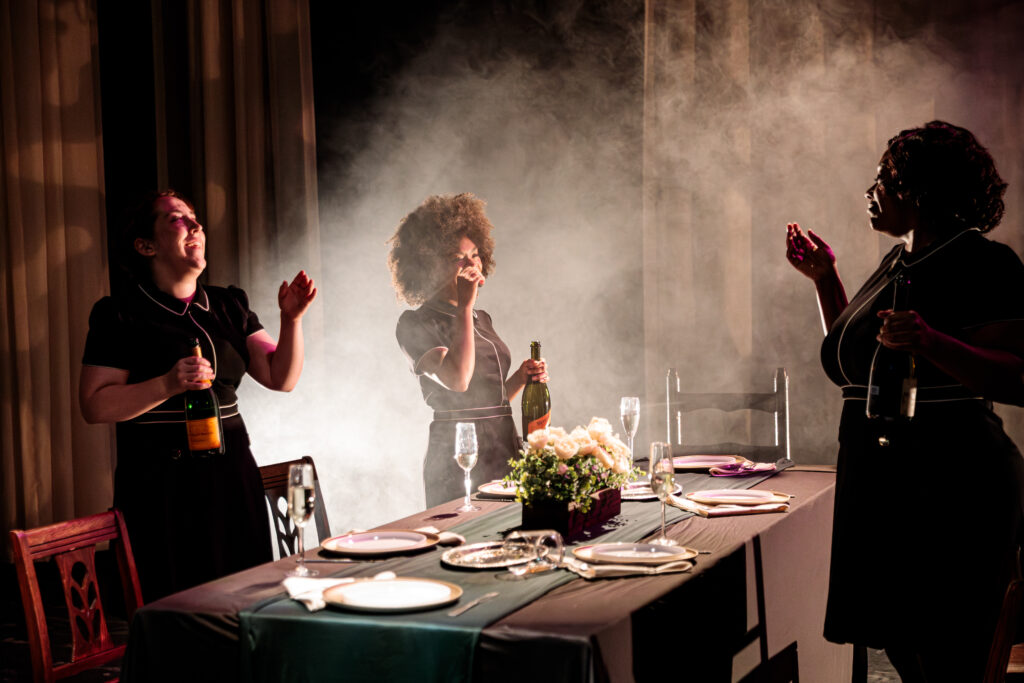
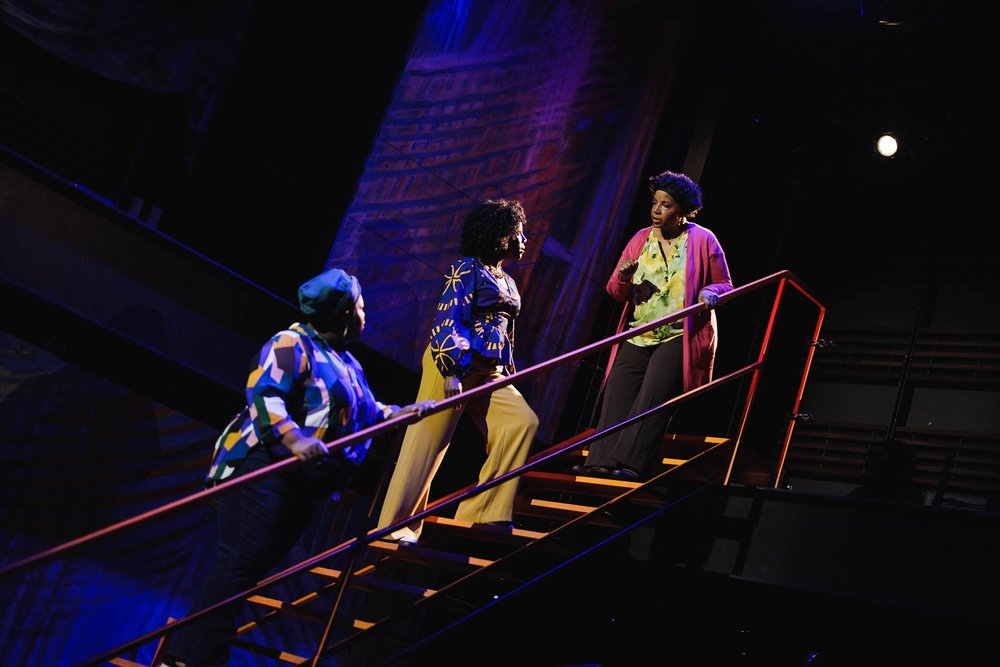
Claire Mitchell, Amanda Esmie Reynolds, and Jade Guerra
To his credit, Edwards doesn’t hide the ball about his intent, which he spells out in the program’s Director’s Notes.
His version of Macbeth (which he nicknamed MK-Beth) reimagines the three witches as architects of state-sponsored psychological manipulation. He sets his version in the thick of a covert 1960s Cold War where Lady Macbeth and her husband are as much test subjects for mind control as they are murderous, power-obsessed co-conspirators.
The central issue, Edwards feels, is “reconsidering ambition, conspiracy and complicity in an era where truth itself could be weaponized.” I don’t know about other audience members, but I was looking forward to a version that was a little more faithful to the original rather than a spin on the contemporary front page political headlines, which take all my psychic energy to avoid.
On its own, Macbeth really does address the issue that Edwards wishes to magnify (the dangers of a budding dictator’s unquenchable thirst for power). Would that he had trusted the audience to “get” that on their own.
Disagreement with his spin aside, its execution has way more misses than hits. On the positive side, imagining Lady Macbeth as a grieving mother who undergoes electro-convulsive therapy at the hands of the three doctors/witches to cure her depression is an interesting conceit, although a baffling way to open the action. We are supposed to have picked up how devoted (and normal) the Macbeths were from family home videos that include the deceased child projected on stage before the play, but that point is a little too subtle to grasp without context.
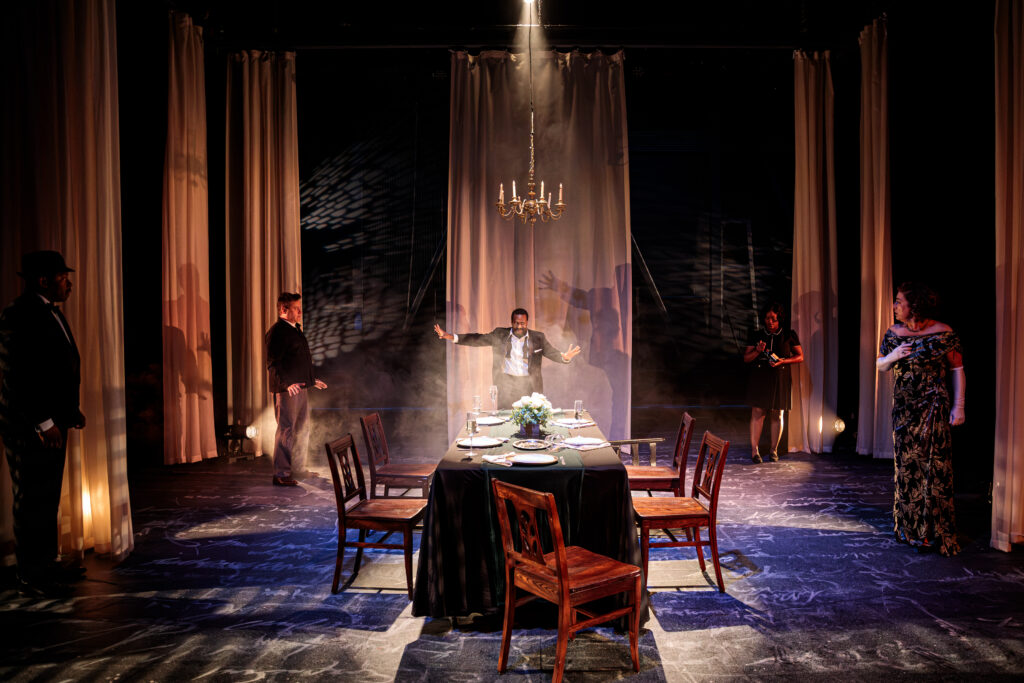
Danielle Ibrahim’s set, however, is marvelous, a gossamer set of white curtains that encircle the stage area and work well with the varying ambiance of the play.
While some of the lesser characters seem to be reciting their lines in a classroom more than delivering them before an audience, there are some noteworthy performances, particularly by Brooke Harman as Lady Macbeth, Dennis Trainor, Jr. as Duncan/Porter, and Chingwe Padraig Sullivan as Malcom.
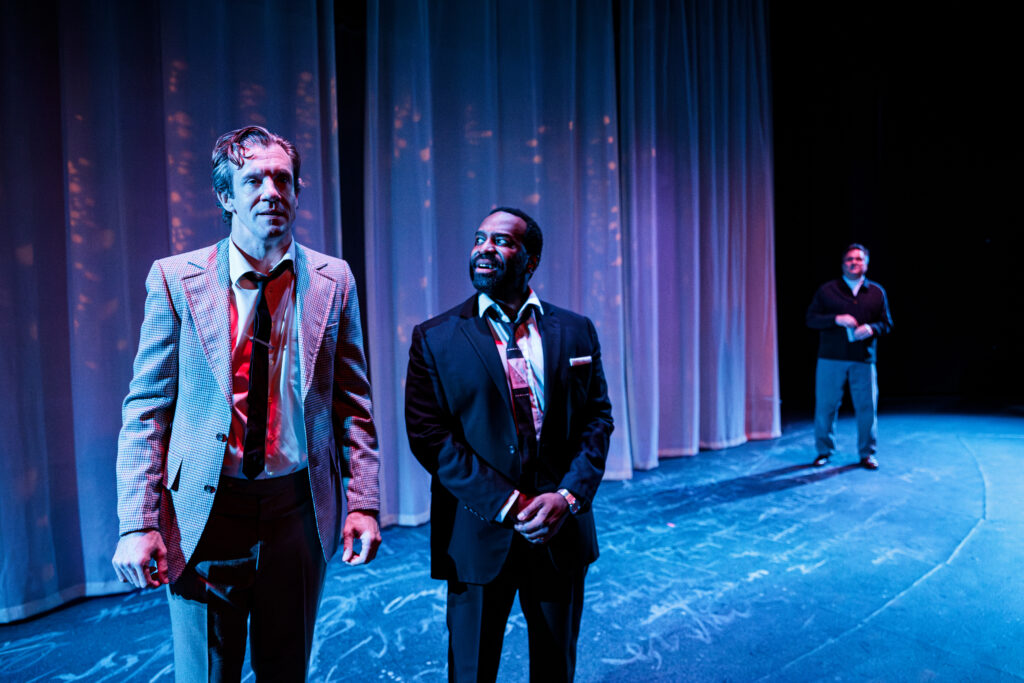
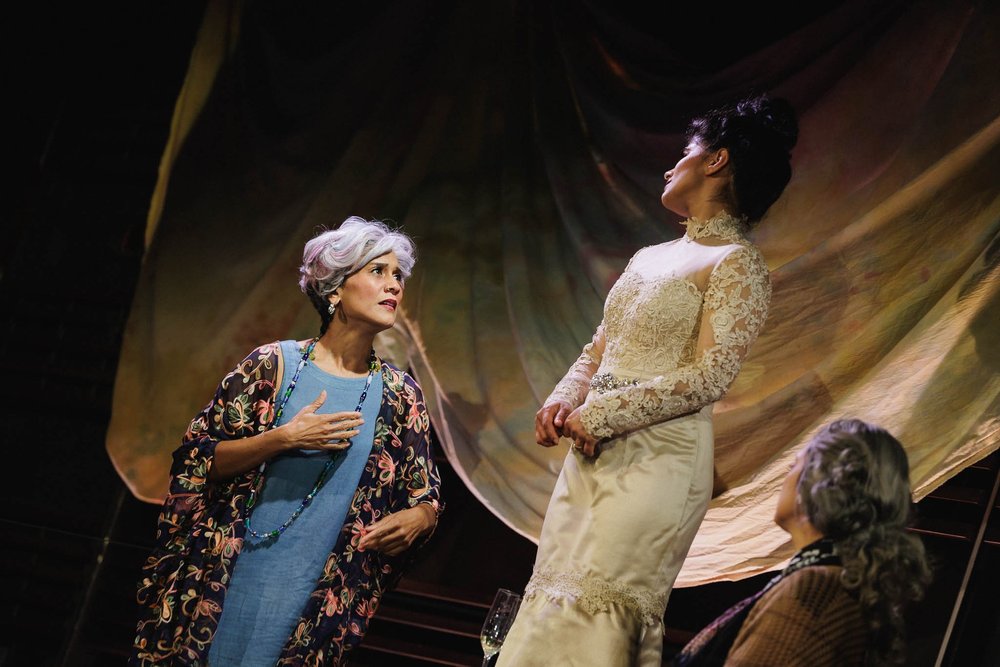
Jesse Hinson, Omar Robinson, and Dennis Trainor Jr.
Omar Robinson (who collected the 2025 Norton award for outstanding lead performance in The Piano Lesson) breaks out of his singularly militant monomaniacal version of Macbeth to court nuance and pathos, particularly in the famous “Out, out, brief candle! Life’s but a walking shadow, a poor player that struts and frets his hour upon the stage and then is heard no more” speech upon learning of Lady Macbeth’s death.
Perhaps ASP’s parting gift to its audience is a back-handed reminder that Shakespeare can bridge eras, standing on its original two feet. I, for one, took that as an invitation to revisit the Bard’s version and went home, dusted off my college Pelican Text, and had a jolly good read.
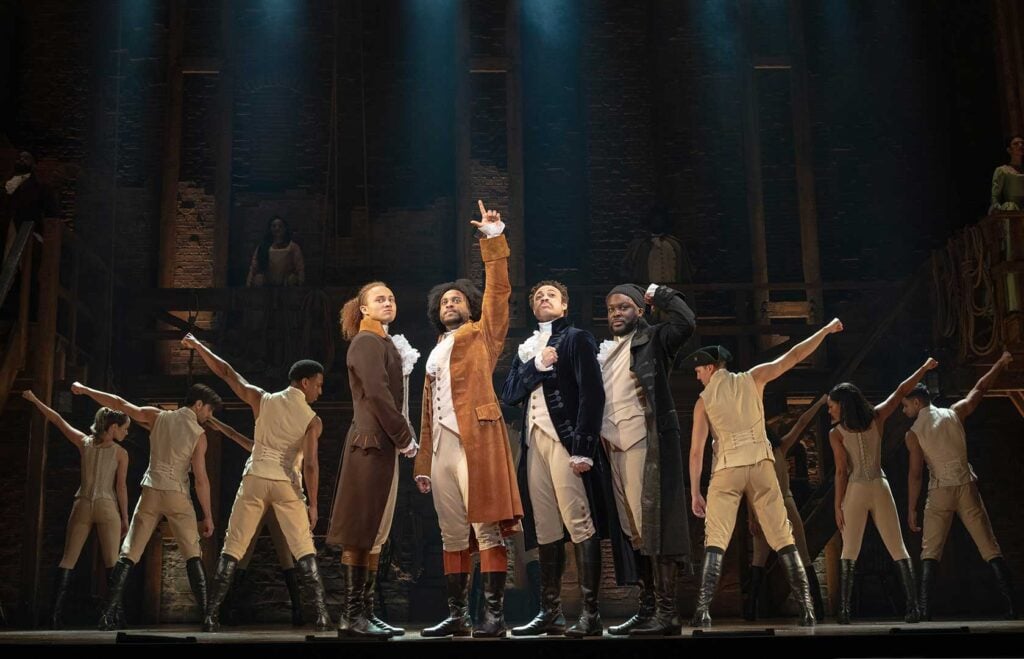
Cast of Broadway in Boston’s ‘Hamilton’. Photos: Joan Marcus
By Shelley A. Sackett
How lucky are we that Lin-Manuel Miranda decided to pack Ron Chernow’s biography, “Alexander Hamilton,” when preparing his bag to take on his first vacation in seven years after the Broadway run of his smash hit, In the Heights. He plowed through the 800+ page book and was mesmerized by Hamilton, particularly his story as a poor immigrant rising to power.
“The moment my brain got a moment’s rest, Hamilton walked into it,” he told Ariana Huffington in an interview.
Had he grabbed any of a number of other bestselling books instead, the world would have been deprived of what remains, after ten years, a singular and thrilling theatrical experience. Broadway in Boston’s production now at Citizens Opera House is as good as it gets, even withstanding a distractingly deficient performance by Hamilton standby, Michael Natt, on the evening I saw it.
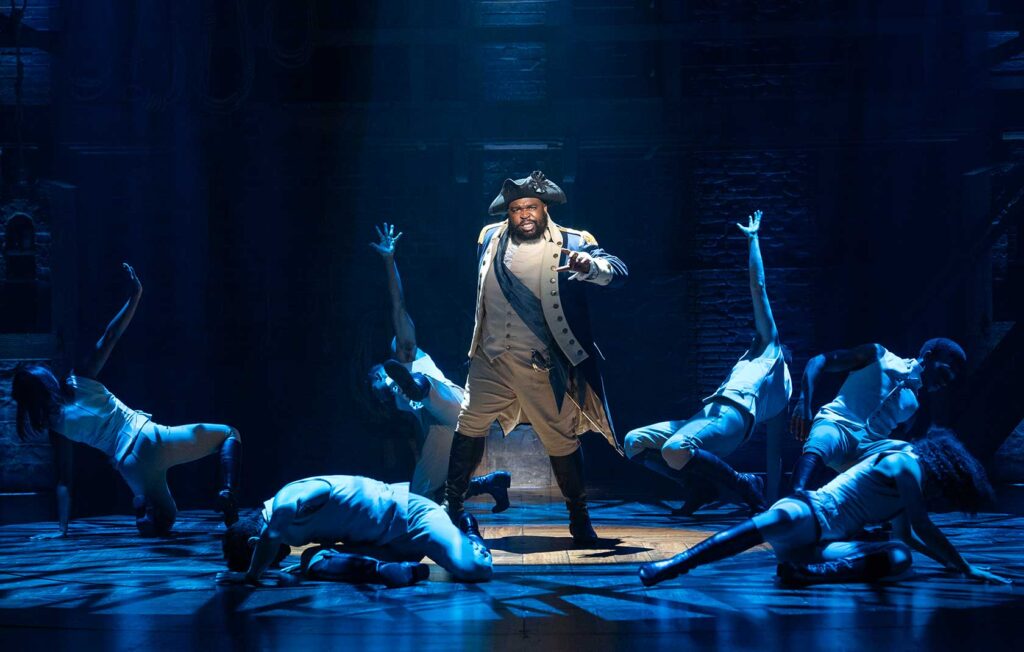
The set, by David Korins, is magnificent. Huge, with a drawbridge, walkways, and two stories, it accommodates the large cast and encourages easy transformation from scene to scene. A circular rotating insert is put to good use, and Paul Tazewell’s costumes both complement and add spice. The orchestra (Emmanuel Schvartzman, conductor) is stupendous and Andy Blankenbuehler’s choreography is cheeky, contemporary and delightfully slick. Last, but hardly least, Howell Binkley’s lighting is literally spot-on and hosannas to Nevin Steinberg and his sound design (and the cast’s flawless articulation) that ensure the audience hears every syllable (hardly a given on Boston stages).
Nathan Haydel, Tyler Fauntleroy, Jared Howelton, Elvie Ellis
The opening number, “Alexander Hamilton,” firmly establishes that the rest of the talented touring cast is not just up to the challenge but will surpass even the highest expectations of excellence. (Ensemble member Miriam Ali is a standout, and not because of her height.)
The storyline is fairly straightforward. It details the life of American Founding Father Alexander Hamilton, from his humble beginnings as a Caribbean orphan to his crucial role in the American Revolution and the formation of the new nation, culminating in his death in a duel with Aaron Burr. Aaron Burr (an outstanding Deon’te Goodman) opens with the line, “How does a bastard, orphan, son of a whore and a Scotsman, dropped in the middle of a forgotten Spot in the Caribbean by Providence, impoverished in squalor Grow up to be a hero and a scholar?” introducing Hamilton as the remarkable immigrant who, through grit, ambition, intelligence and sheer will, rose to positions of power and influence to have an undeniable and lasting effect on this nation’s history.
A.D. Weaver
While the actors may be center stage, it’s Miranda’s breathtaking score that is the true star. Over 30 songs tell the story through hip-hop, jazz, R&B, pop, and good old-fashioned ballads. Their narrative quality and melodic power are timeless, awesome in the truest sense of that now hollowed out and trite adjective.
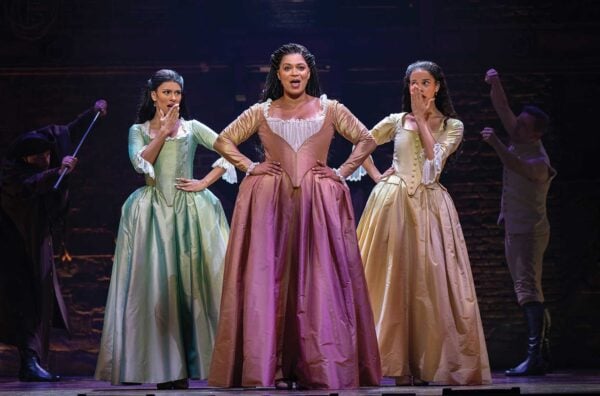
The show features a diverse cast (Miranda broke new ground in many ways, including casting actors of color to play the roles of the Founding Fathers) and highlights Hamilton’s relationships with figures like the Schuyler sisters (despite being a standby, Amanda Simone Lee was splendid as Angelica and Lauren Mariasoosay shone as Eliza), the Marquis de Lafayette and Thomas Jefferson (both played by an excellent Christian Magby), and, of course, George Washington (a powerful A.D. Weaver).
The crowd favorite, however, is always King George III, whose role may be limited but whose songs are among the best in the show. Matt Bittner doesn’t disappoint, chewing up the role and delighting the audience with each brief appearance.
Lauren-Mariasoosay, Marja Harmon, Lily-Soto
Even if you’ve seen “Hamilton” before (and especially if you saw it when it played in Boston on its last disappointing tour), do not hesitate to high-tail it to the Citizens Opera House to see this particular version. I daresay, it is as close as we in Boston can get to the New York experience.
Most highly recommended.
‘Hamilton’ — Book, music and lyrics by Lin-Manuel Miranda. Inspired by Ron Chernow’s “Alexander Hamilton.” Directed by Thomas Kail. Choreography by Andy Blankenbuehler; Music Supervision and Orchestrations by Alex Lacamoire. Presented by Broadway in Boston at Citizens Opera House, Boston through Nov. 2. For more information, visit bton.broadway.com/shows/hamilton/
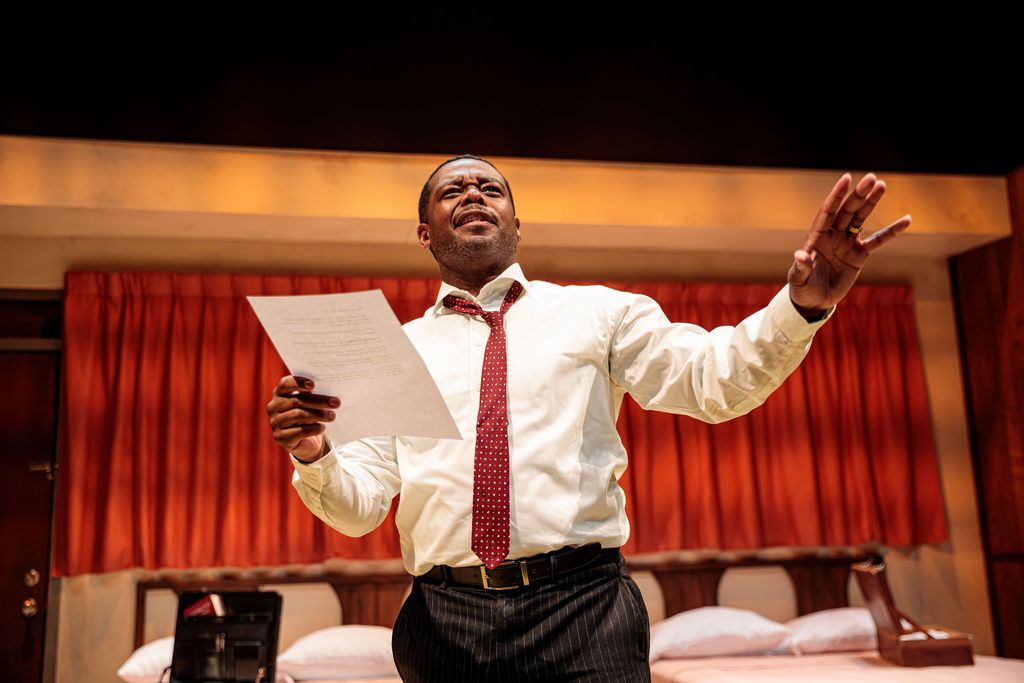
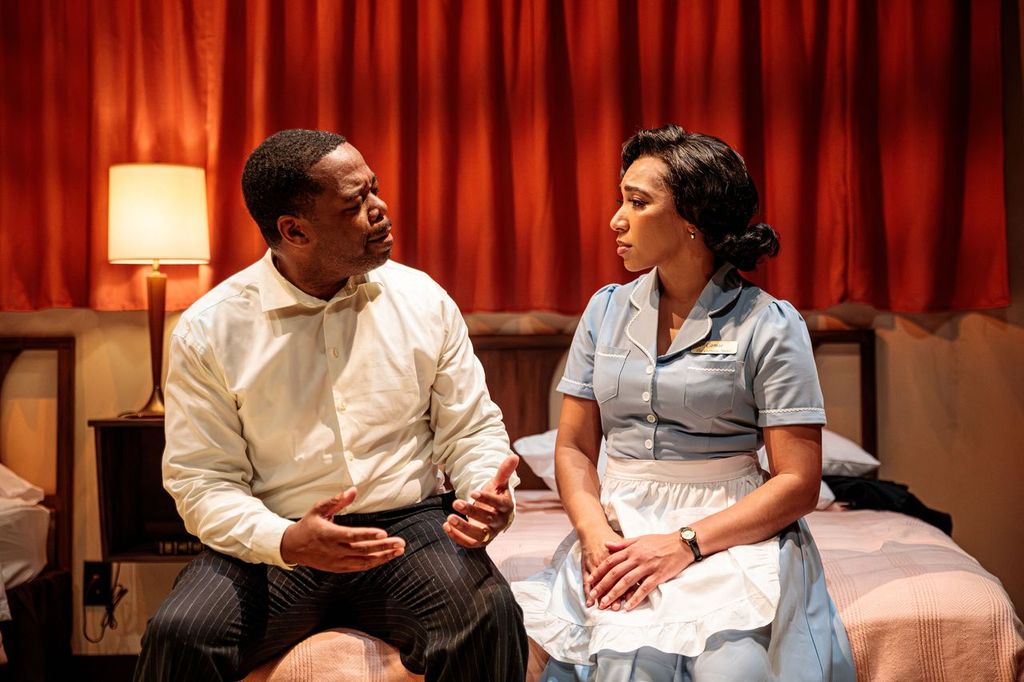
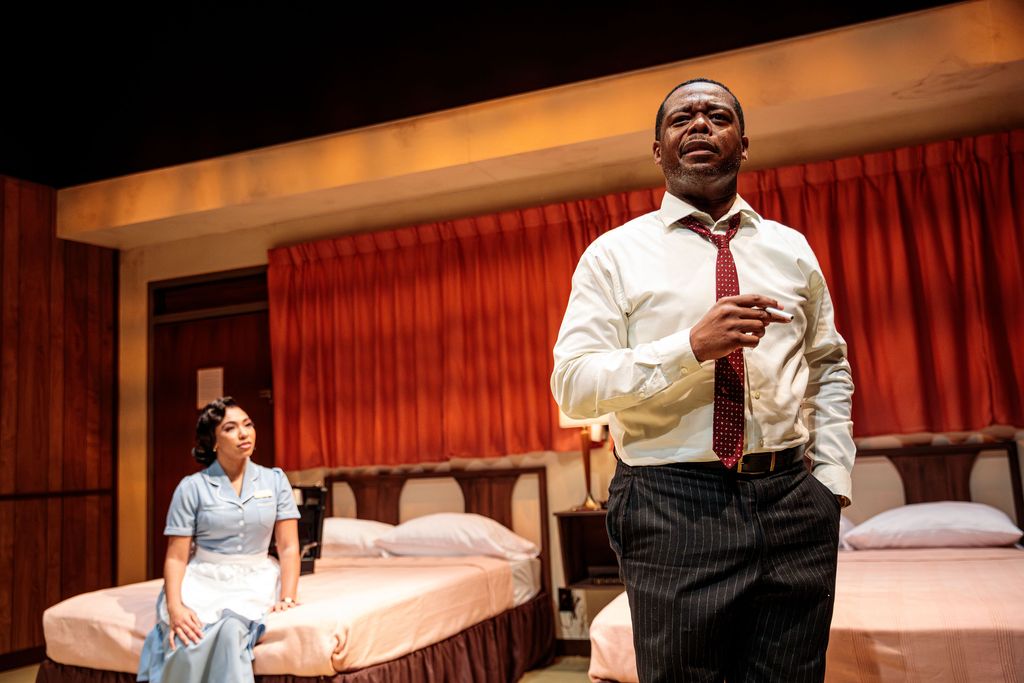
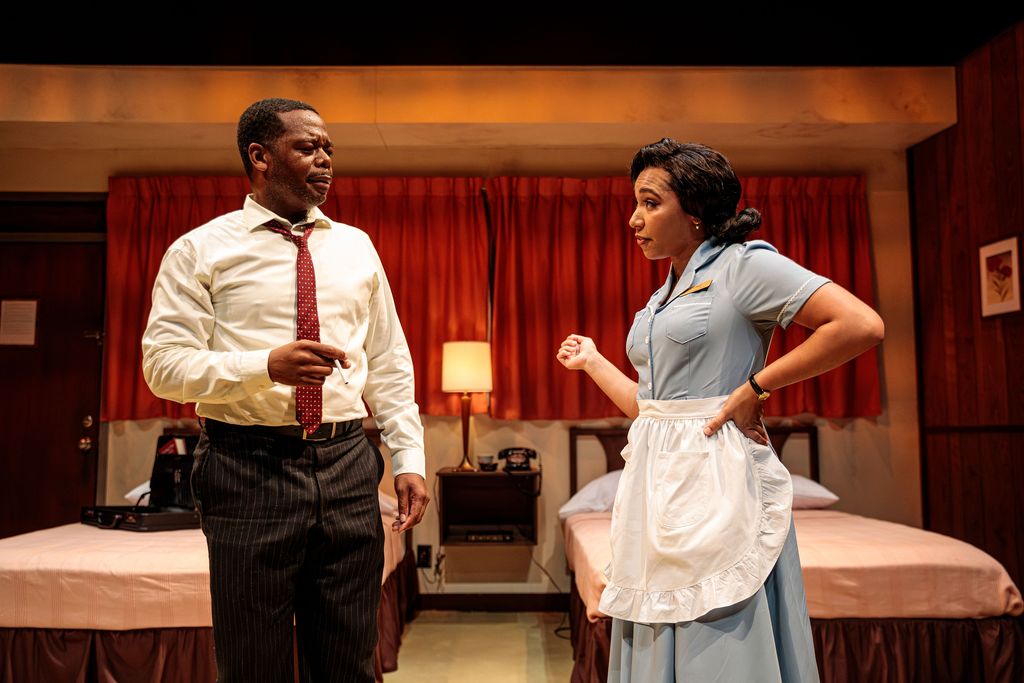
Dominic Carter as MLK in Front Porch Arts Collective‘s ‘The Mountaintop’
By Shelley A. Sackett
Playwright Katori Hall couldn’t have asked for a better production of his Olivier Award-winning play, The Mountaintop, than the one it is receiving at the Modern Theater at Suffolk University. Under Maurice Emmanuel Parent’s pitch-perfect direction, its two stars, Dominic Carter and Kiera Prusmack, deliver impeccable performances as civil rights and social justice leader, Rev. Martin Luther King, Jr. and Camae, a motel employee. Ben Lieberson’s set is straightforward and literal, a classic 1960s era, no frills, wood-paneled motel room.
The time and place are uncomplicated. It is April 3, 1968, and a storm rages outside room 306 of the Lorraine Motel in Memphis. As King, Carter is a commanding presence from the moment he enters the room. He has just delivered his famous “I Have Been to the Mountaintop” speech, in which eerily he proclaims, “I’ve been to the mountaintop… And I’ve seen the promised land. I may not get there with you.”
He was assassinated the next day.
King is exhausted yet wired, spooked by every crack of lightning and suspicious that his room is bugged and his phone tapped (hardly unwarranted since J. Edgar Hoover, FBI director, was known to have targeted King with both).
He is in Memphis to support striking sanitation workers whose nonviolent protests had ended disastrously in rioting and ransacking. All he wants is a cigarette and a cup of coffee. His traveling companion, fellow civil rights activist and Baptist minister, Rev. Ralph Abernathy, has gone to buy the cigarettes. He calls for room service for the coffee.
After some interludes meant to show King’s less saintly and more human side (including smelly feet, petty vanity and annoyance at overhearing a toilet flush in the room next door), he finally settles down to start writing his next speech/sermon. He wants to get more incendiary and provocative, and toys with opening with the line, “Why America Is Going to Hell.”
“They’re really gonna burn me on a cross for this one,” he snickers.
The entire focus and tone of the play shifts with the arrival of a sexy, self-confident young maid named Camae, who delivers more than a pot of coffee. Under the Parent’s kid-glove direction and terrific acting by Carter, the swing from King’s turbulent internal intensity to his slick, external charismatic charm happens with the silent ease of a perfect downshift.
She calls him “Preacher King.” He flirts with her shamelessly, flaunting his male bravado, trying to hide his fear and suspicion. He asks her opinion whether he should shave his moustache. She tells him, “If I was a man, I’d be staring at me, too,” as she runs her hands over her breasts and hips.
Camae just happens to have his favorite cigarettes, Pall Malls, in her apron pocket. She also has a flask, which she offers King before swigging from it directly.
All is light banter (they even have a pillow fight) until the talk turns to the state of race relations in America and what she thinks King should be doing about it. She is his equal, smart, passionate and articulate. “You need something else,” she counsels. “Something other than marching.” He thinks “a new day is coming” and says he will continue preaching “until the day I die.” Her suggestion? “Fuck the white man.”
The tension escalates until the great reveal, which thankfully happens early enough that there is plenty of time left for Pulitzer Prize-winning playwright Hall to spin his magic, culminating in a monologue set against a rapid montage of people, movements and events from 1968 to 2024 (projection design by Pamela Hersch). The effect is as spellbinding as the magical 90 minutes we have just spent in the presence of greatness, from the acting, writing, and direction to witnessing the final hours in the life of a man whose legacy is deservedly legendary. Dr. King, the promised land has never seemed so far away. We sure could use your voice today.
Highly recommended.
The Mountaintop – Written by Katori Hall. Directed by Maurice Emmanuel Parent. Presented by The Front Porch Arts Collective in collaboration with Suffolk University at Modern Theatre, 525 Washington St., Boston, through October 12.
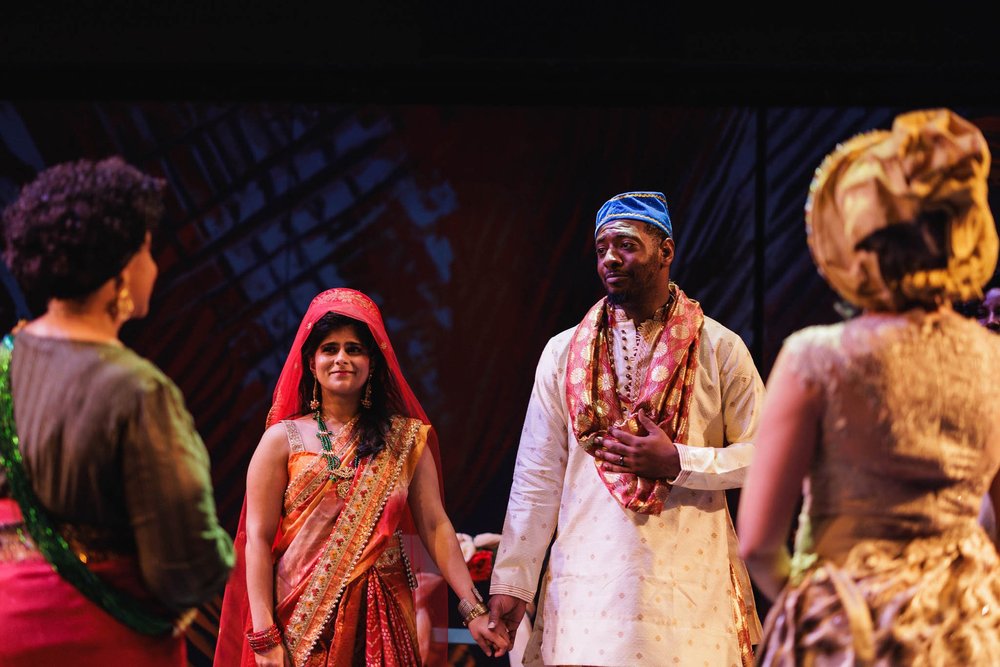
Lumanti Shrestha, Khadaj Bennett in CHUANG Stage’s ‘The Ceremony’ Photos by Ken Yotsukura
By Shelley A. Sackett
Playwright Mfoniso Udofia’s nine-play Ufot Family Cycle follows the various members of the Nigerian Ufot family across three generations, starting with the brutal Nigerian Civil War (also known as the Biafran War) of 1967-1970. With the world premiere of The Ceremony, the sixth in the series, Udofia brings the family firmly into the present (2023) with all its contemporary social mores and cultural pressures.
The Ufot Family Cycle is an unprecedented two-year city-wide festival where theaters and arts organizations around Greater Boston join to produce the nine plays in partnership with universities, social organizations, non-profits, and a host of community activation partners. The Ceremony is produced by the pay-as-you-are CHUANG Stage. At two plus hours (one intermission), the play focuses on the marriage between 31-year-old Nigerian-American Ekong Ufot (a fine Kadahj Bennett) and 32-year-old Lumanti Shrestha (equally fine Mahima Saigal), a Nepalese-American. Both are first-generation Americans, born in one country and raised by parents anchored in another
Whether the two can intertwine their Nigerian and Nepali heritages, with their different cultural traditions— and, more importantly, whether their families will let them — is the challenge they face as they try to plan a wedding that offends none and pleases most.
Compromise is the goal, but first the affianced couple must circumvent complex family issues, including their equally estranged fathers: Disciple (a powerful and complex Adrian Roberts), Ekong’s father; and Lumanti’s never seen but equally resistant father. How well they circumvent these stealth emotional and psychological IEDs will determine if Ekong and Lumanti make it to the wedding finish line.
Udofia leaves us guessing whether the couple can pull it off until the end, one reason the lengthy play doesn’t feel quite as long as it is.
[Although the nine plays are touted as being discrete stories linked together through lineage and characters, those unfamiliar with the Ufot family history may want to prepare by investing the time to listen to the excellent podcast, runboyrun. (It’s worth it for context). The third play in The Ufot Family Cycle, it focuses on Disciple as a boy in war-torn Nigeria and helps understand his tormented character, his relationship with his ex-wife and Ekong’s mother, Abasiama (the always welcome Cheryl D. Singleton), and the significance of such seemingly innocent props as a clock and a stick in The Ceremony.]
The play opens in Worcester in media res, with Lumanti center stage and the Nigerian women (Ekong’s mother, Abasiama, and sisters, Adiana (Regine Vital) and Toyoima (Natalie Jacobs)) above, on a lightly propped catwalk. Large staircases bookend the stage and are used with a practiced light touch under the spot on direction by Kevin R. Free. Cristina Todesco’s efficient and creative set and Andrea Sala’s restrained but effective lighting create a trifecta of simultaneous activity.
All the women are talking at once. Lumanti speaks into her cell phone in Nepali. Unlike some of Udofia’s previous plays (especially The Grove), the use of long passages of unsubtitled, non-English language is not off-putting. Here, the actors and Udofia offer enough clues so that the audience, instead of being shut out, is treated like special guests, invited for a behind-the-scenes peek at what life is like for this young, second-generation couple.
Lumanti is talking to her father, and we get the gist that she is getting an earful. Upstairs, the Nigerian women, with Abasiama lapsing into her native Ibibio, seem to be okay with the wedding, although the sisters are a little less enthusiastic than their mother.
It seems that white, in Nepalese culture, represents death, yet Lumanti has agreed to wear white for the wedding. “We wanted a western wedding,” she unconvincingly says.
The action swings back to the lower stage, where a table and couch shift the scene to Ekong and Lumanti’s apartment. Ekong is in the midst of a disciplined workout. His eyes are glued to one of three overhead projections showing the same episode of “The Fresh Prince of Bel-Air,” the 1992 iconic Black American television show starring Will Smith (projection and digital content design by Michi Zaya).
Ekong doesn’t just enjoy the show, however. He needs it, and his eyes bulge with the panic of an addict who needs his fix until the set flips on. Only then can he truly relax. His mouth goes lax and he zones out from his outside world to the interior existence he channels, where he can step into a world of what his life could have been like if he had had different parents.
He sets a romantic table, complete with flowers and wine. When Lumanti enters the apartment, he is blindsided when she tells him her father, who had adamantly opposed and boycotted their wedding, has changed his mind. He will make the trip from Kathmandu after all. She is overjoyed.
“And you believe him?” Ekong asks. Ekong had assumed that, because Lumanti’s father was a no-show, his own father’s (Disciple) absence wouldn’t be questioned. Suddenly, Lumanti believes both their fathers are capable of change and she wants him to reach out again to his father with the news that hers will be in attendance.
It turns out Ekong never even spoke to his father. Lumanti, changed by the fact that her father will bear witness to the ceremony, has other news — she wants their wedding to be more traditional and include rituals from their two cultures.
“Why?” Ekong asks. “I’m Nepalese,” she replies. “Since when?” he demands. “Since dad said he’s coming,” she responds in all honesty.
And so the scene is set that will drive the rest of this thought-provoking, entertaining, and well-produced drama.
Udofia weaves together several subplots that show, rather than tell, the backstory of Ekong and his father’s 20-year estrangement. The owner of a successful physical therapy practice, Ekong bonds with Philip (the excellent Roberts), a client whom he equates with the idealized Black father figure in the TV show. He even tries to enlist him as a surrogate father, but Philip wisely declines.
Meanwhile, Lumanti navigates her own journey with her mother, Laxima ‘Amma’ Shrestha (Salma Qamain), and Auntie (Natalya Rathnam, funny and wise), and their reactions to the news that her father will attend. The older matriarchs share relationship and marriage advice and the three dig into the work of turning the secular wedding into more of a cultural celebration.
Act II brings out the dramatic strengths of the action and script, especially the scenes between Disciple, Abasiama and Ekong, and, of course, the wedding ceremony itself. Director Free makes free use of the full stage with multiple, simultaneous locations and conversations that keep up the pace and audience’s interest.
Eventually (no spoiler here-), the wedding takes place and the audience is both invited and delighted by the multi-traditional festivity. Something new and unique to Lumanti and Ekong (and their families) has been born from the blending of two families intent on preserving their heritage while acknowledging contemporary realities. Two parts really can make a new whole, but for the audience, the destination was never the brass ring. The journey, with all its potential derailings lying in wait and complicated intra-familial, was always what it was about.
Director Free brings out the best in his cast (with special shout-outs to Bennett (Ekong), Saigal (Lumanti), and Roberts (Disciple)), and Udofia’s script is crisp and unpreachy with just the right amount of humor and pathos. As an added bonus (like we needed one), we get to ride shotgun as both Ibibio and Nepali wedding traditions are unveiled before our eyes, a lovely touch.
There is a reason the show sold out almost immediately, although last-minute seats may be available. Do yourself a favor and try to be one of the lucky ones who scores one.
‘The Ceremony’ — Written by Mfoniso Udofia. Directed by Kevin R. Free. Presented by CHUANG Stage at Boston University’s Joan & Edgar Booth Theatre, 820 Commonwealth Ave., Boston through October 5.

 InSights