Saul Rubinek recasts Shakespeare in the provocative ‘Playing Shylock’

Saul Rubinek in “Playing Shylock.” | DAHLIA KATZ

By Shelley A. Sackett

Ask a Jewish audience what their first reaction is when they think about Shakespeare’s “The Merchant of Venice,” and chances are they will mention the negative portrayal of Jews by the Venetian moneylender and play’s principal villain, Shylock. Long considered a slur against Jews, the very term was condemned by the Anti-Defamation League as antisemitic as recently as last July, when Trump described bankers as “shylocks and bad people” during a rally in Iowa.

Saul Rubinek flips that ingrained stereotype on its head in “Playing Shylock,” the provocative and powerful solo play he stars in and helped develop with playwright Mark Leiren-Young and director Martin Kinch. The play premieres in New York at Polonsky Shakespeare Center and runs through Dec. 7.

Rubinek plays a fictionalized version of himself. The actor is forced to stop “The Merchant of Venice” because his portrayal of Shylock – as Rubinek, a Jewish man – has angered members of the Jewish community, who have successfully petitioned for the production to be shuttered because it “endangers the well-being of some in our community.”

During the play, Rubinek uses the show’s cancellation as a launching pad from which to engage the audience on thorny issues like antisemitism, institutional self-censorship and cultural appropriation, and stereotyping. He challenges the audience to wrestle with whether the theater might be right to consider the current climate of antisemitism or whether it’s more dangerous to censor a play than to stage it.

“Isn’t Shylock part of the history of antisemitism? The most famous Jewish character in theater? And isn’t it important to own it, talk about it and show it?” Rubinek rhetorically asked the Journal over Zoom from his California home. Contrary to popular perception, he posits that “Shylock is not a caricature. He is the first three-dimensional Jew in the history of English literature.”

He details how in 1595, when Shakespeare’s play was first produced, there had been no Jews in England in the 300 years since King Edward I issued the Edict of Expulsion in 1290 (ironically on Tisha B’Av). Jews were portrayed as clowns, puppets with horns, or a devil in religious pageants. Audiences threw figs and oyster shells at them. “They were used to thinking of Jews as not being people because they had never actually met one,” Rubinek said.

Christopher Marlowe’s “The Jew of Malta,” first produced in 1592 (three years before Shakespeare), “sold tickets like Taylor Swift” and was the first antisemitic play where a Jew was played by a living actor. Its Jewish character was a one-dimensional Machiavellian villain. Shakespeare, on the other hand, was the first playwright to humanize his Jewish character.

Although Shylock only appears in five scenes, the character and his lines are synonymous with the play, even though he is not the star (the Italian Antonio is the eponymous merchant) and is deemed vile for demanding the pound of flesh he is owed on a defaulted loan.

Rubinek points to Shylock’s most famous speech: “Hath not a Jew eyes? Hath not a Jew hands, organs, dimensions, senses, affections, passions? Fed with the same food, hurt with the same weapons, subject to the same diseases, healed by the same means, warmed and cooled by the same winter and summer, as a Christian is? … And if you wrong us, shall we not revenge? If we are like you in the rest, we will resemble you in that … The villainy you teach me, I will execute, … but I will better the instruction.”

“The point of that speech,” he said, “is not a plea for humanity;” rather, it is a declaration of a right. “We are human, just like a Christian. And if we are like you in other ways, are we not like you in villainy? Whatever you do to me, I will do back to you tenfold. That is what the character is about. That is what the speech is about. And that is why it’s ageless and relevant.”

In other words, according to Rubinek, Shylock is telling his Christian audience, “If you don’t like what you see in me, look in the mirror to see where it comes from.”

The 77-year old actor, best known for television (“Frasier,” “Billions,” “Mrs. Maisel,” “Schitt’s Creek,” “Hunters”) and films (“Unforgiven,” “True Romance,” “The Battle of Buster Scruggs” and over 60 other features), co-founded and was actor/writer/director at the Toronto Free Theatre (now Canadian Stage). He has continued his work in theater in Canada, the U.S. and Europe.

Rubinek’s love for the theater and storytelling is deeply rooted in his heritage. His parents survived the Holocaust by hiding in a Polish farmhouse for 2 1/2 years. (In 1986, he took his parents back to Poland for a reunion with these farmers and created a book, play and documentary film about the experience). He was born in a refugee camp in Germany after World War II. His father, who was a Yiddish theater actor before the war in Lodz, ran a Yiddish repertory company in Germany before the family immigrated to Canada when Rubinek was 9 months old. He spoke Yiddish and French before learning English, and at age 8 started acting in English on the stage.

Though he attended Talmud Torah and Jewish summer camp and grew up in a world of Talmudic discussion, his Jewish upbringing was secular. “I have never been fond of any organized religion, but I love the Jewish traditions. They matter to me on a deep level even though I don’t go to synagogue,” he shared. He, his wife and his children, who are half Scottish/English, celebrate the Jewish holidays and participate in, for example, tashlich. “I grew up without any grandparents, but with these rituals. They are very meaningful to me,” he added.

Rubinek recalled that his father always wanted to portray Shylock on the stage, but “Hitler stopped him. I always wanted to play my father playing Shylock in his heavy Jewish accent,” he said. One of the play’s most moving scenes is when the Rubinek character, clad in traditional Hassidic garb and channeling his father, recites Shylock’s famous “Does a Jew not bleed?” speech in Yiddish.

In the play (and during this interview), Rubinek tells the story of his 16-year-old father confronted by his father (Rubinek’s Zayde) after he had cut off his payos (sidelocks) so he could continue in the Lodz Yiddish theater he so loved. “My Zayde asked, ‘How could you go so far away from God? How can you betray your family, your people, like this?”’ Rubinek said.

His father explained that he was doing a Yiddish play by a great writer about a Jewish family and their hopes for their children. Rubinek continued, “My father said to his father, ‘Theater – if it’s good – the audience sees themselves on the stage. They laugh. They cry. And for a few minutes each night, they don’t feel so alone.’ And my Zayde said, ‘Maybe it’s not so far from God after all.’

“That’s why I wrote the play,” Rubinek said, with an emotional catch in his voice and the glimmer of a tear in his eye.

For more information, visit https://tfana.org/about/polonsky-shakespeare-center

Muggles Marvel At Magic Tricks in Emerson Colonial’s ‘Harry Potter and the Cursed Child’

Cast of ‘Harry Potter and the Cursed Child’ at Emerson Colonial Theatre
Photo Credit: Matthew Murphy

By Shelley A. Sackett

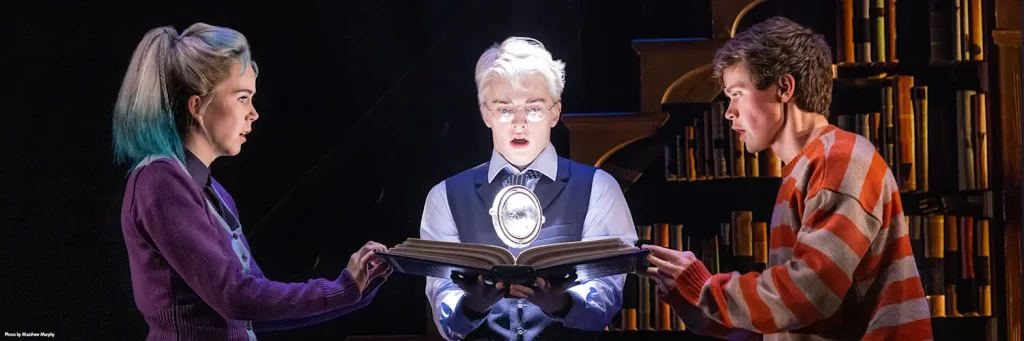
Harry Potter and the Cursed Child is handicapped before the curtain even rises. It is based on the Harry Potter series, a seven-book global phenomenon created by J.K. Rowling. The novels chronicle the lives of a young wizard, Harry Potter, and his friends, Ron Weasley and Hermione Granger, all of whom are students at Hogwarts School of Witchcraft and Wizardry. The main story arc concerns Harry’s conflict with a dark wizard (Lord Voldemort) who intends to become immortal, overthrow the wizard governing body, and subjugate all wizards and Muggles (non-magical people).

The books were responsible for getting millions of children to start reading chapter books and were engaging and cheeky enough to lure their parents to join them. The eight movies the books spawned were even more popular and brought the world of Harry Potter to life on the big screen.

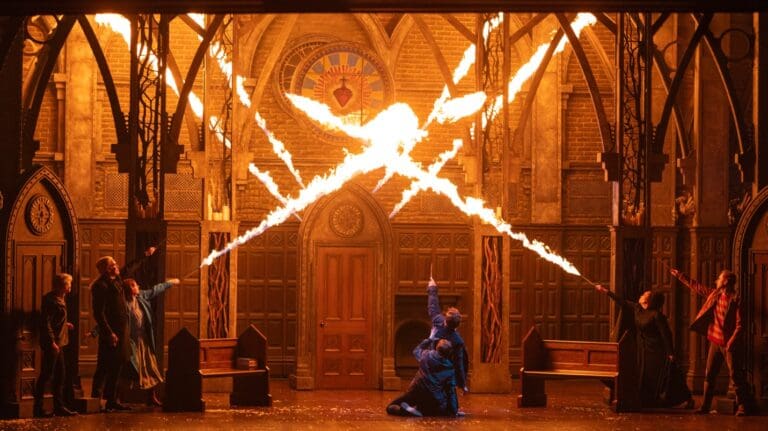
Alas, those same characters appear in Harry Potter and the Cursed Child, but they have not aged well in the 19 years since the last Harry Potter book. Neither has the plot, which, aside from one major twist, is muddled and tedious. At three hours, this ship might have sunk in harbor were it not for one gigantic rabbit it (thankfully) pulls out of its oversized sorting hat — STAGECRAFT MAGIC!!!!

With a stunning set by Christine Jones, illusions and magic by Jamie Harrison, and movement direction by Steven Hoggert, it was easier to ignore the baffling script, uneven accents and uneven miking. Lighting (Neil Austin), sound (Gareth Fry) and costume (Katrina Lindsay) designs enhanced the special effects. This was one production where a seat with good sight lines mattered.

Julia Nightingale, Aidan Close and Emmet Smith 

Right out of the gate, the showmanship elicited oohs and ahhs of wonder and amazement, as characters change costumes mid-sentence, chairs fly, capes whirl and suitcases have minds of their own. Characters slump in their oversize capes and within seconds transform into each other as if by, well, magic.

Later, when the evil dementors descend from the sky, with their unraveling mummy-like bandages and menacing flailing, it is a moment of staging perfection, a trifecta of spot-on music, lights, and sound effects.

It’s all jolly good fun and a lot of visual stimulation. Not since a recent Cirque-de-Soleil have I heard an audience murmur in unison, “How did they do that?”

Which brings us to the story line.

Harry Potter (Nick Dillenburg), the headstrong, brave Boy Who Lived, is now a middle-aged administrator in the Ministry of Magic, a job that bores and depresses him. He married Ginny Weasley (Erica Sweany) and they have two boys, James and Albus Severus (Adam Grant Morrison), and a daughter, Lily.

Following in Harry’s footsteps, Albus is off to Hogwarts, where Harry is mythic. Albus is also an unruly and insubordinate teenager who, like Harry, struggles with the burden of his father’s legacy. “I didn’t ask to be his son,” he retorts when people marvel that Harry Potter’s son is in their midst.

He befriends Scorpius Malfoy (a fine David Fine), son of his father’s nemesis, Draco Malfoy (Ryan Hallahan). The two team up to prove they are more than their fathers’ sons by saving the life of a Hogwarts student who died 20 years ago. There are colorful characters they meet along the way (Mackenzie Lesser-Roy is a scene stealer as quirky, spirited Moaning Myrtle), including their fathers’ teachers (Katherine Leask is a delight, channeling the Maggie Smith and Imelda Staunton characters, Professors McGonagall and Umbridge, and Larry Yando is equally splendid as Albus Dumbledore, Severus Snape and Amos Diggory). There is even a “Time Turner” machine. There is not, however, a life line to save the audience from drowning in a sea of untethered and disconnected actions that make little sense.

While the staging gimmickry, swirling capes, strobes and undulating time travel effects are cool the first, second and maybe even third times, by the umpteenth time (and as the clock marches towards the end of the third hour), they are as tired as some of the audience.

Nonetheless, judging by the raucous standing ovation of the majority of theatergoers, the yawners in the crowd were clearly in the minority.

‘Harry Potter and the Cursed Child.’ Based on an original new story by J.K. Rowling, Jack Thorne, and John Tiffany. A new play by Jack Thorne. Directed by John Tiffany. Presented by Emerson Colonial Theatre at 106 Boylston St., Boston through Dec. 20.

For more information, visit: https://www.emersoncolonialtheatre.com/

Boston Ballet’s ‘Jewels’ Is A Real Gem

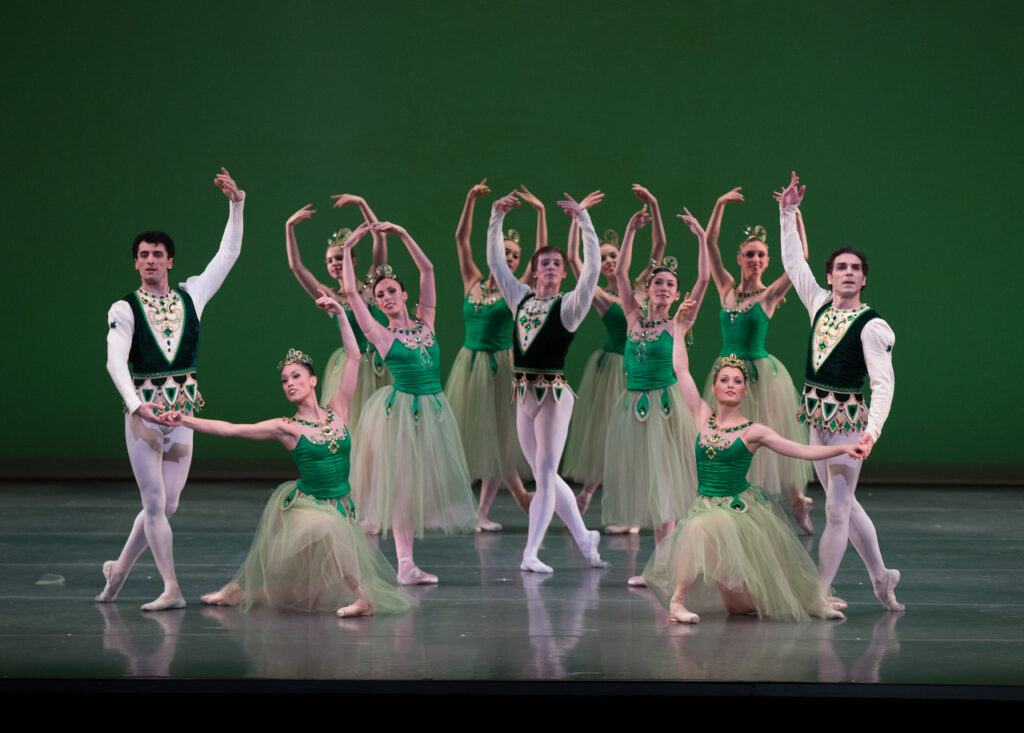
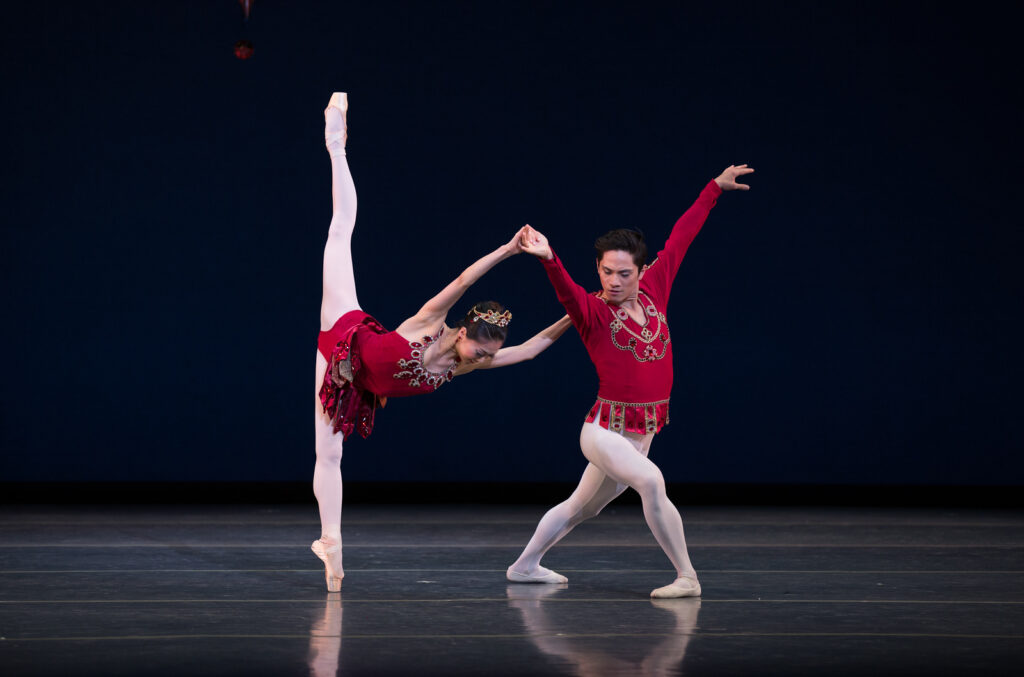
Boston Ballet in George Balanchine’s ‘Jewels’ ©The George Balanchine Trust, photo by Rosalie O’Connor courtesy of Boston Ballet

By Shelley A. Sackett

It’s easy to understand why George Balanchine’s Jewels has endured for more than 50 years. An abstract work, the triptych is not shackled to the narrative constraints of traditional ballet. Rather, each of its three pieces — “Emeralds,” “Rubies,” and “Diamonds” — is a pure sensorial feast of luscious music and stunning choreography. The work is easily appreciated by audiences new to the genre, yet also presents challenges for experienced dancers and critical aficionados.

The first Friday evening performance opened with the dreamy and poetic “Emeralds.” Featuring “Pélléas et Mélisande” and “Shylock” by the French composer, Gabriel Fauré, the piece is meant to evoke Paris. The curtain raised on ten members of the corps, bejeweled in crowns and regal necklaces and dressed in a lime green chiffon that you could almost taste. Like porcelain figures in a French masterpiece oil painting, the figures seem momentarily frozen, and then suddenly the stillness is broken and the dancers spring to life.

With its green backdrop and even greener costumes, “Emeralds” evokes the pastoral enchantment of forests, hunting scenes, courtships, and a tapestry of youthful magic. Balanchine mixes it up enough to keep the audience engaged (pas de deux, staccato hand movements and playful, joyful solos) without demanding overthinking. Oboes, French horns, and flutes present the perfect shading for the elegant partnering of standouts Lia Cirio and Patrick Yocum and the perfect lush background for the final piece, where the full corps strikes a tableau that mirrors and bookends the piece’s opening scene.

After a 20-minute intermission (the show runs 2 hours, 10 minutes total), the evening shifts gears with “Rubies,” Balanchine’s jazzy, modern and saucy piece set to Stravinsky’s “Capriccio for Piano and Orchestra.” Witty, playful and athletic, the dancers emote and engage with the audience, winking, nodding and sharing a sly smile. Karinska’s flapper-inspired ruby red costumes are perfect companions.

Roman Rykine and Larissa Ponomarenko

Balanchine clearly wanted everyone to have fun with this bold, American neoclassical piece. Influenced by Broadway and sexually charged, its emphasis on communication and merriment contrasts sharply with the preceding arms-length, performative “Emeralds.” The dancers jump rope, ride stick ponies and flirt shamelessly. Chyrstyn Mariah Fentroy is a cheeky breath of fresh air and Chisako Oga and Sun Woo Lee are evanescent as a seductive Adam and Eve couple who tango their way (among other feats) through Ruoting Li’s brilliant rendition of Stravinsky’s piano solo.

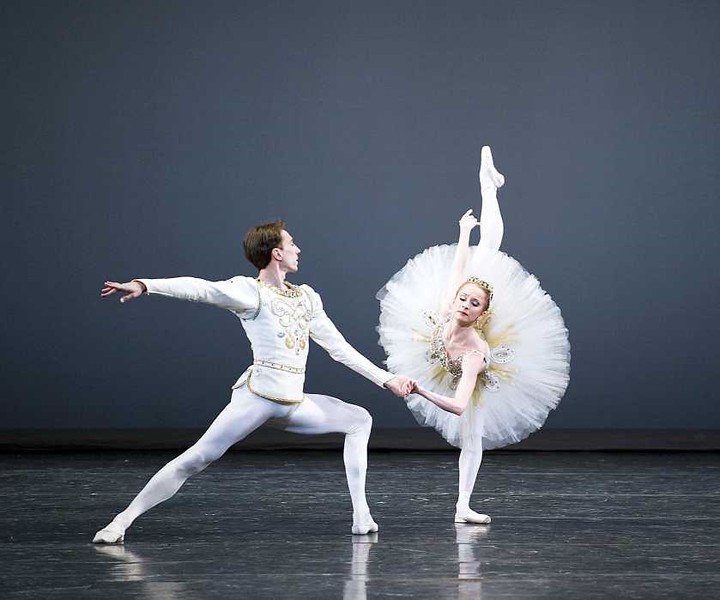
Balanchine circles back to his Russian roots with “Diamonds,” set in St. Petersburg to Tchaikovsky’s “Symphony No. 3, Op. 29, D major.” A tribute to Russian classicism, costumes are glittering white tutus and the set includes a glistening chandelier and generous pleated layers of thick satin draped and tiered along the stage’s sides and across the front. The effect is of an ice castle filled with sugar plum fairies until the dancers begin to prance like reindeer and engage in exuberant couplings.

Grand and imperial, the dancers exhibit disciplined symmetry, creating patterns and shapes. A pas de deux, long and undulating as it unfolds, features the marvelous Viktorina Kapitonova (and talented Sangmin Lee) who steal each other’s — and the audience’s — hearts as their movements reflect the music’s building crescendos and ascending scales, only to resolve harmonically and melodically. There is only grace and beauty in their dance, although the music could have been equally served by more urgent and fitful movements. Fortunately, Balanchine opted for the former approach.

Misa Kuranaga and Jeffrey Cirio

Jewels premiered in 1967 at New York Ballet, where Balanchine was Ballet Master and Principal Choreographer. The full length ballet, one of the world’s first “abstract” ballets, was inspired by a visit to the renown jeweler, Van Cleef & Arpels. Struck by the shimmering contents of the store’s cases, he decided to create dances that would emulate those shimmers with distinctive moods, styles and musical voices.

Boston Ballet is off to a spectacular start in its 2025-2026 season. Be sure to visit their site for more information and to purchase tickets at https://www.bostonballet.org/

‘Jewels’ — Choreography by George Balanchine. Music by Gabriel Fauré, Igor Stravinsky, and Peter Tchaikovsky. Costumes by Karinska. Lighting by Brandon Stirling Baker. Presented by Boston Ballet. With the Boston Ballet Orchestra conducted by Mischa Santora. Run has ended.

‘Murder for Two’ Is A Goofy, Musical Valentine to Classic Whodunits.

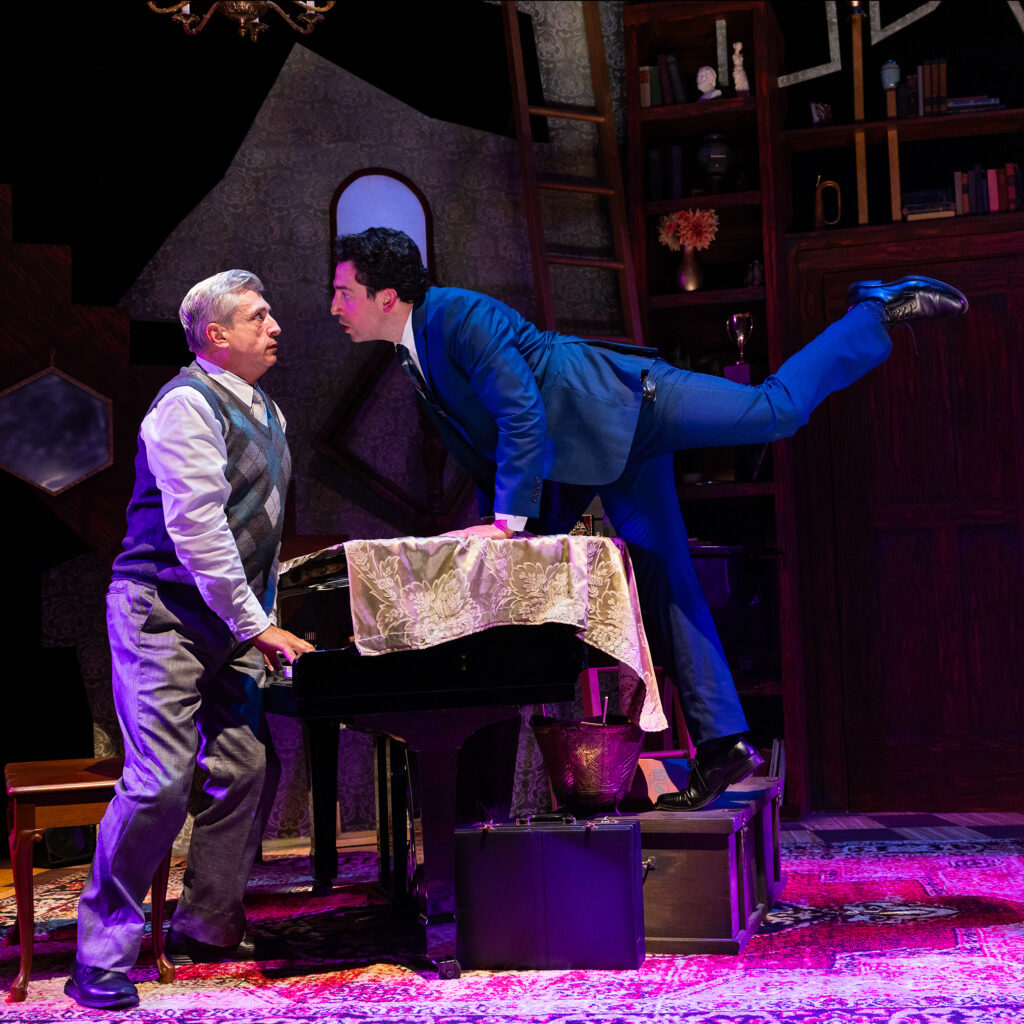
Will McGarrahan and Jared Troilo in “Murder for Two” at Greater Boston Stage
Photos: Niles Scott Studios

‘Murder for Two’ — Book and Music by Joe Kinosian. Book and Lyrics by Kellen Blair. Directed by Tyler Rosati. Music Direction by Bethany Aiken; Scenic Design by Katy Monthei; Lighting Design by Matt Cost; Sound Design by Adam Smith. Presented by Greater Boston Stage Company, 395 Main St., Stoneham, MA through Nov. 9.

By Shelley A. Sackett

Murder for Two is a loving parody of classic murder mysteries. A two-person musical, the 100-minute (no intermission) production is more vaudevillian revue than its genre’s prototypes, relying on gimmicks, songs, and quick changes to tell a familiar story in a new way.

The plot is fairly straightforward and as formulaic as it gets.

In the opening moments, Arthur Whitney, a famous author, is murdered in his mansion on the eve of his own surprise party. It is, of course, a stormy and dark night and the suspects are many — 13, in fact. From the widow, to the niece, psychiatrist, ballerina, town doctor, neighbors and local fireman, each is quirky and none lacks motive.

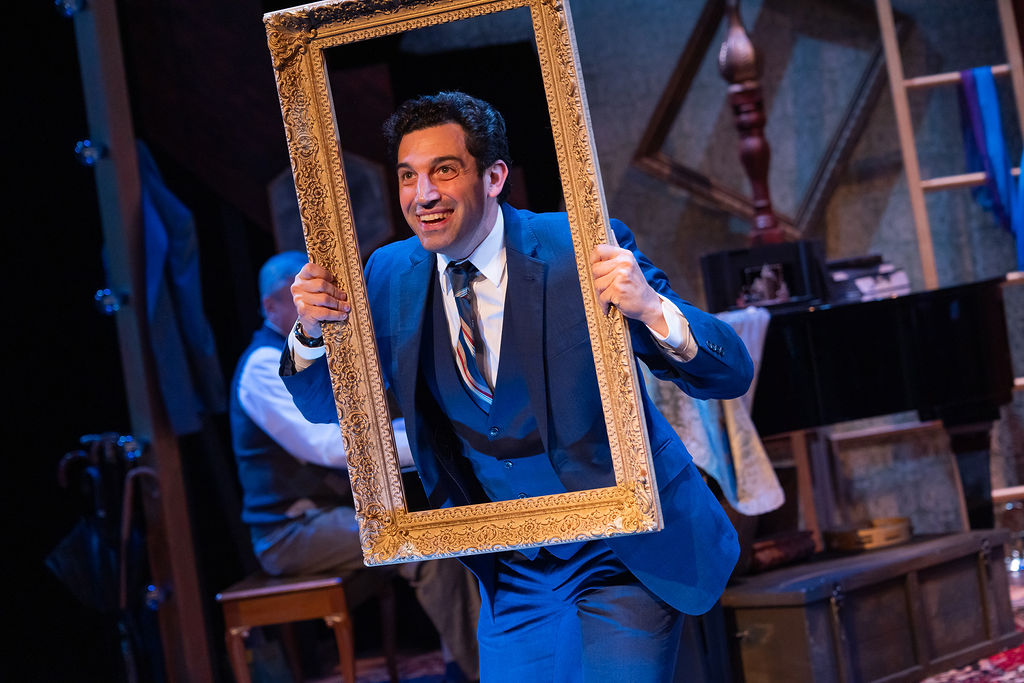
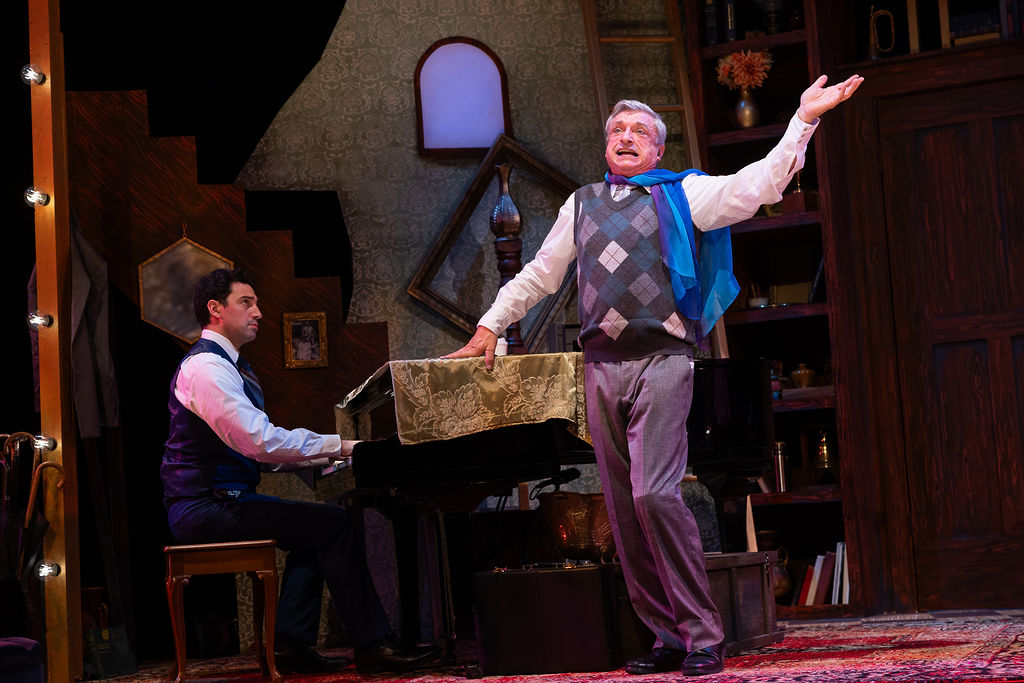
The only thing that keeps Murder for Two from being a total cliché is that all 13 suspects are played by Will McGarrahan, a virtuoso with a supple face and talent for impersonation. A simple hand gesture, distinctive gait, snooty scowl, tutu or pair of cat’s eyeglasses, and he becomes a different character, capturing their essence in the blink of an eye.

Jared Troilo is the small-town cop named Marcus Moscowicz who jumps at the chance to solve the case (and advance his stagnant career) when the real detective can’t be located. A by-the-books kind of guy, he has his work cut out for him dealing with this motley crew.

Troilo

The focal point of the small but expertly designed and lighted set is an upright piano, where the two actors show off their piano playing and vocal chops. Their musical rapport and interaction is delightful. They finish each other’s phrases, take turns singing and accompanying, and shine during four-handed duets. Unfortunately, the songs lack lyrics of substance and tunes with catchy melodies, but the actors’ comfort, confidence, and camaraderie (almost) make up for it.

The play also relies heavily on shtick and, like all shtick, some is laugh-out-loud funny, and some is corny and cutesy, landing with a thud.

At the Saturday evening performance on opening weekend, McGarrahan’s microphone malfunctioned and, despite an unscheduled intermission (which provided fertile fodder and opportunity for the actors to break the fourth wall and ad lib to the audience’s delight), still didn’t work properly. Given the show’s fast pace and McGarrahan’s pivotal role, it made the first half of the show even harder to follow.

McGarrahan 

Following the plot and figuring out who done it, however, is not the point of attending this production. The real reason is the physical comedy and musical showmanship of two actors who are so comfortable with each other and their performances that, at one point, McGarrahan goes off script and shakes a tambourine in Troilo’s face until he cracks up. After an hour of scripted unevenness, the audience applauded in appreciation and relief.

Despite working with such unexceptional material, McGarrahan and Troilo seem to be having the time of their lives on stage. Would that the audience could have shared in some of that.

For more information, visit https://www.greaterbostonstage.org/