Apollinaire’s Thriller ‘Is This a Room’ Asks, ‘Who Is The Real Patriot in Today’s Murky World?’

Cristhian Mancinas-García, Bradley Belanger, Brooks Reeves, and Parker Jennings in Apollinaire Theatre Company’s “Is This a Room.”

‘Is This a Room” — Written by Tina Satter. Directed by Danielle Fauteux Jacques. Concept and Original Direction by Tina Satter. Presented by Apollinaire Theatre Company, 189 Winnisimmet St., Chelsea, through Jan. 18.

By Shelley A. Sackett

Whatever you do, do not under any circumstances listen to any of the excellent podcasts and interviews with Reality Winner, the subject of Apollinaire’s gripping Is This a Room, until after you’ve seen the play — and see it you must.

For 70 minutes, the verbatim transcript of an F.B.I. interview of a 25-year-old woman suspected of violating the Espionage Act is the most unlikely script in this thrilling mystery that packs a wallop and imbues a by-the-books encounter with emotional and psychological depth and humanity.

The play thrusts us into the moment of June 3, 2017, when Reality Winner (a riveting Parker Jennings), returning from doing Saturday chores, is met by F.B.I. agents waiting at her front door. In her cutoff jeans, white button-down shirt, and spunky hi-top sneakers, she looks more like a teenager than a woman who spent six years in the Air Force, speaks Farsi, Dari, and Pashto, and has top-secret clearance with a local military contractor.

The men, Special Agent Justin Garrick (a sublime Brooks Reeves) and R. Wallace Taylor (Cristhian Mancinas-Garcia), introduce themselves and explain they are there to talk “about, uh, possible mishandling of classified information.”

Winner, wide-eyed with innocence and trust, replies, “Oh my goodness. Okay.” The skeletal, abstract set (Joseph Lark-Riley), superb lighting (Danielle Fauteux Jacques, who also directs), and Black Box configuration create an atmosphere of such intimacy that it is as if the audience is watching a real-life proceeding happening in real time.

At first, Winner claims she has no idea what the men are talking about, and Jennings digs deep to find the emotion and vulnerability in her character. We can imagine what she is feeling with each passing minute, and we want to believe her, even after we learn she has three military grade weapons in her house.

Good cop Garrick and less good cop Taylor explain they have warrants (which they never show her) and will be searching her house and car. She doesn’t insist on a lawyer; they don’t read her her Miranda rights. It’s all low stakes and cordial in the beginning, with Winner apologizing and wanting to make it “as easy as possible for you guys,” and the agents making small talk and deflecting her questions with, “We’ll go over all of that…”

The transcript tiptoes towards substance, punctuating the agents’ aw-shucks stammers and guffaws with open-ended but steely questions. Has she ever gone outside her need-to-know/clearance level? Has she ever taken anything outside the building? Has she discussed anything having to do with her job with anyone, ever? Has she ever copied anything?

Suddenly, the atmosphere shifts, and Winner tries to make light of the line of questioning by defending her use of printer and paper. She’s “old-fashioned,” she claims, and uses a lot of paper. She finds it easier to navigate long documents in hard copies rather than online. “Is that what this is about? Fraud, waste and abuse?” she jokes.
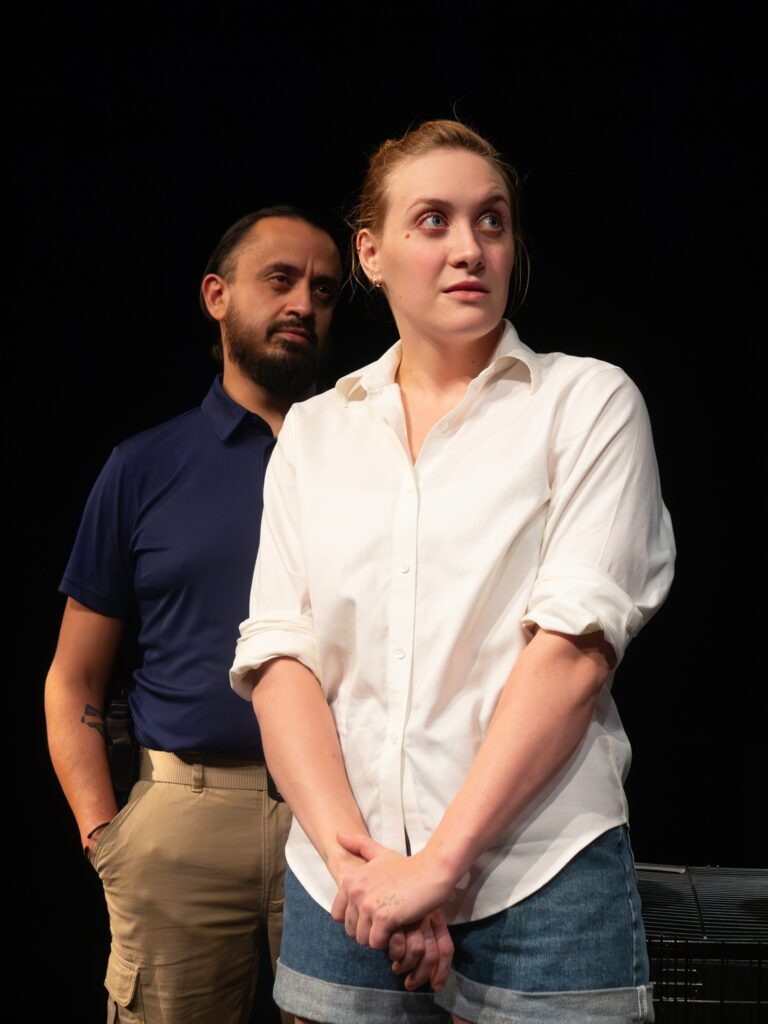
Mancinas-García and Jennings

The agents, still acting as friends, offer her “the opportunity to tell the truth,” and an ominous beat, like the beeping in an ICU or the slow menace of low war drums, thrums. Every time the actual transcript was redacted (brilliantly referenced on the playbill and poster), a blue light glares and the beat intensifies, as if, by proxy, the audience is subjected to psychological torture.

Fifty minutes in, everything changes. The agents say they have the goods on her. Winner’s story wiggles a little. Then it wiggles a lot. The agents straddle a delicate line between doing their job as law enforcers and trying not to overwhelm her. “IS there anything else we should be worried about?” Garrick asks. Not to worry, he implies, as he adds, ”We’ll figure it out.”

Jennings brings credibility and stunning physical nuance to a role that held few clues about the character’s interiority. Her body literally crumbles, muscle by muscle, when she realizes the jig is up. As F.B.I. agents sent to do the bidding of one they may or may not agree with, they are a little nervous and a little lost, sharing details of their personal lives and asking about her CrossFit experiences. They may be doing the devil’s work, but they are neither demons nor demonized.

It’s no secret that Reality Winner pled guilty to leaking documents that contained proof of Russian interference in the 2016 election to an online news source, The Intercept. She was sentenced to more than five years in prison, the longest sentence ever imposed in federal court for an unauthorized release of government information to the media, according to a Times report. She was granted early release, but is prohibited from publicly speaking about certain topics.

In 2025, she released an audiobook, “I Am Not Your Enemy: A Memoir,” and has her own dedicated podcast series, “This Is Reality.” Even with a stiff gag order, the facts that emerge make it impossible not to question why Trump cracked down on the leak of this particular document, which contained proof of Russian interference in the 2016 election (which Trump has denied) and which the NSA, under someone’s orders, buried.

Apollinaire Artistic Director Fauteux could not have chosen a riper moment in which to stage this play, as we round the bend towards a year of predicted mid-term election chaos and mayhem. We may not face the same situation Winner did, with her access to and knowledge of documents proving a possible unlawful official cover-up, but we are left with the same existential dilemma — Is it possible to live a law-abiding life in a world turned lawless, or will only the lawless survive?

Recommended.

For more information, visit: https://www.apollinairetheatre.com

A.R.T.’s Uplifting ‘Wonder’ Wonders What Makes A Life Wonderful

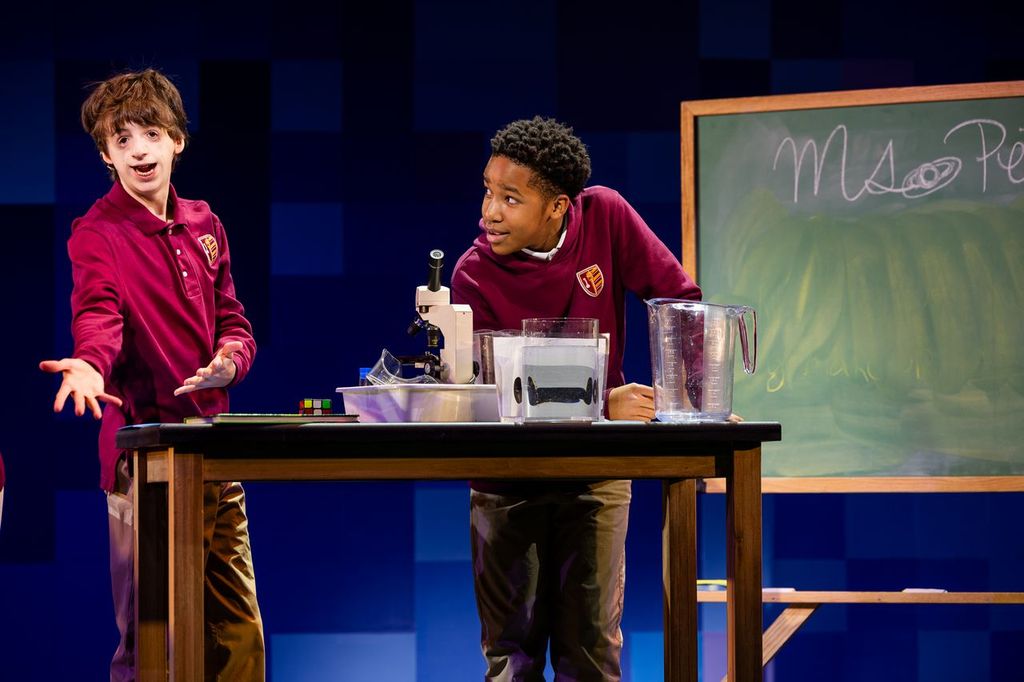
Nathan Salstone, Garrett McNally, and members of the cast of ‘Wonder’ at the A.R.T.
Photos by Hawver and Hall

‘Wonder’ — Book by Sarah Ruhl. Music and lyrics by A Great Big World (Ian Axel and Chad King). Directed by Taibi Magar. Choreographed by Katie Spelman. Music supervision by Nadia DiGiallonardo. Presented by American Repertory Theater at Loeb Drama Center, 64 Brattle St., Cambridge, through Feb. 8.

By Shelley A. Sackett

Middle school is widely recognized as one of life’s toughest crucibles, a time of major physical, emotional and social change. A petri dish of hormonal upheaval, intense social pressures and increased academic demands, it has all the ingredients for an emotive perfect storm.

Now imagine navigating these turbulent waters as a boy with facial differences facing transition from homeschooling to private school, where he will, for the first time, have to mix with other kids, and that perfect storm suddenly lurks as a tsunami of epic proportions.

This is the premise of Wonder, the new coming-of-age musical drama débuting at American Repertory Theater. Based on R.J. Palacio’s best-selling 2012 young adult novel, Sarah Ruhl’s play tells the story of Auggie Pullman, a boy born with Treacher Collins syndrome, a rare genetic disorder that interferes with the development of facial features.

Garrett McNally and Donovan Louis Bazemore

Auggie (Garrett McNally last Friday night. He shares the role with Max Voehl) is a typical 12-year-old in many ways. He straddles childhood and adolescence. His bedroom is still that of a little boy with its bed shaped like a spaceship, and he has an imaginary friend, Moon Boy (Nathan Salstone, a talented standout), who provides protection and companionship.  

Auggie also asks more grown-up, bigger picture questions, wondering, for example, why he was created as he was. He longs to be ordinary, yet by the play’s end, it is his extraordinariness that elevates both Auggie and everyone around him.

Matt Saunders has created an elegant, simple set of moving panels with a patchwork quilt of lighted squares that reflect the mood as they change from celestial blues to red and yellow to shades of pastel mauves (Lighting by Bradley King). Songs by pop duo A Great Big World (Ian Axel and Chad King) are funny, catchy and upbeat with lyrics that reveal their characters’ inner lives and fill us in on important details. (Unfortunately, the band too often drowns them out).

The splashy opening number, “3-2-1 Blast Off!” showcases the charismatic Salstone and introduces us to Auggie. “You Are Beautiful,” a song celebrating Auggie’s unique beauty and strength, recognizes his inspiring journey of 28 surgeries and the “scars tell a story of a boy who’s strong,” making him a “wonder.”

Alison Luff and Garrett McNally

Auggie’s parents, Nate (Javier Muñoz) and Isabel (Alison Luff) have decided it’s time to wean Auggie off homeschooling and shift to the private co-ed Beecher Prep. Isabel needs time to herself and Auggie’s intellectual capacity and needs exceed what she can provide. He needs to integrate with other kids (and, as importantly, they with him).

Auggie is terrified. His experiences with other kids have been disastrous. They can’t get past how he looks, reacting with fear, disgust and ridicule. Eventually, he relents, but not until Moon Boy promises to accompany him and his parents agree to let him bring his space helmet.

The Beecher Prep scenes are where the play shines, with a near-perfect blend of choreography (Katie Spelman), ensemble singing, and terrific performances by its peppy teachers (Pearl Sun and Raymond J. Lee). Director Taibi Magar elicits crisp performances and makes effective use of the concentric rotating circles on stage.

All is not roses for Auggie, however, and bullying becomes a big part of the story. Middle school brings out meanness (aka insecurities) in some kids, and Auggie’s facial difference provides both a focal point and a bull’s eye.

The play’s strength and interest lie in its exploration of other characters’ perspectives. Auggie’s sister Via (Kaylin Hedges) has played second fiddle to her brother since the day he was born. “Hospital waiting rooms were our playground,” she explains. Because her life is so much smaller than his, no one (especially not her parents) pays attention to her. Nonetheless, she is fiercely devoted to her little brother. There are two Auggies, in her opinion — “What I see. What others see.”

As other characters take center stage, we see that everyone struggles, even the bullies. There are enough plot curves to provide interest without the need for heavy lifting, but the lifeblood of Wonder is its message of kindness, empathy and hope.

Auggie’s mother gets the ball rolling, telling Auggie she sees only the wonder and beauty in him, even in his scars. Auggie takes that ball and runs with it, as do the school’s principal, Mr. Tushman and, eventually, all his classmates. They learn what it’s like to walk in another’s shoes, to choose being kind over being right, to value harmony and heart over war and might. Lyricists Axel and King are never preachy nor syrupy, and their lessons resonate all the more because of it. “Auggie can’t change how he looks,” the students are told, “but we can change how we look.”

Magar, in the director’s notes, eloquently echoes the thoughts of many as we start the post-equinox ascent from our darkest to lightest days.

“I hope Wonder meets you wherever you are—whether you’re searching for awe, for hope, for connection, or simply for a story that believes in the goodness we’re capable of. Theater may not change the world the way teachers and politicians do, but it can change us. It can open something. It can remind us of who we want to be. May this performance fill you with a little more wonder—and a little more hope.”

Amen to that.

For more information, visit https://americanrepertorytheater.org/

The Huntington’s Superb Musical ‘Fun Home’ Plumbs Memories and Memoirs

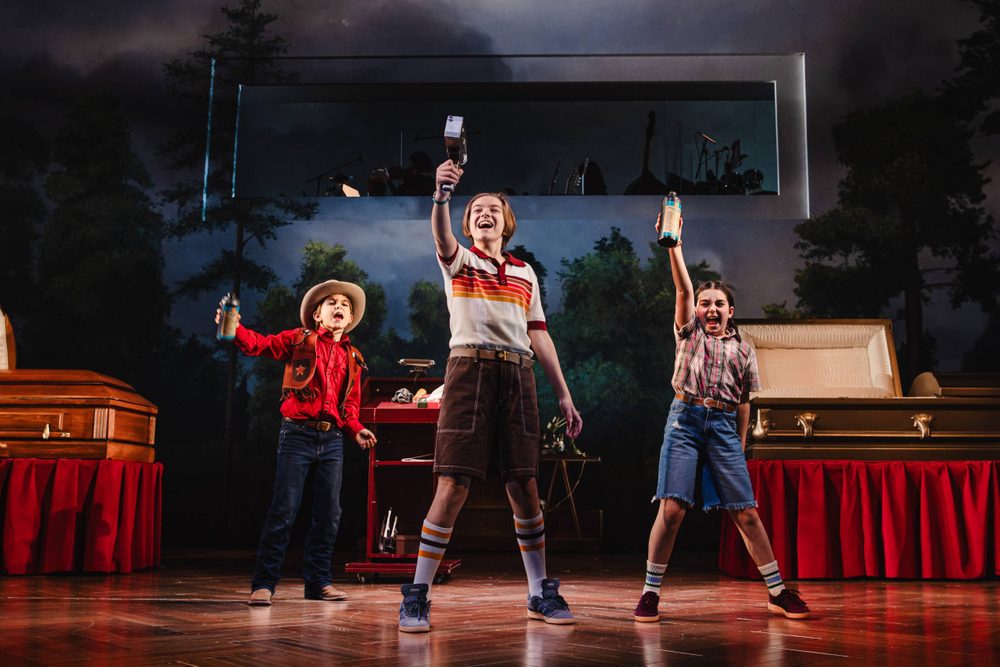
Caleb Levin, Odin Vega, Lyla Randall in ‘Fun Home’ at the Huntington. Photos by Marc J Franklin

‘Fun Home’ — Music by Jeanine Tesori. Book and Lyrics by Lisa Kron. Based on the graphic novel by Alison Bechdel. Directed by Logan Ellis. At the Huntington Theatre, Huntington Ave., Boston through Dec. 14.

By Shelley A. Sackett

In less capable hands, the multiple Tony Award-winning Fun Home, at the Huntington through Dec. 14, could have been a disaster. Adapted from Alison Bechdel’s graphic novel memoir, the storyline follows a family’s journey through sexual orientation, gender roles, suicide, emotional abuse, grief, loss, and lesbian Bechdel’s complicated relationship with her tightly closeted father. To boot, the title refers to the family funeral parlor, where her father worked and she and her siblings played.

Doesn’t sound like the raw material for one of the year’s outstanding Boston area productions? Think again.

Jeanine Tesori, a two-time Tony Award recipient and two-time Pulitzer Prize finalist for drama, has created gorgeous, melodic music for Fun Home. Award-winning playwright and lyricist Lisa Kron hits all the right tones with a masterpiece of storytelling musical numbers overlayed with a balanced, nuanced script that manages to be funny, poignant, clever, wise, and heartbreaking. These two talented women breathe life into Bechdel’s memories, turning what might have been maudlin into a dense and complex story of one family’s journey as narrated by one of its travelers.

Add to the mix a stellar cast, meticulous direction (Logan Ellis), a sumptuous set (Tanya Orellana), effective lighting (Philip Rosenberg), and a superb orchestra (music direction by Jessie Rosso), and you have all the ingredients for one very special evening of theater.

Bockel, Nick Duckart

The play opens with Alison (Sarah Bockel), a 42-year-old successful cartoonist, center stage, huddled over her drafting table. She crumples one sheet of paper after another, throwing them onto the floor. She recalls two other periods in her life: one when she was 10 (Small Alison, played by the showstopping Lyla Randall) and another when she was a freshman at Oberlin College (Medium Alison, played by Maya Jacobson).

Suddenly, Small Alison’s head pops up out of the drafting table. Kron’s narrative lyrics both highlight Bockel and clue us in about her character. Alison is trying to make sense of her childhood and the larger-than-life role her father, Bruce (a knockout Nick Duckart), played in it. At the center is Alison’s joy at discovering she is a lesbian, her first year in college, and Bruce’s tortured and shamed existence as a closeted gay man living as an outwardly “normal,” heterosexual, family man. His suicide (he stepped in front of a truck) only elevated his importance in Alison’s pursuit of answers to the question, “What happened to us?” If she could only unlock the mysteries surrounding his life, perhaps she could understand those surrounding her own.

The problem is, she doesn’t trust her memory. She needs “real things,” both to draw and to rely on. She needs eyewitnesses. She needs Small and Medium Alisons. Told in a series of nonlinear vignettes connected by narration from the adult Alison character, the Bechdel family saga unfolds.

Her childhood in rural Pennsylvania was anchored by the ornate Victorian house her father obsessively and compulsively restores (two traits he also brings to his homosexuality and cruising). She and her siblings played games, including performing an imaginary advertisement for the family funeral home (Randall, as Small Alison, brings down the house in the hysterical and arresting Jackson Five-style “Come to the Fun Home”). Juxtaposed with Partridge Family scenes are their opposites. Bruce, for example, invites Roy, a young man whom he has hired to do yard work, into the house and begins to seduce him in the library while his wife, Helen (the gifted Jennifer Ellis), plays the piano upstairs, trying her best to ignore it (“Helen’s Etude”).

Sushma Saha, Maya Jacobson

Medium Alison (Jacobson is terrific) enacts Alison’s memories of her first lesbian affair with Joan (Sushma Saha) and gushes with delirious post-sexual froth that she is “changing my major to Joan.” She shares that news with her parents and is forever haunted by suspicions that her coming out led to her father’s death. “I leapt out of the closet — and four months later my father killed himself by stepping in front of a truck,” the overhead caption reads.

Many of the musical numbers are more than plot devices; they are emotional powder kegs and stand-alone gems. “Telephone Wire” documents the moment where Alison and her dad try to get into a gay bar but end up defeated, even when she is carded. The tragedy of the missed opportunity for connection, and of the unspoken yearning and loss both feel but can’t acknowledge, is heartbreaking. In “Ring of Keys,” Small Alison (Randall) again brings down the house as a tiny girl transfixed by a butch delivery woman whose uniform and ring of keys open up doors she didn’t even know were locked.

“Days and Days,” Helen’s cri de Coeur, stands out as a vehicle for Ellis’ prodigious vocal power and a showcase for Kron’s Tony-nominated lyrics. As Bruce’s long-suffering wife, humiliated and abused by the homosexual husband she just as fiercely protects and stands by, Helen admits to Alison that she has sacrificed her life to keep the family together. She wants better for her daughter and warns her not to follow in her mother’s footsteps. “I didn’t raise you to give away your days like me,” she says introspectively.

Jennifer Ellis

Fun Home is as complicated as it is simple. It is about a family, its underlying anguish, and the balance between fitting in and being true to oneself. Honest, moving and hilarious, the play never becomes mawkish or angry (though it has every reason to). Each character stands upright, for better and worse, owning their authentic selves.

In the finale, Alison finally realizes the moment when she felt a perfect balance in her life: when her 10-year-old self and her father played “Airplane.” In “Flying Away,” Small Alison duets with her two older selves, a melding at last of past and present that paves a clearer way to the future. The caption above them reads, “Every so often, there was a rare moment of perfect balance when I soared above him.” There wasn’t a dry eye in the house.

Highly recommended.

For more information, visit https://www.huntingtontheatre.org.