
‘Is This a Room” — Written by Tina Satter. Directed by Danielle Fauteux Jacques. Concept and Original Direction by Tina Satter. Presented by Apollinaire Theatre Company, 189 Winnisimmet St., Chelsea, through Jan. 18.
By Shelley A. Sackett
Whatever you do, do not under any circumstances listen to any of the excellent podcasts and interviews with Reality Winner, the subject of Apollinaire’s gripping Is This a Room, until after you’ve seen the play — and see it you must.
For 70 minutes, the verbatim transcript of an F.B.I. interview of a 25-year-old woman suspected of violating the Espionage Act is the most unlikely script in this thrilling mystery that packs a wallop and imbues a by-the-books encounter with emotional and psychological depth and humanity.
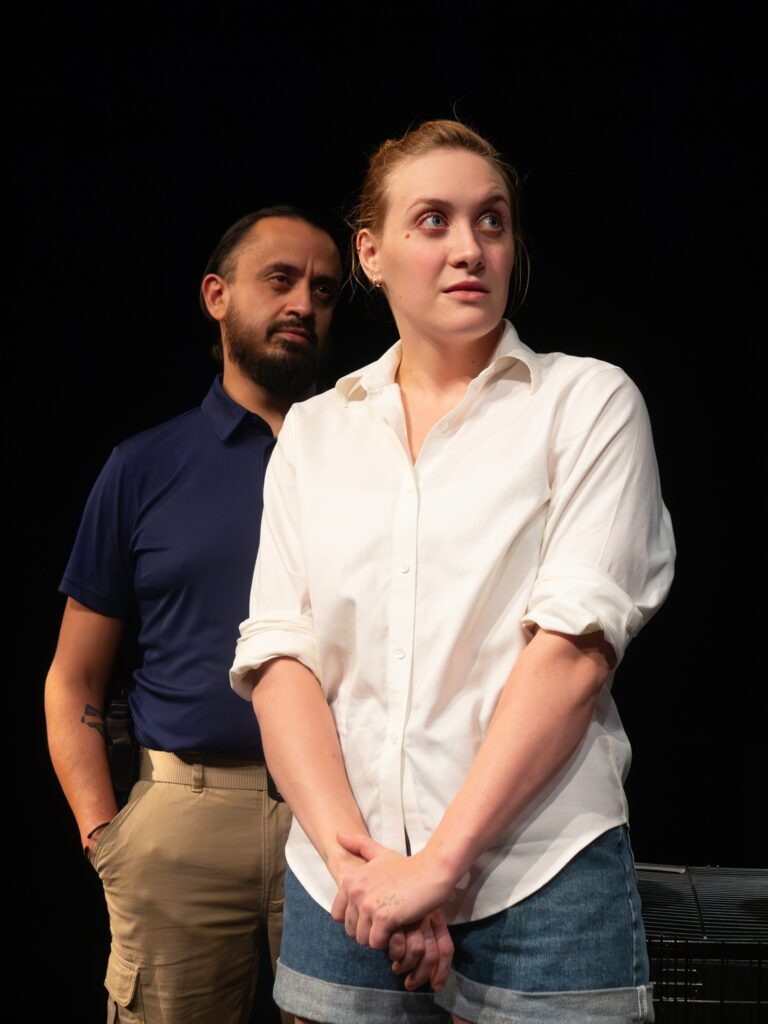
The play thrusts us into the moment of June 3, 2017, when Reality Winner (a riveting Parker Jennings), returning from doing Saturday chores, is met by F.B.I. agents waiting at her front door. In her cutoff jeans, white button-down shirt, and spunky hi-top sneakers, she looks more like a teenager than a woman who spent six years in the Air Force, speaks Farsi, Dari, and Pashto, and has top-secret clearance with a local military contractor.
The men, Special Agent Justin Garrick (a sublime Brooks Reeves) and R. Wallace Taylor (Cristhian Mancinas-Garcia), introduce themselves and explain they are there to talk “about, uh, possible mishandling of classified information.”
Winner, wide-eyed with innocence and trust, replies, “Oh my goodness. Okay.” The skeletal, abstract set (Joseph Lark-Riley), superb lighting (Danielle Fauteux Jacques, who also directs), and Black Box configuration create an atmosphere of such intimacy that it is as if the audience is watching a real-life proceeding happening in real time.
At first, Winner claims she has no idea what the men are talking about, and Jennings digs deep to find the emotion and vulnerability in her character. We can imagine what she is feeling with each passing minute, and we want to believe her, even after we learn she has three military grade weapons in her house.
Good cop Garrick and less good cop Taylor explain they have warrants (which they never show her) and will be searching her house and car. She doesn’t insist on a lawyer; they don’t read her her Miranda rights. It’s all low stakes and cordial in the beginning, with Winner apologizing and wanting to make it “as easy as possible for you guys,” and the agents making small talk and deflecting her questions with, “We’ll go over all of that…”
The transcript tiptoes towards substance, punctuating the agents’ aw-shucks stammers and guffaws with open-ended but steely questions. Has she ever gone outside her need-to-know/clearance level? Has she ever taken anything outside the building? Has she discussed anything having to do with her job with anyone, ever? Has she ever copied anything?
Suddenly, the atmosphere shifts, and Winner tries to make light of the line of questioning by defending her use of printer and paper. She’s “old-fashioned,” she claims, and uses a lot of paper. She finds it easier to navigate long documents in hard copies rather than online. “Is that what this is about? Fraud, waste and abuse?” she jokes.
The agents, still acting as friends, offer her “the opportunity to tell the truth,” and an ominous beat, like the beeping in an ICU or the slow menace of low war drums, thrums. Every time the actual transcript was redacted (brilliantly referenced on the playbill and poster), a blue light glares and the beat intensifies, as if, by proxy, the audience is subjected to psychological torture.
Fifty minutes in, everything changes. The agents say they have the goods on her. Winner’s story wiggles a little. Then it wiggles a lot. The agents straddle a delicate line between doing their job as law enforcers and trying not to overwhelm her. “IS there anything else we should be worried about?” Garrick asks. Not to worry, he implies, as he adds, ”We’ll figure it out.”
Jennings brings credibility and stunning physical nuance to a role that held few clues about the character’s interiority. Her body literally crumbles, muscle by muscle, when she realizes the jig is up. As F.B.I. agents sent to do the bidding of one they may or may not agree with, they are a little nervous and a little lost, sharing details of their personal lives and asking about her CrossFit experiences. They may be doing the devil’s work, but they are neither demons nor demonized.
It’s no secret that Reality Winner pled guilty to leaking documents that contained proof of Russian interference in the 2016 election to an online news source, The Intercept. She was sentenced to more than five years in prison, the longest sentence ever imposed in federal court for an unauthorized release of government information to the media, according to a Times report. She was granted early release, but is prohibited from publicly speaking about certain topics.
In 2025, she released an audiobook, “I Am Not Your Enemy: A Memoir,” and has her own dedicated podcast series, “This Is Reality.” Even with a stiff gag order, the facts that emerge make it impossible not to question why Trump cracked down on the leak of this particular document, which contained proof of Russian interference in the 2016 election (which Trump has denied) and which the NSA, under someone’s orders, buried.
Apollinaire Artistic Director Fauteux could not have chosen a riper moment in which to stage this play, as we round the bend towards a year of predicted mid-term election chaos and mayhem. We may not face the same situation Winner did, with her access to and knowledge of documents proving a possible unlawful official cover-up, but we are left with the same existential dilemma — Is it possible to live a law-abiding life in a world turned lawless, or will only the lawless survive?
Recommended.
For more information, visit: https://www.apollinairetheatre.com
 InSights