
Actors’ Shakespeare Project’s ‘The Bomb-itty of Errors’ Brings out The Bomb in The Bard

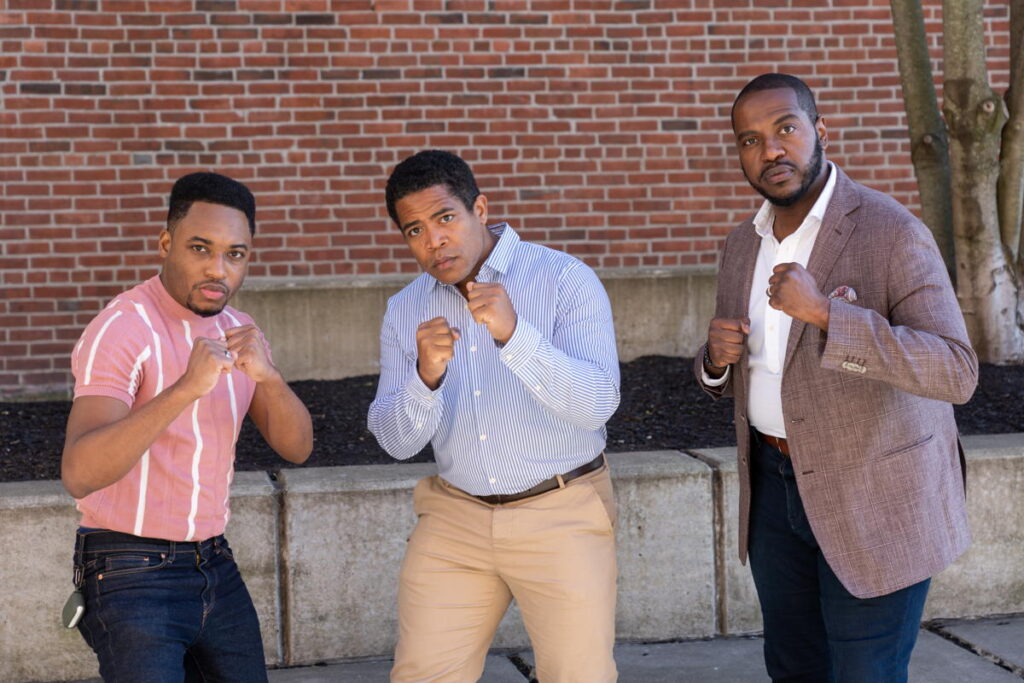
Cast of Actors’ Shakespeare Project’s ‘The Bomb-itty of Errors’

by Shelley A. Sackett

Actors’ Shakespeare Project’s “The Bomb-itty of Errors” is perfect pre-summer fare. Hip-hop and rap, a live DJ, a brilliantly exhaustive (and sometimes exhausting) script, some sublime acting and — as if that’s not enough — the Bard himself, camouflaged but hardly hidden. All wrapped neatly in a 90-minute intermission-less package that is as invigorating as it is boisterous.

The brainchild of four final-year students at New York’s Tisch School of the Arts, “Bomb-itty” started as a university project in 1998. It was so popular that it received enough support to return to New York the following year for a seven-month run, which in turn led to a lengthy Chicago run.

“Bomb-itty” is true to Shakespeare’s style of rhyming couplets, (sometimes bawdy) humor and historical references. The language often mirrors Shakespeare’s with references to other works sprinkled here and there to stroke the egos of those who recognize them. But the real star of the show is the vibrant, beatbox soundbox and the actors who manage to memorize a super-sized number of lines, which they deliver at break-neck speed.

The result is a theater experience unlike any I’ve experienced. (No, “Bomb-itty” is not a “Hamilton” clone. It’s way more fun.)

Based more than loosely on Shakespeare’s “The Comedy of Errors,” the plot involves two sets of identical twins with identical names, mistaken identities, misfortunes galore and a slew of stereotypes (some more offensive than funny). To get the most out of the rapid fire lines and delivery, either arrive early enough to read the playbill’s summary (twice, at least), or spend some time digesting the on-line Cliff Notes version of the original. Trust me, it is time well spent.

Despite first appearances (the prologue is a gem), “Bomb-itty” adheres closely to Shakespeare’s play.

In the original, a merchant of Syracuse, Egeon, suffered a shipwreck some years ago in which he was separated from his wife, Emilia, from one of his twin sons, later Antipholus of Ephesus, and the son’s slave, Dromio of Ephesus. The other slave’s twin, Dromio of Syracuse and Egeon’s remaining son, Antipholus of Syracuse, remained with Egeon.

When he came of age, Egeon allowed Antipholus of Syracuse and his slave Dromio of Syracuse to go in search of his lost brother. When they didn’t return, Egeon set out after his remaining son, and the play begins as we learn of Egeon’s capture and his condemnation to death by Duke Solinus in the hostile city of Ephesus. The details of Egeon’s story move Solinus to pity, and he grants a reprieve until nightfall, by which time a ransom of a thousand marks must be raised.

Unbeknown to all, the missing Antipholus and Dromio landed in Ephesus after the shipwreck and have thrived there. Antipholus of Ephesus and his servant Dromio are thrown into confusion when, unknown to each other, their twin brothers of the same names arrive in town from Syracuse.

In “Bomb-itty,” the Antipholus and Dromio twins are now quadruplets, put up for adoption after their father, a famous rap MC (Master of Ceremonies), committed suicide. The time is today and Ephesus and Syracuse have been replaced by the US East and West coasts.

Antipholus and Dromio of Ephesus visit Syracuse, New York, to take part in an MC competition. In the ensuing mayhem, one Antipholus is called home to a wife he never married, only to fall in love with her sister, Luciana. Meanwhile, the other Antipholus runs afoul of a policeman who enjoys a questionable relationship with his horse.

Four actors play most of the roles. Henry Morehouse as Dromio of Ephesus and Luciana chews up the stage. He has a natural physicality and stellar delivery and is comfortable and confident. He hands-down steals every scene in which he plays Luciana. A recent graduate of Boston University with a BFA in acting, Morehouse is a talent to be watched. His stage presence is spot-on and magnetic.

Likewise, the veteran actor Malik Mitchell brings the same charisma and acting chops to this production that those of us lucky enough to see him in SpeakEasy Stage Company’s “Once on this Island” have already experienced. His Dr. Pinch, the Rastafarian herbal “doctor,” is a show-stopper.

Anderson Stinson, III is all sinew and smiles in his many roles, shining as Antipholus of Syracuse. DJ Whysham strikes all the right beats and Victoria Omoregie rises to the challenge of her many character and costume changes.

Notwithstanding its gratuitous sexism, misogyny and anti-LGBTQ+ rhetoric (and a truly baffling and unforgivable antisemitic portrayal of a Jewish jeweler), the play is worth seeing for its high-energy, rowdy fun and for showing us what hip-hop and rap in the right hands can produce: a unique and exciting contemporary art form. If you listen carefully, you can feel the Bard’s ghostly presence, his sandaled toes tapping out the beats. For tickets and more information, go to: https://www.actorsshakespeareproject.org/

x

MICHAELHOBAN

Cast of Actors’ Shakespeare Project’s ‘The Bomb-itty of Errors’

‘The Bomb-itty of Errors’ — Written by Jordan Allen-Dutton, Jason Catalano, Gregory J. Qaiyum, Jeffrey Qaiyum and Erik Weiner. Based on ‘The Comedy of Errors’ by William Shakespeare. Directed by Christopher V. Edwards. Scenic Design by Baron E. Pugh; Costume Design by Zoe Sundra; Lighting Design by Max Wallace; Props Design by Steve Viera, Sound Design by Abraham Joyner-Meyers. Presented by the Actors’ Shakespeare Projectat the Charlestown working Theater, 442 Bunker Hill St., Chares through June 26.

by Shelley A. Sackett

Actors’ Shakespeare Project’s “The Bomb-itty of Errors” is perfect pre-summer fare. Hip-hop and rap, a live DJ, a brilliantly exhaustive (and sometimes exhausting) script, some sublime acting and — as if that’s not enough — the Bard himself, camouflaged but hardly hidden. All wrapped neatly in a 90-minute intermission-less package that is as invigorating as it is boisterous.

The brainchild of four final-year students at New York’s Tisch School of the Arts, “Bomb-itty” started as a university project in 1998. It was so popular that it received enough support to return to New York the following year for a seven-month run, which in turn led to a lengthy Chicago run.

“Bomb-itty” is true to Shakespeare’s style of rhyming couplets, (sometimes bawdy) humor and historical references. The language often mirrors Shakespeare’s with references to other works sprinkled here and there to stroke the egos of those who recognize them. But the real star of the show is the vibrant, beatbox soundbox and the actors who manage to memorize a super-sized number of lines, which they deliver at break-neck speed.

The result is a theater experience unlike any I’ve experienced. (No, “Bomb-itty” is not a “Hamilton” clone. It’s way more fun.)

Based more than loosely on Shakespeare’s “The Comedy of Errors,” the plot involves two sets of identical twins with identical names, mistaken identities, misfortunes galore and a slew of stereotypes (some more offensive than funny). To get the most out of the rapid fire lines and delivery, either arrive early enough to read the playbill’s summary (twice, at least), or spend some time digesting the on-line Cliff Notes version of the original. Trust me, it is time well spent.

Despite first appearances (the prologue is a gem), “Bomb-itty” adheres closely to Shakespeare’s play.

In the original, a merchant of Syracuse, Egeon, suffered a shipwreck some years ago in which he was separated from his wife, Emilia, from one of his twin sons, later Antipholus of Ephesus, and the son’s slave, Dromio of Ephesus. The other slave’s twin, Dromio of Syracuse and Egeon’s remaining son, Antipholus of Syracuse, remained with Egeon.

When he came of age, Egeon allowed Antipholus of Syracuse and his slave Dromio of Syracuse to go in search of his lost brother. When they didn’t return, Egeon set out after his remaining son, and the play begins as we learn of Egeon’s capture and his condemnation to death by Duke Solinus in the hostile city of Ephesus. The details of Egeon’s story move Solinus to pity, and he grants a reprieve until nightfall, by which time a ransom of a thousand marks must be raised.

Unbeknown to all, the missing Antipholus and Dromio landed in Ephesus after the shipwreck and have thrived there. Antipholus of Ephesus and his servant Dromio are thrown into confusion when, unknown to each other, their twin brothers of the same names arrive in town from Syracuse.

In “Bomb-itty,” the Antipholus and Dromio twins are now quadruplets, put up for adoption after their father, a famous rap MC (Master of Ceremonies), committed suicide. The time is today and Ephesus and Syracuse have been replaced by the US East and West coasts.

Antipholus and Dromio of Ephesus visit Syracuse, New York, to take part in an MC competition. In the ensuing mayhem, one Antipholus is called home to a wife he never married, only to fall in love with her sister, Luciana. Meanwhile, the other Antipholus runs afoul of a policeman who enjoys a questionable relationship with his horse.

Four actors play most of the roles. Henry Morehouse as Dromio of Ephesus and Luciana chews up the stage. He has a natural physicality and stellar delivery and is comfortable and confident. He hands-down steals every scene in which he plays Luciana. A recent graduate of Boston University with a BFA in acting, Morehouse is a talent to be watched. His stage presence is spot-on and magnetic.

Likewise, the veteran actor Malik Mitchell brings the same charisma and acting chops to this production that those of us lucky enough to see him in SpeakEasy Stage Company’s “Once on this Island” have already experienced. His Dr. Pinch, the Rastafarian herbal “doctor,” is a show-stopper.

Anderson Stinson, III is all sinew and smiles in his many roles, shining as Antipholus of Syracuse. DJ Whysham strikes all the right beats and Victoria Omoregie rises to the challenge of her many character and costume changes.

Notwithstanding its gratuitous sexism, misogyny and anti-LGBTQ+ rhetoric (and a truly baffling and unforgivable antisemitic portrayal of a Jewish jeweler), the play is worth seeing for its high-energy, rowdy fun and for showing us what hip-hop and rap in the right hands can produce: a unique and exciting contemporary art form. If you listen carefully, you can feel the Bard’s ghostly presence, his sandaled toes tapping out the beats. For tickets and more information, go to: https://www.actorsshakespeareproject.org/

‘The Bomb-itty of Errors’ — Written by Jordan Allen-Dutton, Jason Catalano, Gregory J. Qaiyum, Jeffrey Qaiyum and Erik Weiner. Based on ‘The Comedy of Errors’ by William Shakespeare. Directed by Christopher V. Edwards. Scenic Design by Baron E. Pugh; Costume Design by Zoe Sundra; Lighting Design by Max Wallace; Props Design by Steve Viera, Sound Design by Abraham Joyner-Meyers. Presented by the Actors’ Shakespeare Project at the Charlestown working Theater, 442 Bunker Hill St., Charles through June 26.

BLO’s ‘Champion: An Opera in Jazz’ Tackles Fate, Faith, Forgiveness and Redemption

by Shelley A. Sackett

Switching gears overnight due to pandemic-related issues, Boston Lyric Opera is to be commended for its recent perseverance and quick-footed adaptability. Instead of offering three performances of “Champion: An Opera in Jazz” as a full opera as rehearsed and planned, the company pivoted to only two concert-style productions with the masked orchestra on stage, costumed chorus in balcony box seats and main performers making do with a sliver downstage.

The only downside to the downsizing was that fewer people were able to experience this ambitious, modern masterwork that brings to life boxer Emile Griffith’s complicated story through a heart-rending melding of music styles and poignant lyrics. By the show’s end — at least in my row — there was not a dry eye. And isn’t that, after all, why we go to the theater and especially to opera? To feel?

The synopsis provided in the playbill is not a spoiler, but an essential guide. The scenes flip from present to past (with the magnificent Brian Major and Markel Reed respectively playing Emile today and during his boxing hey days of the 1960s) and without a roadmap, it’s easy to get lost.

Emile Griffith was not your typical boxer. Born on St. Thomas in the 1950s, he and his many siblings are abandoned by his mother, Emelda. As a youngster, Emile dreams of reuniting with his mother and becoming either a hat maker, a singer or a baseball player. Eventually, he finds her in New York and she introduces him to the hat manufacturer, Howie Albert. But, instead of offering Emile a job making hats, Howie focuses on Emile’s physique and pegs him as a welterweight boxer. He offers to train Emile, and with Emelda’s encouragement (and nose for money), Emile’s artistic dreams fade away.

The trouble is, Emile is gay at a time and in a profession where that is simply not an option. When Benny “Kid” Paret taunts Emile about being a “maricon,” (a Spanish insult for homosexuals) before and during their high-profile match in 1962, it is as if Benny has waved a cape during a bullfight. Emile literally sees red and in seven seconds delivers the 17 blows that will send Benny to the hospital in a coma, where he will die 10 days later.

Emile sits outside Benny’s room those long 10 days, wanting to say he is sorry and begging for forgiveness. His request is denied, and for the rest of his life, that lack of closure will wrack his soul and shake his faith.

Markel Reed, Terrence Chin-Loy and Brian Major from Boston Lyric Opera’s production of “Champion:An Opera in Jazz.”
Courtesy of David Angus, Boston Lyric Opera

Fifty years later, Emile struggles with the chronic traumatic brain injury, the result of “boxer’s brain” and a brutal beating he suffered outside a gay bar. The opera opens as Luis, his caregiver/adopted son/partner, helps dress him, reminding him of a special meeting they are scheduled to attend. Emile’s mind is afloat, uneasily alighting on memories of his fight with Benny and his own beating at the hands of bigots. He is  confused over the smallest action, such as putting on his shoes. He sometimes doesn’t know who or where he is.

Yet during moments of clarity, he remembers his past and the twist of fate that transformed his prized fists into weapons, forever rewriting his legacy from Champion Boxer to murderer.

During these times, he poses some very deep and heart wrenching questions.

“What makes a man a man; the man he is?” Emile wonders. “Who is this man who calls himself me?” Resigned to a life where redemption is beyond his grasp, he accepts his fate, believing he deserves it. “I go where I go,” he explains.

Blanchard’s music keeps the audience riveted and guessing as he winds from the full-throated operatic to slinky, smoky note-bending jazz to a gospel-tinged chorus to a N’awlins style second line. It’s the musical analog to Alvin Ailey’s “Revelations.”

The cast relishes every note. Baritones Major and Reed are nothing short of spectacular as Emile, both as actors and opera singers. Major is a big guy (think Paul Robeson), yet he controls that physicality to appear graceful and vulnerable. Reed is his foil, a compact pretty boy, all sinew and chartreuse satin. And man, can these guys sing.

The rest of the cast are equally noteworthy, from Tichina Vaughn as Emelda to Terrence Chin-Loy as Benny, Jesus Garcia as Luis, Stephanie Blythe as Kathy and Wayne Tigges and Neal Ferreira as Howie and the Ring announcer.

At the end of the day, however, we can’t help but wonder how Emile, in hindsight, might answer this question: was it worth it?

“Champion: An Opera in Jazz.” Music by Terence Blanchard; Libretto by Michael Cristofer. Music Direction by David Angus; Music Conductor – Kwamé Ryan; Set Design by Sara Brown; Costume Design by Trevor Bowen; Lighting Design by Marcus Doshi. Produced by Boston Lyric Opera at the Emerson Cutler Majestic Theatre, 219 Tremont Street, Boston. (Run has ended)

Swampscott mother connecting hungry babies with donated formula

Keiko Zoll singlehandedly launched a nationwide site to match those needing baby formula with donors. Photo: Steven A. Rosenberg/Journal Staff

By Shelley A. Sackett

SWAMPSCOTT — Until her mom, who lives in New Jersey, casually mentioned the nationwide baby formula shortage to Keiko Zoll, news of the crisis was not on her radar. While Zoll was aware of the Abbott formula recall in February, as the mother of a 9-year-old son she hadn’t given it a second thought. “Recalls happen all the time,” she told the Journal, “and I’m a bit removed from the early parenting space.”

Sitting in her car, the nonprofit communications professional tuned into a podcast, “The Baby Formula Crisis,” to learn more. What she heard left her shaken and sobbing in her Swampscott driveway.

Story after story of mothers going to desperate lengths just to feed their babies unleashed memories of what it was like for her when her son was born six weeks prematurely and she had to locate a specialty formula that was critical to his survival and hard to find. She couldn’t imagine what it would have been like to deal with the added stress of a nationwide shortage at the same time.

An interview with a mother ready to pay hundreds of dollars for a single can of formula was Zoll’s tipping point. “As a mother, as a human being, how could anyone not empathize with these women?” she said. “For me, knowing there are babies who may die if they don’t receive the formula they need to survive – it was just too much.”

She knew she had to do something. That night, after her work as director of communications for the Boston Schools Fund, she started building a website to connect families who need formula with those able to donate it.

Just before midnight on Friday, May 13, the Free Formula Exchange website went live. Zoll emailed 300 personal and professional contacts in her network announcing its launch. By the end of the first week, there were 10,000 requests and 1,000 donors from all over the country.

“While this platform doesn’t increase the supply of formula, it does leverage existing supply that most people don’t realize they have access to,” she said.

Zoll and her son in 2013. The baby was born six weeks premature.

Zoll said she was outraged and disgusted by reports of people price-gouging formula online. She emphasized that freeformula.exchange is 100 percent free. Users must create an account to access its database, but no money exchanges hands.

“It was important to me to design a solution that removed the marketplace from the transaction. Cost shouldn’t be a barrier to feeding children.”

Zoll is no stranger to rolling up her sleeves when it comes to helping others. She is a founding member of the Swampscott Antiracism Caucus and helped organize March Like a Mother for Black Lives in Boston in June, 2020, in the wake of the killings of George Floyd, Breonna Taylor, and Ahmaud Arbery. She has volunteered extensively for and served on the board of RESOLVE New England, a nonprofit supporting those struggling with infertility.

She is also a member of the Tzedek LaKol: Justice for All committee at Congregation Shirat Hayam in Swampscott, where she sits on the temple’s board of directors.

Zoll emphasizes that her experiences as a biracial woman have informed her activism throughout her adult life. “I know what it feels like to be unseen and unheard,” she said, referencing the bias, discrimination, and marginalization she has encountered

In addition, her personal values, which “exist at the intersection of Jewish belief and Japanese tradition,” have strongly influenced her volunteerism. She credits the Jewish emphasis on tikkun olam (repair the world) and the Japanese cultural belief known as wabi-sabi (an acceptance of the imperfection of life) as major guiding forces.

“My worldview settles into a comfortable space between these two beliefs: one that accepts our human flaws and also fights for just causes.”

Zoll knows firsthand how draining and overwhelming the onslaught of negative news can be. “It’s especially hard to be a parent in America right now. There are so few systemic supports and inequities abound,” she said.

She urges everyone who can to help out with the nationwide baby formula shortage, whether by scouring stores for formula to donate or simply providing a compassionate ear or shoulder or hug to support those parents who are totally stressed out.

“There are many ways we can all practice chesed (acts of loving-kindness) to our fellow humans in their time of need,” she said.

For more information and to request or donate formula, visit freeformulaexchange.com or follow @FormulaExchange on Twitter, Facebook, and Instagram.

Marblehead teen runs the Zoom camera at Shirat Hayam

Lucas Rosen at Congregation Shirat Hayam in Swampscott

By Shelley A. Sackett

SWAMPSCOTT — Although formal Hebrew School technically ends after grade 7 and a bar or bat mitzvah at Congregation Shirat Hayam, many teens still want to remain involved in synagogue life. One way is through the Center for Jewish Education Madrichim (counselor or leader) Program. By helping out in the Shirat religious school lower grades, these teens serve as role models for the younger students as they continue to learn and grow.

Marblehead eighth-grader Lucas Rosen, however, has found his own way to combine staying connected with his love for video editing, and it is a win-win for both Lucas and CSH. Every Friday night and Saturday morning, he runs the Zoom that allows congregants to enjoy services from the comfort of their homes. His is also the friendly face that sits at the front doors, greeting those coming to services in-person, and checking their Covid vaccination cards.

Lucas, whose parents are Amanda French and Noah Rosen, says he started video editing when he was younger because he wanted to make “really good” YouTube videos and realized he lacked the editing skills and experience to make that happen. The problem was, he didn’t have anything to practice with because he lacked motivation to record his own videos. Then, the pandemic struck in 2020 and for Lucas, its silver lining was the desktop computer he received.

With more powerful and sophisticated programs now at his fingertips, his love for video editing suddenly flourished when people who needed edited videos asked him for help. Soon, he had a cache of material to work on.

He also “really got into gaming” and started doing observation for a video league he played in, essentially becoming the cameraman for video game matches. “I really enjoyed the virtual camera work. Doing it in real life seemed like the next step,” he said.

That opportunity arose when CSH President Ruth Estrich suggested that Perry Hallinan, whose team livestreamed Shirat’s High Holy Day services in 2000 and 2001, ask Lucas if he wanted to help his crew film this year’s Purim Spiel.

Although Lucas had plenty of video experience, he had never gotten behind a real camera until Purim. Hallinan spent an hour teaching him how to operate the 70-200mm lens camera, which easily slips out of focus. “It was nerve wracking. I was stressed I was going to mess something up and ruin it,” he said. Over 150 people packed the synagogue and Lucas says he kept thinking about how many more would watch the finished product.

Rabbi Michael Ragozin (left) and Lucas Rosen (rear wearing a red mask) during Shirat Hayam’s Purim Spiel

His camera station was at the back of the sanctuary, where he recorded the wide establishing shot to capture the action on stage. After 15 minutes or so, he felt like he had the hang of it. “Perry was very nice and trusted me to do things correctly. He didn’t control my every move,” Lucas said.

Hallinan, who has mentored many high school students throughout his career, was impressed by Lucas. “It was great to see Lucas be very present while recording the Purim celebration. He was able to engage with the community through filmmaking, and that was very cool to witness,” he said.

Hallinan has worked as a documentary filmmaker since graduating from Rhode Island School of Design in 1998, primarily with independent teams of filmmakers. His recent projects have included educational films about the importance of watershed systems in Salem and Manchester-by-the-Sea; training films for regional municipalities, and short films about telehealth medicine for the Veterans Administration and American Legions.

He also created the Salem Sketches Program with filmmaking colleague Joe Cultrera for the all-documentary Salem Film Fest, and teaches film production classes at the Phoenix School and Peabody Essex Museum. He is a series editor for PEM’s podcast and an independent editor on a series of films for the Basketball Hall of Fame for Boston-based Northern Light Productions (NLP).

“I’m always looking for new areas to explore where I can bring my talents as a storyteller to make an impact,” Hallinan said.

His first boss in the business was Shirat congregant and Swampscott resident Lenny Rotman, who is senior producer at NLP and recommended Hallinan for the High Holy Day jobs. “The introduction to the Shirat Hayam community opened up an unexpected area for me – to live broadcast a spiritual community into people’s homes. Who would have thought that a pandemic could create a meaningful bridge like this?” Hallinan said.

Hallinan looks forward to working with Lucas during the Purim editing process. With footage from three cameras, there will be plenty of material to choose from to tell the story. “The editing stage takes a lot of patience and focus, and Lucas has that,” he said.

Lucas hopes to take an editing-related elective next year at Marblehead High School. “This was a good next step in my filming/editing journey,” he said, adding that he hopes more opportunities with Hallinan await him at Shirat.

Hallinan sees the work he does with students as a way to give back to the community and share tools and basic skills with young people. “With all these projects, the commonality for success is in building relationships,” he said.

Sex and serious journalism co-mingle in an intimate memoir on kink and polyamory

Rachel Krantz’s new book ‘Open’ breaks the glass wall of taboo while serving as a guide for self-liberation and avoiding gaslighting in any relationship

Rachel Krantz, author of the new memoir, ‘OPEN.’ (Courtesy/ Malika Danae Photography)

By Shelley A. Sackett

Nine years ago, at age 27, award-winning journalist Rachel Krantz was on a second date with Adam, a 38-year-old professor and author. His academic research focused mainly on the psychology of romantic and sexual desire, specifically regarding “triangulation,” more commonly known as the “love triangle.”

Krantz was not just intrigued; she was aroused intellectually, emotionally and sexually — and that was before Adam told her he was interested in their sharing a non-monogamous relationship, with her as his primary partner.

Within months, Krantz was dipping a toe into unchartered waters, exploring Brooklyn sex parties and the wider swinger and polyamorous communities.

From 2015 to 2019, Krantz documented her first journey into non-monogamy and the world of dominance and submission with the seriousness and professionalism a travel journalist would bring to a trek to the North Pole. She interviewed scientists, psychologists and practitioners of various forms of non-monogamy. She plowed through dozens of scholarly and anecdotal articles and books. She kept a journal and taped her therapy sessions. She documented her thoughts and experiences in explicit, frank detail — the good, the bad and the ugly.

The result is her recently published début memoir, “Open: An Uncensored Memoir of Love, Liberation and Non-Monogamy,” a unique blend of open journalism, highly personal memoir and heavily reported nonfiction.

‘Open,’ by Rachel Krantz. (Courtesy/ Harmony House)

Krantz leaves no stone unturned as she chronicles her deep dive into polyamory with page-turning stories and scholarly research. She fearlessly shares her experiences with open relationships, from the highs of heart-opening connections with the men and women she dates to the lows of her battles with jealousy, gaslighting and coercion.

“This book is different from a lot of books about non-monogamy in that it’s not arguing for or against or providing a ‘how-to’ guide,” says Krantz. “It’s really about the messy parts, with a lot of depiction about how things go wrong a lot of the time. But it’s not an agenda either way. It’s just telling a story.”

The Times of Israel spoke to Krantz by phone from her apartment in Sacramento, California, where she was happily curled up in her pajamas.

The following interview has been edited for length and clarity.

The Times of Israel: Polyamorous relationships as an alternative to monogamy seem to have burst out of the closet lately, with many studies and articles on the subject. Why do you think that is?

Rachel Krantz: Mainly because monogamy isn’t working for most people. Despite the stereotype that men are more likely to cheat, women report cheating at equal or higher rates to men, and are more likely to lose interest sexually in long-term live-in relationships. Most people who are “dating” have practiced non-monogamy, in that there is often some unspoken overlap between partners. Serial monogamy is of course common, and half of marriages end in divorce. I think people are looking for ways to have long-term committed partnerships without giving up all future romantic and sexual novelty.

You were a journalist before penning “Open.” Were those reporting pieces as personal as your book?

Not quite as personal, because “Open” is about as personal a book as you can get. But, often I’ve gravitated to first-person journalism. I wrote personal essays about my experience with anti-depressants, the [birth control] pill and marijuana, for example.

What made you decide to write “Open” when you did?

After years of being gaslit in my primary relationship, and having recorded so much of that emotional abuse as it was happening, I wanted to help others in that situation by retracing how that had unfolded for me. I also wanted to come back to a sense of trust in my own mind and reality after so many years of being told my perceptions weren’t true, or that I wasn’t capable.

In addition, I wanted to challenge the Madonna-Whore binary that says either a woman writes explicitly about her psychosexual reality, or she is respectable. As I say in the book, why is a man climbing Mt. Everest considered award-winning journalism, while a woman writing about her sex life and plumbing her most extreme psychosexual depths is considered sexual erotica? It’s a big part of the political statement of my book: No, I am both a sexual being and an intellectual force to be respected. The Madonna-Whore binary is false.

I did over five years’ of reporting and research and immersion journalism living this story, including dozens and dozens and dozens of interviews. It’s also a sexy ride, and both those things are not contradictions. I felt better positioned than most women to make that statement, in that I wouldn’t lose my family, job or children. So I wanted to push the limits of what a woman is “allowed” to admit to.

What were your parents’ reactions when you told them you were polyamorous?

It was lucky and unusual in that my parents are very open-minded. They didn’t ask for a lot of details about how it worked. It was just part of the reality of things. I remember it not being a big deal and feeling grateful for that, but I also didn’t feel so comfortable that I wasn’t really talking about any details in the same way with my mom that I might talk about the primary relationship with Adam. They hadn’t heard too much about other people I was dating, I also wasn’t really talking much about being bisexual. Again, I knew they would accept it; it was just my own kind of internalized shame or feeling like I didn’t want to “make a big deal out of it” that kept me from talking about it.

Was your lifestyle accepted to a degree where you were invited or asked to bring both your primary and polyamorous partners to family events?

I think on the outside, we presented as pretty traditional, even if they knew I was non-monogamous. I was part of his family and he was part of mine. We would attend family events together, but we weren’t bringing our other partners with us. So, from the outside, it all seemed pretty conventional.

Growing up, did religion and synagogue play a role in your family?

I grew up in the Bay Area of California. My parents are New Yorkers, first-generation Americans, making me second generation. My grandparents were from Poland and Lithuania. My parents were raised pretty religiously and maintained a love of Judaism in their identity, although with less strictness than how they were raised. I went to a Conservative instead of Orthodox synagogue and attended a Jewish Day School through 8th grade, but in the Bay Area, these schools were more liberal.

For example, in one class we’d study Torah, but there was a real emphasis on social justice and feminism. So, I guess I grew up on a pretty liberal brand of Judaism. It was important for me, to be sure.

When I went to a private but not Jewish high school, it was a bit of a rude awakening for me, because it was in a part of the Bay Area where there were a lot of blond people. I remember I started straightening my hair at first, and feeling like I had to look a certain way. I got over that and found my group of people, but it was definitely a different culture.

Is there any “Jewishness” in your life as an adult?

Culturally, I identify with my Jewishness strongly and Yiddish came through when I was writing “Open.” In the footnotes, I included some translations, so people could learn some Yiddish. I do find that the older I get, the less drawn I am to ritual celebrations and holidays. Becoming a vegan, I think it’s become harder to do things like a Passover seder with my family, where eating animals is a big part of it. But, I’m always open to finding a new community that is celebrating in a way I can connect to, and I’m proud to be Jewish.

There are so many ways in which people today define — or don’t define — their relationships and themselves. What do you think about that? How do you identify?

I’m still wary of labels, but increasingly feel there is also power in owning them. I’m comfortable calling myself a bisexual, polyamorous woman. Bisexual means the same to me as pansexual, potentially attracted to all genders. I just know who I like when I meet them! I feel that more than anything, I am “fluid.” I can go through periods of physical monogamy in a relationship (like during the pandemic), but emotionally, I think I will always be non-monogamous.

What do you find most rewarding and most challenging about being in a polyamorous relationship?

Now that I’m in a different primary relationship, with someone I communicate a lot better with and feel a lot safer with, what I like most about being non-monogamous is a sense that my future is not written in the romantic realm. I still have that sense of an open-ended possibility of, “Oh, I might experience another love again,” or I might have meaningful connections with other people, without feeling like I’m cheating on my partner or like I might lose him. I like that I can both have a long-term partnership and not have to give up one of my favorite aspects of life, which is having new romantic experiences and connections with people.

In the book, the most challenging aspect of polyamory was definitely jealousy. At this point, what I struggle with sometimes is learning how to compartmentalize, so even if I am polyamorous and definitely capable of loving more than one person at once, you’re still under the social script that taught you that those people are in competition with each other or that you have to choose primarily one of them. It can be confusing when you’re entering into a new relationship with someone and you have new, novelty-based chemicals flowing, and you’re obsessed with wanting to see them, but you don’t want to neglect in the present moment the partner who’s been there longer. It can be tricky.

As much as it’s actually quite easy for me to love more than one person, it can be harder to figure out how to navigate that in a way that’s practical. But I think I’m learning more all the time about how to do that.

Have readers of your book asked you for advice about whether they should try polyamory? What do you tell them?

Yes! I tell them I think you should go for it — but have lots of support! Read books like “Open,” “The Ethical Slut,” and “Love In Abundance.” Listen to podcasts like “Multiamory,” and try to find a therapist or counselor who either specializes in non-monogamy or is listed as a kink-friendly therapist. It’s also a great idea to join polyamorous and/or swinger Facebook groups and local meetups to have a sense of community norms, and a place to go to ask questions.

Have you had readers reach out to you personally and thanked you for having written this book?

Yes, I am hearing from people directly. Someone told me that she read one of the chapters about gaslighting four times, and she realized she had been unable to understand and forgive herself for going through that experience. She told me she felt free now. I heard from another reader that she was able to leave an unhealthy relationship after reading the book. Those kinds of messages have been incredibly meaningful to me.

What do you hope readers take away from the book?

I hope readers will see that they should be able to write their own “Happily Ever After,” and that there are lots of options in between total monogamy and relationship-anarchy-style polyamory. For example, women with men might be surprised to learn that it is such a common fantasy for many men to see their partner with another man — but that’s rarely talked about! Seems like a win-win, even for women who don’t want to deal with jealousy. There’s swinging, there’s primary/secondary polyamory, there are relationships that are only open on one side. Reading “Open,” you get a taste of what all these options might look like, some of the pros and cons. I also hope my book will show the consequences of not communicating clearly about power dynamics in relationships, and give ideas for how to practice BDSM [an acronym for a variety of sexual practices that involve bondage, dominance, and submission/sadomasochism] more safely.

Your book is very explicit in its sexual descriptions. Have you gotten any pushback on that? Were your editor and publisher on board from the get-go or did you have to persuade them that it was integral to your story?

I was expecting I would have to, but my editor Donna Loffredo never tried to censor me and neither did my publisher [Harmony Books, a division of Penguin Random House]. One publisher, who I didn’t go with, asked me in our meeting, “But what do your parents think?” But, Donna never asked things like that. She was willing to have me go wherever I wanted to go, and so was Harmony, which is to their credit because it was really outside anything they’d published before.

This article contains affiliate links. If you use these links to buy something, The Times of Israel may earn a commission at no additional cost to you.

Was the Gangster Meyer Lansky a Mensch?


Meyer Lansky

Lansky as pictured in Lang’s graphic novel.

Photo Credit: Illustration by Andrea Mutti and Shawn Martinbrough/Courtesy Jonathan Lang

By Shelley Sackett

When Jonathan Lang ’98 set out to write a graphic novel about the notorious Jewish gangster Meyer Lansky, he was determined to capture the mobster’s life in all its moral complexity.

The result is 2019’s “Meyer,” for which Lang wrote the story and text (illustrations by Andrea Mutti and Shawn Martinbrough), a fictionalized account of Lansky’s last days hiding out in a Miami nursing home in the 1980s.

In the book, Lansky has one last caper to commit, and while it leads to plenty of murder and mayhem, it also exposes his menschy side – his connection to his Judaism, devotion to his grandfather and support of Israel.

“In my version, Meyer was a businessman and proud Jew,” Lang said. “My Meyer is kind of a Jewish geriatric hero.”

Lansky’s Life

Born Maier Suchowljansky in 1902 in what is now Belarus, Lansky and his family fled antisemitism in 1911, landing on the Lower East Side of Manhattan. He got involved initially with bootlegging and small-time gambling, but then rose through the ranks to become known as “Mob’s Accountant,” running casinos and nightclubs for organized crime in Las Vegas, Cuba and Florida.

Lang sees Lansky’s career choice as very much the result of antisemitism in America at the time. Lang himself had relatives in Brooklyn in the 1940s who worked as numbers runners.

“Lansky didn’t accept the terms life offered him. He took what he wanted,” Lang said. “It wasn’t a matter of morality. It was a matter of survival.”

Lang said it remains unknown to what extent Lansky participated in the violence committed by some of his best-known associates such as “Bugsy” Siegel and “Lucky” Luciano.

The FBI portrayed him as the financial brains behind the mob’s operations — “he would have been chairman of the board of General Motors if he’d gone into legitimate business,” an agent once said — but even that is uncertain. A 1991 biography portrayed him as a failed businessman who bungled the mob’s casino operations in Cuba.

In 1970, Lansky was indicted for tax evasion. He fled to Israel but was refused the right to settle there. It was a devastating blow to the mobster, who had always hoped to be buried beside his beloved grandfather on the Mount of Olives in Jerusalem.

Lansky was eventually acquitted of some of the charges against him while others were dropped, partly because he was in ill health. He lived quietly in Miami until his death in 1983.

Lang Learns About Lansky

Lang’s fascination with Lansky goes back to his childhood, when his father, a neurosurgeon, saw the gangster in the hallway of a Florida hospital.

Lang’s father described Lansky, who was 5-feet 4-inches tall, as “this well-dressed little pisher” [Yiddish for a presumptuous person]. Lansky had the whole hospital hustling around to help him, radiating a presence that commanded respect. “My father said he never saw anything like it,” Lang said.

Lang said he had his own rebellious streak while growing up. He hung out with troublemakers and nearly got kicked out of Alexander Muss High School in Tel Aviv, which offers American students a year abroad in Israel.

“Kindness toward my bubbie [Yiddish for grandmother], performing tikkun olam [repairing the world] and still cutting class were exactly who I was,” he said. “I straddled the line, at times.”

After getting his master’s in film at the University of Amsterdam in 2000, Lang moved back to Florida, living in his childhood bedroom, surrounded by his baby pictures and bar mitzvah mementos.

Depressed, he sought comfort and refuge at the local library.

It was kismet that he picked up “Bloodletters and Badmen: A Narrative Encyclopedia of American Criminals from the Pilgrims to the Present,” a book he remembered using to write a report about Al Capone in the sixth grade. Thumbing through the book, he found the picture that would launch his novel.

A dapper Meyer, wearing sunglasses, was walking his little dog Bruiser in Miami Beach, looking over his shoulder. The FBI had taken the picture. “When was Lansky in Miami? Who was he watching out for?” Lang wondered.

Lang also thought back to his time at Brandeis when he volunteered as a companion to the elderly at a local retirement home. There, he met Fred Flagg, an amazing 103-year-old member of the first graduating class at Tufts Medical School.

They got together once a week, and Lang would sit and soak up his beguiling stories. “What if my community service was with a gangster?” Lang thought to himself, and that gave him the idea of setting his book in a nursing home.

Lang also read about how Lansky secretly worked with the U.S. Navy during World War II to spot German U-boats along the New York City docks he controlled. “This is a man who was both needed and prosecuted by the same government. How do you reconcile that?” Lang asked.

Lang Meets Lansky II

In another instance of kismet, Lang was busy promoting his book on Instagram last fall. While checking his direct messages, he saw one that stopped him cold. “This is Meyer Lansky. I need to talk to you about your book,” it read.

Terrified, Lang says his first thought was, “Is this his ghost?” After a quick search, he realized it was his grandson, Meyer Lansky II.

Lang called Lansky II, and the two hit it off. Lansky II liked the book so much that he offered to write a blurb endorsing it.

Lang and Lansky II are now discussing a synagogue tour and other appearances.

“What a bizarre turn,” Lang said. “An imaginary biography led to a relationship with walking history.”

Over 160 state municipal leaders join fight against antisemitism at Lappin forum

“This is not just a Jewish problem,” Deborah Coltin said at the March 28 forum.

By Shelley A. Sackett

SALEM — The Lappin Foundation on March 28 sponsored “Two Steps Forward Against Antisemitism,” a virtual event aimed to educate Massachusetts city and town officials on two important steps they can take to help their communities stand up to and combat the growing threat of antisemitism. The event drew 168 municipal leaders representing more than 100 localities.

Deborah Coltin, Lappin Foundation executive director, explained the summit’s goal was to educate attendees about two tools available to fight antisemitism: adoption of the International Holocaust Remembrance Alliance’s non-legally binding, working definition of antisemitism, and local enactment of a proclamation to annually commemorate International Holocaust Remembrance Day on Jan. 27.

“This is not just a Jewish problem. Where there is antisemitism, there are also other kinds of hate,” Coltin said.

The IHRA, which has promoted Holocaust education, research, and remembrance since 1998, is the only intergovernmental organization mandated to focus solely on Holocaust-related issues. With strong evidence of a recent rise in antisemitism, its experts determined that in order to begin to address the problem, there must be clarity about what antisemitism is, according to its website, http://www.holocaust­remembrance.com.

The IHRA defines antisemitism as “a certain perception of Jews, which may be expressed as hatred towards Jews. Rhetorical and physical manifestations of antisemitism are directed toward Jewish or non-Jewish individuals and/or their property, toward Jewish community institutions and religious facilities.”

Over a dozen scenarios apply the definition in the contexts of criticism against Israel and contemporary examples in public life, the media, schools, the workplace, and the religious sphere.

Robert Leikind, regional director of the American Jewish Committee of New England, stressed the importance of a common framework to help governmental officials and others understand what is meant by antisemitism. “In the absence of a clear understanding of the definition, you can’t create policies to deal with it,” he said. “You can’t fight what you don’t recognize.”

So far, 35 countries have endorsed the IHRA, including the United States. Twenty states and five governors have adopted its definitions of antisemitism, including Massachusetts, when Governor Charlie Baker signed a proclamation on Feb. 18.

Peabody Mayor Ted Betten­court, honorary chair at the Lappin event, announced that the Peabody City Council unanimously voted to adopt the IHRA’s antisemitism guidelines at its March 24 meeting, making Peabody one of the state’s first to do so (Newton, New Bedford and Lynn have already adopted the IHRA definition). Mayor Bettencout also issued a proclamation on Jan. 27 recognizing it as International Holocaust Remembrance Day and January as Holocaust Education Month.

The Peabody City Council is considering adding Holocaust education to its middle and high school curriculum, Bettencourt said.

Referencing the verbal attack on Chabad Rabbis Nechemia Schusterman and Sruli Baron on Lowell Street in 2019, Bettencourt stressed that acts of hate will not be tolerated in Peabody. “Love and acceptance can triumph over hatred, intolerance, and exclusion,” he declared.

Underscoring the importance of adopting the IHRA guidelines, Robert Trestan, Anti-Defamation League New England regional director, cited a recent poll that indicated almost all American Jews say antisemitism is a problem. Furthermore, 2021 FBI statistics indicate that 60 percent of all hate crimes are against Jews.

“This is not just anecdotal. The increase in violence and antisemitic incidents is real,” Trestan said.

Sharon was the first town to adopt the IHRA definition in March 2021. Sharon community activist Robert Soffer, who was instrumental in this process, emphasized that antisemitism is as grave a danger for non-Jews as for Jews. “It is the ‘canary in the coal mine’ and indicative of all forms of hate,” he said. “If the municipal managers attending this summit truly embrace this fact, then something very important will have been achieved.”

Rounding out the list of speakers were Josh Kraft, president of Kraft Philanthropies and the Foundation to Combat Anti-Semitism; Jody Kipnis, co-founder of Holocaust Legacy Foundation; Lucy New and Sofia Vatnik, cochairs of the Teen Antisemitism Task Force; and Dr. Hans Fisher, a frequent speaker and Holocaust survivor who was aboard the M.S. St. Louis in 1939. The ship carried more than 900 Jews who had fled Germany and hoped to reach Cuba and then migrate to the US, but passengers were not allowed to get off the ship in Havana, and then shut off from docking in Florida. The St. Louis was forced to return to Europe, where more than 250 of the Jewish passengers were killed by the Nazis.

“Antisemitism is alive and well in the US,” Dr. Fisher told the Journal after the summit. “Police protection, unfortunately, is often necessary right now, but strong school education programs can be very effective in ameliorating this scourge.”

In her remarks, Kipnis urged attendees to work to get their communities to adopt the IHRA definition and proclaim January 27 as International Holocaust Remembrance Day. “Ask yourselves two questions: What have I learned? And, how can I make a difference in community,” she said.

For more information about adopting the working definition of antisemitism as an educational tool to identify and combat hate, email Robert Leikind, Director of American Jewish Committee New England, at leikindr@ajc.org. For information about the process Sharon went through to adopt the definition, email Robert Soffer at sofferrobert@gmail.com.

Live screenings return for JCC’s annual film festival in Marblehead

Movies also are available to watch online

Jérémie Renier and François Cluzet in a tense moment in the French thriller, “The Man in the Basement.”

By Shelley A. Sackett

MARBLEHEAD — The Jewish Com­munity Center of the North Shore International Jewish Film Festival is celebrating both its ninth year and its return to in-person screenings with a diverse menu of 12 films inspired by Jewish history, culture, and humor.

All in-person screenings will be shown at the Warwick Cinema in Marblehead. Films also are available to view virtually for those who choose to watch at home.

The festival runs from April 24 through May 5 and includes prerecorded and live Zoom conversations with filmmakers. Fran Levy-Freiman and Izzi Abrams are cochairs. The festival is sponsored by Sharon and Howard Rich and Leslie and Bob Ogan and is partnering with the Central Mass International Jewish Film Festival at the Worcester JCC.

Opening night presents the tense, psychological thriller, “The Man in the Basement,” a French film about a Parisian couple who sells their basement apartment to a seemingly well-mannered former teacher. Their world is turned upside down when they discover he has hidden his secret life as an antisemitic conspiracy theorist, leading to a sinister standoff.

Two historical dramas set in 1942 recount the plight of Jews living in France during the Nazi occupation.

Rebecca Marder and Cyril Metzer star in the French historical drama, “A Radiant Girl.” Photo Credit: Jérôme Prébois

Set in Paris, “A Radiant Girl” is the charming story of a 19-year-old aspiring actress whose carefree life and indomitable spirit are put to the test by the growing Nazi threat to her entire world, especially her close-knit family.

“Valiant Hearts,” starring Camille Cottin, tells the true story of six Jewish children forced to take refuge among the Louvre Museum artworks hidden in the Chateâu de Chambord. This story of exceptional bravery is suitable for the whole family.

Another family choice is “Alegria,” a dramady centered around a matriarch who returns to her native Melilla in Spain for the Sephardic wedding of her niece. Along the way, she reunites with her estranged daughter and reconnects to her roots, illuminating Melilla’s multiculturalism and the richness of her relationships with the women in her circle.

In “Plan A,” a newly released mystery/drama, a Jewish Holocaust survivor meets a radical group of Jewish resistance fighters in 1945. They, like him, have lost hope for their futures after their families were killed by the Nazis. They hatch a revenge operation that takes the concept of “an eye for an eye” to a new level. They will kill six million Germans – one for every Jew slaughtered.

On a lighter note, “The Specials” is an uplifting story about two friends – one an ultra-Orthodox Jew, the other a Muslim – who join forces to advocate for autistic teens that have been rejected by state-run hospitals.

Menachem Begin addresses a crowd in the documentary, “Upheaval: The Journey of Menachem Begin.”

Rounding out the dramatic offerings is the Israeli film, “Greener Pastures,” a comedy about a widowed man obsessed with escaping the nursing home his family has placed him in against his will – until he discovers potentials provided by legal medical cannabis the residents all enjoy and rely on.

Five documentaries complete the lineup. “The United States of Elie Tahari” chronicles the life of fashion designer and mogul Elie Tahari, from his childhood in Israel to his arrival in New York City in 1971 with $100 in his pocket to his fashion empire, worth over a $1 billion today.

Israeli-born filmmaker Becky Tahel grapples with her understanding of religion, love, and identity after her younger sister marries a non-Jew in her introspective film, “American Birthright.” Her quest leads her on an extraordinary journey of self-discovery.

The Israeli film, “Yerusalem: The Incredible Story of Ethiopian Jewry,” describes the brave Ethiopian Beta-Israel immigrants and the people who risked their lives to help them make Aliyah between 1977 and 1985. Despite their long history of observing Jewish traditions and the trauma of a tumultuous exodus, the Beta-Israelis can’t shake their outsider status in Israel, where they still struggle to prove their Jewishness and earn a legitimate place in Israeli society.

“Upheaval: The Journey of Men­achem Begin” portrays the life and essence of the brilliant and proud man who never compromised when the survival of Israel and the Jewish people were at stake.

Finally, closing night (May 5) showcases the film “The Automat,” a valentine to the iconic 100-year food chain, Horn & Hardart. Featuring an original song written and performed by Mel Brooks, the movie includes interviews and reminisces of such notable former customers as Ruth Bader Ginsburg, Howard Schultz, Colin Powell, and others. The in-person screening will be introduced live by Richard J.S. Gutman, America’s leading diner expert.

For more information and to buy tickets, visit jccns.org/film-festival-2022.

Salem Film Fest celebrates ‘Fiddler’s’ 50th anniversary

Chaim Topol and Norman Jewison on the set of “Fiddler.” Photo: Zeitgeist Films

By Shelley A. Sackett

SALEM — Two Jewish films that run the gamut from life to death – “Fiddler’s Journey to The Big Screen” and “On This Happy Note” – make their way to the Salem Film Fest March 24-April 3. These enjoyable, feel-good movies are the perfect respite from this endless winter.

Salem Film Fest, the all-documentary film festival now in its 15th year, will screen 47 features and shorts during its hybrid 2022 season. From March 24-27, all screenings will be in person only at Cinema Salem, Peabody Essex Museum and The Cabot in Beverly. From March 28-April 3, the fest will be exclusively virtual.

2021 marked the 50th anniversary of the beloved “Fiddler on the Roof,” the film The New Yorker’s Pauline Kael called “the most powerful movie musical ever made.” Narrated by Jeff Goldblum, “Fiddler’s Journey” captures the humor and drama of director Norman Jewison’s quest to re-create the lost world of Jewish life in Tsarist Russia and re-envision the stage hit as a wide-screen epic.

Filmmaker Daniel Raim was most interested in the inner lives of the cinema artists making the film. “Ironically, most of the cinema artists making ‘Fiddler on the Roof’ were not Jewish. And that’s what makes this film that much more interesting – because it explores their approach to authentically re-creating Jewish life in Tzarist Russia in 1905,” Raim said in an email.

“I wanted to learn about their exploration of Jewish identity both in front of and behind the camera,” the native Israeli said. Developing these themes into a concise narrative structure was “probably one of the more challenging and rewarding aspects of making this film.”

He remembers his grandparents, who survived the Holocaust, introducing him to “Fiddler” when he was 13 years old. “It was a window into the world my grandparents came from, which no longer exists,” he said.

“On This Happy Note”

Tamar Tal Anati’s remarkable film, “On This Happy Note,” heralds and honors death by documenting the deliberate and thoughtful way one woman chose to live her last days.

We first meet Anat Gov, one of the most influential playwrights in Israeli theater, as she prepares for her death from cancer just a couple of months away. A chain smoker, she is unafraid of her fate. But when she asks her longtime literary agent, Arik Kneller, to be the executor of her will, he struggles to accept the humor, serenity and grace with which she faces her upcoming end.

Gov believes there is such a thing as a happy ending and that it is possible to die in peace. She wants her death to open doors for others by leaving footprints for them to follow. Gov wishes to leave a spiritual legacy.

As it turned out, she also leaves a cinematic legacy.

“On This Happy Note” was launched when Kneller decided to film his final meeting with Gov. She agreed, and the two longtime colleagues and friends recorded as they talked about her work and hopes for how she will be remembered.

Kneller showed the footage to Israeli-born director Anati, who would work with it to create a film. Two weeks later, Gov died and the project temporarily froze.

In the meantime, Anati dove into Gov’s writings, learning about her creative process. She read Gov’s plays and television scripts and, in the course of doing this research, wrote a new script from the scenes and writings Gov left. The film weaves performances from her plays and footage of her family and political world to create a tapestry that highlights the very thin line between documentary and real life and the stories that connect the two.

For Anati, Gov’s way of thinking and dealing with death was not shocking. “In a way, she gave clear and very accurate words to what I felt. The most important thing to her is that fewer people fear death. She thought that if we talked about death and accepted it as part of life, we would live better,” she said from Florence, Italy, via email.

Like Gov and her writings, the film spotlights black humor to address challenging matters and difficult themes. At the film’s premiere, she was shocked by the number of places where people roared with laughter. “It’s kind of a nice release,” she said.

Gov’s family saw the film, and shared their strong, positive reaction to it. “They said they felt like she had returned to life for an hour,” Anati said.

“Fiddler’s Journey to The Big Screen” will screen in person only at Cinema Salem on March 25, 2:45 p.m. “On This Happy Note” will screen virtually from March 28-April 3. For more information go to salemfilmfest.com

Event planner reflects on 40 years of catering the banquets of life

Bruce Silverlieb, The Party Specialist

By Shelley A. Sackett

LYNN — When Bruce Silverlieb, 61, was a 15-year-old growing up in Swampscott, he took a babysitting job to make extra spending money. That job set the trajectory of the rest of his life.

He started making dinner as part of his babysitting duties. Parents hired him whenever they entertained, and word spread. At 16, he printed his first business cards. The Party Specialist was born.

In April 1982, Silverlieb rented the space at 530 Chestnut St. in Lynn and The Party Specialist has called it home ever since.

A lot has changed in the event planning industry over 40 years, Silverlieb said. Small plates and passed hors d’oeuvres have replaced formal sit-down dinners. Production Manager Tammy Choquette of Lynn, Head Chef Richard “Richie” Mintzer of Swampscott, and Silverlieb are all certified in Food Allergy Awareness to accommodate a dramatic increase in special diet requests. Choquette joined the business in 1983 and Mintzer one year later.

Although The Party Specialist is primarily a catering service, clients sometimes request that the team organize the entire event. They have handled events for 3,000 people and tented affairs with a field kitchen lacking access to water or electricity. “Our adaptability allows us to create very special parties even in the most difficult situations,” Silverlieb said.

Silverlieb also works with clients to accommodate unusual requests, such as orchestrating a performance by silk trapeze artists over the guest table in a Boston castle or arranging fireworks displays as a bride and groom depart in a helicopter. “I like being the guy who says ‘yes,’” Silverlieb said with a smile.

He attributes his four decades’ longevity to three things: this “say yes” philosophy, his insistence on quality, and the loyalty and experience of his staff.

“In an industry known for high turnover, we boast an amazing team,” Silverlieb said with pride about the people who feel like family as much as employees. “It’s not unusual to have three generations of staff at a party,” he added.

SIlverlieb, who lives in Marblehead with his husband Dr. Mark Korson, admits that surviving COVID as a small business was the hardest challenge of his career, but is optimistic. “I just want to keep doing exactly what I am doing now,” he said.