Younger Generation Speaks Up for An Infrastructure of Hope in the Middle East

Last summer, Ohad Elhelo received a phone call while he was home in Israel after volunteering to serve in the Protective Edge military operation in Gaza. The Israeli-American Council invited him to address a Combined Jewish Philanthropies-sponsored August 14 “Stop the Terror” rally in support of Israel that was expected to draw 3,000 people in Boston. The 25-year-old Israeli Brandeis University economics and business major wasn’t sure he wanted to accept.

“I believe in delivering productive messages — those that have added value. To go on stage and tell people ‘You must support the IDF’ didn’t seem productive because those people already supported the IDF. That’s why they attended the rally,” he explained.

“I thought, ‘If I am going to speak at this event, I want to give my own message, which is more complicated.’” And more liberal.

Elhelo believes military means alone will not solve the Israeli-Palestinian conflict. It must be paired with a joint Israeli- Palestinian- American effort to rebuild the broken social and economic foundation of Gaza.

He calls this an “infrastructure of hope.”

Elhelo delivered a powerful six-and-a-half minute speech at the rally that went viral almost immediately, reaching over two million viewers http://www.ohadelhelo. com/#!video-gallery/cw47.

“Every round of violence in Gaza weakens the moderates and empowers extremism.

We say Hamas does not want peace and we are right. But being right is not enough. To succeed, we must be smart,” he told the crowd.

“The terrorist infrastructure is not just Hamas. It is also poverty, ignorance, hopelessness, desperation and a lack of political horizon. It is up to all of us — Jews, Arabs, Palestinians, Americans — to build an infrastructure of hope,” he said, summoning the thousands gathered to rise to the challenge of building this joint Israeli-Palestinian organization.

Hundreds of people waited to greet him offstage, many to tell him that they could relate to his words.

“I love Israel and there is no arguing that,” the IDF Special Forces veteran of three military operations said. “Even when I spoke about some sort of criticism for the Israeli government, people were supportive.”

After the rally, he realized he had been given an opportunity to pursue a unique trek.

Right after the Boston rally, Elhelo was interviewed by major TV stations and newspapers in Israel and the United States. He also received invitations to speak at such high-profile fundraising events as the International Lion of Judah Conference of the Jewish Federations of North America, where 1,400 top female contributors of the world donated $27.2 million, and the CJP Major Gifts event in Boston.

At those fundraisers, many people expressed their support for what he was saying. “I came with a message that is slightly different from what some of the peace organizations are doing,” he said, explaining that he doesn’t believe in the “kumbaya” approach of bringing Palestinians and Israelis together to talk about their feelings. “That is basically asking them to do what we want instead of what they want.”

Nor does he think about the leaders when he thinks about role models who can carry a message of collaboration and coexistence. “The current leadership on both sides cannot get along. That is a fact,” he stated.

Ehud 2

Ohad Elhelo and Lidor Cohen served in the Golan Heights, in 2011.

“I think about the entrepreneurs, the students, the young professionals. This is where I want to focus. What do young people care about? What prevents them from working together?” he asked. The answer, Elhelo believes, was they lacked a platform that interested them, one that focused on business startups, entrepreneurship and networking, rather than “coexistence.”

“My message was pragmatic and I needed to pursue this idea with pragmatic people,” he said.

He met with business executives and senior politicians, enlisting them to use their talents, experience and resources to help a younger generation make their voices heard and their constructive energy felt in the region. Brandeis’s senior administration was the first to sign on.

Elhelo explained his idea of setting up a foundation to bring outstanding Palestinian and Israeli students to American campuses to develop their leadership skills and build their own ventures with the goal of developing a new generation of Israeli and Palestinian leadership that will share a powerful vision for a common future. President Lawrence was one of the first to sign on and the Brandeis venture was born.

The cost for the program of two cohorts is $5.4 million, of which Brandeis is committed to contributing $1.4 million. The planning stage is completed and fundraising is in full swing. Projected launch date is either Spring or Fall 2016.

The Board of Advisors and list of mentors includes leaders from Israel, the Palestinian Territories and the U.S.

Under the  program, ten Palestinian and ten Israeli students will come to Brandeis each year for a 15-month Masters program in public policy and business that will focus on negotiations, mediation and leadership skills. Each student will have a mentor who has agreed to participate, including American, Palestinian and Israeli business executives and politicians, including parliament members, heads of security services and senior business executives.

The students will propose and establish their own ventures, up to three per year, from Brandeis and then bring those ventures back to their communities in Israel, the West Bank and Gaza.

Elhelo gave an example of how the program is meant to work.

“If you go to a Palestinian community and ask the students, ‘What do your people care about?’ sometimes the answers will be fascinating. They might tell you, ‘We don’t really mind about the Israeli army but in our village there are no light bulbs on the road and there are many car accidents and that bothers us,’” he said.

If one of the  student ventures were to equip that village with light bulbs, then the single  fellow who returned to his village would be bringing change that the community wanted and needed. “That fellow will be seen as a leader. He is a change agent,” Elhelo said.

In the meantime, the recipient of the prestigious Brandeis University Slifka scholarship is a change agent in his own right. “Collaborative ventures are the answer. They are cheaper than rockets and have greater implications in the long run,” he said.

Pictured at top: Ohad Elhelo addressed the CJP Major Gifts event last fall.

“The Guys Next Door” Celebrates Family, Friendship and Gay Rights

When award-winning documentary filmmaker Amy Geller opened her 2011 Bates Alumni magazine, she was blown away by a story about Rachel Segall, a Jewish alumna from Newton in her 40’s with three teenagers who had recently volunteered to be a surrogate so her gay friends could become parents.

Not once, but twice within two years.

“Rachel had seen a television program about how expensive and difficult it is for gay men to have kids. So she called up Erik, her good friend from college, and said, ‘whenever you want to have kids, I’m your gal,’” said Geller. “I was so inspired that I thought, ‘This could be a film!’” She contacted Rachel through a mutual friend. Rachel was on board and reached out to Sandro Sechi and Erik Mercer, the biological gay dads, who were equally excited. “The Guys Next Door” was a go.

Geller and her filmmaking partner, Allie Humenuk, started shooting in 2011. Geller served as artistic director of the Boston Jewish Film Festival from 2012 until 2014. Her productions have been braoadcast on PBS, the Documentary Channel, the BBC, Yes (Israel) and Turner ClassicMovies.

When shooting began, Erik and Sandro were living in Bedford-Stuyvesant in New York City. Rachel and her family were there visiting. ‘We went down to New York, where both families were staying together in this one-bedroom. It was total chaos. We started filming and we just totally fell in love from the get-go,’ Humenuk said.

Humenuk is an award-winning filmmaker and cinematographer whose films have been broadcast nationally and internationally.

Geller and Humenuk have been shooting on and off for over three years. They started filming when Rachel was eight months pregnant with Eleonora, the second child, who is now three years old.

They have wrapped principal photography, edited a trailer and launched an early Kickstarter campaign, running through April 11, to help raise money for post production.

‘We’ve built a mutual trust and respect with our characters which enabled us to film some very personal moments, like the birth of Eleonora. It seems ironic that filming something so intimate ends up being very public. But it’s those moments that make documentaries so powerful,’ said Humenuk.

The story starts with Rachel, who was raised in a Jewish family and married her Bates College sweetheart, Tony Hurley. They remained friends with fellow alum Erik Mercer and his husband, Sandro Sechi.

‘I am Jewish and my parents raised me to believe in equality and giving to others in whatever ways we can. As a mother now, it is important for me to continue living the foundation of those values and teach them to my children,’ she said.

‘My experience in helping my good friends Erik and Sandro be able to have children symbolizes to me the notion of Tikkun Olam (repair the world) — my little part in helping to heal the world,’ she added.

Rachel said that it struck her as unfair that she and her husband could so easily have children and that for two gay men to have children was such a hardship, especially financially.

‘By helping her gay friends to have daughters, Rachel makes a deeply personal decision that has political implications,’ Geller said. ‘It’s the ultimate tzedakah (charity).’

Because Rachel was in her 40’s, each child had a separate egg donor. It wasn’t important to either Sandro or Erik who the biological father would be. They had some eggs fertilized by Erik’s sperm and some by Sandro’s sperm. ‘They had the DNA test and have the results in a sealed envelope, ‘ Geller said.

In addition to helping her friends have a family, Rachel also saw her surrogacy as a way to create an extended family for her own children. Maddie (now 17), Jordie (now 15), and Zeke (now 13) consider Rachel Maria (now four and a half years old) and Eleonora (now three years old) to be their cousins.

‘I believe that being able to help Erik and Sandro have their daughters not only benefits them, but also benefits my family and, really, benefits the world around us,’ said Rachel.

‘I think that a wonderful gift that has come out of this whole thing is that Rachel’s kids are very invested in this family. So even though there’s no biological connection, they feel very intimately connected,’ said Geller.

Co-director Humenuk thinks a film like ‘The Guys Next Door,’ which chronicles a gay family’s life, can help combat discrimination. ‘The film highlights intimate moments which reveal the beauty, challenge and complexity of being parents. If people see what a loving gay family looks like, it changes minds,’ she said.

Rachel agreed. ‘My hope is that the film helps people see that family can look like many different and wonderful things, and how two gay men, given the opportunity, can create a beautiful home filled with love and strong values, just as well as a heterosexual couple can,’ she said.

To view thefilm’strailer and learn more about the Kickstarter campaign for ‘The Guys Next Door,’ visit asquaredfilms.com.

Pictured at top: A Squared Films (L to R): Daughters Rachel Maria and Eleonora with their dads Erik Mercer and Sandro Sechi

He Wrote the Song

Last fall, when David Brook found out “Legacy,” a song he had co-written, would appear as track 6 on Eminem’s 2013 album “The Marshall Mathers LP 2,” he ran down Madison Avenue screaming at the top of his lungs. “It was the most exciting moment of my life,” the 2006 Marblehead High School graduate said.

That was true until February 8, when the album won the Grammy for Best Rap Album of the Year. “It was as climactic as it gets,” Brook said. “I’m still waiting for the alarm clock to wake me up and tell me it’s all a joke.”

The National Academy of Recording Arts and Sciences of the United States awards a Grammy Award, or Grammy, to recognize excellence in the creation and production of musical recordings.

Brook credits his mom, Bonnie Brook, and Steve Geyer, his Lynn music teacher during his adolescence, for his interest and success in the music industry. “David has always been an exceptional young man,” said Bonnie Brook. “Living in a small town, I took every opportunity to involve my kids in going to Boston so they felt they were part of the larger world.”

Music was one of the ways in which David expanded his horizons. He started writing songs as a middle schooler and made his first real demo while in high school. After learning that his cousin was friends with the wife of Atlantic Records CEO Craig Kallman, David begged her to pass his demo along. It was 2006 and Brook was a freshman at Northeastern University.

“I knew it was a little bit of a stretch, but I thought that maybe if his wife liked it, she would pass it off to Craig,” Brook said. “Maybe something would happen.”

Indeed, something did. The executive loved the song. He flew Brook to New York for a meeting which was leveraged to get a manager and collaborate with “some big writers and producers.” Upon graduating from college in 2011, David penned a deal with Universal Music Publishing Group.

One of his first writing sessions for Universal was with singer-songwriter Polina Goudieva. “We sat down and wrote this ballad on the piano. We thought it was a good song, but didn’t really know what to do with it.” Brook said. The song would become “Legacy.”

Polina played it for an Interscope Record executive who sent it to producer Emile Haynie, who had previously worked with rapper Eminem on his last album. Haynie loved the song and sent it to Eminem after production.

“We sent him that song in late 2011 and the album didn’t come out until fall 2013. There was a gap of two years when we didn’t know what was going on,” Brook said. The selection process is shrouded in secrecy; he knew the song was in the mix for inclusion on the album, but he didn’t know whether it was chosen. “With an artist as big as Eminem, the process is kept very close to a select few,” said Brook. “I later found out he recorded around 200 songs for the album; 16 made the cut.”

One day an employee at Universal called him and told him that the MMLP2 track list had leaked online and “Legacy” was included as Track 6 on the new album. The song included verses by Eminem, which told the story of his troubled childhood growing up in Detroit.

Brook heard the finished version for the first time when it was released to the public. “Eminem is one of my favorite artists of all time. I was expecting it to be great,” he said. The album debuted at #1 on the Billboard 200 Charts and had the second biggest first week sales of the year behind Justin Timberlake. It has sold over four million copies worldwide. “Legacy” peaked at number 44 on the U.S. Billboard Hot R&B/Hip-hop Charts.

Bonnie Brook was confident her son would succeed. “David is someone who really takes advantage of what’s there and is cognizant of how to work the system,” she said. “[Music teacher] Steve Geyer gave him incredible confidence in himself.”

Contrary to the glitz and glamor of the televised award announcements, many categories are announced via the internet on Grammy.com before the show begins. Brook found out the album won Best Rap Album of the Year when a fellow nominee texted him, “Dude, the album won.”

“My mom thought I would go on stage and be on TV for a half hour,” Brook said with a laugh.

Brook watched the Grammy Awards show with friends, his girlfriend, and his sister Alexandra (MHS ’03) at his downtown Manhattan apartment. He could have attended the event, but wanted to spend the night with the people closest to him.

When asked if he will receive the famous gold statue, David replied, “I think I get a certificate or a plaque that says, ‘Congratulations.’” The intangible benefits, however, are priceless. “I wrote a song that’s on the album that won a Grammy for Best Rap Album of the Year,” he said. “It’s been a cool year.”

To listen to “Legacy,” go to vimeo. com/78224432.

A Crusader for Truth and Justice: An Interview with Daniel Mael

When Brandeis University classrooms reopened on January 13, senior Daniel Mael was free to move around campus without restriction. That is because on January 9 university officials rescinded a No Contact Order on the student journalist, Dean’s List student, pro-Israel activist and athlete. The order forbade Mael from being in the same physical location as another student who had petitioned the university administration to “hold Mael accountable” for comments Mael had posted on the website Truth Revolt.org.

It all started after the death of the two New York City police officers who were ambushed and murdered in seeming revenge for the unrelated killings of two black men by policemen. When Brandeis junior Khadijah Lynch, an African and Afro-American Studies major who served as an adviser to other undergraduate students, tweeted on December 20, “I have no sympathy for the NYPD officers who were murdered today,” and, I hate this racist f******g country,” Mael wrote an article at TruthRevolt.org, a conservative website he regularly contributes to, republishing these and other Lynch tweets.

Previous Lynch tweets referenced the rioting in Ferguson, Missouri in August, stating, “the fact that black people have not burned this country down is beyond me,” “amerikka needs an intifada,” and “I am in riot mode.”

The text of Mael’s article is located at truthrevolt.org/news/studentleader- no-sympathy-executed-nypd-officers.


“She was a student leader,” Mael said from Jerusalem, where he was vacationing over winter break, explaining why he wrote the article. “I think students on campus deserve to know if there are members of the community who make calls for violence and intifadas in America.

“I write for TruthRevolt because I believe there are important messages to get out. As a journalist, I believe I spread those messages successfully,” he said.

His article, shared widely on social media, had over 500,000 hits and scores of comments maligning Lynch. Lynch’s supporters rallied to her defense. Lynch threatened to sue Mael for slander.

On December 22, Michael Piccione, a Brandeis senior and member of the 2014-15 student conduct board, sent a mass email to Brandeis President Frederick M. Lawrence, administrators, faculty and students.

The subject line read, “VERY IMPORTANT: Holding Daniel Mael accountable, and other threats to student safety!”

“Hello to all,” it began. “… The safety of one member of the Brandeis community, Khadijah Lynch, has been compromised by another Brandeis student, Daniel Mael.” The email stated that Mael’s TruthRevolt article “has exposed Khadijah to the largely white supremacist following of the website on which he posts, which has led to harassment, death threats, rape threats and excessive hate speech directed to her personal Twitter.”

Piccione continued, “The most pressing concern ought to be the safety of our students” and ended by calling for Mael to be held accountable for his actions. He claimed that Mael had potentially violated multiple parts of Brandeis’ Rights and Responsibilities, including one prohibiting stalking.

Mael had never met Piccione.

Not one Brandeis faculty member or student leader publicly defended Mael. “I was very saddened, but I think it speaks volumes for the current state of affairs at a modern university where there are certain dissenting views that are oftentimes discouraged. People feel intimidated about speaking freely,” Mael said.

Mael did not think he violated Brandeis’ Code of Conduct when he republished Lynch’s tweets. Neither did Alan Dershowitz, the American lawyer, jurist, author, political commentator and outspoken pro-Israel advocate. He published an article on December 27 for newsmax.com titled, “Brandeis Student Shows No Sympathy for Ambushed Cops and Her Critic Is Attacked.”

“Mael had the right — and was right — to expose Lynch’s public words for assessment and criticism,” Dershowitz wrote. “Imagine how different the reaction of these same radical students would be if a white supporter of the KKK (Ku Klux Klan) had written comparably incendiary tweets.”

During winter break, Brandeis responded to Piccione’s complaint by slapping a No Contact Order on Mael, forbidding him from being in the same physical location on campus as Piccione. Mael received a phone call and follow-up email from Jamele Adams, Dean of Students, on December 23.

“You are to have no contact with Michael Piccione in any way, shape or form. Please be aware that the same applies to Michael…These measures will remain in place until further notice,” the email stated.

The punishment was imposed without any due process, according to Mael. “My movement on campus was restricted because I wrote an article,” he said.

While the No Contact Order was in effect, President Lawrence wrote a letter to the Wall Street Journal in which he stated, “Our university has an unyielding commitment to free speech and expression of ideas. No student would ever be sanctioned for holding a specific point of view. In the spirit of our namesake, Justice Louis D. Brandeis, we will staunchly defend every student’s right to advocate for causes they hold dear.”

Kenneth L. Marcus is president and general counsel of the Louis D. Brandeis Center for Human Rights Under the Law, an organization he founded in 2011 to combat the resurgence of anti-Semitism in American higher education.

“This is outrageous in so many ways,” he said when he learned about the No Contact Order. “When civil rights principles are abused in this way, the victims are not only the Daniel Maels of the world, but also those people who truly are harassed and whose claims will be taken less seriously as a result of the distortion of legal principles.

“But I do think that Daniel will emerge from this stronger than ever, and that it will increase his national exposure in ways that I hope will be useful to him down the road,” Marcus added.

Mael has been interviewed by over 25 publications, including The Times of Israel and on television by Fox News’ Fox & Friends about the Lynch episode and its aftermath.

He was advised by local and campus police to take precautions and not walk alone. “I know the facts,” he said. “We’re in a perilous time. There is racial tension in this country. There are extremists who call for violence and support cop-killing.”

In a meeting with Brandeis public safety officials to discuss threats made against him, he was advised to consider changing his dorm room and that it was a reasonable expectation that his car would be vandalized. It was also recommended he purchase mace.

“My last semester will be sharply changed,” the May 2015 graduate said. “I’m going to take everything on that basis to make sure I’m safe and able to function as a student.”

On January 9, four days before spring semester classes would start, Mael received another email from Dean of Students Adams. This one rescinded the order. The time of the email was a few hours after The Washington Free Beacon broke the story about the restrictive order on freebeacon.com.

“Thank you for respecting the No Contact Order between you and Michael. As there have been no reported incidents from either side of attempting to contact one another, I do not see justification for continuing the (NCO) into the spring semester,” Adams wrote.

Mael transferred to Brandeis as a junior in 2013 from Washington University in St. Louis, Missouri, after a 2012 Birthright-Israel trip made him realize he wanted access to more Orthodox infrastructure. He said that “never in my wildest dreams” did he imagine these kinds of events happening to him.

Still, he has no regrets, either about transferring or about writing the article for TruthRevolt. org.

“I’d like to believe from the overflowing level of attention that I’ve been successful in being able to connect or at least give a voice to certain people who would otherwise remain voiceless,” he said, pausing.

“I’m just very thankful for the encouragement and support from the community, especially my mother who has been tested in a trying situation and has done her best to be there for me. I am appreciative and thankful,” he said.

A Perfect Fit: Prosthetics, Tzedakah and Tikkun Olam

When he travels to Zacapa, Guatemala to provide prosthetic limbs and orthotic braces to amputees, Michael Smerka of Marblehead takes his responsibility to heal, repair and transform the world (“tikkun olam”) literally. 


A clinical prosthetist who makes and fits artificial limbs for patients who have suffered limb loss, Smerka recently returned from his third trip to Guatemala, as a member of the Range Of Motion Project (ROMP).

“The work is transformative,” the native New Yorker said. “If you do it once, you get addicted.”

ROMP’s mission is to provide used prostheses to those without access to care. While studying for a post-graduate degree in prosthetics at Northwestern University in 2004, Smerka met ROMP’s co-founder Eric Neufeld when they were assigned as lab partners. He remembers Neufeld talking about wanting to do charitable prosthetic work in the developing world.

The two became aware that in the U.S., federal regulations do not allow used prostheses to be resold, and so they would go to waste if the original owner needed refitting or passed away. They began asking families to donate the components and Neufeld decided to send them outside the U.S. to places where there is not access to the care (people trained to fit a prosthesis correctly) or to the artificial limbs.

Neufeld and Dave Krupa cofounded ROMP in 2005, and started a clinic as part of a regional hospital in Zacapa. Over the years, they spent time training local residents to be clinical experts so they can continue to care for people even when the Western clinicians have left.

Smerka1

Pictured from left: Dave Rotter, Marco, Eric Neufeld and Michael Smerka

“That long-term goal is part of the beauty of ROMP,” Smerka said. “We are able to bring them up to speed on current practices, biomechanics and fabrication. We are bringing 21st century technology to a developing country.”

This year, after securing a grant from Grand Challenges Canada, ROMP and University of Victoria engineers collaborated to bring cutting edge 3D printing and scanning capabilities to the Zacapa rehabilitation clinic. Smerka brought the first printer with him on his most recent trip in October, when seven ROMP volunteer clinicians worked on site to fit between 35 and 40 patients with prosthetic feet, legs, hands and arms. The recipients ranged from 8 to 82 years old.

Smerka thinks it is difficult for people in the U.S. to grasp the impact that these limbs have.

“It’s not just a device; it’s life changing for both the amputees and their families,” he said. “What happens is that when somebody becomes an amputee, they become a drain on an impoverished family already in difficult conditions. This helps a child. It helps a father return as a breadwinner to support his family.”

For example, Hilda, a 27-yearold woman Smerka worked with this year, lost her limb in a work-related accident about 18 months ago. She was fit with a first prosthesis, but needed a new one because of anatomical changes to her residual limb. Louisa, a volunteer firefighter, was fitted with an athletic runner’s device donated by the manufacturer Fillauer, enabling her to resume one of her passions.

Smerka2
Hilda and Louisa 


Candidates for treatment go through a six-month process between the times they first contact the clinic and the time the ROMP team arrives. For follow- up care, or if they missed the opportunity to be treated by ROMP clinicians, they still can be fitted by one of the ROMPtrained local clinicians.

Smerka was one of three Jewish ROMP volunteers on this recent trip. “We didn’t do Shabbos, but we acknowledged it by saying, ‘Shabbat Shalom,’” he said, smiling.

Smerka’s path to his current profession was full of twists, turns and serendipity. After earning a BFA from SUNY Purchase, he followed his artistic passion and tried to make a living creating contemporary fine furniture. Realizing he had to supplement his income, he did commercial custom work, eventually working at the Guggenheim Museum in New York. “That was a really fun job,” he said.

A knee injury and four months of rehabilitation brought him to a crossroad. In addition to his physical limitations, the climate of the furniture making industry was changing, making it harder to earn a living in that field. He wanted a profession that would fit his interests and art background. He had enjoyed the process of physical therapy, but he also wanted to make use of his artistic skills. When he looked into prosthetics, he discovered a good fit.

“It looked like a perfect combination of working with people, being in a rehabilitation medical setting and building things,” he said. Not long after, he began as an unpaid apprentice to see if he wanted to pursue becoming a clinical Prosthetist; he did.

He started in the field in 2001. In 2011, he and his wife, Heather Glick, moved to her native Marblehead, where they live with their four-year-old son and 16-month-old daughter. He now works at A Step Ahead Prosthetics in Burlington. Its founder, Erik Schaffer, organized a prosthetic limb drive for ROMP and regularly fits wounded Israeli soldiers through FIDF (Friends of the Israel Defense Forces).

Smerka plans to develop a ROMP in Boston where people can access services through A Step Ahead. He points to the many under-insured and undocumented people who need this help. Again and again, Smerka circles back to his Jewish roots and to his gratification of fulfilling the mitzvah of tikkun olam. “Having that Jewish lens wherever you are and whatever you do is important to me,” he said.

For more information or to make a donation, go to rompglobal. org.

Pictured at top: Michael Smerka with Hilda in Zacapa, Guatemala

A Stroll Down Our Collective Memory Lane

The warm breeze, aroma of springtime earth, and visions of buds on trees are like a sensory prize at the finish line of this year’s marathon of a winter. Surviving the winter deserves a party, and Alan Maltzman’s two-hour Jewish cultural walking tour of Boston is the perfect way to celebrate. 


A high-tech retiree, Maltzman founded Boston CityWalks in 2006. His menu included tours of the Back Bay, Beacon Hill, downtown Boston, the Freedom Trail and
Cambridge. After repeatedly hearing, “Where’s the Jewish tour?,” he decided to add one to his roster in 2009.

Malzman’s goal is to combine history and architecture, with anecdotes and humor. He delivers on all counts.

First, some tips: There are a lot of cobblestones and much of the walk is uphill, so wear comfortable shoes. Bring a snack and some water. And carry a map of Boston — it helps with orientation when roaming through back streets and alleys.

The tour covers a lot of ground, both literally and historically. We begin at the Milk Street Caf, and end at the Holocaust Memorial. In between, we explore old City Hall, Boston Latin School, Beacon Hill’s Back Slope, the VilnaShul, the North and West End, and more. Maltzman’s narrative thread on local Jewish immigration answers questions about our arrival as a people to Puritan Boston’s shores.

The knowledgeable Maltzman, 67, is a Northeastern Universitytrained industrial engineer. His professional niche was starting up new manufacturing plants for Digital Equipment Corporation, Hewlett-Packard and Compaq; hence his interest in architecture. Born in Chelsea, he grew up loving Boston.

“I thought I knew it all, but when I started these tours I realized how little I actually knew. I now have a library as big as the Library of Congress on the history and architecture of Boston,” he said.

The Famine Memorial (Washington Street/School Street corner), sculptor Robert Shure’s commemoration of the 1845 potato famine that brought the first Irish immigrants to Boston, was our first stop. The significance, explained Maltzman, was that acceptance of the Irish immigrants opened the doors for other groups, including Eastern European and German Jews.

As we meandered towards Beacon Hill, Maltzman peppered facts and figures with delightfully arcane tidbits. We learned, for example, that the Boston Latin student body was 25% Jewish until the first ethnic survey in 1920. After that, the percentage dropped to under 10%. Ho Chi Minh was a chef, Malcolm X was a busboy and the first recipe using chocolate (Boston Cream Pie) was created at the Omni Parker House Hotel. My favorite was the story of how Filene’s got its name. Willem Katz, its founder, was a German Jew who wanted to Americanize his name before emigrating. Not finding “katz” in the dictionary, he substituted “cats,” which led to “feline” and a retail dynasty.

The mid-1880’s Back/North Slope of Beacon Hill was home to the poorest immigrants, including Jews, Italians and Irish, and other “undesirables” such as prostitutes. Maltzman pointed out the architectural differences between North and South Slopes: wooden houses (versus brick); tenement-type structures (versus single family, multi-storied homes); and the presence of stores, noticeably absent to this day in the Boston Brahmin residential area of Beacon Hill.

The Vilna Shul, the former Vilner Congregation, was for me the highlight of the tour. It is now Boston’s Center for Jewish Culture, with a monthly Kabbalat Shabbat service and public programs and events. Of the 50 synagogues that existed within Boston city limits during the 1920’s, this 1919 building is the only one still standing. The second-floor sanctuary is an amalgam of Lithuanian Orthodoxy, New England classical Baroque, art nouveau biblical murals, and pews salvaged from the 1840 Twelfth Baptist Church. Eclectic is an understatement.

The first floor community room houses a small but densely informative History of Jewish Immigration in Boston. It is the only museum of its kind in Boston. We got just a peek; I definitely plan to return.

On our way to the Holocaust Memorial, we stood across the street from the location of the pre-urban renewal West End House. The club was a cornerstone for West End youth for almost 70 years. In 1971, it moved to the Allston-Brighton area and, in 1976, it became one of the first to include female members. There is a West End museum, which was not included on this tour but is open to the public.

The 1995 New England Holocaust Memorial was the last monument we visited. It is no coincidence that it sits on the Freedom Trail. Architect Stanley Saitowitz designed the six, 54-feet high luminous glass towers that sit above six pits. The towers represent six concentration camps; the pits symbolize crematoria. Etched in the towers’ walls are the tattoo numbers of the six million murdered. Walking through the internally lit towers, past the engraved words of survivors, one is struck by the power of memory and impact of the evil that was World War II.

Elie Wiesel, who spoke at the Memorial’s dedication, said at his 1986 Nobel Peace prize acceptance, “For us, forgetting was never an option. Remembering is a noble and necessary act.”

Strolling down our collective memory lane on a beautiful spring day in Boston felt like just such an act. Thank you, Alan Maltzman, for your Jewish Cultural Tour and for providing a means to perform the mitzvah of remembrance.
To sign up for a Boston Jewish Cultural Walking Tour, visit zerve.com/BostonWalks/Jewish. The cost is $25 for a two-hour tour.

Pictured above: Alan Maltzman is the owner of Boston CityWalks and is a tour guide for the Jewish Cultural Walking Tour of Boston.

Celebrating the Beauty of a Hindu-Jewish Fusion Wedding


U
Mass medical students Jhilam Biswas and Danny Barker met in 2006, before classes had even started. His undergraduate academic interest was anthropology; hers was sociology. They shared passions for world travel and global health issues, and both valued religion, culture and family. Jhilam is Hindu and Danny is Jewish.

Early in their relationship, they committed to learning about each other’s traditions, observing the High Holidays, Passover and Durga Puja with their respective families and friends. During their courtship they attended interfaith weddings that featured two distinct ceremonies — one for each religion. But when it came time to plan their own nuptials, Jhilam and Danny wanted to integrate their two unique cultures into one fused ceremony.

Jhilam

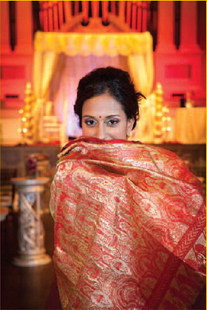
Jhilam Biswas

“Initially, Jhilam and I were both nervous,” Danny reflected. “Would the wedding feel ‘too Hindu’ or ‘too Jewish?’ Would we dishonor our traditions by mixing them together? Could we incorporate both cultures so that each family felt respected?”

Prior to their October 13, 2013 wedding, the couple engaged in many conversations with their religious officiants — Rabbi Lev Baesh of Austin, Texas, and Jhilam’s uncle, Dr. Ranen Chatterjee.

“It was out of our conversations that the parallels and overlapping symbolism were uncovered and woven together,” Rabbi Baesh said.

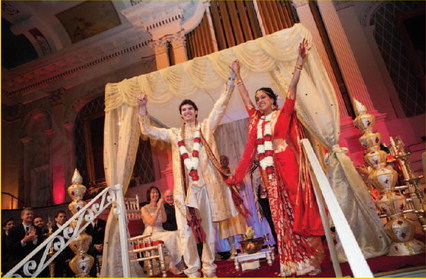
The Jewish chuppah, for example, is a smaller version of the mandap, the Hindu wedding canopy. In both traditions, the number “7” carries symbolic meaning. In a Hindu wedding, the bride and groom circle a fire seven times; in traditional Jewish ceremonies, the bride circles the groom seven times. The Seven Blessings (Sheva B’rachot) and Seven Steps (Saptapadi) are key parts of each service. Finally, at the conclusion of the traditional wedding ceremony, the Jewish groom breaks a glass and the Hindu bride steps on a clay pot. Both rituals symbolize the strength, care, love and respect needed to nurture and protect the marital relationship.

Couple

Danny Barker and Jhilam Biswas under their mandap chuppah.

For Sharmila Biswas, Jhilam’s mother, researching and planning her daughter’s wedding actually taught her something new about her own tradition.

“I did not have a baraat (Hindu marriage procession) at my wedding. It was not part of a Bengali wedding when Anup and I married in 1975. Today, every Indian wedding has a baraat. It is fun and gives people a chance to relax and feel part of the festivities. Through helping to plan this wedding, I was introduced to certain rituals of a modern Hindu wedding,” said Sharmila, who now lives in Norwell.

The baraat was actually a highlight of Jhilam and Danny’s wedding. Danny donned traditional Hindu clothing and rode a bejeweled horse down Worcester’s Main Street, all to the beat of the dhol (an Indian drum) and the rhythm of Indian music. The entire wedding party followed: dancing, clapping, laughing and kvelling.

Danny

Danny Barker rode a bejeweled horse down Worcester’s Main Street as part of a baraat (Hindu marriage procession).

When planning the wedding, the families met regularly to discuss ideas. There were difficult conversations, and compromises on both sides.

“The parents followed their children’s lead in what would be incorporated in the ceremony,” said Jeri Barker of Swampscott, Danny’s mother. “The planning process, and negotiating all the details, brought us all closer together.”

Anup Biswas, Jhilam’s father, agreed. “I always thought our families were very similar. It pleased me greatly to see so many of our wedding traditions intermingle with each other.”

Once the structure of the ceremony was sketched out, the couple designed a booklet for guests explaining the traditions and their meanings. Friends and family members contributed their unique talents and skills.

Dr. Peter Barker, Danny’s father and a passionate gardener, worked with the florist. “My neighbors, friends and I enjoy growing the big, beautiful, dinner plate dahlias,” he said. “I wanted to personalize the wedding flowers by including our dahlias. Some guests got a kick out of recognizing their flowers in the displays.”

Jhilam and Danny chose to be married in Worcester, the city where they met. They fell in love with the elegant and sophisticated Mechanics Hall, a beautiful Renaissance Revival concert hall built in 1857. For Jhilam, whose family has a long history of musicianship, the venue had special significance.

“In the months leading up to the wedding, I described the ceremony to my family and friends as ‘half-Hindu and half-Jewish,’” Danny said. “Looking back on it, that description doesn’t seem quite right. I now recognize it was possible for the ceremony to be fully Hindu and fully Jewish, all at the same time.”

Danny elaborated on this point.

“On the wedding day, I was raised onto a horse during a traditional Indian procession called a baraat, and my Hindu mother-in-law was raised on a chair during the hora. We had a wedding canopy with features of a chuppah and a mandap. My sister wore a beautiful saree from Bangalore, and my father-in-law wore a suit. It was a seamless blend — but most importantly, it was our own,” Danny said.

Jhilam agreed. “Wedding planning was a microcosm for relationship issues that got worked out earlier in our lives rather than later. In the end, we all came together and celebrated our hearts out, side by side,” she said.

Photos by David Tucker