Younger Generation Speaks Up for An Infrastructure of Hope in the Middle East

Last summer, Ohad Elhelo received a phone call while he was home in Israel after volunteering to serve in the Protective Edge military operation in Gaza. The Israeli-American Council invited him to address a Combined Jewish Philanthropies-sponsored August 14 “Stop the Terror” rally in support of Israel that was expected to draw 3,000 people in Boston. The 25-year-old Israeli Brandeis University economics and business major wasn’t sure he wanted to accept.

“I believe in delivering productive messages — those that have added value. To go on stage and tell people ‘You must support the IDF’ didn’t seem productive because those people already supported the IDF. That’s why they attended the rally,” he explained.

“I thought, ‘If I am going to speak at this event, I want to give my own message, which is more complicated.’” And more liberal.

Elhelo believes military means alone will not solve the Israeli-Palestinian conflict. It must be paired with a joint Israeli- Palestinian- American effort to rebuild the broken social and economic foundation of Gaza.

He calls this an “infrastructure of hope.”

Elhelo delivered a powerful six-and-a-half minute speech at the rally that went viral almost immediately, reaching over two million viewers http://www.ohadelhelo. com/#!video-gallery/cw47.

“Every round of violence in Gaza weakens the moderates and empowers extremism.

We say Hamas does not want peace and we are right. But being right is not enough. To succeed, we must be smart,” he told the crowd.

“The terrorist infrastructure is not just Hamas. It is also poverty, ignorance, hopelessness, desperation and a lack of political horizon. It is up to all of us — Jews, Arabs, Palestinians, Americans — to build an infrastructure of hope,” he said, summoning the thousands gathered to rise to the challenge of building this joint Israeli-Palestinian organization.

Hundreds of people waited to greet him offstage, many to tell him that they could relate to his words.

“I love Israel and there is no arguing that,” the IDF Special Forces veteran of three military operations said. “Even when I spoke about some sort of criticism for the Israeli government, people were supportive.”

After the rally, he realized he had been given an opportunity to pursue a unique trek.

Right after the Boston rally, Elhelo was interviewed by major TV stations and newspapers in Israel and the United States. He also received invitations to speak at such high-profile fundraising events as the International Lion of Judah Conference of the Jewish Federations of North America, where 1,400 top female contributors of the world donated $27.2 million, and the CJP Major Gifts event in Boston.

At those fundraisers, many people expressed their support for what he was saying. “I came with a message that is slightly different from what some of the peace organizations are doing,” he said, explaining that he doesn’t believe in the “kumbaya” approach of bringing Palestinians and Israelis together to talk about their feelings. “That is basically asking them to do what we want instead of what they want.”

Nor does he think about the leaders when he thinks about role models who can carry a message of collaboration and coexistence. “The current leadership on both sides cannot get along. That is a fact,” he stated.

Ehud 2

Ohad Elhelo and Lidor Cohen served in the Golan Heights, in 2011.

“I think about the entrepreneurs, the students, the young professionals. This is where I want to focus. What do young people care about? What prevents them from working together?” he asked. The answer, Elhelo believes, was they lacked a platform that interested them, one that focused on business startups, entrepreneurship and networking, rather than “coexistence.”

“My message was pragmatic and I needed to pursue this idea with pragmatic people,” he said.

He met with business executives and senior politicians, enlisting them to use their talents, experience and resources to help a younger generation make their voices heard and their constructive energy felt in the region. Brandeis’s senior administration was the first to sign on.

Elhelo explained his idea of setting up a foundation to bring outstanding Palestinian and Israeli students to American campuses to develop their leadership skills and build their own ventures with the goal of developing a new generation of Israeli and Palestinian leadership that will share a powerful vision for a common future. President Lawrence was one of the first to sign on and the Brandeis venture was born.

The cost for the program of two cohorts is $5.4 million, of which Brandeis is committed to contributing $1.4 million. The planning stage is completed and fundraising is in full swing. Projected launch date is either Spring or Fall 2016.

The Board of Advisors and list of mentors includes leaders from Israel, the Palestinian Territories and the U.S.

Under the  program, ten Palestinian and ten Israeli students will come to Brandeis each year for a 15-month Masters program in public policy and business that will focus on negotiations, mediation and leadership skills. Each student will have a mentor who has agreed to participate, including American, Palestinian and Israeli business executives and politicians, including parliament members, heads of security services and senior business executives.

The students will propose and establish their own ventures, up to three per year, from Brandeis and then bring those ventures back to their communities in Israel, the West Bank and Gaza.

Elhelo gave an example of how the program is meant to work.

“If you go to a Palestinian community and ask the students, ‘What do your people care about?’ sometimes the answers will be fascinating. They might tell you, ‘We don’t really mind about the Israeli army but in our village there are no light bulbs on the road and there are many car accidents and that bothers us,’” he said.

If one of the  student ventures were to equip that village with light bulbs, then the single  fellow who returned to his village would be bringing change that the community wanted and needed. “That fellow will be seen as a leader. He is a change agent,” Elhelo said.

In the meantime, the recipient of the prestigious Brandeis University Slifka scholarship is a change agent in his own right. “Collaborative ventures are the answer. They are cheaper than rockets and have greater implications in the long run,” he said.

Pictured at top: Ohad Elhelo addressed the CJP Major Gifts event last fall.

“The Guys Next Door” Celebrates Family, Friendship and Gay Rights

When award-winning documentary filmmaker Amy Geller opened her 2011 Bates Alumni magazine, she was blown away by a story about Rachel Segall, a Jewish alumna from Newton in her 40’s with three teenagers who had recently volunteered to be a surrogate so her gay friends could become parents.

Not once, but twice within two years.

“Rachel had seen a television program about how expensive and difficult it is for gay men to have kids. So she called up Erik, her good friend from college, and said, ‘whenever you want to have kids, I’m your gal,’” said Geller. “I was so inspired that I thought, ‘This could be a film!’” She contacted Rachel through a mutual friend. Rachel was on board and reached out to Sandro Sechi and Erik Mercer, the biological gay dads, who were equally excited. “The Guys Next Door” was a go.

Geller and her filmmaking partner, Allie Humenuk, started shooting in 2011. Geller served as artistic director of the Boston Jewish Film Festival from 2012 until 2014. Her productions have been braoadcast on PBS, the Documentary Channel, the BBC, Yes (Israel) and Turner ClassicMovies.

When shooting began, Erik and Sandro were living in Bedford-Stuyvesant in New York City. Rachel and her family were there visiting. ‘We went down to New York, where both families were staying together in this one-bedroom. It was total chaos. We started filming and we just totally fell in love from the get-go,’ Humenuk said.

Humenuk is an award-winning filmmaker and cinematographer whose films have been broadcast nationally and internationally.

Geller and Humenuk have been shooting on and off for over three years. They started filming when Rachel was eight months pregnant with Eleonora, the second child, who is now three years old.

They have wrapped principal photography, edited a trailer and launched an early Kickstarter campaign, running through April 11, to help raise money for post production.

‘We’ve built a mutual trust and respect with our characters which enabled us to film some very personal moments, like the birth of Eleonora. It seems ironic that filming something so intimate ends up being very public. But it’s those moments that make documentaries so powerful,’ said Humenuk.

The story starts with Rachel, who was raised in a Jewish family and married her Bates College sweetheart, Tony Hurley. They remained friends with fellow alum Erik Mercer and his husband, Sandro Sechi.

‘I am Jewish and my parents raised me to believe in equality and giving to others in whatever ways we can. As a mother now, it is important for me to continue living the foundation of those values and teach them to my children,’ she said.

‘My experience in helping my good friends Erik and Sandro be able to have children symbolizes to me the notion of Tikkun Olam (repair the world) — my little part in helping to heal the world,’ she added.

Rachel said that it struck her as unfair that she and her husband could so easily have children and that for two gay men to have children was such a hardship, especially financially.

‘By helping her gay friends to have daughters, Rachel makes a deeply personal decision that has political implications,’ Geller said. ‘It’s the ultimate tzedakah (charity).’

Because Rachel was in her 40’s, each child had a separate egg donor. It wasn’t important to either Sandro or Erik who the biological father would be. They had some eggs fertilized by Erik’s sperm and some by Sandro’s sperm. ‘They had the DNA test and have the results in a sealed envelope, ‘ Geller said.

In addition to helping her friends have a family, Rachel also saw her surrogacy as a way to create an extended family for her own children. Maddie (now 17), Jordie (now 15), and Zeke (now 13) consider Rachel Maria (now four and a half years old) and Eleonora (now three years old) to be their cousins.

‘I believe that being able to help Erik and Sandro have their daughters not only benefits them, but also benefits my family and, really, benefits the world around us,’ said Rachel.

‘I think that a wonderful gift that has come out of this whole thing is that Rachel’s kids are very invested in this family. So even though there’s no biological connection, they feel very intimately connected,’ said Geller.

Co-director Humenuk thinks a film like ‘The Guys Next Door,’ which chronicles a gay family’s life, can help combat discrimination. ‘The film highlights intimate moments which reveal the beauty, challenge and complexity of being parents. If people see what a loving gay family looks like, it changes minds,’ she said.

Rachel agreed. ‘My hope is that the film helps people see that family can look like many different and wonderful things, and how two gay men, given the opportunity, can create a beautiful home filled with love and strong values, just as well as a heterosexual couple can,’ she said.

To view thefilm’strailer and learn more about the Kickstarter campaign for ‘The Guys Next Door,’ visit asquaredfilms.com.

Pictured at top: A Squared Films (L to R): Daughters Rachel Maria and Eleonora with their dads Erik Mercer and Sandro Sechi

Moshav: You Can Go Home Again

“Moshav,” the internationally acclaimed American/Israeli group, began when Yehuda Solomon (vocals, percussion) and Duvid Swirsky (vocals, guitar) met as youngsters growing up four doors apart on the Moshav Mevo Modiin. The religious communal settlement in central Israel was founded by Rabbi Shlomo Carlebach and attracted a group of eclectic individuals, including Solomon’s and Swirsky’s parents.

“My parents were living in a hippie commune in northern California and they moved to the Moshav and never left,” said Solomon, who is in his late 30’s and lives in Los Angeles with his wife and three young children.

Swirsky arrived at the Moshav on Shabbat when he was ten years old. “I remember Shlomo as a Santa Claus-like character,” he said. “Everybody danced and sang, banging and screaming and jumping up and down. It was a very accepting and comfortable environment.”

“A lot of us kids from the Moshav are singers, spread out all over the world. We run into a lot of them when we travel,” Swirsky added. He also lives in Los Angeles with his wife and two-year-old son Lev (“heart” in Hebrew).

The duo was singing at the Moshav when they were discovered by some American students traveling in Israel who heard their band play and raised money to bring them to the United States to play for a college tour in the 1990’s. “Moshav” was born and relocated to Los Angeles, where they recorded their first album in 1998.

“Shabbat Vol. 1, released in November 2014, pays homage to the many Sabbaths they spent with their beloved Reb Shlomo in the small synagogue packed with family and friends dancing late into Friday nights. “This record brings us back to our childhood,” said Solomon.

Moshav

Moshav 2014 Moshav Music

The 15 tracks include original, traditional, and Carlebach compositions that the two recorded at their home studio in Los Angeles. “We tried to give it a raw vibe, like we’re all just hanging out again and jamming on the Moshav,” said Solomon.

“This record feels like home,” said Swirsky. “Shabbat is music. Shabbat is roots. Shabbat is open. Shabbat is no judgment.”

Among the songs are “Lecha Dodi,” “Adon Olam” and “Havdallah.” With its mixture of reggae, middle-eastern and traditional styles, and instruments that include bouzouki, banjo, cello, trumpet and oud, the album is an exciting and refreshing way to celebrate Shabbat. “It shows all our colors,” said Solomon.

Standout tracks are a meditative “V’shamru” with its overlay of cellos, the lively reggae-middle eastern styled “Boi Beshalom,” and the catchy, folksy “Shiru.”

“We try to make music that we really love and connect to. We draw from our Jewish roots and heritage, but hopefully the result is universal, something that also sounds really interesting and cool to someone who isn’t Jewish,” Solomon said.

Pictured at top: Duvid Swirsky (left) and Yehuda Solomon met as kids growing up at Shlomo Carlebach’s Moshav commune in Israel.

Ken Marcus: One on One

During his Boston stay, Kenneth Marcus  answered these questions for The Journal:

JJ: How is the Louis D. Brandeis Center addressing preparing high school kids for what to expect when they arrive on campus?

KM: The Louis D. Brandeis Center prepares fact sheets and resource guides that help incoming Jewish college students know their legal rights. For example, we have a short guide to the laws against campus anti-Semitism that can be downloaded free from LDB’s website: brandeiscenter. com/ publications/ factsheets/title_vi_fact_ sheet. We also frequently speak on college campuses, including special presentations for undergraduates, law students, faculty and administrators.

Most importantly, college students should know that LDB’s lawyers are available freeof- charge to consult with them about any anti-Jewish discrimination or harassment that they might encounter. They can call us on the phone at 202-559-9296. Our lawyers are always happy to speak with students. That’s what we’re here for. Alternatively, if students are more comfortable reaching us over the internet, they can contact us here: brandeiscenter. com/contact.

JJ: Students for Justice in Palestine (an anti-Zionist, pro-Palestinian college student activism organization) is wellfunded, disciplined and aggressive. How can our Jewish students maintain the moral high ground of our heritage while not being steamrolled by this opposition?

KM: This is a very important question. It is important always to maintain the moral high ground. This means that our students need to maintain clean hands. In other words, they must always remember their values and their ethics. No matter what the challenges, we must respond in a way that we can be proud of. That means that we must never stoop to the levels of our adversaries, whomever they may be. In responding to adversity, students should do so in a way that maintains their personal safety and their ethical integrity. When they are in doubt, they should seek the advice of adults whom they trust, such as their parents, rabbis, professors, or Jewish communal professionals.

JJ: What are your thoughts about Jewish students who support BDS (the global movement for a campaign of Boycott, Divestment and Sanctions against Israel)?

KM: People have many reasons for coming to their beliefs. I try not to cast aspersions. But the BDS movement is a very dangerous crusade. It is not only an affront to basic academic values, it is also the embodiment of double standards and defamations aimed at the Jewish people. Some BDS advocates are blatant bigots. Others have unwittingly made common cause with groups that seek to harm the Jewish people. If any Jewish students are attracted to the false rhetoric of BDS, I would recommend that they become better educated on the subject. One place to start is Cary Nelson and Gabriel Brahm’s important new edited volume, “The Case Against Academic Boycotts of Israel.” Students should be able to find this book in their college library or order it at amazon. com.

JJ: What do you hope conference attendees get out of the conference?

KM: I want attendees to know that if they face problems on their campuses that they are not alone. We are here for them. I want them to leave with a better understanding of how they can succeed in difficult campus environments, how they can thrive, and what they can do if they face injustice. Too often, Jewish students find that their voices are unheard, that their experiences are disbelieved, and that the challenges they face are denied. I want them to leave feeling stronger and more empowered. I want them to understand what their options are and how they can have the best possible college experience. And if they should find that classmates who are not Jewish are facing other forms of discrimination, bias, or harassment, I want them to be able to use our tools to help these other groups as well. After all, we’re fighting to achieve justice for all.

Pictured at top: Kenneth Marcus, founder and director of the Louis D. Brandeis Center for Human Rights Under Law, addressed the “Break the Hate” Summit at BU.

Opening the Door to Jewish Spirituality

For over half a century Rabbi Arthur Green has taught Jewish mysticism, Hasidism and theology. He recently noticed a new trend. “Young people are asking a question that was never asked in my generation. They are asking, ‘Why be Jewish?’” said Green, who has taught at the University of Pennsylvania, the Reconstructionist Rabbinical College, Brandeis University and Hebrew College.

To answer that question, the preeminent authority on Jewish thought and spirituality and author of more than a dozen books wrote “Judaism’s 10 Best Ideas: A Brief Guide to Seekers.”

“I write for people who think they don’t have a home in Judaism,” Green said. “I want to show them that they do, that there is something interesting and spiritually fascinating and attractive about this tradition.”

The 100-page pocket-book reveals Rabbi Green’s personal understanding of Jewish tradition, based on his experiences teaching, studying and translating sacred texts. Ten chapters address the core tenets of Jewish life, such as simcha (joy), tikkun olam (repair the world) and Talmud (education) in a style that combines warmth and humor with practical applications for contemporary life. “Shabbat — Getting Off the Treadmill,” for example, offers ten pathways toward a new Shabbat with five “to do’s” and five “not to do’s.”

10 Best

“In this day of freer choices of identity, I want to show people that Judaism is an important tradition that still has something to say to the world.

I believe we have things to teach the world and that the best years of this tradition are ahead of us, not behind us. I’m an advocate, and that’s what this book is about,” said Green.

At Hebrew College’s Rabbinical School, which he founded in 2004 and where he is Rector, ten percent of the rabbinical students are converts to Judaism. “These Jews by choice are among the most serious and dedicated future rabbis we have,” said Green. “One part of the audience for this book is people who are considering conversion to Judaism.”

Green believes in opening the gate to Judaism and welcoming people who are seeking a spiritual path, whether they are Jewish or non-Jews. “This book is a door-opener,” explained Green.

In the course of his teaching and lecturing, he also met people who told him they didn’t believe in God but somehow believed in a soul and wanted to have an inner life. “They thought they had no home in the Jewish community because they didn’t believe in God. They found themselves attracted to spirituality through one Eastern teaching or another because Eastern teachers didn’t say, ‘You have to believe first.’ These too are precisely the people I am writing to,” said Green.

Although raised in a nonobservant home (“my father was a militant atheist,” he has said), Green found himself drawn to spiritual language after he read “God in Search of Man” by Rabbi Abraham Joshua Heschel as a high school senior. When he was 16 and a freshman at Brandeis University, he became interested in Kabbalah (Jewish mysticism which originated in Hasidic Judaism) after he heard Zalman Schachter, a leading Hasidic Rabbi, Kabbalist and founder of the Jewish Renewal Movement, speak at a campus event. “He impressed me tremendously,” Green said.

Green eventually founded Havurat Shalom, an egalitarian Jewish community in Somerville in 1968, and remains a leading independent figure in the Jewish Renewal Movement.

Although Green no longer teaches at Brandeis University, his connection to the institution spanned many generations. He attended as an undergraduate (B.A. 1961) and graduate student (Ph.D. 1975), and taught there from 1994 until 2004. He thinks of Brandeis as engaged in a continued struggle with its Jewish identity. “Brandeis positions itself as an American university. In its very short history, it has achieved a remarkable reputation as a leading American university, but with one difference: most of its support comes from the Jewish community. Does that make it in any sense a Jewish institution, and what might that mean?” he questioned. This is a question, he said, that Brandeis has struggled with throughout its history.

Despite Green’s busy teaching, writing and lecturing schedule, he does make free time for himself. “I have a mystery life as an antique collector of early American glass,” he confided. “There’s a group of people out there who only know me as Art Green, the glass guy from Boston. They have no idea that I do anything else. I’m happy to have a second identity. I treasure that.”

He Wrote the Song

Last fall, when David Brook found out “Legacy,” a song he had co-written, would appear as track 6 on Eminem’s 2013 album “The Marshall Mathers LP 2,” he ran down Madison Avenue screaming at the top of his lungs. “It was the most exciting moment of my life,” the 2006 Marblehead High School graduate said.

That was true until February 8, when the album won the Grammy for Best Rap Album of the Year. “It was as climactic as it gets,” Brook said. “I’m still waiting for the alarm clock to wake me up and tell me it’s all a joke.”

The National Academy of Recording Arts and Sciences of the United States awards a Grammy Award, or Grammy, to recognize excellence in the creation and production of musical recordings.

Brook credits his mom, Bonnie Brook, and Steve Geyer, his Lynn music teacher during his adolescence, for his interest and success in the music industry. “David has always been an exceptional young man,” said Bonnie Brook. “Living in a small town, I took every opportunity to involve my kids in going to Boston so they felt they were part of the larger world.”

Music was one of the ways in which David expanded his horizons. He started writing songs as a middle schooler and made his first real demo while in high school. After learning that his cousin was friends with the wife of Atlantic Records CEO Craig Kallman, David begged her to pass his demo along. It was 2006 and Brook was a freshman at Northeastern University.

“I knew it was a little bit of a stretch, but I thought that maybe if his wife liked it, she would pass it off to Craig,” Brook said. “Maybe something would happen.”

Indeed, something did. The executive loved the song. He flew Brook to New York for a meeting which was leveraged to get a manager and collaborate with “some big writers and producers.” Upon graduating from college in 2011, David penned a deal with Universal Music Publishing Group.

One of his first writing sessions for Universal was with singer-songwriter Polina Goudieva. “We sat down and wrote this ballad on the piano. We thought it was a good song, but didn’t really know what to do with it.” Brook said. The song would become “Legacy.”

Polina played it for an Interscope Record executive who sent it to producer Emile Haynie, who had previously worked with rapper Eminem on his last album. Haynie loved the song and sent it to Eminem after production.

“We sent him that song in late 2011 and the album didn’t come out until fall 2013. There was a gap of two years when we didn’t know what was going on,” Brook said. The selection process is shrouded in secrecy; he knew the song was in the mix for inclusion on the album, but he didn’t know whether it was chosen. “With an artist as big as Eminem, the process is kept very close to a select few,” said Brook. “I later found out he recorded around 200 songs for the album; 16 made the cut.”

One day an employee at Universal called him and told him that the MMLP2 track list had leaked online and “Legacy” was included as Track 6 on the new album. The song included verses by Eminem, which told the story of his troubled childhood growing up in Detroit.

Brook heard the finished version for the first time when it was released to the public. “Eminem is one of my favorite artists of all time. I was expecting it to be great,” he said. The album debuted at #1 on the Billboard 200 Charts and had the second biggest first week sales of the year behind Justin Timberlake. It has sold over four million copies worldwide. “Legacy” peaked at number 44 on the U.S. Billboard Hot R&B/Hip-hop Charts.

Bonnie Brook was confident her son would succeed. “David is someone who really takes advantage of what’s there and is cognizant of how to work the system,” she said. “[Music teacher] Steve Geyer gave him incredible confidence in himself.”

Contrary to the glitz and glamor of the televised award announcements, many categories are announced via the internet on Grammy.com before the show begins. Brook found out the album won Best Rap Album of the Year when a fellow nominee texted him, “Dude, the album won.”

“My mom thought I would go on stage and be on TV for a half hour,” Brook said with a laugh.

Brook watched the Grammy Awards show with friends, his girlfriend, and his sister Alexandra (MHS ’03) at his downtown Manhattan apartment. He could have attended the event, but wanted to spend the night with the people closest to him.

When asked if he will receive the famous gold statue, David replied, “I think I get a certificate or a plaque that says, ‘Congratulations.’” The intangible benefits, however, are priceless. “I wrote a song that’s on the album that won a Grammy for Best Rap Album of the Year,” he said. “It’s been a cool year.”

To listen to “Legacy,” go to vimeo. com/78224432.

A Crusader for Truth and Justice: An Interview with Daniel Mael

When Brandeis University classrooms reopened on January 13, senior Daniel Mael was free to move around campus without restriction. That is because on January 9 university officials rescinded a No Contact Order on the student journalist, Dean’s List student, pro-Israel activist and athlete. The order forbade Mael from being in the same physical location as another student who had petitioned the university administration to “hold Mael accountable” for comments Mael had posted on the website Truth Revolt.org.

It all started after the death of the two New York City police officers who were ambushed and murdered in seeming revenge for the unrelated killings of two black men by policemen. When Brandeis junior Khadijah Lynch, an African and Afro-American Studies major who served as an adviser to other undergraduate students, tweeted on December 20, “I have no sympathy for the NYPD officers who were murdered today,” and, I hate this racist f******g country,” Mael wrote an article at TruthRevolt.org, a conservative website he regularly contributes to, republishing these and other Lynch tweets.

Previous Lynch tweets referenced the rioting in Ferguson, Missouri in August, stating, “the fact that black people have not burned this country down is beyond me,” “amerikka needs an intifada,” and “I am in riot mode.”

The text of Mael’s article is located at truthrevolt.org/news/studentleader- no-sympathy-executed-nypd-officers.


“She was a student leader,” Mael said from Jerusalem, where he was vacationing over winter break, explaining why he wrote the article. “I think students on campus deserve to know if there are members of the community who make calls for violence and intifadas in America.

“I write for TruthRevolt because I believe there are important messages to get out. As a journalist, I believe I spread those messages successfully,” he said.

His article, shared widely on social media, had over 500,000 hits and scores of comments maligning Lynch. Lynch’s supporters rallied to her defense. Lynch threatened to sue Mael for slander.

On December 22, Michael Piccione, a Brandeis senior and member of the 2014-15 student conduct board, sent a mass email to Brandeis President Frederick M. Lawrence, administrators, faculty and students.

The subject line read, “VERY IMPORTANT: Holding Daniel Mael accountable, and other threats to student safety!”

“Hello to all,” it began. “… The safety of one member of the Brandeis community, Khadijah Lynch, has been compromised by another Brandeis student, Daniel Mael.” The email stated that Mael’s TruthRevolt article “has exposed Khadijah to the largely white supremacist following of the website on which he posts, which has led to harassment, death threats, rape threats and excessive hate speech directed to her personal Twitter.”

Piccione continued, “The most pressing concern ought to be the safety of our students” and ended by calling for Mael to be held accountable for his actions. He claimed that Mael had potentially violated multiple parts of Brandeis’ Rights and Responsibilities, including one prohibiting stalking.

Mael had never met Piccione.

Not one Brandeis faculty member or student leader publicly defended Mael. “I was very saddened, but I think it speaks volumes for the current state of affairs at a modern university where there are certain dissenting views that are oftentimes discouraged. People feel intimidated about speaking freely,” Mael said.

Mael did not think he violated Brandeis’ Code of Conduct when he republished Lynch’s tweets. Neither did Alan Dershowitz, the American lawyer, jurist, author, political commentator and outspoken pro-Israel advocate. He published an article on December 27 for newsmax.com titled, “Brandeis Student Shows No Sympathy for Ambushed Cops and Her Critic Is Attacked.”

“Mael had the right — and was right — to expose Lynch’s public words for assessment and criticism,” Dershowitz wrote. “Imagine how different the reaction of these same radical students would be if a white supporter of the KKK (Ku Klux Klan) had written comparably incendiary tweets.”

During winter break, Brandeis responded to Piccione’s complaint by slapping a No Contact Order on Mael, forbidding him from being in the same physical location on campus as Piccione. Mael received a phone call and follow-up email from Jamele Adams, Dean of Students, on December 23.

“You are to have no contact with Michael Piccione in any way, shape or form. Please be aware that the same applies to Michael…These measures will remain in place until further notice,” the email stated.

The punishment was imposed without any due process, according to Mael. “My movement on campus was restricted because I wrote an article,” he said.

While the No Contact Order was in effect, President Lawrence wrote a letter to the Wall Street Journal in which he stated, “Our university has an unyielding commitment to free speech and expression of ideas. No student would ever be sanctioned for holding a specific point of view. In the spirit of our namesake, Justice Louis D. Brandeis, we will staunchly defend every student’s right to advocate for causes they hold dear.”

Kenneth L. Marcus is president and general counsel of the Louis D. Brandeis Center for Human Rights Under the Law, an organization he founded in 2011 to combat the resurgence of anti-Semitism in American higher education.

“This is outrageous in so many ways,” he said when he learned about the No Contact Order. “When civil rights principles are abused in this way, the victims are not only the Daniel Maels of the world, but also those people who truly are harassed and whose claims will be taken less seriously as a result of the distortion of legal principles.

“But I do think that Daniel will emerge from this stronger than ever, and that it will increase his national exposure in ways that I hope will be useful to him down the road,” Marcus added.

Mael has been interviewed by over 25 publications, including The Times of Israel and on television by Fox News’ Fox & Friends about the Lynch episode and its aftermath.

He was advised by local and campus police to take precautions and not walk alone. “I know the facts,” he said. “We’re in a perilous time. There is racial tension in this country. There are extremists who call for violence and support cop-killing.”

In a meeting with Brandeis public safety officials to discuss threats made against him, he was advised to consider changing his dorm room and that it was a reasonable expectation that his car would be vandalized. It was also recommended he purchase mace.

“My last semester will be sharply changed,” the May 2015 graduate said. “I’m going to take everything on that basis to make sure I’m safe and able to function as a student.”

On January 9, four days before spring semester classes would start, Mael received another email from Dean of Students Adams. This one rescinded the order. The time of the email was a few hours after The Washington Free Beacon broke the story about the restrictive order on freebeacon.com.

“Thank you for respecting the No Contact Order between you and Michael. As there have been no reported incidents from either side of attempting to contact one another, I do not see justification for continuing the (NCO) into the spring semester,” Adams wrote.

Mael transferred to Brandeis as a junior in 2013 from Washington University in St. Louis, Missouri, after a 2012 Birthright-Israel trip made him realize he wanted access to more Orthodox infrastructure. He said that “never in my wildest dreams” did he imagine these kinds of events happening to him.

Still, he has no regrets, either about transferring or about writing the article for TruthRevolt. org.

“I’d like to believe from the overflowing level of attention that I’ve been successful in being able to connect or at least give a voice to certain people who would otherwise remain voiceless,” he said, pausing.

“I’m just very thankful for the encouragement and support from the community, especially my mother who has been tested in a trying situation and has done her best to be there for me. I am appreciative and thankful,” he said.

A Perfect Fit: Prosthetics, Tzedakah and Tikkun Olam

When he travels to Zacapa, Guatemala to provide prosthetic limbs and orthotic braces to amputees, Michael Smerka of Marblehead takes his responsibility to heal, repair and transform the world (“tikkun olam”) literally. 


A clinical prosthetist who makes and fits artificial limbs for patients who have suffered limb loss, Smerka recently returned from his third trip to Guatemala, as a member of the Range Of Motion Project (ROMP).

“The work is transformative,” the native New Yorker said. “If you do it once, you get addicted.”

ROMP’s mission is to provide used prostheses to those without access to care. While studying for a post-graduate degree in prosthetics at Northwestern University in 2004, Smerka met ROMP’s co-founder Eric Neufeld when they were assigned as lab partners. He remembers Neufeld talking about wanting to do charitable prosthetic work in the developing world.

The two became aware that in the U.S., federal regulations do not allow used prostheses to be resold, and so they would go to waste if the original owner needed refitting or passed away. They began asking families to donate the components and Neufeld decided to send them outside the U.S. to places where there is not access to the care (people trained to fit a prosthesis correctly) or to the artificial limbs.

Neufeld and Dave Krupa cofounded ROMP in 2005, and started a clinic as part of a regional hospital in Zacapa. Over the years, they spent time training local residents to be clinical experts so they can continue to care for people even when the Western clinicians have left.

Smerka1

Pictured from left: Dave Rotter, Marco, Eric Neufeld and Michael Smerka

“That long-term goal is part of the beauty of ROMP,” Smerka said. “We are able to bring them up to speed on current practices, biomechanics and fabrication. We are bringing 21st century technology to a developing country.”

This year, after securing a grant from Grand Challenges Canada, ROMP and University of Victoria engineers collaborated to bring cutting edge 3D printing and scanning capabilities to the Zacapa rehabilitation clinic. Smerka brought the first printer with him on his most recent trip in October, when seven ROMP volunteer clinicians worked on site to fit between 35 and 40 patients with prosthetic feet, legs, hands and arms. The recipients ranged from 8 to 82 years old.

Smerka thinks it is difficult for people in the U.S. to grasp the impact that these limbs have.

“It’s not just a device; it’s life changing for both the amputees and their families,” he said. “What happens is that when somebody becomes an amputee, they become a drain on an impoverished family already in difficult conditions. This helps a child. It helps a father return as a breadwinner to support his family.”

For example, Hilda, a 27-yearold woman Smerka worked with this year, lost her limb in a work-related accident about 18 months ago. She was fit with a first prosthesis, but needed a new one because of anatomical changes to her residual limb. Louisa, a volunteer firefighter, was fitted with an athletic runner’s device donated by the manufacturer Fillauer, enabling her to resume one of her passions.

Smerka2
Hilda and Louisa 


Candidates for treatment go through a six-month process between the times they first contact the clinic and the time the ROMP team arrives. For follow- up care, or if they missed the opportunity to be treated by ROMP clinicians, they still can be fitted by one of the ROMPtrained local clinicians.

Smerka was one of three Jewish ROMP volunteers on this recent trip. “We didn’t do Shabbos, but we acknowledged it by saying, ‘Shabbat Shalom,’” he said, smiling.

Smerka’s path to his current profession was full of twists, turns and serendipity. After earning a BFA from SUNY Purchase, he followed his artistic passion and tried to make a living creating contemporary fine furniture. Realizing he had to supplement his income, he did commercial custom work, eventually working at the Guggenheim Museum in New York. “That was a really fun job,” he said.

A knee injury and four months of rehabilitation brought him to a crossroad. In addition to his physical limitations, the climate of the furniture making industry was changing, making it harder to earn a living in that field. He wanted a profession that would fit his interests and art background. He had enjoyed the process of physical therapy, but he also wanted to make use of his artistic skills. When he looked into prosthetics, he discovered a good fit.

“It looked like a perfect combination of working with people, being in a rehabilitation medical setting and building things,” he said. Not long after, he began as an unpaid apprentice to see if he wanted to pursue becoming a clinical Prosthetist; he did.

He started in the field in 2001. In 2011, he and his wife, Heather Glick, moved to her native Marblehead, where they live with their four-year-old son and 16-month-old daughter. He now works at A Step Ahead Prosthetics in Burlington. Its founder, Erik Schaffer, organized a prosthetic limb drive for ROMP and regularly fits wounded Israeli soldiers through FIDF (Friends of the Israel Defense Forces).

Smerka plans to develop a ROMP in Boston where people can access services through A Step Ahead. He points to the many under-insured and undocumented people who need this help. Again and again, Smerka circles back to his Jewish roots and to his gratification of fulfilling the mitzvah of tikkun olam. “Having that Jewish lens wherever you are and whatever you do is important to me,” he said.

For more information or to make a donation, go to rompglobal. org.

Pictured at top: Michael Smerka with Hilda in Zacapa, Guatemala

Finding Hope Against Hope

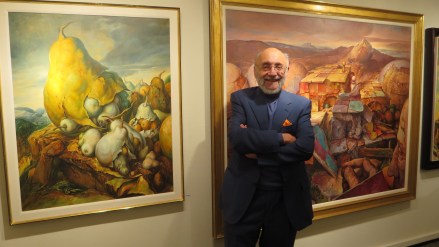
Samuel Bak’s new exhibit is a stunning collection of oil paintings in which the letters “H.O.P.E.” appear in various states of prominence and entirety, sometimes hidden amid bits and pieces of broken bottles and pottery, sometimes clearly visible. Bak’s complex, vibrant paintings address, in his words, “the problem we all share in searching for Hope when it is so difficult to find.” 

“Hope — how did I get there?” the child prodigy and Holocaust survivor rhetorically asked in his preface to the show’s catalog. If there are pictures worth a thousand words, he reasoned, “aren’t there words worth thousands of pictures?”

The show at the Pucker Gallery on Boston’s Newbury Street is as rich in allegory and metaphor as it is in color and texture. Huge fruit, mostly pears, appear in bewildering forms and situations. They are made of metal, stone and wood. They are blue, orange and red. They borrow their identity from cups and vases, shifting from the familiar to the unfamiliar. And yet, each remains unmistakably identifiable.

Bak first painted pears when he was preparing for a big show in Paris during the 1960’s. “I suddenly realized that the pear can be used for all kinds of things that bring different thoughts with them,” he said. For example, the pear brings to mind the female form. It also, according to Bak, can symbolize the limitation of human knowledge. “No one really knows what was the fruit of knowledge,” chuckled Bak, who admitted that, as a child, he disliked apples and that the pear was his favorite fruit.

IMG_3154

“I try to extract whatever I can from a single object,” he said, revealing that returning again and again to the same subject allows him to go deeper into a theme, like a composer whose improvisations create new works based on a single musical theme, such as Bach’s “30 Goldberg Variations.” “My imagination is not surreal; it is grounded in reality,” he added. 


An only child, Bak was born in 1933 to an educated, cultured middle-class family in Vilna. By age three, he was a recognized child prodigy painter. “At that age, I wanted to be a fireman or to sell candy, but little by little I got used to it,” he noted, adding he remembers loving painting and making his parents proud.


At seven years old, on the day after his first day of school, Bak and his family were deported to the Vilna Ghetto. At the age of nine, he had his first exhibition, inside the ghetto. When the Russians liberated Vilna, he and his mother were among its two hundred survivors from a pre-war community of between 70 and 80 thousand. They spent from 1945 until 1948 in German displaced person camps, immigrating to Israel in 1948. His second day of school was in Israel, at age 15. “That’s how it was. My times were not normal when I was young,” Bak said, shrugging.

He lived and worked in Tel Aviv, Paris, Rome and Lausanne, before settling in Weston in 1993. The Pucker Gallery had represented him since 1967, when an Israeli art dealer showed Bernie Pucker some of Bak’s work. “It is a kind of marriage,” Bak said, pointing out that such long relationships between artist and gallery are extremely rare.

Bak1

Under the Arches

Bak is keenly aware of the role the Holocaust has played in his choices of subjects and themes. His imagery reveals survival and suffering, reconstruction and destruction, hope and despair. His paintings are full of bits and pieces of broken objects that have been put back together in sometimes disturbing fashion. His choice of the theme “bits and pieces” is deliberate.

“After the Holocaust, despite the fact that each one of them was haunted by ghosts, the survivors put up an appearance of a certain normalcy, of something that was almost reconstructed but that was intrinsically broken inside,” Bak began.

He continued, “This became the very big subject of my paintings. It means to describe the reality of bringing up an old memory of something that cannot be completely repaired. My paintings are made out of bits and pieces, like the lives of these people.”


Although Bak has been compared to Elie Wiesel, the Holocaust survivor and Nobel Prize-winning author, he identifies more with writers like Primo Levi, the Italian survivor who wrote, “If This Is A Man” and “If Not Now, When”?

“For me, the Holocaust was more of a universal kind of experience. It was a laboratory of human behaviors that showed the extremes of the destructive powers of humans harming each other…For Elie, it is a more Jewish specific drama,” Bak explained, adding, “We speak of the human condition in very different terms. I speak of the terrible with a greater degree of irony and humor. He goes at it more directly.”

Besides, noted Bak, he speaks in images and Wiesel speaks in words. “I was told, ‘You are the Elie Wiesel of painting,’ but there is no such thing.”

Dual Paths for Dual Hands

As the daughter of Holocaust survivors, Monique Illona was shaped by her parents’ pain and anguish. “My parents were traumatized and their experiences traumatized me and my siblings,” Illona said. “They didn’t have the opportunity or resources to learn how to deal with their problems.”

She, however, did. Her recently published book, “A Dual Path: Sacred Practices and Bodywork,” describes her path from pain, bitterness and anger, “the energetic matrix I inherited from my parents,” to an awakened life of transformation and sacredness.

She also offers a blueprint for how the integration of bodywork (massage) and spiritual practices can help one achieve a life that cultivates inner stability, connection and strength.

Illona
Monique Illona


Illona’s parents met in Paris after World War II. Her French mother had survived the war by hiding in Paris and her Czechoslavakian father had survived Auschwitz. They first lived in Paris, but her father could not get a work permit. They applied for visas in three countries, America, Australia and England. The visa to Australia came through first. Her two brothers were born there, but the family eventually settled in England where Illona was born in 1960.

Judaism was a foundation for her growing up. She and her brothers attended weekly Hebrew school, but her parents were conflicted about how to integrate Judaism with raising a family. “My father came out of the Holocaust believing there wasn’t really a God,” she said. One of her brothers wanted to have a traditional Jewish family life, which caused huge arguments at home. “My brother kind of won and we did do Passover and Shabbat and always went to synagogue for the High Holidays,” she said. Her brothers still lead actively Jewish lives.

When Illona was 12, her father discovered that his sister had survived the war and lived in Israel. She accompanied her parents on their first trip there and fell in love with the country. She went back every year from the age of 13 during summer vacations to volunteer at various kibbutzim or to do work study programs.

“A Dual Path” enables others to shorten their own paths from a painful to a more vibrant and meaningful existence.

Once she finished school, she joined an ulpan on a kibbutz to learn the language. She ended up staying, joining the Israeli Defense Forces and becoming a member of a kibbutz in the Golan Heights. “My connection to Israel became stronger than my connection to Judasim,” she said.

She married in Israel and she and her American husband lived in a kibbutz made up of three or four “garinim” (groups of people who serve in the army together and then go to the same community to help build and establish it). Her husband fought in the 1982 Lebanon War in Beirut; many of their fellow kibbutz members died in that war. She and her husband, who are now divorced, decided to leave Israel and give it a go in the U.S.

She completed a B.F.A. at the School of Visual Arts in New York and earned a Masters degree at Lesley University in Expressive Therapies. It was during this program that she began to examine herself and to understand the connection between the legacy she had inherited and the life she had been leading.

She started learning things her parents never had the chance to. “There was something in me that was strong, clear and focused. I realized I could go forward in a whole different direction,” she said, adding, “It was like giving up caffeine. I rejected who I had been until that time.”

Illona was also a self-defense instructor and an inductee into the World Martial Arts Hall of Fame. She met her soulmate and professional partner Blane Allen in 1990 when his martial arts school moved into the building where she lived and worked as a sculptor. They have offered professional massage bodywork since 1991, and created “Hand in Hand Massage” in Marblehead.

At their teaching facility, The Dual Path Institute™, located next door to Hand in Hand, they offer events, programs and workshops for massage professionals and the general public for personal transformation and professional growth. They also travel the country and the globe with their trainings and public speaking.

Illona wanted to write “A Dual Path” to enable others to shorten their own paths from a painful to a more vibrant and meaningful existence. “Once you have enough strength, it’s so much easier. I really feel we have that choice every day in every moment.”

Visit handinhandmassage. com and adualpathpath.com or call 781-639-4380.