Let Us Be a Light Unto Our Children This Hanukkah

Hanukkah, also known as the Festival of Lights and the Feast of Dedication, is a happy holiday, one that commemorates a Jewish military victory and a miracle reflecting God’s intervention on our behalf. It is rich with symbolism and ritual. It is also rich with spirituality, and presents a golden opportunity to teach and show our children what it means to be Jewish.

Like Passover and Sukkot, the majority of Hanukkah rituals take place in the home. We create meaning and memories with our families, taking turns lighting the menorah candles, eating traditional foods and playing dreidel. These activities remind us who we are and where we come from; they link us to each other and anchor us in our Judaism.

These days, it is a challenge to avoid letting Hanukkah become trivialized as a retaildriven, superficial Christmas analog. Our children in particular are under pressure from their peers and the media. It is our job to help them find comfort and significance in the simple act of lighting a candle.

Each flickering flame has the power to connect us to light, the conqueror of darkness and the original source of nourishment. During these dark winter solstice nights, when we place the Hanukkah menorah in a window visible to the public, as is customary in many communities, we go one step further.

Our menorah in the window shows the world that we Jews bring light into the world, that we take seriously and literally our charge of “tikkun olam” (repairing the world). Our menorah in the window shows the world that despite the recent rash of anti-Semitism, we will not be intimidated; we will continue to display our Judaism proudly and publicly.

For Jews, the meaning of light is inspiration, courage, warmth, strength and belief in oneself. This is the lesson of Hanukkah 2014 that we can pass on to our children.

This originally appeared in the Jewish Journal on December 18, 2014.

Passing on Our Spark of Light To the Next Generation

Our Jewish heritage values community, education and tradition. Yet how often, outside of the High Holidays, do we gather as a community of over 700 Jews with the sole agenda of connecting with each other, and our faith, to share, study and celebrate?


LimmudBoston’s fifth annual day-long celebration of lifelong learning on December 7 was just such an occasion, and it was thrilling for the Journal to be there.

The menu of 85 classes clearly proclaimed that we were part of something bigger than ourselves, and that “something” could only be described as being in love with being Jewish.

Rabbis and scholars explored Biblical, Talmudic and contemporary sources. “What’s So Jewish About the News” looked at the top stories in 2014. Classes in spirituality, prayer, parenting, Jewish identity and modern and historic Israel sparked lively debates.

Throughout the day, common themes surfaced: Jews are inclusive; Jews value diversity; vigorous debate is encouraged, but conflict is not; Jews seek a life of meaning; and Jews look to make a difference.

Common questions surfaced, too. The two most often repeated included, “How do we light the spark of a love of Judaism in the next generation? How do we attract the unaffiliated?”

One way might be to make sure everyone has the opportunity to experience an event like LimmudBoston. It is impossible not to come away feeling energized and hopeful. A smaller version of the event could travel to other communities. Campus Hillels could organize transportation so their students could attend. Synagogues could organize field trips for their members and offer free tuition.

One thing is certain: during these tough times of anti-Semitism and attacks against Jews, it is a challenge to remain optimistic about our future. The task of everyone who attended LimmudBoston 2014 is to keep the spark going by spreading their enthusiasm to their communities, friends and families. Like the Hanukkah candles we will soon be lighting, LimmudBoston is a light in the winter darkness.

This originally appeared in the Jewish Journal on December 11, 2014.

A Perfect Fit: Prosthetics, Tzedakah and Tikkun Olam

When he travels to Zacapa, Guatemala to provide prosthetic limbs and orthotic braces to amputees, Michael Smerka of Marblehead takes his responsibility to heal, repair and transform the world (“tikkun olam”) literally. 


A clinical prosthetist who makes and fits artificial limbs for patients who have suffered limb loss, Smerka recently returned from his third trip to Guatemala, as a member of the Range Of Motion Project (ROMP).

“The work is transformative,” the native New Yorker said. “If you do it once, you get addicted.”

ROMP’s mission is to provide used prostheses to those without access to care. While studying for a post-graduate degree in prosthetics at Northwestern University in 2004, Smerka met ROMP’s co-founder Eric Neufeld when they were assigned as lab partners. He remembers Neufeld talking about wanting to do charitable prosthetic work in the developing world.

The two became aware that in the U.S., federal regulations do not allow used prostheses to be resold, and so they would go to waste if the original owner needed refitting or passed away. They began asking families to donate the components and Neufeld decided to send them outside the U.S. to places where there is not access to the care (people trained to fit a prosthesis correctly) or to the artificial limbs.

Neufeld and Dave Krupa cofounded ROMP in 2005, and started a clinic as part of a regional hospital in Zacapa. Over the years, they spent time training local residents to be clinical experts so they can continue to care for people even when the Western clinicians have left.

Smerka1

Pictured from left: Dave Rotter, Marco, Eric Neufeld and Michael Smerka

“That long-term goal is part of the beauty of ROMP,” Smerka said. “We are able to bring them up to speed on current practices, biomechanics and fabrication. We are bringing 21st century technology to a developing country.”

This year, after securing a grant from Grand Challenges Canada, ROMP and University of Victoria engineers collaborated to bring cutting edge 3D printing and scanning capabilities to the Zacapa rehabilitation clinic. Smerka brought the first printer with him on his most recent trip in October, when seven ROMP volunteer clinicians worked on site to fit between 35 and 40 patients with prosthetic feet, legs, hands and arms. The recipients ranged from 8 to 82 years old.

Smerka thinks it is difficult for people in the U.S. to grasp the impact that these limbs have.

“It’s not just a device; it’s life changing for both the amputees and their families,” he said. “What happens is that when somebody becomes an amputee, they become a drain on an impoverished family already in difficult conditions. This helps a child. It helps a father return as a breadwinner to support his family.”

For example, Hilda, a 27-yearold woman Smerka worked with this year, lost her limb in a work-related accident about 18 months ago. She was fit with a first prosthesis, but needed a new one because of anatomical changes to her residual limb. Louisa, a volunteer firefighter, was fitted with an athletic runner’s device donated by the manufacturer Fillauer, enabling her to resume one of her passions.

Smerka2
Hilda and Louisa 


Candidates for treatment go through a six-month process between the times they first contact the clinic and the time the ROMP team arrives. For follow- up care, or if they missed the opportunity to be treated by ROMP clinicians, they still can be fitted by one of the ROMPtrained local clinicians.

Smerka was one of three Jewish ROMP volunteers on this recent trip. “We didn’t do Shabbos, but we acknowledged it by saying, ‘Shabbat Shalom,’” he said, smiling.

Smerka’s path to his current profession was full of twists, turns and serendipity. After earning a BFA from SUNY Purchase, he followed his artistic passion and tried to make a living creating contemporary fine furniture. Realizing he had to supplement his income, he did commercial custom work, eventually working at the Guggenheim Museum in New York. “That was a really fun job,” he said.

A knee injury and four months of rehabilitation brought him to a crossroad. In addition to his physical limitations, the climate of the furniture making industry was changing, making it harder to earn a living in that field. He wanted a profession that would fit his interests and art background. He had enjoyed the process of physical therapy, but he also wanted to make use of his artistic skills. When he looked into prosthetics, he discovered a good fit.

“It looked like a perfect combination of working with people, being in a rehabilitation medical setting and building things,” he said. Not long after, he began as an unpaid apprentice to see if he wanted to pursue becoming a clinical Prosthetist; he did.

He started in the field in 2001. In 2011, he and his wife, Heather Glick, moved to her native Marblehead, where they live with their four-year-old son and 16-month-old daughter. He now works at A Step Ahead Prosthetics in Burlington. Its founder, Erik Schaffer, organized a prosthetic limb drive for ROMP and regularly fits wounded Israeli soldiers through FIDF (Friends of the Israel Defense Forces).

Smerka plans to develop a ROMP in Boston where people can access services through A Step Ahead. He points to the many under-insured and undocumented people who need this help. Again and again, Smerka circles back to his Jewish roots and to his gratification of fulfilling the mitzvah of tikkun olam. “Having that Jewish lens wherever you are and whatever you do is important to me,” he said.

For more information or to make a donation, go to rompglobal. org.

Pictured at top: Michael Smerka with Hilda in Zacapa, Guatemala

Pro-Israel Campus Groups Need To Become A Real Movement

Once again, articles about anti-Israel groups on U.S. campuses peppered the Jewish and secular press this week, leaving the impression that Jewish and pro-Israel students are being harassed, intimidated and compromised.


The ADL, in a November 20 blog titled, “Anti-Israel Activity Prevalent on Massachusetts Campuses This Year,” listed nine events that have occurred since September, including a “Festival of Resistance” at Smith College that culminated in an anti-Israel rally outside Northampton City Hall.

Haaretz reported that Wellesley College’s Hillel director and Jewish chaplain were fired after they asked for a meeting with Wellesley’s Students for Justice in Palestine leaders. The Times of Israel reported about SJP’s planned illegal activities against Jewish students and Israel.

Divestment organizers at UCLA, representing a wide coalition of students from all backgrounds and sectors of campus, celebrated a milestone victory for social justice with the passage of “A Resolution to Divest from Companies Engaged in Violence against Palestinians” that singled out Israel.

Once again, pro-Israel groups reacted independently and inconsistently. Some worried that generating outside attention might inflame the situation, making campuses even more vulnerable. Some planned Israel advocacy trainings and sponsored thoughtful opportunities for dialogue. Others rose in defiance, loudly defending Israel against unfair resolutions.

One challenge they all faced was how to address these injustices without legitimizing them. David Suissa, in his opinion piece on the facing page, proposes a solution that is both proactive and constructive.

He suggests that all pro-Israel groups unite behind a single slogan so potent that it will reframe the debate over Palestine in a way that can empower all students, Jewish and non-Jewish, to support Israel.

His idea? “Israel can save the Middle East.”

Think about what might happen if the various pro-Israel groups banded together as a true movement that spoke with one voice and one goal: to draw attention away from Israel’s flaws and towards Israel’s position as the only positive and democratic influence in the Middle East and the only hope for transforming the chaotic region.

Who knows what could happen? Maybe someday the articles about pro-Israel activity on U.S. campuses might just outnumber their counterpart’s.

This originally appeared in the Jewish Journal on December 4, 2014.

Finding Hope Against Hope

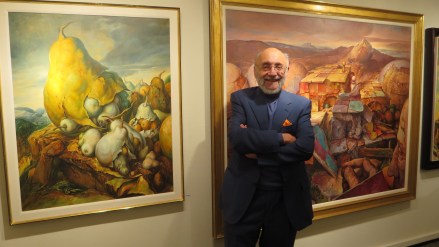
Samuel Bak’s new exhibit is a stunning collection of oil paintings in which the letters “H.O.P.E.” appear in various states of prominence and entirety, sometimes hidden amid bits and pieces of broken bottles and pottery, sometimes clearly visible. Bak’s complex, vibrant paintings address, in his words, “the problem we all share in searching for Hope when it is so difficult to find.” 

“Hope — how did I get there?” the child prodigy and Holocaust survivor rhetorically asked in his preface to the show’s catalog. If there are pictures worth a thousand words, he reasoned, “aren’t there words worth thousands of pictures?”

The show at the Pucker Gallery on Boston’s Newbury Street is as rich in allegory and metaphor as it is in color and texture. Huge fruit, mostly pears, appear in bewildering forms and situations. They are made of metal, stone and wood. They are blue, orange and red. They borrow their identity from cups and vases, shifting from the familiar to the unfamiliar. And yet, each remains unmistakably identifiable.

Bak first painted pears when he was preparing for a big show in Paris during the 1960’s. “I suddenly realized that the pear can be used for all kinds of things that bring different thoughts with them,” he said. For example, the pear brings to mind the female form. It also, according to Bak, can symbolize the limitation of human knowledge. “No one really knows what was the fruit of knowledge,” chuckled Bak, who admitted that, as a child, he disliked apples and that the pear was his favorite fruit.

IMG_3154

“I try to extract whatever I can from a single object,” he said, revealing that returning again and again to the same subject allows him to go deeper into a theme, like a composer whose improvisations create new works based on a single musical theme, such as Bach’s “30 Goldberg Variations.” “My imagination is not surreal; it is grounded in reality,” he added. 


An only child, Bak was born in 1933 to an educated, cultured middle-class family in Vilna. By age three, he was a recognized child prodigy painter. “At that age, I wanted to be a fireman or to sell candy, but little by little I got used to it,” he noted, adding he remembers loving painting and making his parents proud.


At seven years old, on the day after his first day of school, Bak and his family were deported to the Vilna Ghetto. At the age of nine, he had his first exhibition, inside the ghetto. When the Russians liberated Vilna, he and his mother were among its two hundred survivors from a pre-war community of between 70 and 80 thousand. They spent from 1945 until 1948 in German displaced person camps, immigrating to Israel in 1948. His second day of school was in Israel, at age 15. “That’s how it was. My times were not normal when I was young,” Bak said, shrugging.

He lived and worked in Tel Aviv, Paris, Rome and Lausanne, before settling in Weston in 1993. The Pucker Gallery had represented him since 1967, when an Israeli art dealer showed Bernie Pucker some of Bak’s work. “It is a kind of marriage,” Bak said, pointing out that such long relationships between artist and gallery are extremely rare.

Bak1

Under the Arches

Bak is keenly aware of the role the Holocaust has played in his choices of subjects and themes. His imagery reveals survival and suffering, reconstruction and destruction, hope and despair. His paintings are full of bits and pieces of broken objects that have been put back together in sometimes disturbing fashion. His choice of the theme “bits and pieces” is deliberate.

“After the Holocaust, despite the fact that each one of them was haunted by ghosts, the survivors put up an appearance of a certain normalcy, of something that was almost reconstructed but that was intrinsically broken inside,” Bak began.

He continued, “This became the very big subject of my paintings. It means to describe the reality of bringing up an old memory of something that cannot be completely repaired. My paintings are made out of bits and pieces, like the lives of these people.”


Although Bak has been compared to Elie Wiesel, the Holocaust survivor and Nobel Prize-winning author, he identifies more with writers like Primo Levi, the Italian survivor who wrote, “If This Is A Man” and “If Not Now, When”?

“For me, the Holocaust was more of a universal kind of experience. It was a laboratory of human behaviors that showed the extremes of the destructive powers of humans harming each other…For Elie, it is a more Jewish specific drama,” Bak explained, adding, “We speak of the human condition in very different terms. I speak of the terrible with a greater degree of irony and humor. He goes at it more directly.”

Besides, noted Bak, he speaks in images and Wiesel speaks in words. “I was told, ‘You are the Elie Wiesel of painting,’ but there is no such thing.”

Giving Thanks for Shmita

As we gather around our Thanksgiving tables with loved ones and favorite dishes, our thoughts turn to many things for which we are grateful. Despite recent outbursts of anti-Israel and anti-Semitic sentiments, we are thankful that America remains a safe haven for Jews. Despite an unsteady economy and a widening of the gap between the haves and have-nots, we acknowledge that we have a roof over our heads and enough to eat. Although friends and family may be scattered all over the globe, we appreciate that we have the means and desire to come together as a community.


Thanksgiving 5775 is a “Shmita” year, the sabbatical year of a seven-year cycle mandated by the Torah, and we should also take a moment to be thankful for it.

Shmita (literally “release”) is the mitzvah that commands us to let the land rest and to forgive all debts to fellow Jews every seven years. Any fruit which grows of its own accord is deemed ownerless and may be picked by anyone. After six years of farming, our ancestors were called upon to release control over all they owned and owed.

In essence, Shmita teaches us about social justice and sustainability, about how we can help maintain economic, environmental and social balance in the world. It is a commandment of action and commitment. Our gratitude to God expresses itself in deeds. We feed others, whether they are family members or strangers. We revere the land, granting it a year of rest and replenishment. We acknowledge that God sustains living creatures with lovingkindness by extending the same to the earth that sustains us.

Shmita is also a commandment that we slow down, that we stop and rest and examine our own behaviors and beliefs to see what we want to change. Shmita implies that our thankfulness to God should not remain in the realm of emotions, thoughts or even speech, but should also move us to action. It reminds us of our connectedness to God, to each other and to the land.

And so, this year when we say our brachot giving thanks to God before enjoying our holiday meal, let us recognize that Thanksgiving 5775 is special by including an additional prayer for the gift of Shmita.

This originally appeared in the Jewish Journal on November 20, 2014.

Lest We Forget: Remembering Kristallnacht

November 9, 1938, started as just another day for Jews in Germany, Austria and the Sudetenland. After breakfast, fathers went to work, children went to school and mothers kissed their loved ones goodbye. They returned home for a family dinner, went to bed and expected the next day to be identical.


That night, Nazi storm troopers, aided by citizen rioters, burned 267 synagogues, vandalized 7,500 Jewish businesses, murdered 91 Jews and incarcerated 30,000 Jewish men, transferring them to newly built concentrations camps. Overnight, the Holocaust had officially begun.

Kristallnacht — the night of broken glass — marked an important turning point in Hitler’s anti-Semitic policy. Historians uniformly point out that the passivity with which German citizens accepted this violence signaled to the Nazi regime that the public was prepared for their more radical measures aimed at removing Jews entirely from German economic and social life. The Nazis were organized, they were well funded and they were united behind a single mission.

After this summer’s Operation Protective Edge, the trend of declining global anti-Semitism sharply reversed. Daily reports of vandalism, violence and intimidation of Jews all over the world has become the new normal. Classicanti-Jewish tropes have resurfaced, masquerading as critiques of Israel’s political policies and support for Palestinian human rights.

Closer to home, Students for Justice in Palestine, a well-organized group that advocates aggressive and intimidating anti-Israel tactics, is spreading its presence on college campuses throughout the U.S. at an alarming rate. Since June 2014, SJP has formed 28 new chapters, according to the Israel on Campus Coalition (ICC), bringing the nationwide total to 157.

SJP is sponsored by American Muslims for Palestine, a group that promotes and defends posting mock eviction notices on Jewish students’ dorm rooms as “constitutionally guaranteed political speech.”

Kristallnacht was a unique and extreme event that caught its victims completely off guard. Despite mounting evidence, we must remain calm and optimistic, but we must also be alert and vigilant. We must challenge those who claim their blatantly anti-Semitic rhetoric and actions are simply robust exchanges of ideas. Most importantly, we must not be afraid to act. For, in the words of Ayaan Hirsi Ali, “tolerance of intolerance is cowardice.” It is also dangerous.

This originally appeared in the Jewish Journal on November 6, 2014.

Supporting Our Children

Our college students are under pressures most of us did not encounter when we were their age. In addition to the expected stresses of academic and social adjustments, they are part of a generation that must struggle with financial anxieties over how they will bear their share of the exorbitant cost of their education and whether they will find a job in this very competitive market when they graduate. This fall, they must also contend with the burden of what it means to be a Jewish student on an American campus. The summer’s war in Gaza has led to an increase in global anti-Semitism, including pro-Palestinian protests and activism on campuses throughout the country. Some of the rallies, meetings and letter-writing campaigns have been organized by groups expressing reasoned criticism of Israel in respectful ways. Some of the anti-Israel and anti-Zionist demonstrations, however, are hateful attacks against Jews and the Jewish State that embrace Nazi imagery and anti-Semitic slogans. Most of our children have never encountered such openly hostile and aggressive targeting during their lives.


Many campus Hillel organizations have recognized the problem and are offering additional support and resources. For example, at Tufts University, where the Tufts chapter of Students for Justice in Palestine (SJP) will hold its national conference October 24-26, Israel educational programming and advocacy training are available for all interested students. Nonetheless, the presence of so many students, academics and activists who sponsor “Israel Apartheid Week” and promote the movement that advocates boycott, divestment and sanctions against Israel will be unnerving.

And what about our students who do support a two state peaceful and just resolution to the Israel-Palestine conflict? Where can they find a safe place for thoughtful, nuanced civil dialogue in the current polarized environment where even some of their parents have drawn bright lines between what it means to be pro-Israel and what it means to be anti-Israel?

We need to make the time to talk to our young adult children and support them as thinkers in their own right.

This originally appeared in the Jewish Journal on October 23, 2014.

Dual Paths for Dual Hands

As the daughter of Holocaust survivors, Monique Illona was shaped by her parents’ pain and anguish. “My parents were traumatized and their experiences traumatized me and my siblings,” Illona said. “They didn’t have the opportunity or resources to learn how to deal with their problems.”

She, however, did. Her recently published book, “A Dual Path: Sacred Practices and Bodywork,” describes her path from pain, bitterness and anger, “the energetic matrix I inherited from my parents,” to an awakened life of transformation and sacredness.

She also offers a blueprint for how the integration of bodywork (massage) and spiritual practices can help one achieve a life that cultivates inner stability, connection and strength.

Illona
Monique Illona


Illona’s parents met in Paris after World War II. Her French mother had survived the war by hiding in Paris and her Czechoslavakian father had survived Auschwitz. They first lived in Paris, but her father could not get a work permit. They applied for visas in three countries, America, Australia and England. The visa to Australia came through first. Her two brothers were born there, but the family eventually settled in England where Illona was born in 1960.

Judaism was a foundation for her growing up. She and her brothers attended weekly Hebrew school, but her parents were conflicted about how to integrate Judaism with raising a family. “My father came out of the Holocaust believing there wasn’t really a God,” she said. One of her brothers wanted to have a traditional Jewish family life, which caused huge arguments at home. “My brother kind of won and we did do Passover and Shabbat and always went to synagogue for the High Holidays,” she said. Her brothers still lead actively Jewish lives.

When Illona was 12, her father discovered that his sister had survived the war and lived in Israel. She accompanied her parents on their first trip there and fell in love with the country. She went back every year from the age of 13 during summer vacations to volunteer at various kibbutzim or to do work study programs.

“A Dual Path” enables others to shorten their own paths from a painful to a more vibrant and meaningful existence.

Once she finished school, she joined an ulpan on a kibbutz to learn the language. She ended up staying, joining the Israeli Defense Forces and becoming a member of a kibbutz in the Golan Heights. “My connection to Israel became stronger than my connection to Judasim,” she said.

She married in Israel and she and her American husband lived in a kibbutz made up of three or four “garinim” (groups of people who serve in the army together and then go to the same community to help build and establish it). Her husband fought in the 1982 Lebanon War in Beirut; many of their fellow kibbutz members died in that war. She and her husband, who are now divorced, decided to leave Israel and give it a go in the U.S.

She completed a B.F.A. at the School of Visual Arts in New York and earned a Masters degree at Lesley University in Expressive Therapies. It was during this program that she began to examine herself and to understand the connection between the legacy she had inherited and the life she had been leading.

She started learning things her parents never had the chance to. “There was something in me that was strong, clear and focused. I realized I could go forward in a whole different direction,” she said, adding, “It was like giving up caffeine. I rejected who I had been until that time.”

Illona was also a self-defense instructor and an inductee into the World Martial Arts Hall of Fame. She met her soulmate and professional partner Blane Allen in 1990 when his martial arts school moved into the building where she lived and worked as a sculptor. They have offered professional massage bodywork since 1991, and created “Hand in Hand Massage” in Marblehead.

At their teaching facility, The Dual Path Institute™, located next door to Hand in Hand, they offer events, programs and workshops for massage professionals and the general public for personal transformation and professional growth. They also travel the country and the globe with their trainings and public speaking.

Illona wanted to write “A Dual Path” to enable others to shorten their own paths from a painful to a more vibrant and meaningful existence. “Once you have enough strength, it’s so much easier. I really feel we have that choice every day in every moment.”

Visit handinhandmassage. com and adualpathpath.com or call 781-639-4380.

The Sacredness of Sukkot

After the ten-day period of Rosh Hashanah and Yom Kippur, Sukkot is a literal breath of fresh air. Our focus turns from the internal world of selfassessment, forgiveness and atonement to the external gift of the earth in its autumnal glory.


Sukkot’s historical significance commemorates the forty-year period when the children of Israel wandered in the desert, living in fragile, temporary huts. Its agricultural significance celebrates the fall harvest, honoring the relationship between human and earth. We are commanded to build a small, simple shelter (sukkah) with a roof of vegetation through which we can see the stars, and to live in it for seven days. It is an opportunity to leave our partisan, self-centered, materialistic lives and reconnect with the sacredness of family and land.

Although Sukkot is a festive and joyous holiday, it imparts many serious lessons. Unlike the High Holidays, the bulk of its rituals and celebrations occur in the home. This time we spend in a basic, small space with family and friends reminds us how important and valuable communication, community and sharing are. The temporary nature of the sukkah reminds us that, outside Israel, we remain wanderers and that our existence on earth is transitory. The fragility of the structure reminds us that we are fortunate to have a roof over our heads and food on our tables when so many have neither. We learn to appreciate more and take less for granted.

Most critically, however, Sukkot reminds us that our Torah commands us to recognize the holiness of the earth and the role we must play to nurture and protect it. All the holiday’s rituals reinforce our slowing down, simplifying and returning to the basics.

During the High Holidays, we are mindful of perfecting ourselves so we can repair and perfect the world through compassion, justice and peace. During Sukkot, we remember we must appreciate that world for what it is: God’s gift to us. It is our responsibility and within our ability to remain worthy of that trust.

This originally appeared in the Jewish Journal on October 9, 2014.