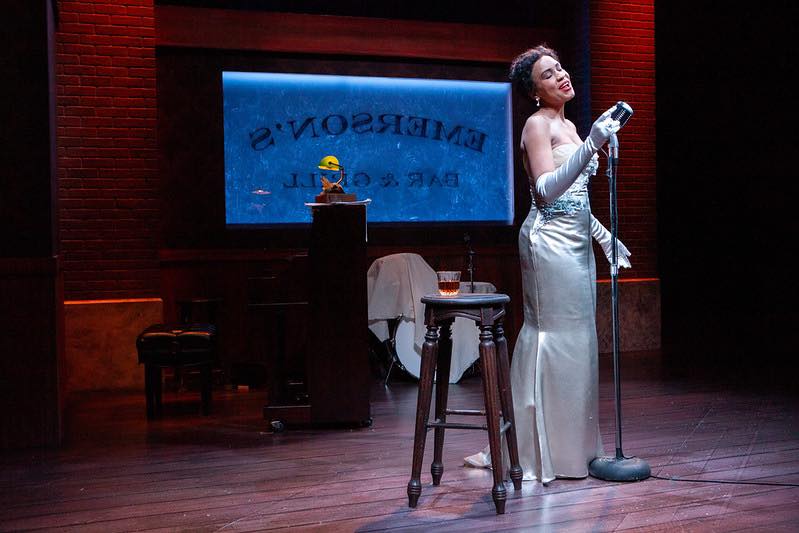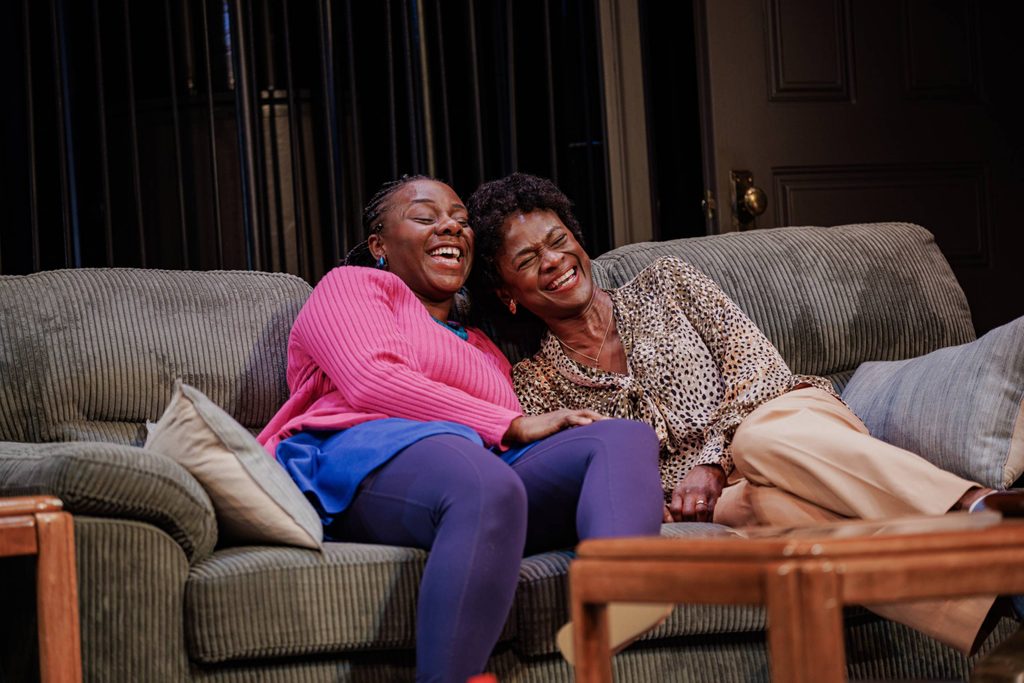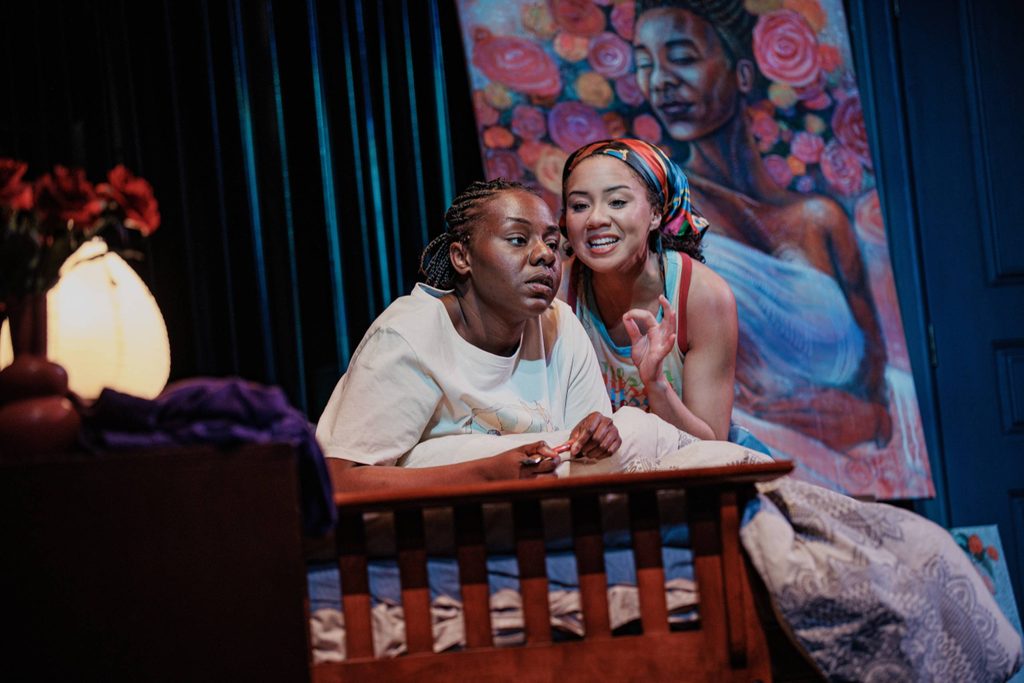
A.R.T.’s ‘The Odyssey’ Catapults Homer’s Ancient Epic Poem into the 21st Century

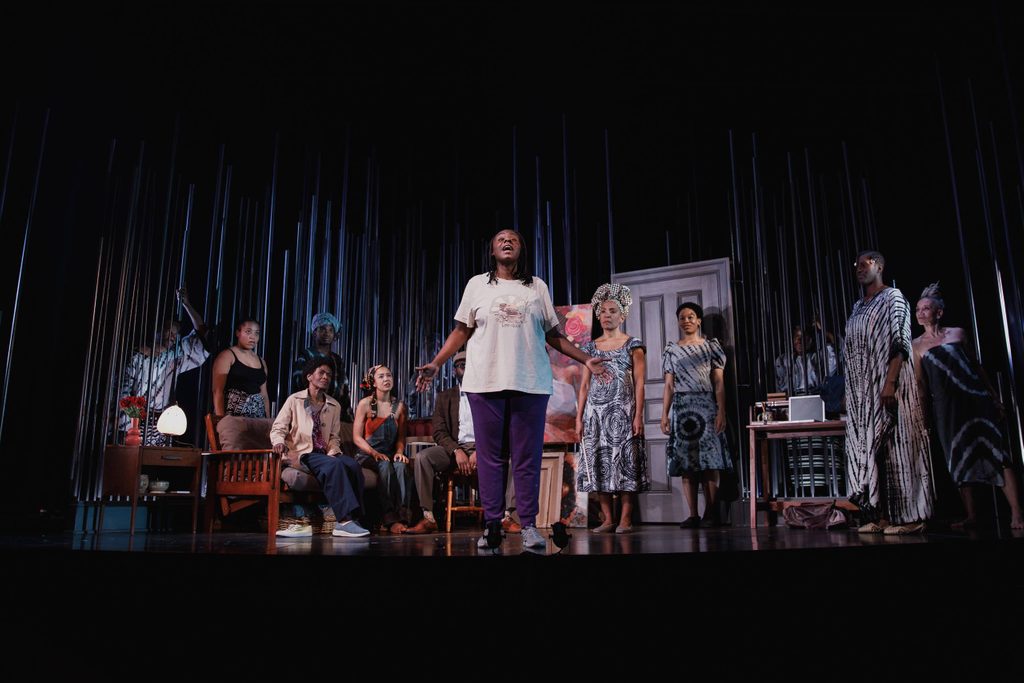
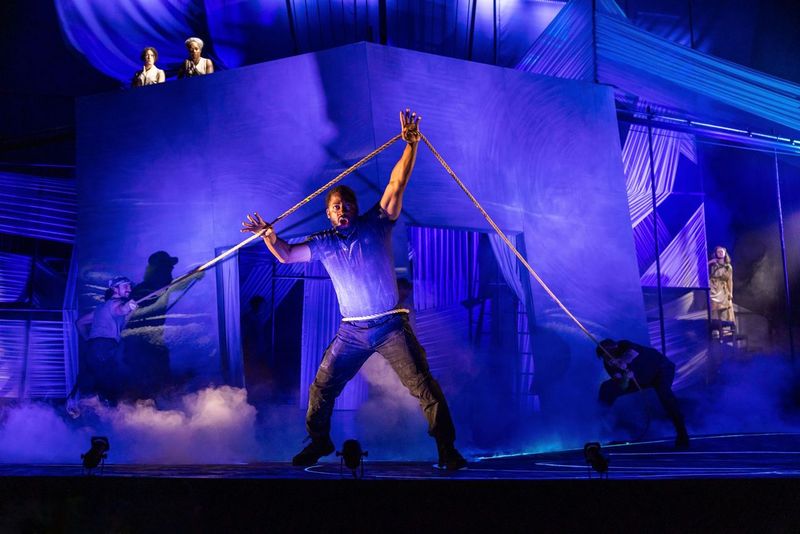
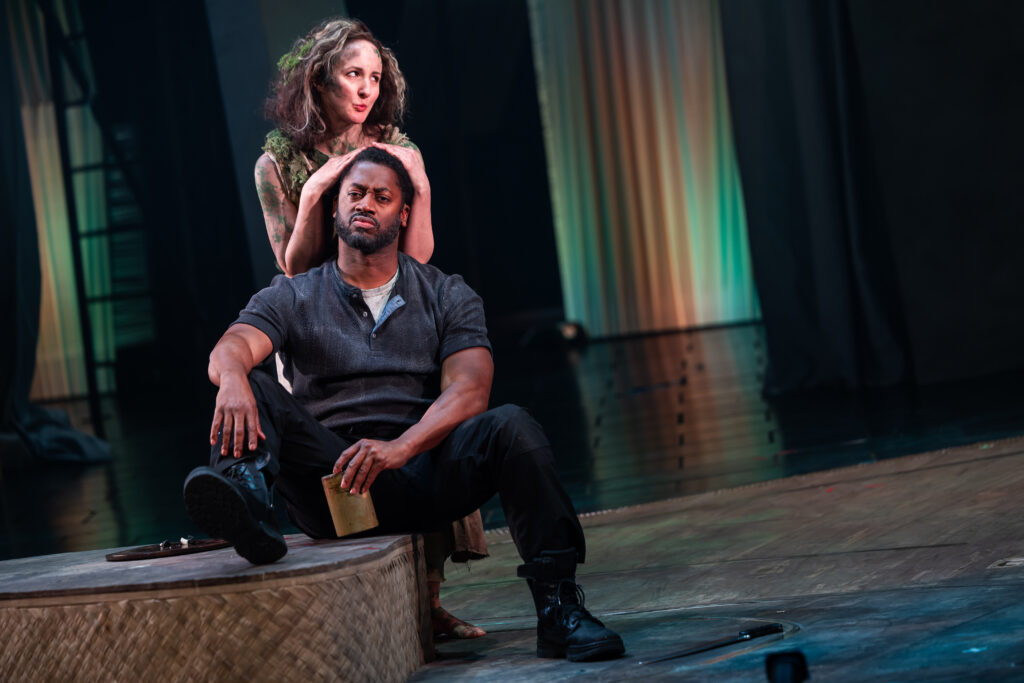
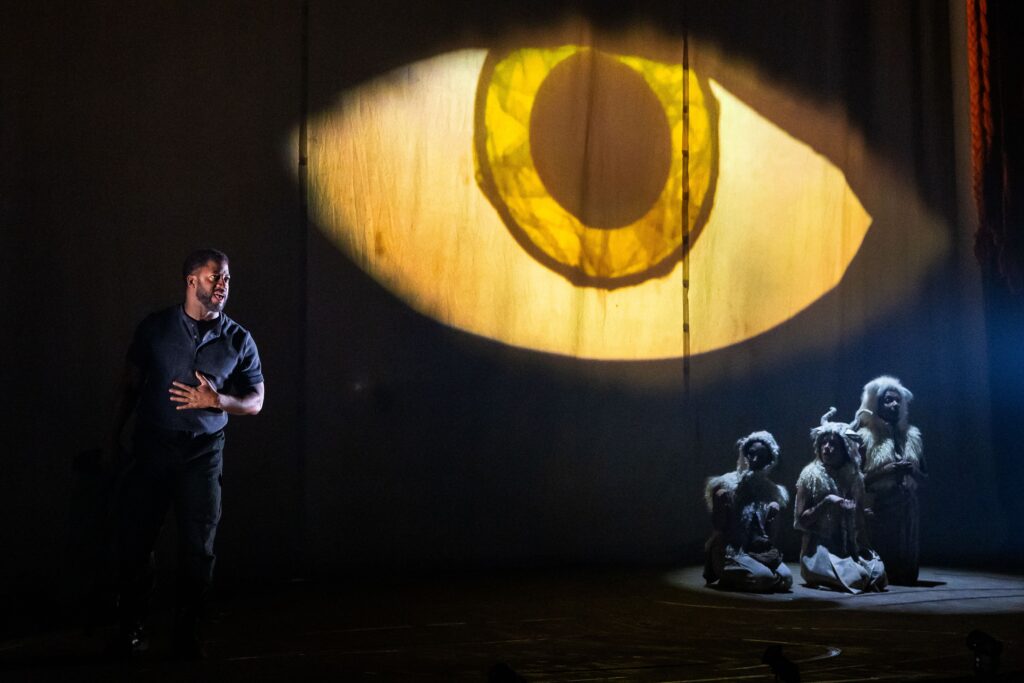
Members of the cast in A.R.T.’s world-premiere production of The Odyssey.
Photo Credits: Nile Scott Studios and Maggie Hall.

By Shelley A. Sackett

“If you’ve gone through something traumatic, can you ever go back to who you were? Can you ever go back home?” is the essential question American Repertory Theater’s Terrie and Bradley Bloom Artistic Director Diane Paulus asks audience members to consider as they experience the world premiere of Kate Hamill’s A.R.T.-commissioned newest work, ‘The Odyssey.’ This spectacularly produced reimagination of Homer’s 8th/7th century B.C. epic poem is the latest retelling of a classic tale by Hamill, who, once again, displays her special talent for penning plays that magically remain true to the original while interweaving parallel contemporary issues, culture and language.

Hamill’s version of The Odyssey evokes both memories of ninth-grade English class and the latest headlines. She is a true master storyteller and alchemist. For three hours (two welcomed intermissions), the audience rides shotgun as she personalizes and contextualizes the Greek epic that follows the hero and king of Ithaca, Odysseus, and his homecoming journey after the ten-year-long Trojan War. During the decades-long trip from Troy to Ithaca, he encounters many perils, and all of his crewmates are killed. During Odysseus’ inexplicably long absence (the distance from Troy to Ithaca is only 565 nautical miles), he is presumed dead, leaving his wife Penelope and son Telemachus to contend with a group of unruly suitors competing for Penelope’s hand in marriage.

Alejandra Escalante, Kate Hamill, NikeImoru and Carr

Homer’s original tale stresses ethical ambiguity and codes of heroic values and displacement. Hamill breathes contemporary life into these themes, adding her own twists that highlight the trauma of war on both those who fight and those they leave at home. Her trademark feminist lens focuses tightly on the play’s many female characters, especially Penelope and her struggles during Odysseus’ 20-year absence.

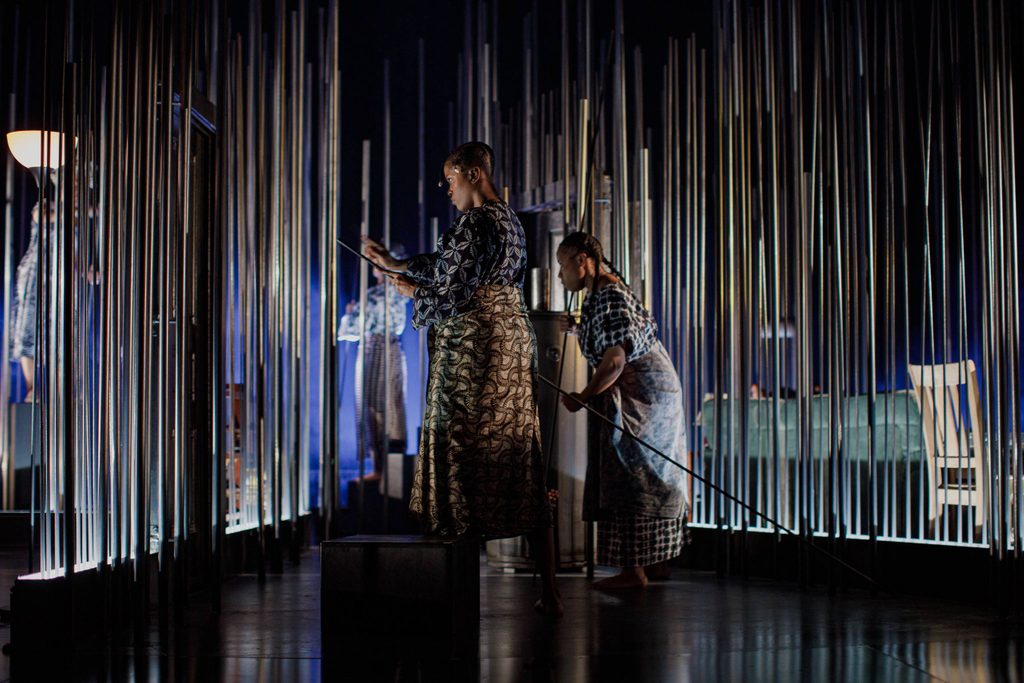
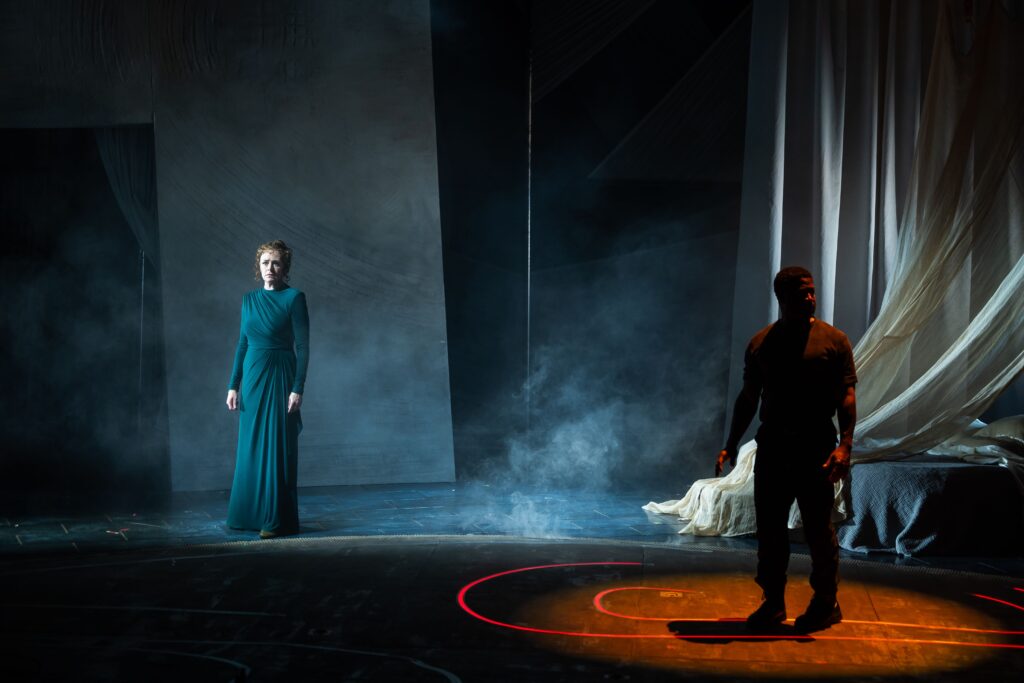
Sibyl Wickersheimer’s set is magnificent in elegance, simplicity and flexibility. Hundreds of yards of fabric shroud the stage as tasseled drapes hanging from the ceiling, geometric sculptural patterns along the back wall, and flowing, free panels. Shifting lighting and projections (Jeanette Oi-Suk Yew) change their color, mood and function. Cut-out boards and shapes shift function from ship to palace to island. The effect is dreamlike and captivating.

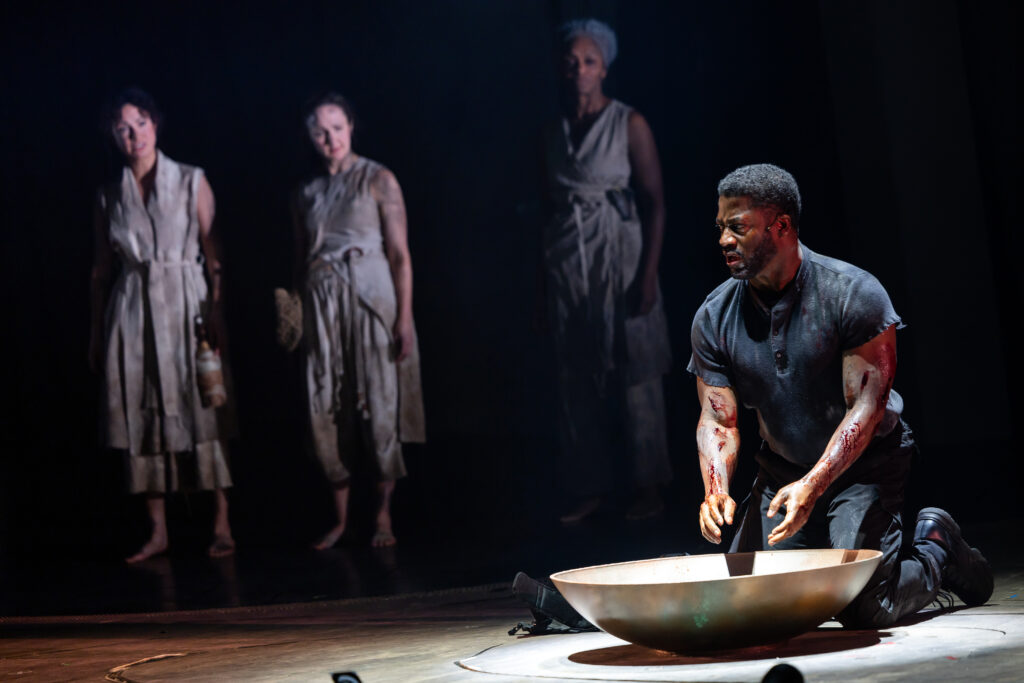
Act I opens on a beach with a chorus of three masked women who approach Odysseus (a credible Wayne T. Carr), as he scrubs his hands in a bowl of water. They act as narrators, dramatically bringing the audience up to speed on Odysseus’ life as king, husband, father and, above all, soldier. They are his guides and will accompany him throughout his travels.

Andrus Nichols and Carr

We learn that Odysseus is the only man who has not yet returned to Ithaca from the war in Troy. Shadow puppets (which appear throughout the play in various forms) illustrate his tale. The effect is Shakespearean, the triad reminiscent of the three witches, and Odysseus’ frantic hand-scrubbing is a hat tip to Lady Macbeth’s obsessive hand-washing in her effort to rid herself of feelings of shame and guilt.

“Your hands are clean,” the women croon, but Odysseus only revs up the pace in response.

In a flash, the language shifts from classical to contemporary vernacular and the beached ship morphs into a disco-like scene, complete with music, sexual innuendos and lots of swearing. We are in Ithaca, where Queen Penelope’s home has been besieged by rough-neck “suitors” intent on becoming the next king.

Flash again, and we are back with Odysseus, docked on an island inhabited by Titans. He and his men encounter the Cyclops, Polyphemus, when they search for food in a cave. Clever staging simultaneously evokes the giant and the cave through projections, puppetry and shadows. The three women (who also play different supporting characters in each scene) are charming as the mouth-watering lambs the men follow into the cave.

Act II is devoted to the cunning sea-witch goddess, Circe (played with impeccable timing, intonation and physicality by a scene-stealing Kate Hamill), and her island Aeaea, where Odysseus and his men almost meet their match. Circe agrees to let the men live if Odysseus stays with her. Finally, he snaps out of his drugged state of no man’s land when one of his men reminds him that, painful as it might be, he needs to confront himself, deal with his sins and pain, and return to his family.

“You can’t forget everything, or you forget what’s worth living for. Don’t you want to go home?” he is asked.

Hamill and Carr

Meanwhile, back in Ithaca, Penelope’s (lithe and elegant Andrus Nichols) outer resolve begins to falter as Amphinomus (Keshav Moodliar) begins to chip away at it with seductive, honey-tongued persistence. The deliciously hung fabric is an exquisite setting in pastel hues of mauve and pink. Penelope admits she is tired of being afraid and alone. “I am worn out by memories,” she says. “I’m not free to choose, but I can touch.”

Act III is the longest and most lively, as Odysseus makes his way home (after a couple more stops) and eventually wins back his throne and family. There are bloody battles, disco galore and plenty of irreverent language. The play may be long, but the pace and production values keep it rolling and engaging.

Carr, Hamill, Escalante, Imoru

Director Shana Cooper has an excellent ensemble assembled, and her pacing, transitions and seamless blocking are all spot-on. Hamill’s script, as always, is a mashup of the classic and contemporary, fiercely loyal to the underlying ancient tale, yet spinning an exciting, smart and thought-provoking contemporary cocoon around it. The result is an adaptation that is accessible to all and explores big-ticket concepts.

What are the relationships between trauma, memory and violence, for example? Who are our heroes and what are their values? In this era of migration and displacement physically, emotionally and politically, what does “home” mean and how secure is it?

Hamill’s works are always something to look forward to. The curtain call at ‘The Odyssey’ left me eager to see what she will tackle next.

The Odyssey’ – Written by Kate Hamill. Based on the epic poem by Homer. Scenic Design by Sibyl Wickersheimer; Costume Design by An-Lin Dauber; Lighting Design and Projection Design by Jeanette Oi-Suk Yew; Sound Design and Music Composition by Paul James Prendergast. Presented by American Repertory Theater at Loeb Drama Center, 64 Brattle St., Cambridge, MA, through March 16.

The Odyssey’ – Written by Kate Hamill. Based on the epic poem by Homer. Scenic Design by Sibyl Wickersheimer; Costume Design by An-Lin Dauber; Lighting Design and Projection Design by Jeanette Oi-Suk Yew; Sound Design and Music Composition by Paul James Prendergast. Presented by American Repertory Theater at Loeb Drama Center, 64 Brattle St., Cambridge, MA, through March 16.

‘Life & Times of Michael K’ is ArtsEmerson’s Latest Must-See Marvel

‘Life & Times of Michael K’ at ArtsEmerson. Photos by Fiona McPherson

By Shelley A. Sackett

In substance, Life and Times of Michael K tells the extraordinary story of an ordinary man. Adapted from the 1983 Booker Prize winner, written by South African novelist J. M. Coetzee, it details the life of the eponymous Michael K and his ailing mother during a fictional civil war in South Africa.

As adapted and directed by Lara Foot in collaboration with the Tony award-winning Handspring Puppet Company, this simple tale becomes the captivating and transportive production presented by ArtsEmerson through February 9. “Must see” hardly does it justice; this is a groundbreaking pilgrimage into the multisensorial world of out-of-the-box theater.

Michael K was born with a severe cleft palate in besieged Cape Town, South Africa. Shunned his entire life, he is nonetheless resilient and good-natured. Devoted to his mother, Anna, he embarks on a journey to take her away from the destructive conflict and back to rural Prince Albert, her birthplace.

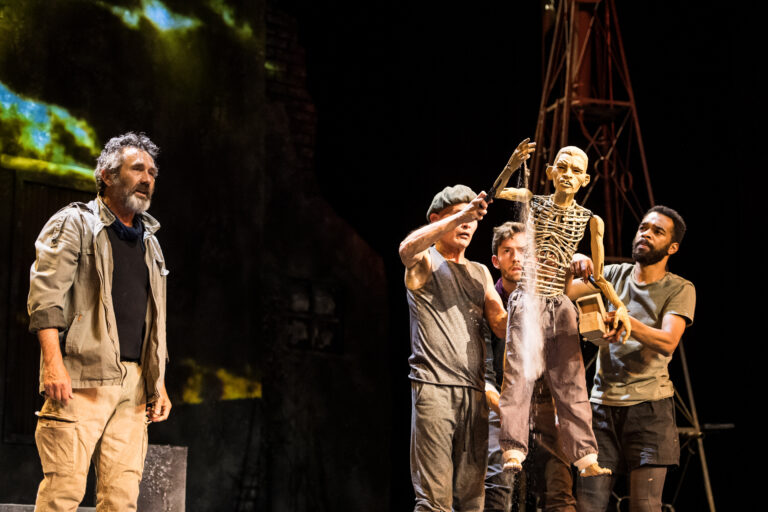
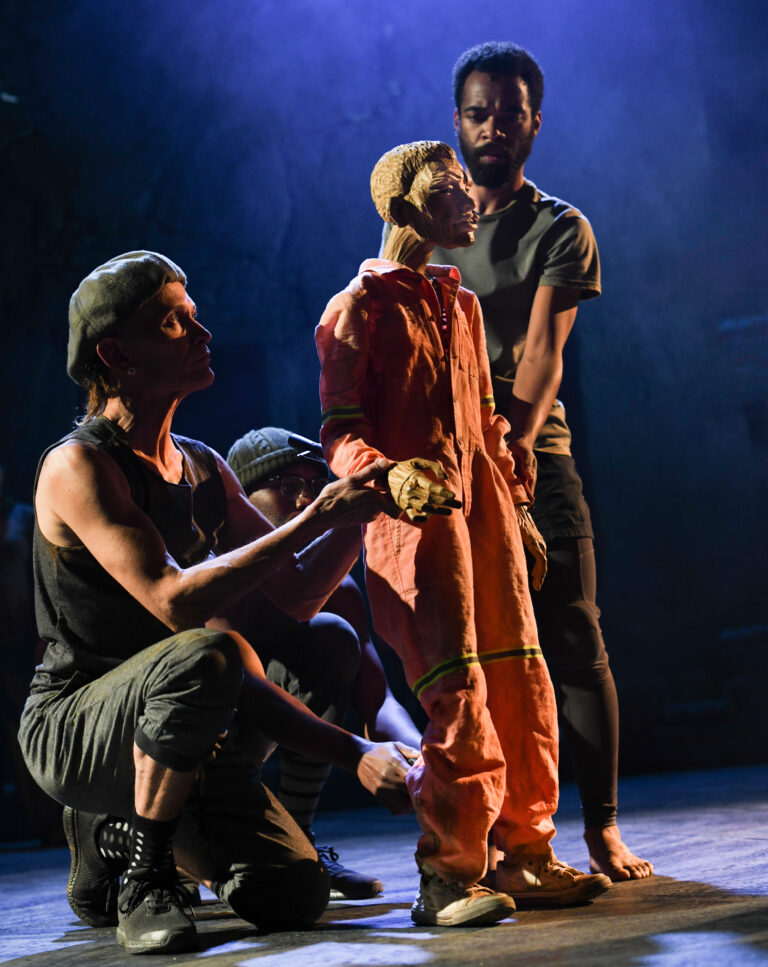
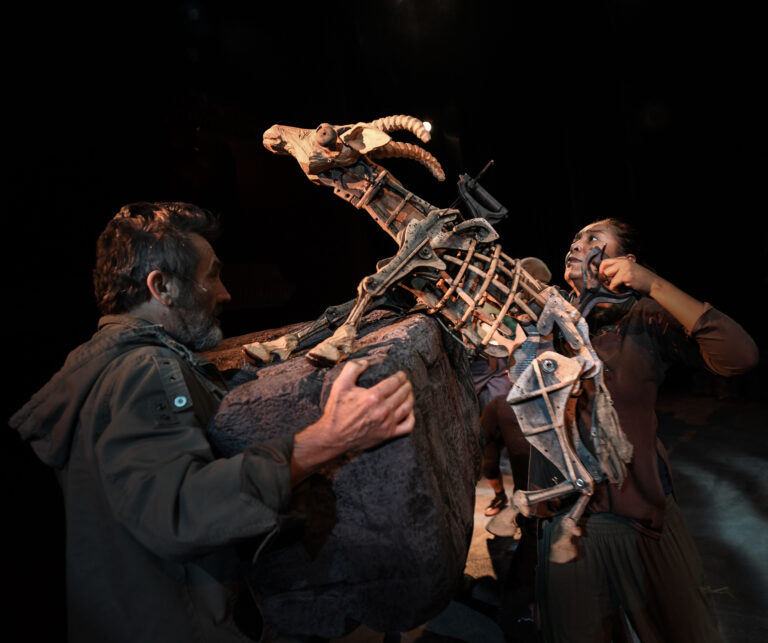
In this uninterrupted two-hour piece, Michael K. also happens to be a three-foot-tall puppet made of wood, cane, and carbon. Yet, miraculously, he is also the embodiment of grace, emotion and human interiority. He is maneuvered by three puppeteers (Craig Leo, Carlo Daniels, and Markus Schabbing) whose precision and synchronicity are impeccable and whose presence is both noticeable and integral to the play.

Life and Times of Michael K doesn’t play smoke and mirror games, camouflaging the puppeteers in black and trying to create the illusion that the puppets somehow function independently. Rather, it spotlights and celebrates the collaboration between human and puppet. Even when there are six people manipulating two puppets, the puppets are the undisputed focus and the magic spell is unbroken.

It’s hard to describe the enchantment of such artistry and skill.

The play opens with soft piano music as a performer carries an orange-shrouded Michael K. onto the stage. The shroud is lifted and a real, yet nonhuman, face is bared. With the slightest turn of the neck or tilt of the chin, that face expresses calm, pain and tears. One side emphasizes his cleft palate; the other his otherwise handsome features.

Yoav Dagan and Kirsti Cumming’s projection designs magnify Michael K.’s face, allowing the audience easier avenues of interior access and empathy. Green screen projections, a closed caption LED board and the use of rotating narrators add a multi-media excitement and emotional accessibility to the production. These elements don’t compete for our attention; rather, they complement and complete the action, conjuring something intoxicating and original.

Although there are nine people on stage — including the three puppeteers who manipulate Michael K — they are neither intrusive nor distracting. Michael K and the other five puppets (his mother, Anna, a feisty goat, and three curious children) seamlessly interact and interplay with the human beside them. They are different, but they are equals. At one point, Michael even addresses his handlers, offering them each a bite of his chicken pie even though he’s nearly dead from starvation.

The storyline is straightforward and told in linear chronology. We witness Michael’s birth (puppet Anna and her three puppeteers are amazing), his mother Anna’s rejection, and his childhood spent in institutions, where he learns gardening. When his mother falls ill and needs his help, she has him released and returned to her care. He now works as a gardener in Cape Town and tends Anna, a domestic servant to a wealthy family. The country descends into civil war and martial law is imposed. When Michael’s mother becomes very sick, he decides to quit his job and escape the city to return his mother to her birthplace, Prince Albert.

First, he jerry-rigs a wheelbarrow cart to transport his mother and their belongings. The two set off on a near-impossible trek that their banter and affection transforms into an adventure. Prone to philosophical questions and self-reflection, Michael K. frequently wonders why he had been brought into this world. His answer: to look after his mother. He never gives a second thought to the fact that his mother never looked after him.

That reason changes when his mother dies in a heartbreaking scene sensitively lit (Joshua Cutts) and soundtracked (Simon Kohler). His life takes a series of twists and turns when he encounters friends, enemies, detours, dangers, passions, hope — and one very spirited goat.

Yet, his innate ability to transcend and find the miracle in everyday life saves him from gloom and despair. He is relentlessly forgiving and accepting, unearthing solace in his life as a cultivator and eventual return to the farm where his mother was born. At last, he can let her ashes go. She is home and, he realizes, so is he.

Enhancing the script and dazzling puppetry are Patrick Curtis’ set design and Dagan and Cummings’ projection design. Curtis uses minimum props and a smoky palette to maximum effect, creating a set versatile enough to serve as delivery room, bus, school, waves, farm and work camp. Backdrop projections ensure the audience is in lockstep with Michael K and his journey with inspired and enhancing visuals.

While Life and Times of Michael K is adapted from a work of fiction written over 40 years ago, its themes of displacement, poverty, discrimination and civil unrest are still relevant and perhaps even more urgently felt today. Yet Michael K’s journey focuses more on the internal than external as he uncovers his personal philosophy of life. “A man must live so that he leaves no trace of his living,” he says, vowing to only eat food he has grown himself. “There is no shame in being simple. One spoonful of water is enough to live,” he adds.

Michael K may be a puppet, but he has more heart and soul than many people.

‘Life & Times of Michael K’ — Adapted and Directed by Lara Foot in collaboration with Handspring Puppet Company. Based on the book written by J.M Coetzee. Adaptors and Puppetry Direction by Basil J.R. Jones and Adrian P. Kohler. Puppetry Design by Adrian P. Kohler. A Baxter Theatre Centre and Düsseldorf Schauspielhaus Production. Presented by ArtsEmerson at the Emerson Paramount Center, Robert J. Orchard Stage, 559 Washington St., through February 9.For more information and to buy tickets, visit www.artemerson.org

Lyric Stage’s ‘Crumbs from the Table of Joy’ Has A Tale to Tell  


Cast of Lyric Stage’s ‘Crumbs From The Table Of Joy’. Photos: Mark S. Howard 
Thomika Marie Bridwell, Madison Margaret Clark, and Dominic Carter 

By Shelley A. Sackett

Luck

Sometimes a crumb falls
From the tables of joy,
Sometimes a bone
Is flung.

To some people
Love is given,
To others
Only heaven.

— Langston Hughes

James Mercer Langston Hughes, best known for his Harlem Renaissance Jazz Poetry, wrote “Luck” in 1947. The poem can be interpreted as a commentary on unfairness, deprivation, and the pursuit of love. It could also be read as a reminder of the injustices faced by Black Americans and other “have-nots’ who must bear witness to the overflowing bounty of the “haves” and hope they are in the right place at the right time to scoop up the discarded scraps.

Lynn Nottage’s 1995 play, ‘Crumbs from the Table of Joy,’ picks up Hughes’ theme and runs with it in a two-act work now in production at Lyric Stage. Fair warning to fans of Nottage’s later, brilliantly biting “Clyde’s,” and Pulitzer Prize-winning “Ruined” and “Sweat” — ‘Crumbs’ is far less absorbing and captivating. A nostalgic look in the rearview mirror, it is a good story but about as edgy as a Hallmark movie.

Set in 1950, “Crumbs” is a memory play about the Crumps, a “colored” family that migrates from Jim Crow Florida to Brooklyn. Although the country is recovering from World War II and the Civil Rights movement is gaining momentum, the discrimination and lack of opportunity that greets them in New York doesn’t differ significantly from what they left behind.

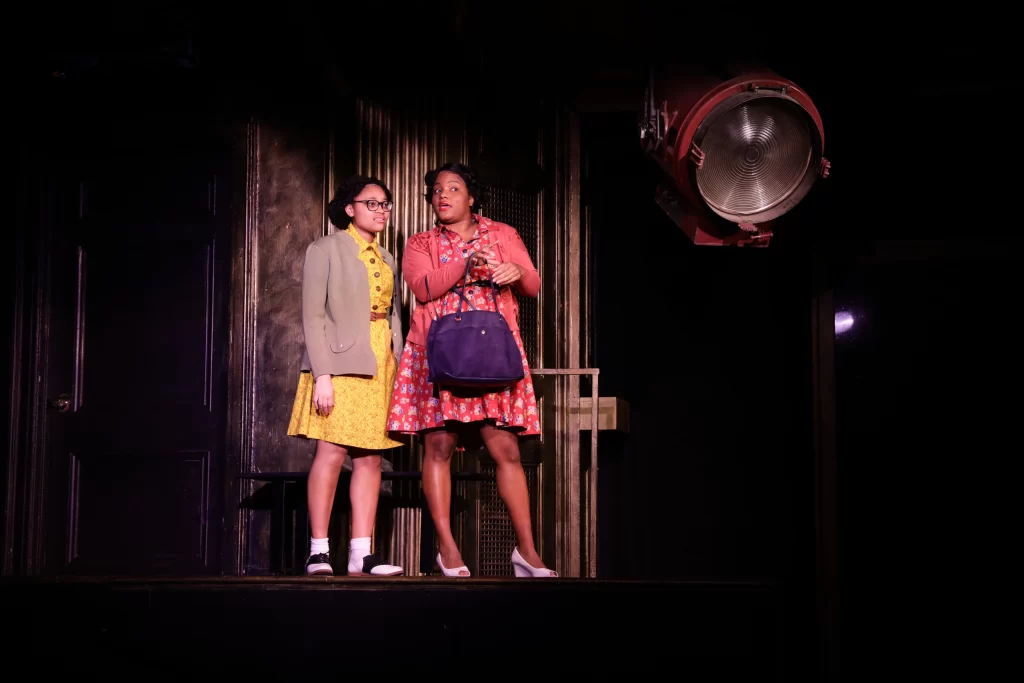
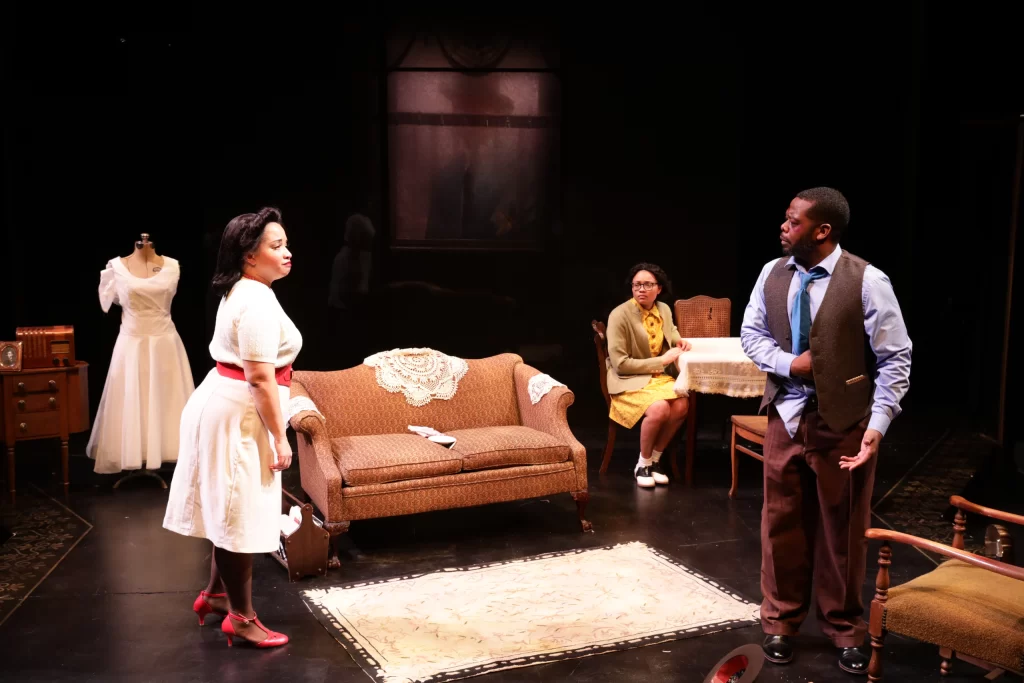
Ernestine Crump (Madison Margaret Clark), a 17-year-old who wears bobby socks and glasses, is the amiable, if hardly charismatic, narrator. She shows us around the cramped Brooklyn flat she shares with her father, Godfrey (a nuanced Dominic Carter) and her bouncy, lively 15-year-old sister Ermina (an engaging Catia).

Grief-stricken and psychologically undone by his wife Sandra’s death and faced with raising two motherless teenage girls on his own, Godfrey uprooted the family to follow the African American evangelist, Father Divine, his personal guru and religious savior. It turns out Brooklyn is the return address on Father Divine’s mail order catalog; his Peace Mission Movement is actually headquartered in Philadelphia.

Undaunted, Godfrey immerses himself in his faith in the belief that this will provide a fresh start and a better life for him and his daughters. He dons blinders and digs deeper into Father Divine’s strict religious teachings of celibacy, sobriety and solemnity on Sundays. Structure and strictures are his lifeline. Father Divine lets him know all will be O.K.

Catia, Bridwell, and Clark

He writes letter after letter to Father Divine, desperate for his advice and a glimmer of direct connection. Finally, the mission writes back, telling him to keep following the path and donate money. Godfrey bestows a church name on himself and his daughters and keeps a notebook into which he obsessively jots down questions he will ask Divine Father during his anticipated face-to-face.

Ernestine and Ermina don’t share this version of deliverance and choose a different escape route from reality. For them, joy is to be found in dreams and fantasy; in other words, at the movies.

Ernestine is also about to graduate from high school, the first Crump to reach that level of education and achievement. One day, a sewing pattern arrives in the mail for her. It turns out her mother had ordered it before she died. She sets up a sewing form in the living room, sewing the dress throughout the play as a reminder of her mother and a bridge between the world they left behind and the one in which they now live.

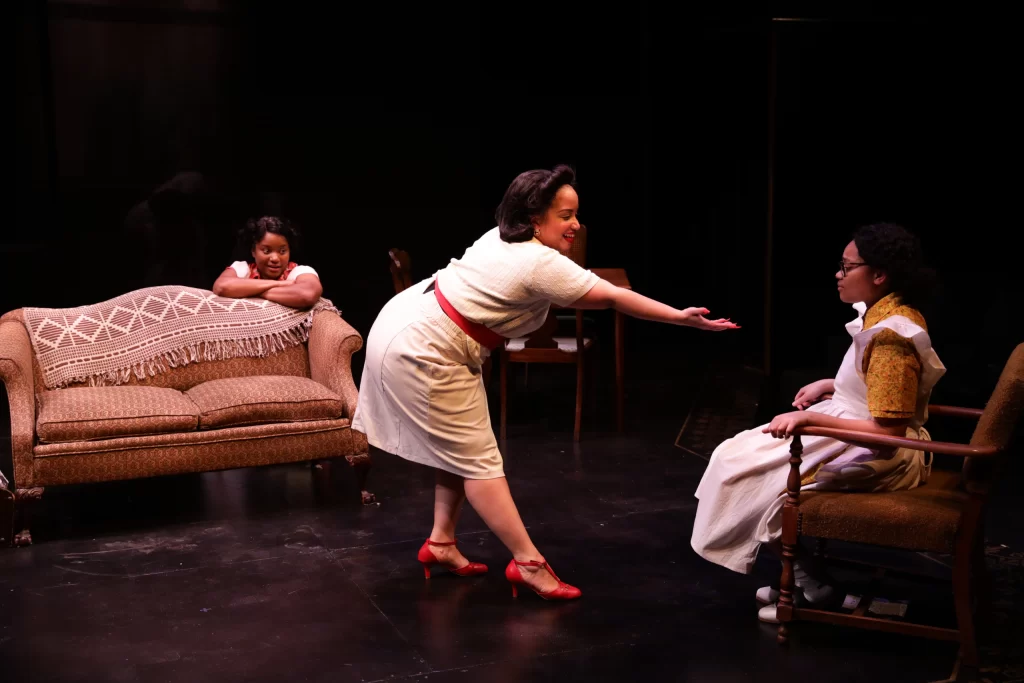
Just when it feels like the weight of Nottage’s sluggish, speech-heavy script (not helped by voice projection problems) might sink the ship before it gets out of the harbor, Sandra’s sister, Lily Ann Green (an outstanding Thomika Marie Bridwell), saves the day. She bursts into the apartment, riding a gale wind that fills the play’s sagging sails and keeps it afloat for the remainder of its almost two-and-one-half-hour running time.

Clark, Catia

Vivacious and uninvited, Lily is dressed in sunglasses, a fur coat and a well-tailored white suit. Red shoes and a cigarette are the perfect accessories. Lily is a non-conformist, an educated woman who lives in Harlem and hobnobs with revolutionaries and communists. Although she didn’t make it to her sister’s funeral, she is committed to moving in with Godfrey and helping raise her sister’s two girls.

She is also committed to raising hell, and although she and Godfrey share a past that she tries desperately to reignite, her antics send him scurrying away, leaving her more isolated than ever.

Lily drinks, cavorts, swears and doesn’t work. She is the unrequited yin to Godfrey’s yang of a consuming need for order and answers. Both are chasing salvation as they try to manage their grief and rage. After Lily goes too far one night, giving Godfrey a kiss which he miserably admits does tempt him, Godfrey disappears for three days, leaving Lily and the girls to fend for themselves.

He returns with Gerte (a terrific Bridgette Hayes), a white German refugee whom he met on the subway and introduces as his wife. He believes he is following Father Divine’s advice to move forward with his life. It’s unclear whether the girls are more unhappy that she’s white or that their father married so soon after their mother’s death. Lily sinks deeper into drinking, humiliated and devastated that Godfrey couldn’t/wouldn’t marry her instead.

Clueless about racial tensions in America but delighted to have found an American husband, Gerte’s one saving grace is the love for movies she shares with the girls. In her dreams, she hungers to be Marlene Dietrich, and the scenes that allow Hayes to channel that persona are a welcome respite and among the play’s most engaging.

Nottage plods on, addressing a myriad of social, political and emotional issues while keeping us in the loop as time marches on for the Crumps. Every member of the family eventually runs smack into the reality of how the color of their skin interferes with their pursuit of the American Dream. Change and revolution may be in the wings, but they are not here yet and they will be traveling hand-in-hand with pain and fear. In the meantime, each Crump must cope in their own way, through action, fantasies, faith and anesthetics.

Director Tasia A. Jones gives us a straightforward version of ‘Crumbs’ and, while Cristina Todesco’s set design and Eduardo Ramirez’s lighting design work well as the action hops from living room to subway car to Ernestine’s movie fantasies, the production lacks coherency, urgency, and intimacy. We want to understand Ernestine and what makes her tick, but her monologues, monotone, and static blocking keep us at arm’s length.

‘Crumbs’ is worth seeing for its solid ensemble and stand-out performances, its homage to the 1950s, and, most of all, for providing a reason to appreciate how far Lynn Nottage has traveled in her 30-year career.

Crumbs from The Table Of Joy.’ Written by Lynn Nottage. Directed by Tasia A. Jones. Sound Design by Aubrey Dube. Costume Design by Mikayla Reid. Scenic Design by Cristina Todesco. Lighting Design by Eduardo Ramirez. Produced by Lyric Stage at 140 Clarendon Street, 2nd Floor, Boston, through February 2nd.

For more information and tickets, visit: https://www.lyricstage.com/

Flight 1619 Finally Lifts Off in SpeakEasy/Front Porch’s Ambitious ‘Ain’t No Mo’

Cast of SpeakEasy/Front Porch’s ‘Ain’t No Mo’ Photos: Nile Scott Studios
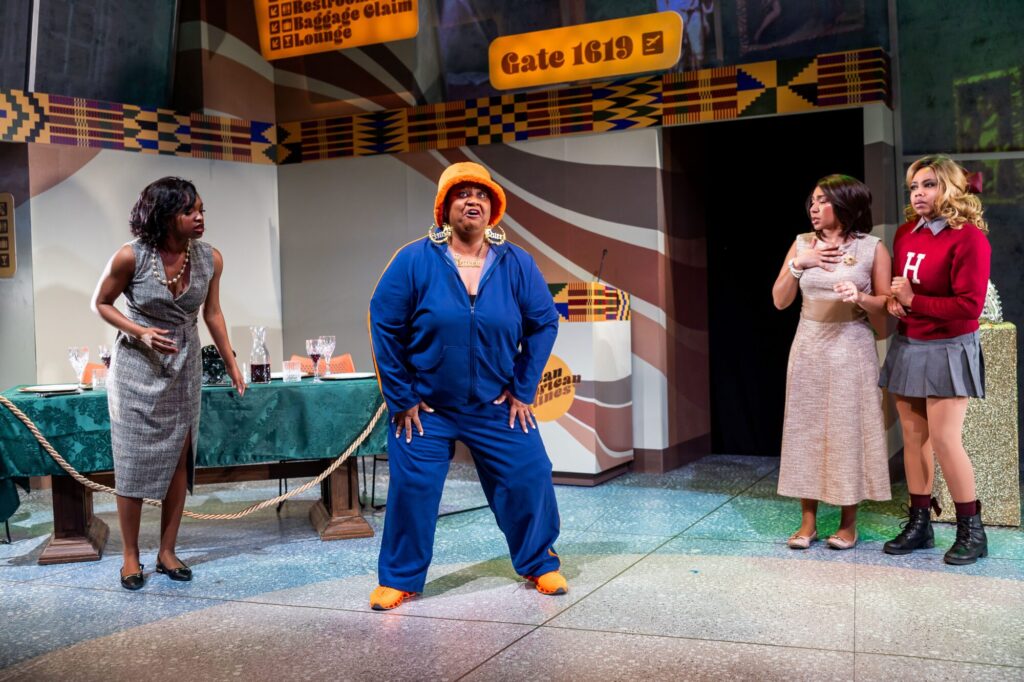
MaConnia Chesser, Kiera Prusmack, De’Lon Grant, Schanaya Barrows, and Dru Sky Berrian.

By Shelley A. Sackett

Jordan E. Cooper’s Ain’t No Mo is a complicated, uneven, scathing, audacious, and hilarious rollercoaster ride of a play. It covers a lot of ground, and Cooper dips his pen into the inkwell of every genre known to playwrights: from satire, allegory, fiction, and parody to tragedy and Shakespeare-worthy soliloquy.

Performed as a series of loosely connected vignettes that sometimes change at whiplash speed during 100 intermission-less minutes, this SpeakEasy Stage Company/Front Porch Arts Collective production is guaranteed to spark lively post-theater discussion.

Here’s the premise.

In 2016, with the election of Donald Trump and the end of Barack Obama’s presidency and its promise of Hope and Equality, African Americans descended from slaves are offered a one-way ticket “home” to Dakar, Senegal. A “dedicated observer of equal oppression,” African American Airlines’ Flight 1619 is in the house, or the White House to be more precise. Whether to stay and live life as it is in this country or leave on the “Reparations Flight” and start anew is each individual’s choice.

The government expects this will solve the problem of racism in America once and for all. Almost all eligible Blacks (millions) register to take advantage of the free flight.

What Cooper does with this simple premise, however, is staggering in terms of its brazenness and sheer creative genius. Director Dawn M. Simmons executes with full-throated flamboyance and exaggeration.

The six-actor ensemble switches into many roles easily, aided by Rachel Padula-Shufelt’s fabulous costume design and wig choices. Mac Young’s set design is both flexible and exacting, flowing smoothly between very different settings. Aja M. Jackson’s lighting design and Aubrey Dube’s sound design help create a unifying aesthetic for the show’s differing segments.

Cooper’s no-holds-barred approach is evidenced full blast even before the house lights are fully dimmed. The mild-mannered recording that announces where exits are and what to do in case of an emergency is suddenly interrupted by Peaches, the Flight 1619 airport gate attendant.

Grant Evan

“Ladies, gentleman, and those who don’t give a damn. Welcome yo ass to The Roberts Theater. Yessss, we in Boston, bitch! It’s ‘bout time to get this thing started, so I hope you had enough sense and shat before you sat,” she shouts into the sound system.

The rest of the play, which starts with the election of President Obama and ends with Flight 1619 taking off, traces the Black American experience with scenes Cooper chooses to exemplify that jumbled, complicated, painful journey. Like a book of loosely connected short stories, each scene functions independently, yet, taken together, they weave a single cloth.

What unites them is their characters’ reactions to news of the subsidized flight to Africa. Will they stay or leave? And, more importantly, why?

The action opens with “Book of Revelation,” a bang-up of a funeral led by Pastor Freeman (played with over-the-top verve by a terrific De’Lon Grant). It is November 4, 2008, and the Black community has gathered to celebrate Obama’s election and lay Brother Righttocomplain, the embodiment of protest and injustice, to rest.

“Ain’t no mo’ shot down dreams with its blood soaking the concrete,” Freeman bellows. “Ain’t no mo’ riots.”

Now that a Black president has been elected, the unrealistic assumption is that centuries of racism and discrimination will suddenly be reversed and a new era of promise will be escorted in.

The joy and celebration is short-lived. After this gospel-infused scene, the mood and time shifts to 2016 and the election of Trump. White backlash against black Americans and ginned-up fear and resentment will set the next agenda.

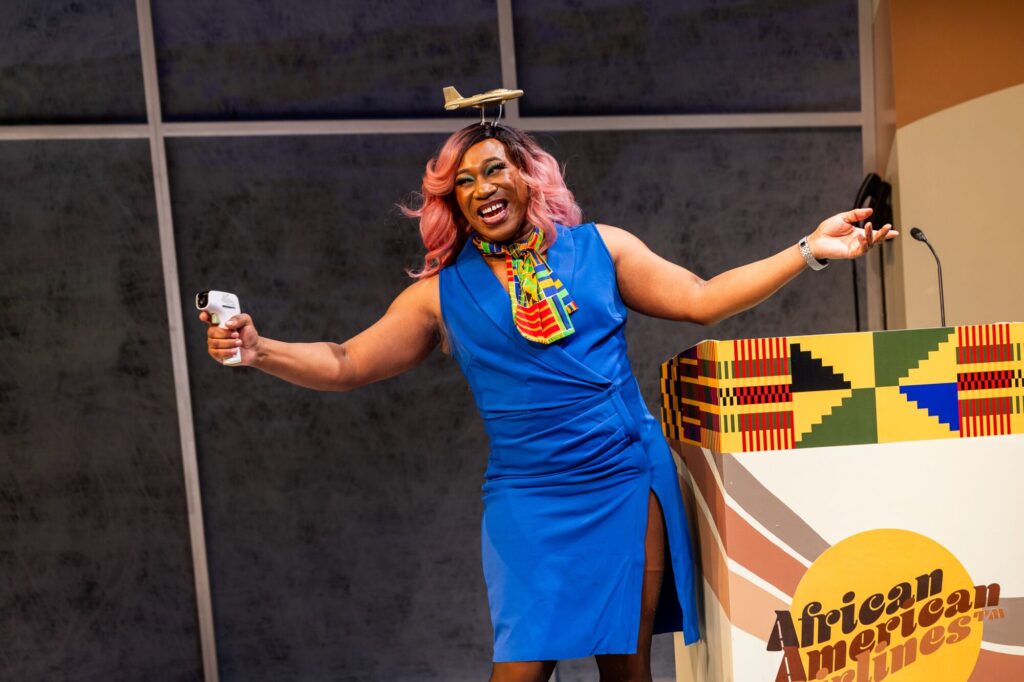
Between each plotted scene, we witness morsels of what Peaches (a scene-stealing non-binary Grant Evan) is dealing with as the sole check-in agent for Flight 1619. A larger-than-life drag queen who wears a hot pink wig, Kente scarf, and model airplane-adorned tiara; her role is the play’s only constant through a series of sketches and settings.

She checks in various passengers and offers counsel to those who are hesitant. She also prepares Miss Bag, a suitcase she claims holds “our entire story as a people in this country,” and encourages passengers to drop their stories in the bag so they may bring it to Africa. She warns those who stay behind will be subjected to “extreme racial transmogrification” by “The Powers That Be”: they will be turned into white people.

The audience comes to trust her voice and feel her frustration and angst as she single-handedly supervises boarding millions. She is the reliable narrator, part mother hen and part Greek chorus.

Dru Sky Berrian, MaConnia Chesser, Kiera Prusmack, and Schanaya Barrows

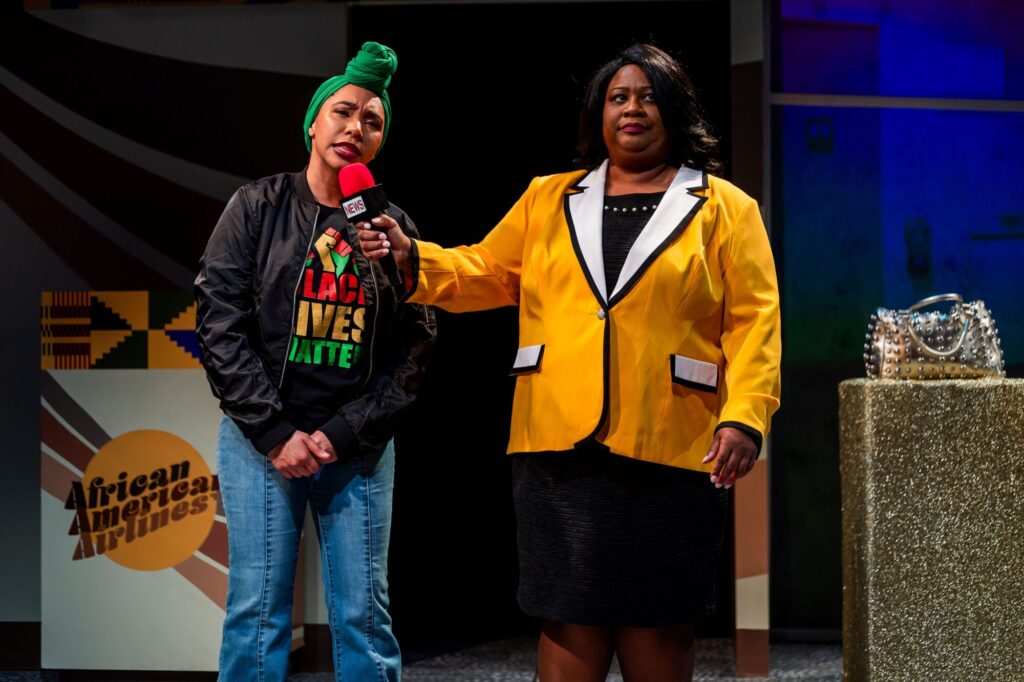
With “Circle of Life,” Cooper tackles the heartbreak of young lives ended by violence and police brutality and the unwillingness of Trisha (Dru Sky Berrian), pregnant by Damien (Grant), to bring a future victim into the world. “A better time is coming. We just have to wait for it,” Damien assures her. Despite his pleas, she is adamant. So are the million other women in line at the Sister Girl We Slay All Day Cause Beyonce Say Community Center, a clinic oasis in a country where abortions are no longer available. Trisha is Number 73,545.

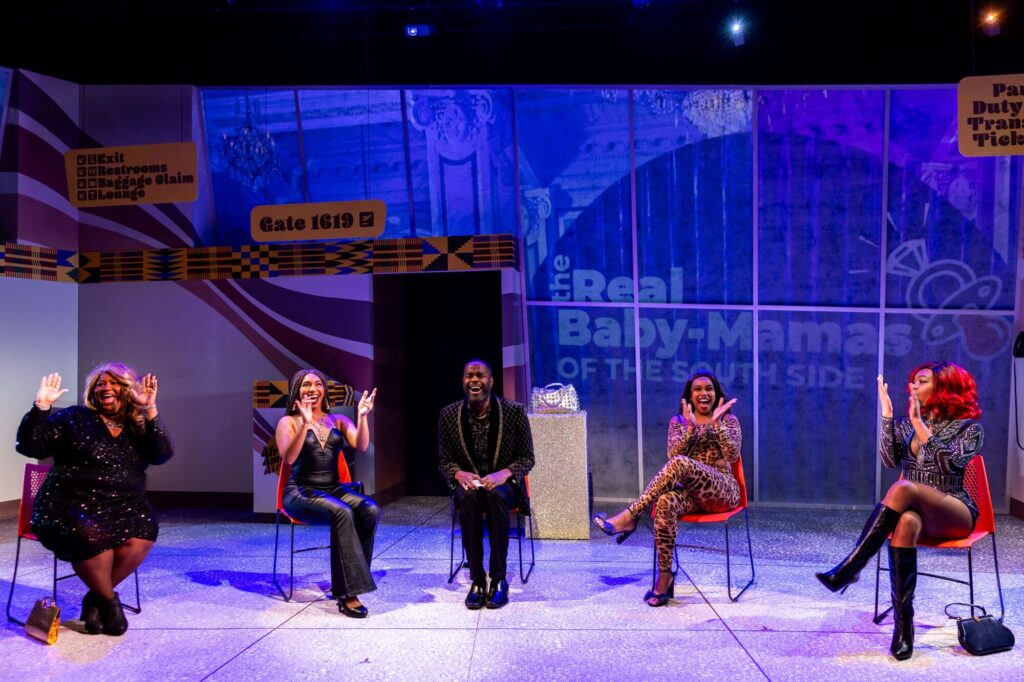
“Real Baby Mamas of the South Side” is a parody of the Real Housewives franchise. This one focused on four black women pretending to have multiple baby daddies and an obsequious host who keeps the provocation flowing. One panelist isn’t even black but is “transracial,’ white Rachel dressed as black Rachonda, “choosing to be herself” and “living her truth” as a black woman.

Tracy, another panelist, breaks character and confronts her. “Race is not a choice. It’s a fact,” she states. Unlike the Rachondas of the world, her skin and the experiences that come with it are NOT optional.

Here, and at many other times, Cooper squanders an opportunity to dig deep into some meaty issues like exploitation, appropriation, stereotyping, ownership, protection of black culture and the tipping point between the humorous and the hateful. Instead, he takes the easy way out, letting the scene devolve into a catfight, leaving the audience unsatisfied and his craftsmanship in question.

In “Green” and “Untitled Prison Play,” Cooper makes his point with more clarity and self-discipline. Each scene features Maconnia Chesser, who anchors and elevates them. In “Green,” Cooper lampoons rich black families who – in this case literally — buried their blackness and partook in the material rewards of assimilation. They have no intention of going anywhere, certainly not to Africa. They have bought into the American Dream, despite its hefty price tag. This is now their America, too.

Chesser plays Black, the human personification of their family’s “blackness,” locked away in the basement by the family’s deceased patriarch for forty years while he became rich. Suddenly, she is set free. She has a lot to say. And she is pissed off.

“Now is the chance to learn who you really are,” she tells them. “I am your family’s black. Come on, we have a plane to catch.” Instead, they plead, threaten and eventually try to shove her back into the basement. No way is this Pandora going back into her box.

Again, the scene devolves into chaos and violence, and again, we are left unsure what point Cooper was trying to make and why.

In “Untitled Prison Play,” the play’s most moving scene, Chesser plays an inmate who can’t leave prison without signing for her possessions and who won’t sign until everything she had when first incarcerated is accounted for and returned. What she’s missing are her joy and a little piece of chaotic peace. Her name. Her place on earth. And, most of all, her smile. Her real smile.

But her choice is stark. Refuse to sign and return to her cell or leave and find herself some new stuff. Like Freedom.

Flight 1619 does finally takes off, but not before Peaches brings down the house with a lightning bolt monologue. There are even last-minute spoilers and pyrotechnics.

When Cooper started Ain’t No Mo, he was just a high school student. Its genesis was in reaction to an incident of police intimidation that rocked and changed him. Its Off-Broadway premiere happened when he was just 24 years old and three years later, Cooper became the youngest Black American to make his Broadway playwriting debut and the youngest Black American playwright ever nominated for a Tony Award. Ain’t No Mo garnered six nominations, including Best Drama, despite its closing after a mere three-week run.

To be sure, Cooper’s play is hardly flawless. It is dated and full of platitudes, pacing issues, and tiresome, gratuitous expletives. It is also in dire need of judicious breadth and length editing.

But Cooper’s pen is a magic wand as well, spinning a smart, confident and grand play out of an undisciplined galaxy of issues and ideas. And when the smoke clears and the stage finally quiets, we’re surprised by the number of important questions left rolling around in our minds, like party favors.

Kiera Prusmack and MaConnia Chesser

If Miss Bag is the “carrier of our entire story as a people in this country” — the music, art, culture, political ideas, and everything else Blacks have contributed to the American landscape — should it travel to a new destination? Will it reassimilate or hold its owners back, married to an old reality while trying to forge a new one?

When émigrés board a plane, for example, perhaps with just one bag, what do they leave behind? What does the country they leave lose? And after they leave, whose story is theirs to tell? What do we do when the story is over? Perhaps, most importantly, where does freedom fit in if its price is a future without a past?

And these questions are just for starters.

‘Ain’t No Mo’.’ Written by Jordan E. Cooper. Directed by Dawn M. Simmons. Co-produced by SpeakEasy Stage and Front Porch Arts Collective at the Calderwood Pavilion, 527 Tremont Street, through February 8.

For more information and to buy tickets, visit https://speakeasystage.com/shows/2025/01/aint-no-mo/

‘Every Brilliant Thing’ at Apollinaire Theatre Co. Delivers On Its Promise

Cristhian Mancinas-Garcia and Parker Jennings in ‘Every Brilliant Thing’ at Apollinaire. Photos by Danielle Fauteux Jacques

By Shelley A. Sackett

A one-person show about suicide and depression that threatens random audience participation, runs for approximately 75 intermission-less minutes, and pledges to be funny and uplifting has a pretty high bar to clear. Yet, Apollinaire Theatre Company does just that with room to spare in its brilliant production of Every Brilliant Thing.

The play’s narrator, the irrepressible Parker Jennings (alternating the role with Cristhian Mancinas-Garcia, who also performs it in Spanish), is already standing in the middle of the stage when even the earliest audience member arrives. As if welcoming them into her own living room, she greets them warmly with an unaffected smile and a blue basket full of cards.

“I have a job for you all this evening,” she exclaims as she hands out the numbered cards with instructions to shout out what is written whenever she says that number.

Set in the round in an intimate black-box space that is furnished with comfortable salon-like seating, Jennings’ rapport with the audience is immediate and palpable. Upbeat jazz and full house lights heighten the sense of communal conversation. Before she has uttered her first line, she has us in the palm of her hand, making us feel like we’re here by design rather than happenstance.

“The list began after her first attempt,” she begins. “A list of everything brilliant about the world. Everything worth living for.”

The first call and response quickly follows. “Number One,” she says, and the person holding that card shouts out, “Ice cream.” Number two is water fights. Three is staying up past your bedtime and being allowed to watch TV. Any flicker of stage fright or self-consciousness has completely evaporated. We are in this together.

In an instant, Jennings the Narrator has morphed into the seven-year-old girl who, after learning that her mother attempted suicide, vows to make her mother feel better by making a list of everything that makes life worth living and sharing it with her. This coping exercise will see her through the next several decades and, by the end of the play, will number one million.

Her first encounter with death (“a loved one becoming an object”) and the first audience-supporting role (as the vet) occurs when she has to put down her beloved dog. Jennings’ improvisational chops and talent for putting the audience at ease are on full display. Other interactive roles will include her father, teacher, school counselor, and first love/wife.

Her second encounter with the idea of death occurs when her father picks her up from school after her mother’s first suicide attempt. He explains to the little girl that her mother is in the hospital because she is sad, because she couldn’t think of anything worth living for.

The precocious child intuits the concept of glimmers, the opposites of triggers. These are small experiences of pleasure that happen during simple, everyday activities. Noticing and appreciating them can cue your nervous system that you’re safe and can relax.

She devotes her life to crafting a list of every brilliant thing she can think of, first in an attempt to save her mother and later for herself, as she navigates her own journey of hills and valleys and, poignantly, fear that her mother’s mental illness tributary runs through her veins as well. As time moves on, the list becomes a sort of diary that reflects the texture of her everyday experiences.

“Things may not always get brilliant, but they get better,” she says. “We need to imagine a future better than the past because that’s what hope is and without hope, life isn’t worth living.”

Thanks to Joseph Lark-Riley’s carefully curated sound design, the significance of blues and jazz also runs deeply. These songs and artists link the Narrator to her vinyl-loving dad and tether her. Lyrics from “Drown In My Own Tears,” “I Love You Just the Way You Are” and “At Last” are more than toe-tapping background; they are placeholders and place setters that connect us to our narrator and her story. It’s no surprise that one of the items on her list is: “A song transporting you back to a moment in time.”

The tone and substance of Duncan Macmillan’s script (written with Johnny Donahoe, a British stand-up comedian who first played the role at the Ludlow Fringe Festival in 2013) covers a lot of ground. The Narrator’s ability to confront issues as heartwrenching as the guilt felt by children of suicides, social contagions, and the virulence of hard-wired, chronic depression with playfulness, insight, and unflinching honesty prevents the play from becoming mawkish, which easily could have happened if penned by a less skillful and empathetic playwright.

Danielle Fauteux Jacques wisely directs with a light touch, and Jennings shoulders the production with chipper verve and a storyteller’s charm. Yet, she also brings an emotional intelligence to her performance, the shadow of a veil that, when lifted, reveals the scars of underlying trauma. Most recently seen as Sarah in Apollinaire’s equally extraordinary “Touching the Void” last May, Jennings is an actress I would (and did) go out of my way to catch in any role she should take on. Her energy, authenticity and confidence are matched only by her raw talent.

As the play winds down, the Narrator’s list takes on a life of its own as an ersatz crowdsourced lifeline, publicly shared and collaboratively complied. Although the list couldn’t save her mother, it may just have prevented her from following in her footsteps. She leaves us collectively more open-hearted and open-minded with the balm of these parting words of benediction: “If you live a long life and get to the end of it without ever once having felt crushingly depressed, then you probably haven’t been paying attention.”

‘Every Brilliant Thing’. Written by Duncan Macmillan with Johnny Donahoe. Directed by Danielle Fauteux Jacques. Scenic and Sound Design by Joseph Lark-Riley. Lighting Design by Danielle Fauteux Jacques. Produced by Apollinaire Theatre Company at Chelsea Theatre Works, 189 Winnisimmet St, Chelsea, MA through January 19th.

For more information and to buy tickets, visit apollinairetheatre.com
A Theatrical Alchemy, A.R.T.’s ‘Diary of a Tap Dancer’ Is More Than the Sum of Its Parts

Ayodele Casel (center) and the cast of A.R.T.s ‘Diary of a Tap Dancer.’
Photos: Nile Scott Studios and Maggie Hall
 

By Shelley A. Sackett

Ayodele Casel’s ‘Diary of a Tap Dancer’ defies pigeonholing. First, it is a crackerjack tap dance concert, choreographed and performed by a jubilant devotée of the genre whose sensitivity to its rhythmic musicality keeps the action moving and the audience’s toes tapping along.

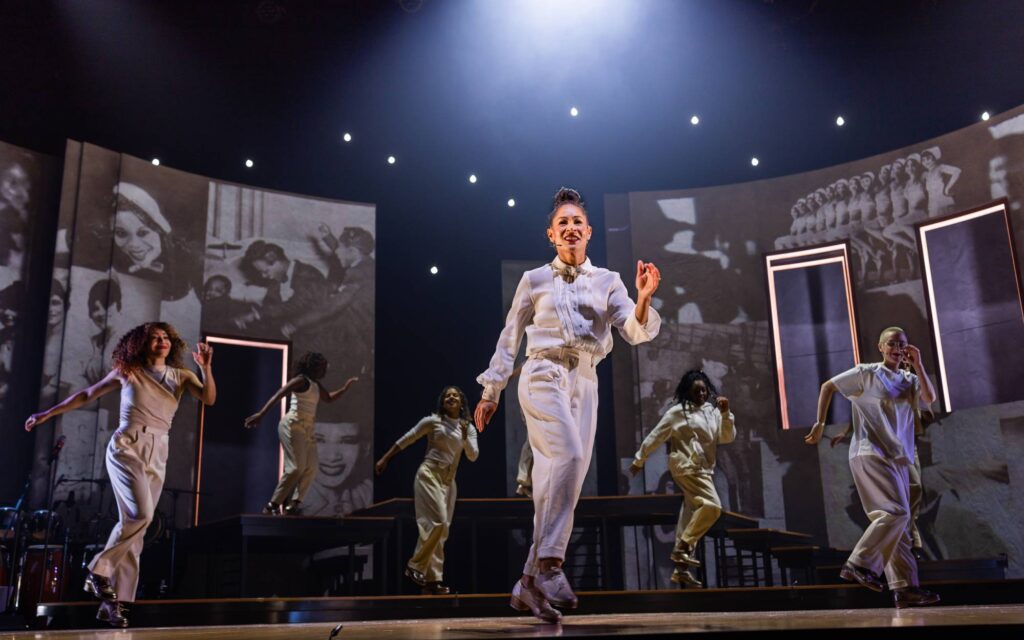
Second, it is a narrative documentary that “shines a light on women hoofers,” especially the unknown and forgotten black tap dancers of the 1920s through the ‘50s who blazed a trail for others, like Casel, to follow. Projection Designer Katherine Freer has curated a six-screen still and moving visual accompaniment that introduces us to all the dancers who might have been written out of history — women like Juanita Pitts, Jeni Le Gon, Cora LaRedd, Louise Madison and Marion Coles —  but for her efforts to draw attention to them.

“I have an intense need, desire and responsibility to speak their names,” Casel, the self-proclaimed sepia Cinderella of tap, shares. “They were entrepreneurs, choreographers and dancers. Our time on earth matters. Don’t wait for an invitation to tell your story.”

Additionally, Casel’s ‘Diary of a Tap Dancer’ is just that- an oral diary that tells, in upbeat, humorous and, at times, painfully repetitive detail, the story of her life.

Born in the Bronx to a Puerto Rican mother and African American father (whom she didn’t meet until she was 17 years old), she was sent as a child to live with her Puerto Rican grandparents, where she honed her scrappy spirit by getting into fist fights with boys. When she returned to the Bronx, she and her mother watched old movies and read movie magazines, falling for the glamor and magic of Ginger Rogers and Fred Astaire. She discovered the world of tap during a high school class in movie history. Later, as an NYU theater major, she took her first tap class, showing up with shoes from “Payless” that were as close to Rogers’ as she could find.

“Tap is magic,” Casel says. “It changed my life.”

Her single-minded persistence landed her a spot as the first woman in Savion Glover’s (of mid-90s off-Broadway hit, “Bring in ‘da Noise, Bring in ‘da Funk,” fame) dance company, a real turning point in her career. Tap legend Gregory Hines has referred to her as “one of the top young tap dancers in the world.”

When it comes to paving the way for other marginalized dancers, Casel doesn’t just talk the talk; she also walks the walk (taps the tap?) by sharing the stage and spotlight with seven female and nonbinary young dancers who both complement each other as an ensemble and shine as soloists. But the spritely, charismatic, and extraordinarily talented Casel can’t help but steal every scene with the simplest flap-ball-change. Who knew tap could be so orchestral and communicative?

Under Torya Beard’s (Casel’s longtime collaborator and wife) direction, the atmosphere is set even before the show starts with an almost holy ambient organ major harmonic dyad punctuated by muted city traffic, sirens, and birds. A simple blue set sports what looks like graffiti but is actually a photograph of 18th-century legislation forbidding slaves from owning drums.

A slow spotlight reveals white-clad dancers using every inch of Tatiana Kahvegian’s sparse but effective stage. Dancers are scattered in little solo spaces reminiscent of the staging of “The Lion King.” When the soundtrack kicks in and they all start tapping, it’s like a magical sound bath of rhythm and movement.

Backed by a terrific trio of on-stage musicians (Carlos Cippelletti on piano, Raul Reyes Bueno on bass and Keisel Jiménez Leyva on drums), the musical dance numbers are a pure delight. Casel tells her intimate and powerful story through straight narration, rap, beat and counter-beat. Her acting chops show in the comfort with which she addresses the audience. It’s no surprise to learn that “Ayodele” is Yoruban for “joy.” Casel is not just a top-notch dancer and choreographer; she is genuinely warm, funny, smart, guileless, and humble. She is also an articulate, eloquent, and bold guide who unlocks the enchantment and triumph of the human spirit that is the essence of tap.

The problem (at least at last Sunday’s world premiere production, which ran 30 minutes beyond the show’s already overly generous 2 hours with one intermission) is that Casel has a lot to say about a lot of topics about which she is understandably passionate. “This show is narrative justice,” she explains.

But by trying to tackle such big-ticket items as racism, sexism, African American history, misogyny, and historical exclusion, instead of leaving her audience feeling enlightened and informed, she leaves them wishing for more dance and less talk. A LOT less talk.

While Casel is an excellent and engaging narrator, it is the magic language of her syncopated footwork and vocal scat work that offer a more compelling and emotionally accessible (and less preachy) tribute to the art form of tap and the black foremothers she seeks to honor. A little editing could go a long way.

‘Diary of a Tap Dancer’ – Written and Choreographed by Ayodele Casel. Directed by Torya Beard. Musical Direction by Nick Wilders; Scenic Design by Tatiana Kahvegian; Costume Design by Camilla Dely; Lighting Design by Brandon Stirling Baker; Sound Design by Sharath Patel; Projection Design by Katherine Freer; Compositions, Orchestrations, and Arrangements by Carlos Cippelletti, Ethan D. Packchar. Presented by American Repertory Theater at the Loeb Drama Center, 64 Brattle St., Cambridge, through January 4, 2025.

For tickets and information, go to: https://americanrepertorytheater.org/shows-events/diary-of-a-tap-dancer/

ASP’s ‘Emma’ Is Deliciously Incisive, Ingenious and Impudent

Lorraine Victoria Kanyike, Fady Demian, Josephine Elwood, and Liza Giangrande in Actors’ Shakespeare Project’s production of ‘Emma’. Photo by Nile Scott Studios.

‘Emma’ — Written by Kate Hamill. Based on the novel by Jane Austen. Directed by Regine Vital. Scenic Design by Saskia Martinez; Costume Design by Nia Safarr Banks; Lighting Design by Deb Sullivan; Sound Design by Anna Drummond. Presented by Actors’ Shakespeare Project at Multicultural Arts Center, 41 Second St., East Cambridge through December 15th.

By Shelley A. Sackett

Jane Austen’s 1815 novel “Emma,” like all her other novels, explores the concerns and difficulties of genteel women living in Georgian–Regency England. Her Emma Woodhouse is a bright, wealthy, and confident young woman who basically has it all — education, intelligence, beauty, and money. She also has a surplus of self-confidence, pride and time. She is as spoiled, meddlesome, and self-deluded as she is witty, charming, and pithy.

She lives in an age that prepares wealthy women like Emma for a life of the mind but permits them no occupational outlet. It is matrimony or nothing. It’s no wonder the poor girl nearly explodes with pent-up energy and resentment.

Bored with her own life, Emma turns to the challenge of meddling in the lives of others, manipulating them for sport. She doesn’t court friends; she undertakes assignments. Although she is as unskilled at reading others as she is at self-examination, she fashions herself a gifted matchmaker. Her delusional overconfidence as a marriage broker blinds her to her own romantic potential and leads to misunderstandings, mayhem and heartache.

To her credit, Kate Hammill has taken Austen’s borderline unsympathetic heroine and turned her into a likable rebel who rails against the cruel patriarchal system that imprisons her potential. “What is the purpose of educating women only to have them marry?” she asks. “I must have something to do, or I shall go mad.”

Hamill is no stranger to the genre (she adapted three other Austen works as well as “Little Women” and “Vanity Fair”), and her “Emma“ brims with a delicious melding of past and present, creating a heroine as at home at a lady’s afternoon tea as cutting up the disco dance floor in a white go-go jumper.

Elwood and Mara Sidmore

Over nearly 2 1/2 hours (one intermission), the plot unfolds. Emma (played with boundless joy and energy by Josephine Moshiri Elwood) and the cast are introduced to us at a party celebrating the wedding of her former governess, Anne (Mara Sidmore), and the widower Mr. Weston (Dev Luthra). Emma tells her father and her best friend since childhood, George Knightley (an outstanding Alex Bowden), that she practically arranged the marriage by introducing them. After such a clear “success,” Emma is determined to make another match. This time, she has set her sights on Mr. Elton, the village vicar. Both Emma’s father and Knightly caution her against interfering, but they ultimately fail to dissuade her.

“You can’t control everything, Emma,” Knightly warns her repeatedly, only to meet the same response: “But isn’t it fun to watch me try?”

In an act as dispassionate and calculating as Henry Higgins’ taking on Eliza Doolittle, Emma decides that for her next “project,” she will undertake the transformation of Harriet, a 17-year-old student of unknown parentage and inferior social status. Harriet is an eager beaver, as compliant and adoring as a lapdog.

Emma sets about improving (i.e., making her more like herself) her “friend,” starting with convincing her that the groundskeeper, Robert Martin (Fady Demian), the man she loves, is beneath her. When he proposes, Emma gets Harriet to refuse him. She is determined to get Mr. Elton to fall in love with Harriet, thereby elevating both Harriet’s social standing and her own reputation as an unmatched matchmaker.

Needless to say, all does not go according to Emma’s plan. The rest of the play is peppered with colorful characters and rotating liaisons that, owing to double and triple casting, are often hard to keep straight. Aloof, mysterious Jane Fairfax (Lorraine Victoria Kanyike) is Emma’s equal and rival, the only one able to ruffle Emma’s feathers. She is as cool as Emma is hot-blooded, as calm as Emma is kinetic.

Adding insult to Emma’s injured pride, she is also accomplished (as a governess) and intriguing (she left her most recent job under mysterious conditions). She is a thorn in Emma’s side, catapulting her best-laid plans into the abyss.

Although marriage doesn’t figure into Emma’s plans for herself, Knightly and Emma are a match made in heaven that is tediously obvious. They squabble and dance around each other until Emma’s former governess, a very pregnant Anne, practically knocks their heads together and tells them to “work it out!”

Emma must first be pushed off her narcissistic pedestal before this can happen. Ironically, it is meek, malleable Harriet who does the honors when she rejects Emma’s “help” and realizes she has been duped. “You think you control everything, but you don’t control me anymore,” she practically spits.

Like a deer caught in headlights, Emma has a major breakthrough of sudden self-examination. Breaking the fourth wall (which Hamill and Vital execute frequently and effectively), she addresses the audience with cartoonish naïveté. “I may not know everything,” she deadpans in the same stunned voice with which Dorothy announces, “Toto, I have a feeling we’re not in Kansas anymore.”

Liza Giangrande and Elwood

Subtlety is hardly this production’s strong suit.

What IS its strong suit is a stellar cast with unrivaled energy. Elwood IS Emma, with all her strengths and weaknesses. It is a pleasure witnessing an actor so comfortable in her own skin and in that of her character’s, and a joy to behold her joy in the role.

As Harriet, Liza Giangrande has to walk a fine line between hysterically funny and pathetically histrionic. Giangrande rises above the sometimes two-dimensionality of her character, embracing Harriet’s more accessible, loveable, trusting side.

Bowden’s Knightly centers the plot and grounds Emma. He also projects and articulates so effectively that even when his back is to the audience (a frequent and unfortunate feature of the staging, as is poor sight lines from most seats), his lines are easily understandable. Likewise for Mara Sidmore’s Anne Weston.

Although the play is fun, full of funny one-liners and Monty Python-esque routines, at the end of the day, it is Emma and the complicated times she lives through that resonate. As we wade through the sight gags, slapstick, and farce, her plaintive refrain rises above to ring clear as a bell: “What is the purpose of educating women if a lady is not allowed real employment?”

Yet Hamill ends on a hopeful note, planting the seeds of 20th-century feminism in 19th-century soil.

“If I teach my girls the best I can and they teach their girls the best THEY can and their girls and their girls, and so on – who knows what we could make? What power we could harness? What we could do? Can you imagine—someday—a whole world full of Emmas, working together?” Emma asks the half-stunned, half thrilled Knightly.

Dev Luthra and Mara Sidmore

“Now THAT, dear Emma,” Knightly should have said in response, ”is a cause indeed worthy of a rebel like you.”

For more information, visit https://www.actorsshakespeareproject.org/

SpeakEasy’s “Pru Payne” Is A Must See for Fans of Fabulous Theater

Karen MacDonald and Gordon Clapp in SpeakEasy Stage Company’s production of Pru Payne.
Photo: Nile Scott Studios

By Shelley A. Sackett

Karen MacDonald, recently introduced as “the empress of Boston,” adds another gem to her tiara with her portrayal of Prudence Payne, a Dorothy Parker-esque reviewer whose sharp wit, acid tongue and encyclopedic familiarity with minutiae of all things cultural have earned her many awards. We are introduced to her as she and her son, Thomas (De’Lon Grant) sit in the Brook Hollow clinic anteroom, awaiting a consultation with a doctor. The television is blaring pablum. Pru regally grabs the remote, waves it like a magic wand. She tries to turn the television set off, but can’t. She retakes her seat, slumping in confused defeat. Tommy reminds her that there are other people in the room who may want to continue watching. “Re. Member,” Pru says, enunciating each letter as if it were a syllable unto itself.

In a flash of a flashback, the music cues and we are transported to 1988 (kudos to Set Designers Christopher and Justin Swader, whose elegantly simple set easily morphs in our mind’s eye from medical waiting room to time travel “Beam Me Up Scotty” mode to grand ceremonial dais.) Pru is at the pinnacle of her career, about to become the first woman and first critic to receive the alliteratively laden AAAA’s (American Academy of Arts and Aesthetics) Abernathy Award.

We catch her as she mounts the podium amidst resounding applause. Her acceptance speech is impudent, provocative and riotously funny. She is brilliant and revels in peppering her monologue with fast-paced literary citations that showcase her sophisticated and seasoned palette while challenging her audience to guess their source. If there were a Mensa Jeopardy, Pru would be its host.

MacDonald, Marianna Bassham

But a sudden shift, almost imperceptible at first, indicates all is not quite right with Pru. She devolves into F-bombs, rectal references and borderline slander. Thomas approaches her, but she waves him away. When she loses her place and starts to panic on stage, MacDonald’s prodigious skills are on full display. In the blink of an eye, her Pru actually pales, her face sags, her shoulders droop and her speech falters. Thomas rescues her and escorts her to her seat. We are back in the waiting room, where the TV continues to blame.

Brook Hollow, it turns out, is a Massachusetts memory clinic where Thomas has brought Pru for evaluation following her speech and the uproar it causes. To smooth the turbulent wake Pru left with the AAAA, he has offered up her memoir as a peace offering, due the following fall. It is only two weeks later, yet we sense that Pru has deteriorated. She is still irreverent and acerbic, yet her confusion and slips are more frequent.

Thomas is desperate to thwart his mother’s memory loss. It is an irony lost to no one that a woman whose memory is galloping away is chasing her past before it is out of reach in order to write her memoir.

For the next 90 intermission-less minutes, we ride shotgun over two decades as Pru travels down the path of full-blown, irreversible dementia. If this sounds gut-wrenching and jarring, it is. Yet, in the skilled hands of master wordsmith and award-winning playwright Steven Drukman (and under Paul Daigneault’s flawless and sensitive direction), it is also rip-roaringly funny and brimming with empathy. The Newton native has married head and heart in a tightly crafted script that abounds in clever one-liners and zinger plays on words. (It also has tons of fun local references). Painful as the topic and Pru’s story are, Drukman’s humor and hopefulness dull the knife’s sharp blade just enough to prevent the play from circling the drain of utter despair.

Greg Maraio, De’Lon Grant

He has also penned a group of supporting characters who each have independent agendas and stories, yet who interlace as an ensemble that embraces and supports the play’s eponymous Pru.

Pru and Thomas, an aspiring novelist, meet with Dr. Dolan (the magnificent Marianna Bassham in an unfortunately understated, somewhat unimaginative role), who, unsurprisingly, wants to admit Pru for observation. They start to protest when Pru spots Gus Cadahy (the quietly show-stopping Emmy, SAG and IRNE Awards winner Gordon Clapp), a custodial engineer who is accompanied by his son, Art (Greg Maraio). They, too, are at Brook Hollow so Gus can be evaluated for memory decline and associated behaviors.

Pru and Gus are yin and yang, opposite forces that form a whole in a balance that is always changing. He is lower middle class, uneducated, and speaks with a thick Boston accent. She is stratospherically wealthy, wears her pedigree on her sleeve, and effects a Brahmin patois. He is unapologetic, hilarious and down to earth, determined to squeeze every last drop of fun and pleasure out of life. He makes no excuses and accepts what comes his way.

She is calculated, driven and controlling. “Good enough” are two words meant to be spat, like a curse. Despite her sophistication and breeding, she is far crasser than the social mores minded Gus.

Their love affair at Brook Hollow opens the door to more than a delineation of their differences. Pru is Gus’ missing piece and vice versa. He softens and grounds her, whether playing gin, dancing, making love or reeling her back from memory’s steep precipice. Pru, for the first time in her life, is able to let go, let loose and let herself love and be loved.

MacDonald, Clapp

Meanwhile, their sons have their own backstory, which would be a spoiler to divulge other than to let slip that, while their parents are creating new memories, their sons are revisiting old ones.

Boston native Maraio is terrific as Art, both in his interactions with his father and with Thomas, especially as concerns their parents’ relationship. He brings a nuanced vulnerability to his external impermeability. Grant, so wonderful as Keith in “A Case for the Existence of God,” brings that same sweet openness to Thomas, a quiet defenselessness and optimism.

Although Drukman meanders peripherally into timely topics of the 1990s and 2000s (AIDS, politics, and the demise of cultural standards, for example), he has the good sense to use this detour for context rather than theme. He has written an important and riveting play about a timely and difficult subject that is, in its own right, much more than just “good enough.”

We ache for Pru and her family, but covet our view through the keyhole at that in-between stage where one starts to become unglued. yet is still together enough to be aware of what is happening (and what is to come). We also come face to face with some heady and introspective queries.

Clapp, MacDonald

How, for example, do you sum up a person, especially one whose life ends in the black hole of dementia and Alzheimer’s Disease? Who is the real Pru? How should she be remembered? Is it fair to her to remember her in her absolute decline or is it dishonest to remember her otherwise? Do we curate our own memories? Do others curate theirs of us? At the end of the day, does it really matter?

As her own memories dissolve and past human connections along with them, Pru has moments lucid enough to still contemplate Pru-worthy big picture questions. What if, she wonders, her entire life was just a memory trick?

What if, indeed.

“Pru Payne”— Written by Steven Drukman. Directed by Paul Daugneault. Presented by SpeakEasy Stage at Boston Center for the Arts, Calderwood Pavillion, 539 Tremont St., Boston, through Nov. 16.For tickets and more information, go to https://speakeasystage.com/

The Huntington’s “Nassim” Bridges Our Differences through Language, Gimmickry and Charm

Jared Bowen in Nassim at the Calderwood Pavillion, BCA. Photos by © Mike Ritter

“Nassim” — Written by Nassim Soleimanpour. Directed by Omar Elerian. A new guest performer for every show. Presented by The Huntington through October 27.

By Shelley A. Sackett

“White Rabbit, Red Rabbit,” Iranian Nassim Soleimanpour’s absurdist adventure, which sits on the boundary of comedy and drama and burst into London’s West End in 20212, changed my opinion about audience participation in theater. Not a big fan of the genre, I left the 2016 performance at New York City’s Westside Theatre a convert.

Conceived while 29-year-old Soleimanpour was barred from leaving Iran for refusing military service, the play challenged its audience on issues of trust, obedience and complicity while demolishing the fourth wall and having a different actor read the script for the first time at each performance.

The words were Soleimanpour’s; the implicit messages were the idea of someone trying to speak through someone else and the question of what censorship means.

So when The Huntington announced it was producing the eponymous “Nassim,” I was on board. Originally commissioned and produced by London’s Bush Theatre in 2017, the drama, comedy and social experiment is even more timely today.

Fueled by curiosity, compassion and a longing for global community, Soleimanpour employs his trademark style of having a different actor cold read his script in front of a live audience. Karen MacDonald, the “empress of Boston theater,” had the honors the night I attended, and she rose to the task with her usual humor, flair and skill.

For 75 intermission-less minutes, MacDonald read from a script (minus the italicized stage directions) projected on a jumbo screen, as its pages were moved by disembodied hands. The play’s theme, a meditation on how foreign languages divide us, slowly comes into focus. While Soleimanpour’s plays have been performed in dozens of languages worldwide, they’ve never been performed in Farsi in his native country because of governmental repression. This situation particularly distresses him because his mother, who still lives in Iran, has never heard or seen one of her son’s plays performed in her (and his) mother tongue.

Although “Nassim” at times feels insubstantial and the gimmicky aspect often crosses over into banal cutesiness, its positive message of global community through communication and understanding prevails. Mimicking a language class, Soleimanpour’s script invites the audience (and especially MacDonald) to experience the beauty and magic of his native language, Farsi. We discover through the timeless and borderless device of fairytales.

Naheem Garcia

“Once upon a time” are our first Farsi words, along with “mom.” “You have to learn your mother tongue,” MacDonald reads.

In Act Two, Soleimanpour’s script turns more autobiographical, and we find out that he wrote the play in Farsi with words he wanted to learn in English. The play, which celebrated its 479th performance and has been staged all over the world, was intended as a means for its author to meet new people and be taught new words all over the world.

“A writer’s heart will always beat in his mother’s tongue,” Soleimanpour says through MacDonald. “But isn’t it amazing how languages work? They bring us together; they tear us apart.”

It would be too much of a spoiler to reveal all the surprises in store, but this charming and timely piece of experimental, experiential theater is a must for anyone curious about more than the shiny, big productions that often dominate conversation, reviews, and box office receipts. Take a chance with this little gem; you won’t be disappointed.

For more information, go to https://www.huntingtontheatre.org/