The Vilna Shul and “The Dybbuk” Are A Match Made in Heaven in Arlekin Players’ Must-See Production

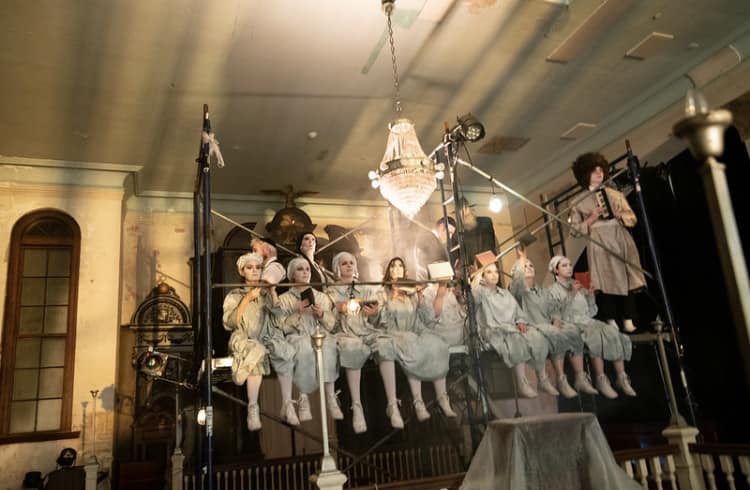
Cast of Arlekin Players’ “The Dybbuk” at the Vilna Shul. Photos: Irina Danilova

‘The Dybbuk, or Between Two Worlds’ — Written by Roy Chen. Based on the original play by S. Ansky. Adapted by Igor Golyak and Dr. Rachel Merrill Moss with additional material from the translation by Joachim Neugroschel. Directed by Igor Golyak. Scenic Design by Igor Golyak with Sasha Kuznetsova. Presented by Arlekin Players Theatre at The Vilna Shul, Boston’s Center for Jewish Culture, 18 Philips St., Boston, through June 23.

By Shelley A. Sackett

Igor Golyak, the peerlessly talented founder and award-winning artistic director of Arlekin Players Theatre, has done it again. Known for his innovative approaches to traditional and virtual theater, his production of “The Dybbuk, or Between Two Worlds” takes the audience on a magic carpet ride straight into the beating heart of a turn-of-the-century Eastern European shtetl.

Set in the iconic and authentic 105-year-old Vilna Shul, Boston’s only surviving synagogue built by and for late 19th/early 20th century immigrants, Golyak creates an otherworldly environment that sucks the audience right in. We are greeted by tiers of metal scaffolding that rise almost to the ceiling in the center of the building, towering above the pews, which have been pushed back along the perimeters. Animated sheets of opaque plastic hang from the frames, dancing ghost-like as strobes, disembodied voices and the sound of dripping water create a multi-sensorial microcosm.

Even if we’re not sure exactly where we are or exactly what is going on, one thing is clear: this will be an extraordinary evening.

The play’s plot is tricky for 21st-century theatergoers to intuit, yet it is essential background to fully appreciate Golyak’s extraordinary vision and interpretation.

In a nutshell, S. Ansky’s 1914 play relates the story of Leah, a young bride possessed by a dybbuk (a malicious spirit believed to be the soul of a dead person stuck between earth and heaven). Yet this dybbuk is anything but malicious; he is Khonen, a poor Yeshiva student who grew up with Leah and loves her.

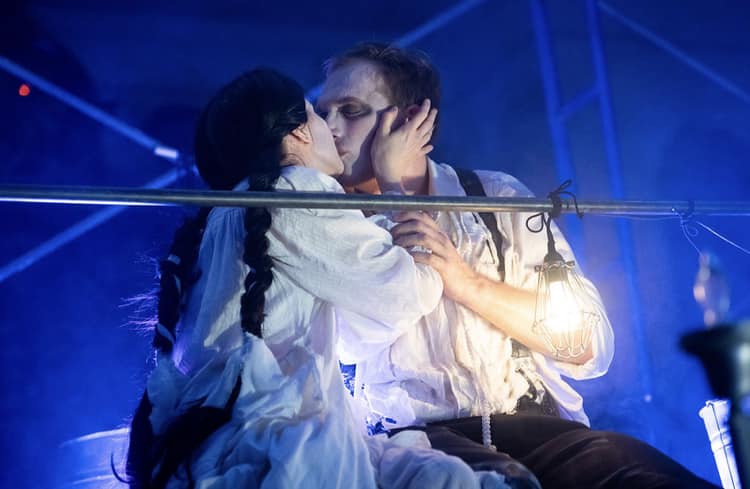
Yana Gladkikh, Andrey Burkovskiy

Only alluded to at the end of the play is a critical piece of backstory (the 1937 Yiddish-language Polish film adds this as an introductory scene). Sender, Leah’s father, and Nisan, Khonen’s father, were close friends whose wives gave birth on the same night. They made a pact that if one had a girl and the other a boy, the two would be betrothed. Nisan drowns shortly after his wife gives birth. Sender, whose wife dies during childbirth, goes on to become a wealthy rabbi.

Years later, Khonen shows up at Sender’s house as a poor yeshiva student, and Sender offers him hospitality. Neither is aware of their underlying connection. Leah and Khonen fall in love, but Sender rejects Khonen, betrothing Leah instead to Menashe, a wealthy nincompoop.

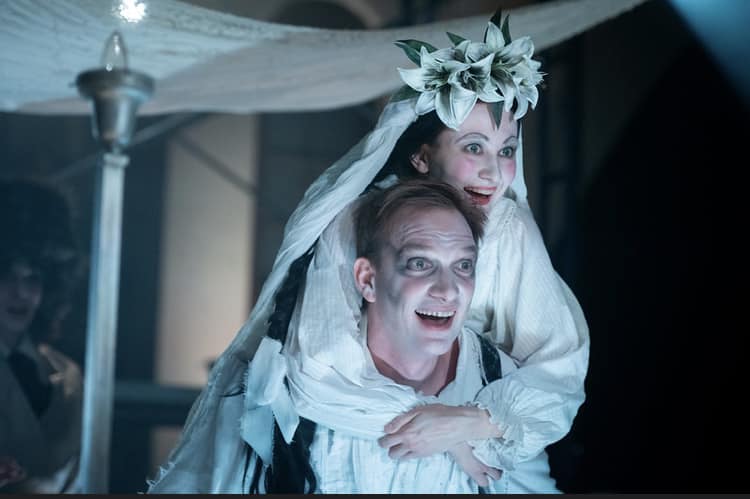
Beside himself, Khonen studies Jewish mysticism (Kabballah) in an effort to alter events by way of magic, even beseeching Satan to help him. He dies before the wedding, returning as a dybbuk who haunts and eventually embodies Leah, possessing her as she stands on the bimah (the altar from which the Torah is read) at her wedding. The ceremony is postponed, and Sender does everything in his power to repossess Leah and unite her with Menashe. After much drama (including a religious exorcism), the two are reunited.

Golyak uses every square inch of the Vilna to astonishing effect. The space behind the pulpit becomes a tiered choir where ghosts (interestingly, all female) act like a Greek chorus. The bulk of the action takes place on and around the Vilna’s bimah, as it does in Ansky’s original script. Strip lighting, handheld firefly-like mini lights, industrial hanging caged bulbs (lighting design by Jeff Adelberd), and spot-on costumes and makeup (Sasha Ageeva) add to the ethereal ethos.

Staging and site notwithstanding, however, it is the extraordinary cast — especially the two leads — who blow this production out of the water.

As Khonen, Andrey Burkovskiy, the expatriated Russian actor, is riveting. His lithe physicality belies his large size as he leaps and pirouettes across the scaffolding, barely but intentionally missing hitting his head on the hanging lights and metal beams. The Beetlejuice makeup is extremely effective at imbuing him with a heartbreakingly sad yet potentially menacing demeanor.

Yana Gladkikh, the Russian actress and film director, is equally spellbinding as Leah. A cross between Pierrot and a floppy ragdoll, she runs the gamut from Tinkerbell lissome to Princess Leia fierce. The chemistry and synchronicity between Burkovskiy and Gladkikh is delicate and subtle, and watching them together is a true theatrical treat.

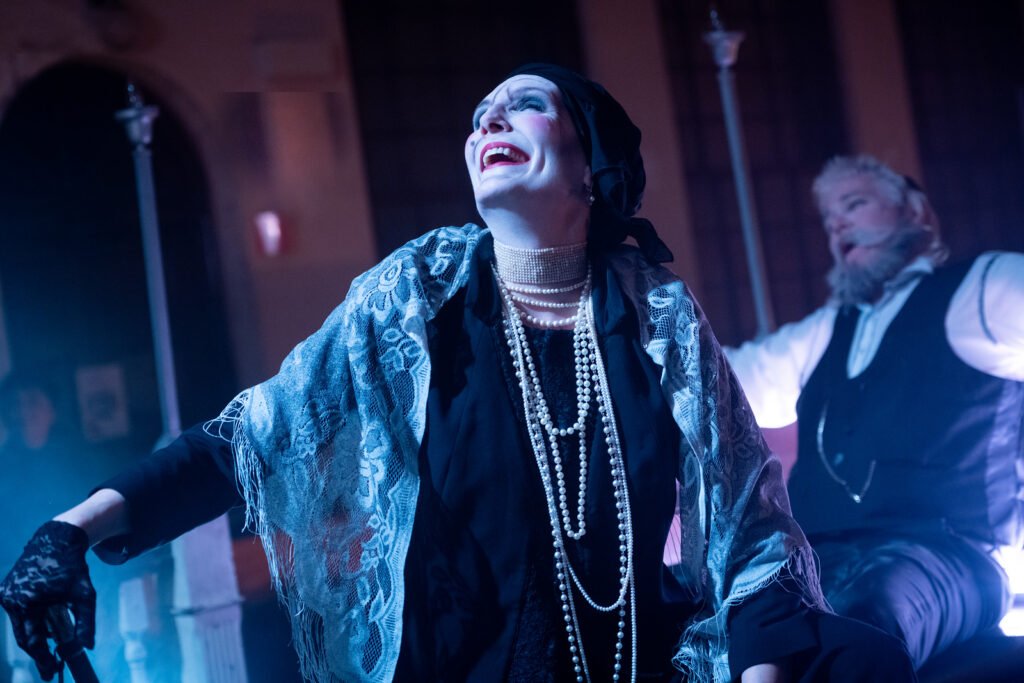
Deb Martin, as Frade, Leah’s paternal grandmother and caretaker, is as opposite an energy as possible. Screeching, cajoling and imperious, she dominates every scene she is in, bringing a countervailing element of melodramatic hysteria and humor to an often somber tale. Like the witch in Hansel and Gretel, she is hunch-backed, skeletal and a force to be reckoned with. You can actually hear her gnashing teeth as she literally chews up the scenery during the exorcism scene. Kudos to Golyak for letting Martin strut her stuff.

Deb Martin

The rest of the cast (especially Robert Walsh, the former artistic director of the Gloucester Stage Company, as the overbearing Sender) is splendid. 110 intermission-less minutes is an eternity at some productions; at “The Dybbuk,” they fly by.

“The Dybbuk” is considered a seminal play in the history of Jewish theater, and played an important role in the development of Yiddish theater and theater in Israel. Based on years of research by Ansky, who traveled between Jewish shtetls in Russia and Ukraine, it documents folk beliefs and stories of the 19th and early 20th century Hassidic Jews, who lived during a time of nonstop pogroms in specific areas, outside of which their residency was forbidden.

Ansky’s account of these times and the two suspended, displaced souls trapped between two worlds and tethered to each other and their community is as relevant today as it was over a century ago.

For Golyak, a Ukrainian refugee, the tale is particularly pertinent.

“Isn’t this where we live? As Jews, as immigrants? It’s where we so often have lived as Jewish people for centuries: between worlds. It’s our story – ancient and mystical, the story of our ancestors, but also our story of living in America today,” he said.

Burkovskiy, Gladkikh

It is impossible to recommend it highly enough! Don’t miss it!

For more information and to buy tickets, go to www.arlekinplayers.com

A.R.T.’s “Gatsby” Is This Summer’s Blockbuster

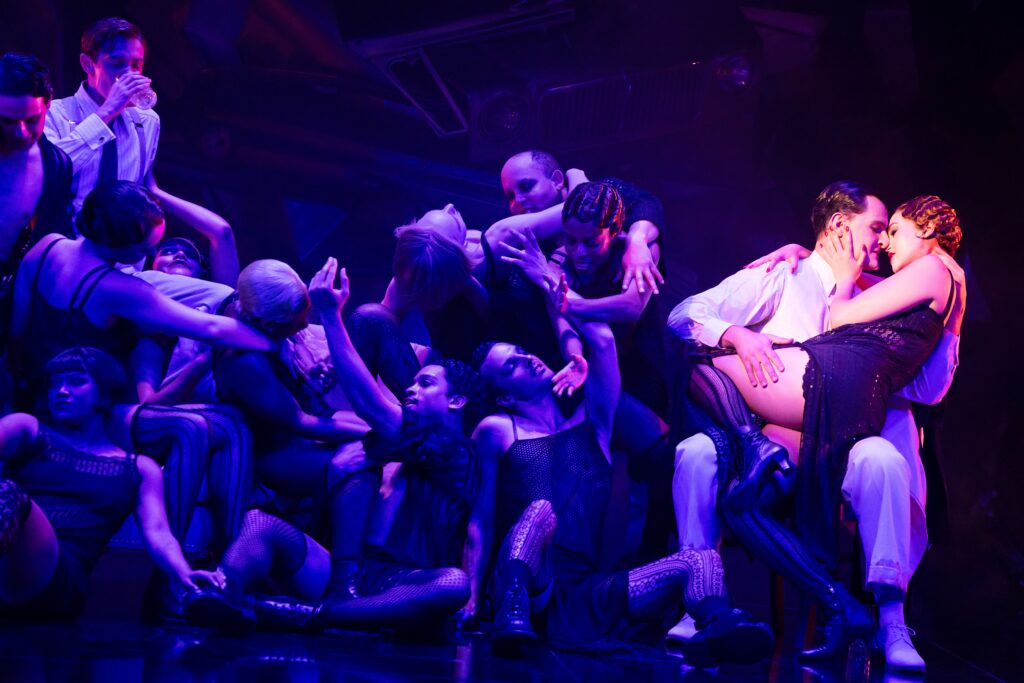
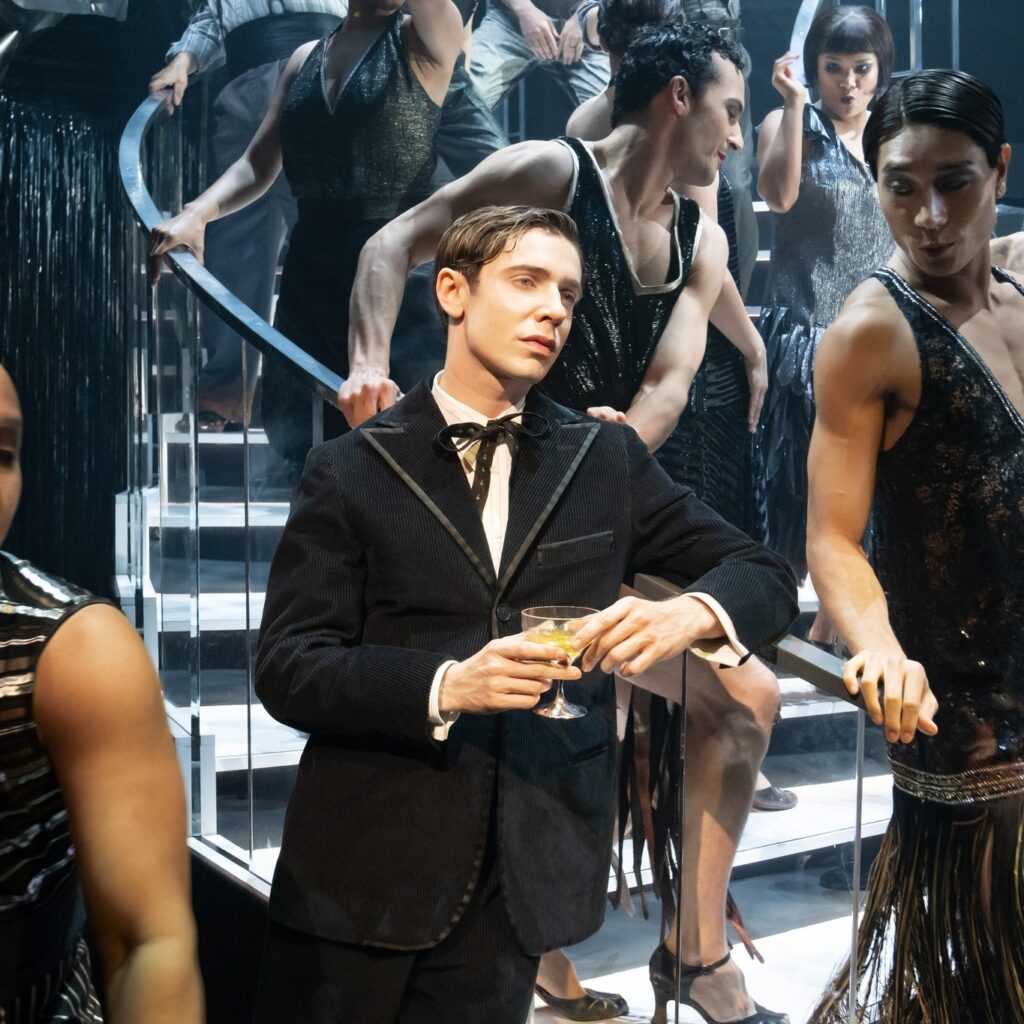
Cory Jeacoma, Solea Pfeiffer, and the cast of A.R.T.’s ‘Gatsby.’
Photo Credits: Julieta Cervantes

“Gatsby.” Book by Martyna Majok based on the novel, “The Great Gatsby” by F. Scott Fitzgerald. Directed by Rachel Chavkin. Music by Florence Welch and Thomas Bartlett. Lyrics by Florence Welch. Choreography by Sonya Tayeh. Orchestration and Arrangements by Thomas Barlett. Scenic Design by Mimi Lien. Lighting Design by Alan C. Edwards. Presented by American Repertory Theater at the Loeb Drama Center, 64 Brattle St., Cambridge, through August 3.

By Shelley A. Sackett

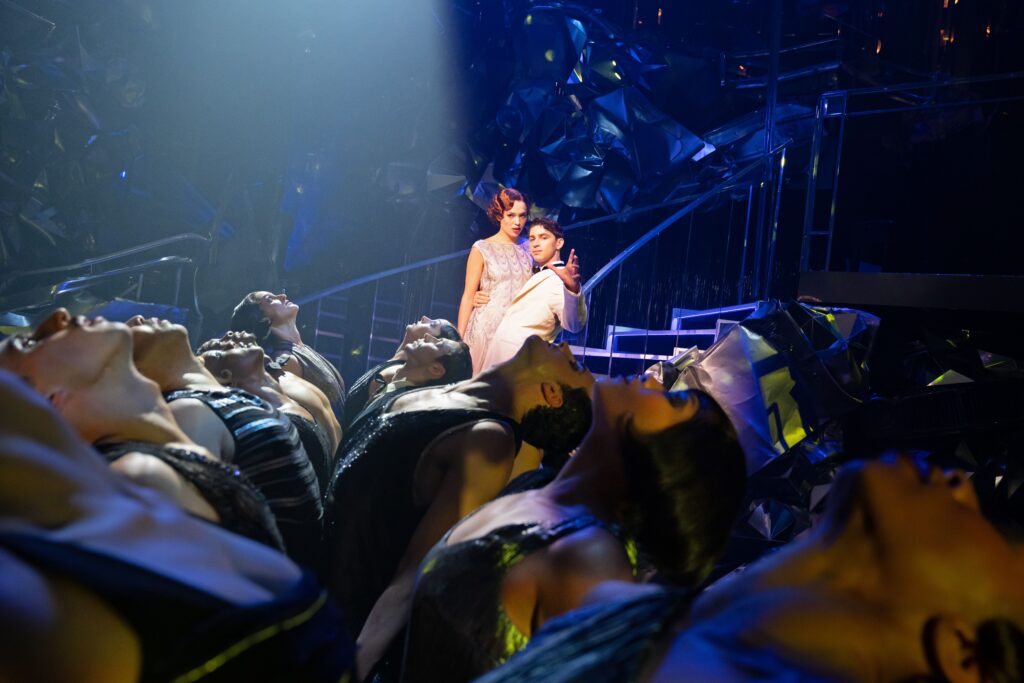
“Gatsby” is a tour-de-force chockful of bells and whistles. A.R.T. spares nothing for its world premiere of the musical adaptation of Fitzgerald’s Jazz Age chronicle. Two colossal heaps of metallic sculpture reminiscent of the infernal “Hadestown” underworld are a Jenga/“Where’s Waldo” of identifiable automobile parts and crumpled rubble (set by Mimi Lien). Draped in gleaming tinsel and expertly lighted by Alan C. Edwards, these gloomy twin towers are a continual reminder of the dangers of decadence and the debris it leaves in its wake.

Like “Moby Dick” and other inventive re-tellings of familiar tales, it’s clear from the get-go that A.R.T. will once again raise the bar on production values.

In preparation for seeing “Gatsby,” I reread the novel both to refresh my 9th-grade memory and to better understand where (and guess why) Martyna Majok had chosen to be faithful to and stray from the original in her adaptation. While hardly necessary – the storyline is short on subtlety – it was fun when I recognized a line that had struck us both as particularly poignant.

At its heart, however, this “Gatsby” is a musical, and the tale is told through its 25 musical numbers. (Unfortunately, the 13-piece orchestra often drowns out those lyrics, leaving the frustrated audience to fill in the blanks). In the exciting first number, “Welcome to the New World,” we meet our narrator, Nick Carraway (Ben Levi Ross), who fills us in on time, place, and tenor. It’s 1922, and the influenza plague and World War I, although in the rearview mirror, left emotional, physical, and financial wreckage in its wake. As if awakening from a nightmare, Jazz Age America has emerged, revving its engine and ready to roar.

Ben Levi Ross

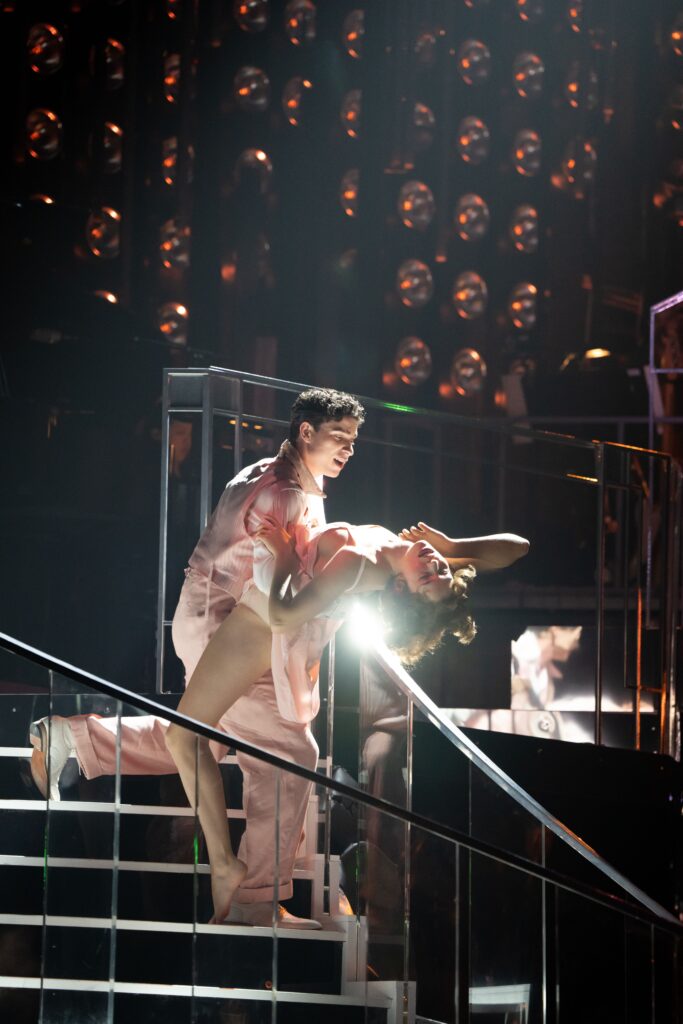
Underscoring the headiness of the era, the 15-member ensemble bursts on the stage clad in flapper period and contemporary non-cis costumes. Costume designer Sandy Powell cleverly introduces us to the main characters by dressing them symbolically. George and Myrtle, the have-not couple, are dressed in hellish red. Daisy, Tom and their friend Jordan, the silver-spoon gentry, wear heavenly white. And Jay Gatsby, our eponymous protagonist, appropriately wears an in-between pink.

As the plot unfolds, so do these characters’ backstories. Each harbors longings, secrets and disappointments that propel them towards disaster while attracting and repulsing them to and from each other. Majok exercises editorial discretion (and keen perception) in adding a richly nuanced focus on these relationships that are lacking in Fitzgerald’s novel.

Nick is just back from the war. While he presents as the affable, “aw shucks” mid-Westerner, his baggage includes heavy loads of PTSD and grief. He has sought the diversion of Long Island high society and the company of his cousin Daisy to reset the trajectory of his life. He rents a cottage for the summer and is immediately invited to join the Fellini-esque world of ultra-rich navel-gazers.

Daisy (Charlotte MacInnes), a former Louisville belle, is married to scion Tom Buchanan (Cory Jeacoma) and lives in a fairytale mansion with her loutish, philandering husband. She and Gatsby had met and fallen in love years ago, right before he was shipped off to war. Her childhood friend and famous golf pro, Jordan Baker (Eleri Ward), provides the stability and affection so sorely lacking in her marriage. She is also the play’s flapper Pied Piper, flamboyantly hedonistic and desperate for everyone to follow her reckless lead.

Isaac Powell, Charlotte MacInnes

Tom is as spoiled and obnoxious as they come. He wears his entitlement as a badge of honor, helping himself to whatever suits his fleeting fancy, including Myrtle Wilson (Solea Pfeiffer), the blue-collar wife of a gas station owner who yearns for the sparkling trinkets Tom dangles before her. Her voracious appetite for excess and risk are sated in the short run, but the long-term damage is one of the play’s underlying themes.

George Wilson (Matthew Amira), Myrtle’s husband, is outnumbered and outmaneuvered. Honest, hard-working, decent, and loyal, he doesn’t stand a chance.

This brings us to Jay Gatsby (Isaac Powell), the mysterious epicenter of the action who throws parties reminiscent of the Rocky Horror Picture Show. Personifying a corrupted version of the “American Dream” where wealth is the sole solution to all of life’s challenges, his obsession with Daisy and maniacally detailed plan to win her back are the ill-fated coattails onto which every other character’s fate hangs.

To her great credit, playwright Majok has managed to both plumb the intricacies of these individuals and their various romantic liaisons and dalliances and create a rip-roaringly entertaining almost-three-hour evening of outstanding song and dance.

Under Rachel Chavkin’s talented direction, the cast hits that sweet spot between virtuoso solo and ensemble performances. There are ample opportunities for each to shine in words, song, and dance. MacInnis brings a needed self-awareness to Daisy, who could easily become a cardboard character. She is as disconsolate a victim in “I’ve Changed My Mind” as she is scheming perpetrator in the duet with Tom in “The Damage That You Do.” Both feature her amazing voice.

As Jordan, Ward adds a sophisticated cynicism and “been there, done that” breeziness to the unbridled frenzy that surrounds the other characters. Willowy and lithe, she is a pleasure to watch as she glides around the cabaret party settings.

Jeacoma (Tom), Powell (Gatsby), and Amira (Wilson) stay in character in less shaded roles. Ross brings a slightly tinted palette to Nick, making him more mysterious and less pathetic than he at times seemed in the novel.

It is Pfeiffer as Myrtle and Adam Grupper as Meyer Wolfsheim, Gatsby’s mentor and syndicate boss, who really stand out. In addition to her outstanding voice, Pfeiffer easily transitions between the grief, rage, and despair she feels in her trapped marriage to a gas jockey and the giddiness of being wildly out of control in the sybaritic world to which Tom gives her the key. I only wish the orchestra didn’t drown out half of her songs.

MacInnes, Powell

Grupper, a Sydney Greenstreet of a presence, could not be drowned out by a 20-piece brass band (thank goodness). “Feels Like Hell,” his solo, brings down the house.

Lien’s flexible set is a presence of its own. Spanning the entire proscenium, the wide staircase, balcony, and stage allow three small scenes to play simultaneously, adding interest and challenge. And last but hardly least, Welch’s music and lyrics turn Fitzgerald’s 200-page novel into an operatic dramatic feast. While there are no tunes that stick in your head after the curtain falls, the actors’ universally extraordinary voices and Welch’s spot-on lyrics (when we can hear them) are the backbone of this summer extravaganza.

For more information and to buy tickets, visit: https://americanrepertorytheater.org/

Huntington’s “Toni Stone” Tells the Story of One of the Best Baseball Players You Never Heard of

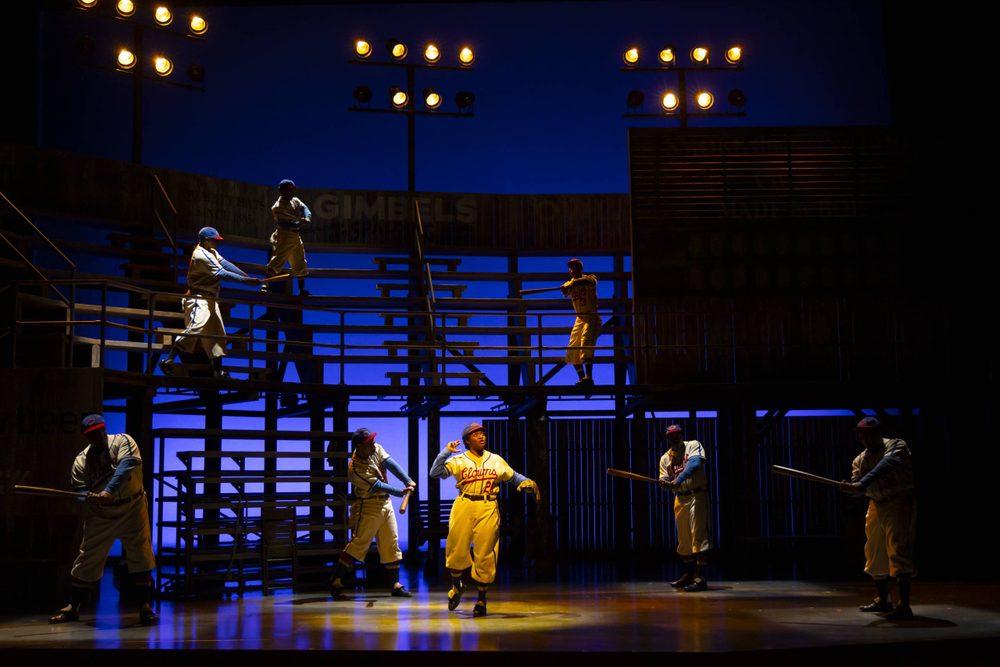
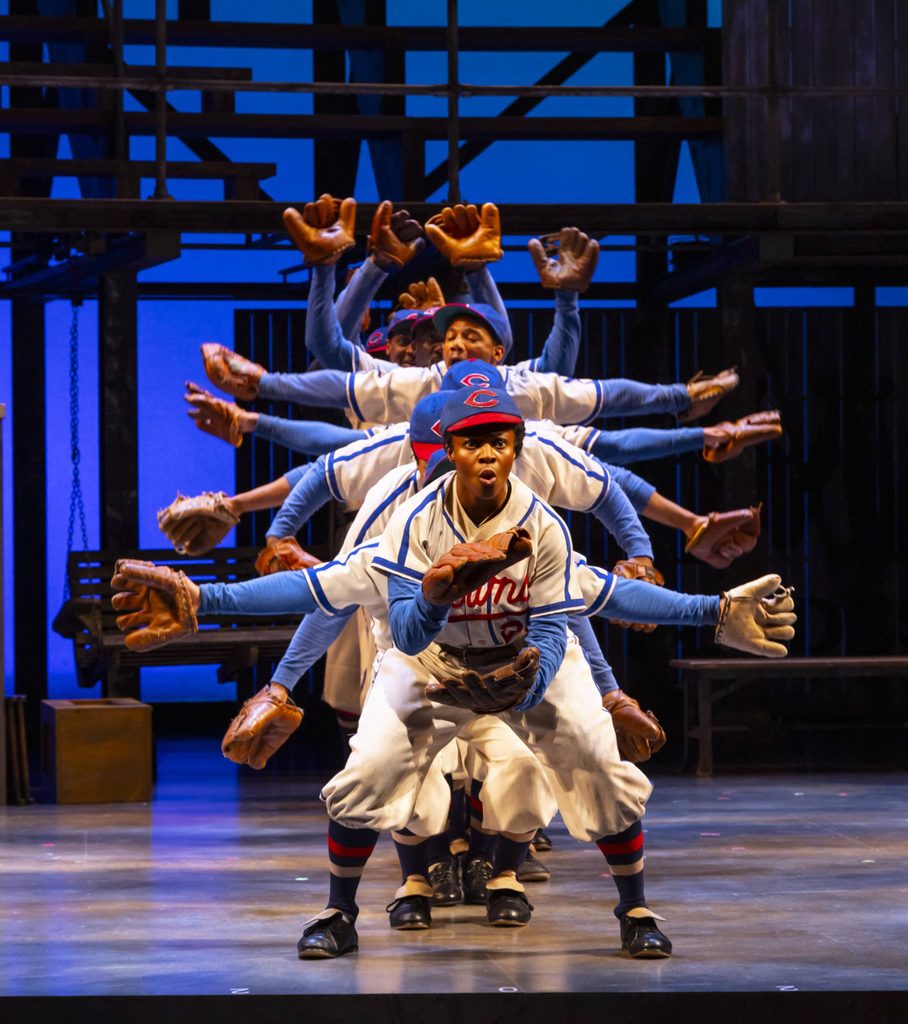
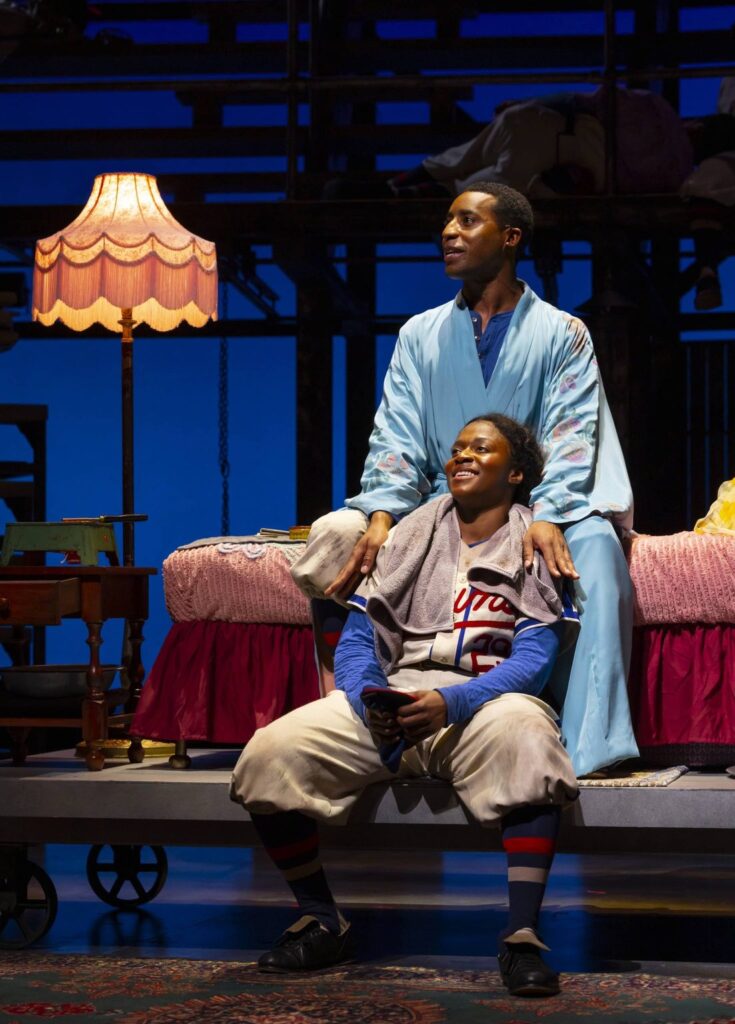
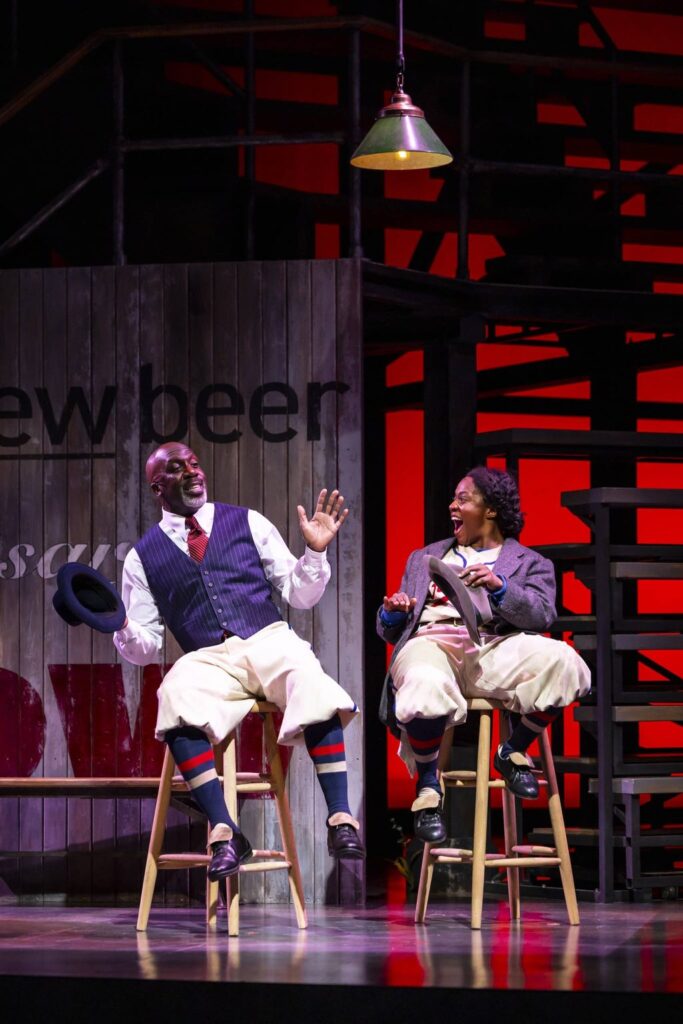
The cast of Toni Stone at The Huntington Theatre. Photos by T. Charles Erickson.

By Shelley A. Sackett

Toni Stone, the subject and title of playwright Lydia R. Diamond’s new drama, has one helluva story to tell. As played by the pitch-perfect Jennifer Mogbock, she is also one helluva terrific storyteller and more than up to the task of narrating the events of her remarkable life.

Which is a good thing, because “Toni Stone,” now at the Huntington, ran almost three hours (with a long intermission and delayed start) on opening night last Wednesday.

Even before the house lights have dimmed, Collette Pollard’s exciting set has placed us smack in the middle of a baseball field, surrounded by bleachers, scoreboards and night lights. Mogbock, a spitfire of energy and physicality, practically leaps onto the stage. A ball rolls slowly on the ground towards her, and she bends down to pick it up.

“The weight of the ball in the hand and the reach,” she announces matter-of-factly as she tosses it in the air. “What this is is what boys are to that girl. This is what I need.”

This — baseball in all its statistical, scientific, and athletic glory — is also what she knows, “maybe better than that girl knows boys.”

Disarming, genuine, and boundlessly enthusiastic, Stone shares her life’s highlights, from her birth in West Virginia to growing up in St. Paul, Minnesota, to becoming the first woman to play baseball in the Negro Leagues. Every step of the way, her single-minded determination to achieve her dream of playing professional baseball lit her path. Overcoming daunting racial and gender barriers, she landed the second base roster spot with the Indianapolis Clowns, taking Hank Aaron’s place when he moved up to the majors in 1953.

Mogbock (front) and team

Stone’s job, she tells the audience, is to tell her story so history doesn’t forget. The audience’s job, she implies, is to remember it. And to pass it on.

With that, the rest of the team bursts onto the stage. Stone introduces them one by one, and then they perform the first of several fabulous dance/acrobatic acts (choreographed by Ebony Williams with original music from Lucas Clopton). These top-notch numbers are a welcome break from the sometimes long stretches of dialogue and give the cast a chance to break loose and shine.

Mogbock is the only woman in the 11-member ensemble, and the ten actors take on individual characters as well as Clown teammates. As Millie, a prostitute who befriends Stone and tries to instill some femininity into the baseball-statistic-obsessed tomboy, Stanley Andrew Jackson is a sublime showstopper. Others play Stone’s parents, manager, coach, and husband. With a simple announcement (“He’s white”) and hand gestures, the all-Black cast also takes on white racist characters in subtle but dramatically powerful ways.

Stanley Andrew Jackson, Mogbock

Through sometimes chronologically disjointed scenes, Stone connects the dots of her personal timeline and, along the way, emotionally connects with the audience. By the end of the play, we don’t just know Stone; we adore her.

She is a complex character, as insecure and flighty socially and intellectually as she is confident and down to earth about her knowledge of and ability to excel at baseball.

As an athletically gifted kid in St. Paul, she excelled at every sport she tried. When her mother steers her towards more “ladylike” sports like figure skating (cute skirts), she easily wins the top city-wide competition and then begs to go back to the sport she really loves. She hated school both because she was bored and because the teachers pigeon-holed her as mentally impaired, misunderstanding her inability to process social cues and making her feel even more isolated and alone. (“When someone tells you there’s something wrong with your mind, you believe them,” she explains).

Yet, there’s nothing wrong with her mind when she’s thinking about a topic that interests her. As she argues with coaches about strategy, spouts baseball card statistics like an AI app, and describes baseball in terms that are poetic and metaphysical, she more than holds her own as confident, shrewd, and articulate.

While Diamond keeps the story light and focused on Stone’s journey, she by no means avoids the harsh realities of racism and misogyny in the 1950s. Stone was shunned and harassed by many of her teammates and was deliberately trampled when defending second base by opposing team members who wanted to “take out that woman.”

At the same time, she and her teammates share more than the same uniform. They are keenly aware that white team owners are using them both to make money and to make the white teams look superior by having them lose in rigged games. After all, and lest they forget their place, the team’s name, “Clowns,” is branded on their uniforms.

Like the Reconstructionist era blackface minstrel “entertainment,” they are supposed to, above all else, entertain. “They know we know what they’re doing to us,” Stone says just as Act I ends. “But we still make them laugh.”

Because that’s the only way a Black person or woman could play baseball in a white male world: by playing “their” game by “their” rules. And at the end of the day, the player’s desire to play ball is greater than their pride.

Jonathan Kitt, Mogbock

The second act (thankfully shorter and tighter) covers a lot of ground. Stone marries and retires from baseball when she ends up spending more time sitting on the bench than playing. She spends a year being a good housewife and then becomes a nurse. Although Diamond drops the ball on dramatic pacing and content at the end, Stone’s words (and Mogbock’s flawless performance) leave the audience with a semblance of closure. 

“There it is,” she says, summing up her life’s story. “I did a thing. Between the weight of a thing and the reach, there is breath. And in that breath is life.” She pauses, looking straight at the audience and melting the proverbial fourth wall. “I reached.”

‘Toni Stone’ — Written and Directed by Lydia R. Diamond. Inspired by “Curveball: The Remarkable True Story of Tony Stone” by Martha Ackmann. Presented by the Huntington, in an arrangement with Concord Theatricals on behalf of Samuel French. At the Huntington Theatre, 264 Huntington Ave., Boston, through June 16.

For more information and to buy tickets, visit https://www.huntingtontheatre.org/

‘Bluey’ Comes to Life in Boston

Bluey’s Big Play at the Boch Wang Center. Photo Credit: Darren Thomas

“Bluey’s Big Play” — Story by Joe Brumm. Music by Joff Bush. Presented by BBC Studios and Andrew Kay in association with Windmill Theatre Co. at the Boch Center Wang Theatre. Run has ended.

By Shelley A. Sackett

It’s true what they say about grandparenthood — there is nothing like it. There are so many things you didn’t even consider doing when childcare duties sucked your days dry of time and energy. But now that those children are grown and have children of their own (and are willing to drive them to meet you at the theater!), the opportunity to not just attend but actually enjoy such events as “Bluey’s Big Play” are the payoff.

Which I cashed in last Saturday with my Bluey-obsessed three-year-old grandson. We had a blast.

The theatrical adaptation of the Emmy® award-winning children’s television series follows the Heeler family through a full day from sunrise to bedtime. Bluey and Bingo work to keep their dad, Bandit, from reading on his phone. Bluey and his mom, Chilli, talk about his being a good example as a big sister to Bingo.

The 45-minute show is approximately as long as six regular “Bluey” episodes, which, although it seemed short by adult standards, was the perfect attention span bandwidth for the preschool crowd.

When the lights first went down, a short section set to the familiar music of “The Weekend” with marionette bird puppets was a delight. A family of three birds enchanted with their charming dances and interactions. It was, frankly, magnificent. The puppetry was terrific, and the ambiance was magical, especially when a flock of smaller birds swept across the stage, creating shadows in the sky and on the walls.

The audio track for “Bluey’s Big Play” was prerecorded by the voice actors from Bluey, and each character in the show was represented onstage by human-sized puppets. Each puppet requires at least one puppeteer to operate its facial expressions (eyes and eyebrows) and arms, while at times, a second puppeteer is needed for actions that control its legs and tail or to add and remove props from the puppet’s hands.

Unfortunately, the puppeteers were very obvious, unlike the recent Daniel Tiger live show, where adults donned life-sized costumes. My grandson’s first comment was, “They’re stuffies (stuffed animals).”

There was no mistaking this Bluey show for the real McCoy.

Nonetheless, the plotline was easy enough to follow, the lessons important ones to take away. And the swag and free pre-show ice cream added a special touch. But the most special treats came after the story ended. Giant balloons were tossed into the audience and they made their way from row to row as kids (and their parents and grandparents) did quick catch and releases. The final extravagance were bubble cannons that shot geysers of bubbles into the air. Not one child — or adult — left the theater without a wide smile on their face.

Apollinaire Theatre Company’s ‘Touching the Void’ Reaches for the Moon

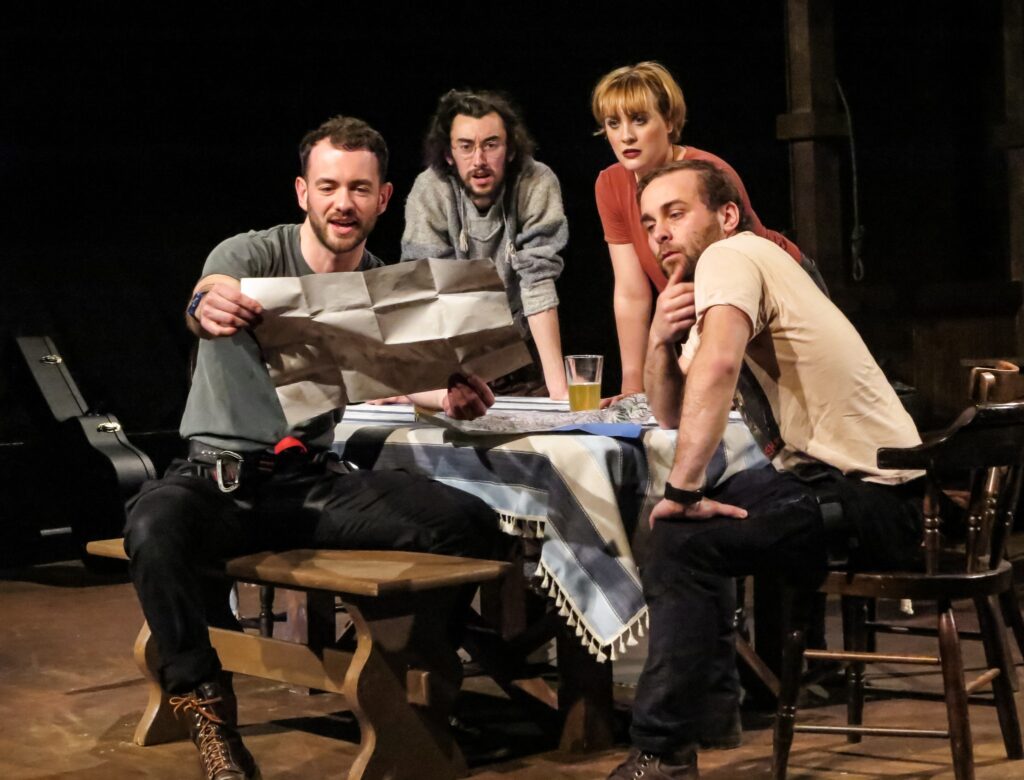
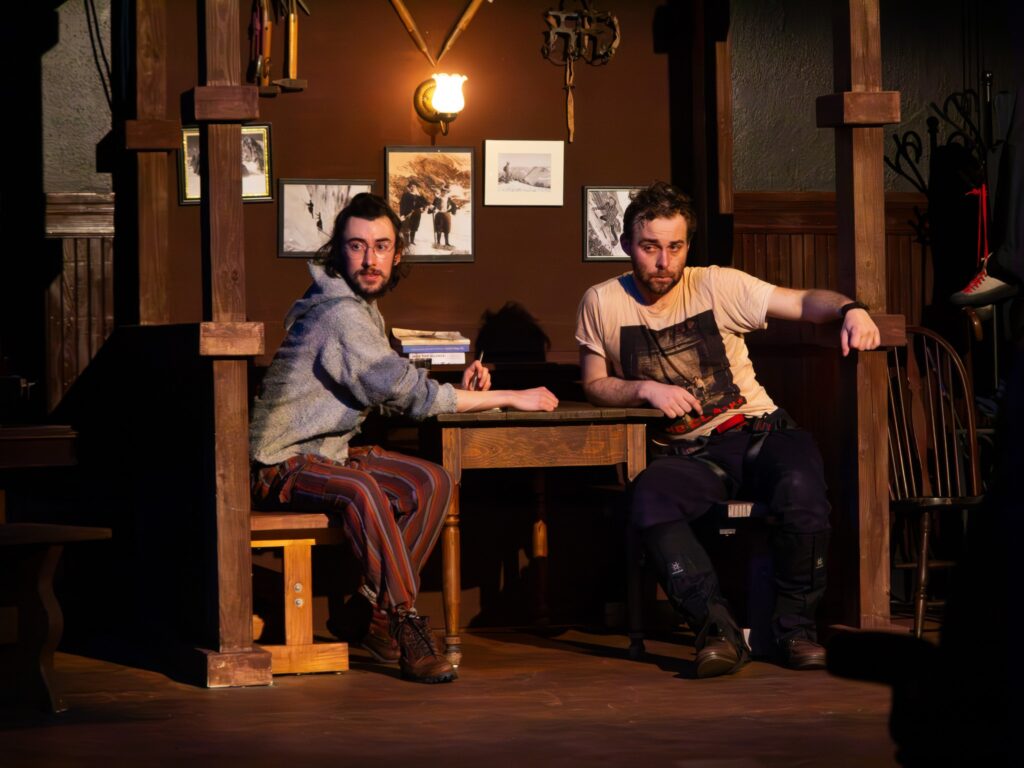
Cast of Apollinaire Theatre Company’s ‘Touching the Void’

‘Touching the Void’  — Based on the book by Joe Simpson. Adapted by David Greig. Directed by Danielle Fauteux Jacques. Scenic and Sound Design by Joseph Lark-Riley; Lighting Design by Danielle Fauteux Jacques; Movement Choreography by Audrey Johnson. Presented by Apollinaire Theatre Company at Chelsea Theatre Works, 189 Winnisimmet St., Chelsea, through May 19.

By Shelley A. Sackett

Touching the Void is special on so many levels. Presented in the intimate Chelsea Theatre Works theater, director Danielle Fauteux Jacques has done a brilliant job of creating multiple settings (including the side of a mountain in the Peruvian Andes!) with minimal fuss and to maximum effect. The four actors (Patrick O’Konis as Joe, Kody Grassett as Simon, Zach Fuller as Richard, and Parker Jennings as Sarah) are equally stellar, and David Grieg’s script is meaty and engaging.

The real star of the play, and an unfortunate rarity these days, is the plot-driven narrative. It is based on climber Joe Simpson’s memoir of his near-death climbing experience, a thrilling and engaging story. There is even a surprise twist ending, which Jacques reveals in a deliciously sly and clever fashion after the curtain falls when the audience least expects it.

Even before the play officially starts, the mood is set. A blond, sullen woman, clad in a leather jacket and boots strolls onto the stage. Her mouth is down-turned. She holds an unlit cigarette, sits alone at a booth in a casual pub, gets up to put a song on the jukebox, and sits down again. She nods, looks at the table, and sighs.

Jennings is captivating; it’s not easy to stay in character in a vacuum. The effect, thanks also to Jacques’ spot-on lighting, is like a Hopper painting come to life.

We learn she is Sarah, Joe’s sister. Joe, we also learn, is presumed dead. She has just come from his body-less wake.

Enter Simon, who survived the climb, and Richard, the base camp manager. She insists on hearing the entire story of the climb, from its planning phase in this very “climbers’ pub” to the moment when Simon cut Joe loose, leaving him to perish in a crevasse.

Kody Grassett, Patrick O’Konis


She wants to understand what drew her brother to take such a risk. She has to experience the climb as he did to do that because she doesn’t believe he is really dead.

Simon and Richard agree to relive the journey with her, and their story, relayed through Sarah’s non-climber eyes, is an enormous one, packed with insight, triumph and peril. It’s also a golden opportunity for director Jacques and sound designer Joseph Lark-Riley to strut their stuff by turning the small stage from the pub to an Andean peak — complete with crunching snow and howling winds that whip the climbers like flags— and back to the pub again.

We witness all this in hindsight and by the end, we share Sarah’s doubt about whether Joe really perished. (No spoilers, but the answer awaits over snacks and drinks in the lobby).

Simon accommodates Sarah’s need to know how her brother lived, not just how he died. He shows her how to climb, painstakingly using chairs and tipped tables to improvise the feeling and rush of the climb. Only after she can relate on a visceral level does the storytelling begin.

Back in 1985, Simon and Joe were experienced Alps climbing buddies who wanted to be the first to climb the West Face of the Andean Siula Grande mountain. Alpine style, which means without extra gear or yuppie brand name accoutrements. “Two men, a rope and the abyss. It’s beautiful, but it’s dangerous,” Joe explains.

Parker Jennings, O’Konis


Accompanied to base camp by their site manager, the amusing and irritating navel-gazer, Richard, the two set off on their impossibly low-tech journey. They make it up, but on the descent, Joe shatters his leg and then disappears over a cliff. With rescue an impossibility and faced with freezing winds and certain death if he didn’t immediately begin his own descent, Simon makes a gut-wrenching decision. Act I ends with him cutting the rope that tethers him to his partner.

Act II opens with Joe, alive, incredulously realizing his situation. He is as devastated by his physical problems of having a shattered leg and being at the bottom of a snow abyss as he is psychologically by the reality that his partner cut him loose to save himself.

Suddenly, Sarah is by his side, coaxing him on, helping him inch his way out of this Dante’s frozen circle of hell. Is Joe hallucinating? Is Sarah imagining herself by her brother’s side? While the agony of Joe’s navigating his slow descent sometimes feels tedious and overdrawn, trust me — it will all make sense in the end.

Touching the Void is an abundance of theatrical pleasures, most notably the performances by the four actors. As Joe and Sarah, Jennings and O’Konis are simply perfect. Fuller imbues Richard with just the right balance of goofiness and competence, and Grassett brings an arm’s length sang froid to Simon that leaves us guessing whether there might not be a few nefarious skeletons in his closet.

Zach Fuller, Patrick O’Konis

If you enjoy theater that makes you think and inspires post-show conversation and debate, then this play is a must. Besides marveling at an inspiring production, you are guaranteed to leave wondering how this story could possibly be true.

For more information, visit apollinairetheatre.com

‘The Dybbuk’ showcases how throughout history, Jews have lived ‘Between Two Worlds’


By Shelley A. Sackett

‘The Dybbuk’ has been adapted from a 1914 play by Igor Golyak, founder and artistic director of Arlekin Players Theatre.

Igor Golyak, founder and artistic director of Arlekin Players Theatre, was an 8-year-old growing up in Kyiv – then part of the Soviet Union – when his family gave him news that would change the trajectory of his life.

They told him that he was Jewish.

Because the practice of Judaism was suppressed by the state, Golyak had never even heard of Jews. His family moved to Boston in 1990 when he was 11 and – other than returning to Moscow to study theater after graduating from high school – he has called the area home since.

In 2009, he founded Arlekin Players, a Needham-based company of mostly Jewish immigrants from the former USSR. It has risen to national and international acclaim, especially since the pandemic and the launch of its ground-breaking Virtual Theater Lab in 2020. The New York Times recently cited Golyak as “among the most inventive directors working in the United States.”

Although Golyak has said he never thought he would be a “Jewish theater director,” the company has increasingly presented works that underscore themes of immigration, antisemitism, displacement, and Jewish cultural and religious identity.

“It’s what’s happening in our world and in my community. I’m Jewish. These are things that I’m trying to understand. These ideas and questions have captured my attention, my imagination and, at least right now, is what’s compelling to me,” he told the Journal by email.

Right after the Oct. 7 Hamas attack, Arlekin Players launched its Jewish Plays Initiative with the goal of shedding light on voices and stories that aren’t being heard; on pain points that are misunderstood; on ideas that are silenced; and on the “beautiful culture of a people that needs to be shared and celebrated.”

“The Dybbuk,” its latest project, was adapted by Golyak and Rachel Merrill Moss and will celebrate its U.S. premiere in partnership with the Vilna Shul, Boston’s Center for Jewish Culture, from May 30 through June 23.

Steeped in Jewish tradition, folklore, and mysticism, “The Dybbuk” – also known as “Between Two Worlds” – is one of the most widely produced plays in the history of Jewish theater. It was written in 1914 by the Russian S. Ansky and is based on the mystical concept from Hassidic Jewish folklore of the dybbuk, a disembodied human spirit that wanders restlessly until it finds a haven in the body of a living person.

In Ansky’s work, a young girl’s father refuses to let her marry her lover, betrothing her to another more worthy suitor. The rejected suitor dies of heartbreak, and his spirit enters the body of his beloved. The two eventually reunite supernaturally.

It is the account of two suspended souls trapped between two worlds, tethered to each other yet also displaced. To Golyak, the tale of these disoriented young people is particularly pertinent.

“Isn’t this where we live? As Jews, as immigrants? It’s where we so often have lived as Jewish people for centuries: between worlds. It’s our story – ancient and mystical, the story of our ancestors, but also our story of living in America today,” he said.

While researching “The Dybbuk,” Golyak learned that its original production in Poland was performed by the Vilna Troupe. When he visited the Vilna Shul in Boston for the first time last fall, he was struck by its history, architectural details, and layers of paint, murals, and Judaica. He could feel the company of several generations, from those Eastern European immigrants who built the shul at the turn of the last century to those who use the space today.

As the only surviving landmark of Boston’s immigrant Jewish past, he knew it would be the perfect space to share “The Dybbuk.”

Elyse Winick, director of arts and culture at the Vilna, hopes the audience will gain a deeper sense of the 1919 shul that is both a performance venue and a living museum. “This is a rare opportunity to synthesize those two aspects of our identity, deepening both the power of seeing the play and the significance of this extraordinary piece of Boston’s Jewish history,” she said by email.

“For us, it is as if the souls of the Polish Vilna Troupe have taken refuge in the Vilna Shul and then come forward to share this tale,” Golyak added.

Golyak’s professional and personal lives overlap, his Jewish identity informing both. In an October 2023 article for WBUR, he wrote in support of Israel and expressed shock at the silence from others in the theater world. “I don’t know if I am an American, or a Ukrainian, or if I am somehow an Israeli, but I know that I am a Jew,” he wrote. “The more we are hated, the more I feel I am a Jew.”

He believes the theater is important as a place where people can experience others’ truths and wrestle with that exposure. “With war, brokenness, displacement, and a rise in antisemitism happening around us, I want to do plays that help us see each other and untangle how we do what we do as human beings,” he said.

In a world where unexplainable hatred exists, he is concerned about his children and the future they may face. “They should be proud of their identity. They are part of a people who feel deeply, think wisely, laugh abundantly, innovate and invent, and will always gather and share food, music and stories,” he said. “They belong wherever they are. And no matter what, they can survive and thrive.” Θ

For more information and to purchase tickets, visit arlekinplayers.com.

The Wheels Go ‘Round and ‘Round and ‘Round in SpeakEasy Stage/Front Porch’s ‘A Strange Loop.’


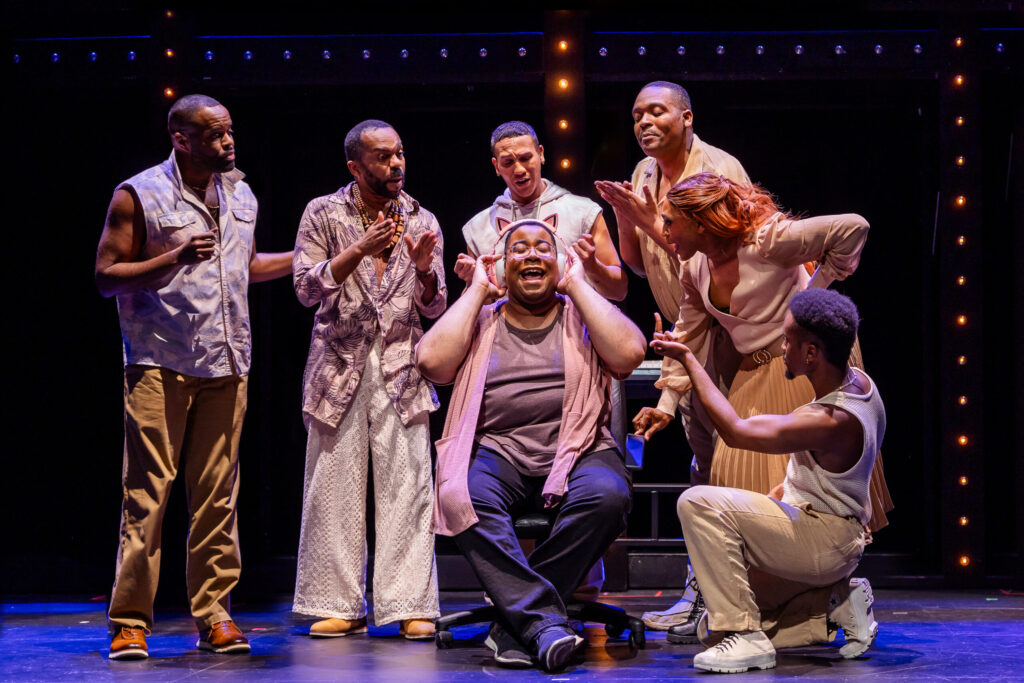
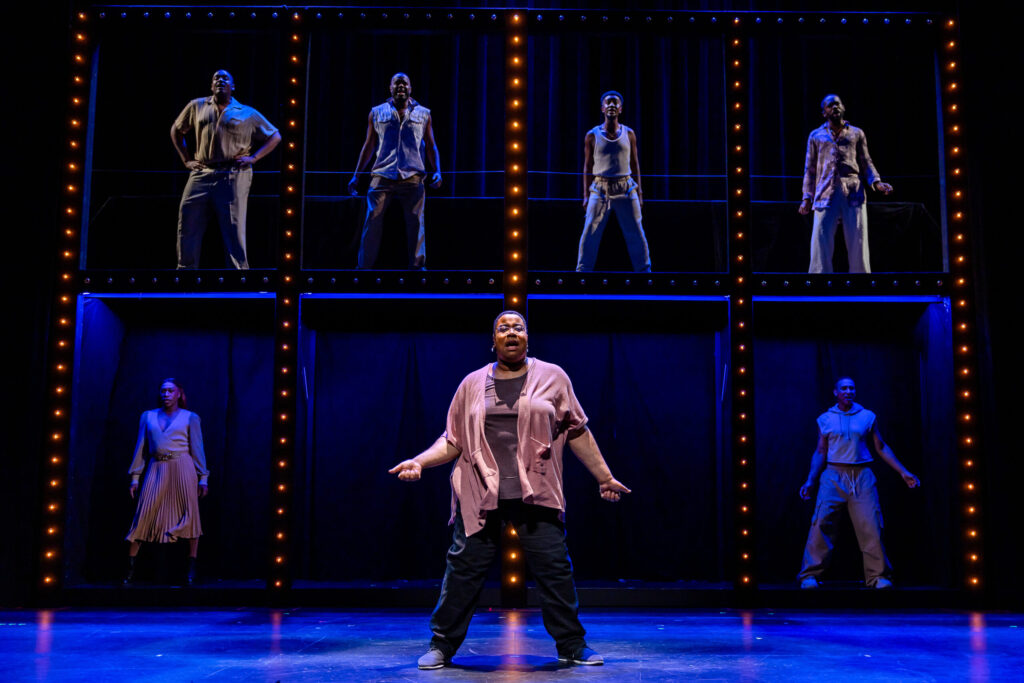
Kai Clifton (center) and the company of A STRANGE LOOP at Speakeasy Stage. From left: De’Lon Grant, Davron S. Monroe, Jonathan Melo, Aaron Michael Ray (background), Grant Evan, and Zion Middleton (kneeling). photos by Maggie Hall Photography.

By Shelley A. Sackett

Playwright Michael R. Jackson, a heavy-set Black queer man, has brought the concept of sharing to a new level in his Pulitzer Prize and Tony Award-winning musical, “A Strange Loop.” The compulsively introspective show, which runs at 100 intermission-less minutes, spelunks into the deepest crevices of the anguished mind of its hero, Usher, a fat, Black, queer man writing a musical called “A Strange Loop” about a fat, Black queer man who’s writing a musical about a fat Black queer man.

It’s a crawl through a wormhole rigged with armed psychological and emotional IEDs, self-loathing, and regrets. It’s also a raucous and playful musical, full of humor, harmony, colorful characters, and even more colorful (potty) language.

The play opens on Jon Savage’s effective, slick set of eight cubes lit in Broadway blue neon. (The only guidance Jackson’s script offers is to describe the setting as “A loop within a loop within a loop inside a perception of one man’s reality.”) Characters meant to represent Usher’s thoughts stand inside each cube. They dance. They sing. The effect is a cross between “Shindig” and “Hollywood Squares.”

We meet Usher (Kai Clifton) as the Thoughts dress him in his professional usher’s uniform. Usher works to make money in a theater where “The Lion King” reigns while he tries to write his play, a “big, Black, queer-ass, American Broadway show.” As he externally prepares to deal with the patrons who will soon flood the theater’s aisles, his mind is busy writing his play. He eagerly shares this work-in-progress with the audience.

““A Strange Loop” will have black shit! All thoughts. And white shit! It’ll give you uptown and downtown! With truth-telling and butt-fucking! There will be butt-fucking!” he belts out with gleeful forewarning.

It’s as if Jackson and Usher want to tip off their audience, “This ain’t no Disney musical, and make no mistake, we aim to deliver,” which they do, especially on the last item.

Usher leads a complicated inner life. His mind is a six-lane highway where Thoughts criticize, intimidate, denigrate, and insult his every move. Every time he resolves to dig himself out of his miserable routine, his thoughts disrupt and derail his plans.

The supporting cast of Thoughts #1-6, donning eye-catching costumes (Becca Jewett), are a vicious gang representing Usher’s agent (Fairweather), his inner cynic (Your Daily Self Loathing) and a host of other unhelpful characters, most notably Mom and Dad.

Through these inner/outer conversations between Usher and himself, Usher reveals his quest to peel back the layers of labels (Black, queer, etc.) and discover who he really is. We learn about all the issues he struggles with, including family pressures to ditch his sexual and professional preferences and embrace the Lord and style of Tyler Perry’s gospel melodramas; trying to figure out what it means to be a Black playwright writing a Black play; and struggling with what today’s world requires if one is to be “Black enough” and “gay enough.”

He also is coping with the bull’s eye homophobia, fatphobia, racism, and a white theater industry painted on his back.

All this should (and does) sound heartbreaking and overbearing. Yet, Jackson manages to pull off a musical that infuses humor and sincerity into a story replete with sadness, desolation, and rejection.

Through seventeen songs, Jackson’s lyrics tell a multilayered story of Usher’s angst-ridden life.

He longs for the unhampered freedom white girls have, yet also feels obligated to fulfill Black boy stereotypes (“Inner White Girl”). His doctor tells him he’s not gay enough because he’s only having sex once a year, but when Usher starts using dating apps, the result is predictably humiliating. He meets an engaging, flirtatious stranger only to discover he is a figment of his imagination.

The list of disappointments and rejections grows longer. His mother calls him on his birthday to remind him homosexuality is a sin, and his father asks if he’s contracted AIDS yet.

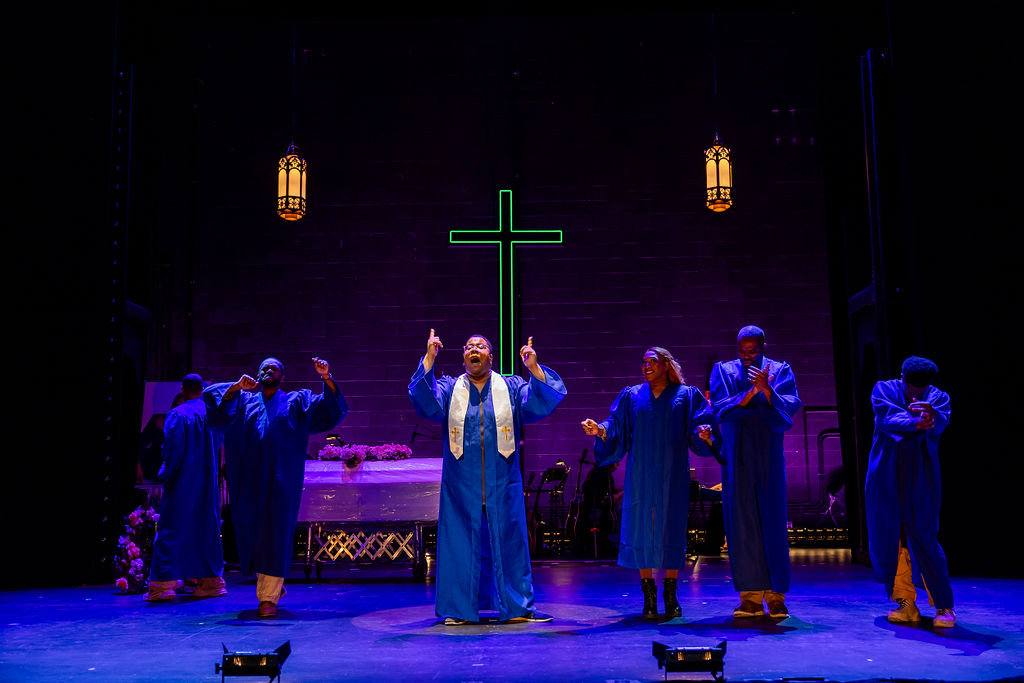
The best scenes, dramatically and musically, are those that have anything to do with Gospel music. When Usher’s agent tells him Tyler Perry is looking for a ghostwriter for his next gospel play, Usher turns up his nose in disgust. His Thoughts accuse him of being a “race traitor,” and in a hilarious scene, historical Black figures persuade him to take the job (“Tyler Perry Writes Real Life”). The full replication of a Tyler Perry set and lyrics that skewer Usher’s parents and parody Tyler (“Precious Little Dream/AIDS Is God’s Punishment”) are a welcome break. The actors’ voices (especially Clifton’s) awaken and strut their range and vibrancy. The lyrics are edgy and funny, the tune snappy and toe-tapping.

With the exception of distracting and annoying technical problems with the sound mixing (the actors’ voices were frequently not mic’d) and muffled lyrics, the production is effective, from Maurice Emmanuel Parent’s thoughtful direction to David Freeman Coleman’s music direction and conducting. The six Thoughts shine individually and blend seamlessly as an ensemble.

But it is Clifton as Usher who literally carries the weight of the show, and he is more than up to the task. Despite the temptation to wash our hands in frustration with this character who can’t seem to get out of his own way, his unfortunate circumstances notwithstanding), Clifton brings an underlying earnestness and likeability that make it impossible to abandon him. Plus, Clifton lets loose a powerful set of pipes during certain numbers (notably the gospel songs).

It’s hard to understand Jackson’s real purpose in writing “A Strange Loop.” It takes its title from a Liz Pfair song and from Douglas Hofstadter’s scientific concept that when a person only moves up or down, they’ll end up where they started. In other words, no matter how far or fast they think they’re going, they are essentially marching in place.

Jackson, now 43, said that although his play is not formally autobiographical, he began writing it as a monologue in his early 20s when he was experiencing himself as “nothing more than a mass of undesirable fat, Black gay molecules floating in space without purpose.”

He wrote Usher as a 26-year-old under unimaginable pressure. He is full of self-doubt and self-loathing, yet compulsively writes about himself in the belief it will magically change him. The more he plumbs his inner self, the more guilt and shame he dredges up. If writing “A Strange Loop” was meant to be Usher’s psychological catharsis, it misses its mark.

After all, Usher’s closing words are:

“Someone whose self-perception is based upon a lie,

Someone whose only problem is with the pronoun “I.”

Maybe I don’t need changing

Maybe I should regroup

’Cause change is just an illusion.

If thoughts are just an illusion, then what a strange, strange loop.”

And maybe that is Jackson’s point, after all. Inside his endless, strange loop of destructive thoughts and desperate hope that he can change who he is, Usher is his own worst enemy. Not only does he see himself as a failure, he assumes that everyone sees him as he sees himself.

His illusions are negative delusions.

It takes someone outside the loop—an impartial audience, for example—to appreciate that underneath this angsty, meek gay Black man beats the heart of a brave, creative person full of caustic wit and laser-sharp insight. We can only hope that Usher and all those suffering as he does can jump off the treadmill of self-doubt and fear, take a deep cleansing breath, and learn to love and accept themselves.

‘A Strange Loop’ — Book, Music and Lyrics by Michael R. Jackson. Directed by Maurice Emmanuel Parent. Music Direction by David Freeman Coleman. Choreographed by Taavon Gamble. Co-produced by SpeakEasy Stage and Front Porch Arts Collective at the Calderwood Pavilion, 527 Tremont Street, through May 25.

For more information and tickets, visit https://speakeasystage.com/

Arts Emerson’s ‘Book of Mountains and Seas’ Brings Chinese Creation Myths to Life

“Book of Mountains and Seas” at ArtsEmerson

By Shelley A. Sackett

“Book of Mountains and Seas” is an artistically adventurous new work by award-winning composer Ruo Huang and MacArthur Fellow puppeteer/artist Basil Twist. Their collaboration is an inventive twist on ancient Chinese myths about creation and destruction that, in this perilous era of climate change, are especially relevant 2,500 years later.

The Chinese government released a series of stamps commemorating Chinese mythology, including the “Book of Mountain and Seas” stories, in the 1980s. Huang saw those stamps and never forgot the images. Four of them are the backbone of his production.

The vocal theater for 12 singers, two percussionists, and puppeteers is an abstract embroidery of sound, movement, and light. A troupe of puppets (handled by superb puppeteers) and the Ars Nova Copenhagen chorus turn Huang and Twist’s ingenuity into an unforgettable theatrical experience.

The performance is sung half in Mandarin and half in a language of the composer-conductor-librettist Huang’s invention, without English supertitles. Projected Chinese titles give the full text of the stories, but the English text is much briefer and its fade in much slower.

The 75-minute intermission-less oeuvre tells four timeless and abstract tales. The first myth, “The Legend of Pan Gu,” describes the creation of the planet. The program notes inform us that Earth is birthed from a cosmic egg that contains the hairy giant Pan Gu, who dies after 18,000 years of holding Earth and the sky apart. From his body spring the Sun, moon, mountains, rivers, animals, weather, and, finally, humans.

The show’s opening sets a spiritual tone, with a twelve-member choir with softly lit faces chanting an atonal primordial soup of notes that sound like church vespers. While there is little puppetry, the scene is set for the emergence of Kua Fu, whose face will be constructed from the pieces of bone-like driftwood scattered about the stage in the show’s final piece.

The ethereal, amorphous, and dissonant music matches the repetitive, slow movements on the background screen and on stage. Those who let go of expectations of linear storylines and dramatic action might enjoy entering a meditative state that is inspiring and nurturing. Others may find the experience boring and pretentious.

The second myth, “The Spirit Bird,” is about a princess who drowns at sea. Her spirit takes the form of a bird that spends the rest of eternity trying to take vengeance on the sea, filling it with pebbles and twigs.

The scene’s use of mottled lighting and undulating white silk for the sea and bird is simple and effective. Unfortunately, the scene is too long, and without the addition of any other imagery (other than a serpent who briefly swims by), the initial visual delight dwindles to the ho-hum.

In the third and fourth scenes, puppetry and drama replace repetition with excitement. “The Ten Suns” tells the tale of the ten Suns, children of heavenly gods. The ten siblings romp and play while taking turns lighting the Earth. When they decide to break this routine, and all go out together, their combined power dries up the Earth and wreaks climactic havoc. Only the intervention of the God of archery, who shoots and kills nine Suns, averts existential disaster. The lone remaining Sun, fearing his own demise, remains faithful to his duty, creating night and day.

With this tale, the show comes to life. Ten charming, anthropomorphic red rice-paper lanterns on slender stalks cavort their way across the sky. The music takes on a more harmonious quality, reminiscent more of early medieval music than a drone. As the Suns meet their fate one by one, sacrificed to save the Earth, the music marks the moment with a soulful but melodious elegy.

Finally, when the Sun-chasing giant Kua Fu appears in the fourth myth, even the most contemplative or somnambulant audience member will awaken and be utterly engrossed. “Kua Fu Chasing the Sun” is the story of a giant who sets out to chase and capture the Sun. Sadly, his quest ends in his dying from heat and exhaustion.

With the assemblage and appearance of the enormous puppet Kua Fu, it becomes apparent why there is a buzz about this show. Under the six puppeteers’ expert hands, the gnarly driftwood scattered across the stage comes to life with thrilling suddenness. Kua Fu’s head bobs, and his neck cranes. He acts and reacts. He runs and reaches. That this puppet exudes so much emotion while remaining abstract and clearly manipulated by humans is a testament to all involved in this show and worth the price of admission.

Lacking definable facial features, he can assume the persona of the gentlest giant or the meanest monster. Each audience member can call it as they see it, which is refreshing and fun.

Alas, the creature’s chase after the sun leads to his no less dramatic demise. White silk cloth again doubles as the sea as Kua Fu crouches on hands and knees and drains it in an attempt to quench his unquenchable thirst. He is dissembled with the same grace and charm with which he was created, his parts scattered once again across the stage.

When he dies, his walking stick falls to the ground, transforming it into a grove of peach blossom trees. Like spinning origami fairies, delicate confetti falls from the sky as the background shifts to a soft orange glow. It is a beautiful moment and an uplifting ending.

The one caveat before seeing this show is that unless you are a totally go-with-the-flow om shanti kind of person, a little context will go a long way. There are some shows where reading the program notes or reviews before experiencing the performance is a mistake. ‘Book of Mountains and Seas’ is not one of them.

Rather than interfering with the joy of forming an opinion based on visceral, in-the-moment reactions, even a brief intro will shed welcome light and might make the evening more enjoyable. Trying to read the too-light and too-briefly-displayed English script was annoying and distracting. An unsolicited suggestion to the team behind future productions: make the program notes available on the venue’s website.

“Book of Mountains and Seas” — Composer and Librettist –Ruo Huang. Director and Production Designer – Basil Twist. Presented by Arts Emerson at the Emerson Paramount Center, 559 Washington St., Boston, through April 21.

Hub Theatre Company Revives Lanford Wilson’s ‘Burn This’

Kiki Samko, Victor Shopov in Hub Theater’s ‘Burn This’

By Shelley A. Sackett

Since Burn This arrived on Broadway in 1987, critics have lamented the same thing – at its core, the play itself is not great. Despite luminary-filled casts (including John Malkovich, Adam Driver, and Edward Norton), the play never garnered the kind of accolades awarded to Wilson’s other works, such as Talley’s Folly (Pulitzer Prize), Hot L Baltimore (Obie), and Fifth of July.

Unfortunately, despite very good direction and standout performances, the underlying over-150-minute play (one intermission) remains at the core of the problem with Hub Theatre Company’s new production.

This is not to say it isn’t worth seeing. Wilson is renowned as a playwright of unparalleled sensitivity, wisdom, and craftsmanship, and his signature style shines through. Just be prepared for a long evening with many pregnant pauses.

The premise is similar to many of Wilson’s other works that deal with family, homosexuality, estrangement, and friendship. The play begins in a Manhattan loft apartment shortly after the funeral of Robbie, a young, gay dancer who drowned in a boating accident with his lover Dom. Robbie’s roommates, his sensitive dance partner and choreographer Anna (played by a standout Kiki Samko) and wisecracking, gay advertising executive Larry (a wonderfully comedic and compassionate Steve Auger) are debriefing after attending the funeral in Robbie’s working-class hometown.

Both are disoriented by how little they knew about their friend, whom they clearly adored and miss. They are even more dismayed by how little his family knew about Robbie. “They never even saw him dance,” Anna repeatedly chants. The early, easy banter between these two is among the most enjoyable moments of the play. Their rapport, sharp irony, and honesty shape fast-paced and engaging dialogue. It’s as if we in the audience are flies on the wall of a very exclusive club.

Soon, rich boy and science-fiction screenwriter Burton, Anna’s longtime lover (Tim Hoover), arrives, and the conversation swings from Robbie to creating extraordinary works of art and “reaching beyond the sun.” The play’s title, in fact, comes from something he says about art: ”Make it personal, tell the truth and then write ‘Burn this’ on the bottom,” he says.

Burton, we learn, has proposed many times to Anna, who is happy to live in the netherworld between dating and commitment. Given the sparkles Anna emanates and Burton’s opacity, it’s hard to blame her. (It doesn’t help that there seems to be zero chemistry between Samko and Hoover).

All three characters claim to feel deeply, but their emotions smolder beneath a thick veneer of isolation, self-sufficiency, and snarky repartees.

With the second scene and the eruptive arrival of Pale, Robbie’s cocaine-snorting, hyperactive restaurant manager brother (a volatile and charismatic Victor L. Shopov), the atmosphere in the apartment quickly changes from defensive introspection to offensive self-preservation. Pale bears the match that will ignite the others and is on a mission to burn down the house.

He has shown up in the middle of the night, unannounced, to retrieve his brother’s things. He is high as a kite, with an air of danger and bad-boy sex appeal. He wields a pistol but worries about a crease in his Armani-style suit. He is Stanley Kowalski on steroids, and Anna, for all the dispassion she exhibits with Burton, responds like a ripe-for-the-picking Stella.

Pale, too, is grieving for his brother and himself. Caught between anger and guilt, he is a whirling dervish of uncontrolled and uncontrollable emotion and physicality. His primal scream unleashes a motherlode of emotion. Anna tells him that he scares her, but it’s clear he also thrills her. He has aroused something long deferred.

These four spend the rest of the play sorting out their relationships with themselves and each other while dealing with the fact that they didn’t really know the Robbie they all so desperately loved. What does that say about who they are? Who they aren’t? Does anyone ever really know another or really let another know them?

Larry is both the least and most stable, relying on the protection of his sense of humor but willing to open up when he feels safe. (The scene between him and Burton is one of the play’s most touching and intimate).

Anna and Pale are the most interesting dyad, circling each other and then zooming in and out of contact. They have awakened something deep and important in each other, something neither has ever felt before. Pale may be reckless, but he is no fool when it comes to love. He recognizes the gift he has been given and is willing to take a chance.

Anna may talk the independent talk, but when it comes to walking the walk, she retreats under the blanket. She goes so far as to acknowledge her feelings for Pale in her choreography but is unwilling to act on them. Sending him away preserves her bubble while nurturing a deep longing and regret that fuels her isolation and artistic career.

While the pacing could be nudged a bit, the production is true to the play, and the actors do a fine job. Samko is terrific as Anna. She embodies the character with a naturalness that belies her acting. Likewise, Auger does the best he can with Larry, who is written as such a stereotype as to become, from time to time, a two-dimensional stand-up comedic caricature. Auger brings a warmth and vulnerability that adds that third dimension.

Shopov is the magnetic center of the play’s motor. He personifies life lived large and is as unpolished and raw as the others are urbane and glib. Although he demands attention in every scene he’s in, Shopov isn’t showboating; he’s just playing Pale as Pale would play Pale.

Yet, he is most effective when he switches from tough guy Hyde to reveal his inner, softer Jekyll. Shopov changes more than his voice and gestures; his entire persona shifts from a nose-thumping, dangerous, tough guy to a sensitive little boy who craves approval and affection.

As in his other works, Wilson offers sociopolitical observation and commentary, which at times feel dated and like unnecessary padding in an already too-long work. Likewise, the repeated back-and-forth between Pale and Anna dilutes the gravitas of their coupling while also adding unneeded minutes.

Nonetheless, and despite its length, Burn This is worth seeing both for its excellent cast and intriguing ideas. Wilson was indeed a maestro of plumbing such subjects as disconnectedness, the purpose of life, and the pyrotechnics of relationships, and his audiences will always leave with their perspectives just a little broadened.

“Burn This” — Written by Lanford Wilson. Directed by Daniel Bourque. Presented by Hub Theatre Company of Boston at the BCA Plaza Black Box Theatre, 539 Tremont St., through April 21.

For more information and tickets, go to: http://www.hubtheatreboston.org/

‘Message In A Bottle’ is a Sublime Synchronicity of Song, Dance and Story

‘Message In A Bottle’ at Emerson Colonial Theatre

By Shelley A. Sackett

The only negative comment that anyone could possibly utter about the earth-shattering Message In A Bottle is that it is an unforgivable shame that its Boston run is a mere five days (seven performances). My suggestion is to interrupt reading this review, trust the reviewer, and jump on your computer to secure tickets while there might still be some left.

Yes, it really is that good.

Since Sting burst onto the music scene with The Police four decades ago, his eclectic styles, keen sense of lyrical storytelling, and hypnotic voice have earned him 17 Grammys, 25 American Music Awards, and 2 MTV Music Awards. He is known for his sociopolitical critiques as much as for his virtuoso musicianship.

Thanks to the virtuosity of British Oliver Award nominee Kate Prince (whose renowned narrative choreography includes West End theatrical hits Some Like it Hip Hop, Into the Hoods, and Everybody’s Talking About Jamie), 28 of Sting’s iconic songs have been transformed into the score for Message In A Bottle, Prince’s phenomenal newest production, which she created, choreographed, and directed.

Master of hip hop, break dance, modern, swing, ballet, and street styles, Prince brings 23 members of her prodigious ZooNation dance company to daze and amaze their Boston audience with their flexibility, acrobatic prowess, and sheer stamina. At times, they seem to float in defiance of gravity, pure gossamer, and magic.

Prince’s storyline focuses on civil wars and the global migrant crisis they have spawned. Through the experiences of one innocent family (father, mother, and three teenage children) who become refugee collateral damage, she shows the wrenching toll exacted on these victims.

She uses Sting’s lyrics, the dancers’ prodigious acting skills, and first-class lighting (Natasha Chivers), set design (Ben Stones), costumes (Anna Fleischle), and video (Andrej Goulding) to narrate this emotional, full-length tale.

Even before the curtain rises, Message In A Bottle makes it clear that this is not simply a dance concert. Creative sparks are everywhere, starting with the opening song (“Desert Rose,” which inspired Prince to create the production) set against giant shadow silhouettes that mask dancers behind a gauzy drape. The drape lifts, revealing a minimalist but effective set with a huge screen backdrop that displays mood-altering graphics. A simple open box-like structure will shift use and mood throughout the production depending solely on how it is lit and how the dancers treat it.

We are thrust into the joyful, bustling thrum of a small village. People are happy. A man (the father) does acrobatic head dancing, then leaps and gyrates with superhuman speed and lightness. The dancers wear brightly colored costumes. There is a spritely playfulness in their steps.

Suddenly, bombs explode, menacing soldiers show up, and this peaceful community is peaceful no more. Violence and danger are now armed and in charge. Costumes change from primary to earthen tones.

Many villagers are sent to a refugee camp, where they are humiliated and tortured. Costumes again change, this time to gray, the benign box in center stage becomes a jail, and rape, pillage, and death are hinted at.

Sting’s “Don’t Stand So Close To Me” and the lyric “To hurt they try and try” are especially powerful and spot-on soundtracks.

Our family flees across the ocean on a flimsy raft, eventually having to separate to safer ground as strangers in strange lands.

“Rescue me before I fall into despair…I’ll send an S.O.S. to the world,” Sting sings as Act I ends somberly.

Act II is more uplifting, though to her credit, Prince does not tie it all together in a happily-ever-after bow. The daughter ends up in a Tahiti-like community where everyone wears long, billowy green skirts and offers her love, safety and a fresh start. Haunted by her trauma and missing her family, she nonetheless latches on and stays.

The two brothers find love, one in the arms of a man, the other in the arms of a woman. (ZooNation is a true company. None of the dancers have named headshots, so I can’t applaud them separately. However, the impossibly willowy blond who plays the bride is the production’s knockout standout.) The scenes of their rebound, with sensational pas de deux, are emotionally tender and artistically astonishing.

Although the siblings may never find each other again, the ending is hopeful; they are together in spirit. They have each found a new life that allows them to live in inner and outer peace.

It is not easy to describe the sheer miracle of this show. The 23 dancers move as a single unit, heaving and weaving in controlled yet casual waves as they leap, twirl, and use their limbs as organic punctuation. Yet individuals become recognizable, especially the blond bride and whirling dervish who play the father in the opening scenes. What a pleasure — and how noticeable — that Prince has brought members of her London-based company on the road with her instead of relying on a touring company to step into their impossible-to-fill shoes.

Prince’s choreography and direction are unquestionable genius. She (and dramaturg Lolita Chakrabati OBE) have woven together a contemporary story about the chaos and upheaval in the world as over 100 million people—more than half under age 18—are forced from their homes only to be greeted as unwelcome immigrants when they seek shelter elsewhere. And they have done it using the language of dancers’ bodies instead of spoken dialogue. The sheer dramatic power of this feat can neither be overstated nor overpraised.

The coordination of set, lighting, costumes, sound, and videography changes tone, place, and time in subtle and effective ways. The boat scenes, in particular, evoke what it would feel like to be at the mercy of both politics and roiling seas.

The lighting is organic, becoming a character that evokes woodcuts, rain, a prison, a love nest, and lush landscapes. In “The Bed’s Too Big Without You,” projected images and razor-sharp choreography and direction create a diorama that the audience can just slip inside.

While the dancers and the realness they bring to the stage can’t be overemphasized, the night really belongs to Sting, who re-recorded his songs for this production, many with female guest vocalists. He has had so many hits over the decades, changing genres and flowing from The Police to various musical partnerships and solo endeavors, that it is easy to forget what a brilliant songwriter and musician he is. Prince has cherry-picked the most perfect lyrics to narrate her story, and hearing this playlist elevates Sting’s work to that of a full opera score. Andrew Lloyd Weber can only be pea green with envy.

This show must be seen both because of its raw and relevant message and because it celebrates the extraordinary feats humans can achieve when they work together to create instead of to destroy.

‘Message In A Bottle’ — Music and Lyrics by Sting. Directed and Choreographed by Kate Prince. Music Supervisor and New Arrangements by Alex Lacamoire; Set Design by Ben Stones; Video Design by Andrej Goulding; Costume Design by Anna Fleischle; Lighting Design by Natasha Chivers; Sound Design by David McEwan. Presented by Sadler’s Wells and Universal Music UK Production with ZooNation: The Kate Prince Company at Emerson Colonial Theatre, 106 Boylston St., Boston, through March 30.

For tickets and more information, go to: https://www.emersoncolonialtheatre.com