Tap and Piano Fuse Magically in the Unique ‘Counterpoint’

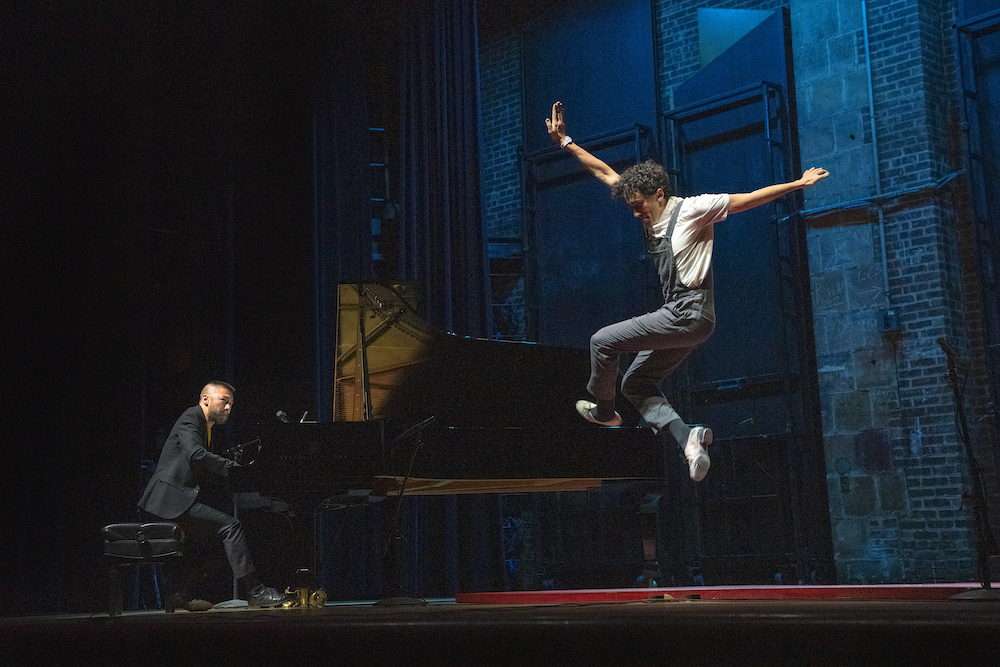
Conrad Tao (L) and Caleb Teicher in ‘Counterpoint, presented by Celebrity Series of Boston. Photo by Richard Termine

By Shelley A. Sackett

Counterpoint, the 75-minute collaboration between pianist and composer Conrad Tao and choreographer and dancer Caleb Teicher, is a magical journey that explores the interplays between two seemingly divergent art forms — tap and solo piano.

Yet, these two virtuoso performers, who met as teenagers and immediately hit it off artistically and personally, perform alchemy to fuse their music and dance and conjure something unique and thrilling. Their exploration of connection rather than divergence results in a program that feels more like eavesdropping on a private performative conversation than attending a formal concert.

Being in the audience (almost) equals the fun and exuberance they exhibit on stage.

“Counterpoint,” is defined in music as the art of playing melodies in conjunction with one another according to fixed rules. In Counterpoint, it becomes a discussion or conversation between Tao and Teicher’s different art forms of music and dance, between their different instruments of piano and tap and between the different traditions that have been attached to each.

It is also an opportunity for the two to improvise, bringing fresh energy to familiar pieces that span a wide selection of musical genres. Their back-and-forth brims with theatricality, harmony and raw rhythm.

Stylistically, the program of 11 pieces meanders from J.S. Bach’s “Aria” from his Goldberg variations to Art Tatum’s “Cherokee,” a Honi Coles and Bufalino Soft Shoe, Brahms’ Intermezzo in E Major, Gershwin’s iconic “Rhapsody in Blue” and back again to Bach’s “Aria.” There is a Schoenberg, Mozart and Ravel along the way, and even two exceptional original pieces, one that changes with each performance and is titled “Improvisation.”

The set is simple: a shiny piano, tap platform, and chair. At first, Teicher just sits as Tao’s soulful rendition of the Bach aria fills the hall. When Teicher stands, his white, short-sleeved jumpsuit is mirrored in the piano’s sheen. He slowly, thoughtfully begins to drag his feet, transitioning to graceful almost slow-motion ballet moves and  eventually breaking into a whimsical introduction to the clickity-clack of the tap element. It’s a perfect way to start this quirky tête-à- tête between pianist and dancer.

“Improvisation” at Saturday’s matinée started with a slow interchange between dissonant piano chords and the soft scarping of Teicher’s shoe. Both increase in intensity almost to the breaking point, yet the two rhythms complement, rather than compete with, each other.

Teicher gives the audience a glimpse of his prodigious stage presence with the theatrical facial expressions and body languages he brings to “Cherokee.” A mere tilt of the head, the whisper of a wink and a smile, silently speak volumes. With his introduction of “Coles and Bufalino Soft Shoe,” he is also the charming emcee, genuinely interested in having the audience join in on the fun.

“Swing Two,” an excerpt from the duo’s Bessie Award-winning “More Forever,” exemplifies the concept of Counterpoint, or two melodic lines interacting. Tao’s piano is as rhythmic as Teicher’s dancing, which is as tuneful as Tao’s keyboard.

The expressive, easily accessible “Rhapsody in Blue” earns the pair an interruptive standing ovation. Its happy fusion of jazz and Broadway and the dramatic blue lighting are perfect backdrops for Tao’s vivid, emotive piano and Teicher’s expressive dancing. They both display playful attitude in this piece. When Teicher strikes a pose or seems to float on the tip of his shoe, there is an impish, elfin hammy element to him that makes his performance all the more endearing.

Both have their solo moments too, Tao in the Schoenberg and Ravel pieces and Teicher in the Bufalino soft shoe and the magnificent Mozart “Alla Turca,” where he demonstrates tap’s vocal range while exuding joy and adorability. Although there is no piano accompaniment, Teicher’s masterful dancing creates an imaginary score which he encourages the audience to try to access. “When you hear these sounds and see me gesture and dance, use your imagination to create a story and fill in the blanks,” he advises. “Watch it again and think about what you see and feel.”

The program ends with an “Aria” bookend, and we have come full circle, but so much richer for the experience.

Celebrity Series of Boston presents Caleb Teicher & Conrad Tao in ‘Counterpoint.’ At the Boston Arts Academy Theater, Feb. 7-8.
The Huntington’s “Nassim” Bridges Our Differences through Language, Gimmickry and Charm

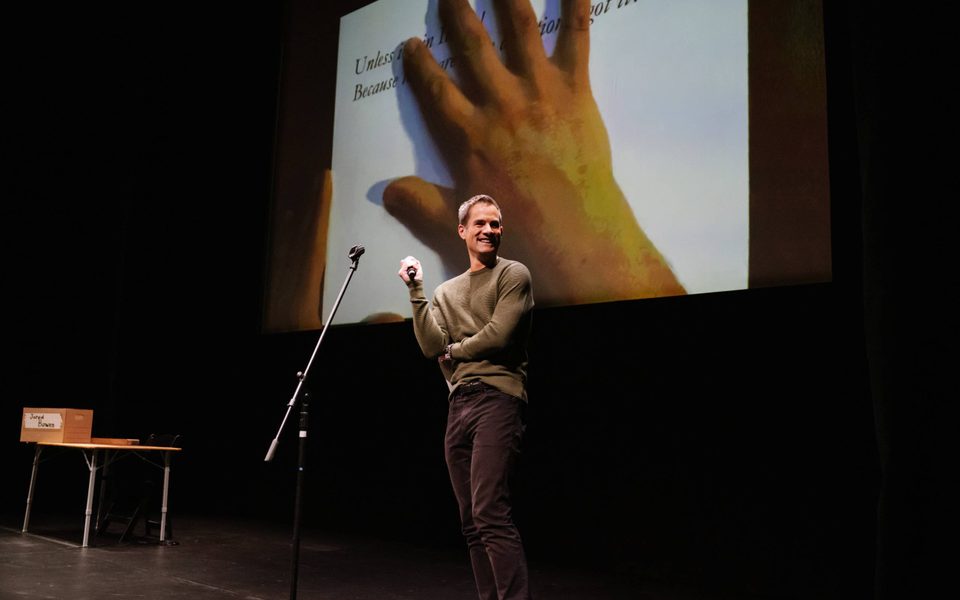
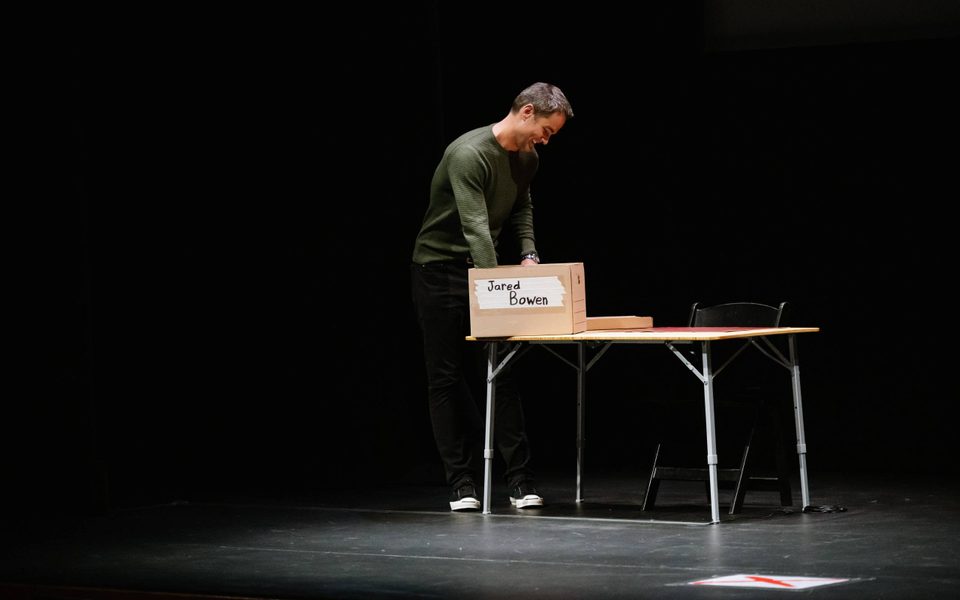
Jared Bowen in Nassim at the Calderwood Pavillion, BCA. Photos by © Mike Ritter

“Nassim” — Written by Nassim Soleimanpour. Directed by Omar Elerian. A new guest performer for every show. Presented by The Huntington through October 27.

By Shelley A. Sackett

“White Rabbit, Red Rabbit,” Iranian Nassim Soleimanpour’s absurdist adventure, which sits on the boundary of comedy and drama and burst into London’s West End in 20212, changed my opinion about audience participation in theater. Not a big fan of the genre, I left the 2016 performance at New York City’s Westside Theatre a convert.

Conceived while 29-year-old Soleimanpour was barred from leaving Iran for refusing military service, the play challenged its audience on issues of trust, obedience and complicity while demolishing the fourth wall and having a different actor read the script for the first time at each performance.

The words were Soleimanpour’s; the implicit messages were the idea of someone trying to speak through someone else and the question of what censorship means.

So when The Huntington announced it was producing the eponymous “Nassim,” I was on board. Originally commissioned and produced by London’s Bush Theatre in 2017, the drama, comedy and social experiment is even more timely today.

Fueled by curiosity, compassion and a longing for global community, Soleimanpour employs his trademark style of having a different actor cold read his script in front of a live audience. Karen MacDonald, the “empress of Boston theater,” had the honors the night I attended, and she rose to the task with her usual humor, flair and skill.

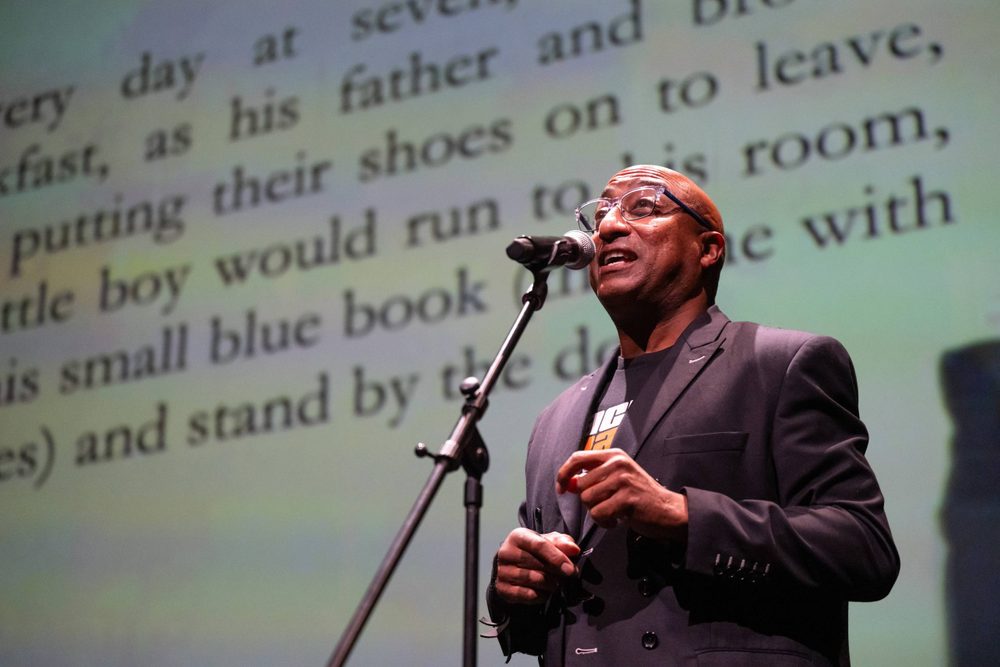
For 75 intermission-less minutes, MacDonald read from a script (minus the italicized stage directions) projected on a jumbo screen, as its pages were moved by disembodied hands. The play’s theme, a meditation on how foreign languages divide us, slowly comes into focus. While Soleimanpour’s plays have been performed in dozens of languages worldwide, they’ve never been performed in Farsi in his native country because of governmental repression. This situation particularly distresses him because his mother, who still lives in Iran, has never heard or seen one of her son’s plays performed in her (and his) mother tongue.

Although “Nassim” at times feels insubstantial and the gimmicky aspect often crosses over into banal cutesiness, its positive message of global community through communication and understanding prevails. Mimicking a language class, Soleimanpour’s script invites the audience (and especially MacDonald) to experience the beauty and magic of his native language, Farsi. We discover through the timeless and borderless device of fairytales.

Naheem Garcia

“Once upon a time” are our first Farsi words, along with “mom.” “You have to learn your mother tongue,” MacDonald reads.

In Act Two, Soleimanpour’s script turns more autobiographical, and we find out that he wrote the play in Farsi with words he wanted to learn in English. The play, which celebrated its 479th performance and has been staged all over the world, was intended as a means for its author to meet new people and be taught new words all over the world.

“A writer’s heart will always beat in his mother’s tongue,” Soleimanpour says through MacDonald. “But isn’t it amazing how languages work? They bring us together; they tear us apart.”

It would be too much of a spoiler to reveal all the surprises in store, but this charming and timely piece of experimental, experiential theater is a must for anyone curious about more than the shiny, big productions that often dominate conversation, reviews, and box office receipts. Take a chance with this little gem; you won’t be disappointed.

For more information, go to https://www.huntingtontheatre.org/

The Vilna Shul and “The Dybbuk” Are A Match Made in Heaven in Arlekin Players’ Must-See Production

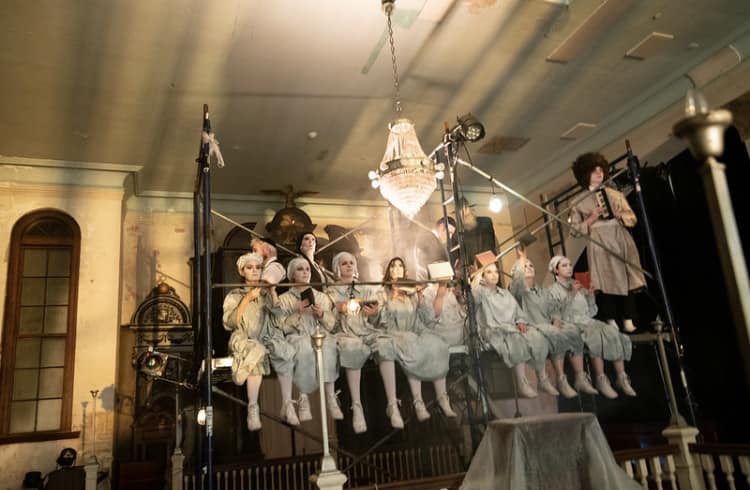
Cast of Arlekin Players’ “The Dybbuk” at the Vilna Shul. Photos: Irina Danilova

‘The Dybbuk, or Between Two Worlds’ — Written by Roy Chen. Based on the original play by S. Ansky. Adapted by Igor Golyak and Dr. Rachel Merrill Moss with additional material from the translation by Joachim Neugroschel. Directed by Igor Golyak. Scenic Design by Igor Golyak with Sasha Kuznetsova. Presented by Arlekin Players Theatre at The Vilna Shul, Boston’s Center for Jewish Culture, 18 Philips St., Boston, through June 23.

By Shelley A. Sackett

Igor Golyak, the peerlessly talented founder and award-winning artistic director of Arlekin Players Theatre, has done it again. Known for his innovative approaches to traditional and virtual theater, his production of “The Dybbuk, or Between Two Worlds” takes the audience on a magic carpet ride straight into the beating heart of a turn-of-the-century Eastern European shtetl.

Set in the iconic and authentic 105-year-old Vilna Shul, Boston’s only surviving synagogue built by and for late 19th/early 20th century immigrants, Golyak creates an otherworldly environment that sucks the audience right in. We are greeted by tiers of metal scaffolding that rise almost to the ceiling in the center of the building, towering above the pews, which have been pushed back along the perimeters. Animated sheets of opaque plastic hang from the frames, dancing ghost-like as strobes, disembodied voices and the sound of dripping water create a multi-sensorial microcosm.

Even if we’re not sure exactly where we are or exactly what is going on, one thing is clear: this will be an extraordinary evening.

The play’s plot is tricky for 21st-century theatergoers to intuit, yet it is essential background to fully appreciate Golyak’s extraordinary vision and interpretation.

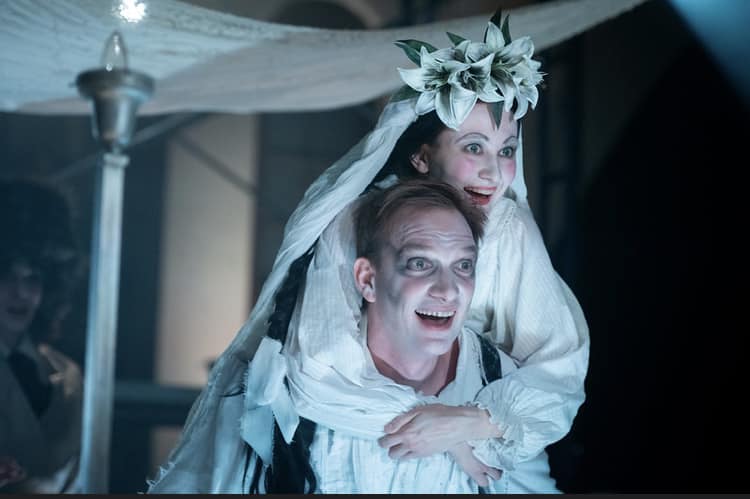
In a nutshell, S. Ansky’s 1914 play relates the story of Leah, a young bride possessed by a dybbuk (a malicious spirit believed to be the soul of a dead person stuck between earth and heaven). Yet this dybbuk is anything but malicious; he is Khonen, a poor Yeshiva student who grew up with Leah and loves her.

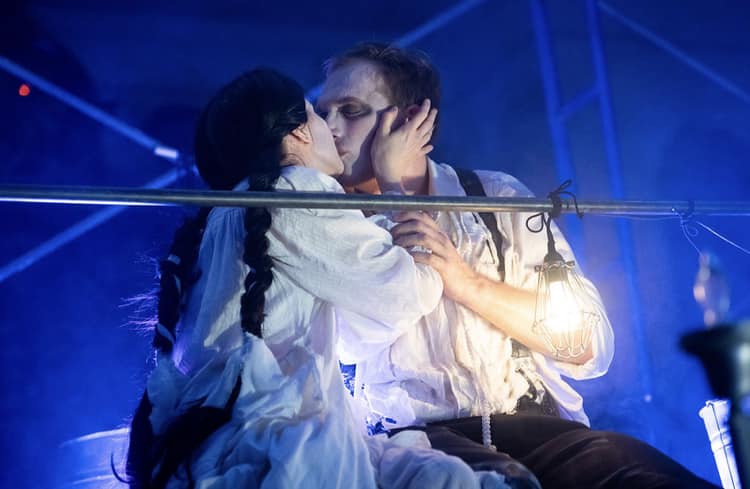
Yana Gladkikh, Andrey Burkovskiy

Only alluded to at the end of the play is a critical piece of backstory (the 1937 Yiddish-language Polish film adds this as an introductory scene). Sender, Leah’s father, and Nisan, Khonen’s father, were close friends whose wives gave birth on the same night. They made a pact that if one had a girl and the other a boy, the two would be betrothed. Nisan drowns shortly after his wife gives birth. Sender, whose wife dies during childbirth, goes on to become a wealthy rabbi.

Years later, Khonen shows up at Sender’s house as a poor yeshiva student, and Sender offers him hospitality. Neither is aware of their underlying connection. Leah and Khonen fall in love, but Sender rejects Khonen, betrothing Leah instead to Menashe, a wealthy nincompoop.

Beside himself, Khonen studies Jewish mysticism (Kabballah) in an effort to alter events by way of magic, even beseeching Satan to help him. He dies before the wedding, returning as a dybbuk who haunts and eventually embodies Leah, possessing her as she stands on the bimah (the altar from which the Torah is read) at her wedding. The ceremony is postponed, and Sender does everything in his power to repossess Leah and unite her with Menashe. After much drama (including a religious exorcism), the two are reunited.

Golyak uses every square inch of the Vilna to astonishing effect. The space behind the pulpit becomes a tiered choir where ghosts (interestingly, all female) act like a Greek chorus. The bulk of the action takes place on and around the Vilna’s bimah, as it does in Ansky’s original script. Strip lighting, handheld firefly-like mini lights, industrial hanging caged bulbs (lighting design by Jeff Adelberd), and spot-on costumes and makeup (Sasha Ageeva) add to the ethereal ethos.

Staging and site notwithstanding, however, it is the extraordinary cast — especially the two leads — who blow this production out of the water.

As Khonen, Andrey Burkovskiy, the expatriated Russian actor, is riveting. His lithe physicality belies his large size as he leaps and pirouettes across the scaffolding, barely but intentionally missing hitting his head on the hanging lights and metal beams. The Beetlejuice makeup is extremely effective at imbuing him with a heartbreakingly sad yet potentially menacing demeanor.

Yana Gladkikh, the Russian actress and film director, is equally spellbinding as Leah. A cross between Pierrot and a floppy ragdoll, she runs the gamut from Tinkerbell lissome to Princess Leia fierce. The chemistry and synchronicity between Burkovskiy and Gladkikh is delicate and subtle, and watching them together is a true theatrical treat.

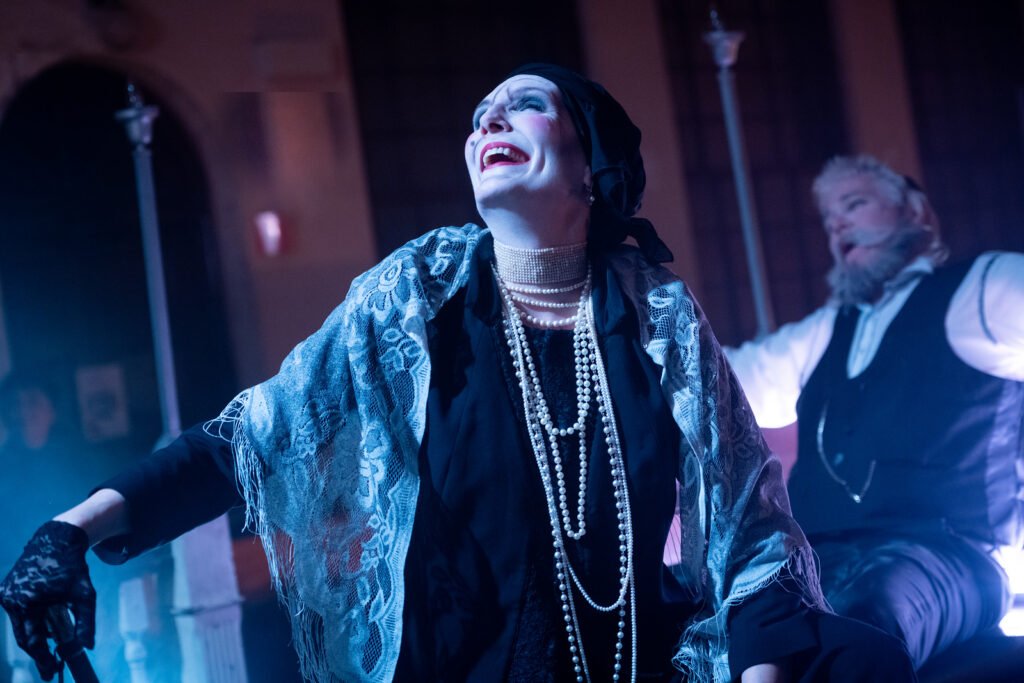
Deb Martin, as Frade, Leah’s paternal grandmother and caretaker, is as opposite an energy as possible. Screeching, cajoling and imperious, she dominates every scene she is in, bringing a countervailing element of melodramatic hysteria and humor to an often somber tale. Like the witch in Hansel and Gretel, she is hunch-backed, skeletal and a force to be reckoned with. You can actually hear her gnashing teeth as she literally chews up the scenery during the exorcism scene. Kudos to Golyak for letting Martin strut her stuff.

Deb Martin

The rest of the cast (especially Robert Walsh, the former artistic director of the Gloucester Stage Company, as the overbearing Sender) is splendid. 110 intermission-less minutes is an eternity at some productions; at “The Dybbuk,” they fly by.

“The Dybbuk” is considered a seminal play in the history of Jewish theater, and played an important role in the development of Yiddish theater and theater in Israel. Based on years of research by Ansky, who traveled between Jewish shtetls in Russia and Ukraine, it documents folk beliefs and stories of the 19th and early 20th century Hassidic Jews, who lived during a time of nonstop pogroms in specific areas, outside of which their residency was forbidden.

Ansky’s account of these times and the two suspended, displaced souls trapped between two worlds and tethered to each other and their community is as relevant today as it was over a century ago.

For Golyak, a Ukrainian refugee, the tale is particularly pertinent.

“Isn’t this where we live? As Jews, as immigrants? It’s where we so often have lived as Jewish people for centuries: between worlds. It’s our story – ancient and mystical, the story of our ancestors, but also our story of living in America today,” he said.

Burkovskiy, Gladkikh

It is impossible to recommend it highly enough! Don’t miss it!

For more information and to buy tickets, go to www.arlekinplayers.com