A.R.T.’s Ephemeral ‘Passengers’ Awes with Acrobatics, Music and Dance

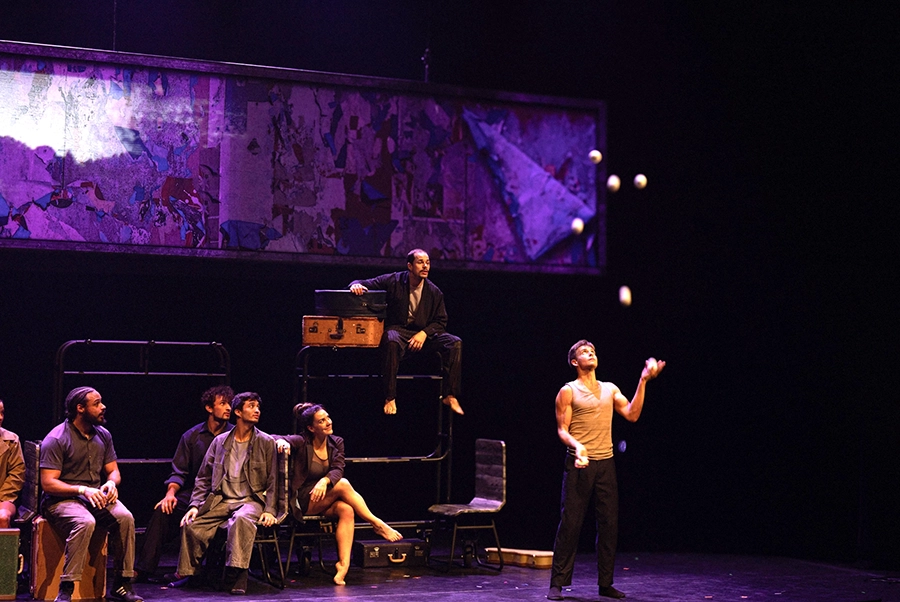
Cast of ‘Passengers’ by The 7 Fingers (Les 7 Doigts) at A.R.T.

By Shelley A. Sackett

Train travel has always evoked a magical aura of nostalgia and romanticism, an opportunity to slow down, observe and contemplate while suspended between past and future, between here and there. American Repertory Theater’s production of Passengers, a contemporary circus performance that combines acrobatics, dance, music and a gossamer thread of dramatic narrative, makes a case that train travel (as a metaphor for life) is all about the journey, not the destination.

For 90 intermission-less minutes, 10 extraordinarily talented acrobats and circus performers (the cast of Montreal-based circus company, The 7 Fingers) use aerial straps, juggling, contortion, hand-to-hand balancing, hoops, pole climbing and aerial silk hammocks to elicit “oohs,” “aahs” and applause from an audience spellbound by the troupe’s physical strength and artistry. Equally dazzling is the show’s crystal clear sound system and arresting 16-song soundtrack of folk, jazz, Latin hip-hop, electronic trance and soulful chamber music. A simple but elegant set uses luggage racks and molded chairs as both acrobatic props and scene creators. Stunning lighting and effective, pleasing projections are icing on the cake.

As Artistic Director Diane Paulus explains in her program notes, the A.R.T. Engagement team develops the Essential Question to catalyze conversation. For Passengers, those questions are: In what ways does life happen while in transit? Is the journey truly more important than the destination?

Passengers’ strength lies in its ability to conjure feeling rather than thought. It is long on the sensual — from visual to auditory to emotional — but short on narrative and nuance.

The show begins with the performers arranging the chairs into train seats. They breathe in waves, creating the illusion of a train’s wheels as a cello and piano reach a velvety crescendo (“Prologue”). Like a mash-up of Pilobolus and a three-ring circus, the performers break off into couples and triads. The effect is spellbinding and its episodic pace and focus set the tone for the rest of the evening.
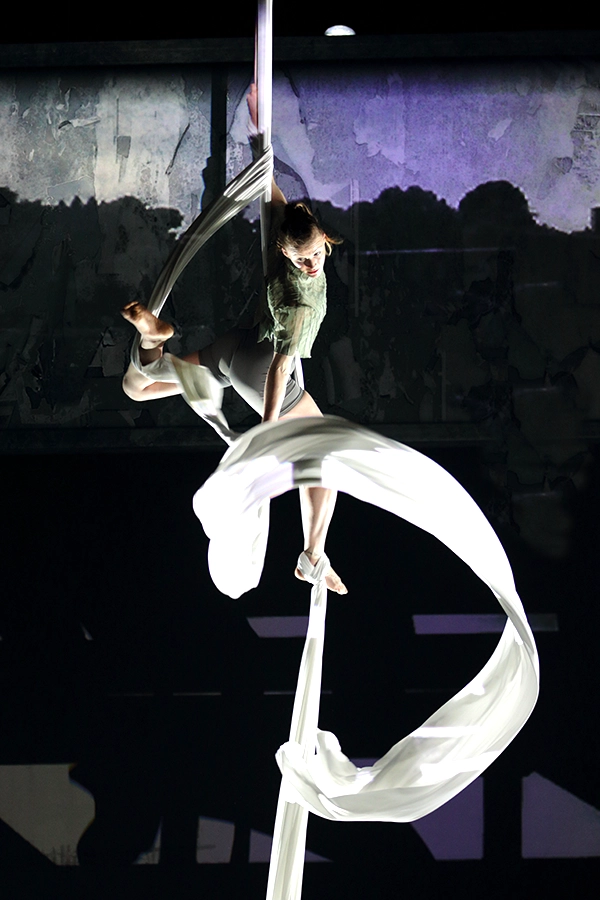
Amanda Orozco. Photo by Sébastien Lozé

Next is the upbeat, swinging “Train Is Coming,” featuring Méliejade Tremblay-Bouchard and her amazing hula hoops. “Sabine’s Departure” features a gorgeous cello and the extraordinary Amanda Orozco, who dazzles and mesmerizes with her white silk parachute aerial skills. There is playful, captivating egg juggling (Santiago Rivera Laugerud), fearless high-flying leaping (Marie-Christine Fournier) and a stunning number that ends with a couple entwined on the floor.

The most whimsical story-lined number has a passenger (Isabella Diaz) somberly waiting for and boarding the train, nervous about the future, sad to leave the past, or a little of both. Once aboard, she unleashes her power to freeze frame time and the other passengers with it. She plays with them lightheartedly, repositioning them and gesturing with expressive, elegant hands, before unfreezing them. Her movements are a delight, as balletic as they are spunky and charming.

Most amazing of all is the fact that these performers work without nets, their safety dependent on teamwork and trust. In addition to inviting us to ponder the passage of time, Passengers also forces us to look our own (and the performers’) mortality squarely in the eye.

The show finishes as it began, with the performers seated in a semi-circle. There is no definitive arrival or resolution, but somehow these passengers seem more connected, more intimate. They (and we) have shared something, even if that something lacks narrative cohesion or clarity.

At the end of the day, Passengers is a valentine to physical strength, flexibility and the extraordinary grace inherent in the human body. If you are in the mood to be entertained by a smaller, gentler, more abstract but no less breathtaking Cirque de Soleil, then Passengers may be right up your alley. If, however, you prefer your live theatrical entertainment to have more plot and clearly definable characters than physical stunts and “acts,” then Passengers may not fit your bill.
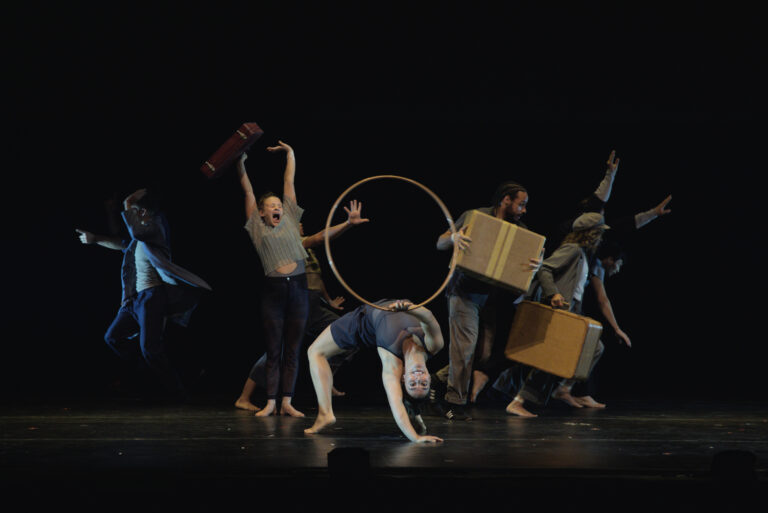
Photo by Grace Gershenfeld

Whether Passengers is theater or contemporary circus (and whether that matters) is an important conversation for another time. Clearly, A.R.T., by opening its 2025/2026 season with the show, believes it belongs on its revered stage.

Colin Gagné; Lyrics by Colin Gagné and Shana Carrol; Scenic Design by Ana Cappelluto; Costume Design by Camille Thibault-Bédard; Lighting Design by Éric Champoux; Projection Design by Johnny Ranger; Sound Design by Colin Gagné and Jérôme Guilleaume. Presented by American Repertory Theater at Loeb Drama Center, 64 Brattle St., Cambridge, through Sept. 26.

For more information, visit americanrepertorytheater.org/
With “The Half-God of Rainfall,” A.R.T. Once Again Breaks New Production Ground

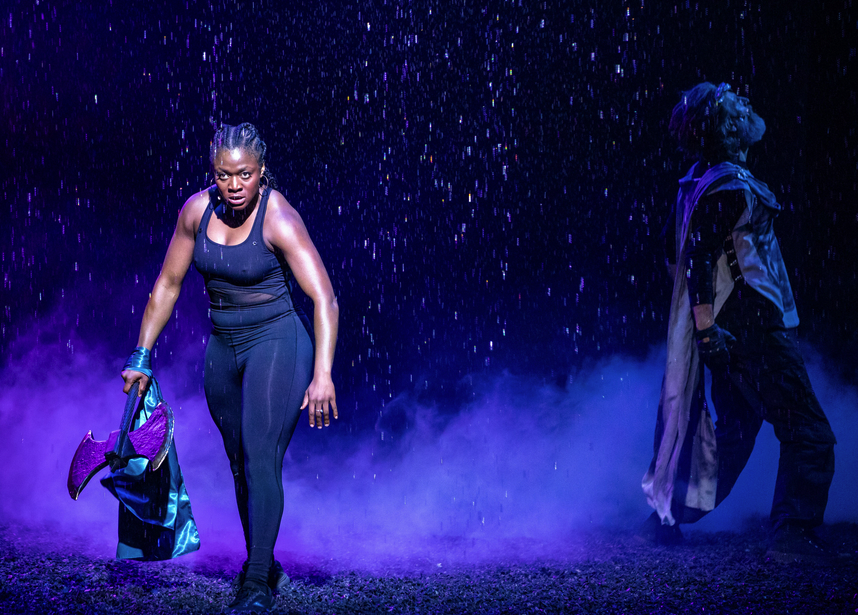
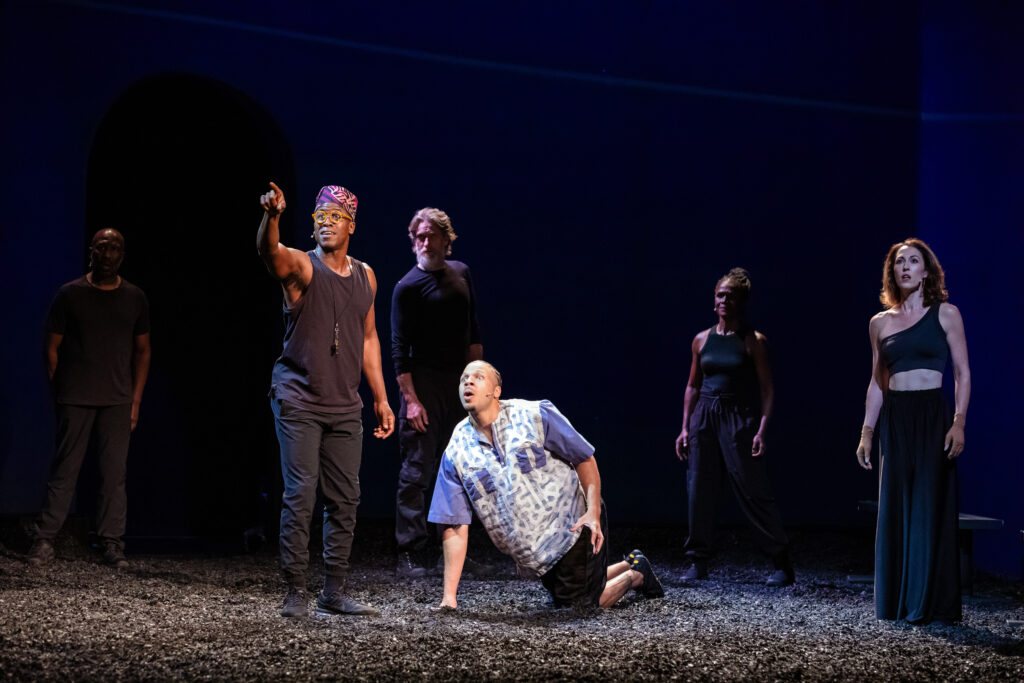
Cast of “The Half-God of Rainfall,” at A.R.T. Credit: Lauren Miller

By Shelley A. Sackett

Will we ever become inured to the other-worldly team at American Repertory Theater and its ability to sprinkle fairy dust on Boston’s theater scene? With “The Half-God of Rainfall,” now in production through September 24, the answer is a resounding “No!”

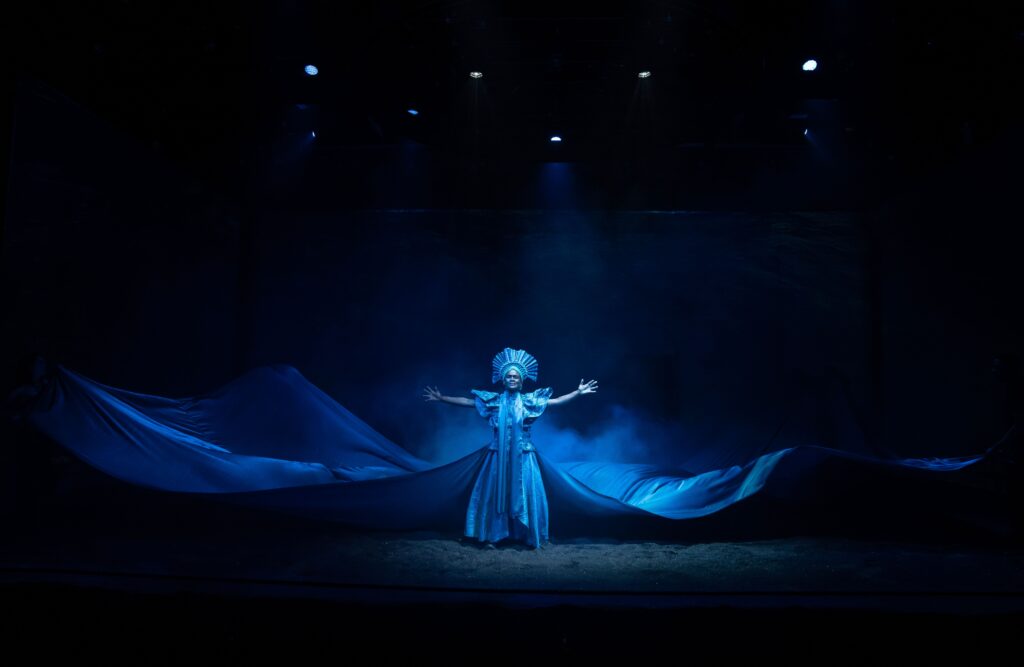
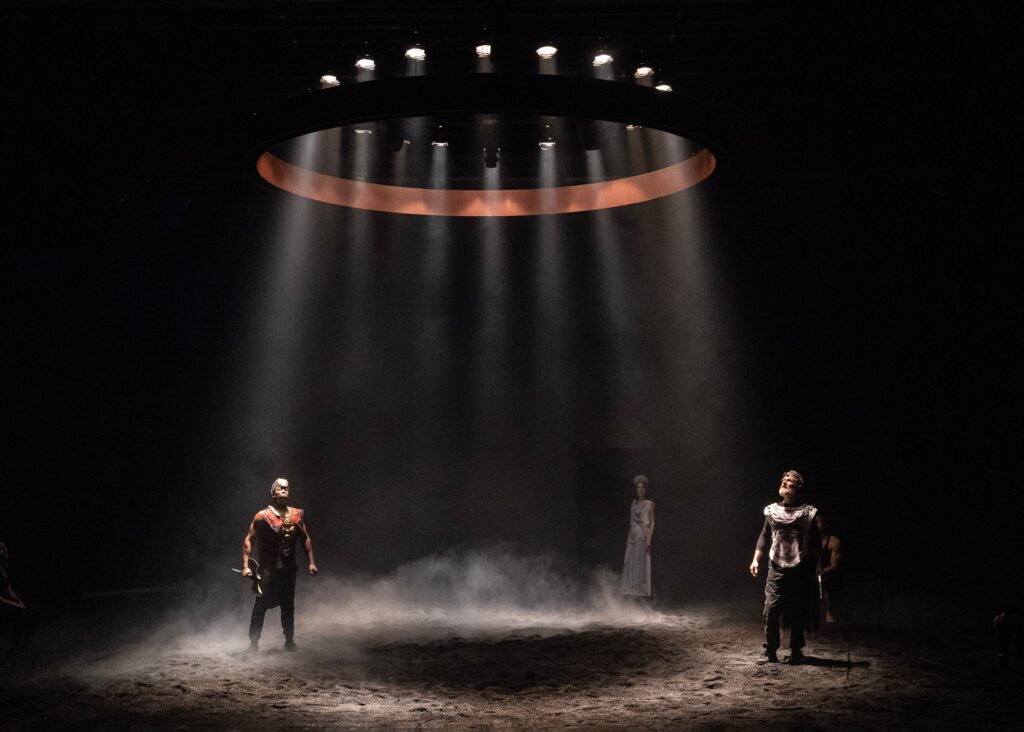
It helps that Nigerian native Inua Ellams’s sinuous play is a masterful blending of unlikely ingredients: Greek mythology and Nigerian Yoruba spirituality, a war between mortals and gods, basketball, toxic patriarchy, white supremacy, female empowerment, and maternal love. Couple that with a script crafted as an epic poem, a stellar cast that works as a seamless ensemble, and breathtaking choreography, lighting, and sound designs, and well, you have all the makings for a night of unparalleled theatrical pageantry.

The scope and ambition of Ellams’s work is staggering.

It’s hard to describe the multilayered and, at times, opaque plot. Using basketball as both ground zero and allegory, Ellams creates a new myth about the half-god, half-mortal Demi (Mister Fitzgerald), born to human Nigerian high priestess Modúpé (Jennifer Mogbock) after she is brutally raped by the Greek titan god, Zeus (Michael Laurence).

Jennifer Mogbock and Michael Laurence

The genesis of the rape is even more chilling. As stand-ins for superpowers, Zeus and Sango (Jason Bowen), Greek and Yoruba gods of thunder, bet on a race. They agree to “boys-will-be-boys” terms as a settlement. The winner gets to take a member of the loser’s world as a prize.

When Zeus wins, he takes Modúpé as his deserved own, to do with as he pleases.

Demi grows up in a poor Nigerian village, gradually becoming aware of his extraordinary abilities to flood the land with the water from his tears and defy gravity with his basketball wizardry. He learns that basketball is more than a sport when he leaves Nigeria for the Golden State Warriors and superstardom. There, he earns the nickname “rainmaker” and rules the courts with his uncanny proficiency.

Yet all is not quiet on Mt. Olympus, where the gods (and especially Zeus) see all. One of the play’s lighter moments is when Nigerian American player Hakeem Olajuwon (Bowen) visits Demi and explains that all the great sports players are demi-gods but that Zeus forbade them from participating in mortal sports after Michael Jordan almost blew their cover by flying on the court. In defiance, Demi sets his sights on the Olympics, daring Zeus to descend from Olympus and stop him.

Examining sports culture and the way it informs and mirrors the best and worst of human behaviors is not all Ellams has up his sleeve, however. At 90 intermission-less minutes, he has ample time to address other meaty themes such as rape and its resultant PTSD, the burden of being a single mother, free will, female solidarity, Black feminism, and the #MeToo movement. And address them he does, with sensitivity, candor, and gusto.

Rather than hammering polemics, however, Ellams weaves important points into the fabric of the plotline by having his characters humanize and personalize them. “What teaches males to take what isn’t given?” Modúpé asks the river goddess Osún (Patrice Johnson Chevannes). Later, she describes how she was able to love her son Demi, despite the fact that his existence was borne of and is a reminder of such pain and trauma. “My body is my body. But my mind – I can’t control it. He (Zeus) took from me control of myself, but he gave me you,” she tells her son, implying that a mother’s love for and connection to her child supersedes all else.

Ellams pens another intriguing exchange between Zeus and Demi as they discuss who is better off, all-powerful gods or mere mortals. Surprisingly, an introspective Zeus shares that even though he fears he (and all gods) could become insignificant to mankind, he is even more threatened by the fact that humans have free will and can choose how to live. As the last free half-god, Demi has one foot in each world; he is half free but also half stuck in Zeus’ world of rules and obligation.

While the play presents challenges in terms of understanding the actors’ accents, hearing their voices and following the entwined and often confusing stories, the actors’ physicality and sheer force of production pyrotechnics provide ample balm. “Half-God” defies pigeon-holing. Part Magical Mystery Tour, part modern dance concert, part art installation, and all ingenious invention, “Half-God of Rainfall” is a must-see for anyone curious about how far the envelope of theater can be pushed. Once again, A.R.T. positions itself as the undisputed leader of the pack with another groundbreaking and thought-provoking production.

‘The Half-God of Rainfall’ – Written by Inua Ellams. Directed by Taibi Magar. Movement Direction by Orlando Pabotoy. Scenic Design by Riccardo Hernández. Lighting Design by Stacey Derosier. Sound Design and Music Composition by Mikaal Sulaiman. Projection Design by Tal Yarden. Orisha Movement Consulting/Choreography by Beatrice Capote. Costume Design by Linda Cho. Presented by American Repertory Theater in co-production with New York Theatre Workshop. At Loeb Drama Center, 64 Brattle St., Cambridge, through Sept. 24.

For tickets and information, go to: https://americanrepertorytheater.org/