ASP’s ‘Macbeth’ Is a Muddled Mashup of Time, Place and Tone

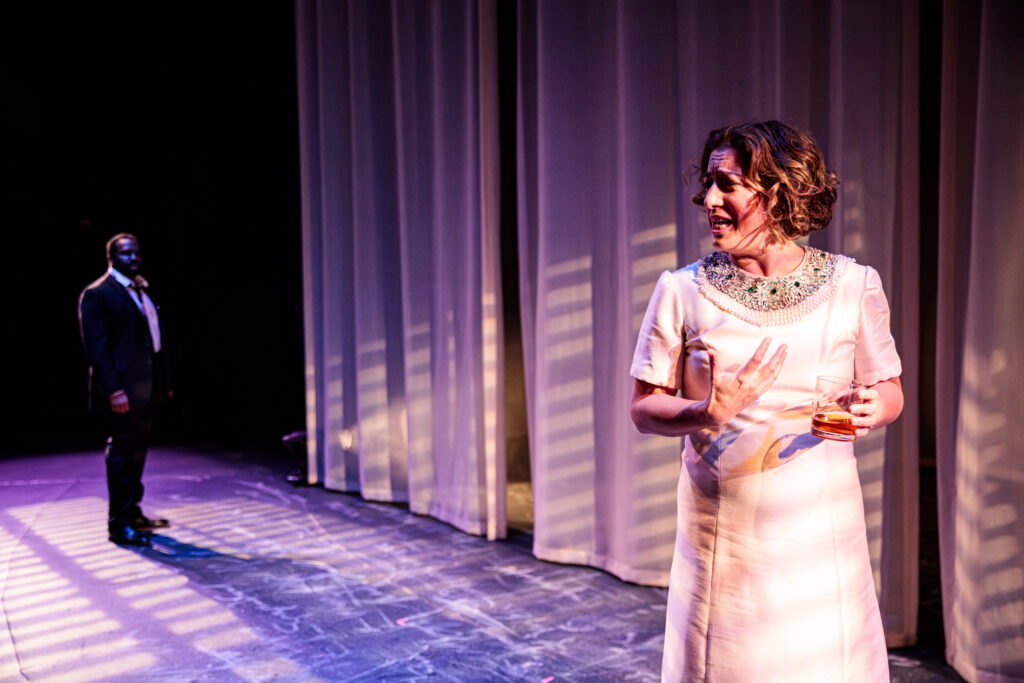
Omar Robinson, Brooke Hardman in Actors’ Shakespeare Project’s ‘Macbeth’
Photos by Benjamin Rose Photography.

‘Macbeth’ — Written by William Shakespeare. Directed by Christopher V. Edwards. Presented by Actors’ Shakespeare Project at Mosesian Center for the Arts, Watertown through October 26.

By Shelley A. Sackett

Ten minutes into ASP’s production of Macbeth, my friend leaned over and whispered, “I thought we were seeing Macbeth.”

He wasn’t being a smart aleck; he was astutely stating the obvious. While it seems au courant (at least in Boston) to catapult timeless Shakespeare into other eras with disco, hip hop, and gratuitous references to current headlines, Actors Shakespeare Project, under the direction of Christopher V. Edwards, proves definitively that it is possible to overreach and completely miss your mark.

One of the Bard’s most quoted and beloved plays (“Fair is foul, and foul is fair,” “Is this a dagger which I see before me?” and “Double, double toil and trouble,” for example), it speaks for itself, elegantly and eloquently. Yet, for some baffling reason, Edwards thinks that contemporary audiences are unable to fully “get” the timelessness of the Elizabethan masterpiece without referencing the Epstein files, ICE, MAGA, the war in Gaza, and AI. Couple that misstep with creative but distracting staging, and you get the fuller picture.
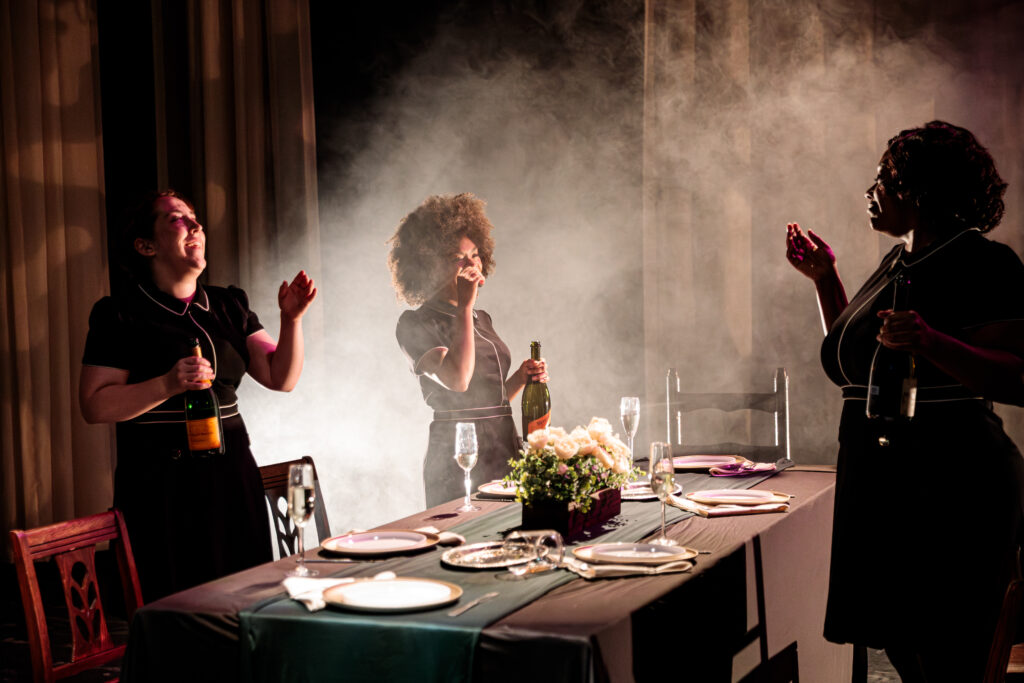
Claire Mitchell, Amanda Esmie Reynolds, and Jade Guerra

To his credit, Edwards doesn’t hide the ball about his intent, which he spells out in the program’s Director’s Notes.

His version of Macbeth (which he nicknamed MK-Beth) reimagines the three witches as architects of state-sponsored psychological manipulation. He sets his version in the thick of a covert 1960s Cold War where Lady Macbeth and her husband are as much test subjects for mind control as they are murderous, power-obsessed co-conspirators.

The central issue, Edwards feels, is “reconsidering ambition, conspiracy and complicity in an era where truth itself could be weaponized.” I don’t know about other audience members, but I was looking forward to a version that was a little more faithful to the original rather than a spin on the contemporary front page political headlines, which take all my psychic energy to avoid.
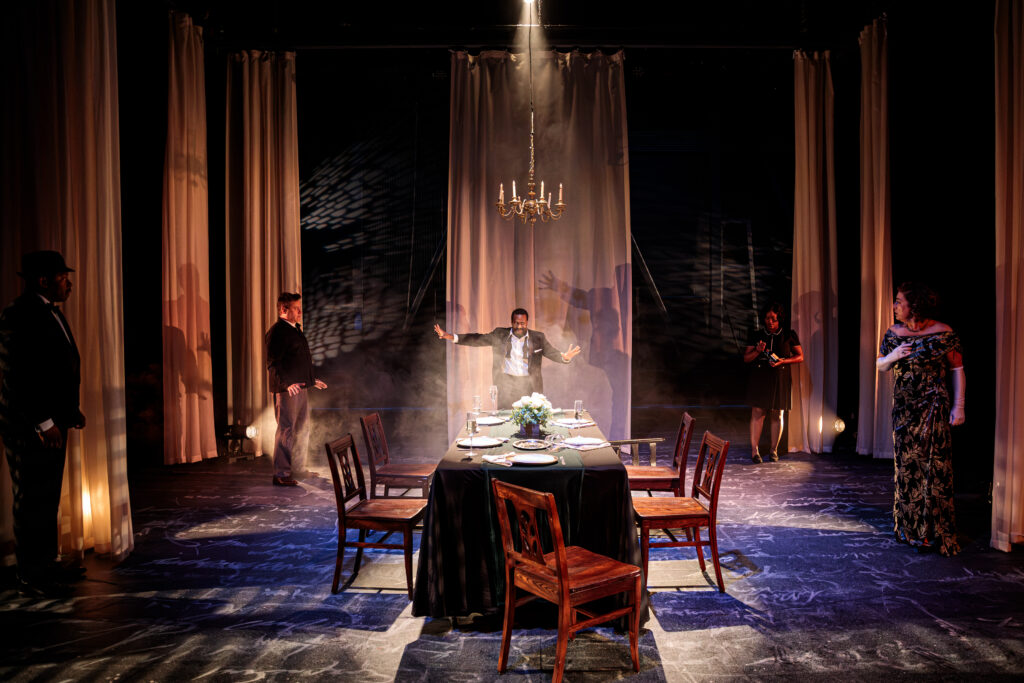
On its own, Macbeth really does address the issue that Edwards wishes to magnify (the dangers of a budding dictator’s unquenchable thirst for power). Would that he had trusted the audience to “get” that on their own.

Disagreement with his spin aside, its execution has way more misses than hits. On the positive side, imagining Lady Macbeth as a grieving mother who undergoes electro-convulsive therapy at the hands of the three doctors/witches to cure her depression is an interesting conceit, although a baffling way to open the action. We are supposed to have picked up how devoted (and normal) the Macbeths were from family home videos that include the deceased child projected on stage before the play, but that point is a little too subtle to grasp without context.

Danielle Ibrahim’s set, however, is marvelous, a gossamer set of white curtains that encircle the stage area and work well with the varying ambiance of the play.

While some of the lesser characters seem to be reciting their lines in a classroom more than delivering them before an audience, there are some noteworthy performances, particularly by Brooke Harman as Lady Macbeth, Dennis Trainor, Jr. as Duncan/Porter, and Chingwe Padraig Sullivan as Malcom.
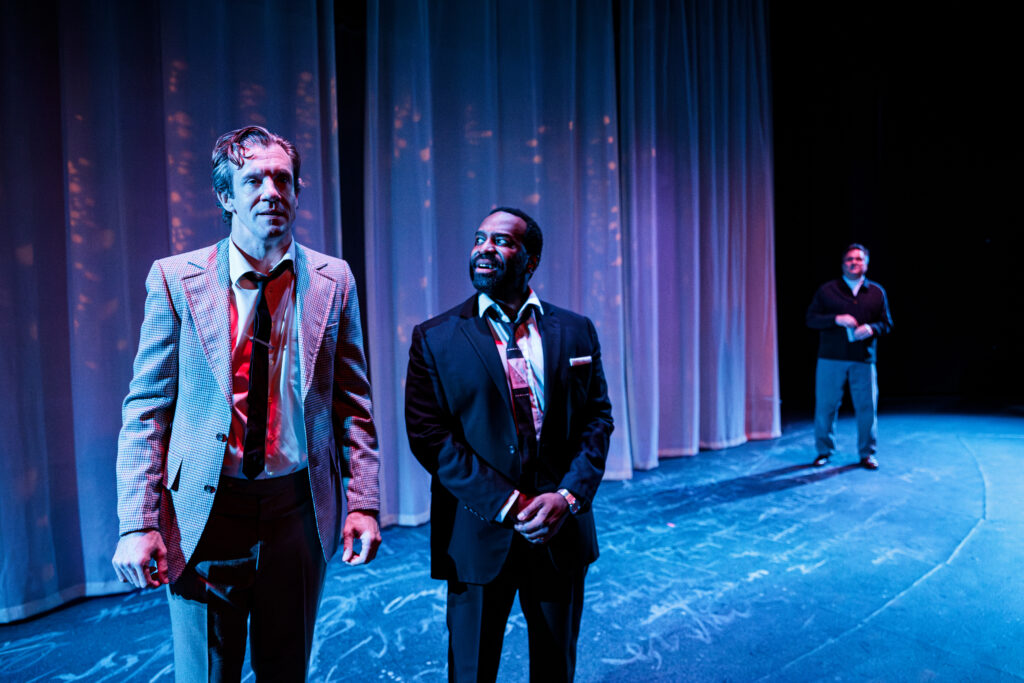
Jesse Hinson, Omar Robinson, and Dennis Trainor Jr.

Omar Robinson (who collected the 2025 Norton award for outstanding lead performance in The Piano Lesson) breaks out of his singularly militant monomaniacal version of Macbeth to court nuance and pathos, particularly in the famous “Out, out, brief candle! Life’s but a walking shadow, a poor player that struts and frets his hour upon the stage and then is heard no more” speech upon learning of Lady Macbeth’s death.

Perhaps ASP’s parting gift to its audience is a back-handed reminder that Shakespeare can bridge eras, standing on its original two feet. I, for one, took that as an invitation to revisit the Bard’s version and went home, dusted off my college Pelican Text, and had a jolly good read.

For more information, visit https://www.actorsshakespeareproject.org/
ASP’s ‘Emma’ Is Deliciously Incisive, Ingenious and Impudent

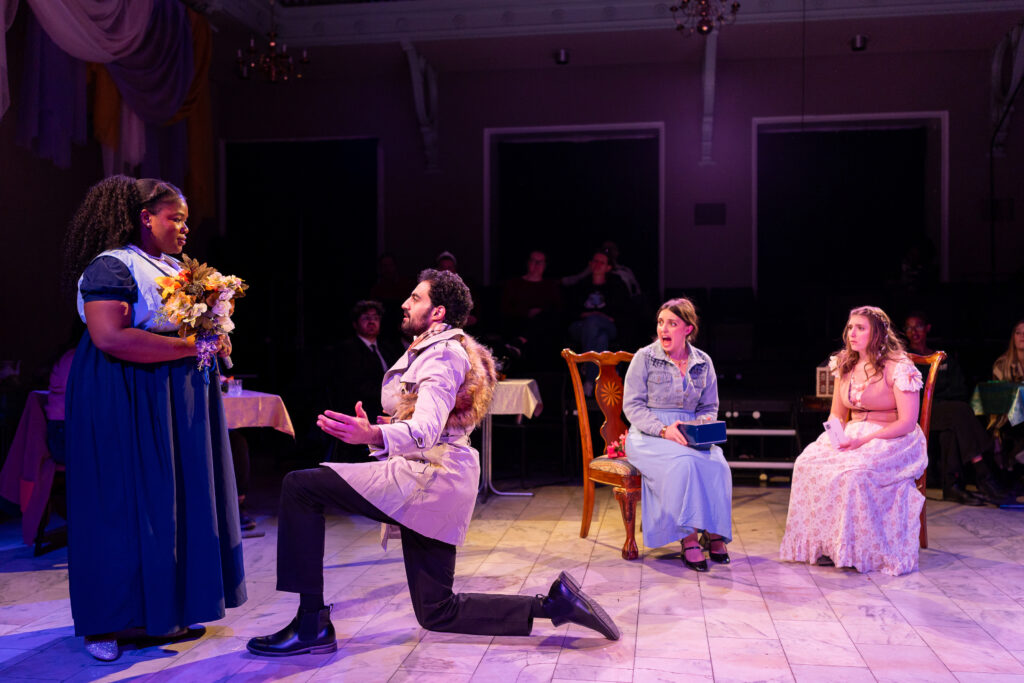
Lorraine Victoria Kanyike, Fady Demian, Josephine Elwood, and Liza Giangrande in Actors’ Shakespeare Project’s production of ‘Emma’. Photo by Nile Scott Studios.

‘Emma’ — Written by Kate Hamill. Based on the novel by Jane Austen. Directed by Regine Vital. Scenic Design by Saskia Martinez; Costume Design by Nia Safarr Banks; Lighting Design by Deb Sullivan; Sound Design by Anna Drummond. Presented by Actors’ Shakespeare Project at Multicultural Arts Center, 41 Second St., East Cambridge through December 15th.

By Shelley A. Sackett

Jane Austen’s 1815 novel “Emma,” like all her other novels, explores the concerns and difficulties of genteel women living in Georgian–Regency England. Her Emma Woodhouse is a bright, wealthy, and confident young woman who basically has it all — education, intelligence, beauty, and money. She also has a surplus of self-confidence, pride and time. She is as spoiled, meddlesome, and self-deluded as she is witty, charming, and pithy.

She lives in an age that prepares wealthy women like Emma for a life of the mind but permits them no occupational outlet. It is matrimony or nothing. It’s no wonder the poor girl nearly explodes with pent-up energy and resentment.

Bored with her own life, Emma turns to the challenge of meddling in the lives of others, manipulating them for sport. She doesn’t court friends; she undertakes assignments. Although she is as unskilled at reading others as she is at self-examination, she fashions herself a gifted matchmaker. Her delusional overconfidence as a marriage broker blinds her to her own romantic potential and leads to misunderstandings, mayhem and heartache.

To her credit, Kate Hammill has taken Austen’s borderline unsympathetic heroine and turned her into a likable rebel who rails against the cruel patriarchal system that imprisons her potential. “What is the purpose of educating women only to have them marry?” she asks. “I must have something to do, or I shall go mad.”

Hamill is no stranger to the genre (she adapted three other Austen works as well as “Little Women” and “Vanity Fair”), and her “Emma“ brims with a delicious melding of past and present, creating a heroine as at home at a lady’s afternoon tea as cutting up the disco dance floor in a white go-go jumper.

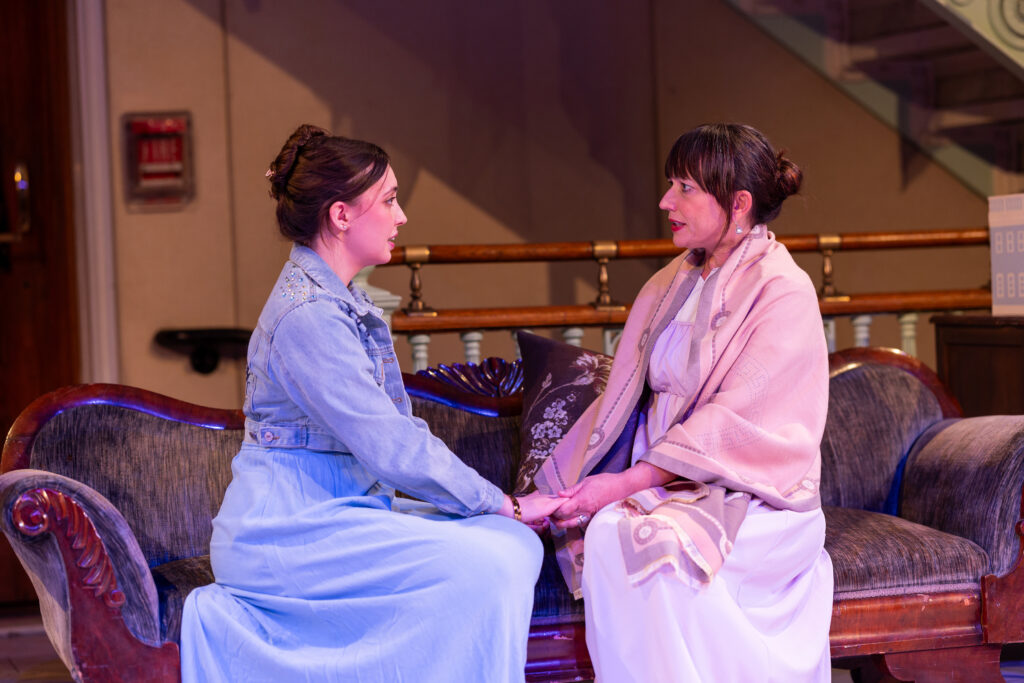
Elwood and Mara Sidmore

Over nearly 2 1/2 hours (one intermission), the plot unfolds. Emma (played with boundless joy and energy by Josephine Moshiri Elwood) and the cast are introduced to us at a party celebrating the wedding of her former governess, Anne (Mara Sidmore), and the widower Mr. Weston (Dev Luthra). Emma tells her father and her best friend since childhood, George Knightley (an outstanding Alex Bowden), that she practically arranged the marriage by introducing them. After such a clear “success,” Emma is determined to make another match. This time, she has set her sights on Mr. Elton, the village vicar. Both Emma’s father and Knightly caution her against interfering, but they ultimately fail to dissuade her.

“You can’t control everything, Emma,” Knightly warns her repeatedly, only to meet the same response: “But isn’t it fun to watch me try?”

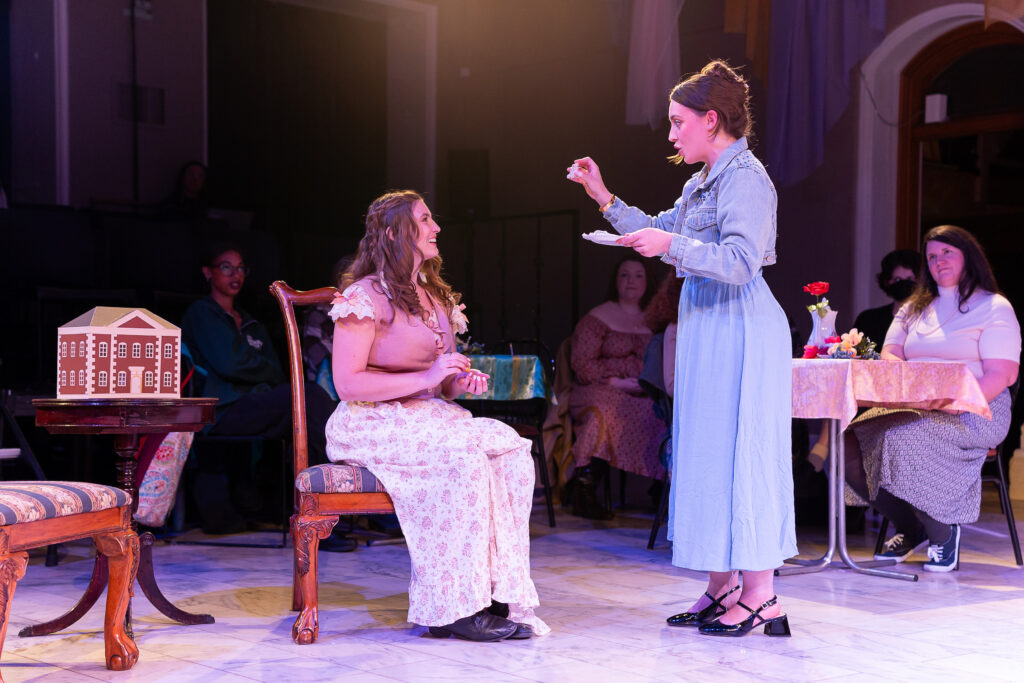
In an act as dispassionate and calculating as Henry Higgins’ taking on Eliza Doolittle, Emma decides that for her next “project,” she will undertake the transformation of Harriet, a 17-year-old student of unknown parentage and inferior social status. Harriet is an eager beaver, as compliant and adoring as a lapdog.

Emma sets about improving (i.e., making her more like herself) her “friend,” starting with convincing her that the groundskeeper, Robert Martin (Fady Demian), the man she loves, is beneath her. When he proposes, Emma gets Harriet to refuse him. She is determined to get Mr. Elton to fall in love with Harriet, thereby elevating both Harriet’s social standing and her own reputation as an unmatched matchmaker.

Needless to say, all does not go according to Emma’s plan. The rest of the play is peppered with colorful characters and rotating liaisons that, owing to double and triple casting, are often hard to keep straight. Aloof, mysterious Jane Fairfax (Lorraine Victoria Kanyike) is Emma’s equal and rival, the only one able to ruffle Emma’s feathers. She is as cool as Emma is hot-blooded, as calm as Emma is kinetic.

Adding insult to Emma’s injured pride, she is also accomplished (as a governess) and intriguing (she left her most recent job under mysterious conditions). She is a thorn in Emma’s side, catapulting her best-laid plans into the abyss.

Although marriage doesn’t figure into Emma’s plans for herself, Knightly and Emma are a match made in heaven that is tediously obvious. They squabble and dance around each other until Emma’s former governess, a very pregnant Anne, practically knocks their heads together and tells them to “work it out!”

Emma must first be pushed off her narcissistic pedestal before this can happen. Ironically, it is meek, malleable Harriet who does the honors when she rejects Emma’s “help” and realizes she has been duped. “You think you control everything, but you don’t control me anymore,” she practically spits.

Like a deer caught in headlights, Emma has a major breakthrough of sudden self-examination. Breaking the fourth wall (which Hamill and Vital execute frequently and effectively), she addresses the audience with cartoonish naïveté. “I may not know everything,” she deadpans in the same stunned voice with which Dorothy announces, “Toto, I have a feeling we’re not in Kansas anymore.”

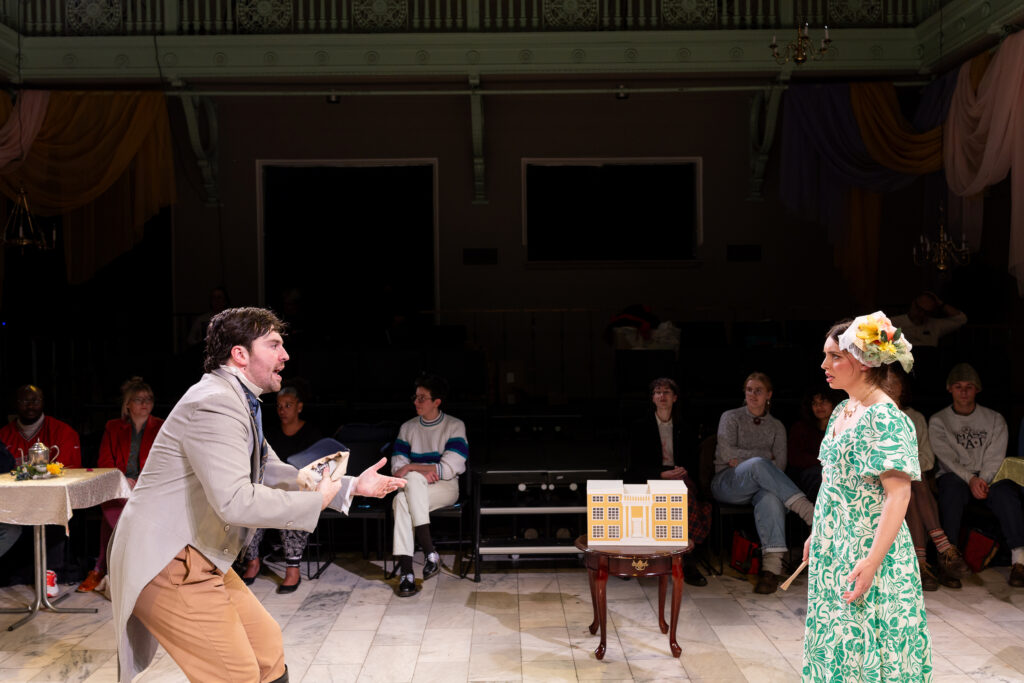
Liza Giangrande and Elwood

Subtlety is hardly this production’s strong suit.

What IS its strong suit is a stellar cast with unrivaled energy. Elwood IS Emma, with all her strengths and weaknesses. It is a pleasure witnessing an actor so comfortable in her own skin and in that of her character’s, and a joy to behold her joy in the role.

As Harriet, Liza Giangrande has to walk a fine line between hysterically funny and pathetically histrionic. Giangrande rises above the sometimes two-dimensionality of her character, embracing Harriet’s more accessible, loveable, trusting side.

Bowden’s Knightly centers the plot and grounds Emma. He also projects and articulates so effectively that even when his back is to the audience (a frequent and unfortunate feature of the staging, as is poor sight lines from most seats), his lines are easily understandable. Likewise for Mara Sidmore’s Anne Weston.

Although the play is fun, full of funny one-liners and Monty Python-esque routines, at the end of the day, it is Emma and the complicated times she lives through that resonate. As we wade through the sight gags, slapstick, and farce, her plaintive refrain rises above to ring clear as a bell: “What is the purpose of educating women if a lady is not allowed real employment?”

Yet Hamill ends on a hopeful note, planting the seeds of 20th-century feminism in 19th-century soil.

“If I teach my girls the best I can and they teach their girls the best THEY can and their girls and their girls, and so on – who knows what we could make? What power we could harness? What we could do? Can you imagine—someday—a whole world full of Emmas, working together?” Emma asks the half-stunned, half thrilled Knightly.

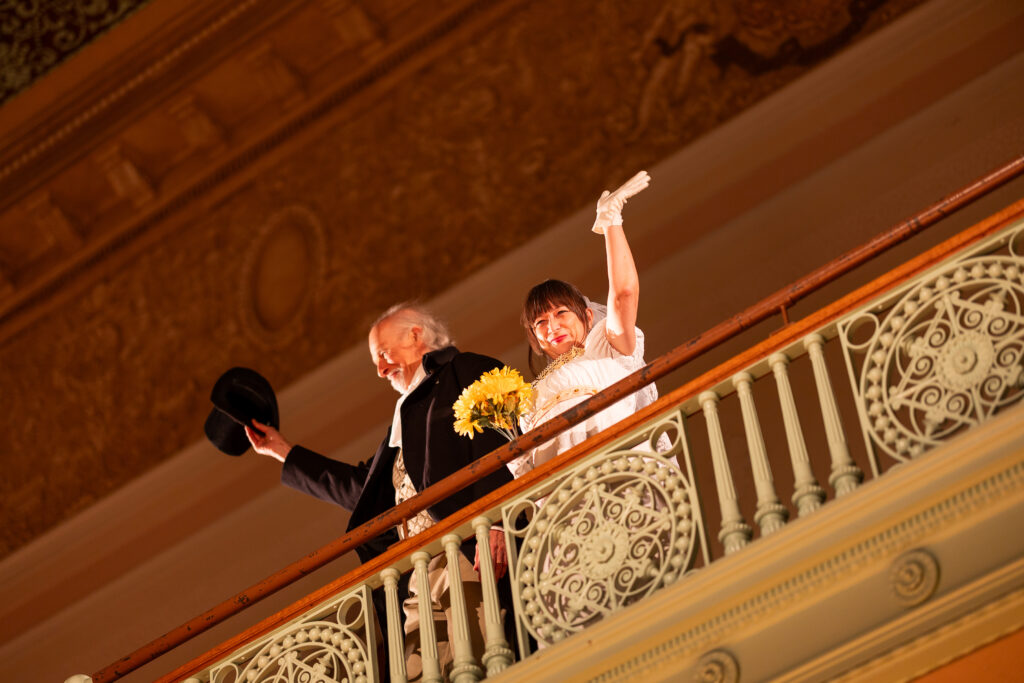
Dev Luthra and Mara Sidmore

“Now THAT, dear Emma,” Knightly should have said in response, ”is a cause indeed worthy of a rebel like you.”

For more information, visit https://www.actorsshakespeareproject.org/