By Shelley A. Sackett
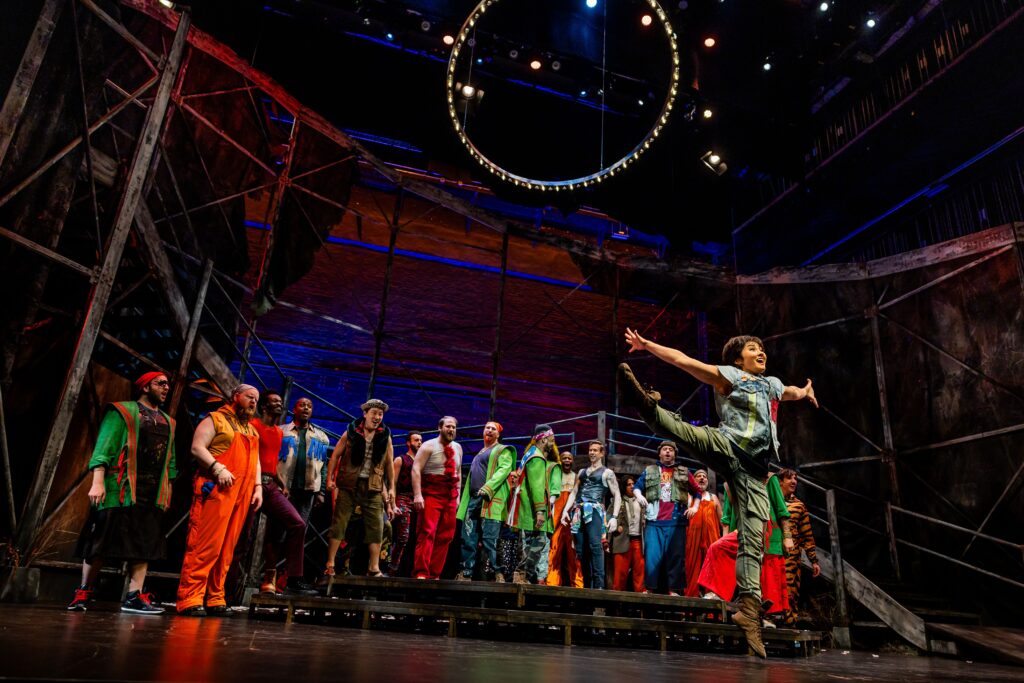
Boston Lyric Opera’s production of Carousel is being touted on many levels. It is a return of Rogers and Hammerstein’s second musical (written just two years after the smash hit Oklahoma) on the same stage where it débuted in 1945 with John Raitt (Bonnie Raitt’s late father) as the lead, Billy Bigelow. Director Anne Bogart’s program notes stress the tension inherent in staging a show with such strong nostalgic ties to tradition for a contemporary audience. She checks the reverence box by not changing a syllable of the original script or lyrics. The notes refer to checking the innovation box by envisioning the players-within-the-play as “a group of refugees who arrive from a great distance to perform the play, seeking to gain access and acceptance,” but, at least for this viewer, that intention yielded only confusion.
The play tackles a lot of heady, heavy issues, many still timely enough to have relevance without the staging gimmickry of neon wigs, tattoos and clownish costumes. Domestic abuse, violence, darkness, shame —these are unfortunately as germane today as they were 80 years ago.
The production opens with house lights up on Sara Brown’s spare, almost sinister stage as the full orchestra (under Conductor David Angus) plays the songless “Prologue (The Carousel Waltz”). An enormous cast files across the winding bridge of an abandoned roller coaster, like animals descending off Noah’s ark. They traverse the stage, gathering in front of prison-like gates and stare up at the audience.
As the gates open and the house lights dim, a circus act takes center stage with actors holding poles meant to represent the poles of a carousel. Costume designer Haydee Zelideth’s whimsical outfits of feather-head-dressed pink ponies and even a tiger hold promise of a transporting theatrical event. It is 1873, we learn, and the bustling carnival has arrived at a staid village on the New England coast.
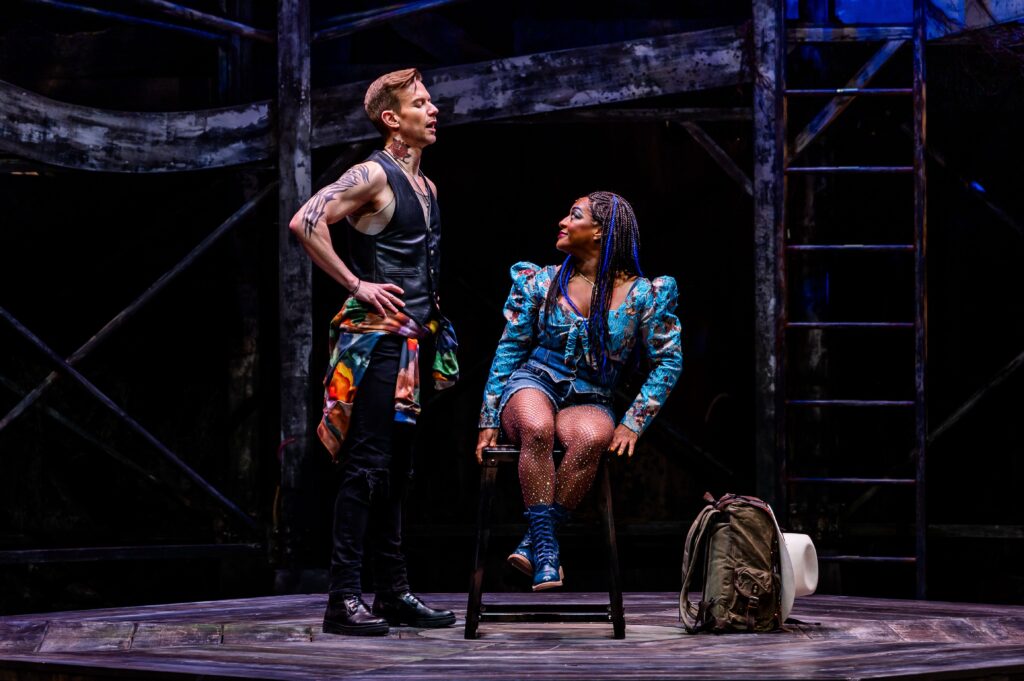
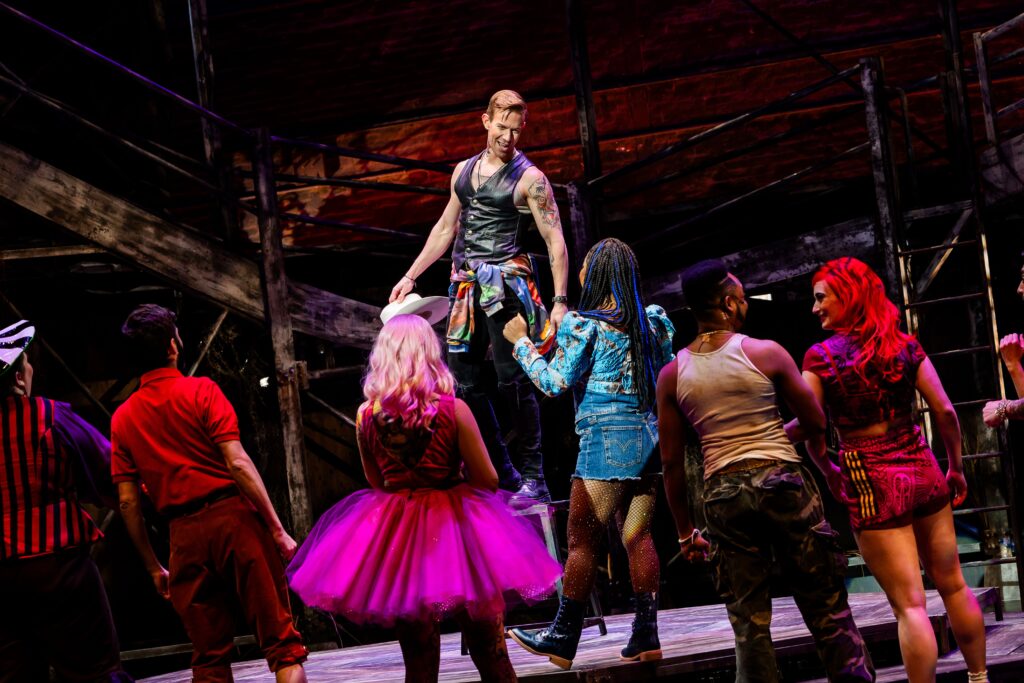
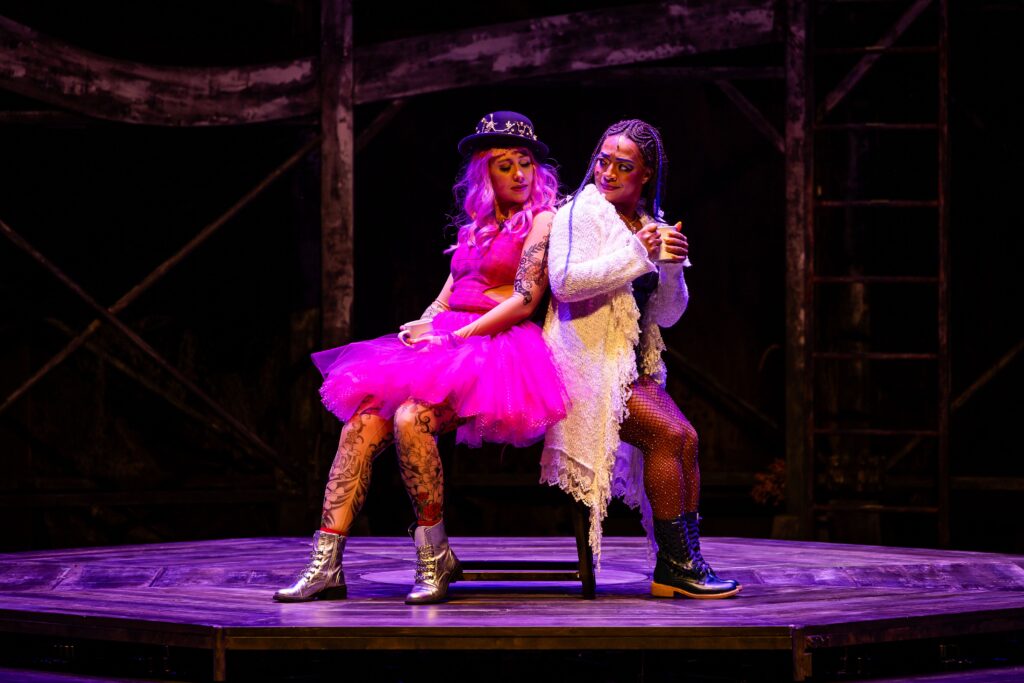
Billy Bigelow (Edward Nelson), the barker, bursts onto the stage clad in leather vest and huge white cowboy hat. All muscle with an animal charisma, he is the ultimate bad boy babe magnet. He meets — and flirts with — Julie Jordan (Brandie Sutton) and her friend, Carrie Pipperidge (Anya Matanovič). Mrs. Mullin (Sarah Meltzel), the carnival’s widowed owner, shows up and witnesses Billy and Julie. She clearly loves Billy, and when he refuses to throw Julie and Carrie off the grounds, she fires him.
Billy, now unemployed and distraught, needs a beer. He also needs a woman’s attention, and Julie is game, even though staying out past curfew will result in her getting fired, too. Their snake-bit romance leads to marriage, a daughter and a tragic end. It also yields some of the show’s best-known songs (“If I Loved You” and “You’ll Never Walk Alone”).
Meanwhile, Carrie confides to Julie that she too has a beau, Enoch Snow (Omar Nahun), a straight-as-an-arrow fisherman.
Billy, increasingly frustrated by not being able to find work, resorts to his ways of carousing all night with his criminal buddy, Jigger. He even hits Julie, earning him the reputation as a wife beater. When Julie announces she’s pregnant, Billy becomes relatively introspective (for him), looking at fatherhood as a chance to wipe the slate clean and focus on the future and his legacy. He vows to take care of his child and provide everything he lacked, especially money. He falls prey to abetting Jigger’s sly plan that, of course, fails. It’s no spoiler to divulge that Billy dies, and a good deal of Act II is spent with Billy in the afterlife, struggling to make sense of, and amends for, his life on Earth.
There are many bright spots in the production, especially Matanovič, whose gorgeous soprano singing and sparkling performance imbue Carrie with light and life. As Enoch Snow, her betrothed, Nahun brings similar energy and the two are a delight to watch. The vocals of most of the actors are sublimely operatic, befitting Carousel’s presentation as “opera theater” (vs traditional musical theater). Finally, Abigail Marie Curran as Louise, Julie and Billy’s daughter, is a whirlwind of fresh air. Her dreamy dance in Act II and pitch perfect combination of innocence and insolence bring the character to life and make one wish she had had more time on stage.
While there is a lot of visual flash and flourish in the production (and the orchestra does a great job), for those without a nostalgic hook to the show (and maybe even for those who grew up singing the songs around the family table), this production misses the mark on many levels. First is the lack of chemistry between Billy and Julie, despite the actors’ vocal ranges and skills. Sutton brings a softness and accessibility to Julie, but Nelson’s Billy is remote and static. It’s hard to believe in their romance, making it even harder to care when things go awry. Then, there are distracting missed lines and glaring miscasting of Theophile Victoria as mill owner and uptight Victorian prig, David Bascombe, and Lee Pelton as Starkeeper. Finally, the pacing elongates several scenes which could be glossed over and glosses over others that shouldn’t.
Whether you enjoy Bogart’s Carousel may depend heavily on the connection you already have with the show. By the end, my companion, who grew up listening to the LP, was teary, verklempt with emotion and nostalgia. After three hours (one intermission), I was just relieved it was over. Equity, Diversity & Inclusion Consultant, Kira Troilo, sums it up best in her program notes. “Can Carousel work now? The answer won’t be the same for everyone, and that’s exactly the point,” she writes.
Rodgers and Hammerstein’s ‘Carousel,’ 80th Anniversary Production. Music by Richard Rodgers. Book and Lyrics by Oscar Hammerstein II. Conducted by David Angus. Directed by Anne Bogart. Presented by Boston Lyric Opera, Emerson Colonial Theatre, 106 Boylston Street, Boston. Run has ended


 InSights