Tap and Piano Fuse Magically in the Unique ‘Counterpoint’

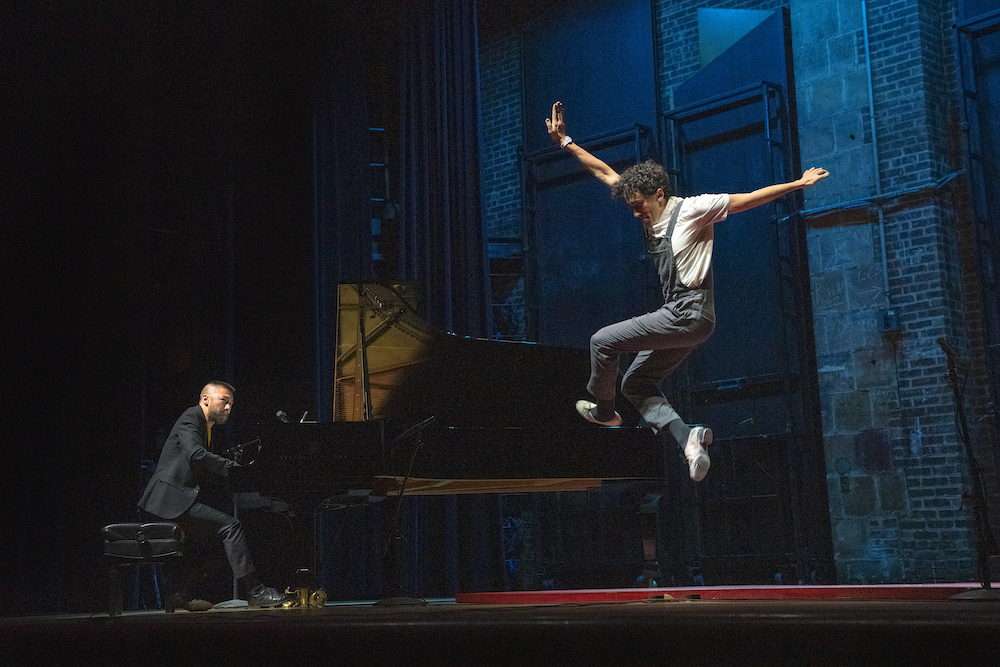
Conrad Tao (L) and Caleb Teicher in ‘Counterpoint, presented by Celebrity Series of Boston. Photo by Richard Termine

By Shelley A. Sackett

Counterpoint, the 75-minute collaboration between pianist and composer Conrad Tao and choreographer and dancer Caleb Teicher, is a magical journey that explores the interplays between two seemingly divergent art forms — tap and solo piano.

Yet, these two virtuoso performers, who met as teenagers and immediately hit it off artistically and personally, perform alchemy to fuse their music and dance and conjure something unique and thrilling. Their exploration of connection rather than divergence results in a program that feels more like eavesdropping on a private performative conversation than attending a formal concert.

Being in the audience (almost) equals the fun and exuberance they exhibit on stage.

“Counterpoint,” is defined in music as the art of playing melodies in conjunction with one another according to fixed rules. In Counterpoint, it becomes a discussion or conversation between Tao and Teicher’s different art forms of music and dance, between their different instruments of piano and tap and between the different traditions that have been attached to each.

It is also an opportunity for the two to improvise, bringing fresh energy to familiar pieces that span a wide selection of musical genres. Their back-and-forth brims with theatricality, harmony and raw rhythm.

Stylistically, the program of 11 pieces meanders from J.S. Bach’s “Aria” from his Goldberg variations to Art Tatum’s “Cherokee,” a Honi Coles and Bufalino Soft Shoe, Brahms’ Intermezzo in E Major, Gershwin’s iconic “Rhapsody in Blue” and back again to Bach’s “Aria.” There is a Schoenberg, Mozart and Ravel along the way, and even two exceptional original pieces, one that changes with each performance and is titled “Improvisation.”

The set is simple: a shiny piano, tap platform, and chair. At first, Teicher just sits as Tao’s soulful rendition of the Bach aria fills the hall. When Teicher stands, his white, short-sleeved jumpsuit is mirrored in the piano’s sheen. He slowly, thoughtfully begins to drag his feet, transitioning to graceful almost slow-motion ballet moves and  eventually breaking into a whimsical introduction to the clickity-clack of the tap element. It’s a perfect way to start this quirky tête-à- tête between pianist and dancer.

“Improvisation” at Saturday’s matinée started with a slow interchange between dissonant piano chords and the soft scarping of Teicher’s shoe. Both increase in intensity almost to the breaking point, yet the two rhythms complement, rather than compete with, each other.

Teicher gives the audience a glimpse of his prodigious stage presence with the theatrical facial expressions and body languages he brings to “Cherokee.” A mere tilt of the head, the whisper of a wink and a smile, silently speak volumes. With his introduction of “Coles and Bufalino Soft Shoe,” he is also the charming emcee, genuinely interested in having the audience join in on the fun.

“Swing Two,” an excerpt from the duo’s Bessie Award-winning “More Forever,” exemplifies the concept of Counterpoint, or two melodic lines interacting. Tao’s piano is as rhythmic as Teicher’s dancing, which is as tuneful as Tao’s keyboard.

The expressive, easily accessible “Rhapsody in Blue” earns the pair an interruptive standing ovation. Its happy fusion of jazz and Broadway and the dramatic blue lighting are perfect backdrops for Tao’s vivid, emotive piano and Teicher’s expressive dancing. They both display playful attitude in this piece. When Teicher strikes a pose or seems to float on the tip of his shoe, there is an impish, elfin hammy element to him that makes his performance all the more endearing.

Both have their solo moments too, Tao in the Schoenberg and Ravel pieces and Teicher in the Bufalino soft shoe and the magnificent Mozart “Alla Turca,” where he demonstrates tap’s vocal range while exuding joy and adorability. Although there is no piano accompaniment, Teicher’s masterful dancing creates an imaginary score which he encourages the audience to try to access. “When you hear these sounds and see me gesture and dance, use your imagination to create a story and fill in the blanks,” he advises. “Watch it again and think about what you see and feel.”

The program ends with an “Aria” bookend, and we have come full circle, but so much richer for the experience.

Celebrity Series of Boston presents Caleb Teicher & Conrad Tao in ‘Counterpoint.’ At the Boston Arts Academy Theater, Feb. 7-8.
Malpaso Dance Company Brings Its Hot Fusion of Cuban Dance, Music, and Spice to Boston’s Winter Wonderland

Malpaso Dance Company. Photos by Robert Torres

By Shelley A. Sackett

With good reason, Malpaso Dance Company is one of Cuba’s most sought-after dance companies. Since its inception in 2012, the company of 11 dancers has served as global ambassadors of Cuban culture, heritage and artistry.

Celebrity Series brought the vibrant troupe back to Paramount Center’s Robert J. Orchard Stage for three performances. On opening night, there was as much excitement in the packed house as there would be on stage during the 90-minute performance.

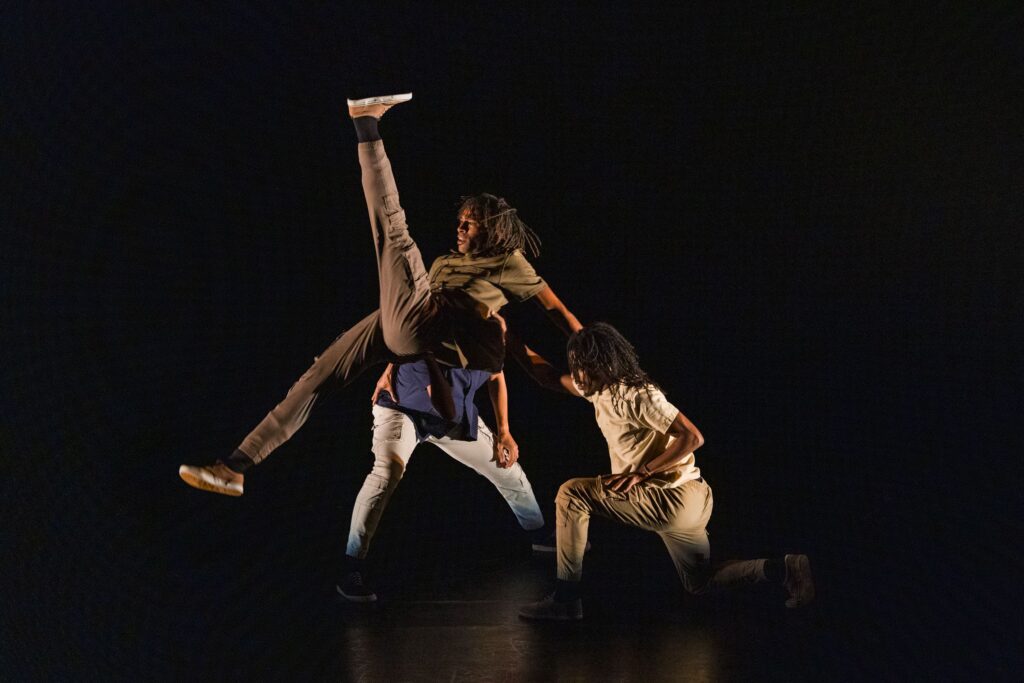
The program of three dances opened with “Floor…y Ando,” a 2023 piece choreographed by Ephrat Asherie (who also designed the costumes) and set to music by Aldo López-Gavilán. Three male dancers stand on stage as the piano jazz solo begins and the house lights dim. Two stand upstage; the third is somewhat downstage on the opposite side. Manuel Da Silva’s spot-on lighting catches their white shirts and pants, arms and legs moving slowly.

As the solo dancer starts to move, the other two follow his lead as mirrored tandem images. The music shifts to a more upbeat tempo, and the dancers follow with short, rapid, fluid floor work. They bounce and roll with joyous abandon, and just as quickly, they’re on their feet, leaping and then shuffling, their sneakers squeaking across the stage.

All too quickly, it’s over and the dancers walk off-stage as they walked on, two audience-left, one audience-right.

The piece (loosely translated as “Floor..and Walking”) is Asherie’s tribute to the late Gus Solomons, Jr., an American dancer, choreographer, dance critic, and actor who was a leading figure in postmodern and experimental works. He also studied architecture at M.I.T. One of his most quoted statements is, Architecture and dancing are exactly the same. You design using all the same elements — time, space and structure — except that in dance, time is not fixed.”

After a brief pause, the curtain opens on choreographer Ronald K. Brown’s “Why You Follow,” a 2014 piece set to hip-hop music that exemplifies the multicultural influences that make Cuba the unique artistic petri dish it is. The full company is dressed in simple costumes (Keiko Voltaire), each sporting a spot of red, either as a belt, shirt patch, or pant stripe. The effect is subtle and coherent.

The dancers celebrate the rhythms of the music by incorporating elements of salsa, samba and Bhangra. There is also a smattering of classical ballet and traditional jazz thrown into the mix. The pure, simple but never monotonous beat of the soundtrack (“Look at Africa” by Zap Mama; “En Route to Motherland” and others by Gordheaven & Juliano) has the dancers shaking their hips and the audience dancing in their seats.

The stage is set like a crowded club, and dancers appear as solos, pairs, and groups. Sometimes, the rush of figures feels like a conga line; other times, a single dancer’s graceful and impossibly supple body is the focus.

There is also a playful element in this piece, a funky, spunky confidence as the dancers circle the stage riding what could be stick horses that they slap with their long, graceful arms. This upbeat element is repeated throughout the piece, each time eliciting the same audience reaction of delight.

Clifton Taylor’s fire engine red lighting design mirrors the up-tempo and pulsation of the dancers and music, creating an electrifying performance that leaves the jubilant audience applauding wildly.

After a brief intermission, “A Dancing Island,” the evening’s longest and final piece, brings the full company back to dance to the music of Alejandro Falcón and Ted Nash & the Cubadentro Trio. Choreographed by Osnel Delgado in 2023, the piece is non-stop sparkle and fizz, a full-throated jamboree of thick, sultry, sassy and uniquely Afro-Cuban Music and dance.

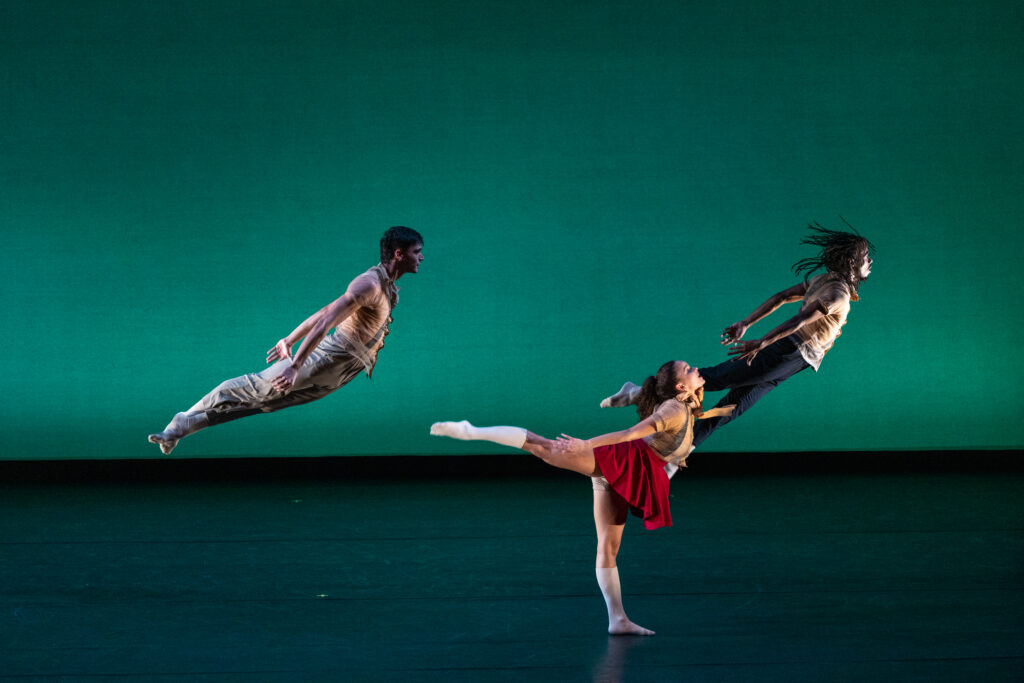
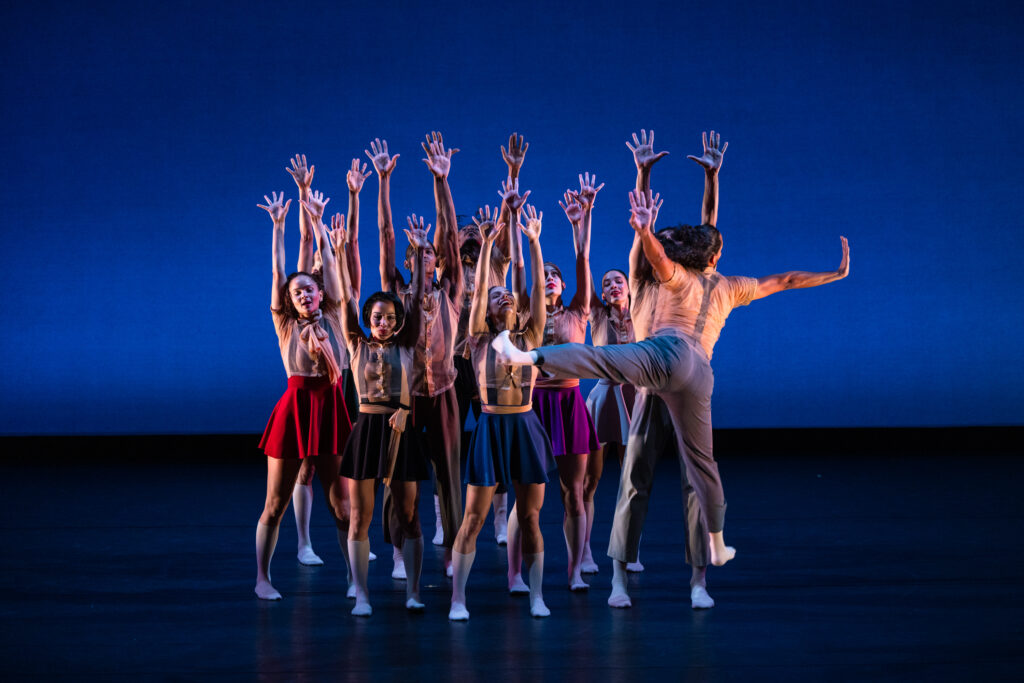
The piece opens with the sound of wind and/or waves, the dancers bathed in hazy spotlights (Manuel Da Silva), clad in flirty costumes (Guido Gali) that are as revealing as they are cheerleader cute. The women even wear white knee socks and T-strap shoes, their sheer-ish tops looking like suspenders over tattoos.

“A Dancing Island” is more of a journey than a single theme, with dancers hanging upside down, then lying prone on the floor for one minute and reflecting the more somber tone of a single female acapella voice the next. There is also an intense intimacy as dancers pair and intertwine, barely touching yet presenting in perfect synchronicity. At one point, the house lights come up and a dancer slowly walks down the aisle to join his partner on stage, a poignant and creative touch.

Like Malpaso Dance Company itself, “A Dancing Island” casts a wide net, one the audience is delighted to be caught in. The only shame is that they were in Boston for such a short time. Be sure not to miss them the next time Celebrity Series brings them to town!

Celebrity Series of Boston presents Malpaso Dance Company. Executive Director and Co-Founder Fernando Sáez. Artistic Director and Co-Founder Osnal Delgado. At the Robert J. Orchard Stage, Paramount Center, January 17-18.