CSC’s ‘As You Like It’ Breathes Fresh Air into the Bard’s Timeless Tale

Cast of CSC’s ‘As You Like It’. Photos by Nile Scott Studios

By Shelley A. Sackett

Boston is a garden of many earthly delights, but none more eagerly awaited and appreciated than Commonwealth Shakespeare Company’s Free Shakespeare on the Common that, for 29 years, has invited people to lay down a blanket, bring a picnic dinner, and enjoy top-notch theater on Boston Common under a starry crescent-mooned sky.

Founding Artistic Director Steven Maler shares in the program notes that he chose As You Like It (which he also directs with surgical precision) because it is one of his favorite Shakespeare comedies. Based on the audience reaction last Wednesday, he may have added many new members to the play’s fan club.

Believed to have been written in 1599 and first published in 1623, As You Like It is the Bard at his most engaging — witty, silly and just plain fun. There is something to sate most palates, from political upheavals to love in various forms to a spritely forest bohemian refuge to mistaken identities and disguises. Yet, beneath the surface is a message that rings timely and (hopefully) true — even in the darkest times, the brightest light at the end of the tunnel is the flame of connection and resilience.

The play bears Shakespeare’s trademark of complex storylines, tangentially related characters, flowery language and one unparalleled speech (in this case, the one that begins, “All the world’s a stage, and all the men and women merely players…”)
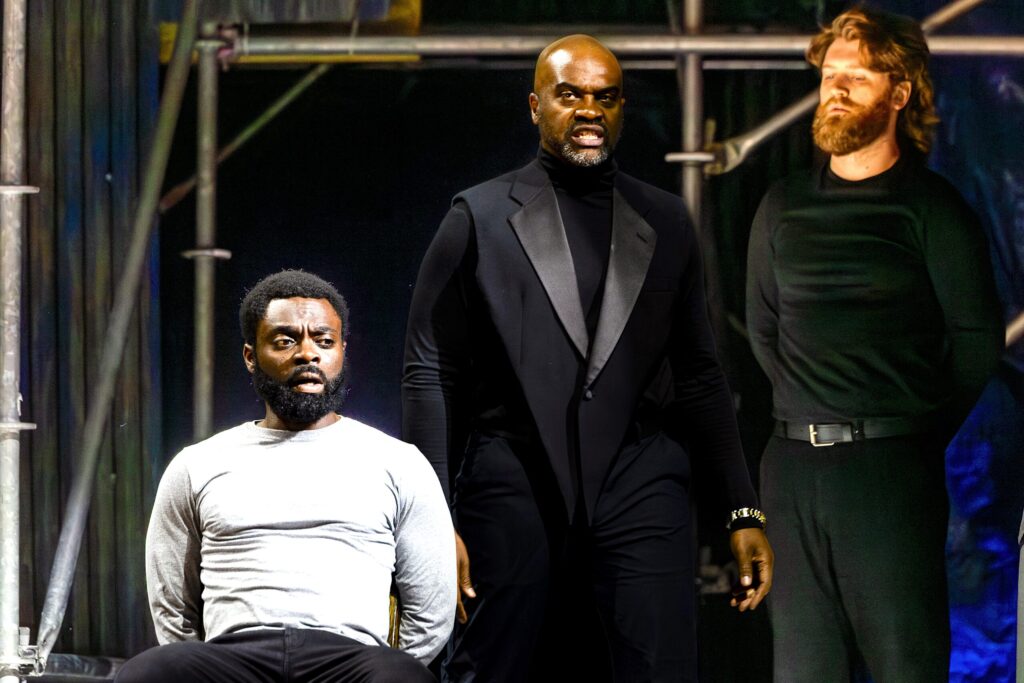
Joshua Olumide (Oliver), Maurice Emmanuel Parent (Duke Senior), and Cleveland Nicoll

Although billed as a comedy, the action opens on a dark note. Duke Frederick has banished his brother and rightful ruler, Duke Senior (both played by a plausible Maurice Emmanuel Parent), usurping a throne not rightfully his. Duke Senior has taken refuge in the Forest of Arden, and his daughter, Rosalind (a magnificent Nora Eschenheimer), has been allowed to remain in the court, mostly to keep her cousin, Celia (a charmingly bubbly Clara Hevia), company.

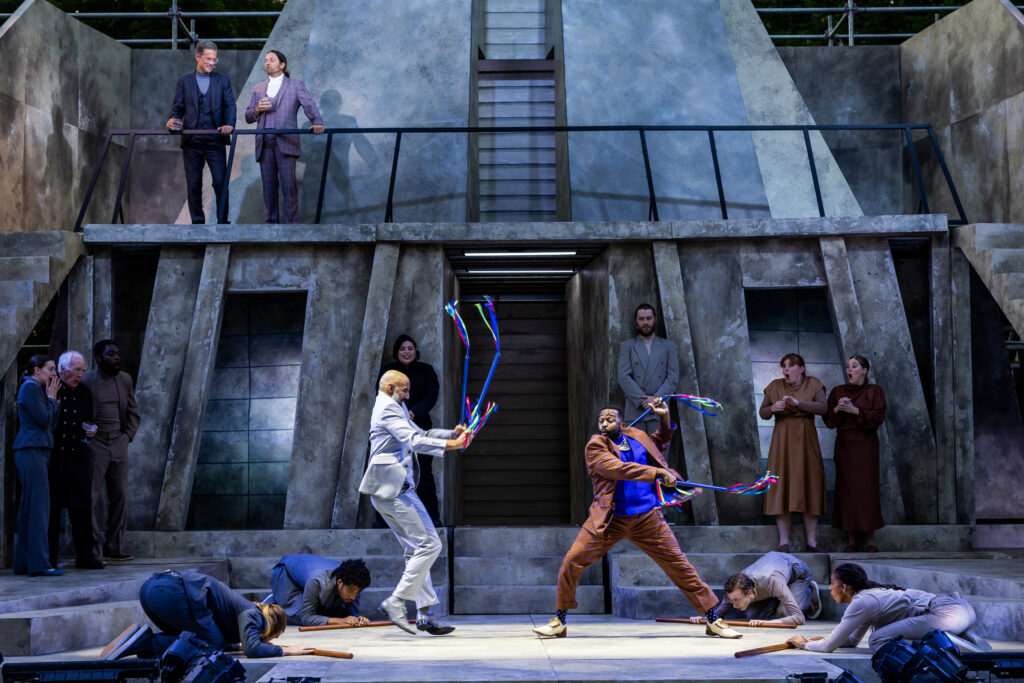
Enter into the court Orlando de Boys (Michael Underhill, an amalgam of James Dean, Marlon Brando and John Travolta). Orlando’s cruel older brother, Oliver (Joshua Olumide), has denied him the inheritance left to him by their recently deceased father. Looking for intervention from Duke Frederick, he instead literally steps into the court’s rink, forced to enter a wrestling match. He quickly dispatches the court champion, giving Orlando a chance to flash much muscle and toothiness. Rosalind, who witnesses the match, is thunderstruck with love at first sight.

Director Maler struts his stuff early on with this scene. Riw Rakkulchon’s set of sometimes clumsy (for the actors) scaffolding and metal fences echoes the depravity of the evil duke and his lackies. (It also brings to mind front-page headlines of the horrors immigrant detainees encounter in 2025 detention camps.) Drum beats and metallic rhythms (sound by Aubrey Dube) heighten the scene’s tension and primal flavor.

But when Orlando and Rosalind lock eyes, time stands still, and we are suddenly transported by Shakespeare’s rom-com mastery.

Nora Eschenheimer (Rosalind) and Michael Underhill (Orlando)

The plot thickens when Orlando discovers Oliver is planning to kill him, fleeing to the Forest of Arden with his aged servant Adam (Brooks Reeves). Meanwhile, Frederick banishes Rosalind, accusing her of being a traitor. She and Celia decide to disguise themselves (Rosalind as a lad, Ganymede, and Celia as his sister, Aliena), take the droll and clownish Touchstone (a scene-stealing John Kuntz), and head — you guessed it — to the Forest of Arden.

The forest is a melting pot of characters. There is the banished duke and his band of loyal followers (Paul Michael Valley brings a gravitas and grace to his standout performance as the moody, contemplative Jacques and Remo Airaldi is a delight as Corin, bringing a Jonathan Winters-like humanity and accessibility to his role). They meet and interact with local farmers and town folk, including a shepherd (Cleveland Nicoll as the patient Silvius) in love with haughty shepherdess Phebe (Stephanie Burden, either miscast, misdirected, or both). And, of course, there is our newest band of merry refugees.

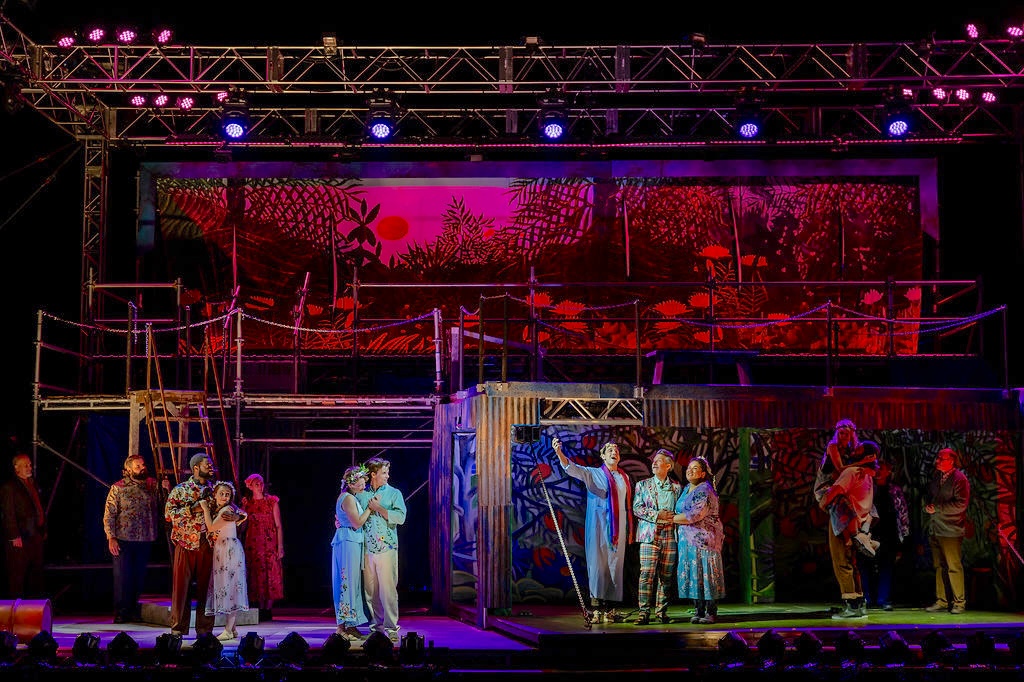
As stark and dark as the court set is with its chain link fence and threatening graffiti, the Forest of Arden is its opposite. Painted panels reminiscent of Henri Rousseau’s finest work brighten the stage, and musical interludes by Amiens (a terrific Jared Troilo) and guitarist Peter DiMaggio (who wrote the arrangements) add a light touch. The costumes (Miranda Giurleo) breathe a dream-like air into the scenes, but as we are constantly reminded, this exile is no dream.

The true stars and focus of the forest scenes, however, are Rosalind as Ganymede and Orlando. Orlando hangs love poems to Rosalind all over the forest and Rosalind (as Ganymede) befriends him, offering to let him practice on him/her so that when he finally meets Rosalind in the flesh, he will know how to woo her. The chemistry between the two is critical to keeping the ruse from becoming tedious, and Eschenheimer and Underhill have chemistry and talent to spare. Eschenheimer in particular is a spritely delight as she pretends to be a man pretending to be a woman.

John Kuntz and Remo Airaldi

Other standouts include Valley, who brings a particular poignance and freshness to the familiar “All the world’s a stage…” speech, and Kuntz, as the harlequin-clad Touchstone.

After a number of plot twists and turns (including a lion attack, sibling reconciliation, and love connections and triangles), all ends well with marriages, revealed identities and renounced usurpations. Maler’s thoughtful, playful direction, a stellar cast, and a fun yet thought-provoking script make for yet another fabulous summer production from the beloved and reliable Commonwealth Shakespeare Company.

‘As You Like It’ — Written by William Shakespeare. Directed by Steven Maler. Scenic Design by Riw Rakkulchon; Costume Design by Miranda Giurleo; Lighting Design by Eric Southern; Sound Design by Aubrey Dube. Presented by Commonwealth Shakespeare Production on Boston Common through August 10.For more information, visit https://commshakes.org/production/asyoulikeit25/
Commonwealth Shakespeare Co.’s “The Winter’s Tale” Sizzles on Boston Common

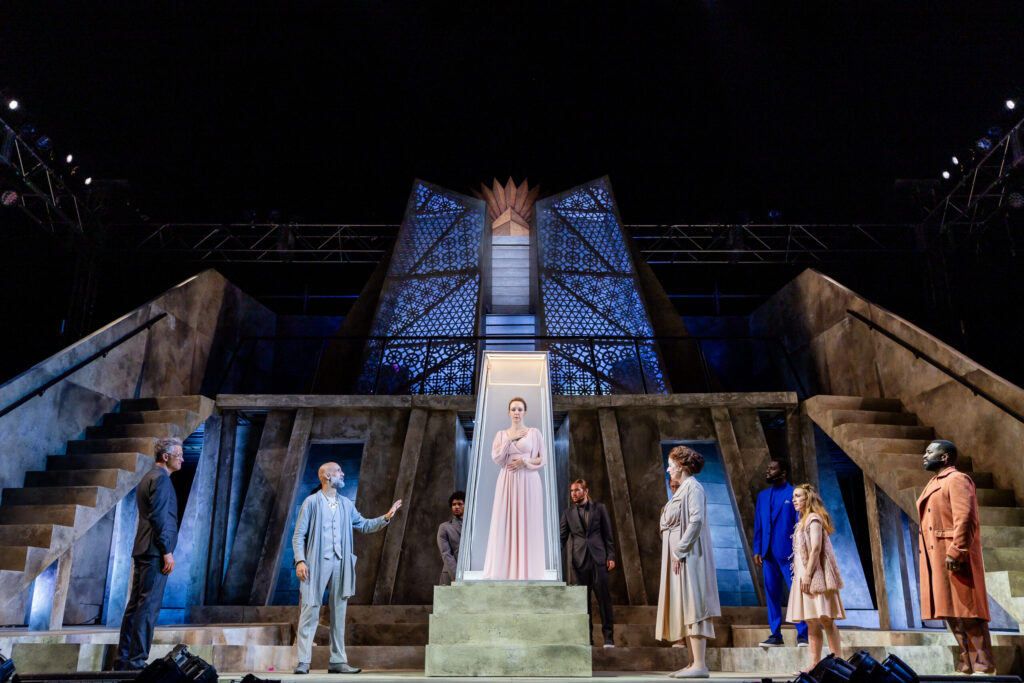
Cast of Commonwealth Shakespeare Co.’s “The Winter’s Tale”. Photo Credit: Nile Scott Studios.

“The Winter’s Tale.” Written by William Shakespeare. Directed by Bryn Boice. Scenic Design by James L. Fenton; Costume and Wig Design by Rachel Padula-Shufelt; Lighting Design by Maximo Grano De Oro; Sound Design by David Remedios; Original Music by Mackenzie Adamick. Presented by Commonwealth Shakespeare Company for Free Shakespeare on the Common, Parkman Bandstand, 139 Tremont St., Boston, through August 4.

By Shelley A. Sackett

The drizzly chill overhead did nothing to dampen Commonwealth Shakespeare Company’s sizzling (and free!) production of Shakespeare’s The Winter’s Tale. From James J. Fenton’s spectacular set to director Bryn Boice’s nuanced yet spunky direction to the exceptional cast, the evening was an example of Boston’s cutting-edge theater scene at its most exciting.

Although the clear-as-bell sound (Sound Design by David Remedios) and colloquial cadence of the actors’ deliveries didn’t require them, two large screens with closed captions were an added bonus, enhancing our ability to really savor Shakespeare’s Elizabethan verse. (There are some truly great and rarely quoted lines in this play.)

The Winter’s Tale was dubbed one of Shakespeare’s four “problem plays” by English critic and scholar Frederick S. Boas because it doesn’t fit neatly into the silos of tragedy or comedy but rather straddles the two. According to Boas, Shakespeare’s problem plays set out to explore specific moral dilemmas and social problems through their central characters. Boas contends that the plays encourage the reader to analyze complex and neglected topics. Instead of providing pat answers and arousing simple joy or pain, the plays confuse, engross, and bewilder.

Boas certainly was spot on as far as The Winter’s Tale is concerned.

The action opens with a full head of steam as a large cast of well-dressed men and women cavort in the castle of Leontes, King of Sicilia (played by the always magnificent Nael Nacer). His pregnant wife Hermione (a radiant Marianna Bassham) and their son are surrounded by loved ones as they entertain King Polixenes (Omar Robinson, fresh from his success in “Toni Stone”), Leontes’ childhood best friend and king of Bohemia.

Polixenes is set to depart for Bohemia after a nine-month visit to Sicilia. When Leontes’ attempts to persuade him to stay longer are unsuccessful, Hermione playfully takes up the challenge. After some innocent and very public mock hanky-panky of hand-holding and cheek-pecking, she accomplishes what Leontes could not. Polixenes will stay one more day.

As the audience witnesses the lightness of Polixenes and Hermione jesting stage right, there are dark clouds gathering stage left, where Leontes is slowly going off the rails. Nacer brings the full force of his physical talent to bear as we swear we see Leontes grow antennae that crackle and hum with every word spoken and gesture exchanged between his wife and best friend.

By the end of the scene, Leontes has gone feral, descending into an all-consuming raging derangement of sexual jealousy. He convinces himself that Hermione has cheated on him with Polixenes and that the baby Hermione carries is the result of the affair.

Leontes plunges into a madness that makes MacBeth and Hamlet look like amateurs. He transforms from a benevolent king to a tyrannical despot, declaring that Hermione will be tried for her crime of adultery, the punishment for which is imprisonment and possibly death. Othello may have his Iago, but Leontes has no need for anyone to egg him on; he is both torturer and the tortured, “in rebellion with himself.”

He entreats Camillo (an engaging Tony Estrella), his cupbearer, to poison Polixenes, but Camillo instead warns Polixenes and flees to Bohemia with him. Not even Paulina (the fabulous scene-stealing Paula Plum), a loyal lady-in-waiting to Hermione and the voice of Leontes’ conscience, can persuade him he is wrong. He can’t see that rather than outraged victim, he is the outrageous culprit.

Hermione gives birth to a girl, Perdita (Clara Hevia), whom Leontes commands Paulina’s husband, Antigonus (Robert Walsh) to abandon in Bohemia. On that dark note, Act I closes as the madness of Leontes’ paranoid jealousy takes its toll, leaving him standing in the smoldering ashes of what once was the heart and hearth of his family and kingdom.

Act II opens in a 180 degree turnabout, the comic antidote to Act I’s tragedies. Both Shakespeare (with his clown and trickster characters) and Boice (with her 21st century spin) have some fun.

Sixteen years have passed. Shakespeare has created a Greek chorus of one in his character Time, gifting her with an explanatory monologue that no one but Plum could deliver with such grandeur and emotion. Boice’s staging is breathtakingly brilliant.

Perdita, who ended up in Bohemia and was found and raised by an old shepherd (the endearing Richard Snee), is throwing a sheep shearing party to end all sheep shearing parties. It is the equivalent of her sweet-16, coming out celebration. Techno music reverberates. Neon abounds (Lighting Design by Maximo Grano De Oro). The guests dress and behave like MTV extras (Costume and Wig Design by Rachel Padula-Shufelt).

Although (like many MTV routines) it goes on a little too long, the scene draws our attention to the stark contrasts between the doom and gloom of Act I’s despotic Leontes’ Sicilia and Act II’s kinder, gentler Bohemian landscape and lordship.

Perdita even has a boyfriend, King Polixenes’ son Florizel (Joshua Olumide). Their relationship is the balm that ultimately heals the rift between their fathers and their kingdoms, a testament to Virgil’s poetic phrase, “Love conquers all.”

Eventually, all ends well enough and Shakespeare manages to reunite friends, foes and family. Leontes repents for his misguided ways, reaping forgiveness and sympathy. As far as he is concerned, he is redeemed and pardoned for his brutal and abusive misuse of power of trust. The death and destruction he caused was collateral damage, water under the bridge. Even Hermione, trapped as a statue, is resigned and forgiving.

Yet, the Bard has left a bitter taste in our mouths.

Boas was right about problem plays. “The Winter’s Tale” certainly explores specific moral dilemmas and social problems through its central characters, leaving us indeed engrossed and bewildered, especially given the discordant nature of the nation as it faces yet another toxic election season.

It is hard to sweep aside the gravity of Leontes’ transgressions and the sleight of hand by which they vanish. He wrecked a world and is then put on a pedestal when he conveniently comes to his senses and rues his own loss. Where is the fairness in that? What moral, social messages are we meant to take away? Where, Mr. Shakespeare, are the eloquent railings against tyranny, toxic masculinity and falsehood? Where are the consequences for immoral and corrupt behavior? And, a few empowering monologues notwithstanding, where have you left your women?

Highly recommended.

For more information, visit commshakes.org/production/winterstale.