DTF’s Timely ‘True Art’ Is A True Masterpiece

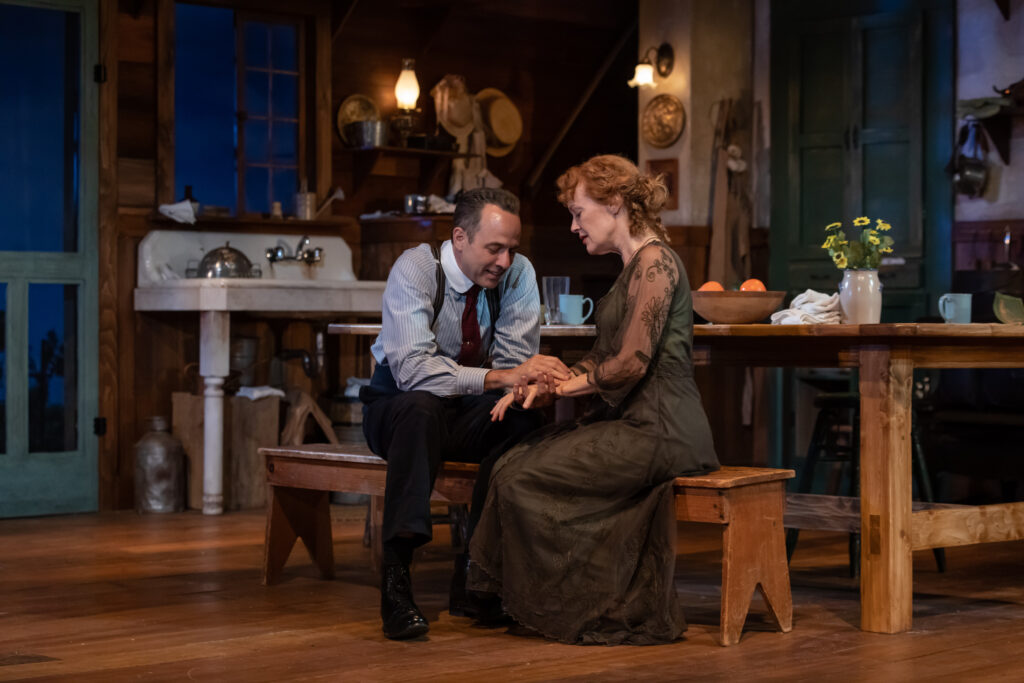
Jayne Atkinson, Fiona Robberson in Dorset Theater Festival’s Timely ‘True Art.’
Photos by T Charles Erickson

By Shelley A. Sackett

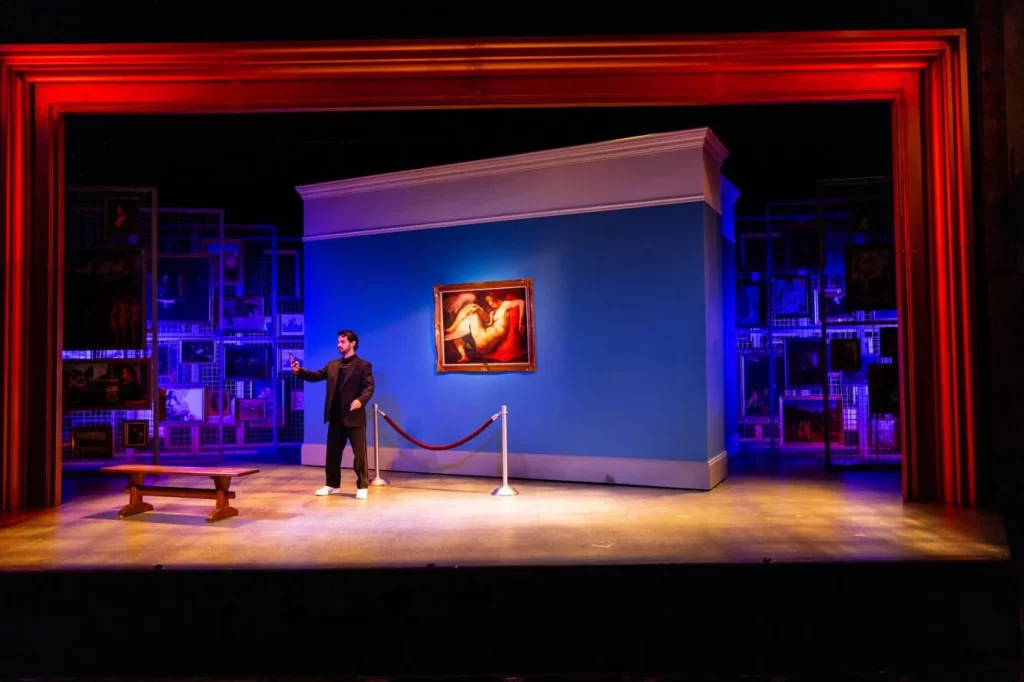
It was good planning to arrive a little early for the Dorset Theatre Festival’s world première of “True Art.” The bewitching set begged a closer look. Center stage, basking in Renaissance splendor, is Michelangelo’s “Leda and the Swan,’ mounted on a rich burgundy panel. Stage left and right are mirror rows of vertical metal grids, each loaded top to bottom with the A-list of coveted museum possessions, from Pollack to Picasso and Monet to Miro.

These were very good replicas, so good in fact, that even up close, even knowing I was in a converted barn in Dorset, Vermont, and not on Museum Mile in New York City, for a split second, I felt like I was on hallowed artistic ground. Although stage prop replicas, these paintings could evoke the same kinds of feelings as the real McCoys.

Is that a bad thing? Is “fake art” valueless? Can only authentic art evoke valid feelings? Is an emotional reaction to counterfeit art necessarily counterfeit too?

It turns out one of the central questions playwright Jessica Provenz asks in her biting, suspenseful, thought-provoking, and funny newest play is in this same vein: In the provenance of the art world, what makes something — and someone — authentic? Is it the art or the artist? Is it what’s on the canvas or what the critics have written about its artist?
Charlie Reid

And, more importantly, how much does its history and reputation as an “important” work of art influence whether and how much we do — or feel we should — like it?

Provenz has a light touch and a gift for writing colloquial dialogue, so her play doesn’t bog down under the weight of these and other important issues she raises. What a gift to make your audience simultaneously laugh, gasp, and contemplate, which she does from the moment the play starts.

The action begins in media res at Christie’s auction house. Between the Swader’s set and Joey Moro’s projections, it is as if we are in the audience as auctioneer Buddy Silver (Bob Ari) coaxes higher and higher bids out of imaginary art collectors. On the block is “Leda and the Swam,” the lost Michelangelo painting recently discovered in a farmhouse somewhere in France.

The painting sets a new record for the most ever paid for a work of art.

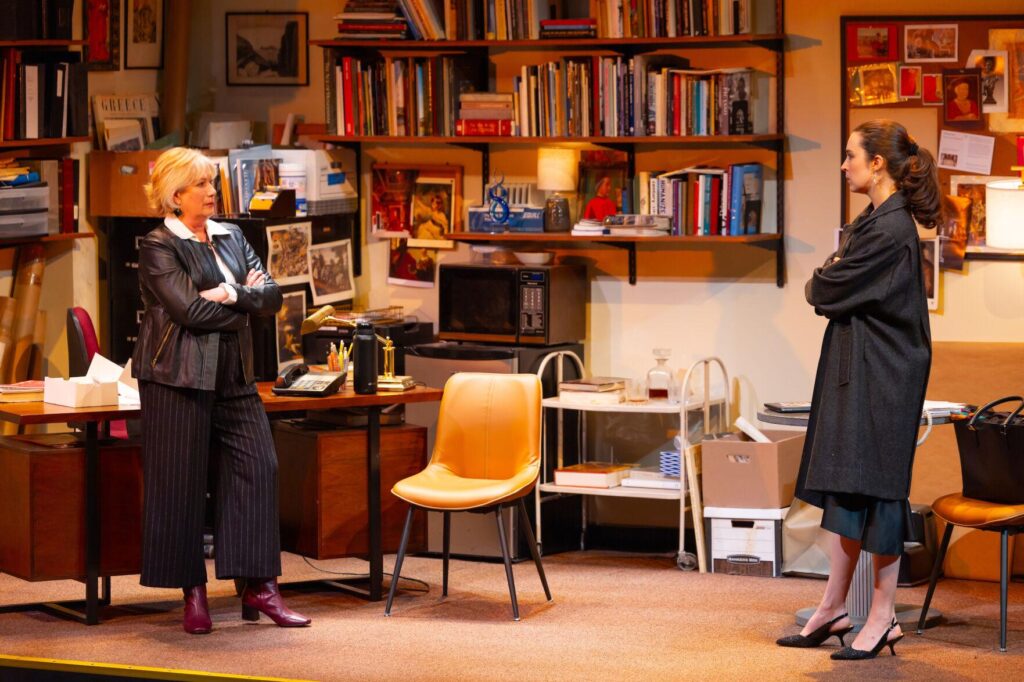
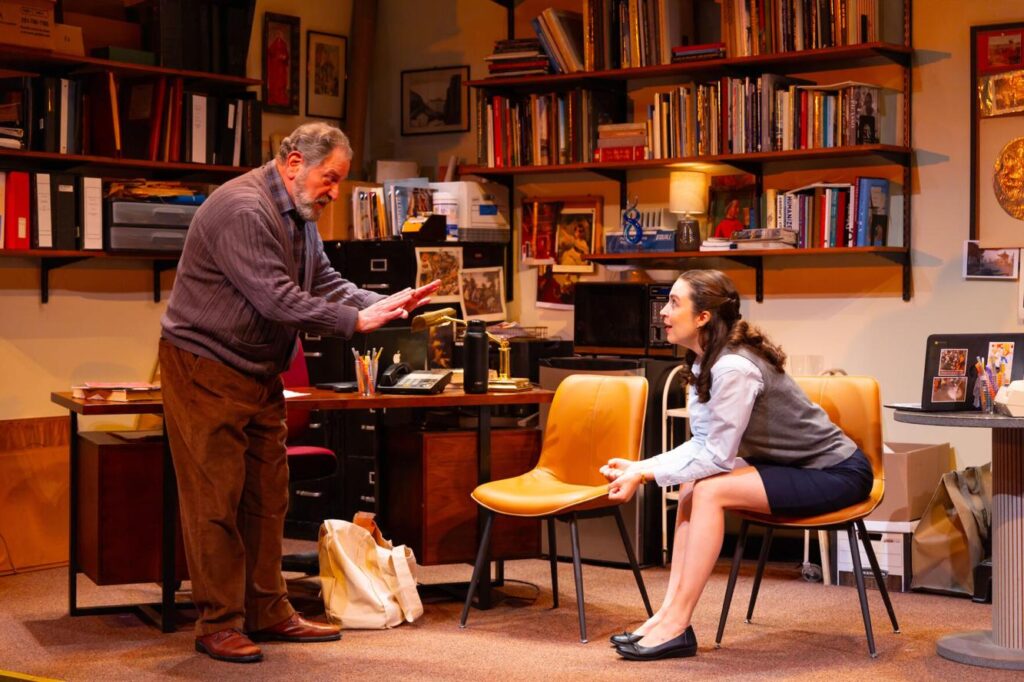
The scene switches to a bench in front of a painting in a gallery at an iconic and prominent museum, where we meet 22-year-old Lauren Anders (a wonderfully talented Fiona Robberson), a midwestern art history major and the new temp of Jodi Dean (the always fabulous Jayne Atkinson). Dean is the 60-something curator of Renaissance art and has a reputation for eating her interns alive. She averages one per month.
Bob Ari, Robberson

Enter J.J. Winchester (Charlie Reid), a flirty, slouchy young man around Lauren’s age who seems to have the keys that open every door in the museum yet has no articulable reason to be there. We get a lot of information from their casual and clever conversation.

Jodi, J.J. tells Lauren, is known as “Dragon Lady” and has had to claw her way to her position of power. She is the only woman being considered for the museum directorship and J.J.’s dad, the museum’s chairman of the board, is the lone holdout on her achieving this life-long goal.

The two are attracted to each other, and the actors bring an innocent carnality and spot-on delivery to their roles. Lauren tells J.J. she intends to become Jodi’s new intern. J.J. bets Lauren she won’t last the day as a temp.

As she scampers off to face the lion’s den, J.J., clearly smitten, gifts her with the tip that Jodi likes her coffee black, extra sweet.

The Swader’s marvelous set then swivels to reveal Jodi in her lair. Atkinson is perfect, playing Jodi as a gladiator and survivor who, from time to time, reveals emotions that surface through the chinks in her armor. She greets Lauren with daring and disdain. She immediately sets ground rules and lets Lauren know the lay of the land.

From the get-go, Lauren stands her ground while slyly taking the wind out of Jodi’s confrontational sails. She predicts and fulfills her desires (like coffee taken black with extra sugar) while pretending to defer, bow and scrape. Lauren is, after all, a Jodi wannabe. She is as determined and ambitious as her boss, willing to do what it takes to get where she wants to go.

Jodi is on her way to an important press conference. It turns out that Jodi and Buddy, Christie’s auctioneer, art dealer, and her sometime boyfriend, are the ones who found the lost Michelangelo masterpiece, “Leda and the Swan.” Her Renaissance department was the anonymous bidder that purchased it.

It also turns out that Lauren did her thesis on that very painting. She does not share her boss’s enthusiasm for the painting or the story of how it was miraculously discovered. Her challenge is to figure out how to navigate in a dangerous sea of deception and high stakes while maintaining her integrity and her job.

Against this thriller backdrop of smoke and mirrors, truth and lies, Provenz weaves a fabulous page-turner plot that examines two meaty topics. First is a deep look into what it takes for a woman to achieve power in a male world and the lengths she will go to retain it as she reaches the twilight of her career.

The second is the whole notion of authenticity, both in the art world and the world of everyday honor and decency. Do facts matter? Does the truth matter? Does getting it right matter as much as getting ahead?

A woman in power? Facts mattering? Timely indeed.
Robberson, Atkinson

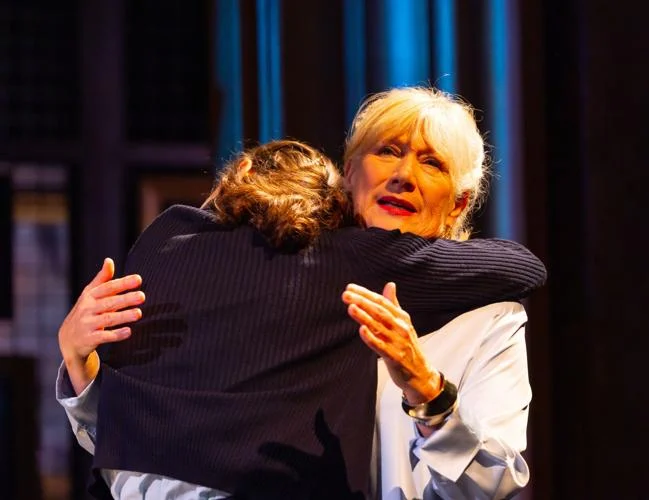
Director Michelle Joyner has an all-star cast to work with, and she milks their talent and Provenz’s script for all they’re worth. Atkinson, known on stage and television, has the chops to tap into both Jodi’s inner Dragon Lady and her insecurities with humor and humanity. Ari plays Buddy with equal parts smarm, charm, and menace. Reid is chameleon-like, understated and enigmatic one minute, and taking the helm and righting the ship the next.

But it is Robberson as Jodi’s protegée Lauren who really shines in every scene. She has a physicality of gesture and facial expression that dares the audience to look away from her. Hopefully, DTF theatergoers will see more of her next season.

“True Art” is chockful of great lines, high production value, and stellar performances, making it a theater lover’s trifecta of bounty. Yet it also leaves us with plenty to spark after-theater conversations, which are the measure of the most satisfying experience.

Jodi is at her rawest and most honest at the play’s end, when she looks herself in the eye, acknowledges the corners she cut and compromises she has made for the sake of her ambition, and wonders if it was worth it.

“What if my life’s work is wrong? What am I then?” she asks softly. What indeed.

“True Art” – Written by Jessica Provenz. Directed by Michelle Joyner. Scenic Design by Christopher and Justin Swader; Costume Design by Barbara A. Bell; Lighting Design by Patricia M. Nichols; Sound Design by Jane Shaw; Projection Design by Joey Moro. Presented by Dorset Theatre Festival, Dorset, Vermont. Run has ended.
In DTF’s ‘Misery,’ Writing Like Your Life Depends on It Takes On New Meaning

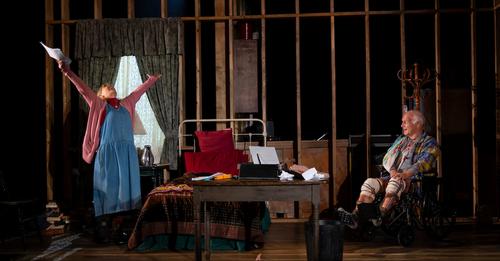
Kelly McAndrew and Dan Butler in ‘Misery’ at Dorset Theatre

By Shelley A. Sackett

Fans of Stephen King’s 1987 novel or Rob Reiner’s 1990 award-winning film, Misery, should not expect more of the same from Dorset Theatre Festival’s season opener, Misery. Playwright William Goldman has transformed the nail-biter of a scary suspense thriller into a lukewarm reminder of its prodigal self.

The excellent cast, director, and production team make the most of the script and gift the audience with an enjoyable evening of theater, but it was hard not to wonder what the same team might have cooked up had they had better-quality raw ingredients.

The plot remains pretty much the same. Annie Wilkes (a convincing and scene-chewing Kelly McAndrew) lives alone in her gothic family home in the remote backcountry of Silver Creek, Colorado. In one of her guest bedrooms lies the shattered body of best-selling romance novelist Paul Sheldon (Dan Butler), whose car went off the road in a snowstorm a few days ago. It seems Annie, his “number one fan,” just happened to be driving behind him when his car plunged into a ravine. Somehow, she managed to wrest his mangled body from the wreckage and bring it home to convalesce.

Paul awakens from the crash to Annie’s chirping chatter as she fills him in on the last few days. His two legs are badly fractured. She has set them to the best of her ability (Isn’t he lucky she’s a nurse!) and plied him with just enough drugs to ebb his pain while increasing his dependence on her.

Annie is more than an obsessed fan of Paul’s Misery series, about an orphaned 19th-century waif named Misery. She is also a lonely, middle-aged homicidal psychopath who talks to God, is divorced, wanders through her house surrounded by photos of dead relatives, and is an expert at lying and stalking.

As she slowly exposes the levels of her derangement and fixation on the Misery character, it becomes clear she intends to do more than just heal Paul. She intends to imprison him. Until death do them part.

Or at least until he writes another novel, which may just spare his life. Or, toys with Annie in this cat-and-mouse game in which she is recast as a lioness and he as a crippled cricket; then again, it may not.

In any case, write he must, as Paul’s life indeed does depend on it. Unbeknownst to Annie, his most recent installment in the Misery series kills off her beloved heroine. Coincidentally, the book’s release overlapped with Paul’s stay at Annie’s.

As his Number One Fan, Annie, of course, has her local bookstore save her all the new Paul Sheldon books. One day, she bursts into his room, triumphantly brandishing her copy.

Annie is excited beyond her wildest dreams. To be reading her idol’s latest Misery book while he is living in her house brings a creepy Little Bo Peep lilt to her gait. Paul knows (as do we) that Little Miss Sunshine will morph into Chucky the moment she reaches the end of the book. Exactly when that will happen is uncertain, but when it does, Annie’s rage will be of force majeure quality.

For his part, Paul is at first grateful, then wary, and finally determined to escape this real-life misery. His pithy, New York sophisticated banter turns less glib as he realizes the peril he is in and plots his escape, no easy feat for a man with two broken legs and an antique wheelchair for a getaway vehicle.

Goldman has provided Annie’s character with the best lines and the grisliest of backstories, and McAndrew milks it for all it’s worth. When Paul pretends to court her, luring her to a romantic dinner as part of his escape plan, Annie sheds her overalls and boots and shows up in a dress befitting Laura Ingalls from “Little House on the Prairie.”. It would be a touching scene if it weren’t for the sheen of Bette Davis’s Baby Jane character with which Annie powdered her nose.

Butler, a talented actor with star-studded credits, does the best he can with the cardboard Paul. Riw Rakkulchon’s revolving set creates a folksy, cozy country home that would be at the top of anyone’s Airbnb list. Thanks to dramatic lighting and sound design, the scenes come to creepy life. Kudos, too, for a system that allows the actors’ words to be easily heard and, more importantly, understood, something increasingly and annoyingly rare in too many Boston theaters.

It’s hard not to miss the intensity and tension generated by the Misery novel and film, but for those in the mood for a Misery-lite summer version that recasts the horror tale as a more whimsical melodrama, Dorset Theatre Festival has just the ticket.

‘Misery’ –Written by William Goldman based on the novel by Stephen King. Directed by Jason Gay. Scenic Design by Riw Rakkulchon; Costume Design by Fabian Fidel Aguilar; Lighting Design by Joey Moro; Sound Design by Daniel Baker/Broken Chord. Presented by Dorset Theatre Festival, Dorset, Vermont, through July 8.

For more information and to buy tickets, visit https://dorsettheatrefestival.org

Dorset Theatre Festival Closes The 2022 Season in Triumph with Its Remarkable World Première of “Thirst”

 David Mason and Kathy McCafferty in THIRST at the Dorset Theatre Festival. Photos by Joey Moro

by Shelley A. Sackett

Arriving early for “Thirst,” playwright Ronán Noone’s dazzling new play, is a stroke of good ole Irish luck. A crisp sound system pumps toe-tapping traditional pub music, setting a jig-worthy mood. Functional period lamps bathe the livable kitchen set in warmth, creating a cozy tone for arguably the best theatrical experience of the 2022 summer season.

By the time the Irish lilted announcements herald the play’s start, the audience has been transported to another time and another place.

And what a time and place it is.

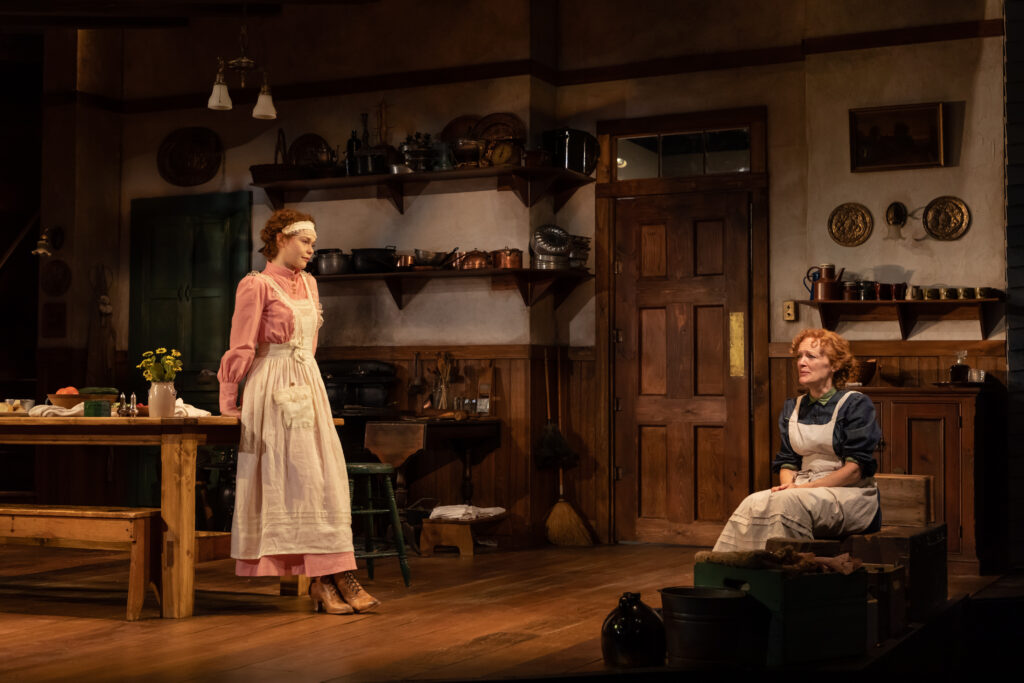
Noone sets “Thirst” in the kitchen of the Tyrone family’s seaside Connecticut home on the August day in 1912 when Eugene O’Neill’s classic tragedy, “A Long Day’s Journey Into Night” takes place. [Although familiarity with that play is not a prerequisite to “getting” ‘Thirst,’ Noone sprinkles his script with delicious breadcrumbs for those who have tasted the original to follow.]

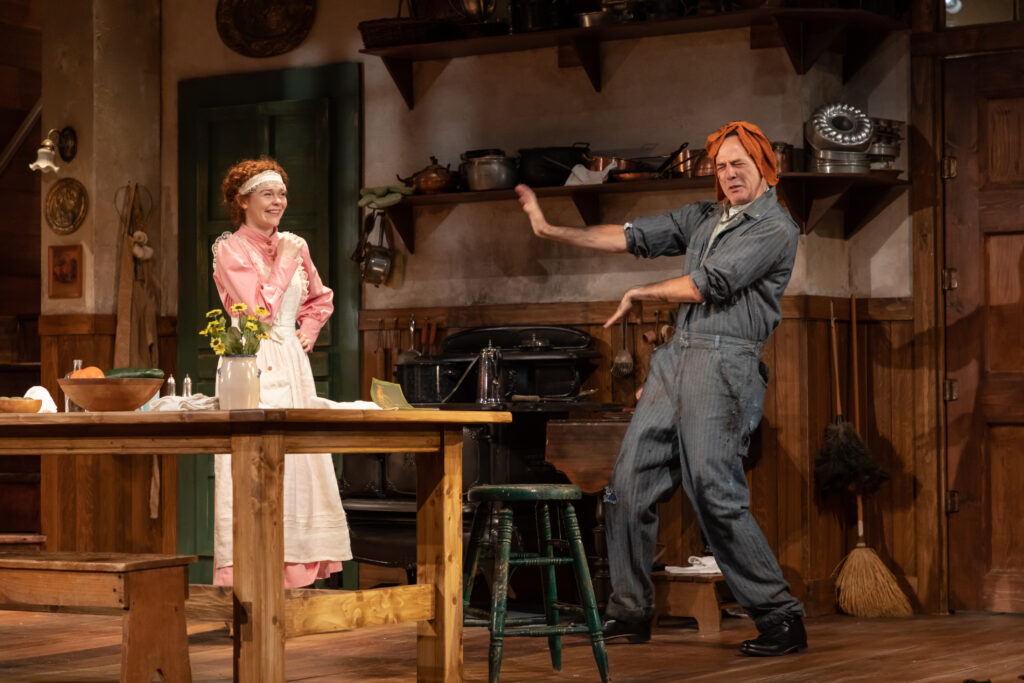
While the Tyrones spend the day destroying themselves and each other offstage in their toile-wallpapered dining room, their cook, kitchen maid and chauffer spend theirs in the kitchen, sitting around the table together, enjoying their privacy and relative freedom while performing their demeaning menial duties. Their individual posts may have led them to this quasi-family-by-default situation, but they are genuine in their interactions. They bicker, they laugh, they tease and they worry. But they do it together, and it comes from their hearts. They genuinely need and enjoy each other’s company.

Each brings a different, but similar, back story to the mix.

Bridget Conroy emigrated from Ireland 16 years ago to become the Tyrone’s cook. Her outer shell is brittle and cynical, but she saves her harshest criticism and reproach for herself, especially for her closeted alcoholism. Yet, the only time she emerges from her carapace is when she’s juiced enough to black out the shame and regrets that poison her every sober breath and thought. Only then can she express — and admit to — the love and need she has for Jack.

Meg Hennessy, McCafferty

For his part, Jack Smythe, a local native and the Tyrone’s chauffeur, grew up poor in this place that is playground to the spoiled rich. He yearns to leave his hometown with its paper trail witnessing his past transgressions and finally, as he approaches middle age, set out to secure his independence and happiness.

Last, but hardly least, is the winsome new arrival, Cathleen Mullen, Bridget’s 18-year-old niece who miraculously survived her trip over on the ill-fated Titanic. She is feisty and blindly optimistic, determined to climb the golden ladder of American success.

These three flawed characters bring real troubles and equally real compassion to their shared  table. Bridget was banished from her home after giving birth at age 16; that birth is only thing she has done in her life that she’s proud of, in spite of its personal cost. Like the penitent sinner she believes herself to be, she dutifully sends money and a letter to her family every week. In 16 years, she has received not even a postcard in return. Although she loved the beach in Ireland, she won’t go to the sea just down the street, either because it makes her too homesick or because she must deny herself all pleasure as penance for her sin, or — most likely — both.

Jack was a drunk, so far gone he couldn’t face his wife’s illness and death and even missed her funeral, when Bridget found him in the street and, like a sick stray, took him home and nursed him back to physical and spiritual health. In return, Jack is determined to offer her the same life raft and save her from a life of self-pity and recrimination — a life he knows too well — not because he owes her, but because he loves her.

Cathleen’s bubble is burst when, shortly after arriving in America, she receives a letter from her fiancé announcing he is ditching her for a woman with property. She’s more annoyed and humiliated than heartbroken. Young, ambitious and resilient, she naively throws herself behind a ditzy plan to become the next “it” girl on Broadway.

These three have more in common than their woes, regrets and heartbreaks. They are survivors and they share a determination to live, no matter the consequences. They also really care about each other. Noone, with his well-tuned ear and light touch, pens robust yet sleek dialogue that tackles a lot of big ticket topics (shame, redemption, assimilation, discrimination to name a few) while staying grounded in the here and now of these three individuals and their intertwined daily lives.

By Ronán Noone Directed by Theresa Rebeck, Scenic Design: CHRISTOPHER & JUSTIN SWADER, Costume Design: FABIAN FIDEL AGUILAR, Lighting Design: MARY ELLEN STEBBINS, Sound Design: FITZ PATTON, Stage Manager: AVERY TRUNKO

Rebeck’s direction is economical, efficient and effective, and she lets each actor spread their wings and breathe life and individuality into their characters. They inhale, they exhale, they react, interact and bring each other lightness and laughter. Kathy McCafferty, as Bridget, is a whirling dervish of anger and productivity, and the kitchen is her made-to-order stage. She cooks (making real scrambled eggs over a real range), scrubs, arranges, rearranges and throws pots and pans, all while letting fly mouthfuls of rapid-fire heavily accented lines.

David Mason brings a lanky self confidence and Kevin Costner-esque genuineness to his Jack. He is a regular, decent guy who made a mistake, acknowledges it and just wants a shot at the brass ring with the girl of his dreams — nothing more, but nothing less.

Rounding out the trio is the lithesome and impossibly creamy-skinned (think yogurt, not heavy cream) Meg Hennessy as the vivacious Cathleen. She brings comic timing, physicality and a gift for facial mood changes that are as talented as they are entertaining.

If there is a flaw, it is that the women’s accented rapid-fire delivery is often muffled or lost, a shame (and annoyance) considering the richness of Noone’s craftmanship. A little microphone could go a long way.

That aside, there are too many positives to give them all justice. Mary Ellen Stebbins’ lighting paints the day’s passing with a sun shape shifting across the kitchen walls. Fitz Patton makes optimum use of a terrific sound system. And Christopher and Justin Swader’s set design, with its punctuating swinging back door, adds more than a mere scenic element — it is an escape route from all the Tyrone kitchen represents to a world of fresh air and fresh starts.

That door swings both ways. Jack and Bridget, after two plus hours, finally manage to cross over the threshold to the land of hope and promise. And Cathleen? Only time — and perhaps a sequel — will tell.

‘Thirst’ — Written by Ronán Noone. Directed by Theresa Rebeck; Scenic Design by Christopher and Justin Swader; Sound Design by Fitz Patton; Lighting Design by Mary Ellen Stebbins, Costume Design by Fabian Fidel Aguilar. Presented by Dorset Theatre Festival, Dorset, Vermont. The run has ended.

Dorset Theatre Festival’s ‘Queen of the Night’ Spins Evening Magic

Leland Fowler (at left) and Danny Johnson in ‘Queen of the Night.’

By Shelley A. Sackett

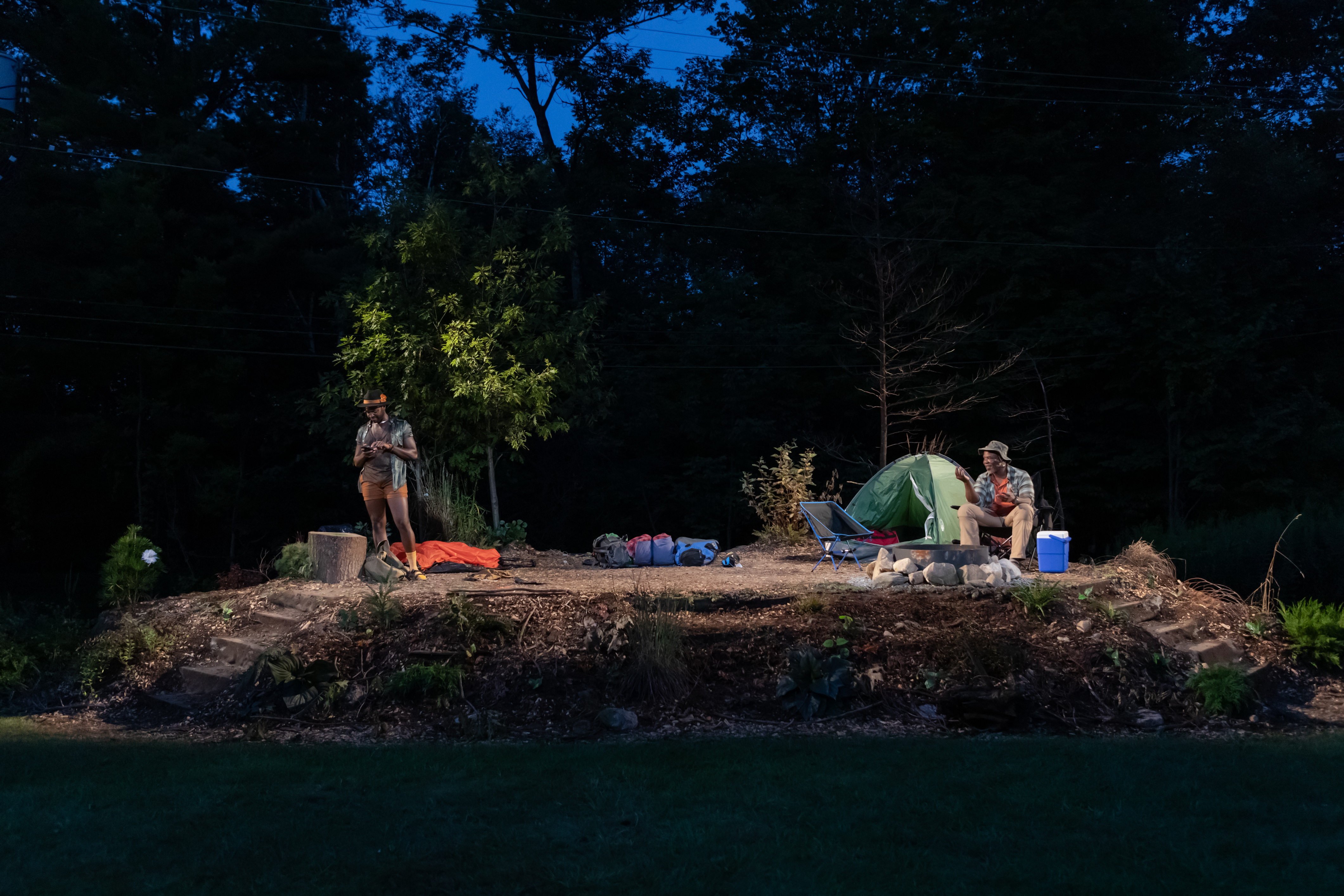
Finding one’s seat (a folding beach chair) for  Dorset Theatre Festival’s world première of “Queen of the Night” at Southern Vermont Art Center’s rustic plein-air stage is like entering a fairy forest world where reality and theater blend. Night creatures are everywhere — by design piped in over the sound system, and by Mother Nature in the woods, open field and air that are the outdoor playhouse. As dusk fades to night, the stars complement the strung overhead lights to create a magical haven far removed from the day’s blaring headlines and latest COVID statistics.

The efficient and effective campsite set, designed by landscape gardeners Justin and Christopher Swader, blends into its organic setting. All the natural world is indeed this play’s intimate stage, and the audience is palpably grateful to be part of it. What could possibly go wrong on a night like this? By the time Tyler (Leland Fowler) and his father Stephen (Danny Johnson) amble onto the “stage” and begin to pitch their tents, it feels like we should jump up, welcome them to the neighborhood and offer to help them set up.

This father and son, however, are not simply taking a break from their Houston lives to spend three peaceful nights camping in a nearby state park. They have brought more baggage than their camping gear and a mile-long laundry list of issues that both unite and divide them. “Ty” is young, black, semi-employed and flamboyantly gay. For his first night in the woods, he shows up in orange short shorts and a black floral, lacy top. L.L. Bean he is not (thanks to Fabian Fidel Aguilar’s bold and fun costumes). He loves city life, gay bars, vamping, prancing and channeling Celine Dion at the top of his talented lungs. He worries about bad cell service and being eaten by bears. He is in constant motion and we are drawn to his physicality like a moth to a flame.

Stephen, on the other hand, is steady and solid, a reliable and dependable employee and family man. Think of a 63-year-old man with James Earl Jones’ octogenarian gravitas. He inhales the campsite with reverence and relief. He pays attention to nature with serious religiosity. He is the obvious yin to his son’s yang; and yet, as the play unfolds, we will see how these opposite and contrary forces may actually be complementary, interconnected, and interdependent. By the end, they actually give rise to and liberate each other as they interrelate.

The presenting reason for this father-son camping trip to their longtime stomping grounds is the impending remarriage of Ty’s mother, which both will attend. They are navigating difficult waters — Ty and his more successful corporate lawyer brother Marshall are trying to be there for both parents without making hurting either; Stephen admits he still loves his (ex-) wife. The weekend is meant to clear the air and reset their clock, to help them reconnect in the way they did when Ty was a young Boy Scout and he and his father would go camping, in this very spot, just the two of them.

The trouble is that they each have very different memories of those trips, and of just about everything else during Ty’s childhood. Stephen wanted to make Ty tough, independent and resourceful. All Ty wanted was to feel his father’s love and acceptance of him, just the way he was.

Over the course of the 90-minute intermission-less production, we witness the erosion of years of hurt, disappointments and missed opportunities as the two let down their guard and act more like buddies than adversaries. Stephen confesses that he has been laid off from his job and that he has been seeing a therapist. He’s changed. He’s sorry. He wants to be close to his son, to undo the damage he had no idea he caused. “You’re my missing piece,” he tells Ty. “I need you.”

Ty acknowledges his frailty and insecurity, his sadness and longing for paternal praise and love. His veneer of gaiety barely camouflages a melancholy so deep that he reflects on his desire to die alone in the woods at night.

tate uses this broken relationship as a platform from which to tackle a bunch of big-ticket themes: being Black; being gay; being a man; being a Black gay man; being accepted; being accepting; unconditional love; self-love, self-hatred, family dynamics, to name just a few. While his dialogue has moments of sharp insight and laugh-out-loud humor, it often feels preachy and spread too thin over too many issues. Some lines feel injected out of nowhere just to make a point, never a help to a two-handed play.

To the script’s rescue, however, is the spectacular acting of the two leads, reason enough to see the production (and anything else these two may appear in).

Danny Johnson brings an elegant sobriety to the father, Stephen. His raspy melodious voice, cadence and spot-on phrasing imbue his character with humility, decency and authenticity, bring true life to a role that could have been easily become two-dimensional. Leland Fowler brings equal parts joie de vivre and soul-crushing heartache to Ty, miraculously keeping the character light and accessible.

A cursory search reveals that Queen of the Night has many meanings, including the villain in “The Magic Flute,” a white night-blooming cactus flower and, slangily, a flamboyant and promiscuous gay man. It’s the operatic aria reference that resonates most with me, with its message that only those who embrace love and forgiveness are worthy to be considered human. These two are indeed all too human beings, dealing with their perceptions of who they are and who they want to be, starting with their roles as father and son.

Queen of the Night’ – Written by travis tate. Directed by Raz Golden. Scenic Design by Christopher and Justin Swader; Lighting Design by Yuki Nakase Link; Sound Design by Megumi Katayama; Costume Design by Fabian Fidel Aguilar. Presented by Dorset Theatre Festival at the Southern Vermont Arts Center in Manchester, Vermont through September 4.

For tickets and information, call 802-867-2223, ext. 101 or visit dorsettheatrefestival.org

‘Private Lives’ a Classy Production of Classic Summer Fare at DTF

TahrO8ql

Rachel Pickup and Shawn Fagan in Noel Coward’s PRIVATE LIVES. Photo by Joey Moro

Reviewed by Shelley A. Sackett

Nothing welcomes light summery breezes like a witty Nöel Coward comedy of manners, and the Dorset Theatre Festival is spot on in its choice of the timeless ‘Private Lives’ to open its 42nd season. “We believe ‘the play’s the thing’ here at Dorset, and this is one of the most fabulous plays of all times- full of wit and sophisticatedly funny. Coward captures the universal humor that sometimes ensues once we lose our minds by falling in love,” said Artistic Director Dina Janis by email.

The plot is deceptively simple. Divorced spouses Elyot (Shawn Fagan) and Amanda (the sublime and worth-the-price-of-admission Rachel Pickup) have remarried and are honeymooning with their respective new spouses, Sybil (Anna Crivelli) and Victor (Hudson Oz). By the divine intervention of Coward’s wicked imagination, they end up in adjacent rooms on the night they are each to start their new lives. When they see each other across their shared balcony’s hedge, the sparks fly and they impulsively flee their hapless new partners to resume what they have idealized as their romantic destiny.


l-AhJSEP

Rachel Pickup, Shawn Fagan, Anna Crivelli, and Hudson Oz in Noel Coward’s PRIVATE LIVES. Photo by Joey Moro


Back at Amanda’s posh Paris apartment, their fiery passion predictably devolves from love to the same incendiary anger from whose ashes desire was restored. Couches practically take flight, ashtrays become bullets and words are poison darts, aimed with years of practiced marksmanship to draw maximum blood. Think Elizabeth Taylor and Richard Burton in ‘Who’s Afraid of Virginia Woolf’ or as their tabloid selves (they actually played these roles in 1983 at New York’s Lunt-Fontanne Theater), and you get the picture.

Their aggrieved new spouses track them down, and the hit-and-miss slapstick ensues. By the curtain’s fall, the pendulum has swung back and forth so many times for Amanda and Elyot that it becomes clear they really are meant for each other. Anyone else would have been bedridden with a bad case of vertigo ages ago; these two enfants terribles are not only still standing, but actually relish the prospect of round three.

The production’s shining stars are two: Rachel Pickup as Amanda and Lee Savage’s gorgeous Art Deco sets. Ms. Pickup gives a Broadway-caliber performance (where, coincidentally, she recently appeared at the St. James in Coward’s “Present Laughter” with Kevin Kline). The impossibly willowy actress is all comedic physicality and glamor, delivering her lines and gestures with surgical precision. Hers is not your average summer theater performance and it is as welcome as it is mesmerizing.


CfOwOwwb

Anna Crivelli, Shawn Fagan, Hudson Oz, and Rachel Pickup in Noel Coward’s PRIVATE LIVES. Photo by Joey Moro


Equally astonishing are the period sets Mr. Savage manages to create in rural Vermont; these too are Broadway worthy. The hotel terraces in Act One are as stunning as they are humorous in their mirror images of floor to ceiling blue draperies and wrought iron balustrades. The details of Act Two’s Paris flat are like a ‘Where’s Waldo” for the audience, complete with Victrola, piano, fainting couch and polar bear skin rug. Asked what was the biggest challenge in mounting this production, Ms. Janis replied without hesitation, “Making the Deco Period come to life on our budget!” Clearly, she succeeded.

Although the second act drags and the rest of the cast pales compared to Ms. Pickup, the production is a theatrical icon whose appeal is as timeless as pink champagne. “The play really gives it all to us, with its sparkling language and the collision of its characters, completely recognizable to a contemporary audience for their passion and for their capacity for selfishness, obstinance and even cruelty,” Director Evan Yionoulis said by email. One can almost hear Nöel Coward whispering, “Touché, darling. Touché.”

‘Private Lives’ – Written by Nöel Coward. Directed by Evan Yionoulis; Set Design: Lee Savage. Lighting Design: Donald Holder. Costume Design: Katherine B. Roth. Sound Design: Jane Shaw. Fight Choreographer: BH Barry.

Through July 6 at Dorset Playhouse, 104 Cheney Road, Dorset, Vt. For more information, visit dorsettheatrefestival.org or call 802-867-2223.