Emerson Colonial’s ‘Mean Girls’ Is More Meh Than Mean
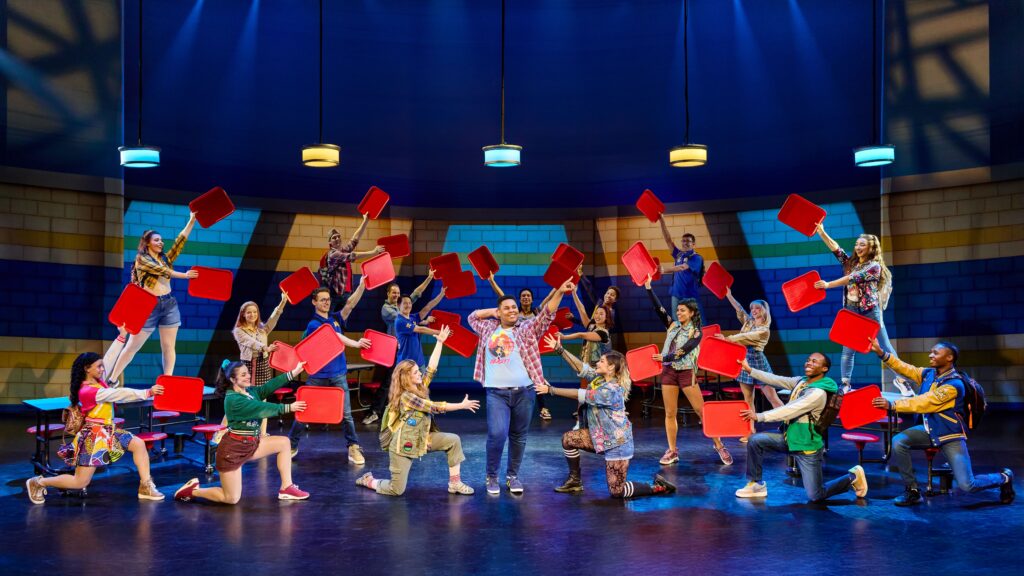
Cast of ‘Mean Girls’ at Emerson Colonial Theatre
By Shelley A. Sackett
Tina Fey’s Mean Girls has certainly milked its appeal. When it first appeared in 2004 as a film starring Lindsay Lohan, Rachel McAdams and Amanda Seyfried, it was a runaway hit. Its 2018 transformation into a Broadway musical fared less well and the 2024 remake of the film fared even worse.
Which brings us to the 2025 theatrical musical version that played at Emerson Colonial Theatre recently. Suffice it say, the newest iteration did nothing to reverse Mean Girls’ downward trajectory. Unless, that is, you happen not to have been born in 2004. In that case, (as was evidenced by the hordes of pink-clad teens and twenty-somethings at a Wednesday evening performance), the latest musical version was just what the Minister of Culture ordered.
Plot-wise, not much has changed. Teenage Cady Heron (a tentative Katie Yeomans) was home-schooled in Africa by her scientist parents. When her family moves to the suburbs of Illinois, Cady is jettisoned into the public school jungle, where she gets a quick primer on the cruel, tacit laws of popularity that divide her fellow students into tightly knit cliques from Damian (a terrific Joshua Morrisey) and Janis (Alexys Morera, also very good). But when she unwittingly finds herself in the good graces of an elite group of cool students run by the Queen Mean Girl, Regina (Maya Petropoulos), and dubbed “the Plastics,” Cady is initially seduced by the allure of being a member of the “in” crowd.” Once she realizes how shallow, and, well, mean, this new group of “friends” is, she rebefriends Janis and Damien and exposes Regina and her acolytes for who and what they really are.
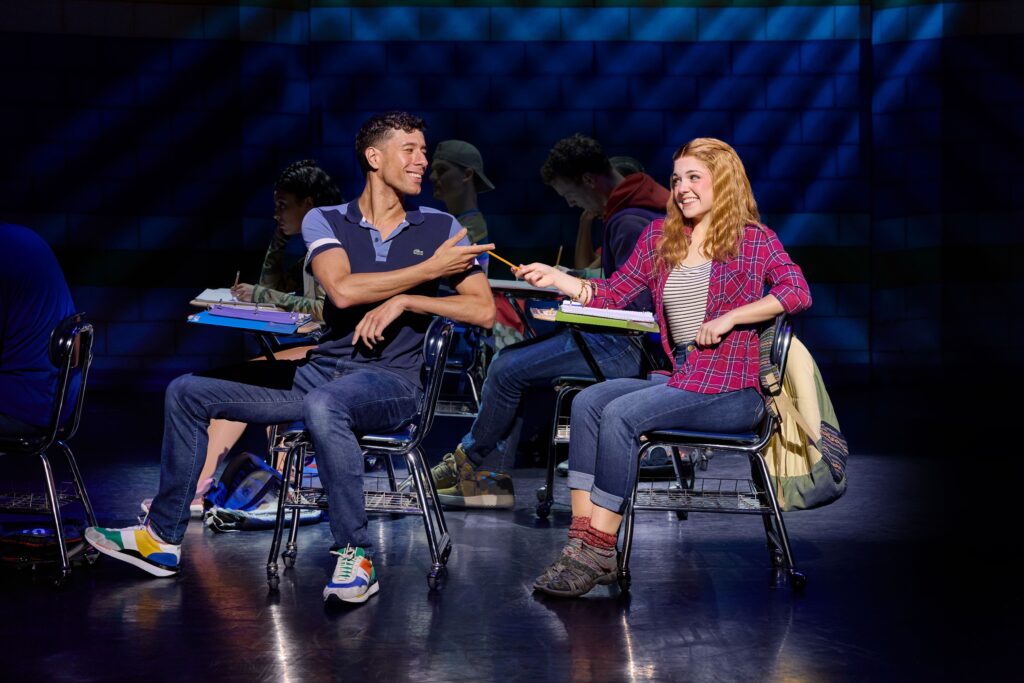
José Raúl, Katie Yeomans
Between opening and closing curtains are 20 musical numbers that take us on a trip through the trials and tribulations of high school with all its unspoken rules and regs, hierarchies, and, of course, sex, drugs, and rock ’n’ roll. Playing multiple roles, Kristen Seggio is a standout as teacher Ms. Norbury, bringing welcome talent and presence to the stage. Scott Pask’s set design is clever and engaging (especially the use of desks on rollers), and John MacInnis’ choreography occasionally shines, especially in the tap number and the use of trays for the lunch scene. But unfortunately, for the most part, the young actors (almost all are debuting in their first national tour) swallow a large percentage of their lines and lyrics, making an at times tedious production all the more so.
There are, to be fair, some high moments, especially during any musical numbers with harmonies. The show opens strongly, with scene-stealer Morrisey and Morera in fine voice and form. Kristen Amanda Smith is effective and (almost) endearing as an on-again, off-again member of Regina’s posse (plus she has a wonderful voice with which she projects and enunciates). As Karen, the airhead blond Regina worshipper, Maryrose Brendel brings a surprising freshness and nuance to a character who is plastic in more than group membership.
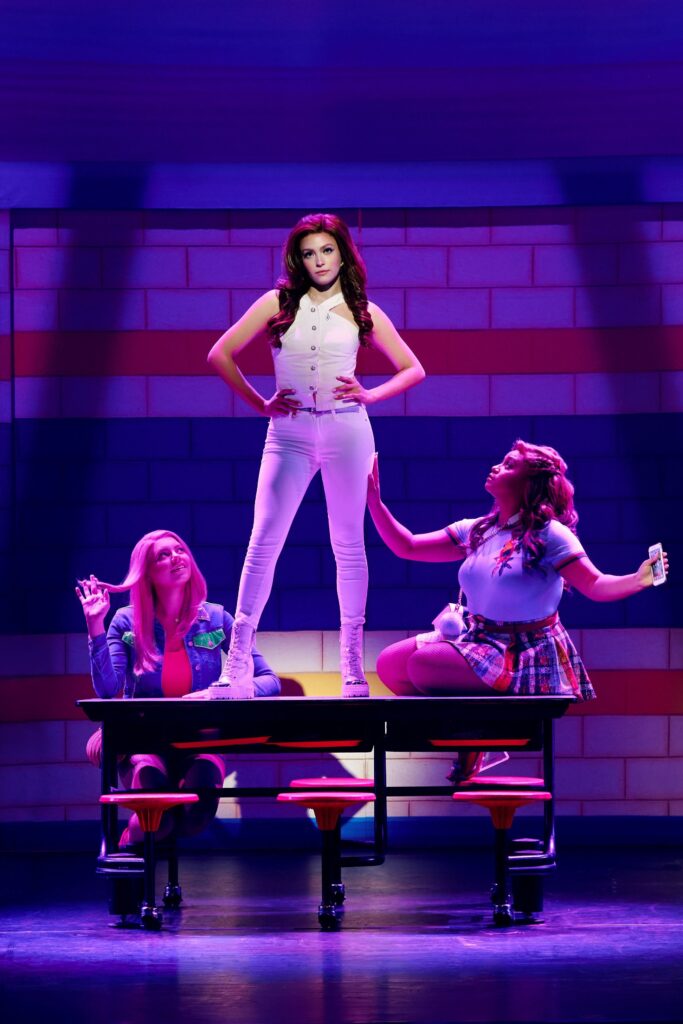
Maryrose Brendel, Maya Petropoulosas, Kristen Amanda Smith
At the end of the day, perhaps Al Franken, Fey’s fellow Saturday Night Live member, summed up Mean Girls’ message to teenagers struggling with the pain of social cliques best. As his beloved character Stuart Smiley would say, “I’m good enough. I’m smart enough. And, doggone it, people like me.”
‘Mean Girls.’ Book by Tina Fey. Music by Jeff Richmond. Lyrics by Nell Benjamin. Based on the Paramount Pictures film “Mean Girls.” Directed by Casey Cushion. Choreography by John MacInnis; Scenic Design by Scott Pask; Costume Design by Gregg Barnes; Lighting Design by Kenneth Posner; Sound Design by Brian Ronan; Music Direction by Julius LaFlamme; Orchestrations by John Clancy; Music Coordination by John Mezzio; Hair Design by Josh Marquette. Presented by Emerson Colonial Theatre, Bolyston St., Boston. Run has ended.
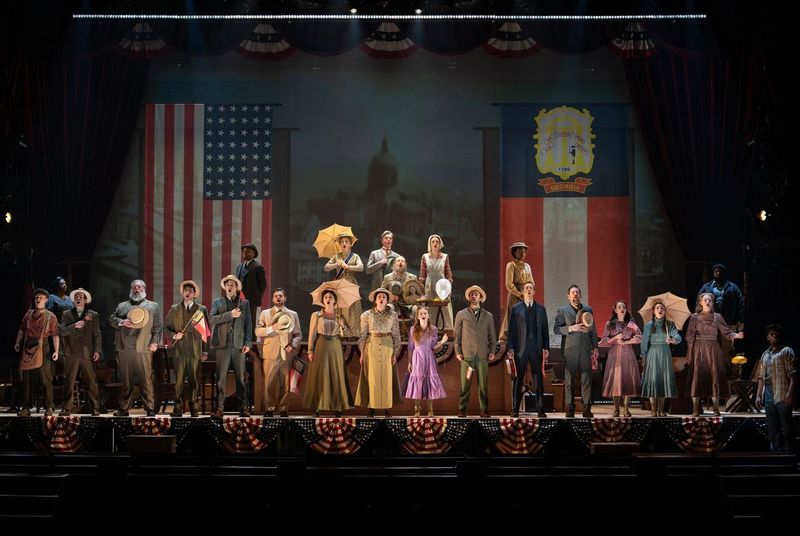
Cast of the National Tour of ‘Parade’ at the Emerson Colonial Theatre. Photos by Joan Marcus
By Shelley A. Sackett
It was with trepidation that I attended opening night of “Parade,” now at the Emerson Colonial Theatre through March 23. After all, the premise of the 2023 multiple Tony Award-winning musical revival is hardly uplifting. The book by Alfred Uhry (author of “Driving Miss Daisy”) is set in 1913 Atlanta and tells the true story of Leo Frank, a transplanted Brooklyn Jew and pencil factory supervisor who is married to his Jewish boss’s daughter, Lucille. As the newlyweds struggle to carve out their lives in the red hills of Georgia, Leo is falsely scapegoated for the murder of a 13-year-old white girl in his employ. The rest of the play dramatizes his trial, imprisonment, and 1915 mob lynching.
In the current climate of rampant disinformation and antisemitism, it’s easy to understand why some might eschew entertainment that is grounded in both.
At no point does the 180-minute show (one intermission) shroud the wretched facts of the case and the ginned up hate, prejudice and calculated lies that fueled Atlanta’s judicial, political and journalistic engines. Yet, like alchemy, first-rate staging, talent and especially Jason Robert Brown’s rapturous Tony Award-winning score of 29 songs transform this cheerless tale into a riveting musical production that scratches well below the surface to examine just what made the Jim Crow South tick.
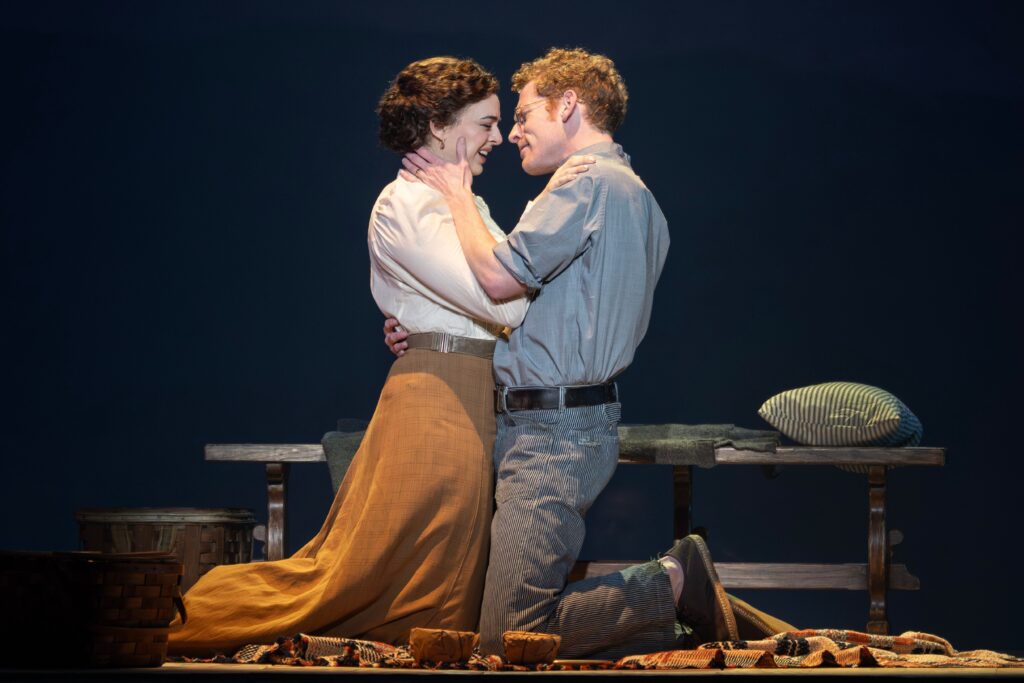
Max Chernin, Talia Suskauer
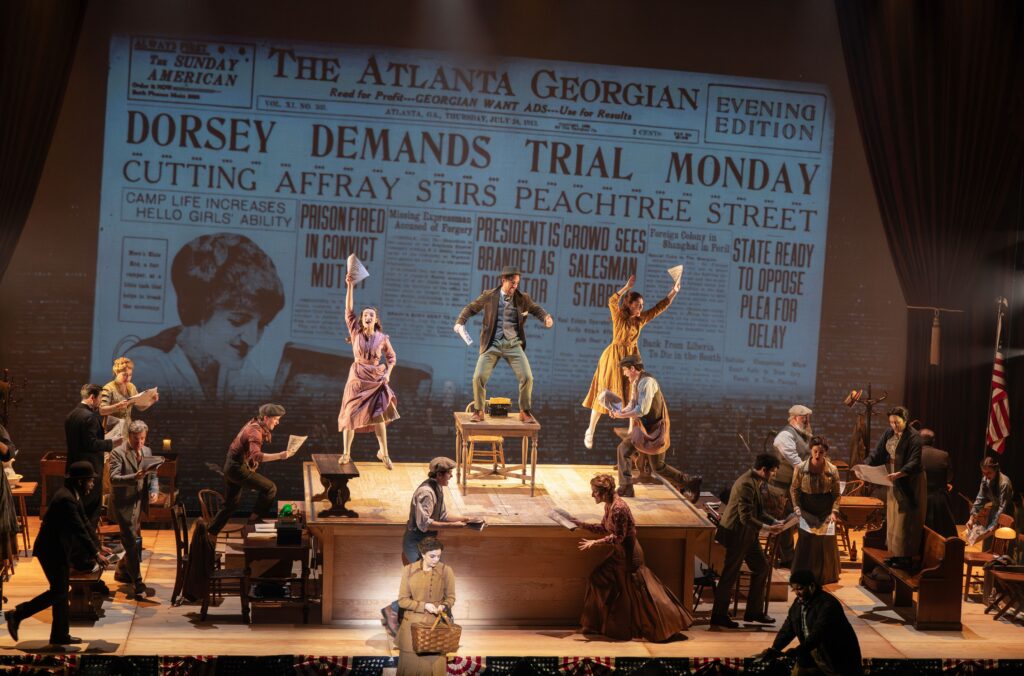
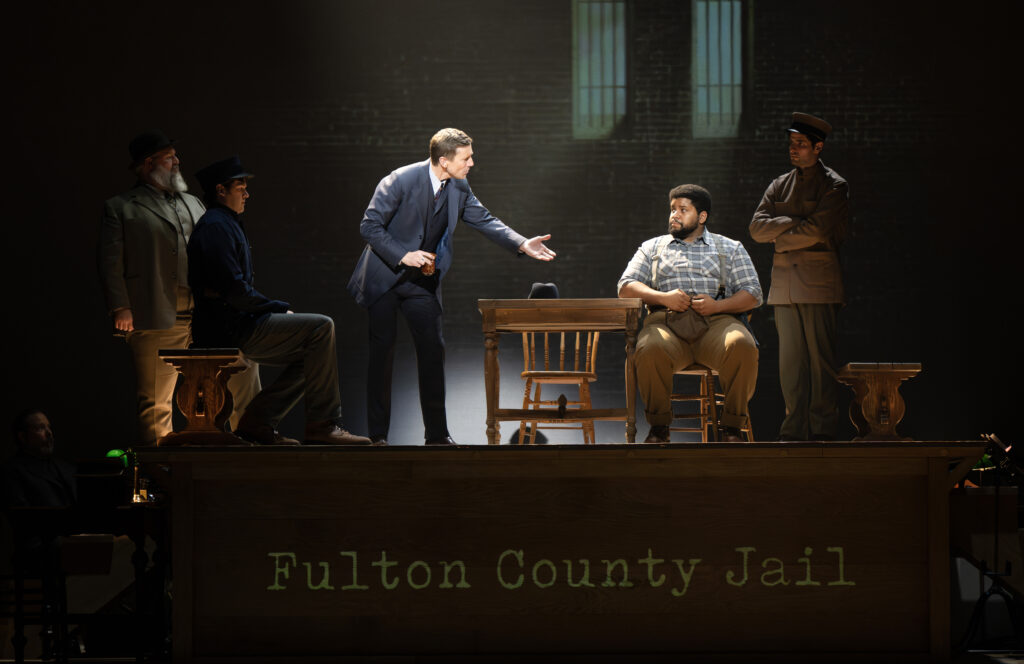
The stage is minimally set (design by Dane Laffrey) with a high and low platform that will magically evoke the Franks’ home, a witness box, a factory, a soapbox, a cell and a governor’s mansion. Throughout the show, background projections display real photographs, names and dates of the play’s characters as well as archival photos of 1910s Atlanta, newspaper stories and the “Leo Frank Lynching” memorial plaque in Marietta, Georgia. These both make the action easier to follow and remind us that “Parade” is based on truth.
The play opens in 1863 Marietta (“The Old Red Hills of Home”) as a young soldier leaves his lover for battle. Fifty years later, Atlantans still romanticize and mythologize the glories of the Civil War’s “Lost Cause” with Confederacy Day, which is when we first meet Leo and Lucille Frank.
“Why would anyone want to celebrate losing a war?” Leo (a pitch perfect, exceptional Max Chernin) asks his wife. Wiry, prickly and bespeckled, he struggles to fathom the mores of Atlantans. “For the life of me, I can’t understand how God could create people who are Jewish and Southern at the same time,” he bemoans.
Lucille (Talia Suskauer, whose voice seems directly wired to her emotions) doesn’t understand Leo’s Yankee manners any better than he grasps the ways of a Jewish southern belle. We are left wondering what drew these two to each other in the first place. Their singing selves couple in a soaring intimacy that their characters just can’t mirror.
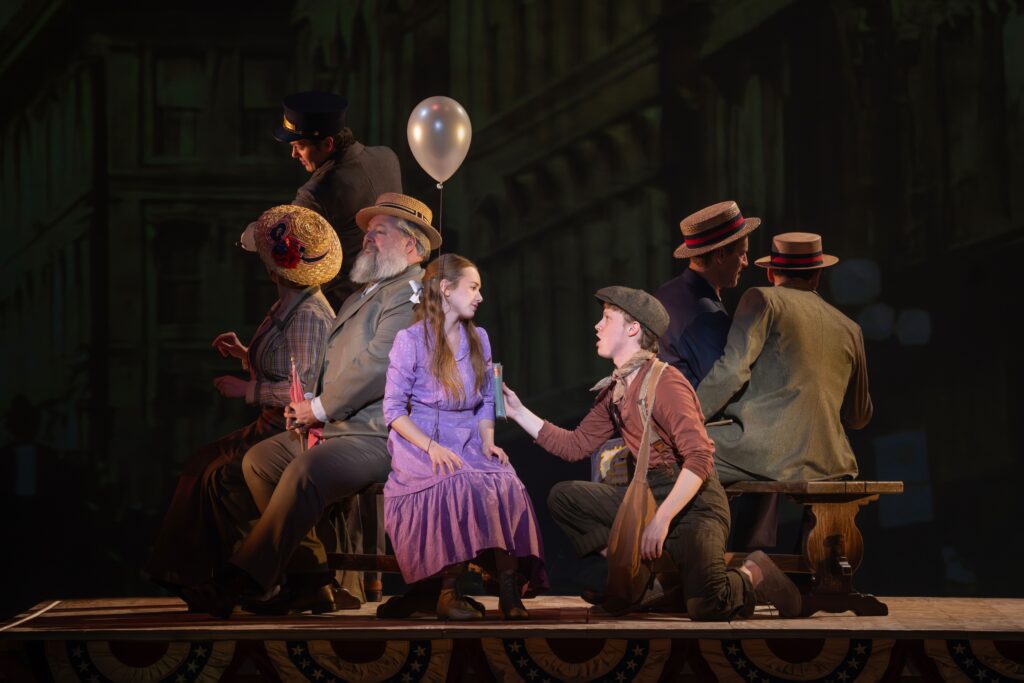
Olivia Goosman, Jack Roden
Their marital conflict pales compared to the troubles that unfold when the body of Mary Phagan is discovered in the factory. Two suspects are ripe for the picking: Newt Lee, the Black night watchman, and Leo Frank. That Leo is a self-absorbed workaholic who carries himself with a supercilious self-importance may make him hard to like, but his downfall is no less tragic.
District Attorney Hugh Dorsey (a believably slimy Andrew Samonsky) needs a conviction, and hanging another Black “ain’t enough.” The professional boost he seeks requires something more. This time, he’ll need to hang “the Jew.” He suborns testimony from many sources, threatening and cajoling even the Frank’s loyal maid, Minnie. Ex-con Jim Conley (Ramone Nelson in a barnstorming, show-stopper of a performance) fabricates eye witness evidence to save his own skin, yet ends up back on the chain gang when Donley double crosses him. Newspaperman Britt Craig (Michael Tacconi) hails the resurrection of his career as he stokes antisemitic hysteria and catches the eye of his editor.
Atlantans are only too happy to take the bait and, as Act I ends, Leo is swiftly convicted, sentenced to death and jailed.
Director Michael Arden’s staging at several critical moments expands “Parade’s” theatricality and our access to Leo’s opaque interiority. Now imprisoned, Leo spends the entire intermission sitting onstage with his head in his hands. Shed of his cocky, brittle skin, he presents as more grounded and relatable. Although jarring, having Leo mime the false testimony of others during his trial is another stroke of dramatic brilliance.
Act II shifts to Leo and Lucille’s marriage, which is strengthened by his imprisonment and their joint efforts to prove his innocence. Eventually, Governor Slaton (a solid Chris Shyer) heeds Lucille’s pleas and, after investigating, commutes Leo’s sentence to life. His fate has already been sealed in the book of public opinion, however, and he is kidnapped and hanged.
With this storyline fully established from the prologue, it is indeed a wonder that “Parade” feels as dynamic, affective and —yes — entertaining as it does. Make no mistake; this is a first rate Broadway production with a lot going for it.
The cast of vocal performers (particularly the leads and Nelson) is, with few exceptions, extraordinary, and they have a lot to work with in Brown’s marvelous score. Backed by a terrific orchestra, Brown’s Sousa-style marches, work songs, haunting duets and raw blues and efficient, targeted lyrics achieve more than a page of dialogue might. While injustice and inhumanity are ever present, they simmer and percolate rather than boil over. Granted, some of the actors’ accents need polishing and the characters’ unambiguous goodness/evil renders them somewhat two-dimensional, but the timeliness and relevance of this ongoing story is almost reason enough to see it.
(Foreground) Andrew Samonsky, Robert Knight
The wave of antisemitism that results in Leo’s conviction and lynching led to both the formation of the Anti-Defamation League and the resurgence of the Ku Klux Klan, both still significant forces. When the chorus of white Georgians chants, “hang ‘im, hang ‘im, make him pay,” it’s impossible not to hear the January 6 refrain and feel its aftershocks. As “Parade” points out, although Leo Frank’s death sentence was commuted, the case, reopened in 2019, is ongoing. Mary’s killer was never found. Unlike the more than 300 cases overturned thanks to the Innocence Project, he has never been exonerated.
As Leo is about to be hanged, right before chanting his final “Shema,” he states, “God chose me for a plan. I don’t know what it is.” Perhaps, at this time of thinking about who gets to write history’s story, one thread of that unknown plan is to broaden the inquiry and ask ourselves who had to pay for those stories we get to tell, and at what price?
Parade – Book by Alfred Uhry; Music and lyrics by Jason Robert Brown; Co-conceived by Harold Prince; Directed by Michael Arden; Choreography by Lauren Yalango-Grant & Christopher Cree Grant; Music direction by Charlie Alterman. At the Emerson Colonial Theatre, Boston, through March 23rd.
For tickets and more information, visit emersoncolonialtheatre.com/
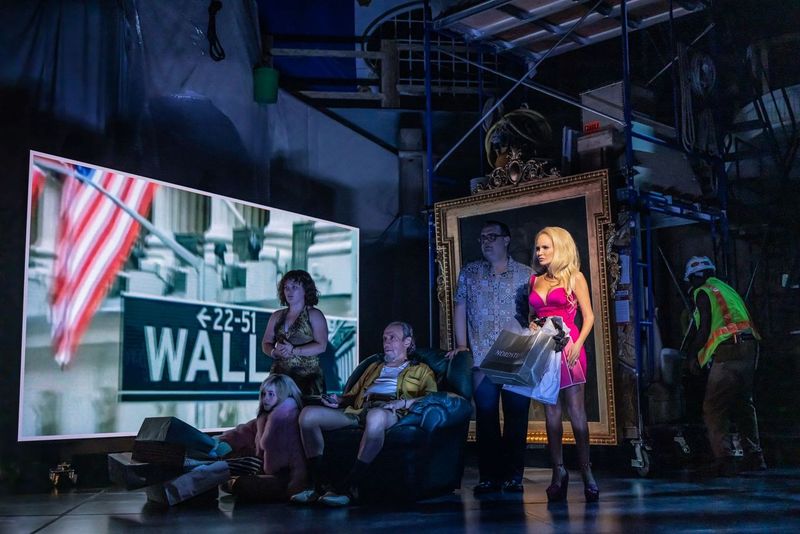
Cast of “The Queen of Versailles” at Emerson Colonial Theatre. Photo Credit Matthew Murphy
By Shelley A. Sackett
There is no more perfect setting for a play about Versailles and consumerism gone awry than Boston’s own Colonial Theatre, with its gold, glitz, and Rococo splendor. On opening night last Thursday, the festive crowd for “The Queen of Versailles,” the Broadway-bound musical extravaganza, was dressed as if auditioning as contemporary cast extras with bling, boas, and bottles of champagne.
But that was nothing compared to Dane Lafrey’s lavish Louis XIV worthy set, thankfully on pre-curtain-rise display to accommodate selfies and elicit oohs and aahs.
On walls as tall as the Louvre hung oil paintings with ornate gold frames. Chandeliers descended, and palace workers dressed in period wigs and frocks went about their menial duties, dusting and fussing. The staff joked about the comical and pompous King Louis XIV (Pablo David Laucerica), who proudly admits he commissioned the Palace of Versailles “because I can.”
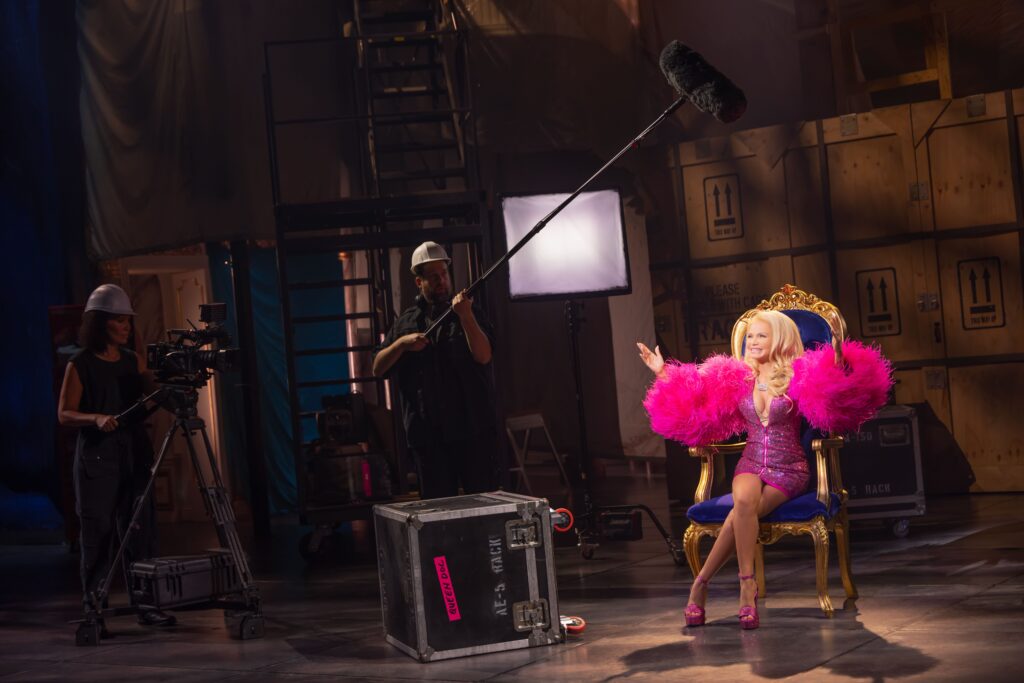
This first musical number primed the audience, and they were cocked and ready for the main attraction. When the royal set lifted along with the curtain, revealing Kristin Chenoweth seated on stage, they exploded into the kind of boisterous adulation reserved for, well, royalty.
Kristin Chenoweth
From the get-go, it was evident the audience’s admiration was well-placed. Chenoweth is a pint-sized spitfire with super-sized talent. She belted out her first song in a clear, articulate voice that was perfectly projected. What a joy to be able not only to hear the lyrics but also to understand them. Stephen Schwartz’s score is smart, funny, and sharply satiric and deserves no less, especially since much of the action takes place in song. (Question for the production team — why no song list?).
In a nutshell, the show is about the riches-to-rags-to-resurrection story of Jackie and David Siegel, whose saga was the topic of Lauren Greenfield’s award-winning 2012 documentary by the same name. Its filming is where Act I opens.
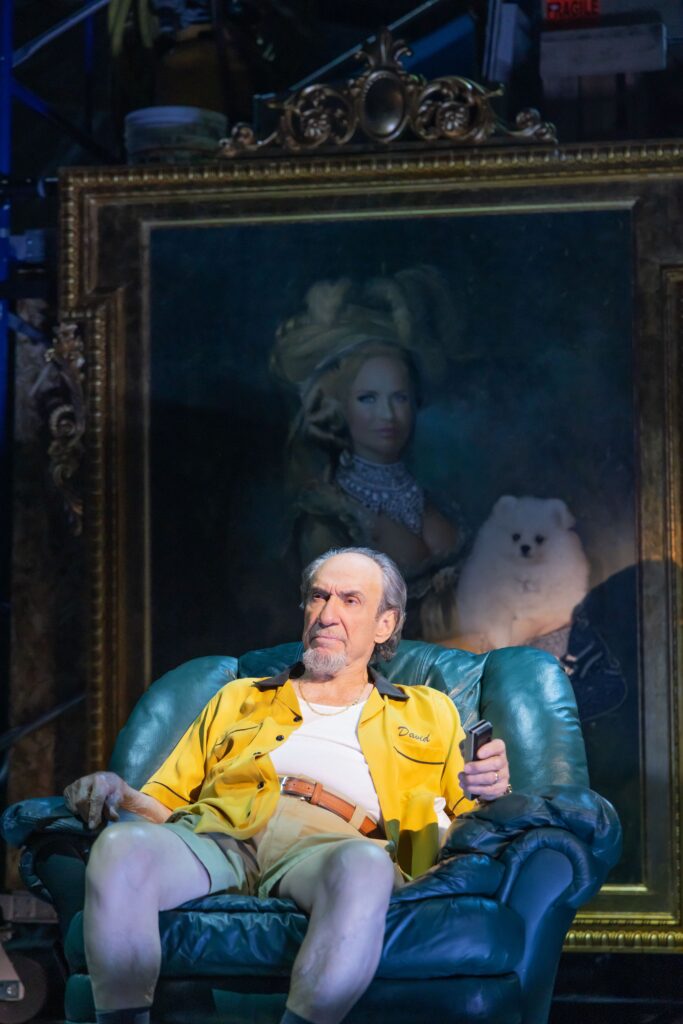
Clad in one of Christian Cowan’s sensationally tacky costumes, Jackie literally holds court in the midst of the construction site of her and time-share mogul husband David’s (a superb F. Murray Abraham) life-fulfilling project: building the largest private home in America.
Why are they building this 18-bedroom, $100 million home? It’s simple when you have champagne wishes, caviar dreams, and deep, deep pockets. “Because we can,” Jackie boasts, echoing her French idol.
F. Murray Abraham
Their 90,000-square-foot house is based on the mirrored palace with a few modifications: Versailles, France, is swapped for Orlando, Florida, and Queen Marie Antoinette has morphed into Jackie. In terms of pointed social commentary, especially since 2016, their story is particularly poignant, and the show milks it dry. “Anyone can become royalty in America,” is the Siegel family credo – or president, even.
Jackie takes us (as the documentarian’s camera rolls) backstage to her humble beginnings. She was raised in Endwell, New York, where she worked several minimum-wage jobs and honed her appetite for success and power at the encouragement of her simple and decent parents. The family’s favorite show was “Lifestyles of the Rich and Famous,” which they watched together with near-religious reverence.
She earned a bachelor’s degree in computer engineering in 1989 and polished her gutsy in-your-face, tell-it-like-it-is style at her first job with IBM. Though Jackie may dress like an airhead, it masks underlying book and street smarts. Coupled with her cutthroat drive, she is a force to be reckoned with.
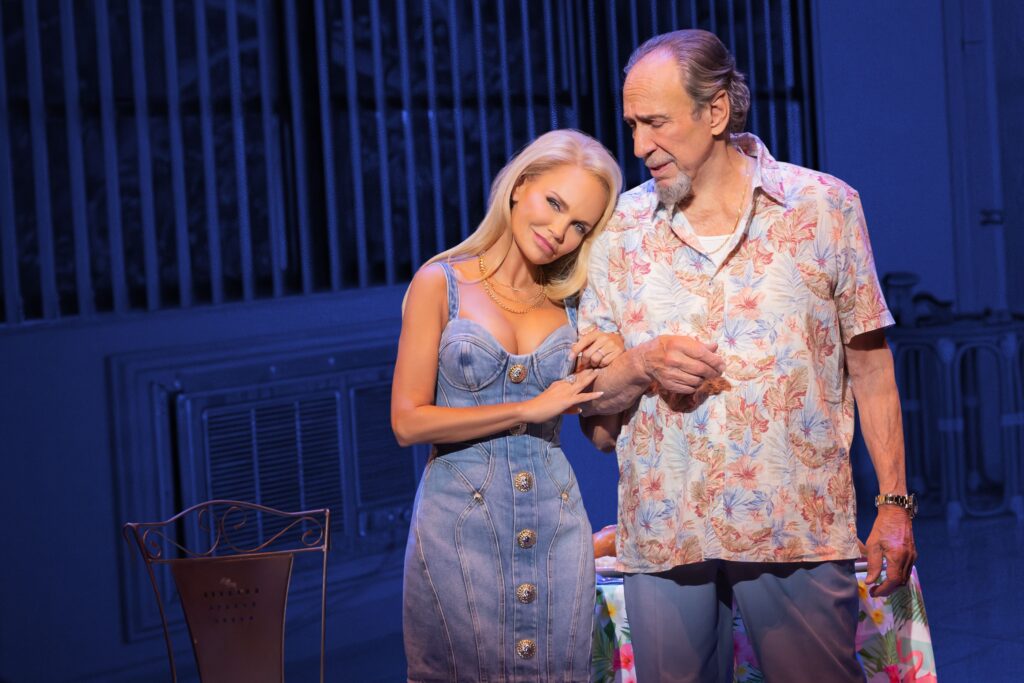
After moving to Florida with her husband, he becomes abusive, and she enters the Mrs. Florida America beauty pageant as a way out (she won), determined to make her pipe dream of great wealth come true. Following her divorce, the now single mom does just that when she meets and, in 2000, marries the financier and “Timeshare King,” David Siegel.
The two travel to France for their honeymoon dressed like Barbie and Ken (“This may surprise you, but we’re not old money,” David dead-pans). When Jackie goes gaga over Versailles, it mirrors every selfie-obsessed narcissist’s sex dream; David declares his ever-lasting devotion in the language that is the vernacular of their relationship: he will build one for her.
The rest of Act I (a hefty 90-plus minutes) details Jackie’s voracious appetite for children (she births 7 and adopts one more, her niece Jonquil) and things. The oldest daughter, Victoria, the product of Jackie’s first abusive marriage (a very good Nina White), is, in Jackie’s estimation, overweight and under-acquisitive. Her clueless mother is tone-deaf and blind to her daughter’s unhappiness. If anything, she adds to it. Jackie, the quintessential material girl who craves its empty calories, urges Victoria to curb her fondness for the one thing that comforts and nourishes her — food.
In Victoria’s solo (in which White shines), she describes the pain and heartbreak she suffers as her mother’s daughter. “Pretty always wins. The only way for me to win that game is not to play it,” she says.
Her sister/cousin Jonquil (Tatum Grace Hopkins), on the other hand, takes to excess like a fish to water. “I could get used to this,” she croons.
Act I closes in 2008, as the Siegel’s world comes crashing down alongside the global financial and subprime markets. Overnight, they go from prince to pauper, monitoring electricity with the same zeal they had reserved for padding their warehouses with stuff. David retreats to his study, demanding Jackie pull the plug on the documentary now that their lives have gone sideways. Jackie, however, has the soul of a phoenix and a cat’s nine lives. She’s not going down with the ship. As God is her witness, she will get her Versailles back.
Act II opens with one of the show’s musical highlights, a gorgeous duet with Jackie and Marie Antoinette (the fabulous Cassondra James). In a rare moment of acknowledging and really listening to Victoria, Jackie realizes the toll all this has taken on her. The girl is depressed and adrift. She needs some roots and parenting.
The two pay a visit to Jackie’s parents, who open Victoria’s eyes to a new world. For the first time, she sees that some people (her grandparents among them) are actually happy with what they have. They have found the magic of “enough.”
Although mother and daughter sing another lovely duet about little homes with big hearts, Jackie chides Victoria when she says she’d like to stay in Endwell. Jackie reminds her of what great wealth can buy, renewing her vow to get Versailles back. “Just because we can doesn’t mean we should,” Victoria says, sounding more like a parent than a child.
The Siegels ultimately regroup after their personal and financial setbacks, but they have paid a heavy price. They keep the unfinished Versailles and even manage to exploit Victoria’s tragedy, manipulating a spin to their own financial and marketing advantage. They are deplorable peas in a morally bankrupt pod, easily two of the least sympathetic characters we’ll ever meet on stage.
Yet, along with the glitterati in the audience, I too rose in a standing ovation, surprised by how much I had enjoyed the show.
Chenoweth is the little engine that can, relentlessly driving the show uphill when its length, digressions and sour message threaten to derail it. She is a prodigious talent and she brings it to bear on her portrayal of Jackie. We may want to dismiss the self-appointed queen as a crass example of the worst capitalism can spawn, yet Chenoweth’s nuanced portrayal leaves the door open enough to glimpse the shadow of admiration and sympathy. And boy, can she sing!
The rest of the cast is a star-studded who’s who of Broadway luminaries. One can only hope that the “Queen of Versailles” that reaches the Big Apple is leaner, more focused, and more deserving of the gifted artists and advance hype it has attracted. Many scenes (especially a cowboy-themed one) belong on the cutting room floor, as do a couple of the many flashbacks to King Louis’s days.
The show has great bones, an engaging score, and a tornado of a star. All it needs is disciplined tweaking, refining, and shortening before it travels south. It deserves to take Broadway by storm.
“The Queen of Versailles” — Music and Lyrics by Stephen Schwartz. Book by Lindsey Ferrentino based on the documentary film “The Queen of Versailles” by Lauren Greenfield and the life stories of Jackie and David Siegel. Directed by Michael Arden. Scenic and Video Design by Dane Laffrey; Costume Design by Christian Cowan; Choreography by Lauren Yalango-Grant and Christopher Cree Grant; Music Supervised by Mary-Mitchell Campbell; Lighting Design by Natasha Katz; Sound Design by Peter Hylenski. Produced by Bill Damaschke, Seaview, and Kristen Chenoweth, through her production banner Diva Worldwide Entertainment. Presented by Emerson Colonial Theatre at 106 Boylston St., Boston through August 25.

 InSights