“Nassim” — Written by Nassim Soleimanpour. Directed by Omar Elerian. A new guest performer for every show. Presented by The Huntington through October 27.
By Shelley A. Sackett
“White Rabbit, Red Rabbit,” Iranian Nassim Soleimanpour’s absurdist adventure, which sits on the boundary of comedy and drama and burst into London’s West End in 20212, changed my opinion about audience participation in theater. Not a big fan of the genre, I left the 2016 performance at New York City’s Westside Theatre a convert.
Conceived while 29-year-old Soleimanpour was barred from leaving Iran for refusing military service, the play challenged its audience on issues of trust, obedience and complicity while demolishing the fourth wall and having a different actor read the script for the first time at each performance.
The words were Soleimanpour’s; the implicit messages were the idea of someone trying to speak through someone else and the question of what censorship means.
So when The Huntington announced it was producing the eponymous “Nassim,” I was on board. Originally commissioned and produced by London’s Bush Theatre in 2017, the drama, comedy and social experiment is even more timely today.
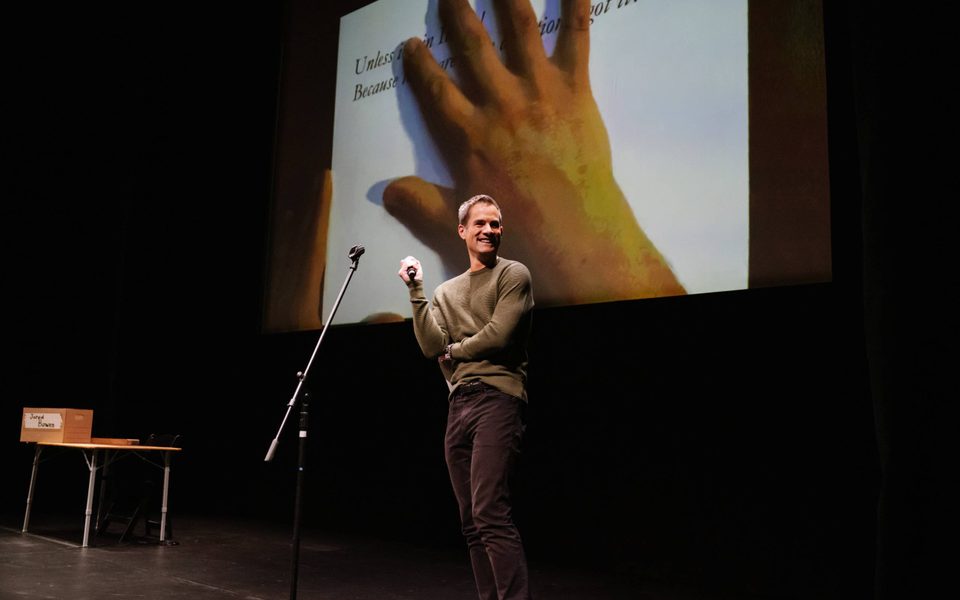
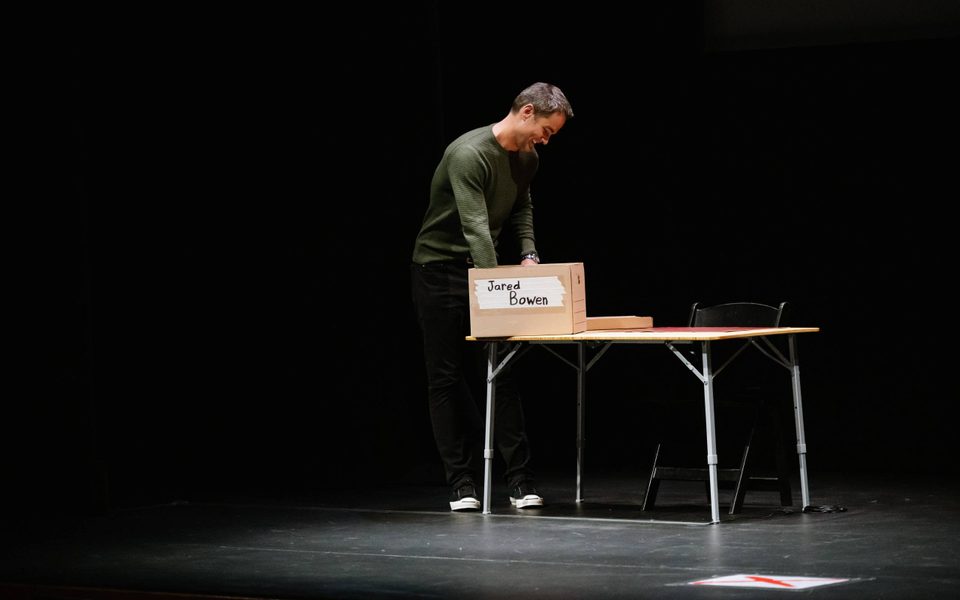
Fueled by curiosity, compassion and a longing for global community, Soleimanpour employs his trademark style of having a different actor cold read his script in front of a live audience. Karen MacDonald, the “empress of Boston theater,” had the honors the night I attended, and she rose to the task with her usual humor, flair and skill.
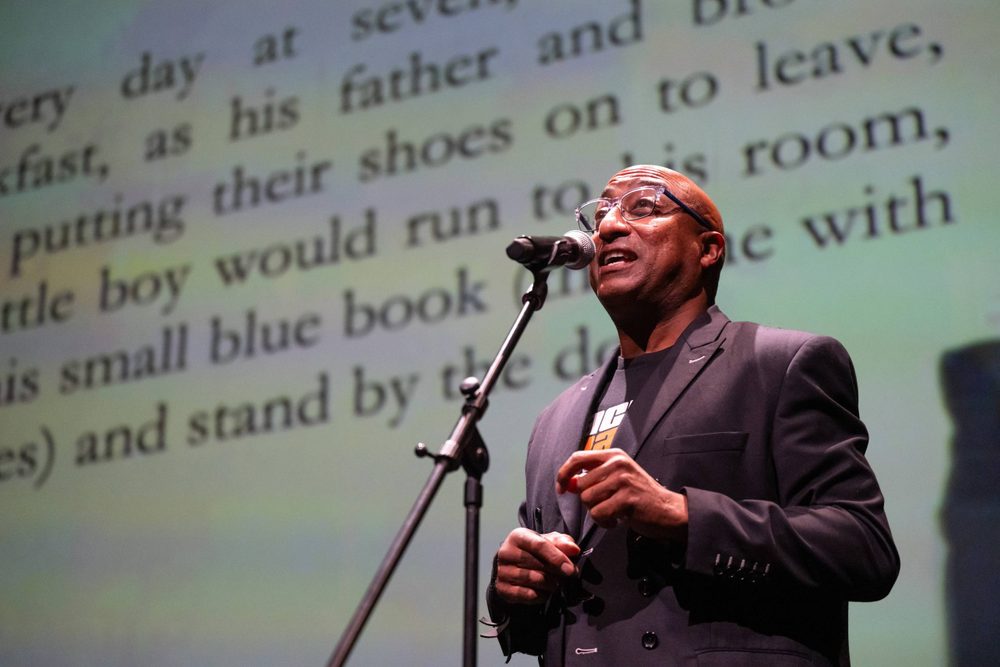
For 75 intermission-less minutes, MacDonald read from a script (minus the italicized stage directions) projected on a jumbo screen, as its pages were moved by disembodied hands. The play’s theme, a meditation on how foreign languages divide us, slowly comes into focus. While Soleimanpour’s plays have been performed in dozens of languages worldwide, they’ve never been performed in Farsi in his native country because of governmental repression. This situation particularly distresses him because his mother, who still lives in Iran, has never heard or seen one of her son’s plays performed in her (and his) mother tongue.
Although “Nassim” at times feels insubstantial and the gimmicky aspect often crosses over into banal cutesiness, its positive message of global community through communication and understanding prevails. Mimicking a language class, Soleimanpour’s script invites the audience (and especially MacDonald) to experience the beauty and magic of his native language, Farsi. We discover through the timeless and borderless device of fairytales.
Naheem Garcia
“Once upon a time” are our first Farsi words, along with “mom.” “You have to learn your mother tongue,” MacDonald reads.
In Act Two, Soleimanpour’s script turns more autobiographical, and we find out that he wrote the play in Farsi with words he wanted to learn in English. The play, which celebrated its 479th performance and has been staged all over the world, was intended as a means for its author to meet new people and be taught new words all over the world.
“A writer’s heart will always beat in his mother’s tongue,” Soleimanpour says through MacDonald. “But isn’t it amazing how languages work? They bring us together; they tear us apart.”
It would be too much of a spoiler to reveal all the surprises in store, but this charming and timely piece of experimental, experiential theater is a must for anyone curious about more than the shiny, big productions that often dominate conversation, reviews, and box office receipts. Take a chance with this little gem; you won’t be disappointed.
When her son was little, Liz Polay-Wettengel tried to get him interested in soccer, which his older brother had loved at that age. Instead, all three-year-old Elias wanted to do was memorize lines from the movie “Frozen” and perform them in the living room.
“We knew he needed to try the stage,” she told the Journal.
By the time he was four, Elias Wettengel was on his way to an acting career that would culminate with his casting in the role of young Jacob/Heini in the new production of Tom Stoppard’s award-winning “Leopoldstadt,” which runs at the Huntington Theatre through Oct. 13.
The sprawling drama follows multiple generations of the fictional Jewish Merz-Jacobowitz family in Vienna in the 20th century. As it moves from 1899 to 1955, the play showcases everyday family dynamics against the ever-changing tides of revolution, war, antisemitism and assimilation.
Stoppard was inspired by the experiences of his own family; all four of his grandparents and three of his mother’s sisters lost their lives in the Holocaust. His stirring masterpiece takes a bold look at what it means to be Jewish for one’s self, in the eyes of others, and in the broader context of history.
“Leopoldstadt” won four Tony Awards in 2023, including Best Play, and two Laurence Olivier Awards, including Best New Play, when it débuted in London’s West End in 2020. The Huntington Theatre production is presented in association with the Shakespeare Theatre Company and features a cast of 15 adults and four children.
Elias, now a 13-year-old student at Collins Middle School in Salem, feels honored to play the roles of Jacob and Heini in such a meaningful play. “As a Jewish kid, the play has extra meaning for me. I sometimes get chills during the scenes,” he told the Journal.
“Leopoldstadt” is an emotionally intense and politically timely production, especially for American Jews. Elias and his mom handle the challenges of his role through open and honest conversations about what being Jewish means today and about how one’s ancestors can shape future generations.
It helps, according to Liz, that her brother-in-law Jason Stark teaches genocide studies. “We answer any questions that arise about death and the Holocaust. We don’t shy away from hard questions and encourage Elias to ask them,” she said.
For Elias, the resilience of family is an important message of the play. “I hope audiences see how generations of Jewish families relate, and the continuous impact they have on each other’s lives throughout time,” he said.
Family is also a major focus of his own religious practice. One of his favorite pieces of Judaism is that his family celebrates holidays like Sukkot by opening their home to everyone who wants to participate, “Being Jewish is always visible in our lives. I love sharing my Jewish culture with my family, friends and community,” he said. He is studying for his bar mitzvah, which his family will host in late 2025.
Elias’s theatrical journey began at the Salem YMCA, and he has since had featured roles in regional productions and in several film and television projects. He acknowledges that balancing the demands of school and performing is sometimes hard, but feels lucky to be a student in a district where his teachers assist him. “They come up with a plan to make sure I’m supported both as an actor and a student,” he said.
He is inspired by the actors he has the opportunity to work with, whether in community theater, films or the current play at the Huntington Theatre, which he hopes will serve as a stepping stone to appearances in additional professional productions. “I’d love to go on a tour or perform on Broadway!” he enthused.
As for advice to four-year-old youngsters who think they want to become actors? “Don’t be sad when you don’t get a role you want. Be happy to be part of theater in general. It isn’t about the role; it’s about the experience,” he said. Θ
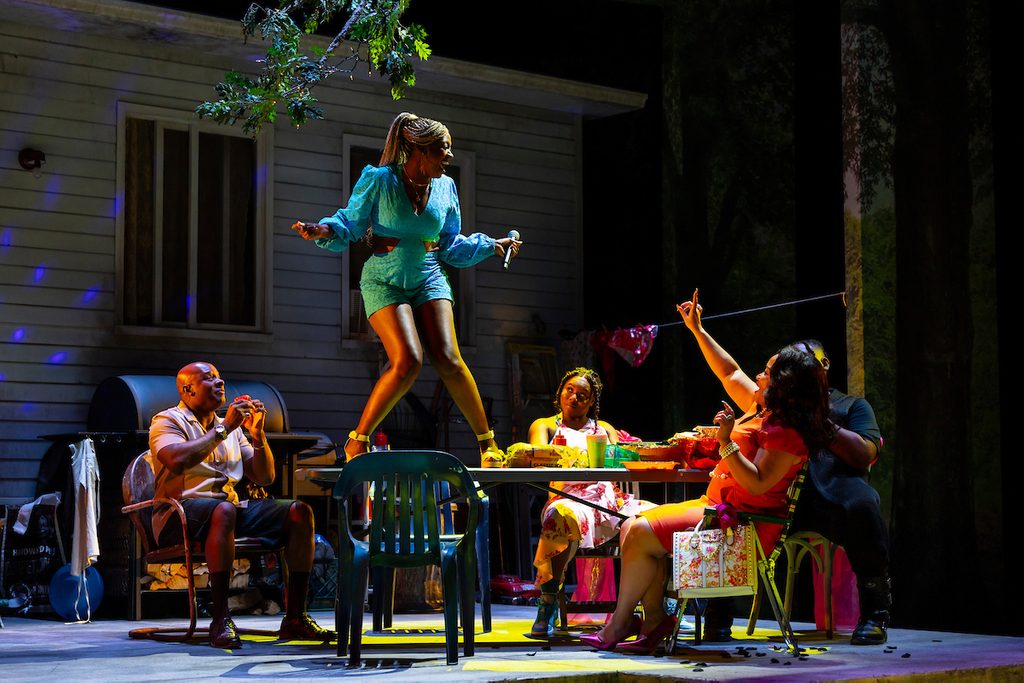
Cast of ‘Fat Ham’ The Huntington Theatre. Photos by T Charles Erickson
By Shelley A. Sackett
“Fat Ham,” winner of the 2022 Pulitzer Prize Award for best drama, is much more than a modern-day riff on “Hamlet,” one of Shakepeare’s most quoted, performed and adapted plays. Using the bones of the Bard’s tragedy as a structural anchor, the exceptionally talented playwright, James Ijames, has fleshed it out with analogous characters whose feet are firmly planted in the here and now and whose modern-day nightmares and dreams reflect both the mundane and the existential.
Like Shakespeare’s “Hamlet,” “Fat Ham” asks the question, “How do we cope in a belligerent world untethered?” and answers it simply: “To thine own self be true.” But instead of engaging in a bloody palace battle over his wearing his father’s coveted crown, this Hamlet wants only to prove his father’s murderer’s guilt and then high tail it to greener, less legacy-laden pastures where he can let down his guard and live an authentic and happy life.
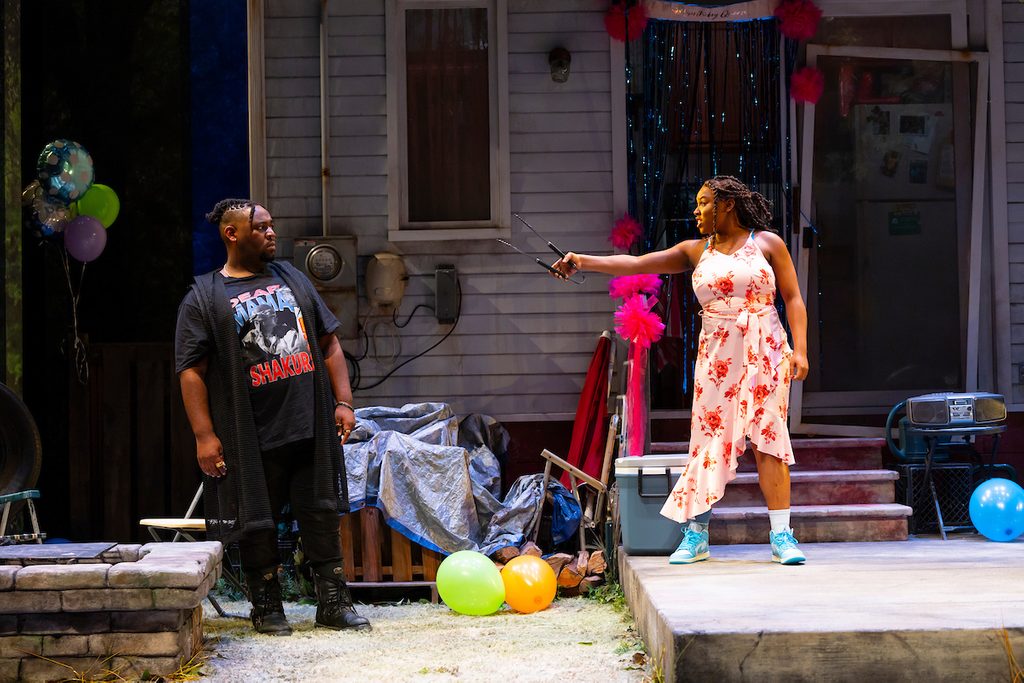
Although full of allusions to the original tragedy about the Danish king (a splendid one-page graphic summary of “Hamlet” by Mya Lixian Gosling is a welcome inclusion in the program), “Fat Ham” stands on its own. Its story is told through the eyes of Juicy/Hamlet (a spot-on Marshall W. Mabry IV), a young, queer Black man marooned in no man’s land with no lifeboat in sight.
The play opens in Juicy’s backyard as Tio/Horatio (the stand-out, gifted Lau’rie Roach), his best friend and greatest advocate, tries to get his buddy to address and snap out of his melancholy. Juicy’s father, Pap, was recently killed in jail, where he was serving time for slitting a man’s throat because he couldn’t stand the smell of his breath.
Tio, more laid back than Juicy, diagnoses Juicy’s problem as more than a reaction to his recent domestic woes. According to Tito (who sees a therapist, so he has cred in this department), Juicy isn’t suffering from individual filial grief. Rather, his is the inescapable condition of Black “inherited trauma.” “Your Pop went to jail; his Pop went to jail. His Pop went to jail. His Pop went to jail, and what’s before that?” he asks. “Slavery.”
As if that weren’t heavy enough, Juicy (like Hamlet) has much more on his plate. His mother, Tedra (a slinky Ebony Marshall-Oliver), married Pap’s brother Rev (James T. Alfred, who also plays Pap) while Pap’s body was still warm. Then, just as the backyard bar-b-q wedding celebration is about to begin, Pap appears to Juicy as a ghost.
Pap is one mean son-of-a-bitch, cursing Juicy for being soft and trying unsuccessfully (he is, after all, a noncorporeal ghost) to beat him to a pulp. Yet, he has a message and directive that Juicy can’t ignore.
Rev was behind Pap’s murder, he tells his son. He insists Juicy man up and avenge his death.
“It’s amazing what fathers think they own just because they share the same name as their son,” Juicy tells Tito, who couldn’t see Pap’s ghost but knows exactly what Juicy means.
Mirroring the relationship he had/has with his father, there is also no love lost between Juicy and Rev, who treats his nephew/son with contempt and one-upmanship, calling him a pansy and stealing his college tuition money to remodel a bathroom worthy of a new man of the house.
What should Juicy do? Be a man, embrace violence and follow in his father’s footsteps? Or take the road advocated by the laidback, don’t-worry-be-happy Tito and reimagine what it means to be a man?
If this sounds solemn and heavy, it is. (Just read the original “Hamlet.”) Yet, in Ijames’ magical hands (and under Stevie Walker-Webb’s razor-sharp direction), such profound topics as: the unending cycle and generational trauma of male violence; sexual and racial inequity, and freedom of identity become manageable because they arrive wrapped in the gift of comedy.
Ijames’s true genius (and no doubt a reason for his well-deserved Pulitzer Prize) is his ability to infuse this story of tragedy and violence with laugh-out-loud jokes, songs, sight gags and such modern props as a karaoke machine. His troupe of lively, original and (other than Rev) compassionate people each literally vibrate to their own rhythm.
Opal/Ophelia (a perfectly cast Victoria Omoregie) is a pouty teenager, chafing at her mother’s heavy-handed directive to be ladylike and wear a dress when all she wants is to join the military and scream at the top of her lungs that she likes girls. Rabby, her rabid liquor-loving, church-lady mother and a stand-in for the equally judgmental Polonious, is played by scene-stealer Thomika Marie Bridwell. Larry/Laertes (the splendid Amar Atkins), Opal’s Marine brother who is also a closet gay, rounds out the cast.
Ijames has many tricks up his sleeve to keep the fast-paced, 90-minute (no intermission) play moving effortlessly. He manages to combine an unlikely list of ingredients (serious soliloquies, characters who break the fourth wall, slapstick, stoner raps, MTV-worthy musical song-and-dance numbers and internal monologues) to create a satisfying, hearty four-course meal.
Luciana Stecconi’s set brings the audience squarely into a lower-middle-class, well-loved, and much-used backyard. Her keen eye and attention to countless details, such as a screen door off its hinge, shows.
The one criticism (and this production is not alone in this department, unfortunately) is that the actors need to have better mics, and their lines frequently need better pacing. Nothing is more frustrating to an audience than when the end of a line is swallowed or a new one begun before laughter from the previous one has died down. Ijames’s writing is too delicious not to savor.
Some have complained that the end is a facile cop-out meant to offer an easy out for the current feel-good streaming culture. Ijames deserves more credit than that. His ending may be upbeat (and a delectable dessert), but it is deliberate and message-laden.
The playwright challenges us to answer Tito’s rhetorical question: What would life be like if we chose pleasure over harm? Judging from the audience’s reaction to the finale, it would be pretty darn good indeed.
Fat Ham’ — Written by James Ijames. Directed by Stevie Walker-Webb, Scenic Design by Luciana Stecconni, Costume Design by Celeste Jennings, Sound Design by Aubrey Dube, Lighting Design by Xiangfu Xiao. Presented by The Huntington Theatre in association with Alliance Theatre and Front Porch Arts Collective at the Calderwood Pavilion at the BCA, 527 Tremont St., through Sunday, October 29, 2023.
Harold Surratt and April Nixon in the Tony Award nominated “Clyde’s.” / KEVIN BERNE
By Shelley A. Sackett/JEWISH JOURNAL
Tikkun Olam, as explained in the Mishnah, is a Jewish concept defined by acts of kindness performed to perfect or repair the world. There are innumerable ways for us to do tikkun olam in our daily lives, each one with the potential to change everything for everyone.
Although it’s unlikely playwright Lynn Nottage had this concept in mind as she wrote the Tony Award-nominated comedy “Clyde’s,” now in production at the Huntington through April 23, its message runs throughout her play.
The setting (and what a set it is!) is Clyde’s, a truck stop café near Reading, PA. More than a way station for the road-weary, it is also a shelter for its four employees, all felons. For the three recent arrivals who need to show a weekly paycheck to maintain parole, it is also their only shot at getting back on track after derailment. Montrellos (Monty), Clyde’s elder statesman, role model and Zen master, supervises this crew.
Under the annihilative command of Clyde, the owner, achieving that goal is an uphill battle.
The play opens with Clyde and Monty (dressed in bright dashiki and kufi) in mid-conversation. He begs her to taste his latest creation, a sublime twist on the grilled cheese sandwich. She blows cigarette smoke in response. Wearing a glow-in-the-dark orange waist-length wig and exterior black corset, she looks like a cross between a deranged Tina Turner imposter and an S&M dominatrix. The effect is terrifying.
Instead of tasting the sandwich, she uses it to crush out her cigarette, just as she relentlessly snuffs out any hint of hope or happiness she senses smoldering.
The staff live in fear of her temper and she taunts them sadistically with threats to make up a parole violation and report them to the police. Behind the kitchen’s swinging door, without her lurking, they are free to connect and actually enjoy their work. Cautiously, they relearn how to trust, revealing what landed them in the slammer. Letitia, a quick-witted, sassy single mom, broke into a pharmacy to steal unaffordable seizure medicine for her daughter. Rafael, a playful recovering addict, tried to rob a bank with a BB gun while high. Jason, Clyde’s only white employee, is covered in white supremacy tattoos and fresh out of prison for assault.
In his role as mentor, Monty is kind, sage and committed to helping his charges survive their difficult transition. Although he doesn’t reveal why he served time until the play’s end, he has clearly walked the same walk.
His trick is the quest to create the perfect sandwich, that “most democratic of all foods.” Sandwiches can be more than the quotidian ingredients they slap between two pieces of bread for the café’s clientele, Monty counsels. They can reflect their creators’ dreams and truths. They even have the magic power to unlock the gate to their salvation. He is living proof. The others bite, joining him on his pilgrimage. They bond over shared imaginary recipes, light-heartedly chanting ingredients like tantric mantras. After hours, each secretly works out combos that might earn Monty’s approval and, by extension, launch them toward a sense of self-worth.
Clyde doesn’t see sandwiches (or anything else) through the same rose-tinted lenses as Monty. Although she, too, was imprisoned, empathy and tikkun olam hardly drive her to hire only ex-cons. Rather, she uses them as cheap labor to populate her own sort of jail where she reigns as warden to these “loser” ex-prisoners who float in painful limbo between “real” prison and the ersatz one she has created.
Against great odds, and with Monty’s critical help, her employees ultimately free themselves from her grip by banding together and refusing to follow an order they just cannot abide. Although what triggers their rebellion is on its surface comedic, Nottage deftly handles this turning point moment, plumbing it for deeper beauty, poignancy and strength.
Nottage also has a gift for comedy, and under Taylor Reynold’s tight direction, her zingers are laugh-out-loud funny. The terrific actors playing the kitchen crew are an airtight ensemble that breathe life into their parts.
Unfortunately, the same is not true of the unnuanced Clyde. To be fair, Nottage has created a cardboard caricature, giving the actress little to work with. The distraction of her dozen or so wig and outfit changes only emphasizes the playwright’s missed opportunity in not fully fleshing her out.
Which is too bad, because Clyde exemplifies what can happen when, in pursuit of financial gain and raw power, we lose sight of what really feeds and sustains us. Luckily, her crew has Monty, with his belief in the restorative power of the sandwich, to lead by example and show them a better way.
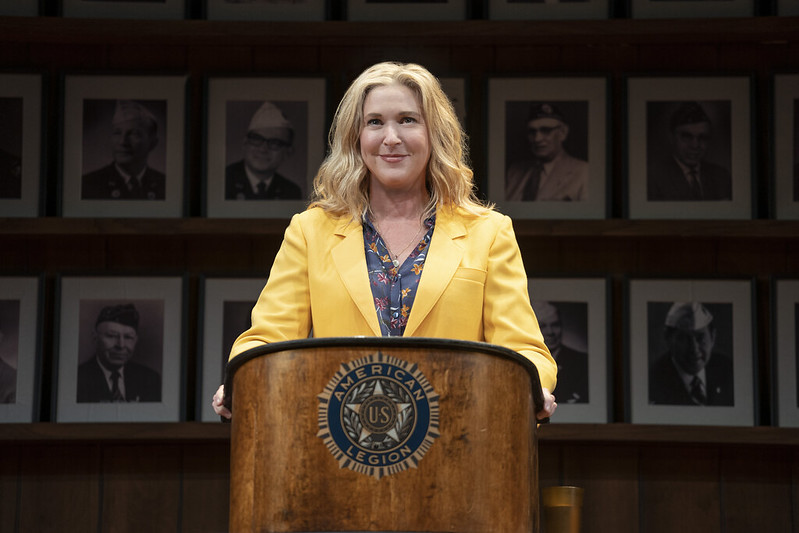
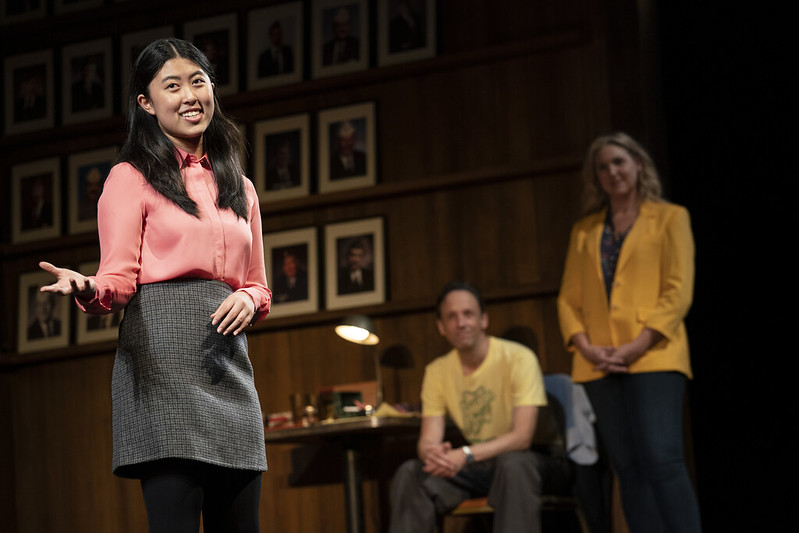
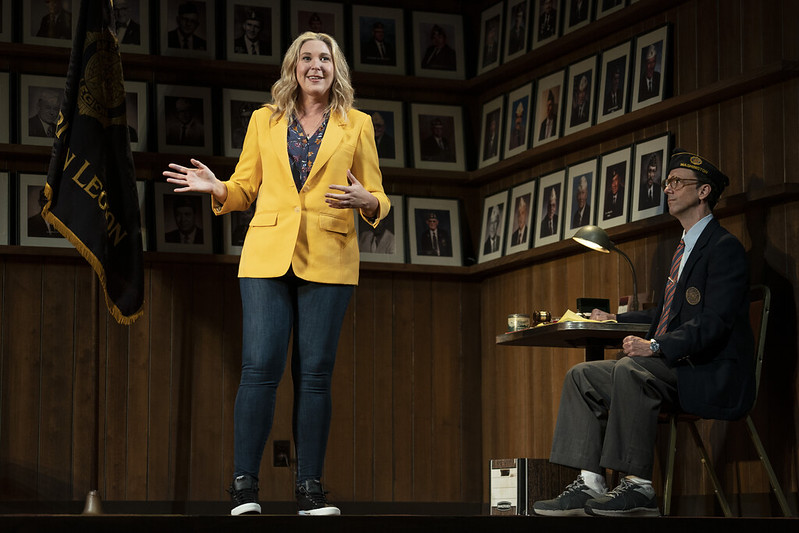
Cassie Beck in the Huntington’s ‘What the Constitution Means to Me’ at the Emerson Cutler Majestic Theatre. Photos: Joan Marcus
by Shelley A. Sackett
What The Constitution Means to Me asks us to think about and get personal with the US Constitution, and that request couldn’t come at a more timely moment. It seems that hallowed document is front and center in our daily lives, whether we invite it or not. We read the news and, while we were aware Trump was shredding the Constitution with the hope it could never be pieced back together again, we now have to wonder — did he also flush it down the toilet?
We browse news of the Supreme Court’s latest actions and can’t help shivering at how the majority of the chief enforcers of our alleged democracy seem hell-bent on following his lead, emboldening those who would discriminate, marginalize and disenfranchise.
Which is why the Constitution is something I — and I’m sure I’m not alone — have thought about a lot lately.
Jocelyn Shek, Mike Iveson and Beck
That experience cemented a deep love for and knowledge of the document she unapologetically venerated until she realized, as she grew older and the rose tint of her glasses faded, that its authors’ intentions were more repressive than liberating.
The spectacularly talented Cassie Beck channels Heidi, and she is a powerhouse and marvel to witness. She is a consummate storyteller, appearing extemporaneous and almost ditzy at times as she methodically lays the groundwork for some heady conclusions. She addresses the audience with warmth, humor and honesty, whether playing her 15-year-old or 41-year-old self. She confesses of late she has been troubled by an unanswered question: what was it she had loved so much about the Constitution when she was a teenager?
For the next hour of the 105-minute intermission-less production, Heidi/Cassie wanders through the Constitution, exposing its flaws and malevolent intent with stories from her own family and from Supreme Court cases. (Authentic recordings of actual Supreme Court hearings add a compelling touch). She highlights how the Framers — all white male property owners — deliberately omitted reference to anyone else when they drafted the Constitution meant to provide equal protection under the laws of the land that document would rule.
Iverson
The Constitution, she points out, “was designed to protect the men who made it and their property — which was sometimes people — from the government.”
This has resulted in sanctioned violence against generations of Native Americans, people of color and women, including her own mother, whose first memory of her stepfather was him socking her mother in the face.
Along for the ride, we learn quite a bit about the Constitution in a way that is not at all reminiscent of law school. Schreck’s understanding and appreciation of that document is deep, and her script transforms complicated concepts into easily relatable vignettes. She tells story after story about women in particular who, she notes, aren’t even acknowledged as existing until the 19th Amendment, ratified in 1920. “What does it mean if the Constitution doesn’t protect women?” she bemoans. By way of tragic example, she shares her own mother’s and grandmothers’ stories of heart-wrenching abuse, allowed by “centuries of laws that told them they were worthless.”
Later, after treating the audience to her primal scream/howling sob — her instinctive coping mechanism against rage and despair that has chased away more than a few boyfriends — she wonders aloud, ”Maybe this is just the appropriate response to everything right now?” That line drew thunderous applause.
Beck, Iverson
Lest this paint a dark and pedantic image of this dazzling production, be assured that there are as many moments of hilarity and lightness as there are of stark reckoning. Teenage Heidi doesn’t only love the Constitution; she also loves Patrick Swayze, magic spells and making out with boys. Beck is charming and engaging, and the physicality and expressiveness of her acting chops is as mesmerizing as it is enjoyable. This is Broadway-quality acting at our own back door.
The last 15 minutes of the show unfortunately break the mood and shift the pace. They are devoted to a debate about whether the Constitution should be scrapped or tweaked. A parliamentary debater, Emilyn Toffler, a 17-year-old Californian — who was annoyingly difficult to hear and understand — joined Beck on stage. The audience received pocket-sized copies of the Constitution (a nice party favor) and, after listening to both sides, was asked to vote whether to preserve the US Constitution as written or scrap it and start over. “It is because of the Constitution, not in spite of it, that we can have this debate,” said Toffler, who was arguing for preservation. In the end, the representative audience member chosen at random to deliver the verdict, agreed.
And so, at least as of last Wednesday night’s performance, the Constitution remains the ruling document of the land. For more information and tickets, go to: https://www.huntingtontheatre.org/
‘What the Constitution Means To Me’ — Written by Heidi Schreck. Directed by Oliver Butler; Scenic Design by Rachel Hauck; Costume Design by Michael Krass; Lighting Design by Jen Schriever; Sound Design by Sinan Refik Zafar. Presented by Huntington Theater Company atEmerson Cutler Majestic Theatre through March 20.
Louis Reyes McWilliams, Shannon DeVido, Emily Townley, Portland Thomas, Gregg Mozgala in ‘Teenage Dick’, at The Huntington Calderwood/BCA. Photos: Teresa Castracane
by Shelley A. Sackett
From the moment he walks onto the bare stage and addresses the audience in the first of many private monologues, it’s clear 17-year-old Roseland High School junior Richard Gloucester (Gregg Mozgala) has an angle beyond just establishing a connection with the audience. What that angle is is less clear, and will shape-shift with dizzying speed during the next 70 minutes until the audience is left in a delicious murky space of questioning almost everything they thought they knew about both Richard and themselves.
That Richard (and, as it turns out, Mozgala) has cerebral palsy, however, is indisputable. He wears two leg braces and walks with a spastic gait. It galls him that the junior class president is Eddie, the lunkhead quarterback and the vice president is Clarissa, a pandering religious toady, while he, imminently more qualified, languishes in his role as secretary.
But languish he will no more. Whatever it takes, this Richard is determined to rise to the top.
Mike Lew’s ambitious ‘Teenage Dick,’ a thinly disguised riff on Shakespeare’s “King Richard III,” appropriates the Elizabethan amoral, villainous scoliotic protagonist bent on murdering his way to the throne and recasts him as an impishly fiendish disabled high school senior, hell-bent on not just winning the election, but humiliating and grinding his opponents into dust.
Commissioned by Apothetae theater company, which is dedicated to productions that “explore and illuminate the ‘disabled experience,’” and where Mozgala is artistic director, ‘Teenage Dick’ deliberately features disabled actors on stage. The result lends a riveting authenticity. These actors aren’t just playing a part; they reveal what disability really feels like from the inside.
Back to teenage Richard who, still in his introductory aside, informs us matter-of-factly that he will “vault past my inglorious station” and become class president by systematically destroying the competition and holding dominion over the entire school. “I come to bury Eddie, not to praise him. Is this a ballot I see before me?” he asks in a mashup of well-known Shakespearean lines.
But why would he do something so mean? “Because they all hate me, that’s why! I was stamped for their hatred from birth. They see my unpleasant shape and like a magnet I must repulse,” he tells us. Yet, from the play’s prologue to its epilogue, we are left wondering: Is Richard’s self-hatred the result of his classmates’ rebuff or its cause? And, more critically, is disability something you learn to accept and adjust to or is it just one of life’s hurdles you strive to rise above?
Before those enquiries have time to sink in, poof! We are transported to Elizabeth York’s (Emily Townley) English class, where Richard’s classmates are none other than Eddie (Louis Reyes McWilliams), Clarissa (Portland Thomas) and “Buck,” (the show stopping, scene -stealing Shannon DeVido), Richard’s wheelchair-bound best friend.
Aptly, the class is studying Machiavelli’s The Prince, the original handbook for unscrupulous politicians. Unsurprisingly, Richard has devoured every word. He is armed and ready for election battle. He even has a plan: he will run a covert campaign.
He also has an accomplice. Or two. He has imperiously assumed Buck would be on board. He also manipulates the support of Ms. York —who is advisor to the drama club — by promising he will make sure the school’s discretionary funds don’t all go football. “I know someone like you understands the importance — the all-consuming social importance — of live theater!” she croons. When Richard responds by mugging to the audience, the masked crowd went wild.
Just as Shakespeare’s King Richard III seduces Lady Anne in his scrabble to the throne, Richard decides he needs to add Eddie’s cool ex-girlfriend, dancer Anne Margaret (the impossibly lithe and lovely Zurin Villanueva) to his arsenal. He turns his Machiavellian charm her way, conning her into asking him to the Sadie Hawkins dance and giving him dance lessons.
With his unbalanced and unpredictable shuffle, Richard is a challenge, but one Anne is up for. The scenes between these two are among the play’s most critical. They address disability head on and from the heart. Anne, intimately connected with the joy her body affords her, teaches Richard to acknowledge and accept his own limitations rather than fight against it. Their interactions are tender, intimate and beautifully staged.
“Richard, can I ask? What’s it like? Like the way that you move, what does it feel like to you?” Anne asks sincerely.
When Mozgala/Richard answers, the authenticity is palpable. “I’ve never been asked… You know how sometimes in winter when you hit an ice patch you didn’t know was there, how you brace yourself before you’re about to slip on the ice?… That’s what it’s like for me all the time,” he answers.
The interactions between the sardonic hilarious Buck and Richard are similarly loaded. These two travel the same path and when they talk about it, it is from a place of shared legitimacy. Yet, their approaches couldn’t be more different.
“Do you believe our social station is circummountable, or is it immutable? Don’t you believe we can rise past our station, given sufficient cunning and skill?” Richard asks. “Nope, I don’t. I’m not like you, yearning to fly beyond nature’s boundaries like some kind of disabled nerd Icarus,” Buck replies.
But then she asks him the bigger question, the one at the heart of his personal psychological limitation. “Richard. Why can’t you be happy just being yourself?” Richard responds: “This [high school] is as good as it gets for us. This isn’t our awkward phase, it’s the rest of our lives.”
Although the writing and acting is uneven, this production is worth seeing for DeVido’s performance as Buck alone. Her delivery, gesticulations and wheelchair maneuvering are spellbinding and side-splittingly hysterical. Lew has given her the play’s best lines and she chews them up, spitting them out with relish.
Kudos also to Mozgala and his nuanced performance, Villanueva for her dancing and Palmer Hefferan for her punchy sound design.
Alas, Lew’s shifts from satire to TV sitcom to high drama, melodrama and horror give the audience a mild case of the bends, and by the time Richard reveals his true self in his epilogue monologue, emotional fatigue has set in. Yet these words arouse us from our sensory overload:
“You already decided who I was before it was mine to choose it, so what else could I do but act out the role that’s been writ? If that makes me the villain, welllll… You already knew I wasn’t the hero from the moment I came limping your way. So close your eyes and forget about me. You always do anyhow,” Richard says.
Lew’s zinger closing line goes to the heart of the biggest issues ‘Teenage Dick’ addresses, that is: Did Richard choose to be a villain or was he forced into that role? Is he undone by his own psychological defects or by outside forces that have marginalized and bullied him? And, ultimately and most importantly, how much of the responsibility do we in the able-bodied world bear based on how we might have perceived and treated the disabled?
‘Teenage Dick’ – Written by Mike Lew; Directed by Moritz von Stuelpnagel; Scenic Design by Wilson Chin; Sound Design by Palmer Hefferan; Lighting Design by Amith Chandrashaker; Choreography by Jennifer Weber; Fight Choreography by Robb Hunter. Presented by The Huntington Theatre Company at The Calderwood Pavillion, 527 Tremont St., Boston through January 2, 2022.‘Teenage Dick’ – Written by Mike Lew; Directed by Moritz von Stuelpnagel; Scenic Design by Wilson Chin; Sound Design by Palmer Hefferan; Lighting Design by Amith Chandrashaker; Choreography by Jennifer Weber; Fight Choreography by Robb Hunter. Presented by The Huntington Theatre Company at The Calderwood Pavillion, 527 Tremont St., Boston through January 2, 2022.






 InSights