A.R.T.’s ‘The Odyssey’ Catapults Homer’s Ancient Epic Poem into the 21st Century

Members of the cast in A.R.T.’s world-premiere production of The Odyssey.
Photo Credits: Nile Scott Studios and Maggie Hall.

By Shelley A. Sackett

“If you’ve gone through something traumatic, can you ever go back to who you were? Can you ever go back home?” is the essential question American Repertory Theater’s Terrie and Bradley Bloom Artistic Director Diane Paulus asks audience members to consider as they experience the world premiere of Kate Hamill’s A.R.T.-commissioned newest work, ‘The Odyssey.’ This spectacularly produced reimagination of Homer’s 8th/7th century B.C. epic poem is the latest retelling of a classic tale by Hamill, who, once again, displays her special talent for penning plays that magically remain true to the original while interweaving parallel contemporary issues, culture and language.

Hamill’s version of The Odyssey evokes both memories of ninth-grade English class and the latest headlines. She is a true master storyteller and alchemist. For three hours (two welcomed intermissions), the audience rides shotgun as she personalizes and contextualizes the Greek epic that follows the hero and king of Ithaca, Odysseus, and his homecoming journey after the ten-year-long Trojan War. During the decades-long trip from Troy to Ithaca, he encounters many perils, and all of his crewmates are killed. During Odysseus’ inexplicably long absence (the distance from Troy to Ithaca is only 565 nautical miles), he is presumed dead, leaving his wife Penelope and son Telemachus to contend with a group of unruly suitors competing for Penelope’s hand in marriage.
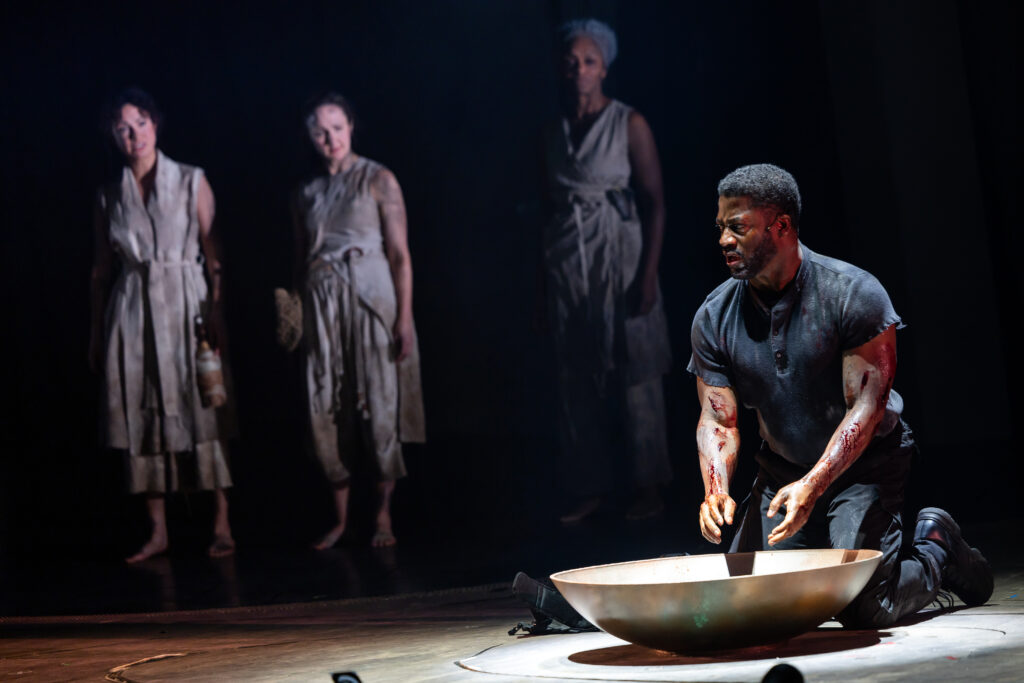
Alejandra Escalante, Kate Hamill, NikeImoru and Carr

Homer’s original tale stresses ethical ambiguity and codes of heroic values and displacement. Hamill breathes contemporary life into these themes, adding her own twists that highlight the trauma of war on both those who fight and those they leave at home. Her trademark feminist lens focuses tightly on the play’s many female characters, especially Penelope and her struggles during Odysseus’ 20-year absence.

Sibyl Wickersheimer’s set is magnificent in elegance, simplicity and flexibility. Hundreds of yards of fabric shroud the stage as tasseled drapes hanging from the ceiling, geometric sculptural patterns along the back wall, and flowing, free panels. Shifting lighting and projections (Jeanette Oi-Suk Yew) change their color, mood and function. Cut-out boards and shapes shift function from ship to palace to island. The effect is dreamlike and captivating.

Act I opens on a beach with a chorus of three masked women who approach Odysseus (a credible Wayne T. Carr), as he scrubs his hands in a bowl of water. They act as narrators, dramatically bringing the audience up to speed on Odysseus’ life as king, husband, father and, above all, soldier. They are his guides and will accompany him throughout his travels.
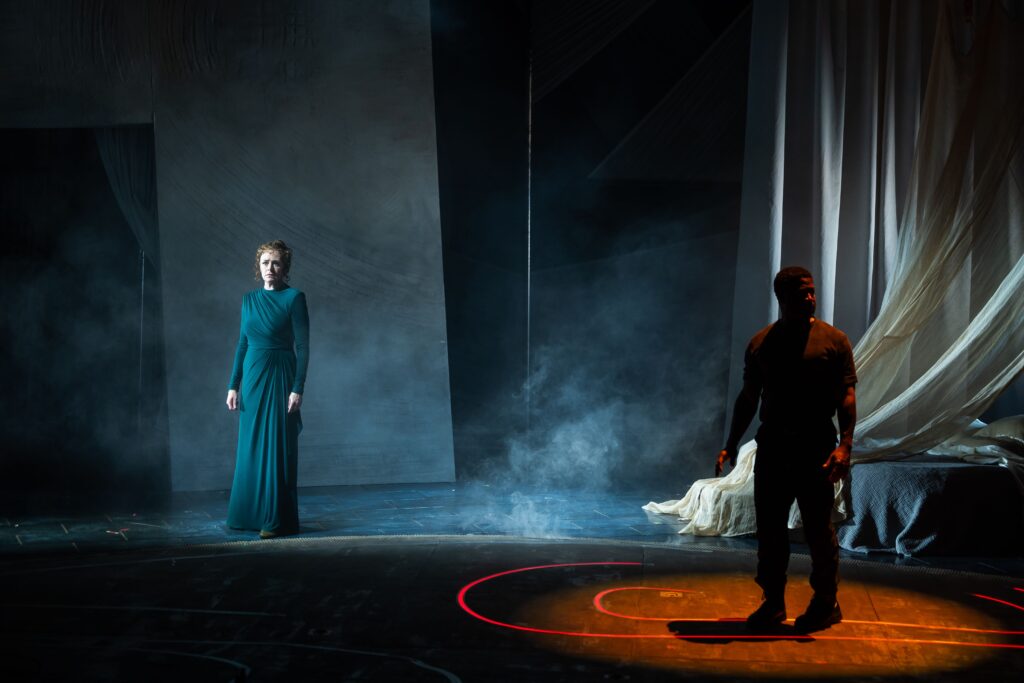
Andrus Nichols and Carr

We learn that Odysseus is the only man who has not yet returned to Ithaca from the war in Troy. Shadow puppets (which appear throughout the play in various forms) illustrate his tale. The effect is Shakespearean, the triad reminiscent of the three witches, and Odysseus’ frantic hand-scrubbing is a hat tip to Lady Macbeth’s obsessive hand-washing in her effort to rid herself of feelings of shame and guilt.

“Your hands are clean,” the women croon, but Odysseus only revs up the pace in response.

In a flash, the language shifts from classical to contemporary vernacular and the beached ship morphs into a disco-like scene, complete with music, sexual innuendos and lots of swearing. We are in Ithaca, where Queen Penelope’s home has been besieged by rough-neck “suitors” intent on becoming the next king.

Flash again, and we are back with Odysseus, docked on an island inhabited by Titans. He and his men encounter the Cyclops, Polyphemus, when they search for food in a cave. Clever staging simultaneously evokes the giant and the cave through projections, puppetry and shadows. The three women (who also play different supporting characters in each scene) are charming as the mouth-watering lambs the men follow into the cave.

Act II is devoted to the cunning sea-witch goddess, Circe (played with impeccable timing, intonation and physicality by a scene-stealing Kate Hamill), and her island Aeaea, where Odysseus and his men almost meet their match. Circe agrees to let the men live if Odysseus stays with her. Finally, he snaps out of his drugged state of no man’s land when one of his men reminds him that, painful as it might be, he needs to confront himself, deal with his sins and pain, and return to his family.

“You can’t forget everything, or you forget what’s worth living for. Don’t you want to go home?” he is asked.

Hamill and Carr

Meanwhile, back in Ithaca, Penelope’s (lithe and elegant Andrus Nichols) outer resolve begins to falter as Amphinomus (Keshav Moodliar) begins to chip away at it with seductive, honey-tongued persistence. The deliciously hung fabric is an exquisite setting in pastel hues of mauve and pink. Penelope admits she is tired of being afraid and alone. “I am worn out by memories,” she says. “I’m not free to choose, but I can touch.”

Act III is the longest and most lively, as Odysseus makes his way home (after a couple more stops) and eventually wins back his throne and family. There are bloody battles, disco galore and plenty of irreverent language. The play may be long, but the pace and production values keep it rolling and engaging.
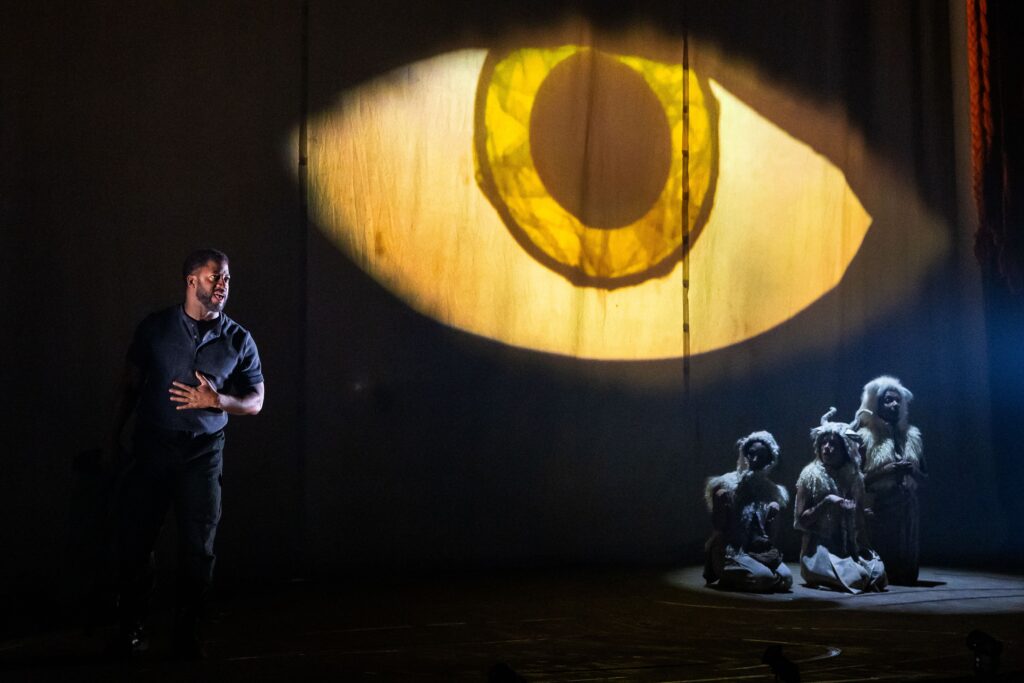
Carr, Hamill, Escalante, Imoru

Director Shana Cooper has an excellent ensemble assembled, and her pacing, transitions and seamless blocking are all spot-on. Hamill’s script, as always, is a mashup of the classic and contemporary, fiercely loyal to the underlying ancient tale, yet spinning an exciting, smart and thought-provoking contemporary cocoon around it. The result is an adaptation that is accessible to all and explores big-ticket concepts.

What are the relationships between trauma, memory and violence, for example? Who are our heroes and what are their values? In this era of migration and displacement physically, emotionally and politically, what does “home” mean and how secure is it?

Hamill’s works are always something to look forward to. The curtain call at ‘The Odyssey’ left me eager to see what she will tackle next.

The Odyssey’ – Written by Kate Hamill. Based on the epic poem by Homer. Scenic Design by Sibyl Wickersheimer; Costume Design by An-Lin Dauber; Lighting Design and Projection Design by Jeanette Oi-Suk Yew; Sound Design and Music Composition by Paul James Prendergast. Presented by American Repertory Theater at Loeb Drama Center, 64 Brattle St., Cambridge, MA, through March 16.
The Odyssey’ – Written by Kate Hamill. Based on the epic poem by Homer. Scenic Design by Sibyl Wickersheimer; Costume Design by An-Lin Dauber; Lighting Design and Projection Design by Jeanette Oi-Suk Yew; Sound Design and Music Composition by Paul James Prendergast. Presented by American Repertory Theater at Loeb Drama Center, 64 Brattle St., Cambridge, MA, through March 16.
ASP’s ‘Emma’ Is Deliciously Incisive, Ingenious and Impudent

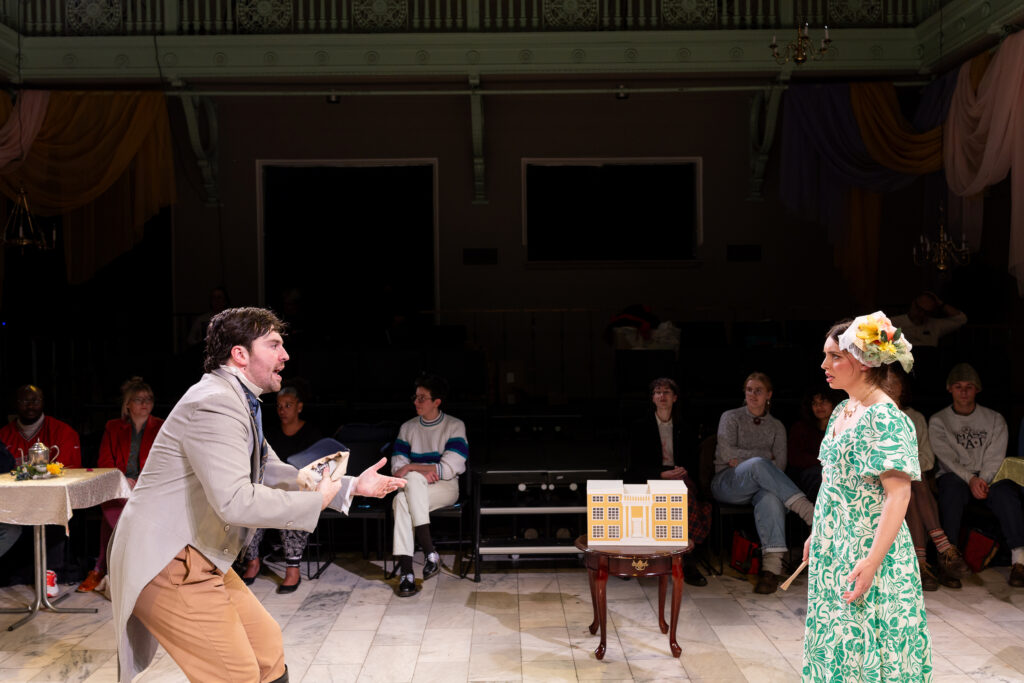
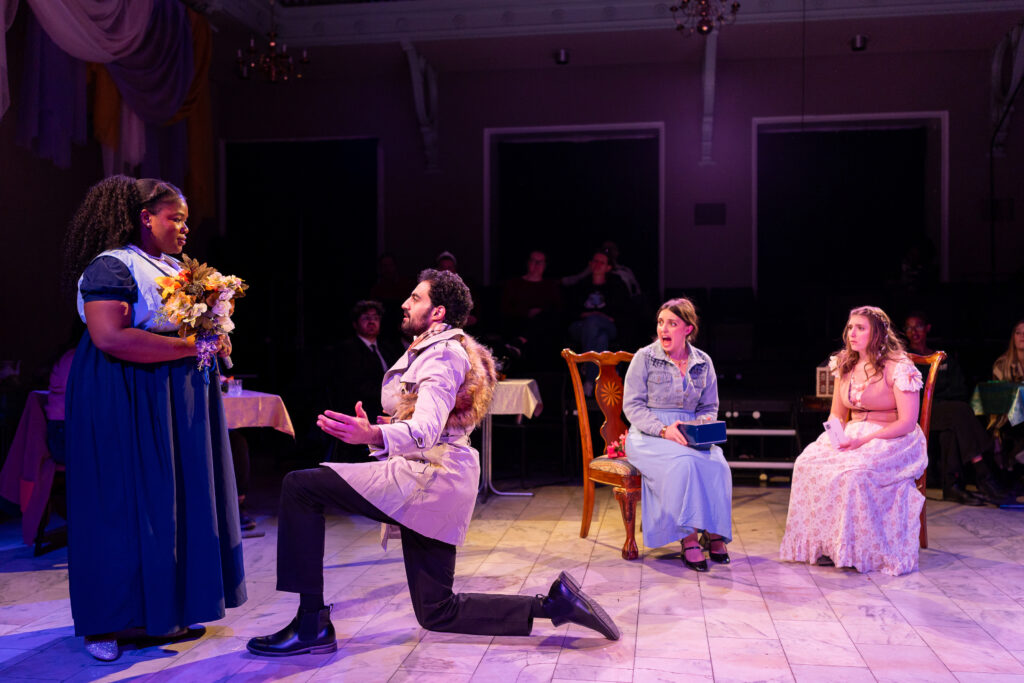
Lorraine Victoria Kanyike, Fady Demian, Josephine Elwood, and Liza Giangrande in Actors’ Shakespeare Project’s production of ‘Emma’. Photo by Nile Scott Studios.

‘Emma’ — Written by Kate Hamill. Based on the novel by Jane Austen. Directed by Regine Vital. Scenic Design by Saskia Martinez; Costume Design by Nia Safarr Banks; Lighting Design by Deb Sullivan; Sound Design by Anna Drummond. Presented by Actors’ Shakespeare Project at Multicultural Arts Center, 41 Second St., East Cambridge through December 15th.

By Shelley A. Sackett

Jane Austen’s 1815 novel “Emma,” like all her other novels, explores the concerns and difficulties of genteel women living in Georgian–Regency England. Her Emma Woodhouse is a bright, wealthy, and confident young woman who basically has it all — education, intelligence, beauty, and money. She also has a surplus of self-confidence, pride and time. She is as spoiled, meddlesome, and self-deluded as she is witty, charming, and pithy.

She lives in an age that prepares wealthy women like Emma for a life of the mind but permits them no occupational outlet. It is matrimony or nothing. It’s no wonder the poor girl nearly explodes with pent-up energy and resentment.

Bored with her own life, Emma turns to the challenge of meddling in the lives of others, manipulating them for sport. She doesn’t court friends; she undertakes assignments. Although she is as unskilled at reading others as she is at self-examination, she fashions herself a gifted matchmaker. Her delusional overconfidence as a marriage broker blinds her to her own romantic potential and leads to misunderstandings, mayhem and heartache.

To her credit, Kate Hammill has taken Austen’s borderline unsympathetic heroine and turned her into a likable rebel who rails against the cruel patriarchal system that imprisons her potential. “What is the purpose of educating women only to have them marry?” she asks. “I must have something to do, or I shall go mad.”

Hamill is no stranger to the genre (she adapted three other Austen works as well as “Little Women” and “Vanity Fair”), and her “Emma“ brims with a delicious melding of past and present, creating a heroine as at home at a lady’s afternoon tea as cutting up the disco dance floor in a white go-go jumper.

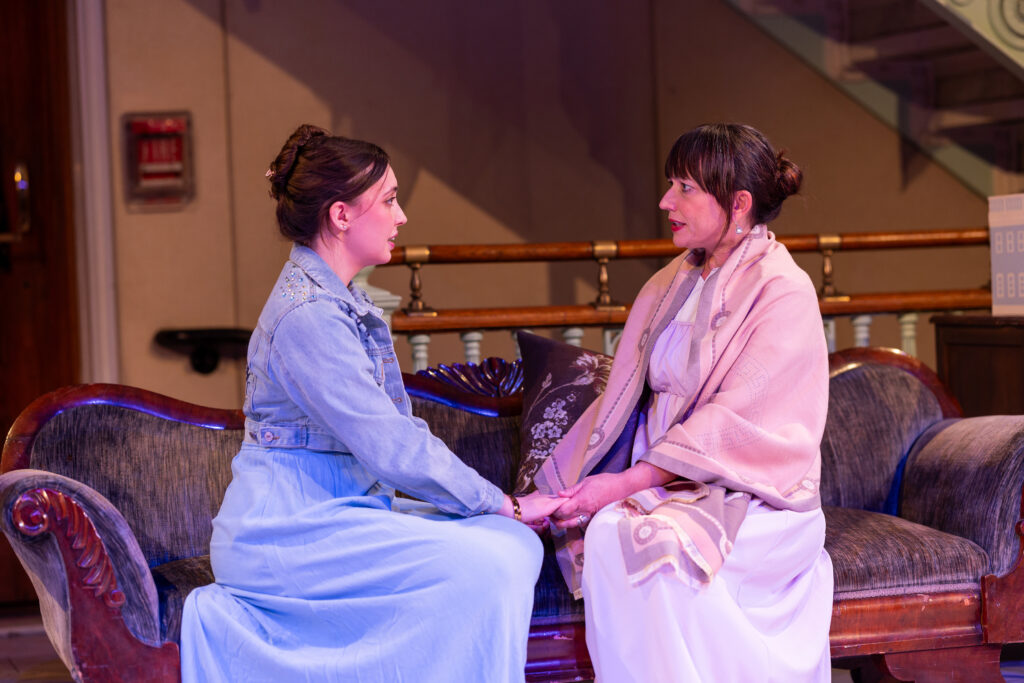
Elwood and Mara Sidmore

Over nearly 2 1/2 hours (one intermission), the plot unfolds. Emma (played with boundless joy and energy by Josephine Moshiri Elwood) and the cast are introduced to us at a party celebrating the wedding of her former governess, Anne (Mara Sidmore), and the widower Mr. Weston (Dev Luthra). Emma tells her father and her best friend since childhood, George Knightley (an outstanding Alex Bowden), that she practically arranged the marriage by introducing them. After such a clear “success,” Emma is determined to make another match. This time, she has set her sights on Mr. Elton, the village vicar. Both Emma’s father and Knightly caution her against interfering, but they ultimately fail to dissuade her.

“You can’t control everything, Emma,” Knightly warns her repeatedly, only to meet the same response: “But isn’t it fun to watch me try?”

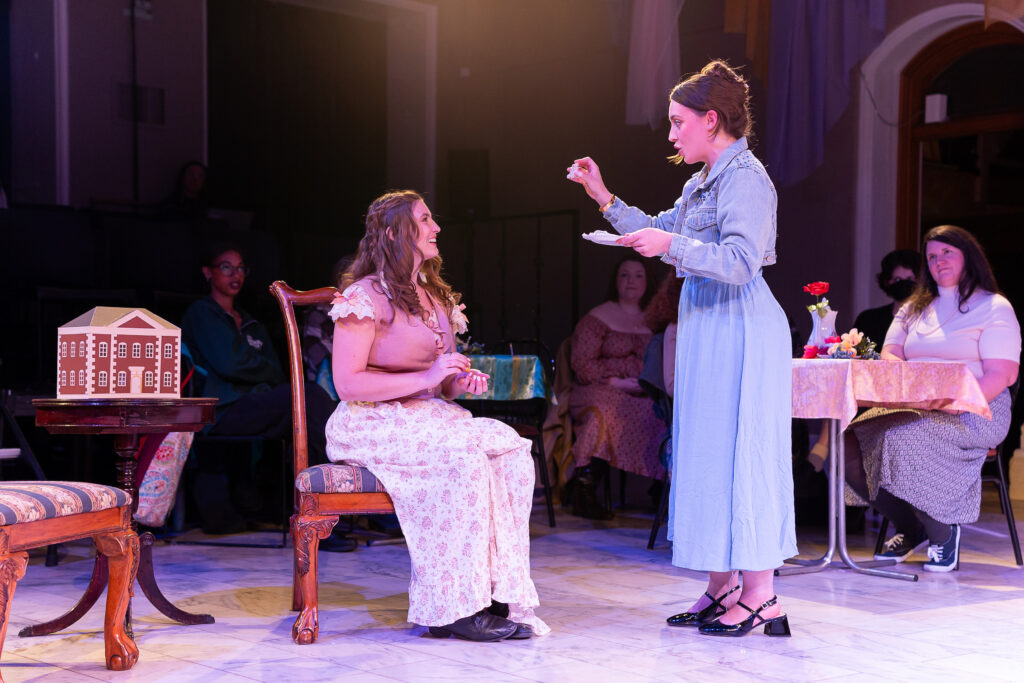
In an act as dispassionate and calculating as Henry Higgins’ taking on Eliza Doolittle, Emma decides that for her next “project,” she will undertake the transformation of Harriet, a 17-year-old student of unknown parentage and inferior social status. Harriet is an eager beaver, as compliant and adoring as a lapdog.

Emma sets about improving (i.e., making her more like herself) her “friend,” starting with convincing her that the groundskeeper, Robert Martin (Fady Demian), the man she loves, is beneath her. When he proposes, Emma gets Harriet to refuse him. She is determined to get Mr. Elton to fall in love with Harriet, thereby elevating both Harriet’s social standing and her own reputation as an unmatched matchmaker.

Needless to say, all does not go according to Emma’s plan. The rest of the play is peppered with colorful characters and rotating liaisons that, owing to double and triple casting, are often hard to keep straight. Aloof, mysterious Jane Fairfax (Lorraine Victoria Kanyike) is Emma’s equal and rival, the only one able to ruffle Emma’s feathers. She is as cool as Emma is hot-blooded, as calm as Emma is kinetic.

Adding insult to Emma’s injured pride, she is also accomplished (as a governess) and intriguing (she left her most recent job under mysterious conditions). She is a thorn in Emma’s side, catapulting her best-laid plans into the abyss.

Although marriage doesn’t figure into Emma’s plans for herself, Knightly and Emma are a match made in heaven that is tediously obvious. They squabble and dance around each other until Emma’s former governess, a very pregnant Anne, practically knocks their heads together and tells them to “work it out!”

Emma must first be pushed off her narcissistic pedestal before this can happen. Ironically, it is meek, malleable Harriet who does the honors when she rejects Emma’s “help” and realizes she has been duped. “You think you control everything, but you don’t control me anymore,” she practically spits.

Like a deer caught in headlights, Emma has a major breakthrough of sudden self-examination. Breaking the fourth wall (which Hamill and Vital execute frequently and effectively), she addresses the audience with cartoonish naïveté. “I may not know everything,” she deadpans in the same stunned voice with which Dorothy announces, “Toto, I have a feeling we’re not in Kansas anymore.”

Liza Giangrande and Elwood

Subtlety is hardly this production’s strong suit.

What IS its strong suit is a stellar cast with unrivaled energy. Elwood IS Emma, with all her strengths and weaknesses. It is a pleasure witnessing an actor so comfortable in her own skin and in that of her character’s, and a joy to behold her joy in the role.

As Harriet, Liza Giangrande has to walk a fine line between hysterically funny and pathetically histrionic. Giangrande rises above the sometimes two-dimensionality of her character, embracing Harriet’s more accessible, loveable, trusting side.

Bowden’s Knightly centers the plot and grounds Emma. He also projects and articulates so effectively that even when his back is to the audience (a frequent and unfortunate feature of the staging, as is poor sight lines from most seats), his lines are easily understandable. Likewise for Mara Sidmore’s Anne Weston.

Although the play is fun, full of funny one-liners and Monty Python-esque routines, at the end of the day, it is Emma and the complicated times she lives through that resonate. As we wade through the sight gags, slapstick, and farce, her plaintive refrain rises above to ring clear as a bell: “What is the purpose of educating women if a lady is not allowed real employment?”

Yet Hamill ends on a hopeful note, planting the seeds of 20th-century feminism in 19th-century soil.

“If I teach my girls the best I can and they teach their girls the best THEY can and their girls and their girls, and so on – who knows what we could make? What power we could harness? What we could do? Can you imagine—someday—a whole world full of Emmas, working together?” Emma asks the half-stunned, half thrilled Knightly.

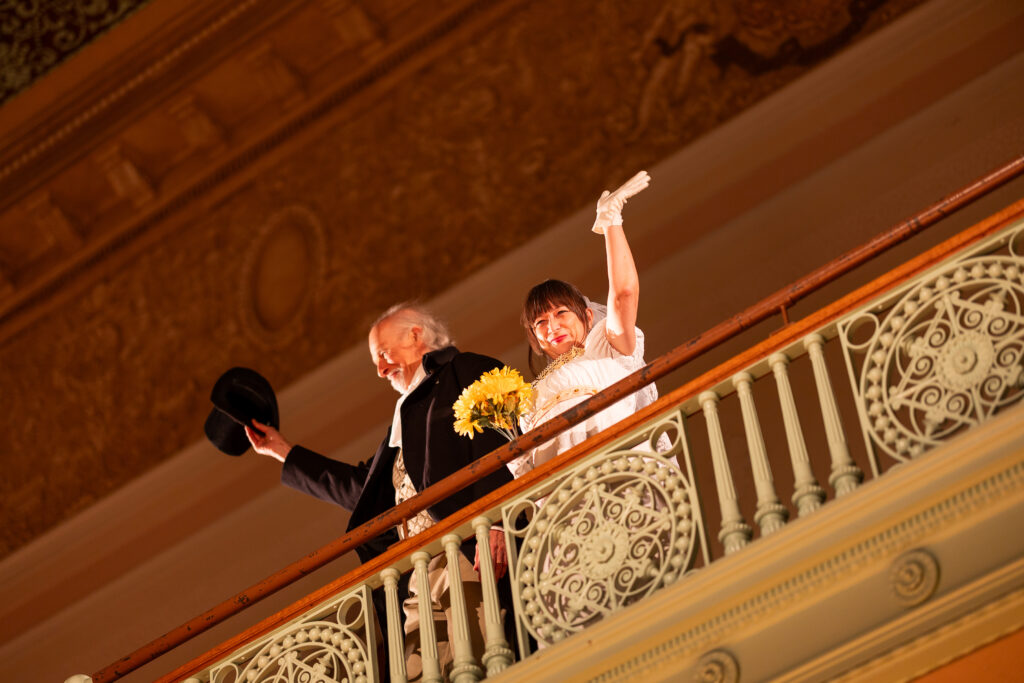
Dev Luthra and Mara Sidmore

“Now THAT, dear Emma,” Knightly should have said in response, ”is a cause indeed worthy of a rebel like you.”

For more information, visit https://www.actorsshakespeareproject.org/

‘Pride and Prejudice’ Gets A Gender-Bending Contemporary Twist


Pride-and-Prejudice-10WEB-RES-Ensemble-1024x683

Cast of Actor’s Shakespeare Project’s ‘Pride & Prejudice. PHOTO CREDIT NILE SCOTT STUDIOS


Reviewed by Shelley A. Sackett

Jane Austen, the 19th century author of ‘Sense and Sensibility’, ‘Pride and Prejudice’, ‘Mansfield Park’ and ‘Emma’ did not hide the ball. Marriage in sexist Regency England is the central theme of all her novels, which she penned under the pseudonym “A Lady.” The laws of coverture, which governed marriage, stripped a wife of all her legal and economic rights, essentially making her a ward of her husband. In the absence of brothers, her family’s fortune would pass to her husband upon her father’s death.

Ironically, a young girl’s sole raison d’être was to secure such a union of legal indentured servitude.

And that is just the predicament the four Bennett daughters are in. Spearheaded by Mrs. Bennett, their storm trooper mother (played beautifully, but for the sometimes screeching exuberance, by Mara Sidmore), the four Bennett sisters are on a crusade: to find a rich husband who will save the family from destitution following the death of Mr. Bennet, whose estate will pass by law to his cousin, the slithery Mr. Collins (more about him later).


pride-1024x683

ASP Pride and Prejudice – Doug Lockwood, Mr. Collins; Zoe Laiz, Jane; Anna Bortnick, Lydia; Lydia Barnett-Mulligan, Lizzy; Louis Reyes McWilliams, Mary


The set (designed by Alexander Woodward) works beautifully to evoke 19th century grand drawing-room country life. The three moving panels with doors provide ample opportunities for entrances, exits and that old standby favorite, slamming doors.


The audience meets Mr. Bennet (played by Gabriel Kuttner in a standout performance), the anchor to the Bennett women who copes with his wife’s frenzy over marrying off their daughters by ignoring it. He is the one calm touchstone throughout the production, providing wry relief when Mrs. Bennet threatens to hurl us all over the edge.


She approaches prepping her daughters for a ball, where her recon has revealed there will be several eligible bachelors, as she would conduct paramilitary drills. Some of the play’s best lines (“We couldn’t be more poised for a victory,” she tells her husband) and some of the best- choreographed scenes are these preliminary family drills.


Each daughter, in turn, approaches the idea of marriage differently. Lizzy (played with solemnness and heart by Lydia Barnett-Mulligan) wants no part of it, either because she refuses to play the game or because she is afraid of making a bad choice. Jane (Zoë Laiz) is aware of both her biological ticking clock and her responsibility as the eldest. Lydia (played with tremendous physical and verbal comedy by a scene-stealing Anna Bortnick, who is equally as impressive in her role as Miss de Bourgh) is 14-years-old and in it for the sport. Mary (Louis Reyes McWilliams, who inexplicably plays her as part Nana-the-dog (from Peter Pan), part Lurch and part omniscient Greek chorus) rounds out the family female tree.


The rest of the play follows these four as they bounce from one romantic crisis to the next. As the level of desperation rises (“This is not a game,” Mrs. Bennet warns), even marriage to Mr. Bennet’s distant cousin Mr. Collins, who will inherit the Bennet estate, is considered.


As played by Doug Lockwood (and dressed by Costume Designer Haydee Zelideth), Collins is all menace and creepiness, his constantly moving hands itching to reach out and snatch the nearest female flesh within his reach. Lockwood plays the part brilliantly, with gusto and credibility. His is one of the few over-the-top performances that blends seamlessly into the rest of the play.


Pride-and-Prejudice-05-1024x683

(Lydia Barnett-Mulligan, Lizzy; Omar Robinson, Darcy


Although marriage to Collins would be fine by Mrs. Bennett, the girls put their foot down and so the family future is even more imperiled. Lizzy eventually meets her match in Mr. Darcy (played with gravitas by Omar Robinson), Jane finds love with Mr. Bingley, and Lydia arguably gets whom she deserves. Since Mary’s eligibility for marriage is questionable, Mrs. Bennet can at last rest and Mr. Bennet can get some well-deserved peace and quiet.


Many of the actors play multiple roles, including some gender-bending ones. Garbriel Kuttner transforms his girth and baldness into a believable Charlotte Lucas (Lizzy’s best friend who makes the disastrous decision to marry Collins) and Doug Lockwood is brings great physicality to Miss Bingley. Since Mary, as directed, is of questionable species, the fact that she is played by Louis Reyes McWilliams is less noticeable.


Under Christopher V. Edwards’ direction, feminist playwright Kate Hamill’s brilliant female-centric adaptation takes on a slightly screwball character that is hit-and-miss. Although Hamill deliberately wrote the play as a farce, some of the slapstick and sight gags work, and some land like a lead balloon. By the end of two and a half hours, most of the freshness has faded.


That said, the acting is overall outstanding and the production is light-heated and fun. Hamill’s script is full of incisive and cutting quips, tacitly alluding to the similarities between the 19th and 21st centuries. “The heroines of Austen’s novels are often struggling with how to reconcile the dictates of their consciences with the demands of their society,” Hamill said. “And I think many of us identify with that.” Judging from the laughter and applause at Wednesday’s show, Hamill’s mission was accomplished.


For tickets and information, go to: https://www.actorsshakespeareproject.org/plays-events/pride-and-prejudice/

‘Pride and Prejudice’ –Written by Kate Hamill; Adapted from the novel by Jane Austen; Directed by Christopher V. Edwards; Choreography by Alexandra Beller; Sound Design by Ian Scot; Lighting Design by Deb Sullivan. Presented by Actors’ Shakespeare Project, Balch Arena Theater, 40 Talbot Ave., Medford, through June 29.