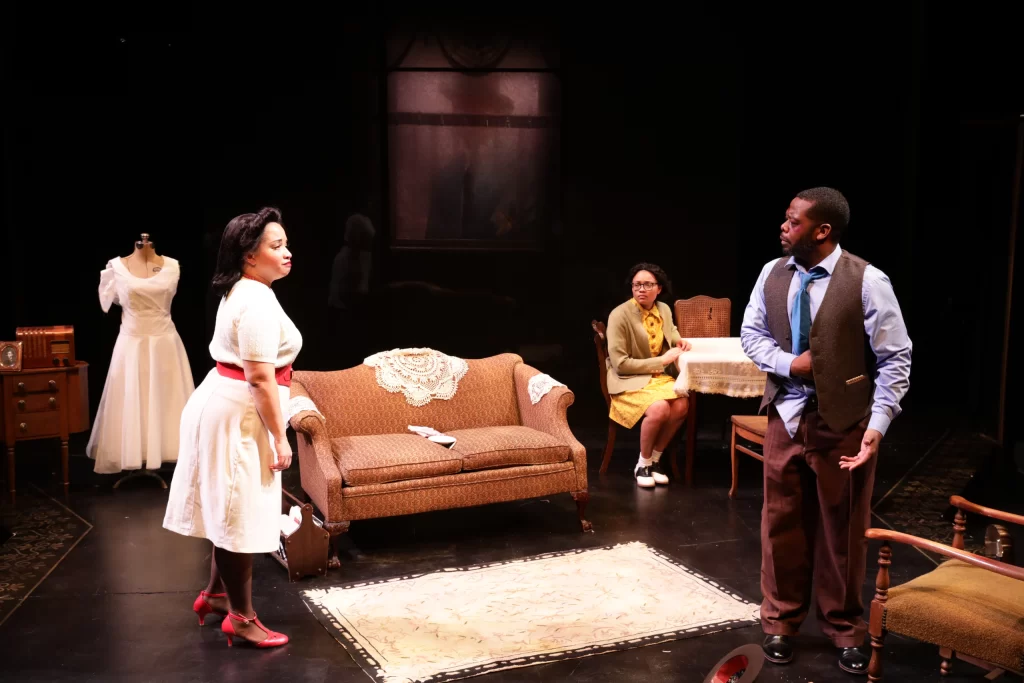
Thomika Marie Bridwell, Madison Margaret Clark, and Dominic Carter
By Shelley A. Sackett
Luck
Sometimes a crumb falls
From the tables of joy,
Sometimes a bone
Is flung.
To some people
Love is given,
To others
Only heaven.
— Langston Hughes
James Mercer Langston Hughes, best known for his Harlem Renaissance Jazz Poetry, wrote “Luck” in 1947. The poem can be interpreted as a commentary on unfairness, deprivation, and the pursuit of love. It could also be read as a reminder of the injustices faced by Black Americans and other “have-nots’ who must bear witness to the overflowing bounty of the “haves” and hope they are in the right place at the right time to scoop up the discarded scraps.
Lynn Nottage’s 1995 play, ‘Crumbs from the Table of Joy,’ picks up Hughes’ theme and runs with it in a two-act work now in production at Lyric Stage. Fair warning to fans of Nottage’s later, brilliantly biting “Clyde’s,” and Pulitzer Prize-winning “Ruined” and “Sweat” — ‘Crumbs’ is far less absorbing and captivating. A nostalgic look in the rearview mirror, it is a good story but about as edgy as a Hallmark movie.
Set in 1950, “Crumbs” is a memory play about the Crumps, a “colored” family that migrates from Jim Crow Florida to Brooklyn. Although the country is recovering from World War II and the Civil Rights movement is gaining momentum, the discrimination and lack of opportunity that greets them in New York doesn’t differ significantly from what they left behind.
Ernestine Crump (Madison Margaret Clark), a 17-year-old who wears bobby socks and glasses, is the amiable, if hardly charismatic, narrator. She shows us around the cramped Brooklyn flat she shares with her father, Godfrey (a nuanced Dominic Carter) and her bouncy, lively 15-year-old sister Ermina (an engaging Catia).
Grief-stricken and psychologically undone by his wife Sandra’s death and faced with raising two motherless teenage girls on his own, Godfrey uprooted the family to follow the African American evangelist, Father Divine, his personal guru and religious savior. It turns out Brooklyn is the return address on Father Divine’s mail order catalog; his Peace Mission Movement is actually headquartered in Philadelphia.
Undaunted, Godfrey immerses himself in his faith in the belief that this will provide a fresh start and a better life for him and his daughters. He dons blinders and digs deeper into Father Divine’s strict religious teachings of celibacy, sobriety and solemnity on Sundays. Structure and strictures are his lifeline. Father Divine lets him know all will be O.K.
He writes letter after letter to Father Divine, desperate for his advice and a glimmer of direct connection. Finally, the mission writes back, telling him to keep following the path and donate money. Godfrey bestows a church name on himself and his daughters and keeps a notebook into which he obsessively jots down questions he will ask Divine Father during his anticipated face-to-face.
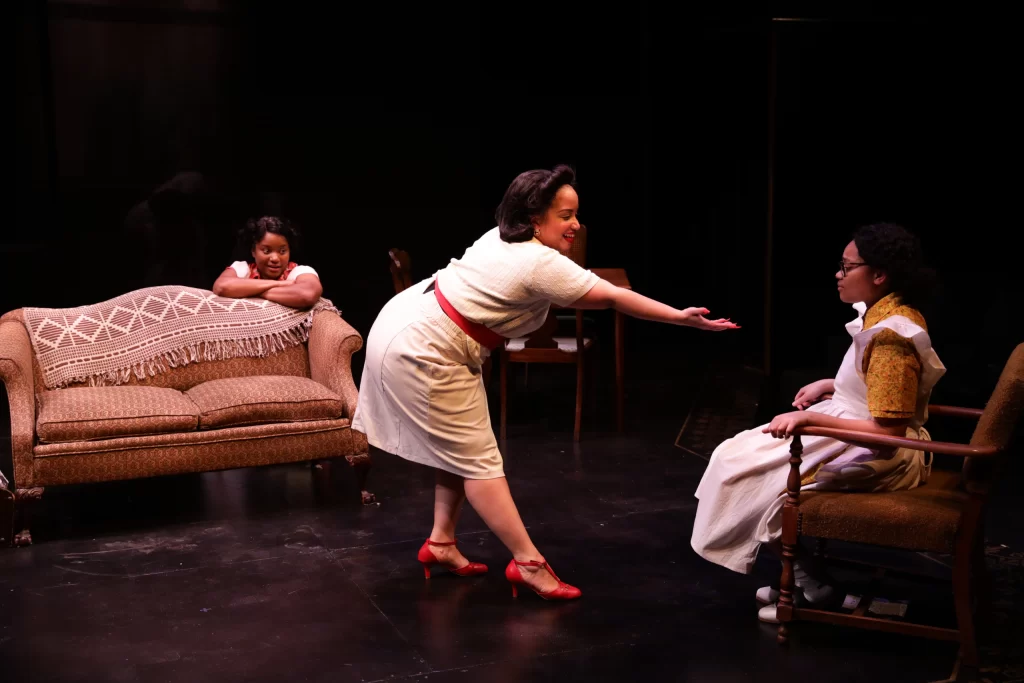
Ernestine and Ermina don’t share this version of deliverance and choose a different escape route from reality. For them, joy is to be found in dreams and fantasy; in other words, at the movies.
Ernestine is also about to graduate from high school, the first Crump to reach that level of education and achievement. One day, a sewing pattern arrives in the mail for her. It turns out her mother had ordered it before she died. She sets up a sewing form in the living room, sewing the dress throughout the play as a reminder of her mother and a bridge between the world they left behind and the one in which they now live.
Just when it feels like the weight of Nottage’s sluggish, speech-heavy script (not helped by voice projection problems) might sink the ship before it gets out of the harbor, Sandra’s sister, Lily Ann Green (an outstanding Thomika Marie Bridwell), saves the day. She bursts into the apartment, riding a gale wind that fills the play’s sagging sails and keeps it afloat for the remainder of its almost two-and-one-half-hour running time.
Vivacious and uninvited, Lily is dressed in sunglasses, a fur coat and a well-tailored white suit. Red shoes and a cigarette are the perfect accessories. Lily is a non-conformist, an educated woman who lives in Harlem and hobnobs with revolutionaries and communists. Although she didn’t make it to her sister’s funeral, she is committed to moving in with Godfrey and helping raise her sister’s two girls.
She is also committed to raising hell, and although she and Godfrey share a past that she tries desperately to reignite, her antics send him scurrying away, leaving her more isolated than ever.
Lily drinks, cavorts, swears and doesn’t work. She is the unrequited yin to Godfrey’s yang of a consuming need for order and answers. Both are chasing salvation as they try to manage their grief and rage. After Lily goes too far one night, giving Godfrey a kiss which he miserably admits does tempt him, Godfrey disappears for three days, leaving Lily and the girls to fend for themselves.
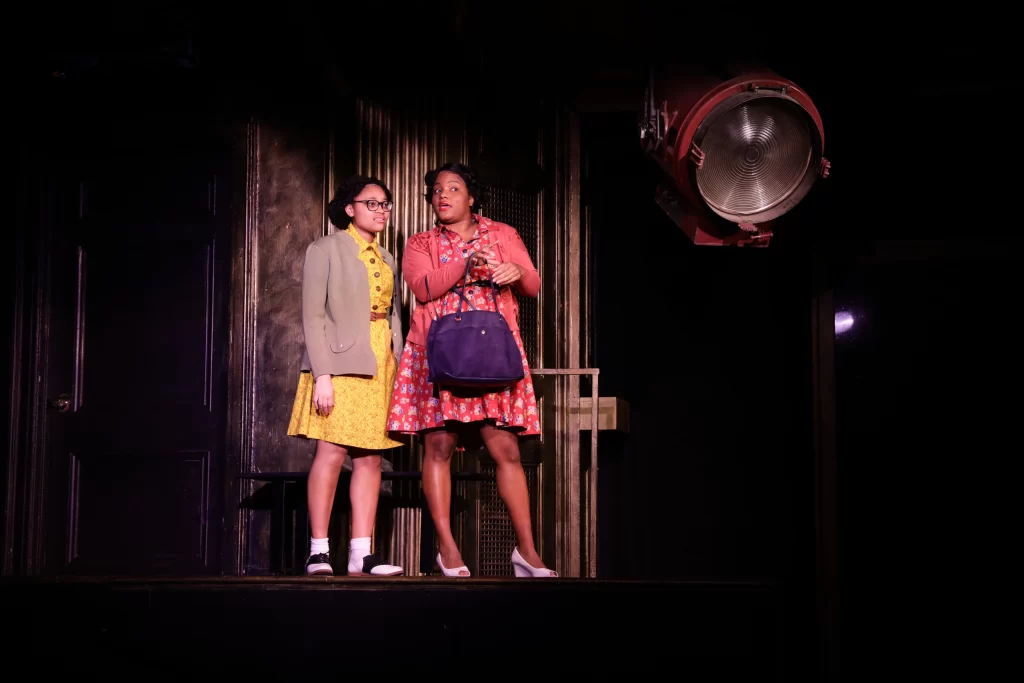
He returns with Gerte (a terrific Bridgette Hayes), a white German refugee whom he met on the subway and introduces as his wife. He believes he is following Father Divine’s advice to move forward with his life. It’s unclear whether the girls are more unhappy that she’s white or that their father married so soon after their mother’s death. Lily sinks deeper into drinking, humiliated and devastated that Godfrey couldn’t/wouldn’t marry her instead.
Clueless about racial tensions in America but delighted to have found an American husband, Gerte’s one saving grace is the love for movies she shares with the girls. In her dreams, she hungers to be Marlene Dietrich, and the scenes that allow Hayes to channel that persona are a welcome respite and among the play’s most engaging.
Nottage plods on, addressing a myriad of social, political and emotional issues while keeping us in the loop as time marches on for the Crumps. Every member of the family eventually runs smack into the reality of how the color of their skin interferes with their pursuit of the American Dream. Change and revolution may be in the wings, but they are not here yet and they will be traveling hand-in-hand with pain and fear. In the meantime, each Crump must cope in their own way, through action, fantasies, faith and anesthetics.
Director Tasia A. Jones gives us a straightforward version of ‘Crumbs’ and, while Cristina Todesco’s set design and Eduardo Ramirez’s lighting design work well as the action hops from living room to subway car to Ernestine’s movie fantasies, the production lacks coherency, urgency, and intimacy. We want to understand Ernestine and what makes her tick, but her monologues, monotone, and static blocking keep us at arm’s length.
‘Crumbs’ is worth seeing for its solid ensemble and stand-out performances, its homage to the 1950s, and, most of all, for providing a reason to appreciate how far Lynn Nottage has traveled in her 30-year career.
‘Crumbs from The Table Of Joy.’ Written by Lynn Nottage. Directed by Tasia A. Jones. Sound Design by Aubrey Dube. Costume Design by Mikayla Reid. Scenic Design by Cristina Todesco. Lighting Design by Eduardo Ramirez. Produced by Lyric Stage at 140 Clarendon Street, 2nd Floor, Boston, through February 2nd.
For more information and tickets, visit: https://www.lyricstage.com/

 InSights