By Shelley A. Sackett
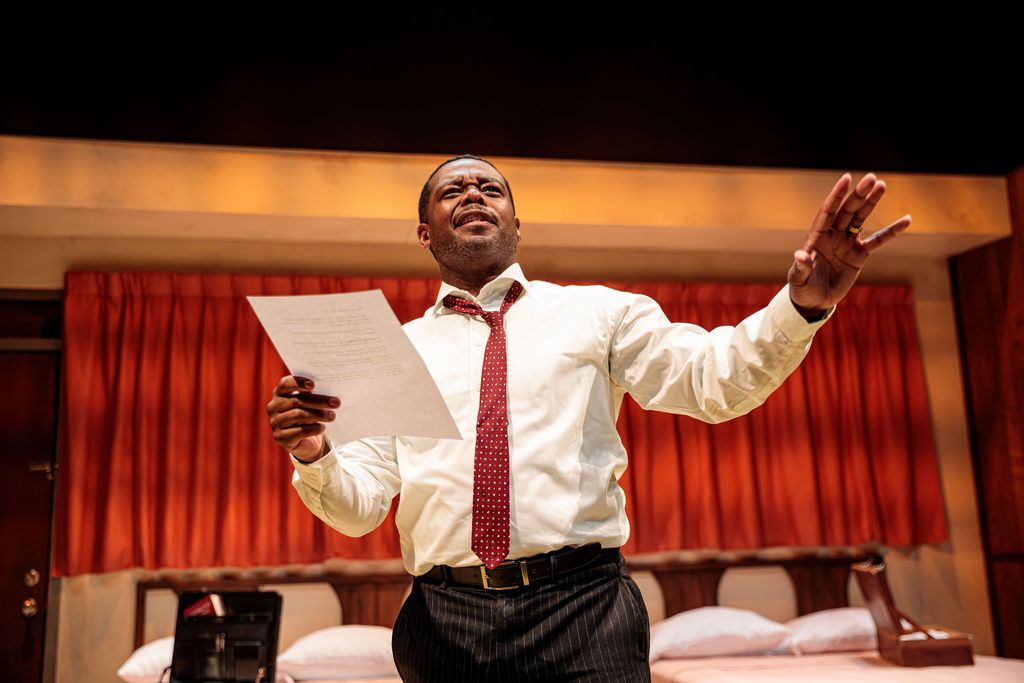
Playwright Katori Hall couldn’t have asked for a better production of his Olivier Award-winning play, The Mountaintop, than the one it is receiving at the Modern Theater at Suffolk University. Under Maurice Emmanuel Parent’s pitch-perfect direction, its two stars, Dominic Carter and Kiera Prusmack, deliver impeccable performances as civil rights and social justice leader, Rev. Martin Luther King, Jr. and Camae, a motel employee. Ben Lieberson’s set is straightforward and literal, a classic 1960s era, no frills, wood-paneled motel room.
The time and place are uncomplicated. It is April 3, 1968, and a storm rages outside room 306 of the Lorraine Motel in Memphis. As King, Carter is a commanding presence from the moment he enters the room. He has just delivered his famous “I Have Been to the Mountaintop” speech, in which eerily he proclaims, “I’ve been to the mountaintop… And I’ve seen the promised land. I may not get there with you.”
He was assassinated the next day.
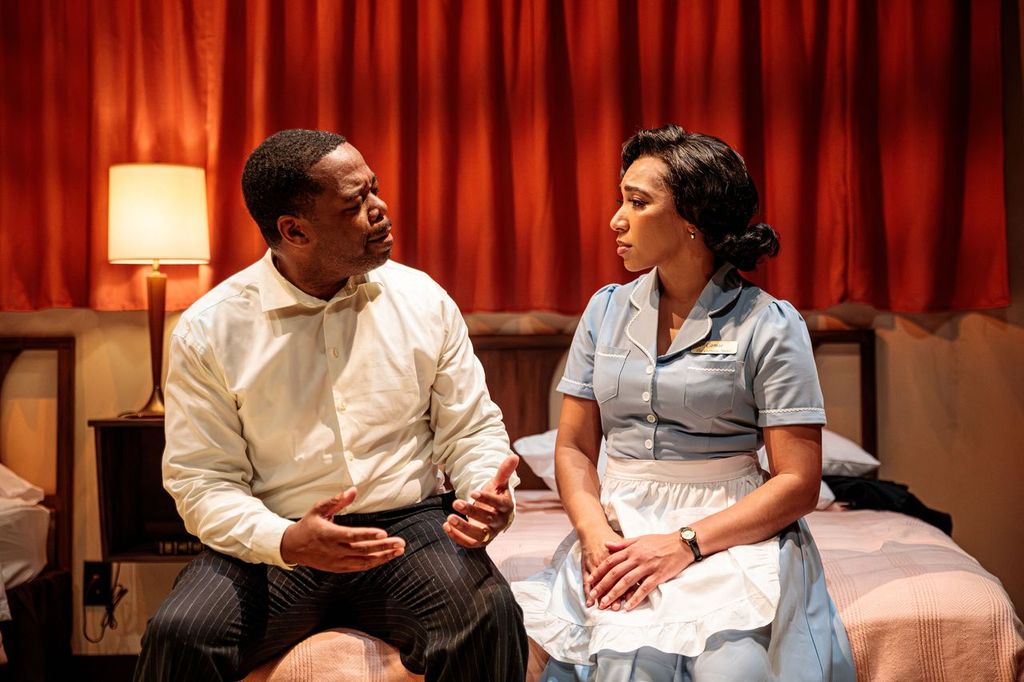
King is exhausted yet wired, spooked by every crack of lightning and suspicious that his room is bugged and his phone tapped (hardly unwarranted since J. Edgar Hoover, FBI director, was known to have targeted King with both).
He is in Memphis to support striking sanitation workers whose nonviolent protests had ended disastrously in rioting and ransacking. All he wants is a cigarette and a cup of coffee. His traveling companion, fellow civil rights activist and Baptist minister, Rev. Ralph Abernathy, has gone to buy the cigarettes. He calls for room service for the coffee.
After some interludes meant to show King’s less saintly and more human side (including smelly feet, petty vanity and annoyance at overhearing a toilet flush in the room next door), he finally settles down to start writing his next speech/sermon. He wants to get more incendiary and provocative, and toys with opening with the line, “Why America Is Going to Hell.”
“They’re really gonna burn me on a cross for this one,” he snickers.
The entire focus and tone of the play shifts with the arrival of a sexy, self-confident young maid named Camae, who delivers more than a pot of coffee. Under the Parent’s kid-glove direction and terrific acting by Carter, the swing from King’s turbulent internal intensity to his slick, external charismatic charm happens with the silent ease of a perfect downshift.
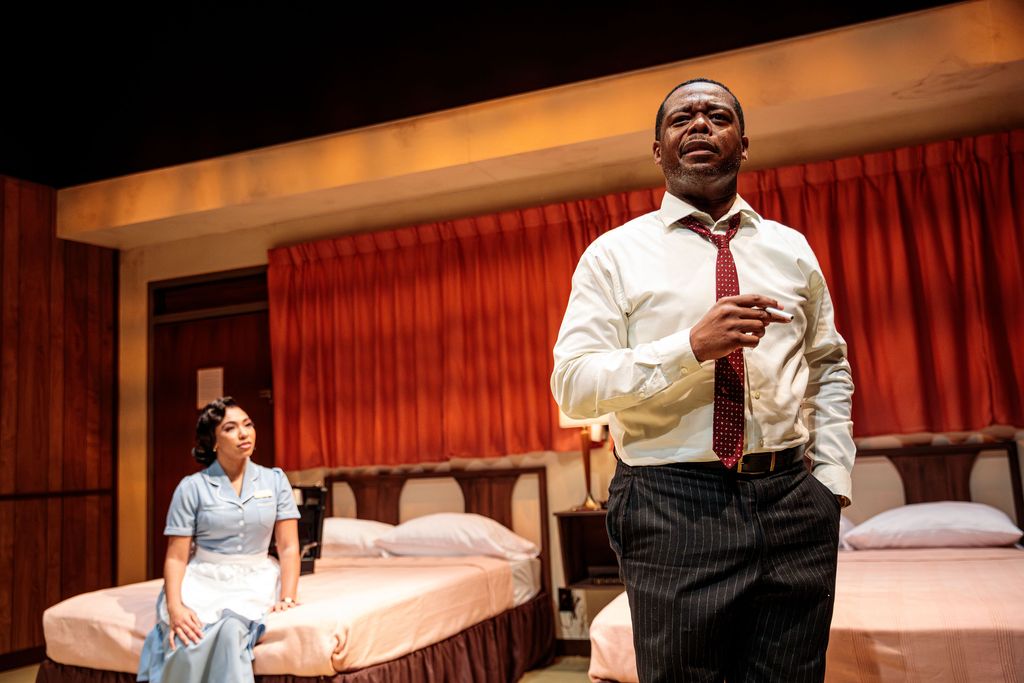
She calls him “Preacher King.” He flirts with her shamelessly, flaunting his male bravado, trying to hide his fear and suspicion. He asks her opinion whether he should shave his moustache. She tells him, “If I was a man, I’d be staring at me, too,” as she runs her hands over her breasts and hips.
Camae just happens to have his favorite cigarettes, Pall Malls, in her apron pocket. She also has a flask, which she offers King before swigging from it directly.
All is light banter (they even have a pillow fight) until the talk turns to the state of race relations in America and what she thinks King should be doing about it. She is his equal, smart, passionate and articulate. “You need something else,” she counsels. “Something other than marching.” He thinks “a new day is coming” and says he will continue preaching “until the day I die.” Her suggestion? “Fuck the white man.”
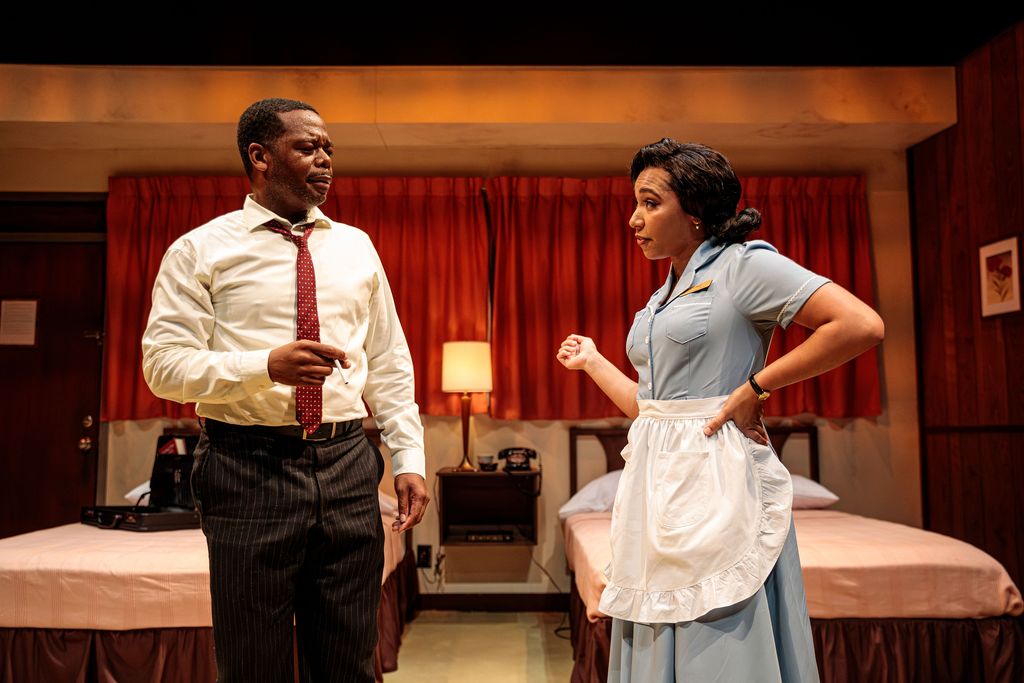
The tension escalates until the great reveal, which thankfully happens early enough that there is plenty of time left for Pulitzer Prize-winning playwright Hall to spin his magic, culminating in a monologue set against a rapid montage of people, movements and events from 1968 to 2024 (projection design by Pamela Hersch). The effect is as spellbinding as the magical 90 minutes we have just spent in the presence of greatness, from the acting, writing, and direction to witnessing the final hours in the life of a man whose legacy is deservedly legendary. Dr. King, the promised land has never seemed so far away. We sure could use your voice today.
Highly recommended.
The Mountaintop – Written by Katori Hall. Directed by Maurice Emmanuel Parent. Presented by The Front Porch Arts Collective in collaboration with Suffolk University at Modern Theatre, 525 Washington St., Boston, through October 12.
For more information, visit https://www.frontporcharts.org/
 InSights