Apollinaire’s Thriller ‘Is This a Room’ Asks, ‘Who Is The Real Patriot in Today’s Murky World?’

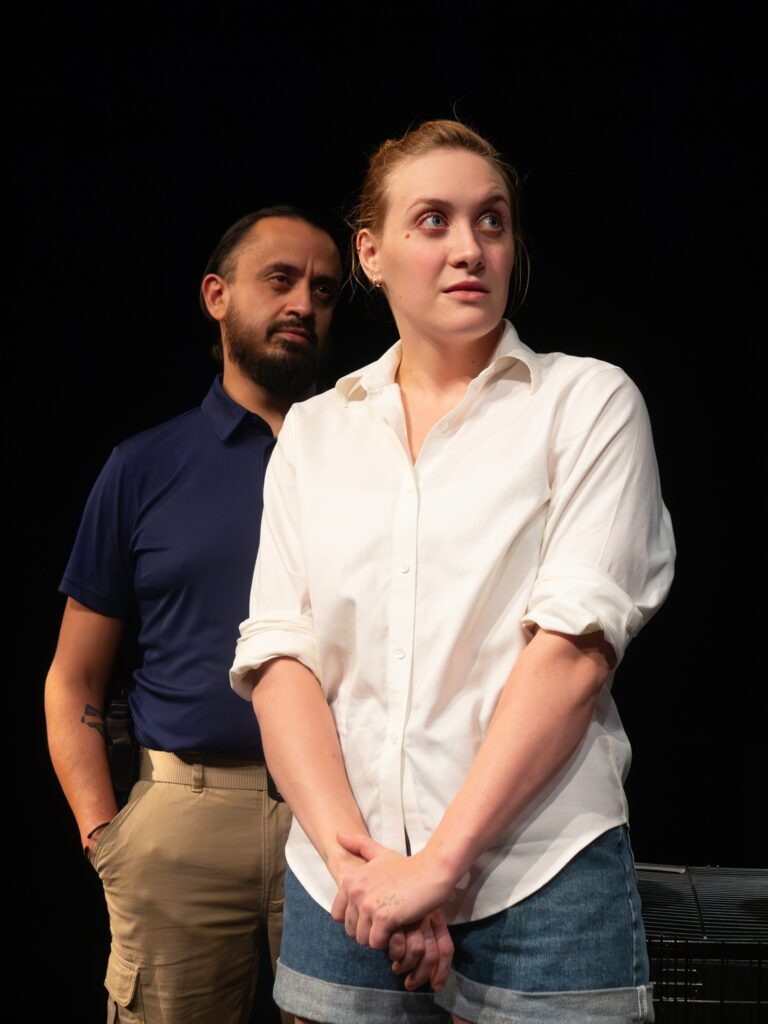
Cristhian Mancinas-García, Bradley Belanger, Brooks Reeves, and Parker Jennings in Apollinaire Theatre Company’s “Is This a Room.”

‘Is This a Room” — Written by Tina Satter. Directed by Danielle Fauteux Jacques. Concept and Original Direction by Tina Satter. Presented by Apollinaire Theatre Company, 189 Winnisimmet St., Chelsea, through Jan. 18.

By Shelley A. Sackett

Whatever you do, do not under any circumstances listen to any of the excellent podcasts and interviews with Reality Winner, the subject of Apollinaire’s gripping Is This a Room, until after you’ve seen the play — and see it you must.

For 70 minutes, the verbatim transcript of an F.B.I. interview of a 25-year-old woman suspected of violating the Espionage Act is the most unlikely script in this thrilling mystery that packs a wallop and imbues a by-the-books encounter with emotional and psychological depth and humanity.

The play thrusts us into the moment of June 3, 2017, when Reality Winner (a riveting Parker Jennings), returning from doing Saturday chores, is met by F.B.I. agents waiting at her front door. In her cutoff jeans, white button-down shirt, and spunky hi-top sneakers, she looks more like a teenager than a woman who spent six years in the Air Force, speaks Farsi, Dari, and Pashto, and has top-secret clearance with a local military contractor.

The men, Special Agent Justin Garrick (a sublime Brooks Reeves) and R. Wallace Taylor (Cristhian Mancinas-Garcia), introduce themselves and explain they are there to talk “about, uh, possible mishandling of classified information.”

Winner, wide-eyed with innocence and trust, replies, “Oh my goodness. Okay.” The skeletal, abstract set (Joseph Lark-Riley), superb lighting (Danielle Fauteux Jacques, who also directs), and Black Box configuration create an atmosphere of such intimacy that it is as if the audience is watching a real-life proceeding happening in real time.

At first, Winner claims she has no idea what the men are talking about, and Jennings digs deep to find the emotion and vulnerability in her character. We can imagine what she is feeling with each passing minute, and we want to believe her, even after we learn she has three military grade weapons in her house.

Good cop Garrick and less good cop Taylor explain they have warrants (which they never show her) and will be searching her house and car. She doesn’t insist on a lawyer; they don’t read her her Miranda rights. It’s all low stakes and cordial in the beginning, with Winner apologizing and wanting to make it “as easy as possible for you guys,” and the agents making small talk and deflecting her questions with, “We’ll go over all of that…”

The transcript tiptoes towards substance, punctuating the agents’ aw-shucks stammers and guffaws with open-ended but steely questions. Has she ever gone outside her need-to-know/clearance level? Has she ever taken anything outside the building? Has she discussed anything having to do with her job with anyone, ever? Has she ever copied anything?

Suddenly, the atmosphere shifts, and Winner tries to make light of the line of questioning by defending her use of printer and paper. She’s “old-fashioned,” she claims, and uses a lot of paper. She finds it easier to navigate long documents in hard copies rather than online. “Is that what this is about? Fraud, waste and abuse?” she jokes.
Mancinas-García and Jennings

The agents, still acting as friends, offer her “the opportunity to tell the truth,” and an ominous beat, like the beeping in an ICU or the slow menace of low war drums, thrums. Every time the actual transcript was redacted (brilliantly referenced on the playbill and poster), a blue light glares and the beat intensifies, as if, by proxy, the audience is subjected to psychological torture.

Fifty minutes in, everything changes. The agents say they have the goods on her. Winner’s story wiggles a little. Then it wiggles a lot. The agents straddle a delicate line between doing their job as law enforcers and trying not to overwhelm her. “IS there anything else we should be worried about?” Garrick asks. Not to worry, he implies, as he adds, ”We’ll figure it out.”

Jennings brings credibility and stunning physical nuance to a role that held few clues about the character’s interiority. Her body literally crumbles, muscle by muscle, when she realizes the jig is up. As F.B.I. agents sent to do the bidding of one they may or may not agree with, they are a little nervous and a little lost, sharing details of their personal lives and asking about her CrossFit experiences. They may be doing the devil’s work, but they are neither demons nor demonized.

It’s no secret that Reality Winner pled guilty to leaking documents that contained proof of Russian interference in the 2016 election to an online news source, The Intercept. She was sentenced to more than five years in prison, the longest sentence ever imposed in federal court for an unauthorized release of government information to the media, according to a Times report. She was granted early release, but is prohibited from publicly speaking about certain topics.

In 2025, she released an audiobook, “I Am Not Your Enemy: A Memoir,” and has her own dedicated podcast series, “This Is Reality.” Even with a stiff gag order, the facts that emerge make it impossible not to question why Trump cracked down on the leak of this particular document, which contained proof of Russian interference in the 2016 election (which Trump has denied) and which the NSA, under someone’s orders, buried.

Apollinaire Artistic Director Fauteux could not have chosen a riper moment in which to stage this play, as we round the bend towards a year of predicted mid-term election chaos and mayhem. We may not face the same situation Winner did, with her access to and knowledge of documents proving a possible unlawful official cover-up, but we are left with the same existential dilemma — Is it possible to live a law-abiding life in a world turned lawless, or will only the lawless survive?

Recommended.

For more information, visit: https://www.apollinairetheatre.com

Hell Hath No Fury Like Hedda Gabler’s Scorn

Theater Mirror

Parker Jennings and Joshua Lee Robinson in Apollinaire’s ‘Hedda Gabler’
Photo Credits: Danielle Fauteux Jacques

By Shelley A. Sackett

In ‘Hedda Gabbler,’ Ibsen dramatizes the miserable life of his title character, the iconically unclassifiable Hedda Gabbler. The pampered daughter of a wealthy general, Hedda recently married the mild-mannered, decidedly middle-class George Tesman. Fearing her years of youthful abandon might be behind her, she snagged the first – and only – bird that actually landed in her hand. “I can’t think of anything ridiculous about him,” she explains when asked by a former suitor why she had settled for George. He is also respectable, conscientious about his research work, and intent, under any circumstances, to look after her.

What George is not, however, is dangerous, sexy or aggressive, three traits Hedda admires, embodies and craves.

Director Danielle Fauteux Jacques cleverly arranges for the actors and audience to settle simultaneously. As the theater seats fill, actors stroll across the comfortable set, moving furniture, placing flowers, even repositioning a piano. The spacious, tastefully furnished drawing room is decorated in dark colors and lit by tiers of candles. Solo piano music enhances the mood, and Elizabeth Rocha’s costumes reflect the play’s end-of-19th-century time period.

The Tesmans, we learn from the maid Berta (Ann Carpenter) and Aunt Julia (a splendid (Paola Ferrer), have just returned to Christiana (Oslo) from a whirlwind six-month European honeymoon. George (played by a suitably understated, good-natured, if somewhat clueless, Conall Sahler) is enthralled by both their new wife, Hedda, and the ancient manuscripts he unearthed. He and Aunt Julia (the maiden aunt who raised him) are in the midst of reconnecting over George’s boyhood slippers when Hedda stomps onto the stage, barefoot and with a head full of steam explainable only by her having been interrupted either in the middle of brawl or while on the prowl to start one.

Unlike George, Hedda (played with almost relentless malice and moue by Parker Jennings) has returned bored, disappointed, and generally pissed off. She doesn’t like the house; she insults Aunt Julia’s new hat, and most of all, she doesn’t like being married to George. Like a freshly caught wild animal suddenly caged and on display, she paces. She is trapped but not tamed.

Disengaged from her own life, Hedda is in desperate need of a diversion. When Judge Brack (a smarmy Christhian Mancinas-García) comes to call, he and Hedda have the opportunity to reconnect in private. It’s clear the two share both a sexual backstory and many of the same values. “I get these impulses,” Hedda confesses to Brack. “I have no talent for life.” He seems to know exactly what she means.

Brack offers a polyamorous triangular relationship as a solution, but Hedda’s boredom is not that easily assuaged. What she needs, she declares, is to manipulate another’s life, to control them completely through her power and her will. As if on cue, her girlhood schoolmate, Thea (a credibly solid, earnest Kimberly Blaise MacCormack), arrives with all the ingredients to set Hedda’s plan in motion.

Paola Ferrer and Conall Sahler

George’s academic rival, Eilert Løvborg (an outstanding Joshua Lee Robinson), has resurfaced. An alcoholic, Løvborg was mired in scandal and poverty after squandering the family fortune on debauchery. Recovered and renewed, Løvborg wrote a book that was received with thunderous acclaim. The bestseller is in the same field as George’s, and George worries that Løvborg’s success could put a damper on his chances of securing the professorship he was financially banking on when he married Hedda and went into hock to buy her a house (which she hates) and take her on the extravagant honeymoon she expected and abhorred.

Thea’s agenda has nothing to do with the Tesmans. She and her husband, Sheriff Elvsted, took Løvborg in when he was down and out to tutor Thea’s stepchildren. While her husband was away on business, she worked closely with Løvborg on his newest manuscript and developed a great love for him. She worries that his fragile rehabilitation is in jeopardy now that he is back in the city with a pocketful of royalties money. She has packed a bag, left her disastrous marriage, and is now trying to locate Løvborg so they can pick up where they left off.

Knowing that he and George were university chums, she has come to ask George to write a letter asking Løvborg to visit him. She tells the Tesmans that her husband sent her, but Hedda has a nose for deception (being the Queen herself) and sniffs out the juicier tale.

She dispatches George to write the letter and ruthlessly grills Thea until the poor girl divulges her secret to her new and trusted confidante. Hedda assures Thea she will take care of everything, but as she breaks the fourth wall and treats the audience to a Snidley Whiplash wink, we know all will not end well for anyone.

Jennings

Løvborg gets the message and comes to the Tesman house in a tizzy. From the first hello, it is clear he and Hedda also shared a romantic past. In their scenes together, Hedda comes as close as she does in the play to displaying genuine compassion and vulnerability. Jennings and Robinson have real chemistry in the scenes when they sneak embraces as George comes in and out of the room. Hedda’s evil side doesn’t need the hammering Parker sometimes gives it; her words make her unlikeable enough. But these tiny glimpses of her inner humanity soften her character just enough to make her believable and less of a melodramatic stereotype. A very little could go a very long way.

In any case, Hedda will be damned if she lets Thea’s influence over Løvborg eclipse her own. No matter what it takes, she vows to smash their liaison.

To George’s relief, Løvborg has no intention of competing with him for the coveted professorship but has his hopes pinned on the masterpiece sequel he has written, the only copy of which he totes about in a brown paper envelope. Thea shows up, and Hedda immediately breaks her promise of confidentiality, telling Løvborg that Thea followed him to the city because she feared he would relapse. Løvborg reacts poorly, and Hedda delights when he goes off the wagon in front of her. She convinces him to accompany George and Brack to a party where she knows there will much drinking and carousing, assuring him she and Thea will be fine dining alone.

Predictably, Løvborg falls hard, failing to show up at the Tesmans the next morning. George returned earlier with the coveted manuscript, which Løvborg lost during the evening. When he is called away to his dying Aunt Rima’s bedside, he instructs Hedda to safeguard it.

Løvborg does eventually show up, a messy aftermath of a nasty night. He lies to Thea and Hedda, telling them he destroyed his manuscript. Thea is bereft; that work was their love child, a validation of her worth and his reform. Hedda does nothing to contradict Løvborg or reassure Thea. Distressed and disappointed, Thea leaves the former lovers alone.

Løvborg confesses that he actually lost the “child,” an act infinitely more unforgivable than destroying it. Hedda convinces him that the only recourse is for him to end his life with “vine leaves in your hair.” (Vine leaves in the hair are a symbol of Dionysus, the Greek god of wine and tragic insight). She gives him one of her father’s pistols and happily sends him away with one command: that if he chooses to do this, he do it beautifully.

Cristhian Mancinas-García, Robinson, and Sahler

The moment he leaves, she retrieves the manuscript and, one page at a time, ceremoniously burns it in its entirety, her face aglow from the flames and her own inner satisfaction. “One is not always mistress of one’s thought,” she will later muse.

It would be unforgivable to spoil the rest of the plot, but suffice it to say that Hedda’s plan goes awry, and she gets a healthy dose of her own medicine. Fauteux Jacques takes directorial liberties and adds elements that translate what passed for shock in 1891 into terms that resonate more in 2025 (I refer to one of the final scenes between Hedda and Brack). Kudos to Fauteux Jacques for this bold and stirring move.

Yet, despite inspired staging and acting, Ibsen’s starchy, dusty “Hedda Gabbler” is a difficult piece to access. Hedda is neither rational nor irrational in the usual sense of being random and unaccountable. Her logic is personal and unique. What she desires is critical to her happiness, yet it represents what “normal” society would reject as unacceptable. Hedda’s interior is as complicated as her exterior, which is razor-focused. Jennings does an excellent job of trying to carry this intricate character from beginning to end, but it is a real challenge to make believable why Hedda would command the attention of the men in her life, much less that of her audience.

‘Hedda Gabbler’ — Written by Henrik Ibsen. Adapted by the company from the translation by Edmund Grosse and William Archer. Directed by Danielle Fauteux Jacques; Scenic and Sound Design by Joseph Lark-Riley; Costume Design by Elizabeth Rocha; Lighting Design by Danielle Fauteux Jacques. Presented by Allpoinnaire Theatre Company at Chelsea Theatre Works, 189 Winnisimmet Street, Chelsea, through March 16.

For more information and to buy tickets, go to www.apollinairetheatre.com

‘Every Brilliant Thing’ at Apollinaire Theatre Co. Delivers On Its Promise

Cristhian Mancinas-Garcia and Parker Jennings in ‘Every Brilliant Thing’ at Apollinaire. Photos by Danielle Fauteux Jacques

By Shelley A. Sackett

A one-person show about suicide and depression that threatens random audience participation, runs for approximately 75 intermission-less minutes, and pledges to be funny and uplifting has a pretty high bar to clear. Yet, Apollinaire Theatre Company does just that with room to spare in its brilliant production of Every Brilliant Thing.

The play’s narrator, the irrepressible Parker Jennings (alternating the role with Cristhian Mancinas-Garcia, who also performs it in Spanish), is already standing in the middle of the stage when even the earliest audience member arrives. As if welcoming them into her own living room, she greets them warmly with an unaffected smile and a blue basket full of cards.

“I have a job for you all this evening,” she exclaims as she hands out the numbered cards with instructions to shout out what is written whenever she says that number.

Set in the round in an intimate black-box space that is furnished with comfortable salon-like seating, Jennings’ rapport with the audience is immediate and palpable. Upbeat jazz and full house lights heighten the sense of communal conversation. Before she has uttered her first line, she has us in the palm of her hand, making us feel like we’re here by design rather than happenstance.

“The list began after her first attempt,” she begins. “A list of everything brilliant about the world. Everything worth living for.”

The first call and response quickly follows. “Number One,” she says, and the person holding that card shouts out, “Ice cream.” Number two is water fights. Three is staying up past your bedtime and being allowed to watch TV. Any flicker of stage fright or self-consciousness has completely evaporated. We are in this together.

In an instant, Jennings the Narrator has morphed into the seven-year-old girl who, after learning that her mother attempted suicide, vows to make her mother feel better by making a list of everything that makes life worth living and sharing it with her. This coping exercise will see her through the next several decades and, by the end of the play, will number one million.

Her first encounter with death (“a loved one becoming an object”) and the first audience-supporting role (as the vet) occurs when she has to put down her beloved dog. Jennings’ improvisational chops and talent for putting the audience at ease are on full display. Other interactive roles will include her father, teacher, school counselor, and first love/wife.

Her second encounter with the idea of death occurs when her father picks her up from school after her mother’s first suicide attempt. He explains to the little girl that her mother is in the hospital because she is sad, because she couldn’t think of anything worth living for.

The precocious child intuits the concept of glimmers, the opposites of triggers. These are small experiences of pleasure that happen during simple, everyday activities. Noticing and appreciating them can cue your nervous system that you’re safe and can relax.

She devotes her life to crafting a list of every brilliant thing she can think of, first in an attempt to save her mother and later for herself, as she navigates her own journey of hills and valleys and, poignantly, fear that her mother’s mental illness tributary runs through her veins as well. As time moves on, the list becomes a sort of diary that reflects the texture of her everyday experiences.

“Things may not always get brilliant, but they get better,” she says. “We need to imagine a future better than the past because that’s what hope is and without hope, life isn’t worth living.”

Thanks to Joseph Lark-Riley’s carefully curated sound design, the significance of blues and jazz also runs deeply. These songs and artists link the Narrator to her vinyl-loving dad and tether her. Lyrics from “Drown In My Own Tears,” “I Love You Just the Way You Are” and “At Last” are more than toe-tapping background; they are placeholders and place setters that connect us to our narrator and her story. It’s no surprise that one of the items on her list is: “A song transporting you back to a moment in time.”

The tone and substance of Duncan Macmillan’s script (written with Johnny Donahoe, a British stand-up comedian who first played the role at the Ludlow Fringe Festival in 2013) covers a lot of ground. The Narrator’s ability to confront issues as heartwrenching as the guilt felt by children of suicides, social contagions, and the virulence of hard-wired, chronic depression with playfulness, insight, and unflinching honesty prevents the play from becoming mawkish, which easily could have happened if penned by a less skillful and empathetic playwright.

Danielle Fauteux Jacques wisely directs with a light touch, and Jennings shoulders the production with chipper verve and a storyteller’s charm. Yet, she also brings an emotional intelligence to her performance, the shadow of a veil that, when lifted, reveals the scars of underlying trauma. Most recently seen as Sarah in Apollinaire’s equally extraordinary “Touching the Void” last May, Jennings is an actress I would (and did) go out of my way to catch in any role she should take on. Her energy, authenticity and confidence are matched only by her raw talent.

As the play winds down, the Narrator’s list takes on a life of its own as an ersatz crowdsourced lifeline, publicly shared and collaboratively complied. Although the list couldn’t save her mother, it may just have prevented her from following in her footsteps. She leaves us collectively more open-hearted and open-minded with the balm of these parting words of benediction: “If you live a long life and get to the end of it without ever once having felt crushingly depressed, then you probably haven’t been paying attention.”

‘Every Brilliant Thing’. Written by Duncan Macmillan with Johnny Donahoe. Directed by Danielle Fauteux Jacques. Scenic and Sound Design by Joseph Lark-Riley. Lighting Design by Danielle Fauteux Jacques. Produced by Apollinaire Theatre Company at Chelsea Theatre Works, 189 Winnisimmet St, Chelsea, MA through January 19th.

For more information and to buy tickets, visit apollinairetheatre.com