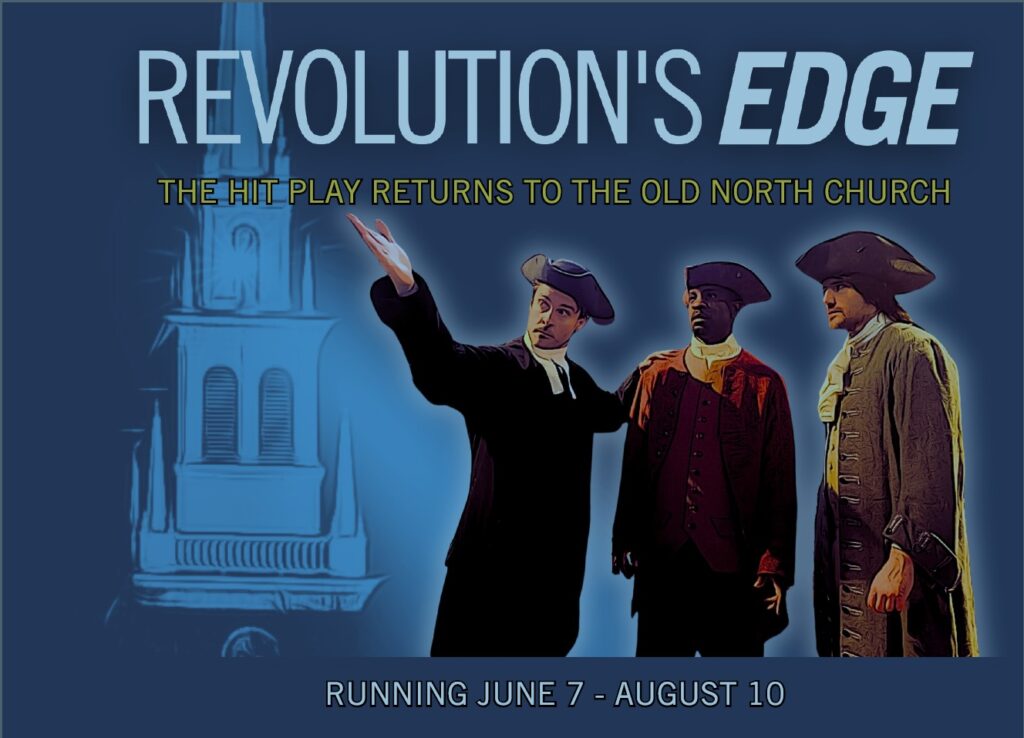
At Boston’s Old North Chuch, “Revolution’s Edge” Time Travels to the Start of the American Revolution

“Revolution’s Edge.” Written by Patrick Gabridge. Directed by Alexandra Smith. Produced by Plays in Place. Commissioned by Old North Illuminated. Staged at The Old North Church, 193 Salem St, Boston through August 10.

By Shelley A. Sackett

“Revolution’s Edge,” a site-specific play by the award-winning playwright, producer, novelist, and screenwriter Patrick Gabridge, packs a lot into 45 minutes.

It is set on the evening of April 18, 1775, a turning point in both the history of the Old North Church (then Christ Church) and the history of America. The church played a pivotal role in the nation’s fight for independence. It was in its steeple, after all, where two lanterns were hung on that very night to signal that British soldiers were heading across the Charles River.

The event has been immortalized by the line, “One if by land, and two if by sea,” in Henry Wadsworth Longfellow’s 1860 poem “Paul Revere’s Ride.”

Gabridge’s inspired drama is set in the North Church in real time during a moment that is almost invisible in history books. It was mere hours before the signals were hung. Three men whose lives intersect and diverge meet in the church’s vestry as altercations between British troops and American patriots threaten to boil over just outside its doors. The imagined conversation among three real people on that historic afternoon is the subject of the play.

Christ Church’s second rector, the Rev. Dr. Mather Byles, Jr., remains loyal to the British crown. Vestry member John Pulling, Jr. is a fervent Patriot and one of the men who will later hang the lanterns in the bell tower. The two have been friends for decades. Their children have grown up together; their families even share the same pew. (Be sure to look at the pew where both Byles’ and Pullings’ families have plaques).

Cato, a slave, has just been baptized by Byles, his owner. Fearing for his family’s safety, Byles recently resigned as minister and plans to move his family to Portsmouth, New Hampshire.

All three characters are based on real people, and thanks to Gabridge’s fastidious research, they are as historically accurate as archival materials permit. The dramatic and personal details that transform them into three-dimensional characters are all thanks to Gabridge’s uncanny ability to dig deeply beneath the surface of his research and plumb the hearts and minds of his characters. “Revolution’s Edge” is no mere reenactment; it pulls back the curtain and lets a modern audience witness what really made these men tick.

That that audience is also sitting in the very place where the events of the play took place is nothing short of sublime.

As the conversation unfolds that tense day in 1775, Gabridge first focuses our attention on the characters’ commonalities. All three are fathers who value family above all else. They want the best lives possible for their children and are willing to sacrifice their own happiness to achieve that goal. They have all suffered profound losses and setbacks in their lives. At their cores, they are decent, practical and honest men, strongly opinioned yet respectful and compassionate.

The playwright then teases out all the ways in which they differ. Byles is an ardent supporter of the King of England and may have been colluding with the British troops. Pulling is just as ardent a Patriot, ready and willing to launch the attack that will finally set America free from tyranny.

Byles has his blind spots. For example, he can’t see the inhumanity of his assumption that, because he owns Cato and because he and his wife have five children they can’t care for on their own, Cato not only must leave his own family in Boston and accompany them to New Hampshire, but he also should be grateful for the opportunity. He is tone-deaf in his paternalistic attitude toward Cato, whom he sees as needing (and wanting) his master’s protection.

Cato, who was kidnapped in Africa as a child and brought to America as a slave, just wants to raise his family among the friends he has made during his many years in Boston. When Pulling asks Cato whether he wants to accompany Byles to Portsmouth or stay in Boston, Cato is stunned. No one had ever asked him what he wanted before. Yet he is comfortable and confident enough to point out the absurdity of asking that moot question now.

Instead of answering Pulling’s question, he poses one of his own. “Did they ask if I wanted to come to this country when I was seven years old?” he counters.  

The play raises many thought-provoking issues in understated but effective ways. Pulling argues that he and his fellow Patriots refuse to be slaves to the King, yet he can’t make the connection that Cato might feel the same way about his enslavement. Byles insists that “all this” is God’s plan, but when pressed by Pulling, he can’t say which part he means. Is it taxation? Occupation? Slavery? “There’s not much subtle about the times we’re living in,” Pulling observes.

Finally, they address the elephant in the room: in a land where no one is native, who is a true American? Is it the English settler (and his fellow loyalists) who may live in New England but whose allegiance is to the original version across the pond? Or is it the colonists (and fellow Patriots) who have embraced their new homeland and no longer consider themselves English immigrants but full-blooded citizens of the autonomous and independent America?

The splendid cast of three last Thursday (two casts act in rotation) included Joshua Lee Robinson as Cato, Tim Hoover as Byles, and Kevin Paquette as Pulling. Most of the action takes place in the front of the pews, although the actors walk up and down the aisle from time to time. While they both bring style and authenticity to their characters, Hoover and Paquette might do well to temper their deliveries. Their rapid fire, loud, angry vocalizations rendered many of their lines incomprehensible, which is particularly unfortunate with such a dialogue-driven script.

As Cato, Robinson was much easier to understand. His even, clear, calm enunciation added much to the audience’s ability to relate to his character.

Gabridge is the founder and Producing Artistic Director of Plays in Place, which develops site-specific plays tailored to helping an audience find new meaning in the places, topics, and people at the heart of the piece. He hopes “Revolution’s Edge” enables its audience to appreciate that the people in our past were real people who led complicated lives that required them to make hard decisions.

“Sometimes we look back in history and we feel like it was easy for them to make their choices. You know, ‘It was so much simpler back then.’ But I think when we look at them as real complex humans, we realize that just like us today, they didn’t know what was going to happen next, just like we don’t,” he said.

For more information, go to www.oldnorth.com/revolutions-edge/

‘The Nature Plays’ Bring Mt. Auburn Cemetery to Life in a Spectacular Plein Air Tour de Force


Namesakes

Ed Hooperman (as Louis Agassiz), Jacob Oommen Athyal (as Elizabeth Agassiz) and Theresa Hoa Nguyen (as Jane Gray) debate their legacies in “Namesakes.”


Reviewed by Shelley A. Sackett

This review first appeared in The Theater Mirror. theatermirror.net/ All photos by Corinne Elicone.


Mt. Auburn Cemetery and its rich, natural environment is a heaven-made set for Playwright Patrick Gabridge’s spectacular first set of five site-specific one-act plays, collectively titled, “The Nature Plays.” Each ten-minute play touches on a topic germane to its particular setting in the 174-acre cemetery, which is also an arboretum and National Historic Landmark District.

The plays run through June 9 with another series of five short plays, “The American Plays,” scheduled to run September 14-22.

Gabridge, who is also Mt. Auburn Cemetery’s Artist-in-Residence, chose the topics based on “whatever interested him.” The result is five works, each stunning in its whimsicality, creativity, craftsmanship and depth. They seamlessly blend big-picture topics like global warming and the role the present plays in shaping history and legacy with slapstick and zingy one-liners.

Courtney O’Connor directs and cast members, all members of Actors Equity Association, include: Lisa Tucker, Jacob Athyal, Ed Hoopman, and Theresa Nguyen.

Over the course of the 75-minute production, the audience travels about a mile from site to site with the actors, wandering from pond to gravesite to secret mushroom trove to birding hot spot to sheltered glen. Chairs are set up at each site and there is not a bad seat in the house.


Patrick MAC umbrella close up

Patrick Gabridge, Playwright and Mt. Auburn Artist-in-Residence


Last Saturday at 5 pm, the stroll through the park-like setting was as magical as the plays themselves. Gabridge was on hand to offer bug spray and a brief introduction to the 35 people lucky enough to have scored a ticket to the sold out show.

The five plays are: “Hot Love in the Moonlight,” about the strange mating habits of spotted salamanders (“but it’s also a play about choosing to have children in a dangerous world,” Gabridge told Theater Mirror); “Namesakes,” which shows the 19th century naturalists Asa Gray and Louis Agassiz confronting the impermanence of their legacies; “Sworn to Secrecy,” a peek at the hidden world of mushroom hunters; “Cerulean Blue,” about the inner lives of bird watchers; and “Love and Loss in the Glade,” a play about healing and loss told through the words of three trees.


Hot Love

Jacob Oommen Athyal (as spotted salamander Jeremy) courts Theresa Hoa Nguyen (as spotted salamander Samantha) in “Hot Love in the Moonlight.”


Along with a natural soundtrack of chirps and tweets, bird recordings of warblers, orioles and warbling vireos chime in during the bird-watching play.


The Nature Plays - Cerulean Blue2

Ed Hooperman (as deaf birdwatcher Dan) and Lisa Tucker (as blind birdwatcher Leanna) share their observations in “Cerulean Blue.”


Each play provides both charm and a deeper message, and the actors clearly revel in delivering their clever lines. “So much life in a place dedicated to the dead….I never expected to feel so much less lonely here,” one bird watcher tells another.

Playwright Patrick Gabridge is an award-winning writer of historical and contemporary stage plays, novels, audio plays, and screenplays. His short plays have been produced more 1,000 times in theaters and schools in 14 different countries around the world and appear in various anthologies. His recent site-specific works include “Blood on the Snow” and “Cato & Dolly” for The Bostonian Society/Old State House, and “Both/And: A Quantum Physics Play” for the MIT Museum.

In 2018, Gabridge launched Plays In Place, a new company that works in partnership with museums, historic sites, and other cultural institutions to develop and produce site-specific theatrical plays and presentations to help engage, entertain, and enlighten visitors in new and vibrant ways.  Gabridge’s Mount Auburn plays are presented in partnership with Plays in Place as one of the company’s inaugural projects.

The Theater Mirror caught up with Gabridge, who answered these questions.

TM: How did you decide on the topics for “The Nature Plays?”

G: One of the cool things about being artist-in-residence at Mount Auburn Cemetery is the freedom we get to choose what to create, and also the richness of the history and environment of the place. There are 100,000 people buried there, but it’s also a world-class arboretum, an important stop on the migratory bird pathway. It has lots of interesting wildlife and some very smart programs to get people involved with science and nature.

As I got to know the Cemetery, it quickly became apparent to me that I’d have to write about BOTH history and nature. There was just so much to write about, so many different elements, that I decided to write two series of plays. And even then, The Nature Plays cover quite a bit of ground. The plays themselves also have different styles and takes on their subjects. I love the ability to experiment and play, and I think the audience is going to have a good time, too.


TM: What are the challenges of working/performing in an outdoor environment? What are some of the rewards?

G: The hardest thing about outdoor work is unpredictability, especially around weather. We’re fortunate at Mount Auburn in that we have an indoor rain backup space, at Story Chapel. You also have a lot less control over passersby, random environmental noise, etc., that you don’t have to worry about in the controlled space of an indoor theatre.

However, the rewards are great. We get a vividly real, three-dimensional environment, better than any set we could ever create. In Mount Auburn, we get an incredibly beautiful venue in which to perform and it comes with great spatial depth that we can use.

One thing I love about site-specific work like this is that it’s super intimate—often the audiences and performers are quite close. The formal barrier that exists between actors and audience in a traditional space is much more permeable, much less rigid. This enables more engagement, and I don’t necessarily mean the actors are talking to the audience, but there’s a sense of connection that’s deeper. This kind of experience often has great appeal for people who are less comfortable in a formal theatre environment. There’s a sense of shared experience, even among the audience themselves, that creates a memorable and engaging event.


TM: What do you hope audiences will take away from the experience?

G: I hope they’ll see Mount Auburn a little differently than they did before. That the specific spots where we perform will have a new resonance for them. I hope that they’ll be drawn to visit again, and when they do, they’ll look at the birds and trees and the place with a new curiosity, and also with a sense of belonging. They’ll know something about this place, and I hope they’ll feel like they’re a part of it, and it’s a part of them, in some small way.


TM: What initially inspired you to develop site-specific works?

G: I started creating site-specific plays in Colorado, in 1993. I had co-founded Chameleon Stage, with a bunch of other writers and a director friend, and we had no money, but wanted to experiment with creating new short plays. So we made plays for wild spaces in the mountains of Colorado, just west of Denver. It was called ‘Theatre in the Wild.’ It was so much fun we did more of them, toured a tiny bit (to Aspen and Golden), and then did Asphalt Adventures, a set of parking lot plays. I learned a lot about creating and producing site-specific plays.

TM: Anything you want to add?

G: I hope people will also keep an eye out for the second set of Mount Auburn plays, which will be in September.

THE NATURE PLAYS (30 May to 9 June)

Mount Auburn Cemetery, 580 Mount Auburn Street, Cambridge, MA

617-607-1980 or mountauburn.org