
SpeakEasy’s “POTUS” Soothes Our Distressed Political Souls With the Balm of Humor

Cast of SpeakEasy Stage’s production of “POTUS” (Courtesy Nile Scott Studios)

“POTUS: Or, Behind Every Great Dumbass are Seven Women Trying to Keep Him Alive” by Selina Fillinger. Directed by Paula Plum. Scenic Design by Jenna McFarland Lord. Sound Design by Aubrey Dube. Lighting Design by Karen Perlow. Costume Design by Rebecca Glick. Fight Choreography by Angie Jepson. Presented by Speakeasy Stage at the Calderwood Pavilion, Boston, through October 15.

By Shelley A. Sackett

Hands down, “POTUS” takes the prize for the most winning opening scene currently on stage in Boston. It is shriek-out-loud funny, clever, pithy, lightning-paced, and uncompromisingly no-nonsense.

The setting is The White House, not exactly the Trump administration, but also not exactly not the Trump administration. Two pantsuit-clad women are in mid-conversation when the audience joins them.

Chief of Staff Harriet (Lisa Yuen) is filling in Press Secretary Jean (Laura Latreille) on the morning’s diplomatic meeting and on what POTUS did that she, as press liaison, will have to spin at the press briefing that is about to start.

The play’s first line sets the tone for the rest of the evening. “Cunt,” says Harriet, lassoing Jean’s and the audience’s attention. Apparently, POTUS excused his wife Margaret’s absence by saying she was having a “cunty” day. Beyond the use of the “C” word, the even bigger trouble is that Margaret was in the room. The whole time. Sitting (obscured) right in front of POTUS.

Not to worry. Jean’s job, after all, is to support and protect POTUS and, despite his worst instincts and basest actions, keep him (and herself) in power. She is used to donning rubber gloves and cleaning up the mess. “That’s not so bad. We can contain that,” she says, brightening. “We all have cunty mornings sometimes. My son has them every week.”

Playwright Selina Fillinger’s “POTUS” is aptly subtitled, “Or, Behind Every Great Dumbass Are Seven Women Trying to Keep Him Alive.” She has populated her farce/satire with seven strong behind-the-scenes women whose sole purpose is to keep a dangerous and inept man in office, not because they believe in him, but because the only way they are allowed near the epicenter of power is by clinging to his coattails.
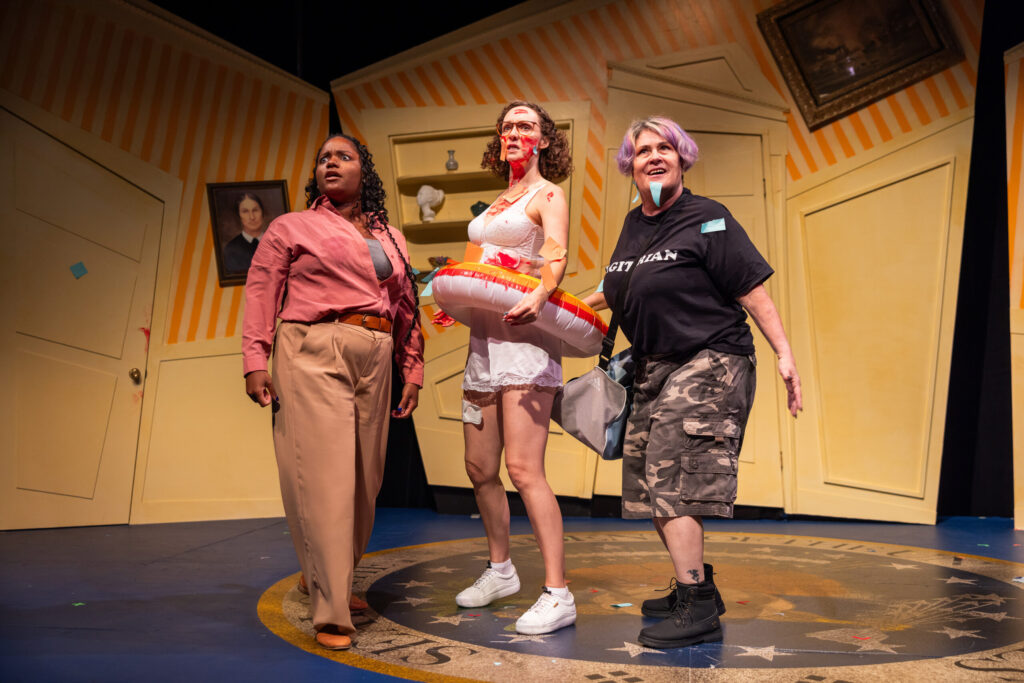
Catia, Marianna Bassham, and Johanna Carlisle-Zepeda

In addition to Harriet and Jean, the other women in the president’s inner circle are his savvy, earthy, and jaded wife Margaret (Crystin Gilmore) and his neurotic, perfectionist personal secretary Stephanie (Marianna Bassham). Clearly, these women are the only reason he has a job. They are brilliant, dedicated, and gifted at damage control. What they aren’t is respected, acknowledged, or valued by anyone except each other.

“Why isn’t SHE president?” is the common refrain as each rises to the next challenge and douses the next blaze. The answer boils down to one word — patriarchy. “People don’t love him,” one character explains. They’re just afraid of the alternative — US!”

Add to the mix his cocky, queer, convicted-felon sister Bernadette (Johanna Carlisle-Zepeda), Chris, the recently post-partum reporter whose attire includes breast pump attachments (Catia), and the president’s pregnant girlfriend Dusty (the impossibly flexible Monique Ward Lonergan), and you have all the ingredients for a no-holds-barred satirical farce. There is a little of everything, from door slamming, slapstick, sight gags to dramatic anarchy, comic invective, and mistaken identity.

There’s even a bottle of psychedelic tabs masquerading as Tums.

Yet beneath all this droll merriment are serious messages for these serious times. According to Fillinger, those messages may be political, but they are hardly partisan. The pain and rage that underpin the biting humor in her words are aimed squarely at the White Patriarchy that keeps women in their places and men like POTUS in his.

Director Paula Plum has plumbed the sizeable talents of her extraordinary cast to create an ensemble where each individual performer shines, and the whole is even greater than the sum of its parts, no small feat with these remarkably gifted women.
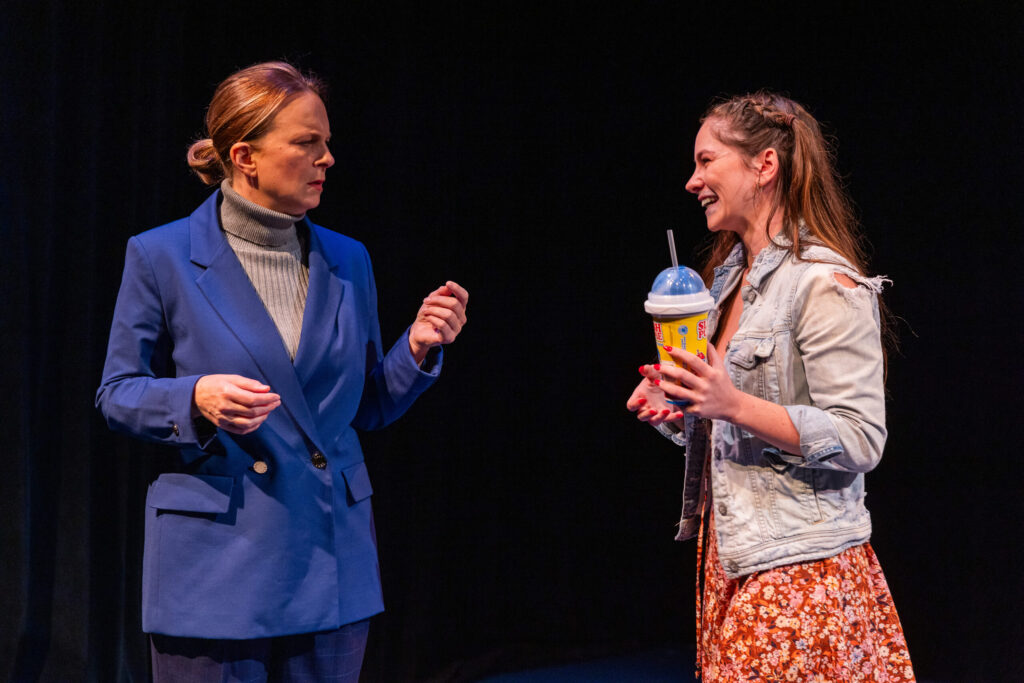
Laura Latreille, Monique Ward Lonergan

Jenna McFarland Lord has created the perfect set, part “Laugh-In,” with lots of doors to open and slam, and part Pee Wee’s Playhouse, where even the pictures are askew. The result is a dizzying, unhinged quasi-reality, mirroring the conditions our heroines face daily.

Despite her use of potty language, piercing wit, and crude jokes (most of which hit their mark), Fillinger has a serious point to make. What would it be like if these skillful, thoughtful women were able to spend their time actually running the world instead of covering and cleaning up after the inept dumbass who was elected to perform that duty but can’t? Is that idea really that scary?

Asked what she hopes audiences take away from seeing “POTUS,” Fillinger said, “I hope they wake up the next day and put their money, time and votes towards equity and freedom for all,” to which we add, “Amen.” For tix and information, go to: https://speakeasystage.com/

Child Is Father to Man in SpeakEasy Stage Company’s “The Children.”


CHILD-site

DRINK PARSNIP WINE. Karen MacDonald, Tyrees Allen and Paula Plum in SpeakEasy Stage’s production. All photos by Maggie Hall Photography.

By Shelley A. Sackett

Playwright Lucy Kirkwood had wanted to write about climate change for quite a while when the 2011 Fukushima nuclear disaster in Japan provided the impetus and inspiration. With “The Children,” a must-see production enjoying its Boston premiere at SpeakEasy Stage Company through March 28, she has succeeded in crafting a thoughtful and provocative three-character play that manages to raise profound existential and moral questions while slowing peeling back the layers of this three-some’s long and complicated history.

It is also one heck of a riveting eco-thriller/emotional detective story brilliantly acted by the inimitable stage luminaries Tyrees Allen, Karen MacDonald and Paula Plum.


The_Children_0159


The lights first come up almost mid-sentence on a rustic kitchen where Rose (MacDonald) stands, trying to staunch the flow of blood as it gushes from her nose and stains her shirt. Hazel (Plum) enters with a towel, trying to assist, but Rose waves her away. Rose asks after Hazel’s children. Hazel casually mentions she thought Rose was dead. Their banter is informal and the tone almost familial, but it is clear from the get-go that theirs is a tricky relationship and that there is something uneasy and troubling in this cottage.

As the story unfolds, we learn that Hazel and her husband, Robin (Allen), both retired, have taken refuge in their country cottage because their pastoral English seaside community has been devasted by a nuclear power plant disaster caused by an earthquake and tsunami. Their farm/home now lies in the toxic exclusion zone. All now in their 60s, the three met as 20-something physicists and engineers when they worked together building the power plant that just melted down.


Rose clothes her unannounced arrival—Hazel hasn’t seen her in 38 years—as concern about the disaster and how it has affected Hazel and Robin. But all is not what meets the eye and it soon becomes clear that the three share a complicated entanglement and that Rose’s visit is neither spontaneous nor agenda-less. Yet the question remains: Why is she there?


The_Children_0118


Kirkwood masterfully delineates her characters, revealing their personality infrastructures slowly, deliberately and subtly. Hazel and Robin raised four children and Hazel, even in her new post-apocalyptic existence where the air is radioactive and electricity is rationed, maintains her rigid domestic and yoga regimens. She is dogmatic in her belief that one must adapt to survive. “If you’re not going to grow, don’t live,” she practically spits at Rose. She is determined to live to a ripe od age and to die on her own terms. She is beholden to none; she has paid her dues.

Rose, on the other hand, never married, spent time in America and has been prescribed birth control pills to extinguish her fomenting libido. As it turns out, that treatment has been only minimally effective, as the smoldering embers of an old triangle soon reveal. She is the wild child yin to Hazel’s buttoned-up yang, mischievously clogging Hazel’s toilet by deliberately doing a “number two” after being asked not to and defiantly smoking cigarette after cigarette.

Robin is the fulcrum between the two, the double-dipper who ended up with Hazel but who still ignites in Rose’s proximity. He copes with his new reality by continuing to farm and care for his cows despite the risk posed by prolonged exposure to radiation. He seems rudderless and passive, going with the flow (including marrying Hazel when she became pregnant despite his arguable preference for Rose), creating no wake.

Over an hour into the 100-minute intermission-less show, Rose’s purpose is revealed: she has come to recruit Hazel and Robin to clean up the radioactive mess their shortsighted and negligent engineering knowingly created. “We built it. We’re responsible. I feel the need to clean it up,” she admonishes. Furthermore, she believes it is their duty to trade places (and, by implication, deaths) with the 20-somethings assigned the task of scrubbing away the radioactive debris. “It’s our duty to a child to die at some point,” the childless Rose chides. “I’ll know when I’ve had enough,” Rose yells back, later admitting, “I don’t know how to want less.”

No spoilers here about Robin and Hazel’s choices, but Kirkwood asks some deep and soul-searching questions. If we know the facts about climate change, why are we failing so catastrophically to change our behavior? Is it enough to stop contributing to the damage or is there a duty to fix what we created and are leaving the next generation? And who are the real children referred to in the title: those who are the actual children, powerless victims inheriting a flawed world or their parents, who act like children with their selfish irresponsibility and assumptive impunity?

“The Children”. By Lucy Kirkwood. Directed by Bryn Boice. Presented by SpeakEasy Stage Company, Calderwood Pavilion at the BCA, 537 Tremont Street, Boston through March 28.