
By Shelley A. Sackett
SALEM – Between the early 1400s and late 1600s, the area in Northern Belgium now known as Flanders was embroiled in war, plagues, and religious upheaval. Ruled by Spain, borders shifted regularly and the reigning Catholic archdukes tried to stem Protestant encroachment. Most Flemish art served religious or political purposes, created for royalty and clergy to hang in palaces and churches.
The Peabody Essex Museum in Salem is showcasing the artistic renaissance of the period in “Saints, Sinners, Lovers and Fools: 300 Years of Flemish Masterworks,” a major exhibition of paintings, sculpture, and decorative arts on view through May 4.
Jewish life during this time was marked by its own history of persecution, expulsion, and ultimately, a muted religious freedom. Jews who had refused conversion to Christianity in Spain were expelled or killed by the Catholic monarchs during the Inquisition of 1492. Some fled to Portugal, where they were able to live as Marranos (also known as crypto-Jews, or Jews who converted to Christianity but secretly practiced Judaism). Many became merchants, trading in Iberian commodities.
Jews were drawn to the port city of Antwerp – then part of Portugal – a hub of international commerce. There, they played a key role in the city’s economy as non-citizens who could practice their trade, if not their religion.
By the 1600s, Flanders was flourishing, awash in the unprecedented wealth that global trade brought through ports such as Antwerp. Other major cosmopolitan cities, including Ghent and Bruges, became influential centers for a new bracket of business and intellectual elites. A modern civil society emerged, where a free market allowed all entrepreneurs to elevate themselves above their station and control their own fate.
Life was good for this rising middle class, and for the first time, Flemish artists and craftsmen had a new market for their works, one fueled by the tastes and appetites of these nouveau consumers rather than by the political needs of reigning royal and religious power.
These Flemish Renaissance painters radically changed European art and generated a booming commercial market, the first in European history. It is in homage to these artists that Peabody Essex Museum hosts this exhibition. Co-organized by the Denver Art Museum and the Phoebus Foundation in Antwerp – now in Belgium – it features rarely exhibited masterpieces by Peter Paul Rubens, Anthony van Dyck, Hans Memling, Jan Gossaert, Jan Brueghel, Clara Peeters, Jacob Jordaens, Frans Francken, and Michaelina Wautier, among many others.
The extensive exhibit is carved into seven sections that break 300 years of tumultuous Flemish tumultuous history into discrete areas of intense focus. Wisely, the exhibit starts with “This Is Flanders,” geographically grounding the viewer. Maps and an introductory video are both helpful.
“God Is in the Details,” the largest section, displays devotional art earmarked for both private and public prayerful use. The Catholic Church was the biggest commissioner – and displayer – of these religious paintings. Pensive religious hymns echo through the gallery, complementing the display.
With “New Perspectives,” the subject matter and style shifts from the rigidly iconic and religious to richer, freer artistic compositions of landscapes, still lifes, and portraits that capture the personality of both subject and artist.
“Everyone to His Taste,” by Michaelina Wautier (circa 1650), is a luminescent painting of a boy trying to take an egg from another. It illustrates the proverb, “To each his fancy, but sharing is best.” Wautier is one of four female artists represented in the exhibit.
Innovations of all sorts are highlighted and heralded. Artistic and scientific inventions, such as oil painting and bird dissection, were invented in Flanders and influenced how artists depicted the body. As new genres emerged in the 1600s, Flanders became a center for experimentation by curious scientists, engineers, physicians, botanists, cartographers, and humanists.
“Fool in the Mirror” is a section full of whimsical, clever scenes that, while humorous and irreverent, caution Flanders’ wealthy citizens that although living a Dionysian life of excess may feel good, they should beware of crossing the ever-present line that would prevent them from getting into heaven. These cautionary messages hint at the importance – and challenge – of maintaining pious and humble lives in the face of such sudden immense wealth.

Jan Massijs, Rebus: The World Feeds Many Fools, about 1530. Oil on panel. © The Phoebus Foundation, Antwerp
“Rebus: The World Feeds Many Fools” by Jan Massijs (circa 1530) is a showstopper in this section. It is also a rebus word puzzle the artist has challenged the viewer to solve. All the rage in the 1500s, a rebus is a device that combines the use of illustrated pictures with individual letters to depict words or phrases. Massijs’s rebus has hints and even the answer displayed beside it.
The last section, “Cabinets of Wonder,” pays tribute to the collections of “curiosities” Flanders’s individuals amassed to both reflect their wealth and connections and also possess a microcosm of the world in miniature. PEM’s “Wünderkammer Gallery” evokes these 17th century cabinets, which are full of such seemingly random items as cauliflower coral, a skull-shaped pendant, and a stuffed ostrich. More than 100 objects hail from Africa, Australia, Brazil, China, Indonesia, and Japan.
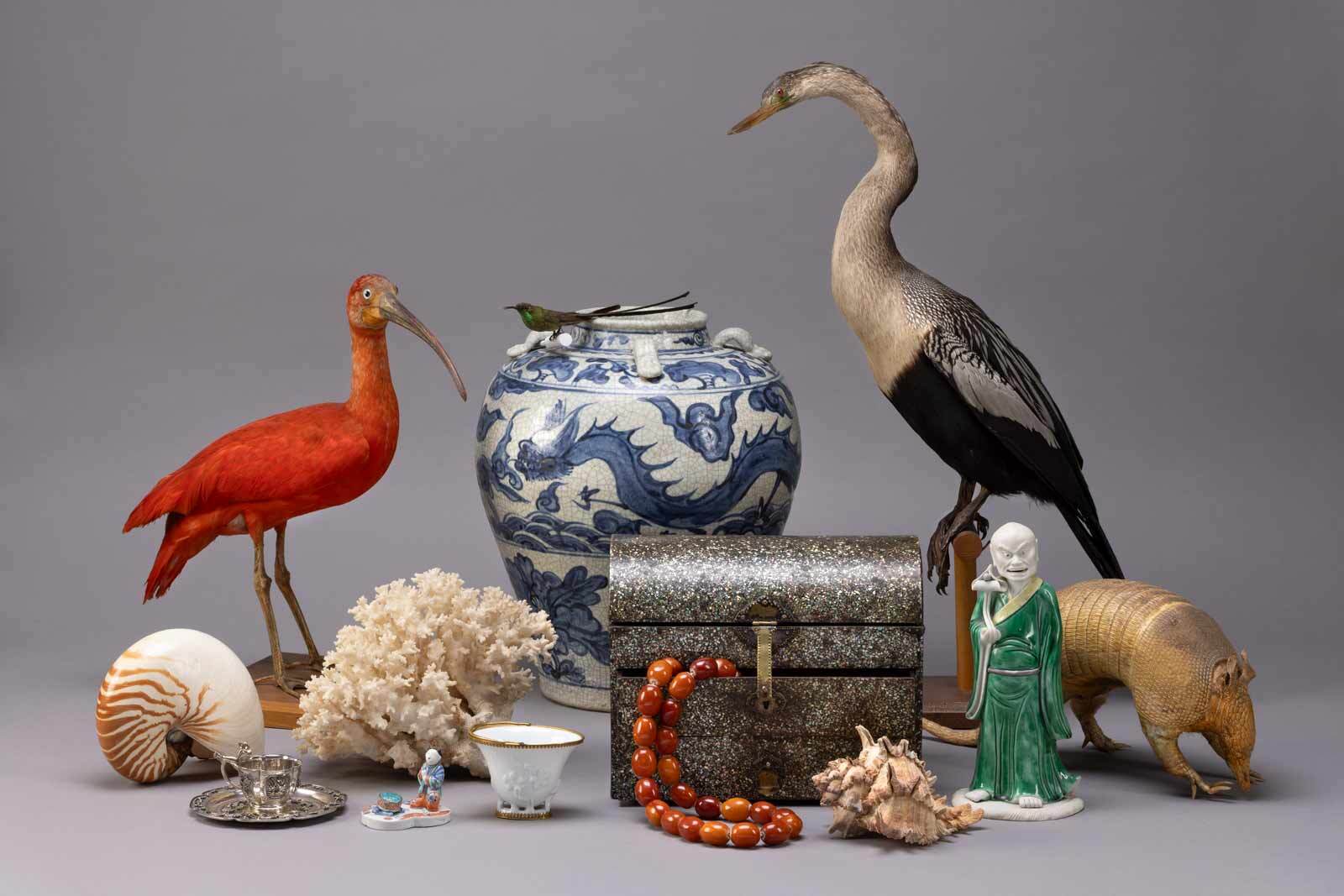
A selection of natural and man-made wonders in the Saints, Sinners, Lovers, Fools cabinet of wonders at PEM
There are two omissions from the exhibit. One is deliberate and due in part to lack of space. Although Brussels was the principal center for tapestry weaving at the turn of the 15th and 16th centuries, a bias toward painting existed both then and in the collection on display at PEM.
The other omission is any mention of the crypto-Jews who fled the persecutions and expulsions in the Iberian Peninsula and the key roles they played in cultivating Antwerp’s economic preeminence by helping develop the important diamond, pearl, and commodities industries.
 InSights