It’s a Topsy-Turvy Planet in The Huntington’s ‘We Had A World’

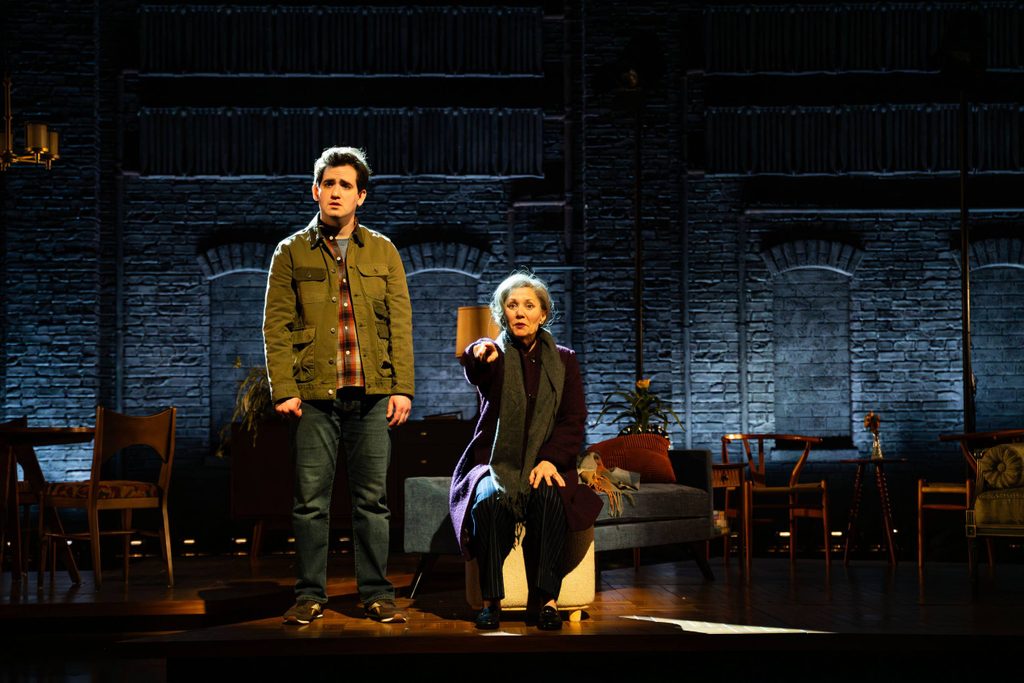
Amy Resnick, Will Conard in Huntington’s ‘We Had A World’. Photos by Annielly Camargo

‘We Had A World’ — Written by Joshua Harmon. Directed by Keira Fromm. Scenic Design by Courtney O’Neill; Costume Design by Izumi Inaba; Lighting Design by Tyler Micoleau; Sound Design and Original Music by Melanie Chen Cole, Presented by The Huntington at Wimberly Theatre, Calderwood Pavilion, 527 Tremont St., Boston through March 15.

By Shelley A. Sackett

Joshua Harmon covers a lot of ground in the arresting We Had A World. On its surface, the 100-minute one-act play is a deeply personal disinterment and examination of the complicated dyad relationships among his grandmother (Nana/Renee), his mother (Ellen), and Josh, Harmon’s autobiographical self. Equal parts loving requiem and vicious vendetta, the playwright fleshes out these complicated characters, channeling the emotional messiness and magnificence of a family where acrimony, blame, selfishness, and self-destruction share the stage with humor, love, gratitude, generosity, self-sacrifice and honesty. Spanning 1988-2018, the story is told in a nonlinear fashion, a patchwork quilt of episodes where each square is one person’s version of the same event. As the colors and patterns shift, so do our impressions of the three characters.

Scratch even slightly below that surface, however, and a more universal message bubbles up: we all have secrets, every family harbors its own shame, every family member has their own version of what REALLY happened. “Family is just a collection of people who can see things extremely differently,” Josh explains.
Resnick

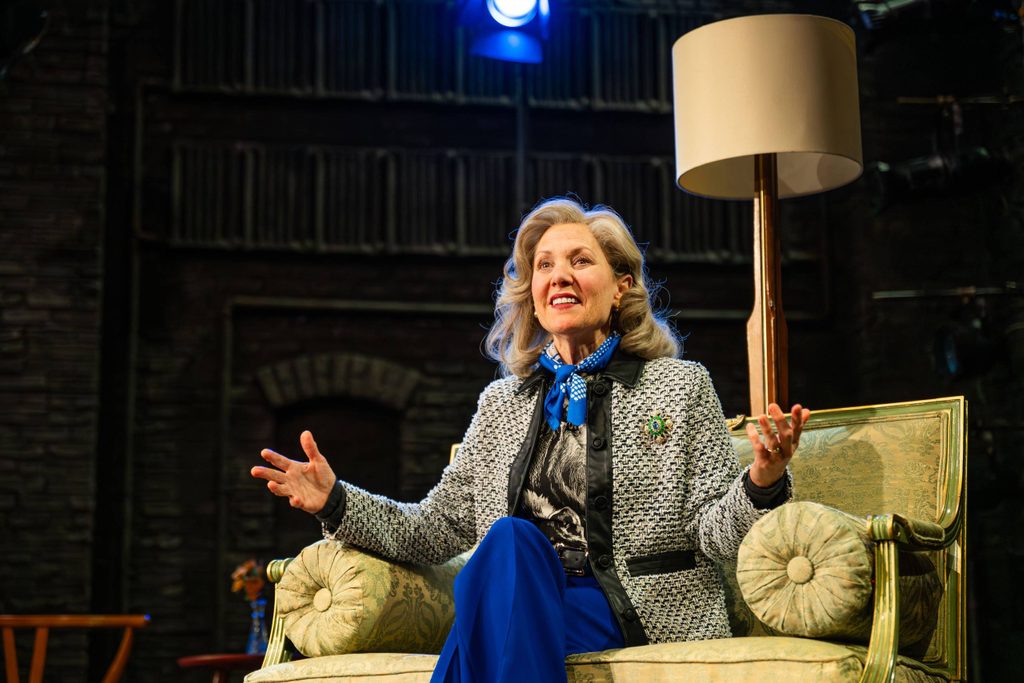
The play begins with 94-year-old Renee (a commanding Amy Resnick) telling Josh (Will Conard, perfectly cast) she has incurable cancer. She asks him to write a play about their family, giving him the green light to do what he has always wanted to but was afraid to ask for her permission. There is one catch, however: the play must be as bitter and vitriolic as possible. “It ought to be a real humdinger,” Nana says gleefully. “You can even make your grandmother a real Medea.” (Reminder – Medea is the one who kills her own children and suffers neither consequence nor conscience).

Josh literally jumps at the chance to plumb his backstory, both to pay homage and loosen its tightly wrapped shroud. When Nana and mom Ellen (a forceful Eva Kaminsky) snatch the mic out of his hand, he gives them free rein to chime in, but this is his story, and their accounts reach us as his memories of them.

We start our journey riding shotgun beside a 5-year-old Josh. He lives in the suburbs of New York City, which he realizes, even at that young age, is not where he belongs. Nana lives in an elegant apartment in Manhattan’s Upper East Side. She feigns a British accent, despite being raised in Brooklyn by immigrant parents. Even her furniture has an exotic backstory (she brought it home from Paris).

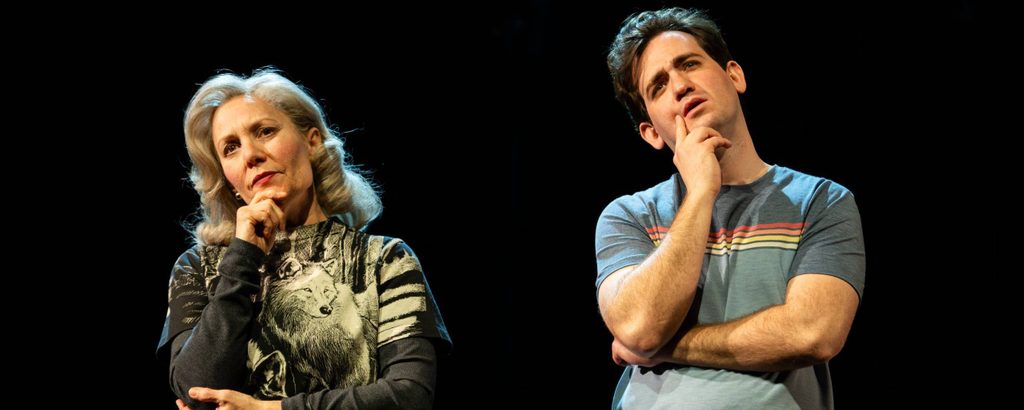
She is as devoted to her grandson as he is smitten with her. She is unfiltered, outrageous and honest. She treats him as an equal, speaking as if he were a contemporary rather than six decades her junior. At five, she signs him up for a two-week art class at the Met. At nine, she takes him to a Robert Mapplethorpe exhibit. She senses the smoldering ember of Josh’s artistic proclivity and, rather than dousing it, turns the fan on full blast.
Resnick, Conard

At ten, she takes him to see Medea. Afterwards, he asks her if she would ever kill her own children. “That would depend on the situation,” she says without hesitation.

Josh’s mother, Ellen, is as buttoned up and earthbound as Nana is mercurial. A lawyer and self-proclaimed bitch, Ellen is the personification of the sandwich generation, responsible parent to both her mother, Renee, and son, Josh. She is a problem solver and provider. She feels burdened and resentful, seething with anger at her own mother, yet unable to let go of her need to be her caregiver.

If ever there were a contest for poster children to represent destructive co-dependence, these two would win hands down.

Josh is caught in the middle of a situation he doesn’t understand. Why can’t the two most important people in his life get along? Why does he have to feel like he has to choose sides?

Eventually, after Nana fails to show up at Josh’s first acting gig, Ellen unlocks the family closet and the skeletons come tumbling out. Josh learns that Nana is an alcoholic. Ellen’s father was, and remains, her enabler and protector. Ellen grew up neglected and psychologically abused, cleaning up after her mother and, in return, earning attacks of her unbridled rage.

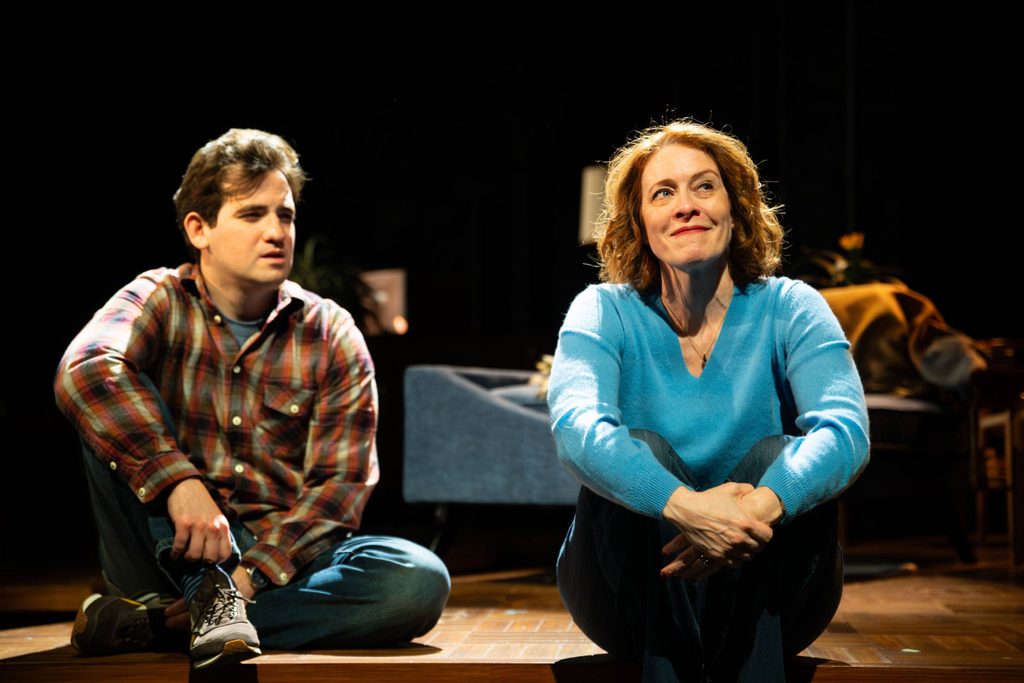
His mother’s vigilance and overprotection are not, Josh realizes, based on jealousy of his relationship with Nana. She is only trying to be the kind of parent she wishes she had had. “If you botch raising your children, nothing else matters,” Ellen tells Josh. “Raising your children is the most important thing we do.”
Conard, Eva Kaminsky

Suddenly, Josh’s world is flipped on its head. His mom’s animosity toward her mother makes sense. And Nana, whose crown he has happily polished and revered, is suddenly off her pedestal. How he reconciles his feelings about both with this new intel puts his loyalty squarely in his mother’s court. When Renee, ever the triangulator, tries to pit Josh against his mother, he responds differently for the first time.

“I cannot think of a more giving, generous, loving, thoughtful member than my mother, and attempts to hurt her hurt me very, very deeply. Trying to balance my relationship with my family and you has not been easy the past few years. But if you force me to choose sides, as it were, you must know I will always side with my family,” he writes in response to an invitation from Renee to a family vacation that excludes Ellen.

In a play with only three characters, the quality of the acting is critical, and director Keira Fromm has plenty to work with. The chemistry among the actors is palpable, and each brings a believable naturalness to their role. Resnick, as Renee, shines, relying on gestures, gait and cadence to skip from 65- to 94-years-old. Although presenting physically as frail and diminutive, Resnick’s Renee casts an oversized shadow over Courtney O’Neill’s fetching set.

Kaminsky is solid as Ellen, bringing an element of compassion and empathy to an otherwise one-dimensional, strident role. It is Conrad’s Josh, however, who is the centrifugal force that keeps these two repellant magnetic forces from sailing off into the stratosphere. His unpretentious ease and facial expressions rope us in and give nuance and gravitas to what could have been a plastic character in less skilled hands.

Harmon’s script is by no means perfect, and the nods to climate change feel forced and awkward, as do some vignettes which overstay their welcome by a beat or two. Overall, though, the pace is brisk, the humor (for the most part) lands well, and the dialogue and narration hit their marks.

Harmon, whose credits include Prayer for the French Republic, Bad Jews, Admissions, and Significant Other, is no stranger to tackling big-ticket, macro topics. In We Had A World, he still examines Judaism and Jewish identity, family dynamics, and the effects of the passage of time, but this time, he brings it to a micro level where it is possible to submerge and totally relate.

Grandparents are meant to play a different role in their grandchildren’s lives, and Harmon’s valentine to his own Nana, warts and all, is as universal as it is heartwarming.

“Women who should not have been mothers can make very compelling grandmothers,” Josh concludes. “Nana, if you’re really watching, I just want to say thanks.”

For more information, visit https://www.huntingtontheatre.org/

‘Bar Mitzvah Boy’ wrestles with keeping the (Jewish) faith when bad things happen to good people

Rabbi Michael (Diane Di Bernardo) and Joey Brant (Peter Palmisano) prepare for Joey’s upcoming adult Bar Mitzvah in ‘Bar Mitzvah Boy.’

By Shelley A. Sackett

Right out of the gate, playwright Mark Leiren-Young challenges his audience to leave their assumptions in the (virtual) lobby. ‘Bar Mitzvah Boy,’ his prize-winning 90-minute two-hander, opens as a young woman wearing jogging gear, baseball cap and rock-blasting ear buds pauses by a bench, then continues on the wooded trail, straight up the front steps of a stately mid-20th century synagogue.

Inside the rabbi’s office, a 60ish man, dressed in full rabbinic regalia —  gray suit, tallis (prayer shawl), kippah and tefilln (phylacteries) — pulls a book from the book shelf. He sits at his desk, poring over it somberly, as a woman’s nasal voice bleats over a tinny loudspeaker, “Rabbi. You’ve got a visitor.”

The jogger enters and freezes. “Excuse me?” she says with ambiguous inflection. “I don’t mean to be rude, but I’m waiting for someone,” the man replies. In the first of many twists meant to keep us untethered, it turns out the woman is Rabbi Michael Levitz-Sharon (Diane Di Bernardo) and the man, a prosperous divorce attorney, is Joey Brant (Peter Palmisano).

Joey has a mission; he begs her to prepare him for a traditional Bar Mitzvah. He is desperate to carry on this family practice before his grandson, Ben, celebrates his own Bar Mitzvah the following week in the same synagogue, but “no one can know.” Rabbi Michael objects, complaining only a magician could pull off such a feat, but when Joey deploys his talent for persuasion, she reluctantly agrees to take him on as a student.

These opening scenes lay the groundwork for this thinly-plotted, character-driven play, and establish Leiren-Young as a gifted craftsman. The dialogue is witty, smart and fast, full of one-liners and prickly punch lines delivered by two talented actors. Although Joey and Rabbi Michael initially seem poles apart, the more they talk, the more their chemistry grows. They riff off each other. Both make their livings through words, and they delight in the gamesmanship of debate. They are skilled active listeners and articulate, honest responders. They share a sense of humor which has helped each navigate life’s hardships and disappointments. And they both wear their hearts — and their pain — on their sleeves.

Yet, on other levels, the two couldn’t be more different. Joey is impatient, pushy and demanding, a man who knows what he wants and is used to getting it. He abandoned Judaism 52 years ago and hasn’t  been in a synagogue since.

Rabbi Michael, on the other hand, is a third-generation rabbi who entered the “family business” because she wanted to help people. She is in love with the sense of home she gets every time she enters any synagogue, anyplace in the world. Her faith is her bedrock;  her community, her lifeline.

As the play evolves, the tenor of their conversation deepens and Leiren-Young lets his characters ask the question the audience has been pining to have answered. “Why are you here?” Rabbi Michael finally asks. Joey replies, “I want to believe in God,” but admits he has trouble when he sees “stuff like this,” referring to Rachel, the 11-year-old terminal cancer victim he saw at services the previous Saturday. “She’s my daughter,” Rabbi Michael (whose name, ironically, means “beloved of God) answers, and with that, ‘Bar Mitzvah Boy’ shifts gears as the two join forces in their quest to make sense of Judaism in the light of unspeakable tragedies.

The pitch of their conversations deepens in intellectual, spiritual and emotional tone as their relationship morphs from teacher/student to trusting friends. The rabbi shepherds Joey on his journey of Jewish rediscovery despite her breaking heart, putting on a “good face” for her congregation and supporting her daughter’s desire is to be called to the Torah as a Bat Mitzvah before she dies. She candidly admits that Rachel’s imminent passing and the marital separation it caused has stressed her faith to the breaking point. Whether it will survive her death is anyone’s guess.

Joey, too, lets down his guard and reveals the real reason he never had a Bar Mitzvah. For him, a Bar Mitzvah doesn’t represent a coming-of-age rite; it is a coming-back-to-faith turning point.

Joey and Rabbi Michael’s meaty discussions about the Bible as metaphor, miracles, forgiveness, tragedies, and what it means to “feel” Jewish are certainly heady and thought provoking. ‘Bar Mitzvah Boy’ is, after all, a Jewish play with a universal story about keeping faith when bad things happen to good people.

But at the end of the day, these scholarly concepts alone can’t save them. Rather, it is their personal connection as caring friends that helps them build a bridge over the rough waters of their doubts, and their shared faith in the power of community that might just carry them across.

‘Bar Mitzvah Boy’ — Written by Mark Leiren-Young; Directed by Saul Elkin; Produced by David Bunis; Managing Director- Jordana Halpern; Stage Manager- Keelin Higgins; Set Design by David Dwyer; Costume Design by Ann Emo; Sound Design by Nicholas Quin. Presented by Jewish Repertory Theatre. ‘Bar Mitzvah Boy’ is available for digital download from November 5-25. For more information or to purchase tickets, visit jccns.org/event/bar-mitzvah-boy/

Adea’s is a vegetarian Middle Eastern delight


David Winer, the 32-year-old owner, chef, manager and server at the recently opened restaurant, Adea’s Mediterranean Kitchen, has been up since before dawn, preparing the day’s homemade menu. At an hour when most people are enjoying their first cup of coffee, he is already busy stirring an enormous pot of Jerusalem Bean Soup that has been bubbling away for four hours.


“It’s a very simple recipe with very simple ingredients,” he said, describing the Israeli staple that is made of two kinds of beans, tomato paste, onions, salt pepper, oil and water. “That’s it. Then cook it for eight hours.” He checked to make sure the soup wasn’t burning.


bubling-bean-soup

Jerusalem Bean Soup bubbles away.


The secret that separates Adea’s’ bean soup from its peers? “We cook it with a lot of love,” he said with a wide grin.


Adea’s, located at 90 Lafayette Street in the space previously occupied by Salem Theatre Company, is Salem’s first kosher vegetarian eatery. The 41-seat restaurant is open from 10 a.m. Sunday through Friday, closing at 3 p.m. on Friday and 4 p.m. the rest of the week.


Winer chose Salem for business and lifestyle reasons. He and his family live in an apartment around the corner from the restaurant and he loves how local Salem is. “It’s a city with a small town feel,” he said.


It also is a city known for its varied restaurants and excellent food. “They have the basics here, but there is nothing like ours. In Boston, there are hummus places all over the place. In Salem, there is no kosher or falafel restaurant,” he said.


Adea’s is under the kosher supervision of Chabad of the North Shore.

img_4772


Having a kosher restaurant is important to Winer because he and his family eat only kosher food. However, he points out that being kosher is an add-on value for Adea’s. For him, the larger issue is that he serves only vegetarian food. “It’s an environmentally friendly thing,” he said proudly.


The menu is small, featuring a handful of staples, including a hot hummus platter, stuffed grape leaves, Israeli salad, babaghanoush, and the crowd-pleasing bean soup. There are also two or three daily specials, such as roasted Tuscan vegetables with Tuscan beans and black bean and veggie soup with rice. “What we like about our menu is that it’s very small. We have a lot of leeway,” he said, emphasizing that everything is cooked fresh every day.


For Winer, returning to the North Shore is returning to his roots. He grew up in Swampscott, where he graduated from Swampscott High School in 2002. After earning a degree from University of Massachusetts in hospitality management, he worked in Florida and New York City. At age 24, he decided to go to Israel, intending to visit for six months. Instead, he stayed for six years, becoming co-partner of Tel Aviv’s Café Kaymak, a coffee shop.

hummus

Adea’s famous hummus with tahini and chickpeas.


In Israel, Winer explained, there is a real “coffee shop culture”, which draws people for conversation and camaraderie. “Coffee shops are the real gathering places whereas in America, it’s usually bars and restaurants,” he said.


“It was a great learning experience for me,” he said of the “cool, funky, bohemian” place where he fine-tuned his recipes for hummus, falafel, bean soup and other Middle Eastern fare. “There is a lot of influence from there,” he said of Adea’s’ menu. “I wanted to create a place with an Israeli feel.”


His Israeli coffee shop provided more than just schooling in authentic Israeli cuisine. It also provided him the opportunity to meet Adena, his Ethopian-born Israeli wife.


“Cliché as it is, it was love at first sight,” he said. Adena came to an event at his Café Kaymak shop and one year later, they were married. The couple has two young children and do everything themselves.


Word of mouth about the new restaurant is nothing short of raves. Elana Gerson, of Salem, lived in Israel for five years. “The food is fantastic,” she said as she lunched on the Adea’s sampler platter. “I feel like I’m in Israel.”


Susan Steigman of Marblehead agreed. “The food is delicious and the service hospitable. The hummus is outstanding,” she said


On a recent Monday, the restaurant was nearly full as a steady flow of people ordered lunch. David and Adena were behind the counter, she taking customers’ orders and he wielding a giant spatula.


“It’s a real Mom and Pop restaurant. It’s just the two of us. We have no employees. It’s early mornings and late nights,” he said. “It’s a lot of work, but we wanted it, we asked for it and we got it.”


Although Winer admits there were many unforeseen challenges to taking on an empty space and creating a restaurant from scratch, the man who “loves serving people” has no regrets.

img_4773


“The feedback has been unbelievable. My first loves are my daughters and my wife and my family. But when people say, ‘Wow, I love your food’, it makes me feel so good. I really couldn’t see myself doing anything else. I guess this was my calling.”


Judging from their cleaned plates and satisfied smiles, his customers couldn’t agree more.


For more information, visit http://adeasmk.com.