Flight 1619 Finally Lifts Off in SpeakEasy/Front Porch’s Ambitious ‘Ain’t No Mo’

Cast of SpeakEasy/Front Porch’s ‘Ain’t No Mo’ Photos: Nile Scott Studios
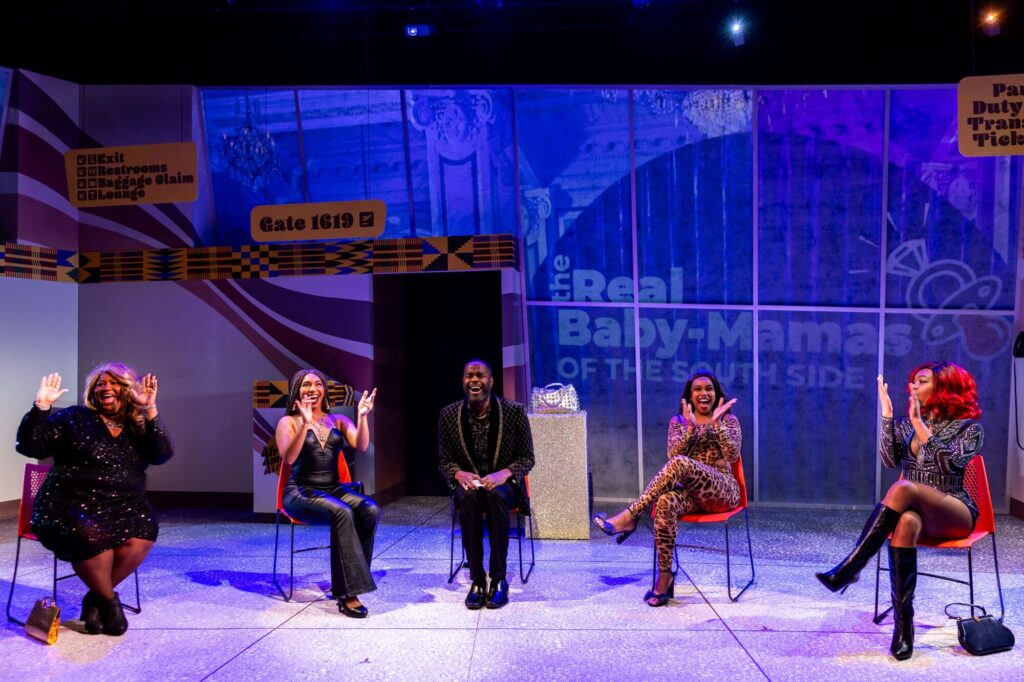
MaConnia Chesser, Kiera Prusmack, De’Lon Grant, Schanaya Barrows, and Dru Sky Berrian.

By Shelley A. Sackett

Jordan E. Cooper’s Ain’t No Mo is a complicated, uneven, scathing, audacious, and hilarious rollercoaster ride of a play. It covers a lot of ground, and Cooper dips his pen into the inkwell of every genre known to playwrights: from satire, allegory, fiction, and parody to tragedy and Shakespeare-worthy soliloquy.

Performed as a series of loosely connected vignettes that sometimes change at whiplash speed during 100 intermission-less minutes, this SpeakEasy Stage Company/Front Porch Arts Collective production is guaranteed to spark lively post-theater discussion.

Here’s the premise.

In 2016, with the election of Donald Trump and the end of Barack Obama’s presidency and its promise of Hope and Equality, African Americans descended from slaves are offered a one-way ticket “home” to Dakar, Senegal. A “dedicated observer of equal oppression,” African American Airlines’ Flight 1619 is in the house, or the White House to be more precise. Whether to stay and live life as it is in this country or leave on the “Reparations Flight” and start anew is each individual’s choice.

The government expects this will solve the problem of racism in America once and for all. Almost all eligible Blacks (millions) register to take advantage of the free flight.

What Cooper does with this simple premise, however, is staggering in terms of its brazenness and sheer creative genius. Director Dawn M. Simmons executes with full-throated flamboyance and exaggeration.

The six-actor ensemble switches into many roles easily, aided by Rachel Padula-Shufelt’s fabulous costume design and wig choices. Mac Young’s set design is both flexible and exacting, flowing smoothly between very different settings. Aja M. Jackson’s lighting design and Aubrey Dube’s sound design help create a unifying aesthetic for the show’s differing segments.

Cooper’s no-holds-barred approach is evidenced full blast even before the house lights are fully dimmed. The mild-mannered recording that announces where exits are and what to do in case of an emergency is suddenly interrupted by Peaches, the Flight 1619 airport gate attendant.
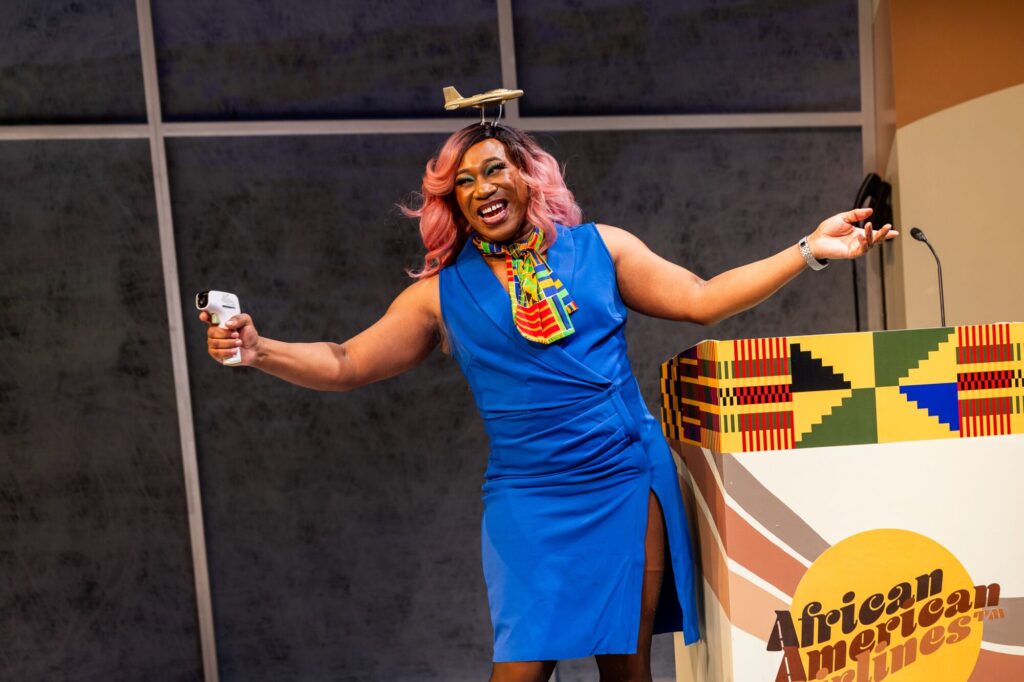
Grant Evan

“Ladies, gentleman, and those who don’t give a damn. Welcome yo ass to The Roberts Theater. Yessss, we in Boston, bitch! It’s ‘bout time to get this thing started, so I hope you had enough sense and shat before you sat,” she shouts into the sound system.

The rest of the play, which starts with the election of President Obama and ends with Flight 1619 taking off, traces the Black American experience with scenes Cooper chooses to exemplify that jumbled, complicated, painful journey. Like a book of loosely connected short stories, each scene functions independently, yet, taken together, they weave a single cloth.

What unites them is their characters’ reactions to news of the subsidized flight to Africa. Will they stay or leave? And, more importantly, why?

The action opens with “Book of Revelation,” a bang-up of a funeral led by Pastor Freeman (played with over-the-top verve by a terrific De’Lon Grant). It is November 4, 2008, and the Black community has gathered to celebrate Obama’s election and lay Brother Righttocomplain, the embodiment of protest and injustice, to rest.

“Ain’t no mo’ shot down dreams with its blood soaking the concrete,” Freeman bellows. “Ain’t no mo’ riots.”

Now that a Black president has been elected, the unrealistic assumption is that centuries of racism and discrimination will suddenly be reversed and a new era of promise will be escorted in.

The joy and celebration is short-lived. After this gospel-infused scene, the mood and time shifts to 2016 and the election of Trump. White backlash against black Americans and ginned-up fear and resentment will set the next agenda.

Between each plotted scene, we witness morsels of what Peaches (a scene-stealing non-binary Grant Evan) is dealing with as the sole check-in agent for Flight 1619. A larger-than-life drag queen who wears a hot pink wig, Kente scarf, and model airplane-adorned tiara; her role is the play’s only constant through a series of sketches and settings.

She checks in various passengers and offers counsel to those who are hesitant. She also prepares Miss Bag, a suitcase she claims holds “our entire story as a people in this country,” and encourages passengers to drop their stories in the bag so they may bring it to Africa. She warns those who stay behind will be subjected to “extreme racial transmogrification” by “The Powers That Be”: they will be turned into white people.

The audience comes to trust her voice and feel her frustration and angst as she single-handedly supervises boarding millions. She is the reliable narrator, part mother hen and part Greek chorus.
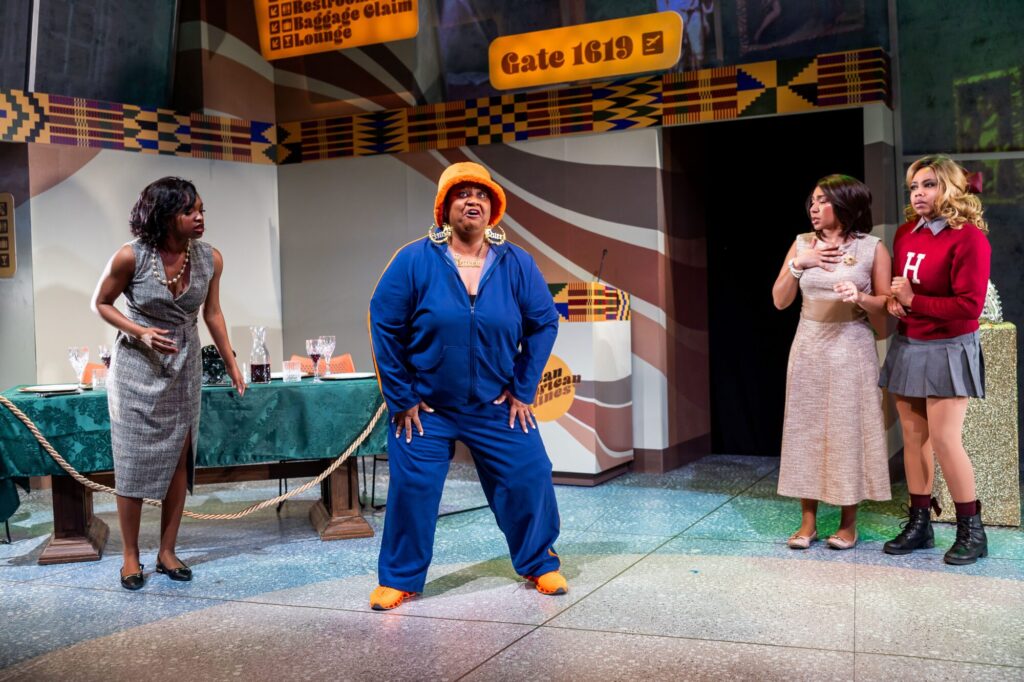
Dru Sky Berrian, MaConnia Chesser, Kiera Prusmack, and Schanaya Barrows

With “Circle of Life,” Cooper tackles the heartbreak of young lives ended by violence and police brutality and the unwillingness of Trisha (Dru Sky Berrian), pregnant by Damien (Grant), to bring a future victim into the world. “A better time is coming. We just have to wait for it,” Damien assures her. Despite his pleas, she is adamant. So are the million other women in line at the Sister Girl We Slay All Day Cause Beyonce Say Community Center, a clinic oasis in a country where abortions are no longer available. Trisha is Number 73,545.

“Real Baby Mamas of the South Side” is a parody of the Real Housewives franchise. This one focused on four black women pretending to have multiple baby daddies and an obsequious host who keeps the provocation flowing. One panelist isn’t even black but is “transracial,’ white Rachel dressed as black Rachonda, “choosing to be herself” and “living her truth” as a black woman.

Tracy, another panelist, breaks character and confronts her. “Race is not a choice. It’s a fact,” she states. Unlike the Rachondas of the world, her skin and the experiences that come with it are NOT optional.

Here, and at many other times, Cooper squanders an opportunity to dig deep into some meaty issues like exploitation, appropriation, stereotyping, ownership, protection of black culture and the tipping point between the humorous and the hateful. Instead, he takes the easy way out, letting the scene devolve into a catfight, leaving the audience unsatisfied and his craftsmanship in question.

In “Green” and “Untitled Prison Play,” Cooper makes his point with more clarity and self-discipline. Each scene features Maconnia Chesser, who anchors and elevates them. In “Green,” Cooper lampoons rich black families who – in this case literally — buried their blackness and partook in the material rewards of assimilation. They have no intention of going anywhere, certainly not to Africa. They have bought into the American Dream, despite its hefty price tag. This is now their America, too.

Chesser plays Black, the human personification of their family’s “blackness,” locked away in the basement by the family’s deceased patriarch for forty years while he became rich. Suddenly, she is set free. She has a lot to say. And she is pissed off.

“Now is the chance to learn who you really are,” she tells them. “I am your family’s black. Come on, we have a plane to catch.” Instead, they plead, threaten and eventually try to shove her back into the basement. No way is this Pandora going back into her box.

Again, the scene devolves into chaos and violence, and again, we are left unsure what point Cooper was trying to make and why.

In “Untitled Prison Play,” the play’s most moving scene, Chesser plays an inmate who can’t leave prison without signing for her possessions and who won’t sign until everything she had when first incarcerated is accounted for and returned. What she’s missing are her joy and a little piece of chaotic peace. Her name. Her place on earth. And, most of all, her smile. Her real smile.

But her choice is stark. Refuse to sign and return to her cell or leave and find herself some new stuff. Like Freedom.

Flight 1619 does finally takes off, but not before Peaches brings down the house with a lightning bolt monologue. There are even last-minute spoilers and pyrotechnics.

When Cooper started Ain’t No Mo, he was just a high school student. Its genesis was in reaction to an incident of police intimidation that rocked and changed him. Its Off-Broadway premiere happened when he was just 24 years old and three years later, Cooper became the youngest Black American to make his Broadway playwriting debut and the youngest Black American playwright ever nominated for a Tony Award. Ain’t No Mo garnered six nominations, including Best Drama, despite its closing after a mere three-week run.

To be sure, Cooper’s play is hardly flawless. It is dated and full of platitudes, pacing issues, and tiresome, gratuitous expletives. It is also in dire need of judicious breadth and length editing.

But Cooper’s pen is a magic wand as well, spinning a smart, confident and grand play out of an undisciplined galaxy of issues and ideas. And when the smoke clears and the stage finally quiets, we’re surprised by the number of important questions left rolling around in our minds, like party favors.
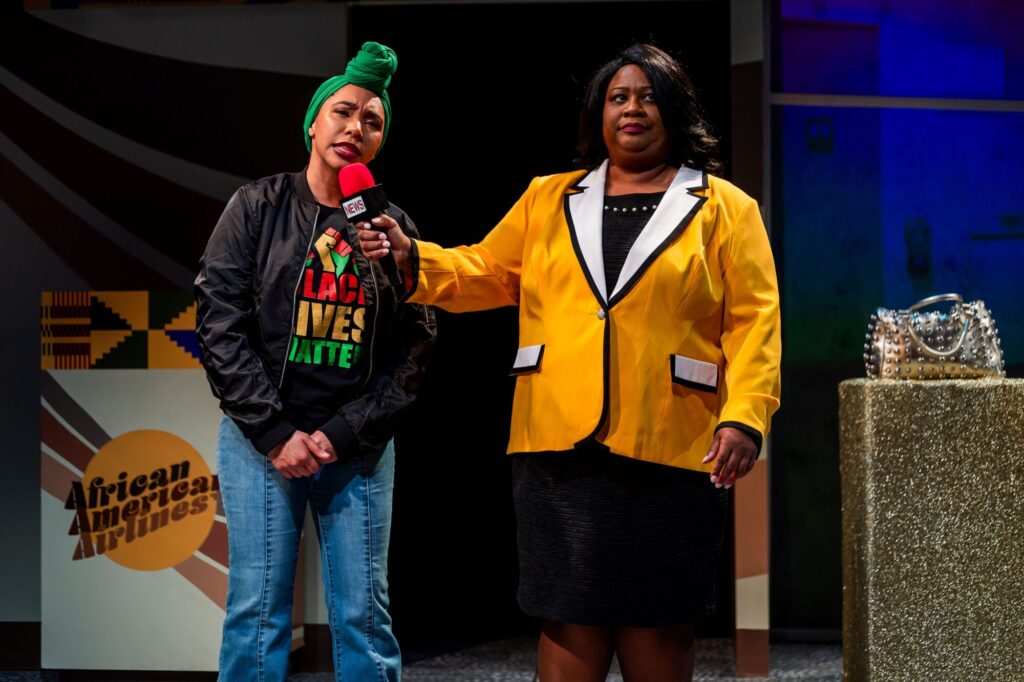
Kiera Prusmack and MaConnia Chesser

If Miss Bag is the “carrier of our entire story as a people in this country” — the music, art, culture, political ideas, and everything else Blacks have contributed to the American landscape — should it travel to a new destination? Will it reassimilate or hold its owners back, married to an old reality while trying to forge a new one?

When émigrés board a plane, for example, perhaps with just one bag, what do they leave behind? What does the country they leave lose? And after they leave, whose story is theirs to tell? What do we do when the story is over? Perhaps, most importantly, where does freedom fit in if its price is a future without a past?

And these questions are just for starters.

‘Ain’t No Mo’.’ Written by Jordan E. Cooper. Directed by Dawn M. Simmons. Co-produced by SpeakEasy Stage and Front Porch Arts Collective at the Calderwood Pavilion, 527 Tremont Street, through February 8.

For more information and to buy tickets, visit https://speakeasystage.com/shows/2025/01/aint-no-mo/

Speakeasy Stage’s ‘Pass Over’ Packs a Timely Wallop

“Mister (Lewis D. Wheeler), Moses (Kadahj Bennett), and Kitch (Hubens “Bobby” Cius) in Speakeasy Stage’s ‘Pass Over’ – Photos by Nile Scott Studios


By Shelley A. Sackett

Even before ‘Pass Over’ begins, as theatergoers blithely check emails and jockey for their seats, the actors make clear theirs is a production that will claim one’s full attention and engagement. Two young scruffy black men, dressed in hoodies, oversized footwear and hats, prowl around the sparse stage, demanding eye contact and flirting with the women in the front row. By the time the house lights go down and the stage lights go up, these two have established an uneasy arms-length rapport with the audience.

Moses (Kadahj Bennett) and Kitch (Hubens “Bobby” Cius) hang out on their street corner under the watchful eye of a lone street light, to which they seem to be tethered by an invisible leash. They pass their unemployed time talking about their hopes and dreams, waiting for a sign that their life is about to start in earnest. They count off the names of those unarmed friends and family members killed by the police – “Po-pos”- while playing a game called “Promised Land Top Ten.” They take turns naming the ten things they would like to see when they “pass over” to paradise – ranging from clean socks to a brother back from the dead – but the undercurrent of anxiety and foreboding darkens the spirit of their light-hearted banter. The threat of violence from the police looms darkly beyond the four corners of their tight quarters and it takes all their energy to keep panic at bay. Lighting bursts and menacing sound eruptions add to the unease.


Playwright Antoinette Nwandu has fashioned her blistering, complex and ambitious 2019 Lortel Award winner for Outstanding Play as a sweeping landscape to address systemic racism, police brutality, gun violence, slavery and the Exodus story of freedom from oppression. She uses Samuel Beckett’s absurdist canon, “Waiting for Godot,” as a stylistic framework and while familiarity with that play is not required, it doesn’t hurt.

Yet, Nwandu imbues Moses and Kitch with such humanity and personality that they are hardly absurdist symbols, but rather fully fleshed out individuals whose plights are heartbreaking. Both Bennett and Cius  give award-worthy performances that paint an intimate camaraderie through dance, verbal games and elaborate bumps. Bennett’s Moses is a pillar of discipline, strength and optimism. He is resolved to escape this dead end. “You’re going to live up to your true potential. I’m going to lead you,” he tells Kitch. Cius plays Kitch as Moses’s sweet puppy-dog younger brother, full of frenetic, unfocused energy and blinding desire to please.

The play’s two white characters are “Mister,” a wolf-like dandy off to visit his grandmother with a picnic basket, and a racist, sadistic thug of a police officer. Lewis D. Wheeler plays both with a razor sharp but impersonal crispness that is both intimidating and merciless. Both are cartoonish, flat and soulless, especially compared to Moses and Kitch.


Much has been written about the play’s use of the “n-word” and the opinions are as numerous as the critics who pen them. When Moses and Kitch use it, the term is one of endearment, companionship and solidarity. When uttered by Mister or the policeman, the term drips with venom and malevolence. What is not ambiguous is whether Nwandu intends her  generous use of the word to indicate a green light for its acceptance in contemporary speech. “Aside from the actors saying the lines of dialogue while in character, this play is in no way, shape, or form an invitation for anyone to use the n-word,” she notes in the script.

“Pass Over” is an important work by a playwright with a strong, smart, original voice, performed by an all-star cast. Anyone who values serious thought-provoking theater should not miss this  stellar production. For tickets and information, go to: https://www.speakeasystage.com/

‘Pass Over’ – Written by Antoinette Nwandu; Directed by Monica White Ndounou; Scenic Design by Baron E. Pugh; Costume Design by Chelsea Kerl; Lighting Design by Kathy A. Perkins; Sound Design by Anna Drummond. Presented by SpeakEasy Stage Company and Front Porch Arts Collective at Roberts Studio Theatre, Calderwood Pavilion through February 2.


SpeakEasy Stage’s ‘Admissions’ Pierces the Veil of White Male Privilege

Nathan Malin, Maureen Keiller and Michael Kaye in SpeakEasy Stage’s Production of “Admissions.” (Maggie Hall Photography)

By Shelley A. Sackett

Joshua Harmon’s terrific new play “Admissions,” now making its Boston premiere at SpeakEasy Stage Company through November 30, packs a timely wallop. Set at and near Hillcrest, a toney progressive New Hampshire prep school, the plucky drama starts out poking fun at Sherri, Hillcrest’s white admissions director who is not happy with the draft of the Admissions Catalog she has just received.

It seems the catalog does not bear adequate witness to the milestone achievement of her 15-year tenure: tripling the diversity of Hillcrest’s predominantly white student body from 6% to 18% students “of color.” She knows this because she has counted all 52 pictures, and only three feature non-white faces. That is precisely 5.7%, and Sherri is livid. She has summoned Roberta, the veteran development officer responsible for the draft, to point out her glaring blunder.

Roberta is Sherri’s opposite. She is a frumpy, plain-spoken woman who calls a spade a spade. She is from another era, when personal qualities and merit mattered more than mathematical quotas. Roberta defiantly defends her work, pointing to a photo that features Perry, the son of a biracial teacher. “Perry’s black, isn’t he?” Roberta asks, confused. “Of course he is, but he doesn’t read black in this photo. He looks whiter than my son,” Sherri counters, exasperated. “I don’t see color. Maybe that’s my problem,” Roberta says.

Cheryl McMahon, Keiller

That exchange sets the stage for Harmon’s intelligent and riotous drama that exposes the raw nerve of hypocrisy among white people of privilege who hide behind political correctness, loudly trumpeting an abstract policy of affirmative action and diversity right up until the moment they are personally impacted by its application. Then, these same folks sing a “not in my backyard” refrain. They may talk the talk (and talk-and talk they do), but when push comes to shove, they would never walk the walk.

Sherri’s husband, Bill, is head of school at Hillcrest, where their 17-year-old high-achieving son, Charlie, is a student hoping to attend Yale with his best friend, the not-visually-black-enough Perry. Perry’s white mother, Ginnie, is Sherri’s best friend, neatly tying a bow that encircles and intertwines the play’s characters.

Ginnie and Sherri hang out a lot. Later that day, in Sherri’s kitchen, both sip white wine and wring their hands over their sons’ fates. Today is the day they will find out if they got into Yale. Harmon’s razor-sharp dialogue reveals the first cringe-worthy chinks in their personal moral codes. Ginnie has brought Charlie a cake from Martin’s Bakery, the same one she bought for Perry, despite evidence the baker is a pedophile. “What are you gonna do? His cakes are great,” she says with a shrug. Sherri shares her catalog fiasco, lying to Ginnie that she couldn’t use the picture of her son because it was blurry.

Marianna Bassham, Keiller

Ginnie receives “the” phone call first – Perry, whose application classified him as black, was accepted. When Charlie is deferred, the victim, he believes, of reverse discrimination, Harmon goes to town as Charlie’s parents’ liberalism and personal ambitions for their son collide. “How did I not see this coming,” Charlie wails, as he points an accusing finger at his parents, the architects of the very quota-driven system that denied him his due. “I don’t have any special boxes to check.”

Later in the intermission-less 105-minute production (no spoilers in this review), Harmon asks his audience the same question faced by Charlie’s horrified parents: what would you do if your child became a casualty of the system of ethics and fairness you champion? Would your moral True North shift?

“Admissions,” with its double-entendre title, captured both Drama Desk and Outer Circle awards for 2018 best play, and the SpeakEasy production is a bases-loaded home run with Nathan Malin (Charlie) as its runaway star. This 20-year-old Boston University College of Fine Arts junior brings depth, vulnerability and physicality to a character that could have become a caricature in less capable hands. Cheryl McMahon is equally outstanding as the well-meaning and misunderstood Roberta and Maureen Keiller (Sherri) and Marianna Bassham(Ginnie) bring humor and humanity to their parts. Hopefully, Michael Kaye (Bill) has smoothed out the edges since press night.

Malin Keiller

Harmon, who’s “Bad Jews” took a whack at religious dogmatists, is gay and Jewish and knows a thing or two about life as a minority. “So much of what I think about revolves around questions of identity,” he said in an interview published in SpeakEasy’s program notes. “This play is trying to hold up a mirror to privilege and white liberalism, while remaining very conscious that this is just one narrow slice of a larger conversation.” For tickets and information, go to: https://www.speakeasystage.com/

This review first appeared in the Jewish Journal (jewishjournal.org).

‘Admissions’ – Written by Joshua Harmon; Directed by Paul Daigneault; Scenic Design by Eric Levenson; Lighting Design by Karen Perlow; Costume Design by Charles Schoonmaker; Sound Design by Dewey Dellay; Stage Managed by Stephen MacDonald. Produced by SpeakEasy Stage Company at the Stanford Calderwood Pavilion at the Boston Center for the Arts through November 30, 2019.