‘The Dybbuk, or Between Two Worlds’ — Written by Roy Chen. Based on the original play by S. Ansky. Adapted by Igor Golyak and Dr. Rachel Merrill Moss with additional material from the translation by Joachim Neugroschel. Directed by Igor Golyak. Scenic Design by Igor Golyak with Sasha Kuznetsova. Presented by Arlekin Players Theatre at The Vilna Shul, Boston’s Center for Jewish Culture, 18 Philips St., Boston, through June 23.
By Shelley A. Sackett
Igor Golyak, the peerlessly talented founder and award-winning artistic director of Arlekin Players Theatre, has done it again. Known for his innovative approaches to traditional and virtual theater, his production of “The Dybbuk, or Between Two Worlds” takes the audience on a magic carpet ride straight into the beating heart of a turn-of-the-century Eastern European shtetl.
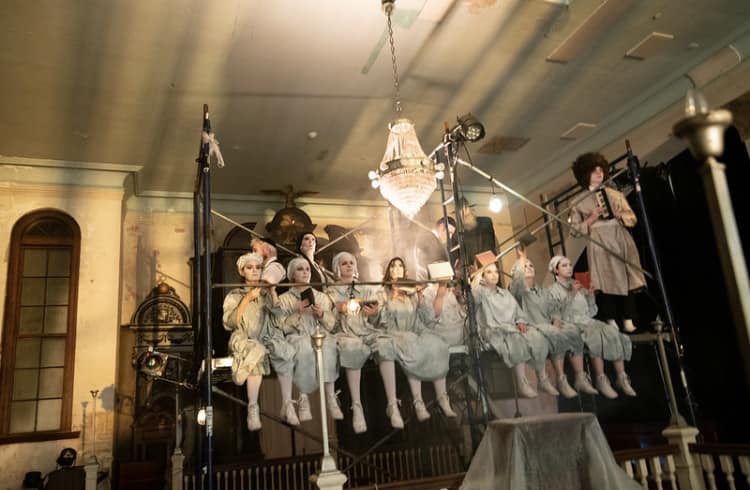
Set in the iconic and authentic 105-year-old Vilna Shul, Boston’s only surviving synagogue built by and for late 19th/early 20th century immigrants, Golyak creates an otherworldly environment that sucks the audience right in. We are greeted by tiers of metal scaffolding that rise almost to the ceiling in the center of the building, towering above the pews, which have been pushed back along the perimeters. Animated sheets of opaque plastic hang from the frames, dancing ghost-like as strobes, disembodied voices and the sound of dripping water create a multi-sensorial microcosm.
Even if we’re not sure exactly where we are or exactly what is going on, one thing is clear: this will be an extraordinary evening.
The play’s plot is tricky for 21st-century theatergoers to intuit, yet it is essential background to fully appreciate Golyak’s extraordinary vision and interpretation.
In a nutshell, S. Ansky’s 1914 play relates the story of Leah, a young bride possessed by a dybbuk (a malicious spirit believed to be the soul of a dead person stuck between earth and heaven). Yet this dybbuk is anything but malicious; he is Khonen, a poor Yeshiva student who grew up with Leah and loves her.
Only alluded to at the end of the play is a critical piece of backstory (the 1937 Yiddish-language Polish film adds this as an introductory scene). Sender, Leah’s father, and Nisan, Khonen’s father, were close friends whose wives gave birth on the same night. They made a pact that if one had a girl and the other a boy, the two would be betrothed. Nisan drowns shortly after his wife gives birth. Sender, whose wife dies during childbirth, goes on to become a wealthy rabbi.
Years later, Khonen shows up at Sender’s house as a poor yeshiva student, and Sender offers him hospitality. Neither is aware of their underlying connection. Leah and Khonen fall in love, but Sender rejects Khonen, betrothing Leah instead to Menashe, a wealthy nincompoop.
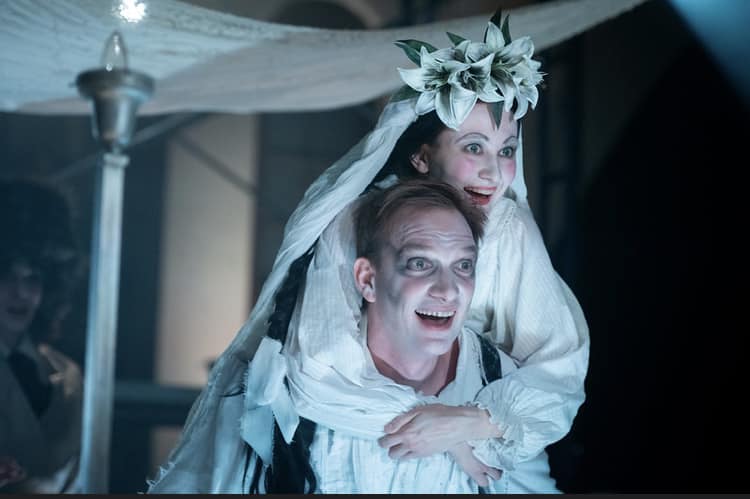
Beside himself, Khonen studies Jewish mysticism (Kabballah) in an effort to alter events by way of magic, even beseeching Satan to help him. He dies before the wedding, returning as a dybbuk who haunts and eventually embodies Leah, possessing her as she stands on the bimah (the altar from which the Torah is read) at her wedding. The ceremony is postponed, and Sender does everything in his power to repossess Leah and unite her with Menashe. After much drama (including a religious exorcism), the two are reunited.
Golyak uses every square inch of the Vilna to astonishing effect. The space behind the pulpit becomes a tiered choir where ghosts (interestingly, all female) act like a Greek chorus. The bulk of the action takes place on and around the Vilna’s bimah, as it does in Ansky’s original script. Strip lighting, handheld firefly-like mini lights, industrial hanging caged bulbs (lighting design by Jeff Adelberd), and spot-on costumes and makeup (Sasha Ageeva) add to the ethereal ethos.
Staging and site notwithstanding, however, it is the extraordinary cast — especially the two leads — who blow this production out of the water.
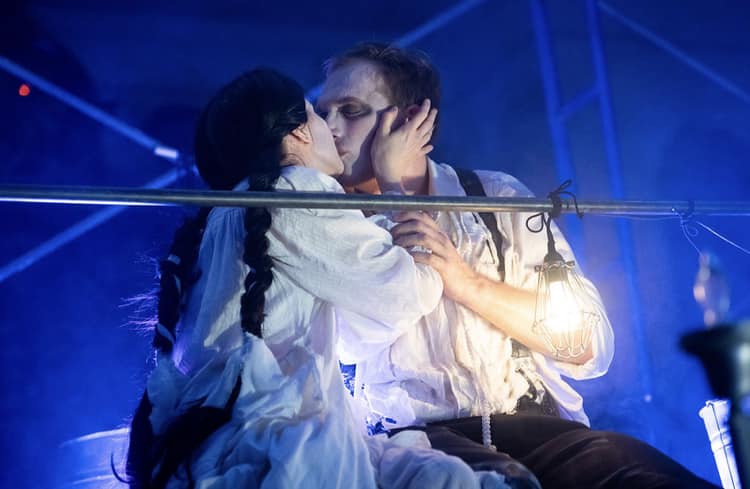
As Khonen, Andrey Burkovskiy, the expatriated Russian actor, is riveting. His lithe physicality belies his large size as he leaps and pirouettes across the scaffolding, barely but intentionally missing hitting his head on the hanging lights and metal beams. The Beetlejuice makeup is extremely effective at imbuing him with a heartbreakingly sad yet potentially menacing demeanor.
Yana Gladkikh, the Russian actress and film director, is equally spellbinding as Leah. A cross between Pierrot and a floppy ragdoll, she runs the gamut from Tinkerbell lissome to Princess Leia fierce. The chemistry and synchronicity between Burkovskiy and Gladkikh is delicate and subtle, and watching them together is a true theatrical treat.
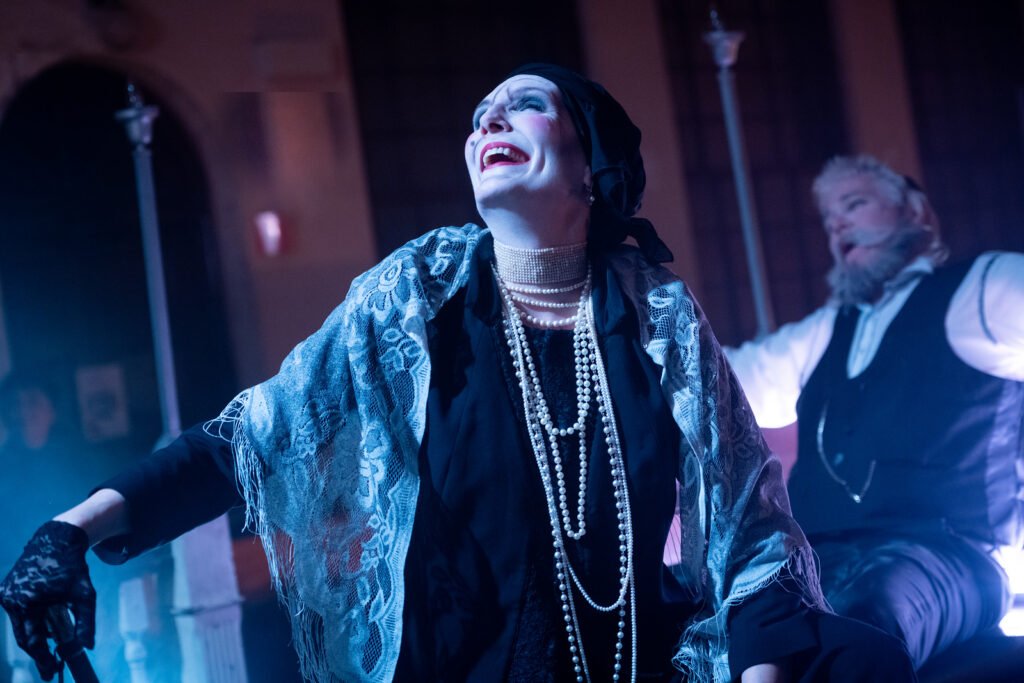
Deb Martin, as Frade, Leah’s paternal grandmother and caretaker, is as opposite an energy as possible. Screeching, cajoling and imperious, she dominates every scene she is in, bringing a countervailing element of melodramatic hysteria and humor to an often somber tale. Like the witch in Hansel and Gretel, she is hunch-backed, skeletal and a force to be reckoned with. You can actually hear her gnashing teeth as she literally chews up the scenery during the exorcism scene. Kudos to Golyak for letting Martin strut her stuff.
The rest of the cast (especially Robert Walsh, the former artistic director of the Gloucester Stage Company, as the overbearing Sender) is splendid. 110 intermission-less minutes is an eternity at some productions; at “The Dybbuk,” they fly by.
“The Dybbuk” is considered a seminal play in the history of Jewish theater, and played an important role in the development of Yiddish theater and theater in Israel. Based on years of research by Ansky, who traveled between Jewish shtetls in Russia and Ukraine, it documents folk beliefs and stories of the 19th and early 20th century Hassidic Jews, who lived during a time of nonstop pogroms in specific areas, outside of which their residency was forbidden.
Ansky’s account of these times and the two suspended, displaced souls trapped between two worlds and tethered to each other and their community is as relevant today as it was over a century ago.
For Golyak, a Ukrainian refugee, the tale is particularly pertinent.
“Isn’t this where we live? As Jews, as immigrants? It’s where we so often have lived as Jewish people for centuries: between worlds. It’s our story – ancient and mystical, the story of our ancestors, but also our story of living in America today,” he said.
It is impossible to recommend it highly enough! Don’t miss it!
For more information and to buy tickets, go to www.arlekinplayers.com

 InSights