In The Huntington’s ‘The Triumph of Love,’ All’s Fair in the War Between Reason and Romance

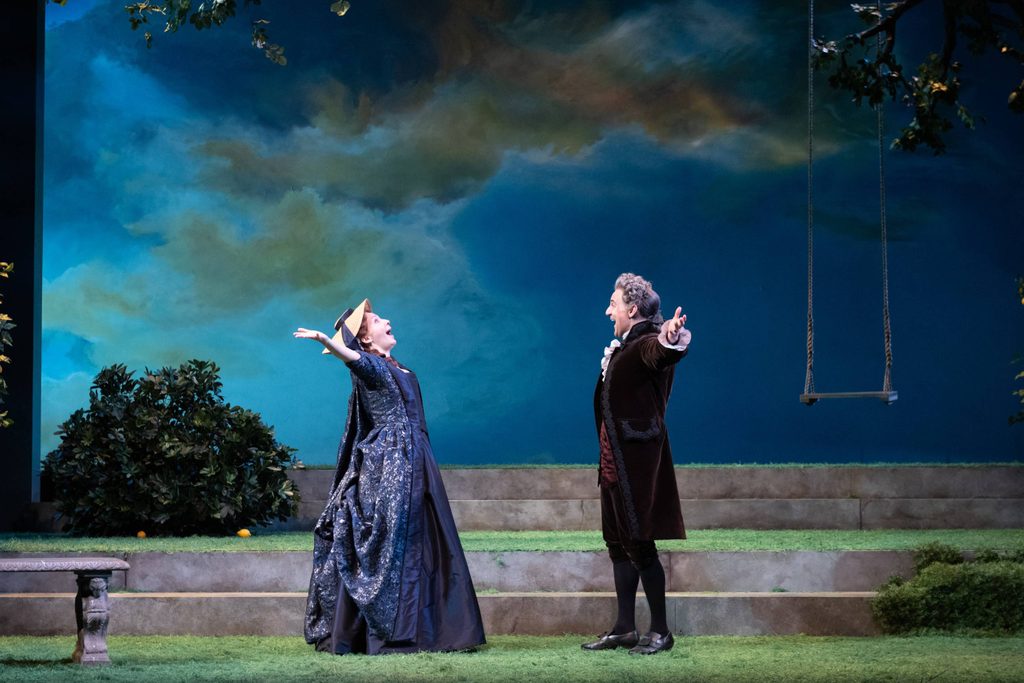
Marianna Bassham, Nael Nacer in Huntington’s ‘The Triumph of Love’. Photos by Liza Voll

By Shelley A. Sackett

Pierre Carlet de Marivaux’s “The Triumph of Love,” which premiered in 1732 and is at The Huntington through April 6, is like a trifle dessert, with light spongey layers of raucously funny deceptions, disguises and mistaken identities soaked in a sherry-spiked pastoral period set design. Instead of the traditional alternating tiers of sweet jams and custard, however, Marivaux has substituted a bitter concoction of calculated cruelty and manipulation. The end result is a sugar-coated confection that leaves a very bitter taste in the mouth.

Stephen Wadsworth’s definitive and sparkling translation is chock-full of clever double entendres and contemporary plays on words that prevent Marivaux’s commedia dell’arte from getting stuck in 18th-century French linguistic mud.

A hectic first scene gives the lay of the land. We meet two women, loosely disguised as men, in the country retreat setting of a manicured garden. Princess Léonide (an excellent Allison Altman) and her maid, Corine (Avanthika Srinivassan), quickly bring the audience up to speed on who they are, why they are there, and what they plan to accomplish.
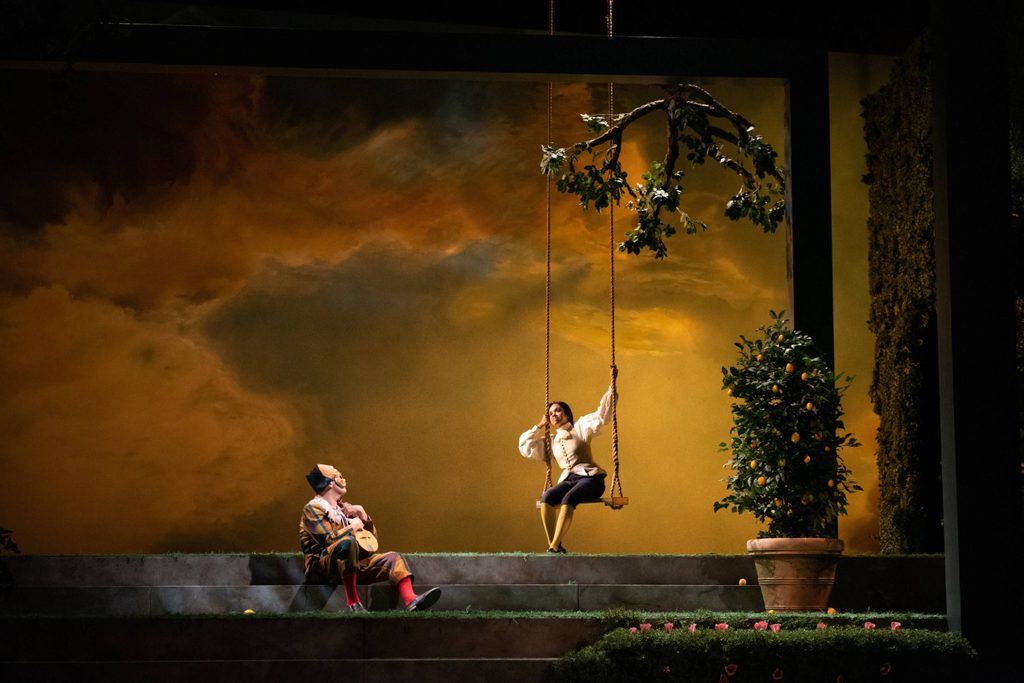
Vincent Randazzo, Avanthika Srinivasan

Léonide (incognito as the man Phocion) is the princess of Sparta, but only because her uncle stole the throne from the rightful king (who, to make matters more complicated, had kidnapped the rightful king’s mistress). While on a walk in the woods, Léonide spotted the young man Agis (Rob Kellogg), who lives in the household of the old philosopher Hermocrates (a terrific Nael Nacer) and his spinster sister, Léontine (Marianna Bassham, perfectly cast). It turns out that Agis is the true prince and rightful heir to the Spartan throne. Hermocrates, a strict follower of Enlightenment tenets, rescued him and raised him in seclusion to embrace the safety of rational reason and spurn the dangers of the kind of romantic love that destroyed his parents.

Undaunted, Léonide vows to win Agis’ heart and restore him to power. First, though, she has to get past the brother and sister team of Hermocrates and Léontine. No problem for our wily and ingenious princess; she will simply get them both to fall in love with her so she can then use them in her pursuit of her true love.

All of which, through a series of tricks, treacheries and outright cons, she accomplishes. Employing a variety of alter egos and all her charm and quick-tongued-ness, she turns the heads of the stuffy Hermocrates, his desiccated old maid sister, and his virginal charge.
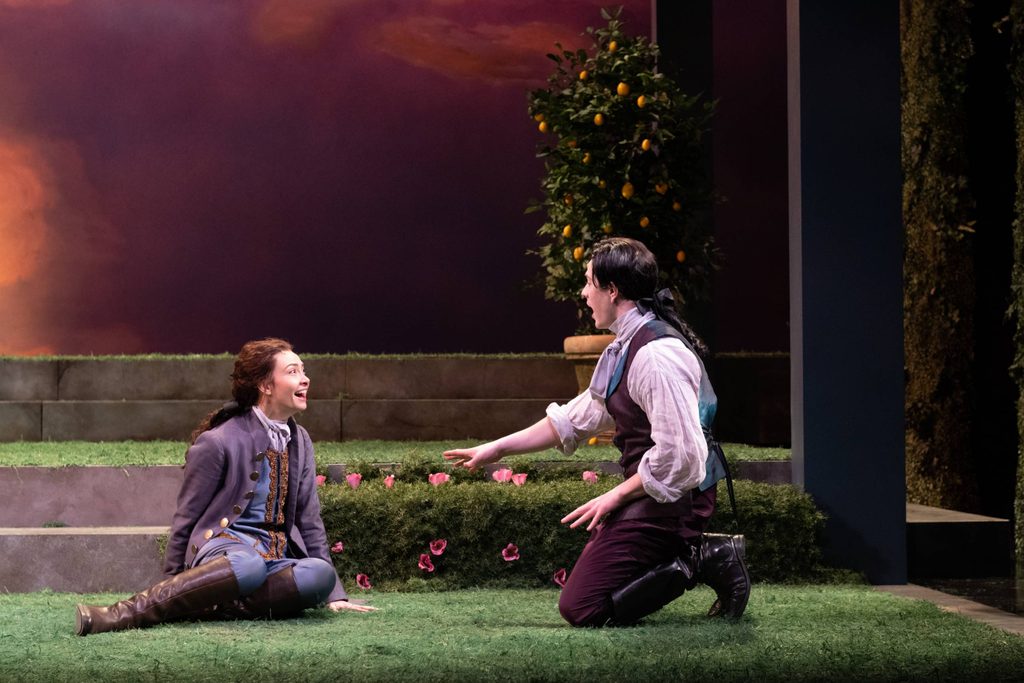
Allison Altman, Rob B. Kellogg

On its surface, ‘A Triumph of Love’ explores and ridicules the sharp lines drawn between the Enlightenment’s Age of Reason and the subsequent Romanticism movement, which focused instead on emotion, individualism, and the sublime. There are some great supporting characters, including Hermocrates’ servant, Harlequin (a delightfully spry Vincent Randazzo), and gardener, Dimas (Patrick Kerr), and some corny, rim-shot humorous one-liners. (“They are dresspassers,” Harlequin says of Léonide and Corine, and “Digression is the better part of a valet.”) Harlequin and Dimas are breaths of fresh air, and Randazzo’s entr’acte solos are wonderful diversions.

There is also a lot of meaty, thought-provoking dialogue about the meaning of life, liberty and the pursuit of happiness, especially when it comes to love. Marivaux isn’t afraid of exposing his characters’ seamier sides, and he asks some tough, smart questions about complicated philosophical issues.
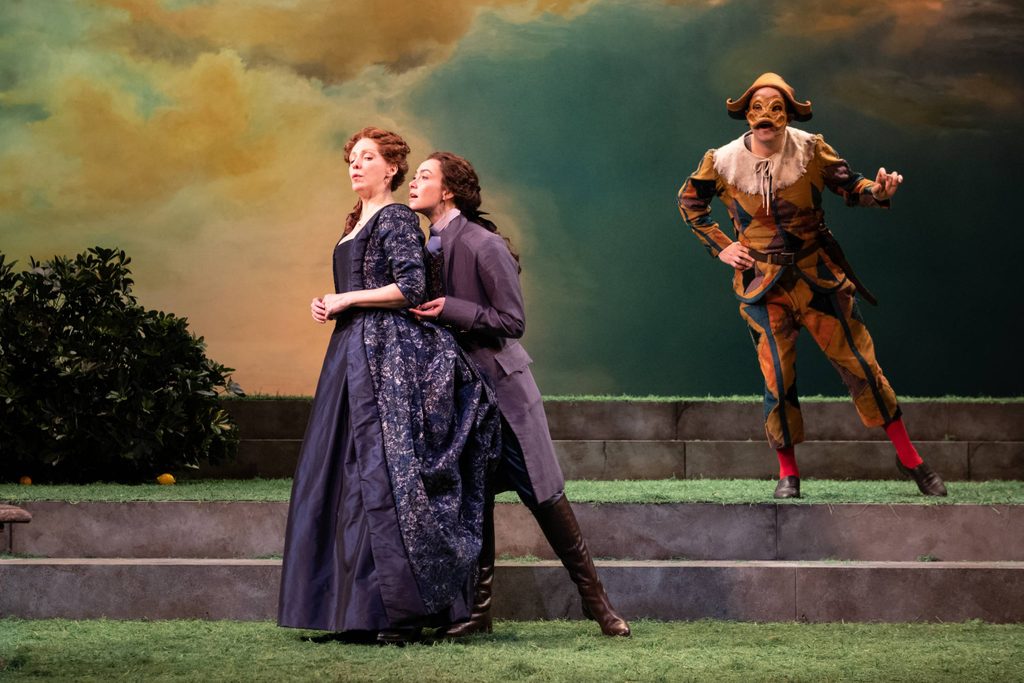
Bassham, Altman, Randazzo

Junghyun Georgia Lee’s classically elegant set and costume designs are spot on, as is Tom Watson’s hair, wig, and makeup design (special kudos for Nacer’s transformed pate!). Although the first act drags a bit, director Loretta Greco (and, therefore, her cast) find their footing in the second act, which flows more easily and naturally. As Léonide, Altman is a triumph, which is fortunate since she dominates nearly every scene during the production’s 135 minutes (one intermission). She never ceases to surprise and engage, no matter how contrived and repetitive the ruse, a masterly feat to be sure.

Yet, for all the romping and spoofing, there is an undeniable nastiness reminiscent of “Les Liaisons Dangereuses.” To try to change the minds of those stuck in the rigid rules of reason and logic, and advocating for a life of feeling and love by engaging in honest debate, is one thing. But proving your point that a life of passion is not only possible but preferable by tricking people to fall in love with you and then discarding them is just plain mean. Awakening a frozen heart to feeling and then condemning it to a life of philosophy without love not only proves the point that love is self-serving, hazardous and risky; it also raises an even bigger and more timely issue: can nefarious means ever justify the ends?

‘The Triumph of Love.’ Written by Pierre Carlet de Marivaux. Adapted by Stephen Wadsworth. Directed by Loretta Greco. Scenic and Costume Design by Junghyun Georgia Lee. Hair, Wig, and Makeup Design by Tom Watson. Lighting Design by Christopher Akerlind. Composer and Sound Design by Fan Zhang. Presented by The Huntington Theatre, 264 Huntington Ave., Boston through April 6, 2025.

For more information, visit https://www.huntingtontheatre.org/whats-on/the-triumph-of-love/

‘Prayer for the French Republic’ chronicles generations of antisemitism

Carly Zien, Amy Resnick, Will Lyman and Joshua Chessin-Yudin. | PHOTO T Charles Erickson

By Shelley A. Sackett

Nothing crystallizes millennia of antisemitism like the Martyrology Service during Yom Kippur afternoon service. “Why are we so hated?” “Can anyplace ever be truly safe?” and “Where will be next on this list?” we can’t help wondering.

As if on cue, the Huntington Theatre’s season opener speaks to these questions and more with Joshua Harmon’s exceptional “Prayer for the French Republic,” winner of the 2022 Drama Desk Outstanding Play Award. Under Loretta Greco’s razor-sharp direction, Harmon’s themes of antisemitism, assimilation, family, freedom, identity, and fear come to life.

Set in Paris in 2016-17 and 1944-46, “Prayer” follows five generations of Jewish piano sellers. Marcelle Salomon Benhamou, the current matriarch, her husband Charles, and their children, Daniel, 26, and Elodie, 28, are the limbs of the original Salomon family tree.
The play opens with house lights up as Patrick, the play’s narrator and Marcelle’s brother, addresses the audience. His eye-contact and hands-in-trousers-pockets ease establish rapport and immediacy. “What is the beginning of a family?” he asks as he strolls across a set that will represent both 1944 and 2016. “And what,” he doesn’t ask but seems about to, “is its end?”

Abruptly, the calm evaporates. We are in the Benhamou apartment, where Marcelle (the sublimely talented Amy Resnick) is mid-sentence, explaining her convoluted genealogy to Molly, an American cousin who has just arrived to spend her junior year abroad. Only one thing seems clear: Marcelle’s Ashkenazi family has been rooted in French soil for centuries.

Just as Molly sort of gets it, Charles (the always amazing Nael Nacer) bursts through the front door with Daniel, who has been attacked by a gang of antisemitic thugs. Daniel’s face is bloodied, but he is nonplussed. His parents are apoplectic.

“How many times have I begged you to wear a baseball cap?” Marcelle pleads. Daniel teaches at a Jewish school and wears a kippah. She urges her son to acknowledge and adapt to the danger he invites by advertising his religion in a world where antisemitism and fascism are on the rise. What she doesn’t do is entertain any thought of leaving France.

Charles’ reaction is more flight and fright than fight. He has walked this walk and knows where it can lead. He and his North African Sephardic Jewish family have lived in diaspora since antisemitism forced them to flee Algeria in the 1960s.

“It’s the suitcase or the coffin,” he says. “I’m scared. Something is happening.” This wandering Jew is tired of living at the whim of host countries. He wants to go “home.” He wants to move to Israel.

Harmon quietly relocates us to 1944 (Andrew Boyce’s set makes this seamless), where we meet Marcelle and Patrick’s great-grandparents. They sit in their comfortable apartment, wondering what has happened to the rest of their family. Miraculously, they were able to remain in Paris during the war after the Nazi sent to deport them took pity on their age and left them alone. They even kept their piano store.

The rest of the play vaults between these two time periods, connecting them with the overarching question: When is the tipping point between suitcase and coffin? When is it best to leave, even if one’s family has been there for centuries and no other place will ever feel like home?

“You have to trust your instincts,” Charles implores. “It’s all you have.”

Writing cutting, funny, fast-paced, and well-researched dialogue that tackles difficult, uncomfortable topics is one of Harmon’s many attributes. His humor is often dark and our laughter is tainted with discomfort, but he wields his pen judiciously and always hits his introspective mark. He expertly uses Elodie (an electrifying Carly Zien) as his trademark firebrand mouthpiece, and her show-stopping monologue deserves a standing ovation.

Harmon doesn’t ignore the question of whether Israel’s politics have changed our feelings about it being a home for all Jews. Conflating Israel and Judaism has become painfully unavoidable. When Charles expresses his discomfort at reciting “A Prayer for the French Republic” during services, it’s hard not to relate.

Harmon is not pessimistic. We don’t pray to what is, he implies, but for what is not. “What is a prayer but speaking out loud to hope?” a character asks. Yet, can we really call a country whose politics marginalize who we are “home?” By ending “Prayer” with the cast belting out the French anthem, “La Marseillaise,” instead of Israel’s “Hatikvah,” Harmon’s answer, at least for now, seems to be yes.

The play runs through Oct. 8 at the Huntington Theatre, 264 Huntington Ave. Visit huntingtontheatre.org.

It’s All in the Family in Huntington’s Spectacular ‘The Lehman Trilogy’

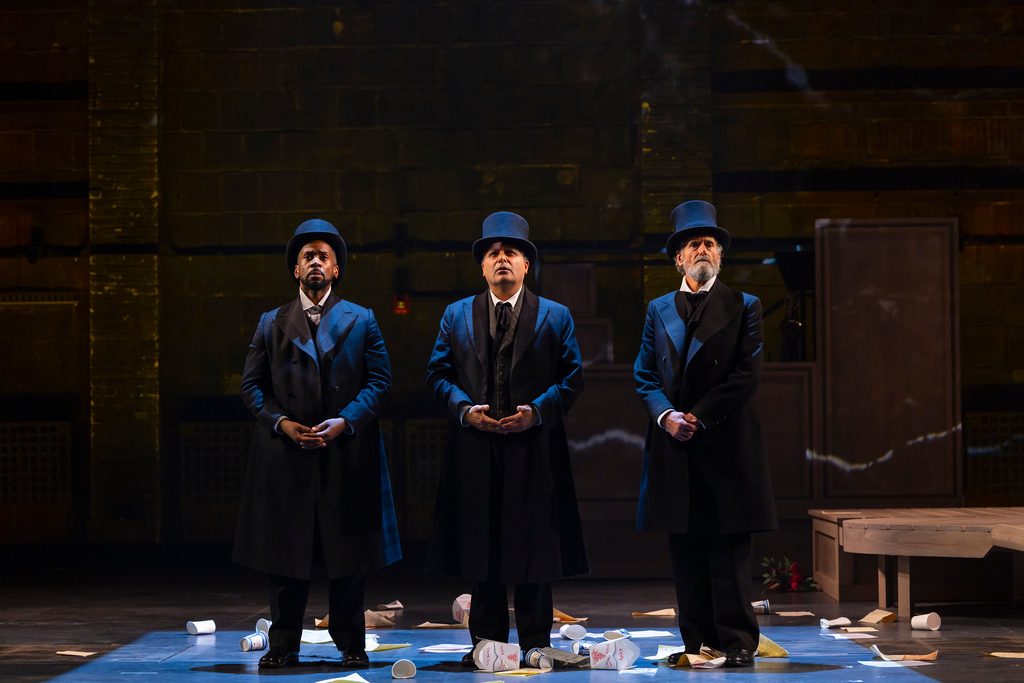
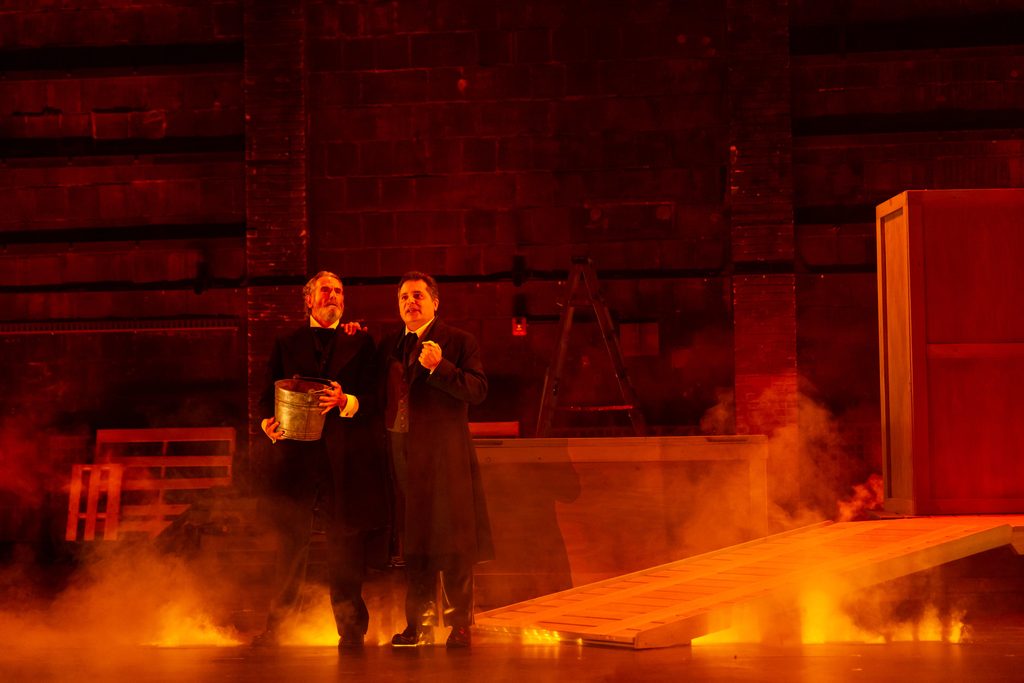
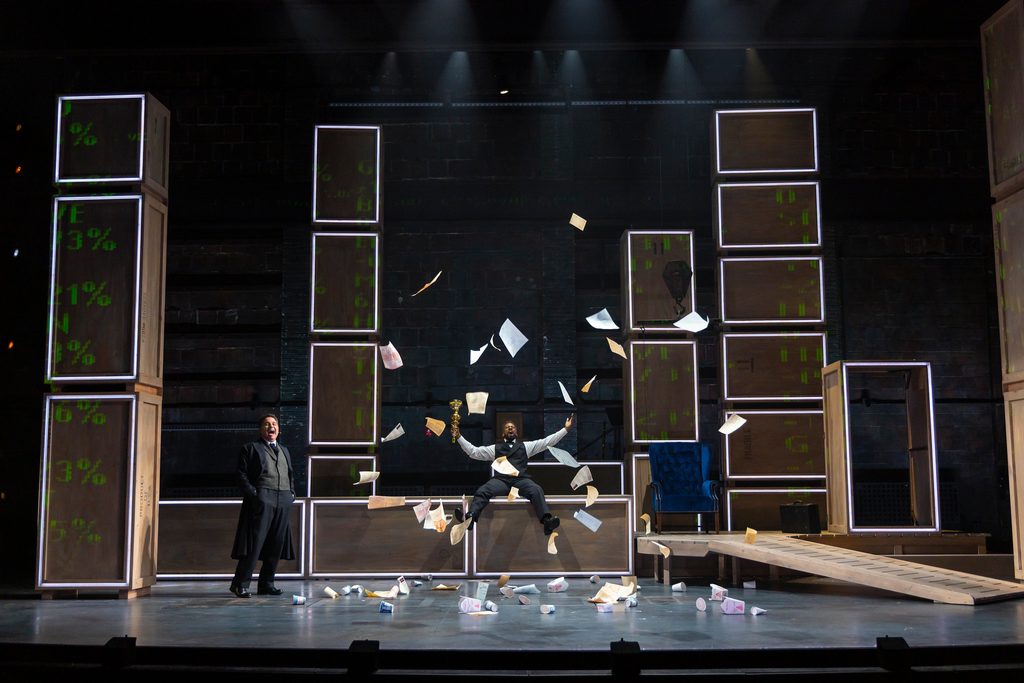
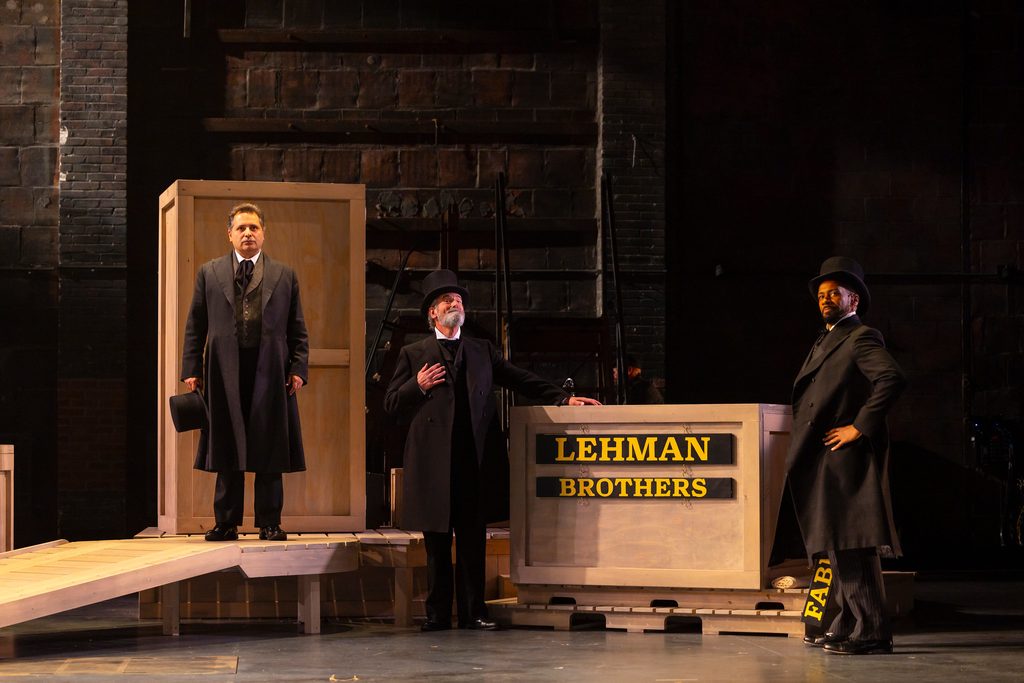
Joshua David Robinson, Firdous Bamji, and Steven Skybell in ‘The Lehman Trilogy’ at the Huntington. Photos by T. Charles Erickson

By Shelley A. Sackett

A lone and mournful clarinetist (Joe LaRocca) wanders across the stage of the Huntington’s theatrically astonishing “The Lehman Trilogy,” inviting comparisons in tone and content to the spirited drama “Fiddler on the Roof.” Steeped in ritual and Judaism, both stories trace what happens to a family when political oppression forces it to leave home, leading most of its members to emigrate to America.

For the dairyman Tevye ben Shneur Zalman, tradition and God are immutable and one; he will walk the straight and narrow walk wherever he wanders. For the Lehman brothers — and especially for their American progeny — tradition and God are moving targets, luxuries that morph with the exigencies of assimilation.

Yet the unobtrusive but ever-present LaRocca and his plaintive clarinet, saxophone, and flute melodies (original music by Mark Bennett) are constant reminders of the Lehmans’ past and the threads that, though frayed and denied, they share with Tevye and his ancestors.

“The Lehman Trilogy,” winner of the 2022 Tony Award for Best Play, assumes the 2008 demise of Lehman Brothers, the colossal bank whose collapse helped trigger the global Great Recession, is well known. Instead of rehashing that final piece of the story in detail, it wisely spends the bulk of its three and a half hours (two intermissions) chronicling the lesser-known details of the enterprise’s birth and extraordinary upward trajectory. 

The action opens on 9/11/1844 with the New York arrival of 21-year-old Henry (Steven Skybell, the standout in a cast of standouts) from Rimpar, Bavaria. He immediately sets sail for Mobile, Alabama, with little but his experience in trade and finance and his skill with cloth. Buoyed to be in the American South, where Jews are allowed to own land and where the caste system is built on race rather than religion, Henry quickly makes enough money as a peddler to fund his move inland to Montgomery, where he settles down and opens a dry goods store. Younger brothers Emanuel (Joshua David Robinson) and Mayer (Firdous Bamji) soon follow to this promised land of milk and honey and cotton where “a man can live to work, not work to live.”

Absent the violence, restrictions, and family restraints of Rimpar, the brothers create their own American version of the Lehman myth, tradition, and legacy. Their unbridled ambition, ingenuity, and taste for fortune lead them to adapt to the times and fill any gap they spot. 

The first Lehman Brothers sign is hung on a dry goods storefront that starts out selling fabrics and cotton and ends up as a powerful monopoly that buys raw cotton from antebellum plantations and resells it to factories in the North. The brothers ingeniously invent the profession of being a middleman, making their first fortune off the back of an economy dependent on slavery.

They also dip their toes into the business that will fuel their rise and fall. By offering credit to planters short of funds, they become cotton brokers, the first stage in their eventually becoming an investment bank.

Only after the cotton economy’s collapse in the wake of the Civil War do we hear a word of admonition or conscience about their connection to slavery (word is the lines were only added in response to criticism), and those are spoken by only one character, a local doctor.

“Everything that was built here was built on a crime,” he tells the brooding Mayer. “The roots run so deep you cannot see them, but the ground beneath our feet is poisoned. It had to end this way.”

Like a phoenix rising from the ashes, Lehman Brothers transforms and reinvents itself, helping the South as it reconstructs. Over the decades, it will survive two world wars, the 1929 stock market crash and the Great Depression, mutating from a brokerage house to an investment bank and finally to architects of subprime mortgages. The brothers relocate to New York and create the Cotton Exchange, Coffee Exchange, and Stock Exchange, all admirable strokes of business genius which pad their own pockets handsomely.

Structured in three parts, the play follows the Lehman family through 164 years of successive generations. We ride shotgun on the journey that proves even more tragic for the fabric and integrity of the heritage the three brothers so revered. Along the way, ethics, decency, and loyalty are qualities that vanish from the Lehman family tree, especially in the wake of the 1960s creation of a trading division run by non-family members. From boardroom savagery to talk of how to get people to buy things they don’t want with money they don’t have, the apples fall far, far from the ancestral tree.

And therein lie the bones of the play and the attraction of its world. At heart, this is a very human story about real, complicated people living real, messy lives. The story’s true tragedy and greater lesson is to be found in the degradation and demise of their familial — rather than financial — legacy.

When we first meet Henry, Emanuel, and Mayer in the 1840s, they are untarnished, wide-eyed boychiks, still tethered to their religious and family values. We bond with them. We root for them. Most all of, we care about them.

Henry is funny and sympathetic, his guilelessness rendering him accessible and charming. Mayer and Emanuel elicit similar reactions. When their children and grandchildren become characters from “Succession,” we cut them a little slack because we knew their parents and grandparents. Although we’re glad they’re not around to witness the havoc they wrought, we miss them.

Fleshing out this compelling story is the real reason “The Lehman Trilogy” is in that rare not-to-be-missed category: the breathtaking three actors (the entire cast!) who switch genders and ages to portray a score of characters. Starting out as the engaging Henry, Skybell is a delight as a tightrope walker, a crusty, old rabbi, a flirty divorcée, and others. Bamji is no less extraordinary as the youngest (and patronized) brother Mayer. His acting chops are on full display as the ruthless Bobbie, a blushing bride, a pouty toddler, and more. As the steady, stalwart middle brother Emanuel, Robinson clearly enjoys the looser reins when playing the later Lehman clan members and their gang of motley plunderers.

Equally praiseworthy are Perloff’s razor-sharp direction (the wrecking ball pendulum as 2008 draws nigh is brilliant), Brown’s efficient yet thrilling set, and Oi-Suk Yew’s use of projected images.

Much has been penned complaining about the play’s underemphasis on the role slavery played in the Lehmans’ initial success and the short shrift given to the firm’s 2008 nosedive crash and burn finale. My take is that these were not intended as deliberate snubs. Rather, they were omitted because they were peripheral to playwright Massini’s core purpose: to allow us a peek through the keyhole at the tale of three German Jewish brothers from Bavaria and the way they took America by storm.

The resulting epic — intimate and engaging — is a nonjudgmental study of the personalities, relationships, and events that shaped this one family’s shifting definition of the American dream.

Don’t be put off by the play’s length. The story is so engrossing, the production (and acting!) so remarkable that more than one patron was overheard commenting that they wished it had been even longer!

‘The Lehman Trilogy’ – Written by Stephano Massini and Adapted by Ben Power. Directed by Carey Perloff. Scenic Design by Sara Brown; Projection Design by Jeanette Oi Suk-Yew; Costume Design by Dede Ayite; Lighting Design by Robert Wierzel; Original Music by Mark Bennett; Co-Sound Design by Mark Bennett and Charles Does. Presented by the Huntington Theatre, 264 Huntington Ave., through July 23.

For tickets and information, go to: https://www.huntingtontheatre.org/whats-on/lehman-trilogy/