“Prayer for the French Republic” Tackles Existential Issues with Humor, Grit and Gravitas

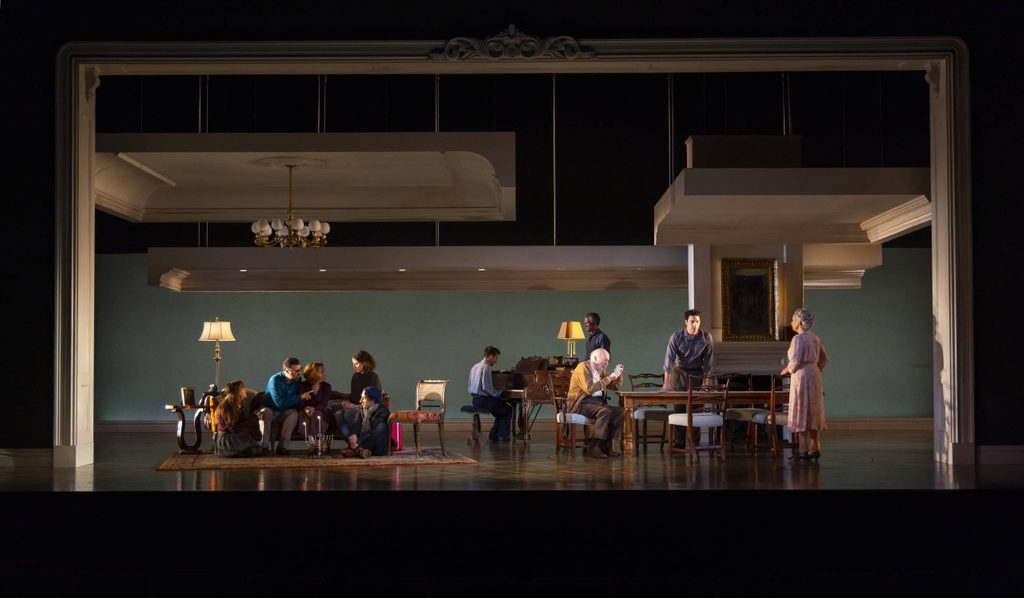
Cast of The Huntington’s ‘Prayer for the French Republic’.  Photo by Nile Hawver.

‘Prayer for the French Republic’ – Written by Joshua Harmon. Directed by Loretta Greco. Scenic Design by Andrew Boyce. Costume Design by Alex Jaeger. Lighting Design by Christopher Akerlind. Sound Design and Composition by Fan Zhang. Presented by Huntington Theatre, 264 Huntington Ave., through October 8.

By Shelley A. Sackett

Playwright Joshua Harmon has a gift for tackling important, profoundly challenging and topical subjects and, through sheer brilliance of characters and dialogue, creating intimate and accessible theater that both rivets his audience and leaves them in a standing ovation of thunderous applause.

He did it with “Bad Jews,” “Admissions,” and “Significant Other,” which Boston theatergoers had the good fortune to see at SpeakEasy Stage Company. Thanks to the Huntington Theatre’s season opener, the 2022 Drama Desk Outstanding Play Award-winning “A Prayer for the French Republic,” they have the opportunity to experience this supremely talented writer’s latest and most ambitious project.

And experience it they should.

Under Loretta Greco’s razor-sharp direction, the 11-member cast masterfully brings Harmon’s themes of antisemitism, assimilation, family, freedom, identity and fear — to name a few — to life. Despite its three-hour running time (one intermission), the fast-paced and sharp-witted dialogue makes the time fly by.

Set in Paris in 2016 and 1945, the play follows five generations of Jewish piano sellers. Marcelle Salomon Benhamou, the current matriarch, her husband Charles and their children, Daniel (26) and Elodie (28), are the contemporary members of the original Salomon family. Hers is a complicated and intricate family tree, full of twists and turns and bent and broken branches.
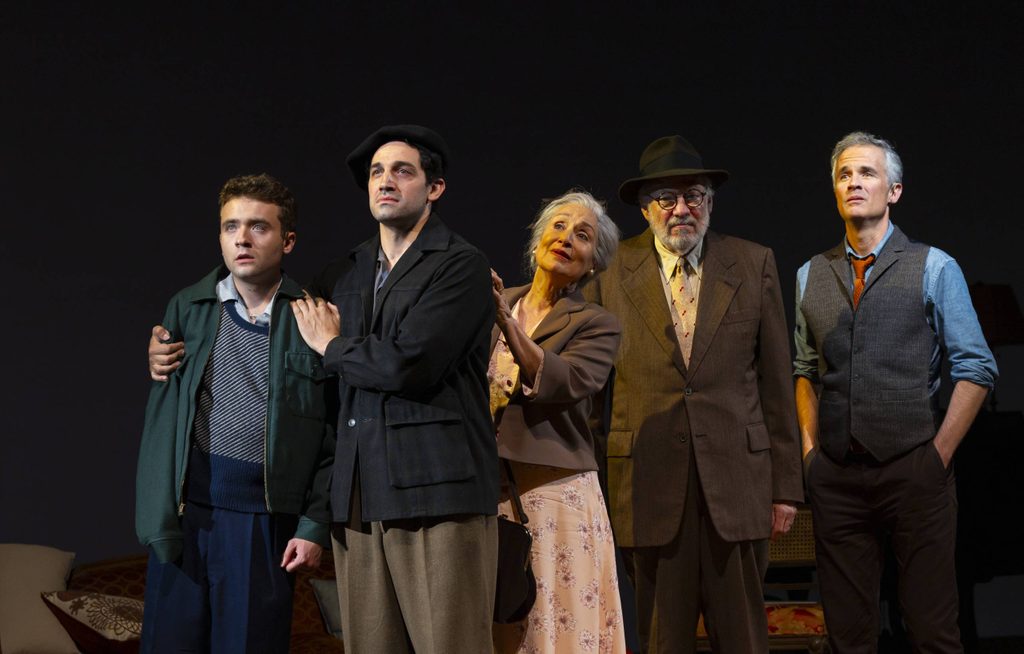
Jesse Kodama, Jared Troilo, Phyllis Kay, Peter Van Wagner, Tony Estrella

The play opens with house lights up as Patrick (Tony Estrella), the play’s narrator and Marcelle’s brother, addresses the audience. His eye contact and hands-in-trousers-pockets ease establish rapport and immediacy. “What is the beginning of a family?” he asks as he strolls across a set that will represent both 1945 and 2016. “And what,” he doesn’t ask but seems about to, “is its end?”

The calm is broken by a thrust into the Benhamou apartment, where Marcelle (the sublimely talented Amy Resnick) continues Patrick’s train of thought by explaining the family genealogy to a dumbfounded guest, Molly (Talia Sulla), a naïve and distant sort of cousin from America who is spending her junior year abroad in Paris. Molly (like the audience) tries to absorb the details but is thankful when Marcelle repeats the accounting.

Jumping to the present, Marcelle explains that Daniel is their religiously observant son. Daughter Elodie has been struggling with mental health issues and is, well, Elodie. Molly nods in mute agreement.

Just as Molly (and we) sort of get it, Charles (the always amazing Nael Nacer) and Daniel (Joshua Chessin-Yudin) burst through the door. Daniel, who teaches at a Jewish school and wears a kippah (Jewish head covering), has been attacked by a gang of antisemitic thugs. His face is bloody, but he is nonplussed. His parents are apoplectic.

“How many times have I begged you to wear a baseball cap?” Marcelle pleads, comparing his refusal to hide the kippah to painting a target on his back that screams, “Here I Am.” She urges her son to wake up to the danger he invites by advertising his religion in what is France’s current climate, where Holocaust deniers and Nazi sympathizers hold more sway. What she doesn’t do is entertain any thought of fleeing the country where her family of Ashkenazi ancestors has lived for centuries.
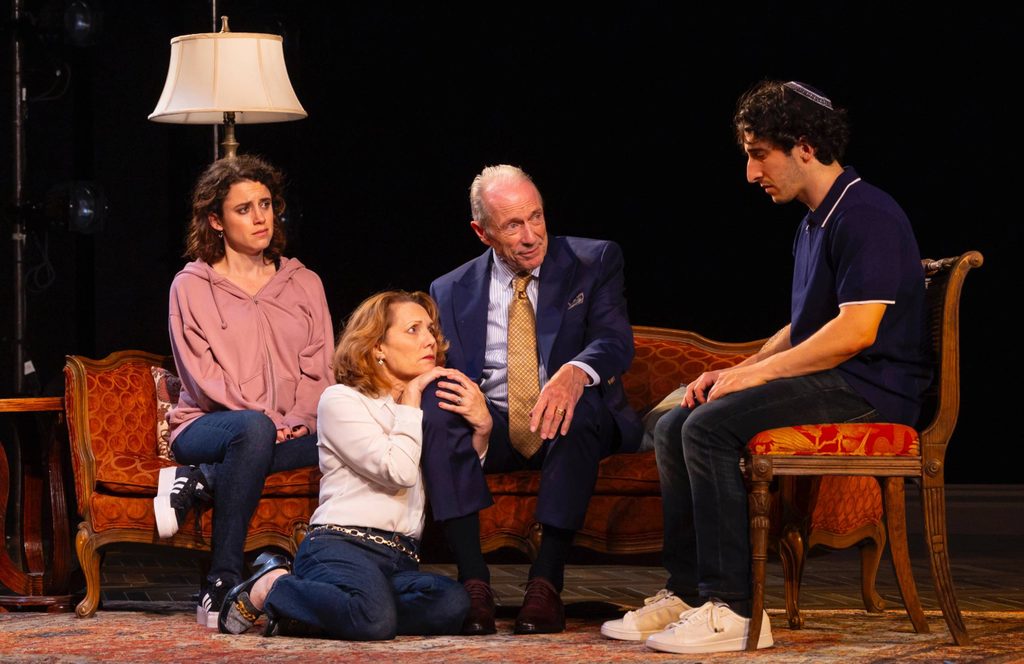
Carly Zien, Amy Resnick, Will Lyman, Joshua Chessin-Yudin

Charles’ reaction is different. He has seen this before and knows where it can lead. His North African Sephardic Jewish ancestors have been living in diaspora since they were forced to flee their home in Algeria in the 1960s. 

“It’s the suitcase or the coffin,” he says. He has reached his limit. He wants to go “home.” He wants to move to Israel. It may be unsafe there, too, but at least everyone is unsafe, not just Jews.

The family’s real firebrand and deliverer of Harmon’s celebrated monologues and dialectic analyses is Elodie (an electrifying Carly Zien, who steals every scene she’s in). While she may present as disheveled, her lines of logic and fact-based arguments are sources of encyclopedic knowledge and awe. She is not mentally ill so much as she is reacting in an unhinged way to a world that has come unhinged. (Her interaction with Molly at a bar is worth the price of admission and deserving of a standing ovation).

Harmon then quietly relocates us to 1944 (Andrew Boyce’s set accomplishes this seamlessly and with elegant artistry), where we meet Marcelle and Patrick’s great-grandparents, Irma and Adolphe Salomon (Peter Van Wagner and Phyllis Kay, both charming). They sit in their apartment towards the end of World War II, wondering what has happened to the rest of their family. Miraculously, they were able to remain in Paris during the war after the Nazis sent to deport them took pity on their age and left them alone. They have even managed to hold onto their piano store.

“What do people remember when you’re gone?” narrator Patrick asks the audience, pointing to his forebears. He then tells the story (Estrella really shines here) of how Irma would butter Adolphe’s toast first, and then use what was left to butter her own, in order to make it last longer and hide their dire circumstances from Adolphe. Those tiny, very human details are only one example of Harmon’s many playwriting virtuosities.

Writing cutting, funny, fast-paced and well-researched dialogue is another. The words fly at whiplash speed when the action shifts from 1944 back to 2016, where we pick up where we left off. Daniel and Molly are getting to know each other. (“How did you become religious?” she asks. “I prayed and I liked it, so I kept going,” he replies.)
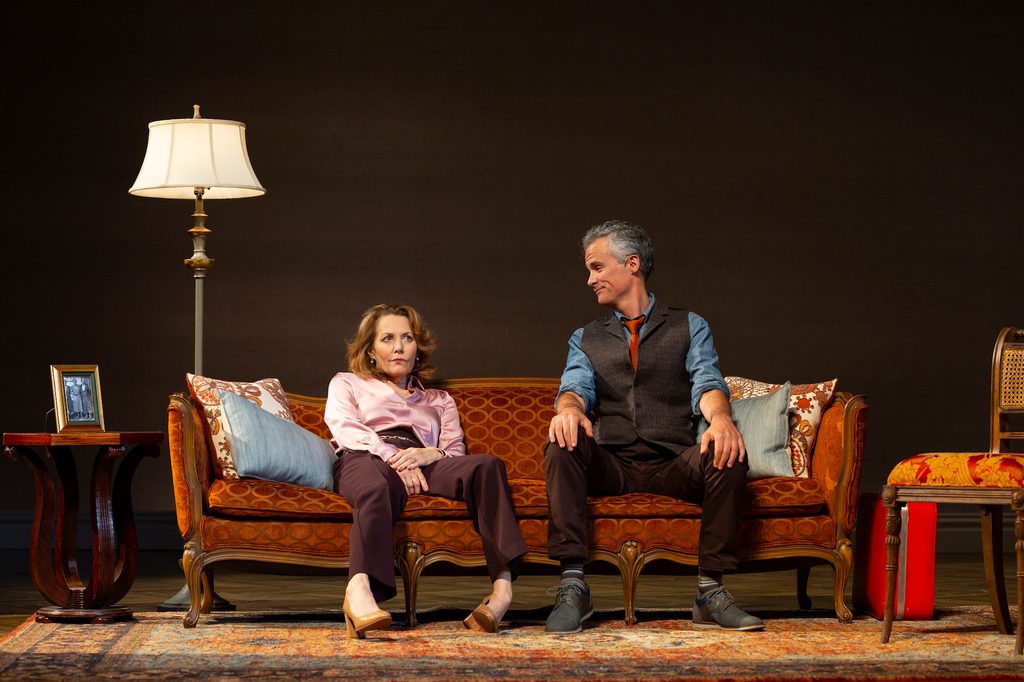
Amy Resnick, Tony Estrella; photo by T Charles Erickson

Charles makes his case for leaving France before it’s too late (“I’m scared. Something is happening,” he confesses). Marcelle, quintessentially French and clinging to control, argues that Jews are never safe. Anywhere. At any time. Jew hatred, which in 2016, with the 2015 Charlie Hebdo and kosher deli shootings in Paris, the rise of the ultra-right in Europe and the election of Trump in America, has been regaining a foothold globally, is just the way it is.

“What is history but a bunch of stuff other people tell you to get over,” Patrick asks when later, with calm, cynicism and a touch of sadness, he gives a matter-of-fact account of the centuries of persecution suffered by Jews at the hands of the French, starting in 1096 with the Crusades.

And yet, France was the first country in Europe to offer Jews the full rights of citizenship in the hope that they would stop acting like a separate nation and assimilate, identifying more as French than as Jews. Making the case for staying put, he alludes to the fact that even the Holocaust couldn’t uproot the Salomon French family tree. Nor did it force them to convert (although he chose to marry a Catholic). They can withstand this comparative blip.

“Prayer for the French Republic” addresses many deeply troubling topics. Why are people obsessed with Israel? Is it appropriate for Jews to be scared? Is it irresponsible not to be? Now that Israel’s internal politics have so radically shifted, is even Israel still safe? Is it really “home?” Are we at the same tipping point where we were right before the Holocaust? At what point do we acknowledge that our world has hit an iceberg and, like it or not, our choices are to jump overboard or go down with the mother ship?

For this reviewer, the most telling moment was the play’s end. Would Harmon come down on the side of staying put in France or moving to Israel? As the cast belted out the French national anthem, “La Marseillaise” instead of Israel’s “Hatikva,” we had our answer.

For more information and to buy tickets, visit https://www.huntingtontheatre.org/
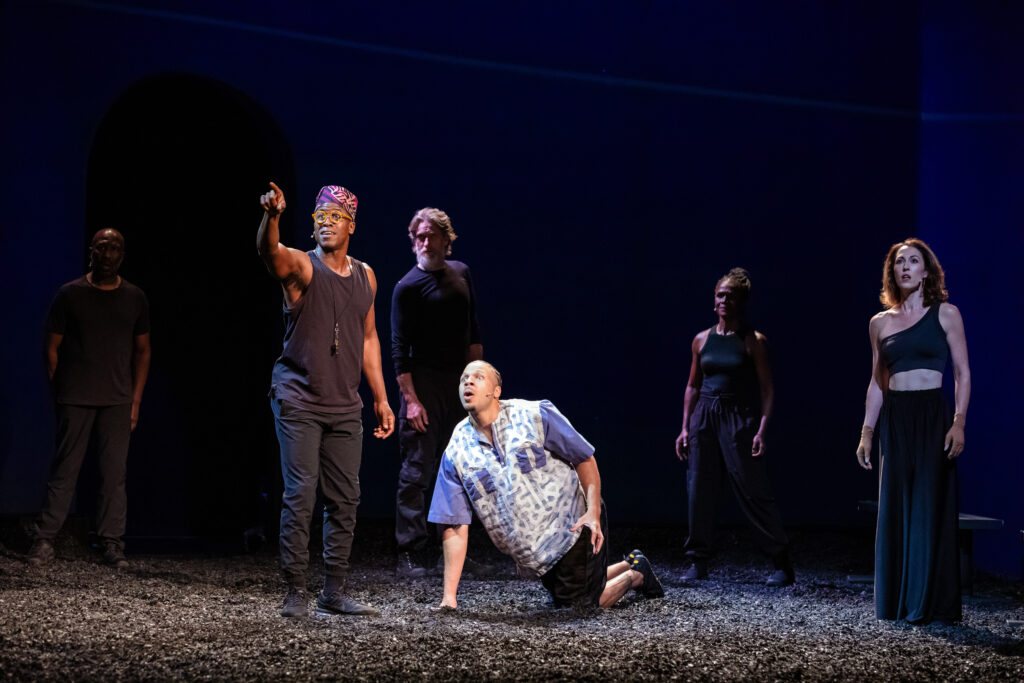
With “The Half-God of Rainfall,” A.R.T. Once Again Breaks New Production Ground

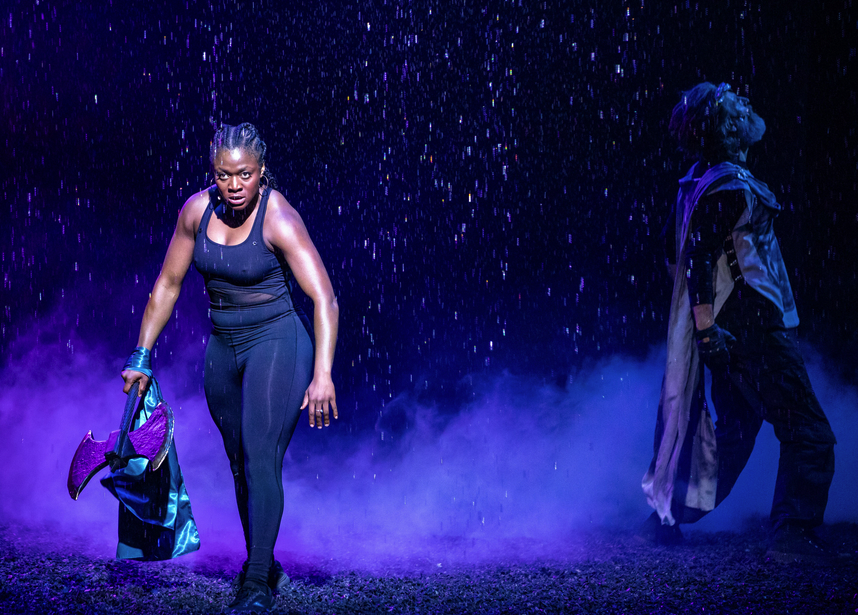
Cast of “The Half-God of Rainfall,” at A.R.T. Credit: Lauren Miller

By Shelley A. Sackett

Will we ever become inured to the other-worldly team at American Repertory Theater and its ability to sprinkle fairy dust on Boston’s theater scene? With “The Half-God of Rainfall,” now in production through September 24, the answer is a resounding “No!”

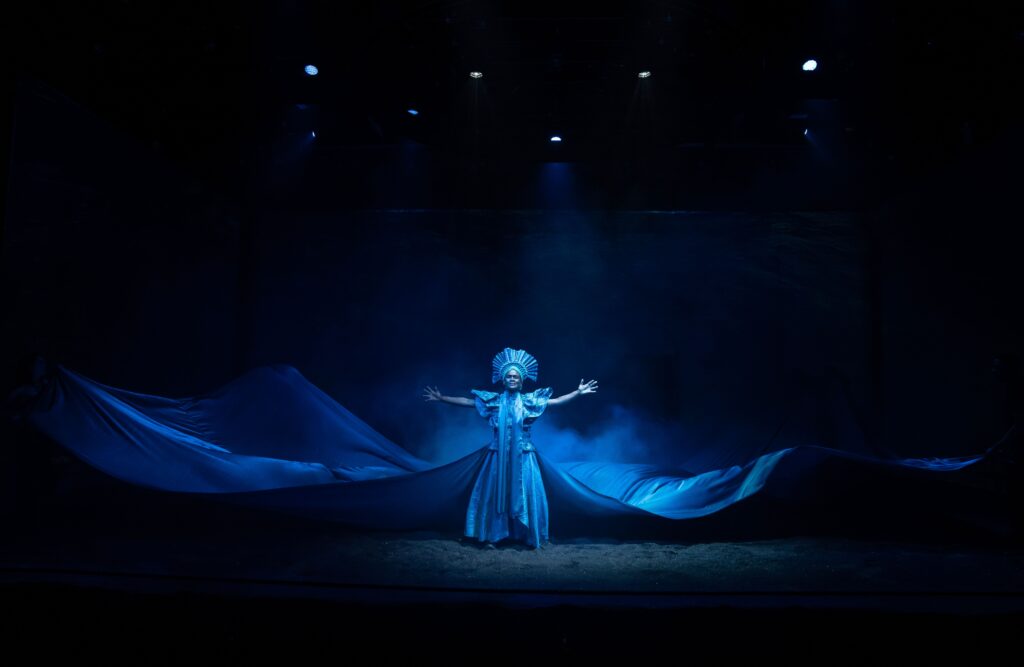
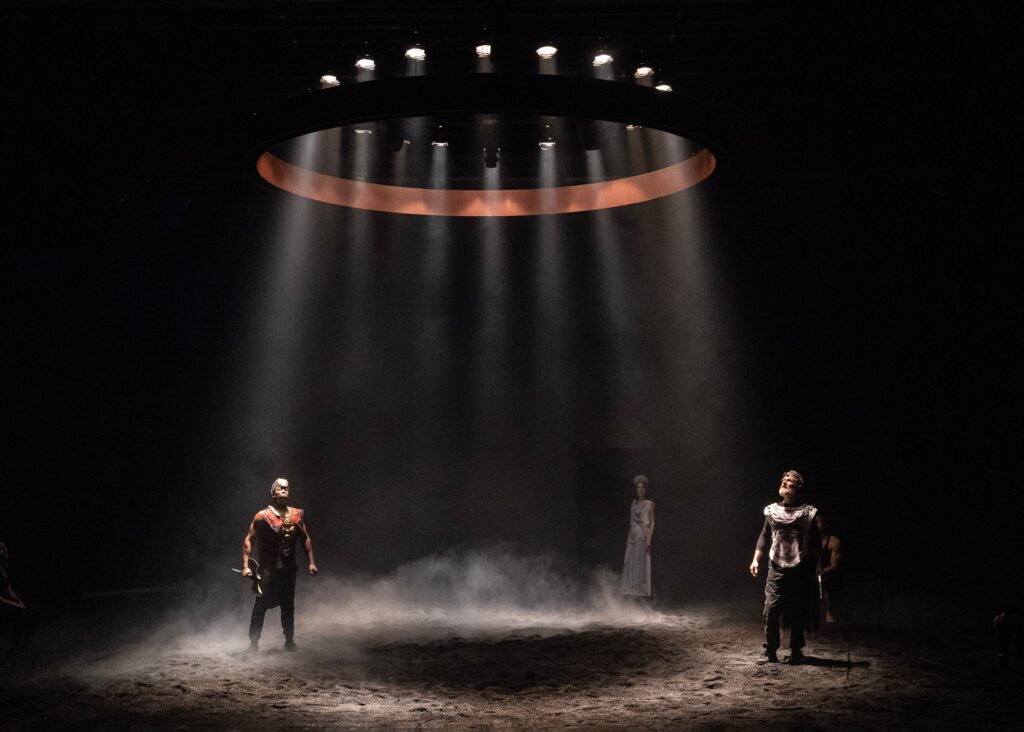
It helps that Nigerian native Inua Ellams’s sinuous play is a masterful blending of unlikely ingredients: Greek mythology and Nigerian Yoruba spirituality, a war between mortals and gods, basketball, toxic patriarchy, white supremacy, female empowerment, and maternal love. Couple that with a script crafted as an epic poem, a stellar cast that works as a seamless ensemble, and breathtaking choreography, lighting, and sound designs, and well, you have all the makings for a night of unparalleled theatrical pageantry.

The scope and ambition of Ellams’s work is staggering.

It’s hard to describe the multilayered and, at times, opaque plot. Using basketball as both ground zero and allegory, Ellams creates a new myth about the half-god, half-mortal Demi (Mister Fitzgerald), born to human Nigerian high priestess Modúpé (Jennifer Mogbock) after she is brutally raped by the Greek titan god, Zeus (Michael Laurence).

Jennifer Mogbock and Michael Laurence

The genesis of the rape is even more chilling. As stand-ins for superpowers, Zeus and Sango (Jason Bowen), Greek and Yoruba gods of thunder, bet on a race. They agree to “boys-will-be-boys” terms as a settlement. The winner gets to take a member of the loser’s world as a prize.

When Zeus wins, he takes Modúpé as his deserved own, to do with as he pleases.

Demi grows up in a poor Nigerian village, gradually becoming aware of his extraordinary abilities to flood the land with the water from his tears and defy gravity with his basketball wizardry. He learns that basketball is more than a sport when he leaves Nigeria for the Golden State Warriors and superstardom. There, he earns the nickname “rainmaker” and rules the courts with his uncanny proficiency.

Yet all is not quiet on Mt. Olympus, where the gods (and especially Zeus) see all. One of the play’s lighter moments is when Nigerian American player Hakeem Olajuwon (Bowen) visits Demi and explains that all the great sports players are demi-gods but that Zeus forbade them from participating in mortal sports after Michael Jordan almost blew their cover by flying on the court. In defiance, Demi sets his sights on the Olympics, daring Zeus to descend from Olympus and stop him.

Examining sports culture and the way it informs and mirrors the best and worst of human behaviors is not all Ellams has up his sleeve, however. At 90 intermission-less minutes, he has ample time to address other meaty themes such as rape and its resultant PTSD, the burden of being a single mother, free will, female solidarity, Black feminism, and the #MeToo movement. And address them he does, with sensitivity, candor, and gusto.

Rather than hammering polemics, however, Ellams weaves important points into the fabric of the plotline by having his characters humanize and personalize them. “What teaches males to take what isn’t given?” Modúpé asks the river goddess Osún (Patrice Johnson Chevannes). Later, she describes how she was able to love her son Demi, despite the fact that his existence was borne of and is a reminder of such pain and trauma. “My body is my body. But my mind – I can’t control it. He (Zeus) took from me control of myself, but he gave me you,” she tells her son, implying that a mother’s love for and connection to her child supersedes all else.

Ellams pens another intriguing exchange between Zeus and Demi as they discuss who is better off, all-powerful gods or mere mortals. Surprisingly, an introspective Zeus shares that even though he fears he (and all gods) could become insignificant to mankind, he is even more threatened by the fact that humans have free will and can choose how to live. As the last free half-god, Demi has one foot in each world; he is half free but also half stuck in Zeus’ world of rules and obligation.

While the play presents challenges in terms of understanding the actors’ accents, hearing their voices and following the entwined and often confusing stories, the actors’ physicality and sheer force of production pyrotechnics provide ample balm. “Half-God” defies pigeon-holing. Part Magical Mystery Tour, part modern dance concert, part art installation, and all ingenious invention, “Half-God of Rainfall” is a must-see for anyone curious about how far the envelope of theater can be pushed. Once again, A.R.T. positions itself as the undisputed leader of the pack with another groundbreaking and thought-provoking production.

‘The Half-God of Rainfall’ – Written by Inua Ellams. Directed by Taibi Magar. Movement Direction by Orlando Pabotoy. Scenic Design by Riccardo Hernández. Lighting Design by Stacey Derosier. Sound Design and Music Composition by Mikaal Sulaiman. Projection Design by Tal Yarden. Orisha Movement Consulting/Choreography by Beatrice Capote. Costume Design by Linda Cho. Presented by American Repertory Theater in co-production with New York Theatre Workshop. At Loeb Drama Center, 64 Brattle St., Cambridge, through Sept. 24.

For tickets and information, go to: https://americanrepertorytheater.org/

Read all about it: Salem Literary Festival coming September 5-10

Jenna Blum/JANNA GIACOPPO and Hank Phillippi Ryan/IDEN FORD

By Shelley A. Sackett

SALEM – Fans of the Jewish Community Center of the North Shore’s Jewish Book Month speaker series will be thrilled to learn that two favorite authors, Jenna Blum and Hank Phillippi Ryan, will appear at the upcoming Salem Literary Festival.

Presented by The Salem Athenaeum, the Salem Lit Fest will run in virtual and in-person format from Sept. 5 through Sept. 10 with a host of events that range from writing workshops and moderated author panels to a puppet show and a Spanish/English bilingual community read.

On Friday, Sept. 8, Blum will share the stage with Laurie Lico Albanese to speak about, “A Telling Story: Familiar Tales Retold” at Salem Academy Charter School. The free, in-person event will start at 7 p.m. (registration required).

GennaRose Nethercott will bring added value (and her handheld and shadow puppets) to the evening with a presentation of her novel, “Thistlefoot,” a reimagination of the centuries-old character Baba Yaga as a Jewish woman living in a shtetl in 1919 Russia, a time of civil war and pogroms. This charmed exploration of Jewish myth and lyrical prose is a sweeping epic rich in Eastern European folklore, sibling rivalry, and Kyiv magic.

Keynote speaker Blum is the author of three novels: “Those Who Save Us,’’ which won the Ribalow Prize awarded by Hadassah magazine and adjudged by Elie Wiesel; “The Lost Family,” and “The Stormchasers,” and a memoir about her dog, “Woodrow on the Bench.” She is cofounder/CEO of the online author platform A Mighty Blaze. She has taught writing workshops at Grub Street Writers in Boston for over 20 years.

Blum grew up in Montclair, N.J., a town with a robust Jewish population. Her dad was “Jewish in culture – a self-described bagel Jew,’” and her mom, a “recovering Lutheran.”

Her Westchester paternal grandparents introduced her to lox and schmear, kugel, kasha, and Yiddish terms with which she still peppers certain conversations. She always had Jewish friends and identified strongly as a “half-Jewish girl.” Reading “The Diary of Anne Frank” affected her so deeply that she prepared for the Nazis’ inevitable arrival in Montclair by outfitting an attic hiding place with her favorite stuffed animals, books, and Lorna Doones.

In the mid-1990s, after a life-changing post-college trip to Germany with her mother, Blum immersed herself in research about the Third Reich, its causes, victims, and citizens. Of most importance to her were the four years she spent interviewing Jewish survivors in the Minneapolis-Saint Paul area for Steven Spielberg’s Survivors of the Shoah Visual History Foundation (now the USC Shoah Foundation). “It was, and is, the greatest honor of my life,” she said by email.

Almost every survivor told her, “The world should know what we went through so it will never happen again.” As a writer and an activist, she takes the moral responsibility of transmitting the stories of those who no longer can speak for themselves.
“If I spent the rest of my life communicating what they went through, it would never be enough,” Blum said.

The main characters Anna (“Those Who Save Us”) and Peter Rashkin (“The Lost Family”) owe much of their full-fleshed emotional spectrum to Blum’s careful listening and deep-dive exploration. Although she used no actual survivor testimony in writing “Those Who Save Us,” out of respect for the “hallowed ground” those memories occupy, she refracted their anguish and horror through a fictional lens.

“That is another reason I wrote the novel: to pay survivors homage,” she said.

On Saturday, Sept. 9, Hank Phillippi Ryan fans will have the opportunity to hear her moderate an author discussion titled, “Crime Time: Secrets of Suspense.” The in-person event starts at 4 p.m. at the Community Life Center.

An on-air investigative reporter for Boston’s WHDH-TV who has won 37 Emmy Awards, Ryan is also the USA Today bestselling author of 15 psychological thrillers, winning the most prestigious awards in the genre: five Agathas, five Anthonys, and the coveted Mary Clark Higgins Award.

Of growing up as one of the only Jewish kids in rural Indiana more than 55 years ago, Ryan said, “I didn’t know it was strange until it was strange.” At that time, she ascribed her lack of friends, dates, and invitations to garden variety unpopularity. She remembers wondering what she had done wrong until her mother explained that behaviors she took for granted – celebrating Jewish holidays, attending temple, observing Passover – marked her as “different.” Her high school class voted her “Most Individual.”

Ryan always loved reading, and was especially drawn to Nancy Drew books, Sherlock Holmes short stories, Dorothy Sayers, and Agatha Christie. “I fell in love with storytelling, and the architecture of a mystery,” she said. That love blossomed into her first mystery novel, the Agatha Award-winning “Prime Time,” which she wrote in 2007 after she “simply had a good idea” while working at Channel 7 on what was otherwise an ordinary day. Finishing writing that book was encouraging evidence she could succeed as a writer.

Ryan crafts her books with her readers in mind, wanting them to be unable to resist finding out what happens next. She creates compelling characters, an important problem that needs to be solved, life-changing secrets and stakes, and an ending that gets justice and changes the world a little.

“The big key of suspense is to have readers care about what happens,” she said. Her fast-paced thrillers weave intricate plots, but also tackle thought-provoking themes like female empowerment and the power that persuasive words in the wrong hands can have to devastatingly change a person’s life.

Ryan, 72, considers herself the poster child for undertaking new pursuits at midlife and urges others to consider following suit. “I’m proof, as I sit here writing my 16th book, that it’s never too late to follow your dreams,” she said. Θ

For more information and to register for the Salem Literary Festival, visit salemlitfest.org.