Lyric Stage’s ‘Our Town’ Is A Classy Production of A Timeless Classic

Will McGarrahan as the Stage Manager in Lyric Stages’ “Our Town”
Photos by Nile Hawver

By Shelley A. Sackett

Our Town, Thornton Wilder’s 1938 Pulitzer Prize-winning play, is set in the fictional New Hampshire town of Grover’s Corners. Narrated by a Stage Manager (Will McGarrahan, excellent in the sober yet not dispassionate part), this classic uses a minimal set to explore universal themes of life, love, and death. Described by Edward Albee as “the greatest American play ever written,” it presents the fictional American town of Grover’s Corners, New Hampshire, between 1901 and 1913. Through its citizens, and especially the Webb and Gibbs families, Wilder celebrates our shared humanity and the importance of appreciating the present moment, especially the glimmers of community and connection that keep us grounded and give our lives meaning.

And who couldn’t use a glimmer of light during dark times, whether it’s 1938 or 87 years later?

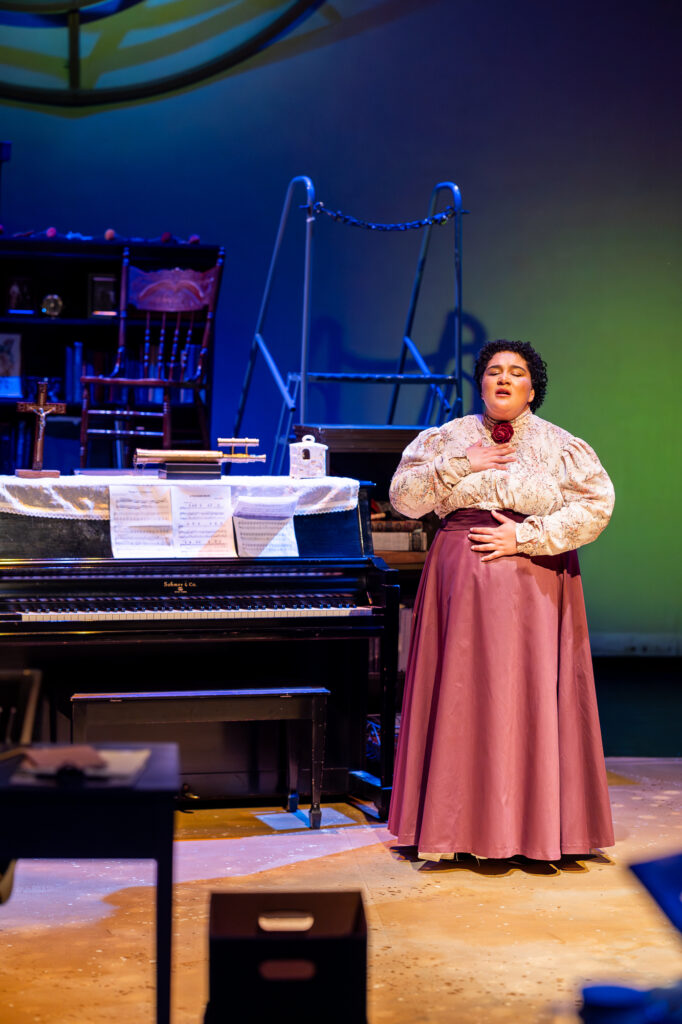
Act I (“Daily Life”) of the two-hour (one intermission) production opens on a set (Shelley Barish) of movable curved benches, Jenga-like in their flexibility and simplicity. They start as an arc and turn into whatever a scene calls for. Courtney O’Connor directs with a steady hand (especially the pantomiming in the prop-less production). Lighting and costumes subtly supplement.

The Stage Manager then presents each character, each building, and each historical fact, context meant to orient and bond the audience with time, place, and, most importantly, people.

“The play is Our Town. In our town, we like to know the facts about everyone,” he states matter-of-factly.

It is dawn on May 7, 1901. The Stage Manager guides us on a tour of the town, with its six churches, town hall/post office/jail, grocery store, drug store, and the homes of the Gibbs and Webb families. We are introduced to Joe Crowell (Jacob Thomas Less) as he delivers the morning paper, “The Grovers Corner Sentinel,” to Doc Gibbs (Robert Najarian). As Howie Newsome (Jesse Garlick) delivers their milk, we meet the rest of the townspeople, including Editor Webb (the always welcome De’Lon Grant) and the rest of the Webb and Gibbs families.

Mrs. Webb (Amanda Collins) and Mrs. Gibbs (a refreshingly nuanced Thomika Marie Bridwell) ready their children and husbands for their days. Emily and Wally Webb (Josephine Moshiri Elwood, Darren Paul) and George and Rebecca Gibbs (Dan Garcia and the irresistibly magnetic Kathy St. George) attend school together. The romance between Emily and George will become the lens through which the town’s story unfolds.

Professor Willard (John Kuntz, notable as always) and Editor Webb fill in some of the gaps, giving us the skinny on the history of the town and its socioeconomic status and political and religious demographics.

The Stage Manager then gets into the weeds about each character’s relationships and challenges, along the way presenting the town’s more colorful and minor characters. Simon Stimson (Kunz), the church organist and choir director, is also the town drunk. Doc Gibbs chews his son out for not helping his mother with her chores, and George and Rebecca’s eventual romance begins to bud under a full moon.

The Stage Manager dismisses us with a no-nonsense, “That’s the end of Act I, folks. You can go and smoke, now. Those that smoke.”

Act II (“Love and Marriage”) opens three years later. The Stage Manager summarizes the themes of Acts I and II — daily life, love and marriage — adding, “There’s another act coming after this. I reckon you can guess what that’s about.”

Emily and George’s courtship takes center stage, and the delightful ice cream parlor scene in Act II is one of the play’s best.

As Emily and George prepare to marry, the interactions with their families are warm, intimate and funny. Bride and groom are terrified, caught between wanting to remain kids and needing to follow the rules of the natural order of things, at least as they are in Grover’s Corners.

Doubling as wedding officiant, the Stage Manager says plainly, “People were made to live two by two… I’ve married over two hundred couples in my day. Do I believe in it? I don’t know.” The important thing, reminds Mrs. Soames (St. George), is to be happy. “I’m sure they’ll be happy. I always say, ‘Happiness, that’s the great thing!’”

Act III (“Death and Eternity”) takes place nine years later. The Stage Manager paints broad brushstrokes of changes — even the farmers drive cars, people now lock their doors — but quickly circles back to the play’s main themes of the unavoidable passage of time, the importance of paying attention to life’s little moments, and the miracles that are the substance of everyday life and the fabric of eternity.
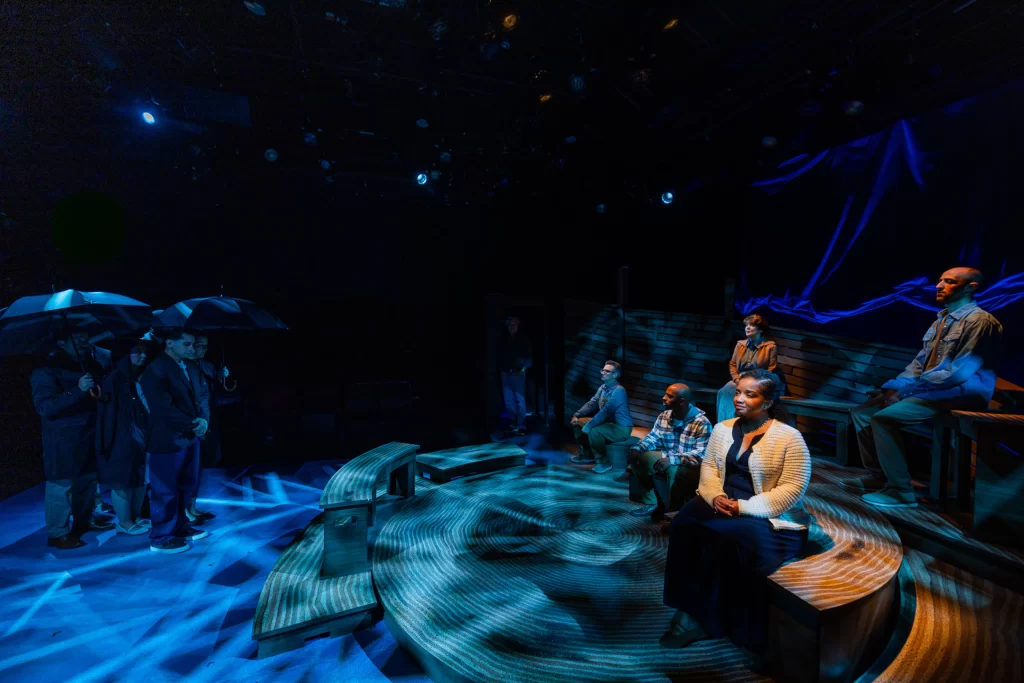
Focused on those who have passed away in the last nine years, the act takes place in the town cemetery. The Stage Manager describes how each person died before letting us know whose funeral is about to take place. The most thought-provoking of the three acts, playwright Wilder urges that we seize each day and celebrate the “magnificence and magnitude of life.” Asked if anyone truly understands the value of life while they live it, the Stage Manager responds, “No. The saints and poets, maybe —they do some.”

The rest of us? Not so much.

Some might complain that Our Town is dated and question why Lyric Stage has chosen to open its 2025/2026 season with this oft-produced classic. I say kudos to Producing Artistic Director Courtney O’Connor for recognizing an existential need in the current external turmoil to remind us that even in these dark times — especially in these dark times — we must not forget to slow down, breathe deeply and acknowledge that life is — no matter what — the most precious gift we are given.

Recommended.

‘Our Town’ – Written by Thornton Wilder. Directed by Courtney O’Connor; Scenic Design by Shelley Barish; Costume Design by Rachel Padula-Shufelt; Lighting Design by Deb Sullivan; Sound Design by Andrew Duncan Will. Presented by The Lyric Stage Company of Boston, 140 Clarendon Street, Boston, through October 19.

For more information, visit: https://lyricstage.com/
CST’s ‘Silent Sky’ Aims for The Stars But Falls Short

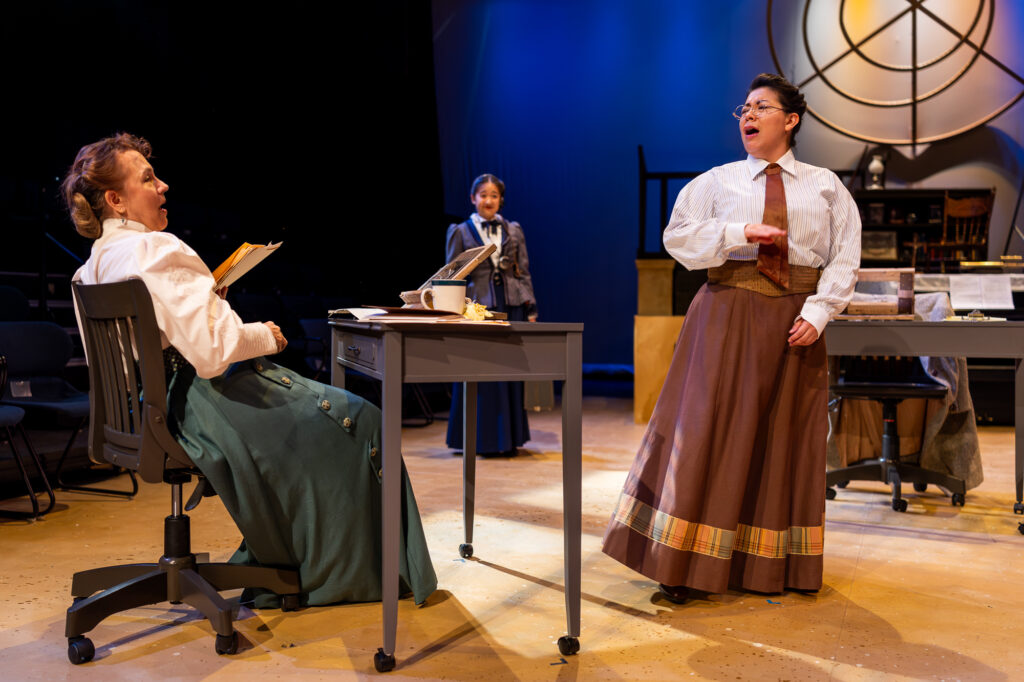
Lee Mikeska Gardner, Jenny S. Lee, Erica Cruz Hernández in Central Square’s ‘Silent Sky’
Photos by Nile Scott Studios

By Shelley A. Sackett

Lauren Gunderson’s career as a playwright (she is also a screenwriter and short story author) has largely focused on stories about iconoclastic women in history, science and literature. She is one of the top 20 most produced playwrights in the country, with over twenty plays produced. (Lyric Stage Boston’s 2022 production of her The Book of Will was a knockout).

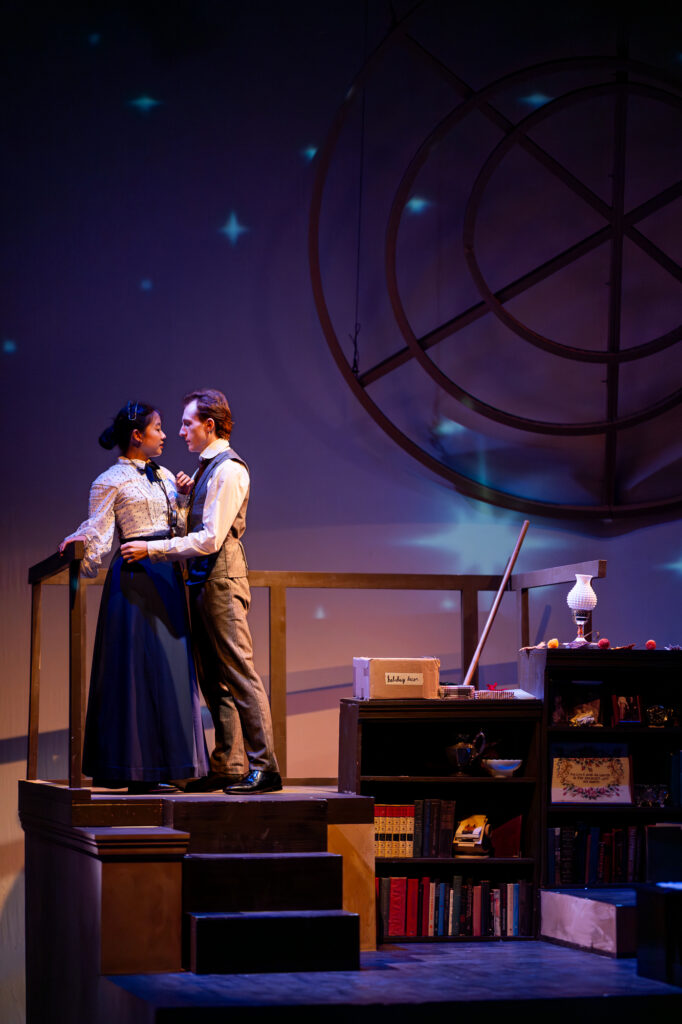
With Silent Sky, a Catalyst Collaborative@MIT Production presented by Central Square Theater through October 5, she turns her attention to the story of Henrietta Swan Leavitt, a young astronomer whose scientific brilliance and curiosity led to her discovery of the relationship between luminosity and the period of Cepheid variables (a star that pulsates).

If that sounds wonky and more opaque than incandescent, it is. Yet, thanks to Gunderson’s witty, tightly crafted script and several outstanding performances, the almost two hours almost fly by.

The play starts in 1902 with Henrietta (Jenny S. Lee), the daughter of a rural preacher in Lancaster, Mass., speaking to her sister, Margaret Leavitt (Kandyce Whittingham). Henrietta, a recent Radcliffe College graduate, studied the classics with strong interests in math and astronomy. She considers herself, above all else, to be a scientist.

Margaret, on the other hand, considers herself (and Henrietta) to be unmarried, marriage-aged women whose lives will be unfulfilled until their status changes.

Kandyce Whittingham

Henrietta has just received an invitation to join the Harvard College Observatory. She assumes that she will be working with the college’s “Great Refractor” telescope directly under its greatest faculty member, Dr. Pickering. She is determined to accept their offer, despite Margaret’s trying her best to get her to understand that she will die an old maid if she does.

Ironically, her words fall on deaf ears (Henrietta contracted a disease that led to deafness). “I need to start my life,” Henrietta pleads. “With daddy’s money.”

Dowry in hand, she burns any hope of marrying and heads to Harvard.

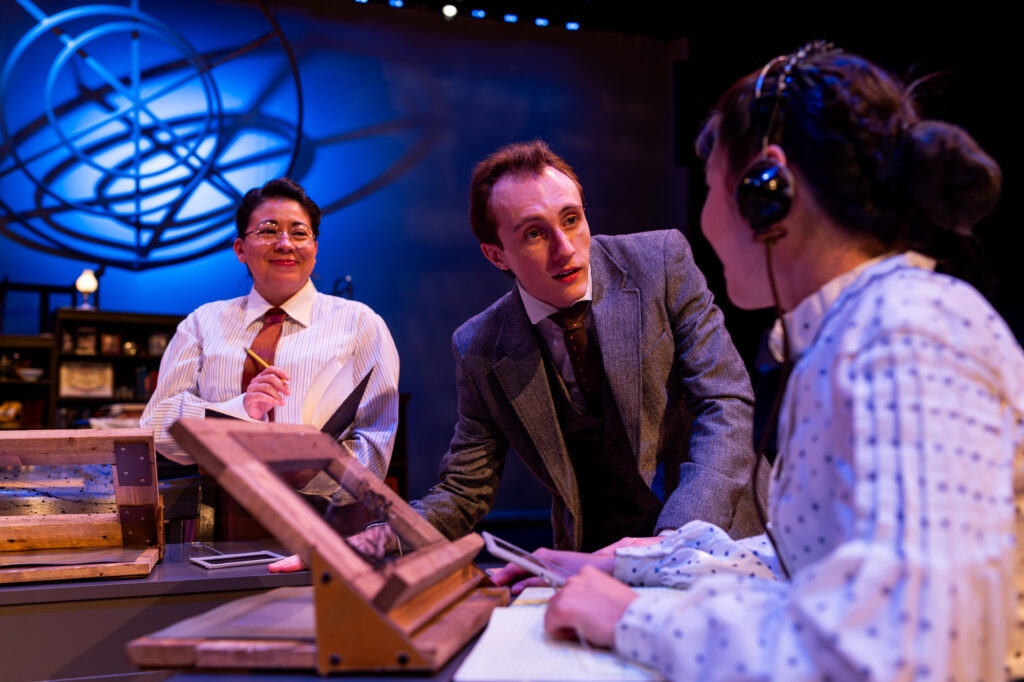
There, she is met by Peter Shaw (an excellent Max Jackson). It is Shaw’s unfortunate duty to inform Henrietta that she has been hired to join The Harvard Computers, a sisterhood of scientists who analyze plates that contain images from the telescope they are not allowed to touch. These women do the necessary mathematical equations for the observatory’s male-only research team, who absorb (code for steal) the women’s work and pass it off as their own.

Lee, Max Jackson

Shaw’s second unfortunate duty is to inform Henrietta that he is her boss and mediator to Dr. Pickering, whom she will also never see. Needless to say, Henrietta goes ballistic in the first of many scenes that are so well written but flatly executed.

As Shaw, the inferior physicist whose father’s connections landed him his job, Jackson turns in a solid performance. He is clearly out of his league professionally and his will, credentials and verbal swordsmanship are no match for Henrietta’s. The two circle the desk as Henrietta puts on her best pit bull persona, furious and determined.

Gunderson’s script is crisp, funny and fast-paced, a gift to both actors and audience. The problem is that Lee doesn’t quite have the tone and touch that the part of Henrietta requires. Strident and droning, she struggles to flesh out Henrietta with the nuance and rhythm she needs.

Her co-workers, thankfully, are another story. As Williamina Fleming, the Scottish housekeeper turned “computer,” Lee Mikeska Gardner is the runaway showstopper. Pitch perfect in every way, she milks her character’s dry sense of humor with straight-faced deliveries in an impeccable (and easily comprehensible!) brogue. She has some of the show’s best lines and delivers them like the consummate (and much regaled) actress she is.

Annie Cannon (Erica Cruz Hernández, also very good) is the no-nonsense, brilliant scientist and head of the computing team. A diva relegated to backup singer, she is at peace with her lot. “I don’t need a title,” she declares. “My life is my work.”

The two convince Henrietta to stay. At least she has access to the world she longs to live in and, with Cannon and Fleming as her colleagues, its best minds.

The play unwinds fairly chronologically with relationships, historical events and family crises moving the story along. Eventually, her discovery allowed astronomers to estimate greater distances up to ten million light-years away, much greater than one hundred light-years. Hubble used the law to estimate the distance of the Andromeda galaxy in light-years. She was nominated for the Nobel Prize in physics, but she had already passed away 4 years earlier.

Gunderson tackles more than just Henrietta’s contribution to science, however, with big-ticket issues and questions. Societal restrictions on women permeated every aspect of her life. It was expected she would be a homemaker and supporter rather than a contributing participant. Her legacy was to be her children, a life well lived, measured in her husband’s accomplishments.

Lee

Henrietta, on the other hand, dared to challenge long-held norms and trumpet the call for women’s independence, unfettered scientific research, and academic gender bias blindness. Thank you, Central Square Theater, for spotlighting this little-explored crusader. Sadly, over a century later, her concerns couldn’t be more relevant.

‘Silent Sky.’ Written by Lauren Gunderson. Directed by Sarah Shin. Scenic Design by Qingan Zhang; Costume Design by Leslie Held; Lighting Design by Eduardo M. Ramirez; Sound Design and Composition by Kai Bohlman. A Catalyst Collaborative@MIT Production. Presented by Central Square Theater, 450 Massachusetts Ave., Cambridge through October 5.

For more information, visit https://www.centralsquaretheater.org/

SpeakEasy’s Outstanding ‘Primary Trust’ Simmers Slowly Until It Boils Over

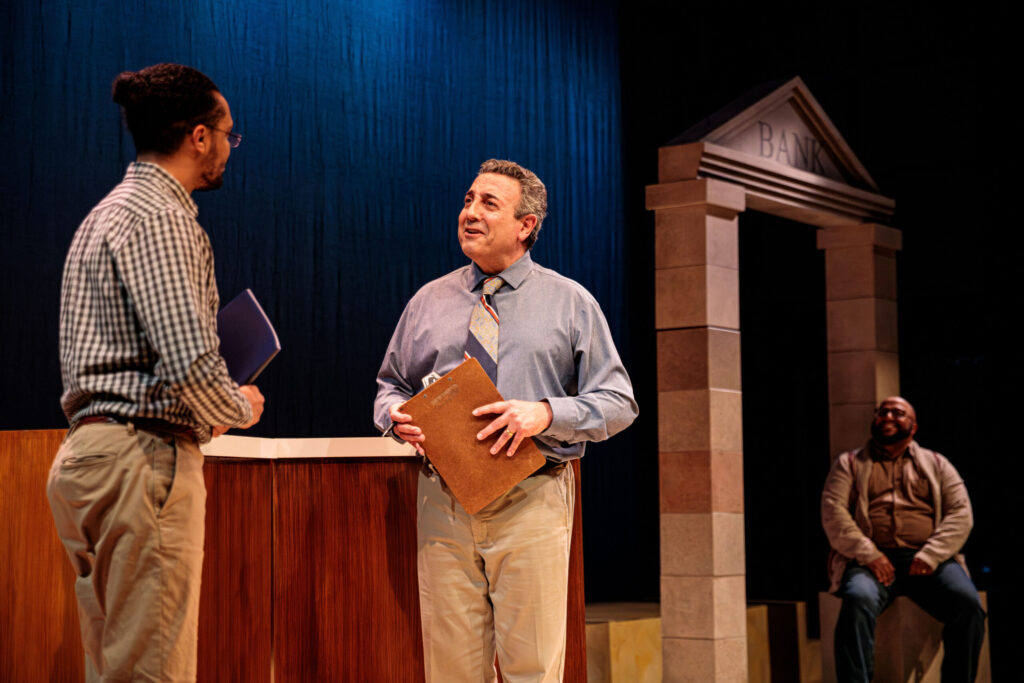
David J. Castillo, Luis Negrón and Arthur Gomez in Speakeasy’s “Primary Trust”.
Photos by Benjamin Rose

By Shelley A. Sackett

Like homesickness and old age, some things just “creep up” on us. A feeling that might start suddenly and imperceptibly, the sensation gradually builds until reaching a tipping point, after which we are acutely aware of and significantly affected by it.

Such is the case with SpeakEasy’s first production of the 2025/2026 season, Primary Trust, now enjoying a long run through October 11 (so there’s plenty of time to catch this gem).

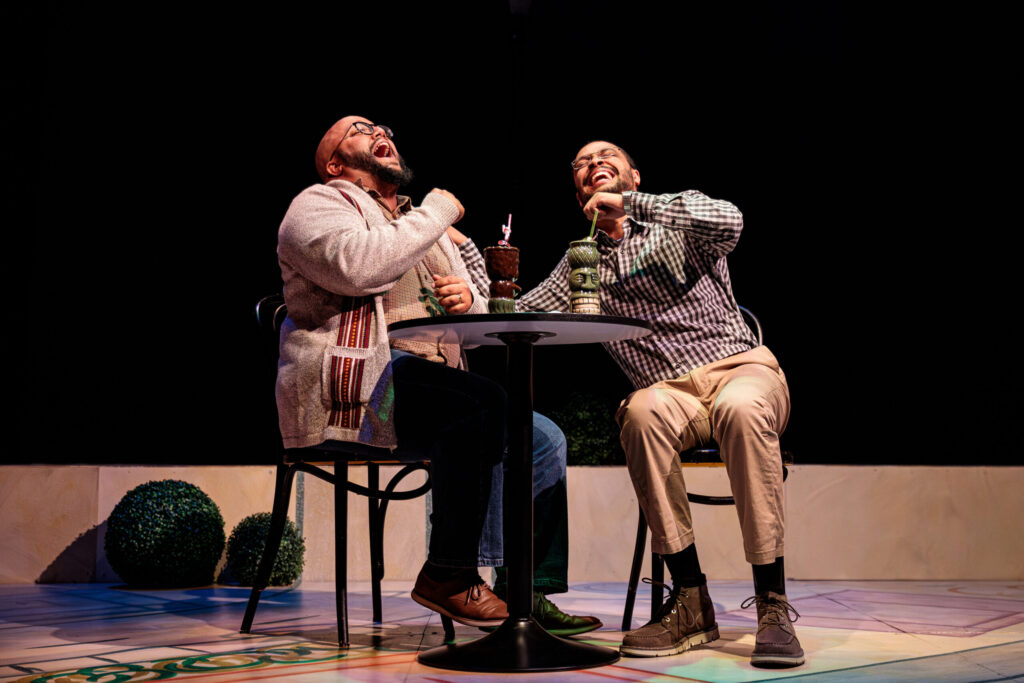
Winner of the Pulitzer Prize in Drama in 2024, the drama focuses on an emotionally delicate young man (late 30s) named Kenneth (a magnificently understated David J. Castillo). Orphaned at 10 years old, he coped with the traumas of childhood abandonment by creating an imaginary companion named Bert (Arthur Gomez in a pitch-perfect, unfussy performance).

“This is the story of a friendship,” Kenneth says by way of introduction. He then begins to tell his tale.

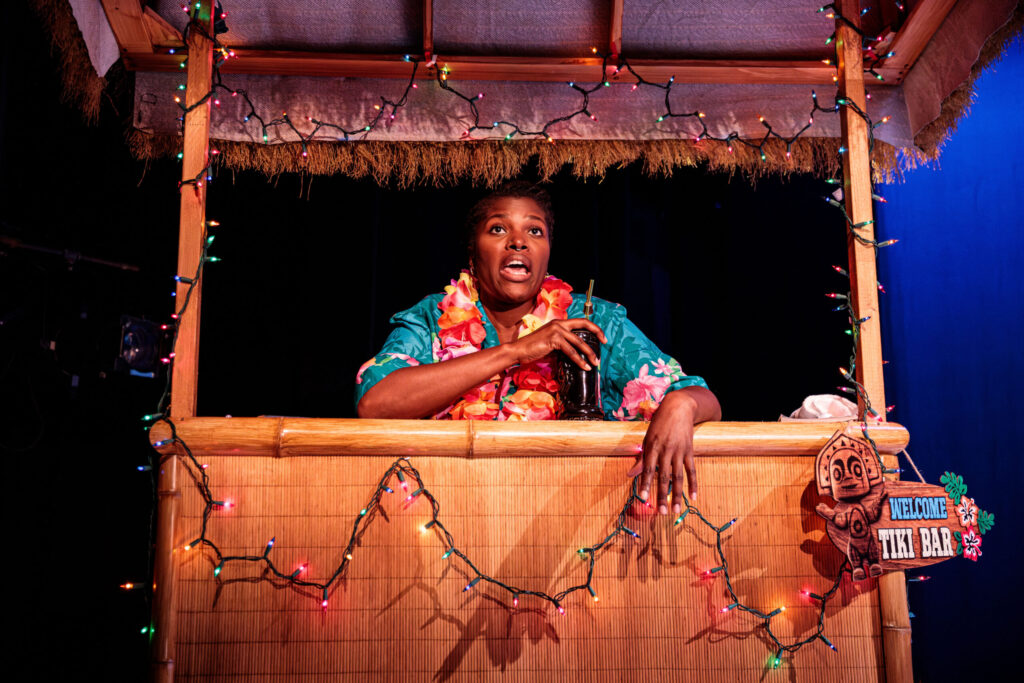
He lives in Cranberry, New York, an upstate mostly white town (“there are some Cambodians”) of 15,000, where his mother and he had settled. For almost 20 years, Kenneth has spent his days working in a bookstore run by Sam (Luis Negrón, playing a number of roles effectively). He spends his nights at Wally’s, the local Tiki bar where he (and he as Bert) drink 2-for-1 Mai Tais until Kenneth’s pain reaches the tipping point of anesthetization.

It is through his conversations with Bert that we get our first glimpse of Kenneth’s interior world. Robotic and guarded at work, he opens up (after his first handful of drinks) with his best friend, who, though imaginary, isn’t fake. “He’s the realest thing I know,” Kenneth says matter-of-factly.

Gomez, Castillo

Frequent asides to the audience also clue us in to the inner turmoil that Kenneth just manages to keep a lid on. The routine he has established — work, Wally’s, stumble home blackout drunk — gives him the stability and sense of purpose he so desperately craves.

All comes to a grinding halt when Sam announces his intention to sell the bookstore and move to Arizona. That night, Bert barely succeeds in calming him down. Unmoored, Kenneth will, for the first time in his adult life, have to find a job on his own and establish a new routine.

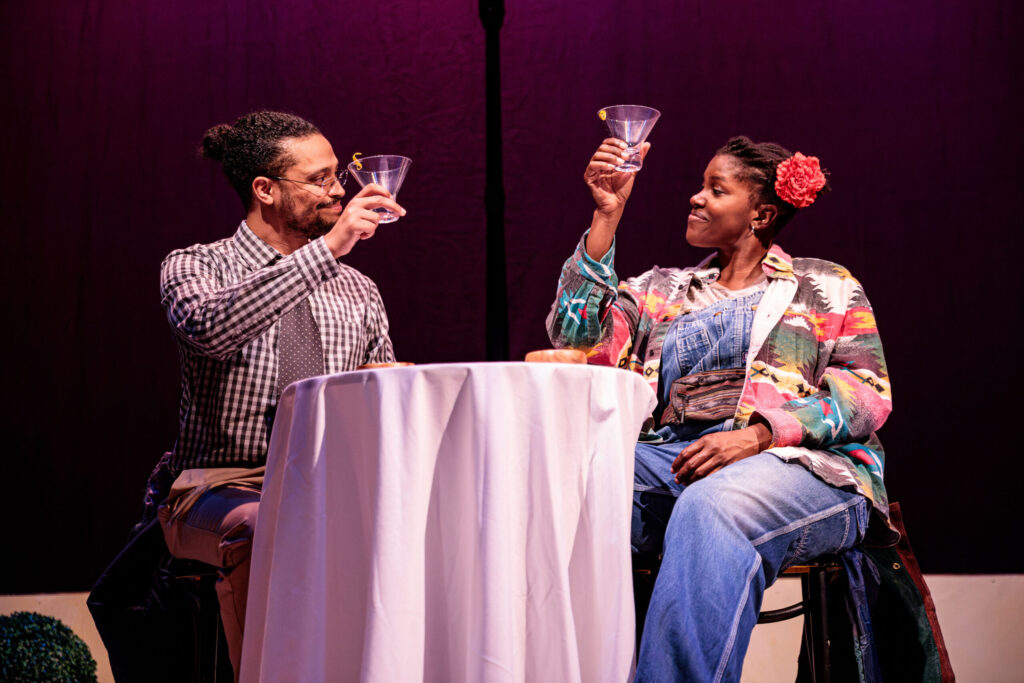
The first indication that this upheaval might have a silver lining is the night he befriends Wally’s bartender, Corinna (Janelle Grace, who plays a number of roles well, especially Corinna). This is a huge step for Kenneth. He has been coming to Wally’s every night for 15 years and, until Corinna sits down at his table, has never said a word to anyone other than Bert.

She suggests he apply for a job at Primary Trust, the aptly named local bank where, coincidentally, his mother had worked. She also manages to draw him out of his shell, sensitive to his skittishness but unwilling to let him retreat. She, too, is lonely, and director Dawn M. Simmons masterfully handles their initial encounter with restraint and grace. “It’s nice to know I’m not alone,” Corinna shares.

Janelle Grace

Kenneth lands the job at the bank and knocks it out of the ballpark, becoming a top producer in short order. His biggest challenge now shifts to keeping his inner demons at bay during the day until he can hightail it to the safety of Wally’s. Bert is no longer the only imaginary part of his life. This unfamiliar veneer of “normalcy” and success is like the skin that forms on a pot of milk right before it boils over.

Slowly, and with Corinna’s help, Kenneth tiptoes out of his comfort zone, sharing and receptive to more. She brings out a playfulness in him. She also earns his trust and she (and we) learn the details of the events that catapulted Kenneth from the harshness of reality to the haven of the imaginary.

Although he is still anxious and searching for his North Star, with Corinna, he starts to understand that there are others in the real world he can connect with and that solitude may be more of a prison than a sanctuary.

Playwright Booth handles Kenneth’s transformative transition with subtlety and precision. She has a knack for economical dialogue that gets the job done (a breath of fresh air). Confident in his craftsmanship, he elevates the pathos by imbuing it with glimmers of optimism and bright sparks of humor.

Shelley Barish’s set is simple, effective and efficient. Wally’s Tiki Bar and Primary Trust bank anchor the left and right sides of the stage, the center fluctuating between Sam’s bookstore, a snowy sidewalk, and a fancy restaurant. Simmons makes some interesting directorial decisions. Booth punctuates his script with asterisks meant to indicate that the actor pauses for a beat. Unlike many playwrights who specify directorial translation, Booth leaves it up to the individual director to decide how to interpret that transition.

Simmons has chosen to mark those beats with the clang of a bell. At first confusing and annoying, they grow on you, eventually making sense. Kudos to Simmons for this creative and bold move.

Castillo, Grace

At 95 minutes (no interruption), Primary Trust has ample time to build an arc of crisis and dénouement that is both satisfying and thought-provoking. By the play’s end, we are as altered as Kenneth. By sharing his intimate experience and ultimate survival, he has reminded us how much we mean to and need others.

As Simmons states in her program notes, “My deepest hope is that Primary Trust offers you something…meaningful — a jolt of hope, a whisper of kindness, or simply a moment to breathe and reflect on what it means to walk through this world together.”

Primary Trust’ — Written by Eboni Booth. Directed by Dawn Simmons. Scenic Design by Shelley Barish; Lighting Design by Karen Perlow; Costume Design by Chelsea Kerl; Sound Design by Anna Drummond. Presented by SpeakEasy Stage Company at Boston Center for the Arts, 527 Tremont St., Boston through October 11.

Recommended.For more information, visit speakeasystage.com/

NSMT’s ‘Rent’ Is Well Produced And Timely Entertainment

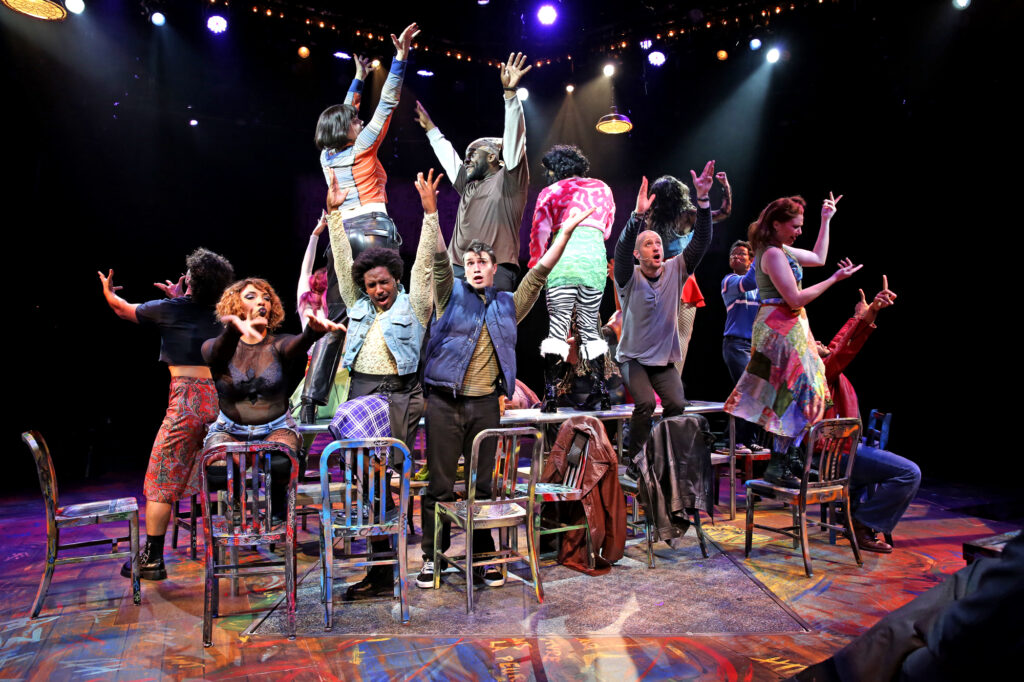
The cast of “Rent” at North Shore Music Theatre. Photos by Paul Lyden

By Shelley A. Sackett

North Shore Music Theatre is tailor-made for musicals with its theatre-in-the-round, signature creative set designs and talented casts. With Rent, the Pulitzer Prize and Tony Award-winning musical set in New York City’s East Village from 1989 to 1990, it manages to pay homage to a classic that defined an era while also spotlighting its relevance to today.

Jonathan Larson’s rock opera became a sort of psalm for the era when HIV/AIDS first appeared and quickly steamrolled into a full-blown cultural and health crisis. The musical follows a diverse group of struggling wannabe artists as they navigate love, death, pre-gentrified Alphabet City, and the roller coaster that is always one’s early 20s. Add sex, drugs, performance art and rock and roll to the recipe, and the pot bubbles up and froths over, like a chemistry lab experiment gone rogue.

Yet, all is not doom and gloom. Strength, connection and love see these folks through the dark times of marginalization, false narrative and sickness. These themes reflected reality 30 years ago, and, sadly, they resonate just as powerfully today.

Jeffrey D. Kmiec’s set conjures the gritty area of 11th Street and Avenue B. Metal scaffolding gives the actors platforms and the audience the feeling they, too, are up on a roof, clinging to its rungs for dear life. Simple props evoke a shabby warehouse loft apartment and later a CBGB-esque club, restaurant and others.

The musical spawned many hit songs that became anthems for the era, such as “Rent,” “Tango: Maureen,” “Seasons of Love,” “La Vie Bohème,” “Out Tonight,” and “Take Me or Leave Me.” All receive superior treatment from NSMT’s terrific orchestra (under Robert L. Rucinski’s direction) and a cast of great voices.

A brief primer is in order to make sense of the fast-paced and complex string of scenes and keep track of the huge roster of characters.

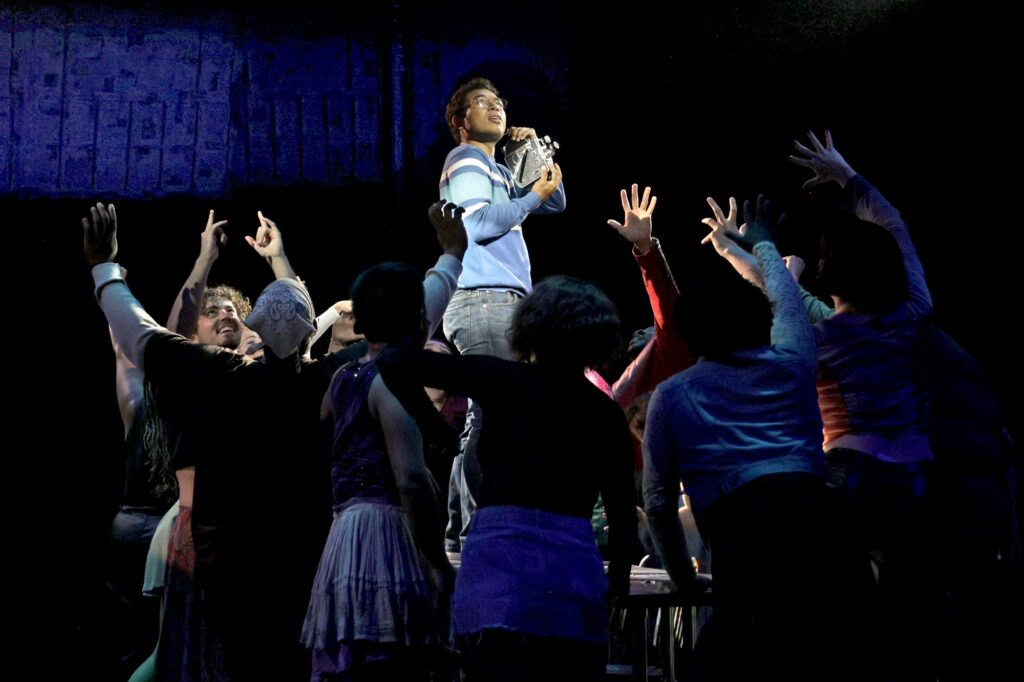
Aaron Alcaraz as Mark Cohen

The action opens on Christmas Eve. Two roommates, Mark (Aaron Alcaraz), a filmmaker, and Roger (Austin Turner), a rock musician, struggle to stay warm and keep the electricity going in their “apartment.” Their voice message machine brings the audience up to date. Their rent is not just due; their former roommate, Benny, their new landlord, is reneging on their oral agreement and demanding that, unless they pay last year’s rent in full, he will shut off their electricity and evict them. Mark’s mother leaves an edgy, passive-aggressive message from Mark’s hometown on Long Island.

We also learn in short order that: Mark’s girlfriend, Maureen (Cate Hayman, a knockout talent), dumped him; Roger contracted AIDS from his former girlfriend, who slit her wrists; and their friend, Tom Collins (Aaron Arnell Harrington, great vocals), a gay anarchist professor of computer-age philosophy at NYU, was just mugged outside their apartment.

Roger, a former “pretty boy front man,” longs to write one last, great song before his inevitable death.

Tom is rescued by Angel (Robert Garcia), a cross-dressing street drummer. It’s love at first sight, uncomplicated by the specter of AIDS since they are both already positive. Rounding out the scene are Mimi (gifted singer Didi Romero), Roger and Mark’s neighbor and an exotic dancer and drug addict, and Joanne (Kat Rodriguez, another excellent singer), Maureen’s new girlfriend and a lawyer.

All this within the first few minutes.

At this point, the plot thickens to a dense pea soup. Benny (former roomie, current landlord) shows up at Mark and Roger’s and tries to convince them that, his threats to evict them notwithstanding, he is actually a good guy. He’s trying to raise money from investors so he can buy the building and turn it into a cyber arts studio that will benefit them all. All they have to do is convince Maureen to call off her organized protest against his plans. If they do that, Benny promises, they can officially live as rent-free tenants.

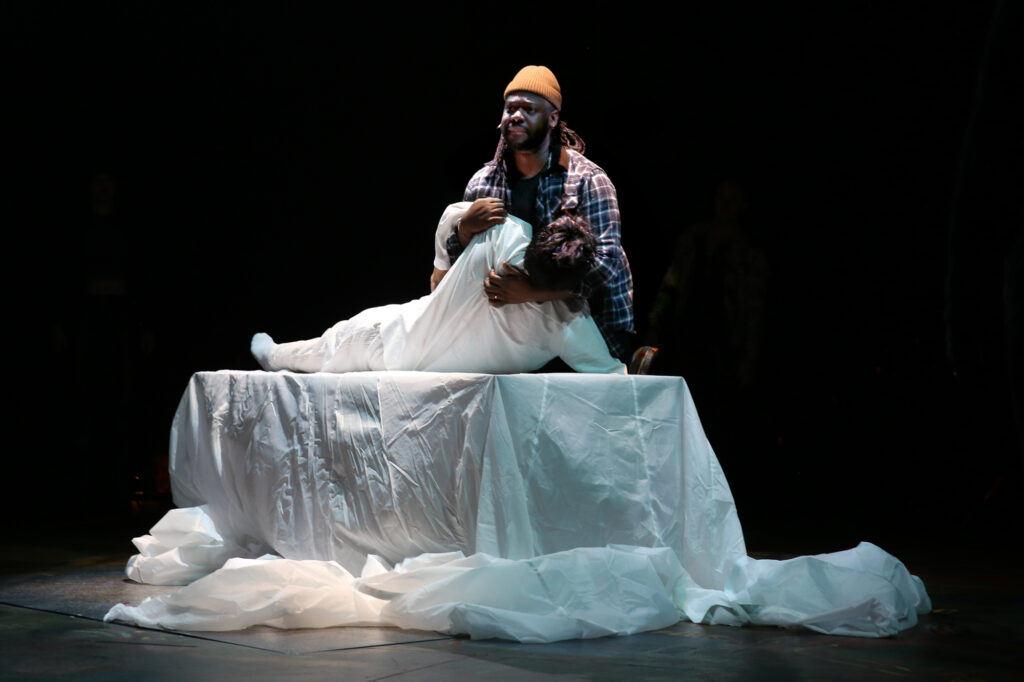
Aaron Arnell Harrington (as Tom Collins) with Isaiah Rose Garcia (as Angel Dumott Schunard)

Roger and Mark refuse.

Mark heads over to the protest to help Maureen with the sound system. Instead, Joanne (the new girlfriend and lawyer) is there, mucking with the equipment. The two circle each other like territorial alpha dogs before uniting in their shared dislike of Maureen’s manipulative, promiscuous nature. They literally join forces in the harmonious and witty duet dance, “Tango: Maureen.”

Despite their non-commutable death sentences (this was the late 80s, early 90s when there was no such thing as hope or a cure for those with AIDS), these neighbors bond to support and help each other. They share from the heart at their weekly support group and talk freely about their dreams for the future. Collins (Harrington) plumbs his soul (and baritone vocal chops) in “Santa Fe,” where he imagines he and Angel opening a restaurant.

One of “Rent’s” strangest numbers is Maureen’s protest performance piece, “Over the Moon.” Hayman is riveting as she writhes, growls, howls and scats her way through the wild number that combines song, dance, poetry and punk. Even when just seated at a table or as a member of the chorus, Haywood would command attention, even if she wasn’t impossible to ignore due to her height. Her physicality and raw talent are magnetic.

Thanks to Larson’s robust score and narrative lyrics, the show doesn’t bog down despite its dramatic morass. “La Vie Bohème” celebrates the group’s love for their lifestyle and priorities while acknowledging its pitfalls and fallout. As Act I ends, Mark and Roger learn that their building has been padlocked, a riot has broken out and Roger and Mimi share their first kiss.

Act II begins with the full cast singing “Seasons of Love,” a reminder that no matter what happens, life is to be measured in love. The plotlines blur frequently, with the musical numbers throwing a lifeline of coherence and entertainment. Maureen and Joanne’s duet, “Take Me or Leave Me,” is hands down the show’s most impressive. Hayman (Maureen) and Rodrigues (Joannne) reach such a high pitch on every level, it’s hard to believe they don’t spontaneously combust. There is always one such number (when we’re lucky) in every musical, and in NSMT’s version of “Rent,” this is it.

The show is one of the longest-running shows on Broadway, closing in 2008 after a 12-year run. Even if you’ve seen the show several times, it’s time to do it again. Its 1990’s messages of perseverance in the face of adversity, community and connection in times of divisiveness, and protesting unfairness and cruelty couldn’t be more contemporary.

‘Rent’ — Book, Music and Lyrics by Jonathan Larson. Musical Arrangements by Steve Skinner. Direction and Choreography by Marcos Santana. Scenic Design by Jeffrey D. Kmiec; Costume Design by Rebecca Glick; Lighting Design by José Santiago; Sound Design by Alex Berg; Video Design by Beth Truax. Presented by North Shore Music Theatre through September 28.

For more information, visit https://www.nsmt.org/

Bearing witness: 85-year-old Holocaust survivor relives her childhood in the docudrama, ‘Hidden: The Kati Preston Story’

By Shelley A. Sackett

Kati Preston being interviewed for the film. | KELLY FAN

On Sept. 20, the 41st Boston Film Festival will host the world premiere of “Hidden: The Kati Preston Story.” The 75-minute film is a powerful docudrama that follows the extraordinary journey of 85-year-old Holocaust survivor Kati Preston. Exceptionally well-edited, directed and produced, it retells the story of one person’s resilience and survival in the face of a society descending into antisemitism, authoritarianism, dictatorship and tyranny.

The film opens on a bucolic country scene with a horse peacefully grazing near a white clapboard house. Smoke spirals invitingly from its chimney. Inside, a woman sits at her desk, turning the pages of a scrapbook of sepia-toned family photos. “Everybody here is dead. I’m the only one left,” says Kati Preston. “It feels so strange because I feel like I’m in exile. The world I come from is gone. When I die, nobody will remember these people because I’m the last person who bears witness.”

Seamlessly, the screen melts into 43 seconds of black-and-white archival footage that shows Jews living openly Jewish lives followed quickly by scenes of them being rounded up, transported, beaten and murdered. The last shot is of crematoria ovens, doors wide open, displaying their interiors of ashen, bony remains. Mercifully short, these devastating images are a reminder of the lightning speed and crusading evil that are the backdrops to Kati’s story.

Based on Kati’s award-winning graphic novel, “HIDDEN: The True Story of the Holocaust,” the film is narrated by Kati and features reenactments of her story. In 1943, her hometown of Nagyárad, Hungary (now Oradea, Romania) boasted a thriving Jewish community with synagogues, a Jewish hospital, Jewish schools and Jewish coffee houses. Despite a diverse society that welcomed religious Jews, Roma and Muslims, Jews remained insulated, not wanting to assimilate.

Kati’s childhood was one of luxury. Her mother ran a dressmaking business with 40 employees and her father was a carp wholesaler. At 5 years old, she was beautifully dressed, wore curlers to bed every night and enjoyed the comforts of maid and governess. Her father was Jewish, her mother a Catholic who converted. Although they were secular Jews, Kati remembers her mother lighting Shabbat candles every Friday night.

She also remembers going to the opera on Sundays with her Catholic grandmother. Those outings routinely ended with the two of them sitting at a bar and her grandmother slugging down shot after shot until she was drunk.

Kati’s father was playful and happy-go-lucky. Her mother, whom Kati feared and loved but “did not like,” was more in control and controlling. To make sure Kati was trained to be a proper young lady, she hired Fraulein, who “terrified children into behaving instead of educating them.” One tool in Fraulein’s toolbox was her book of Grimm’s Fairy Tales, which was used to teach German children the dangers of misbehavior through traumatic stories. These included a child having his thumbs cut off for thumb-sucking and a girl who burns to death for playing with matches.

Interspersed among the narrative reenactments are interviews with Tom White (Holocaust and genocide educator), Dr. Martin Rumscheidt (Christian minister, educator, author and theologian), Annette Tilleman Lantos (Holocaust survivor from Budapest), Rabbi Oberlander Baruch (Chief of the Budapest Orthodox Rabbinate) and Kati’s son Daniel Mator, who directed “Hidden.” His six-year collaboration with filmmaker Jody Glover and determination to trace his family roots are responsible for Kati’s story being brought to life.

Inserting talking heads into a docudrama can be risky. If clumsily done, these can interrupt rather than augment, breaking the mood and boring the audience. Director Mator and his team avoid this common pitfall, masterfully using these commentators to supplement the interviews with eye witness accounts and historical context. In particular, Mator’s on-the-ground guided narration of life and lives in the Jewish ghetto in the 1940s feels more like an immersion experience than a lecture, thanks to his use of animated maps and archives.

Things go from bad to worse for Kati and her mother after Hitler invades Hungary. Her mother sews the mandatory yellow star onto Kati’s coat, which she proudly wears until a man sees it and spits on her. “I couldn’t understand why I had to wear a star that would make someone spit on me,” Kati says of her first encounter with antisemitism.

A Hungarian farmer woman who feels beholden to Kati’s mother agrees to hide Kati in her barn. Miraculously, she avoids detection until she can be reunited with her mother. The defeat of the Nazis brings Russian occupation and a different set of perils, as those soldiers rape, pillage and murder with impunity. Again, Kati’s mother displays fearless ingenuity and chutzpah when she curries favor by offering to make a dress for one of the female Russians. Soon, she is outfitting the entire women’s corps. In exchange, mother and daughter are protected and amply fed.
Their lives under Stalin’s communist regime take an even darker turn, as Kati, “brainwashed,” actually reports her own mother to the police. Mator eventually brings us into the 21st century, focusing on generational trauma and the troubling narrative of Hungary’s revisionist history.

Kati is one of the two (out of 52) kindergarteners in her class who survived the Holocaust. She lost all 28 members of her extended family to Nazi genocide. Believing that her survival has given her “the energy to make my life count,” she pursued careers in journalism, fashion, theater and education before dedicating her life to sharing her story. She speaks in schools, libraries and public institutions, emphasizing survival over victimhood and the urgency of combatting prejudice.

Along with former New Hampshire Gov. Chris Sununu, she succeeded in getting Bill HB115 passed to make Holocaust education compulsory in New Hampshire schools. Her remarkable connection with youth has inspired her graphic novel, and now this film. These are being combined with classroom lesson plans for a worldwide distribution to schools as an initiative towards Holocaust education.

“I loved my childhood,” Kati reminds her audience. “Then things shifted. These things can happen here.”

Paul Melendy Soars in GBSC’s Fabulous ‘Featherbaby’

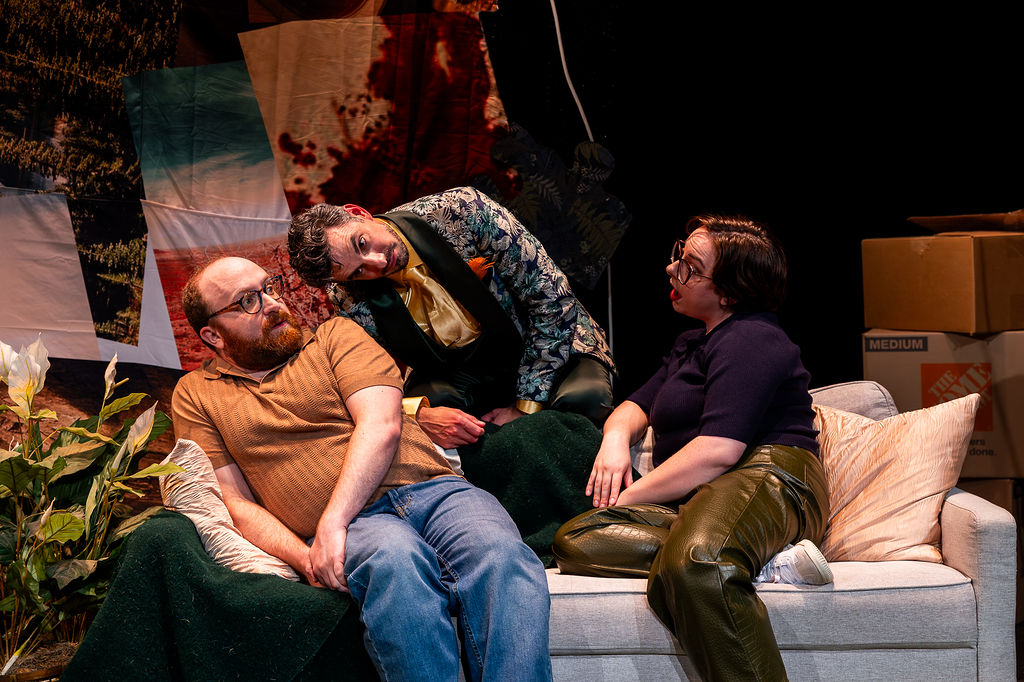
Gabriel Graetz, Paul Melendy and Liv Dumaine in GBSC’s ‘Featherbaby’

By Shelley A. Sackett

There are not enough words of praise to describe Paul Melendy’s sublime performance as the insightful, unfiltered and outrageously funny trash-talking parrot, Featherbaby, in the eponymous play now running in its co-world premiere through September 28 at Greater Boston Stage Company in Stoneham. If you only see one production this entire season, this is the one that should be at the top of your list.

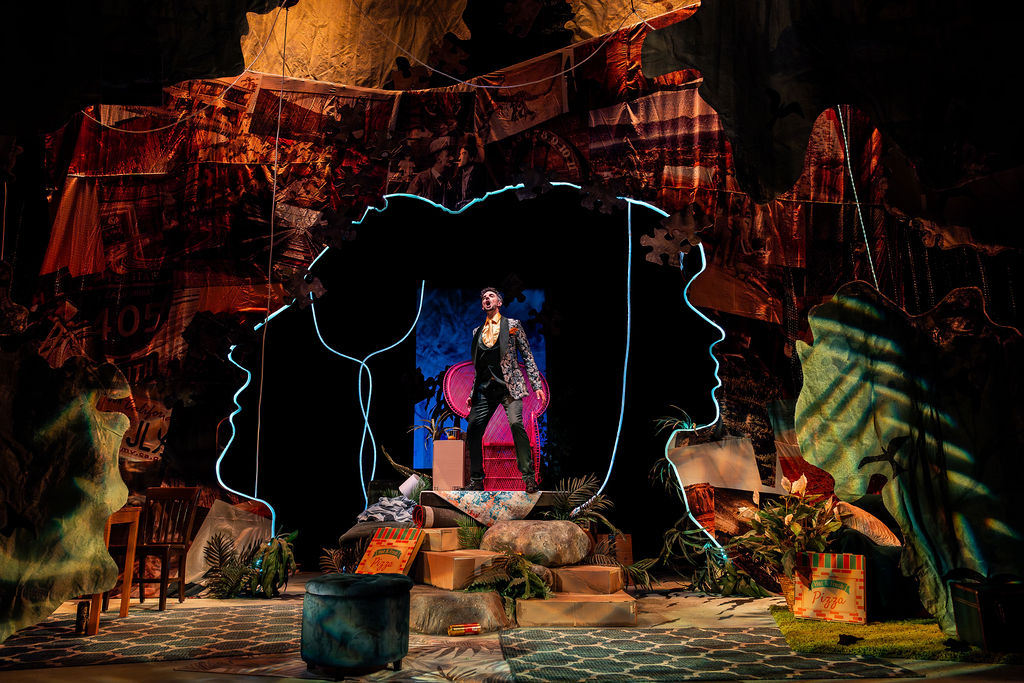
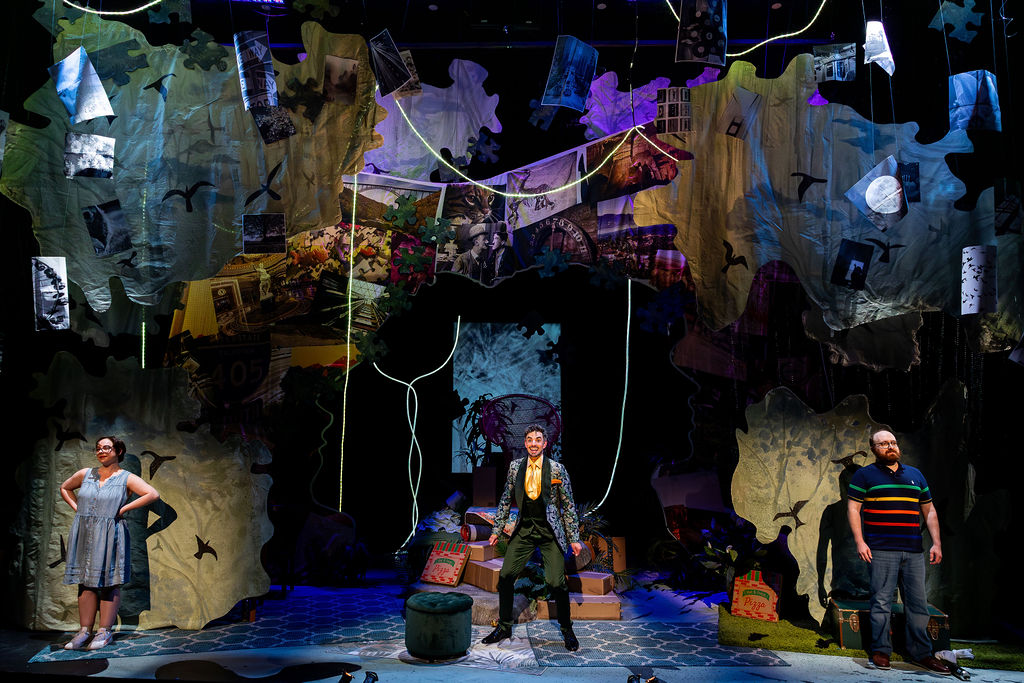
The set (Katy Monthei) alone is worth the price of admission. A pink wicker peacock chair sits high and center stage, an eye-catching focal point that will double as Featherbaby’s cage. Jigsaw pieces, rainforest motifs painted on cloth panels, strings of lights, and photographs of crime scenes foretell later plot elements, but before the curtain even goes up, all are indicative of the uniquely inventive theatrical event soon to begin. A simple desk and chair stage right and small table stage left bridge Featherbaby’s world and the two humans who will later share their stage.

The play opens with Melendy sashaying on the stage in full regalia. Thankfully, that does NOT include a stuffed-animal-like mascot costume of a green parrot. Rather, Deirdre Gerrard has captured the image of an Amazon parrot while allowing Melendy’s plasticene physicality to strut its stuff by creating an outfit of floral, formal dinner jacket, green vest and matching pants, and luminescent yellow satin shirt and tie. Melendy makes expert use of the long, wide double flaps in the jacket’s back as he manipulates his “tail” to great dramatic effect.

Melendy

“I am adorable,” Featherbaby announces. Melendy casts a magical spell as his facial expressions, neck twitching, and bird-like prancing transform him into a believable version of a bird. “I am also,” he says unnecessarily, “intense.”

Maniacally egotistical, Featherbaby also needs constant attention and will go to great lengths to make sure he is at its center. “I AM HERE!!!!!” is his favorite refrain, seconded only by “poop.”

Melendy goes on, with manic and jaw-dropping physicality, to describe the evolutionary history and modern-day life of the parrot. We learn that parrots are descendants of dinosaurs and that their primary purpose in the wild is as simple as it is singular: avoid getting eaten. We also learn a new vocabulary that includes “crunching” (biting) as in, “I feel a crunch coming on.”

He describes being bagged by poachers and transported from his rainforest Amazonian haven to a cage in America. Melendy is an indescribable delight to watch, as he vamps, pantomimes, and literally inhabits Featherbaby. He even ad-libs at one point, when he tosses Mason’s “heavily scented boxer shorts” into the audience, only to have them thrown back in his face.

“There’s only room for one cheeky parrot in this play,” he says with a menacing, eyebrow-raised sneer.

The loose-limbed plot involves Angie (Liv Dumaine), the unpredictable and effervescent human who saved Featherbaby from an unfortunate shelter, and Mason (Gabriel Graetz), a man she brings into her (and Featherbaby’s) life.

Angie is a working gal who has recently broken up with her former roommate and girlfriend. The parrot now provides her only companionship. As Angie, Dumaine is all hope and toothy smiles when she brings Mason, a fellow jigsaw puzzle fanatic, home for the first time. Featherbaby takes an instant dislike to Mason, and the hostility is returned. Parrots are terrifically territorial, and when Mason begins to threaten Featherbaby’s previously exclusive relationship with Angie, Featherbaby’s tail feathers become ruffled. He crunches Mason relentlessly, hoping to nip the connection in the bud. That tactic fails, and when Mason moves into the apartment, it is all-out war to win back Angie’s full attention.

Graetz, Melendy

Angie (not quite the nice girl she pretends to be) leaves Featherbaby with Mason (more of a marshmallow sap than he realizes) to resume a relationship with Catherine, her former girlfriend. The two abandoned and betrayed former Angie beloveds must figure out a way to coexist. Eventually, after months of humorous and poignant hits and misses, they strike a truce and end up the better for it.

Along the way, Featherbaby’s asides and narrations delve into deeper issues of friendship, loyalty, competition, respect, and the multifaceted nature of relationships in general and love in particular. Most important are the lessons he learns (and shares) involving acceptance, love and trust.

“Who ends up in our bones is not always our choice,” Featherbaby notes. “Sometimes the bones choose.”

“What excites me most about Featherbaby is that it manages to be both laugh-out-loud funny and deeply touching,” said Director and Producing Artistic Director Weylin Symes in the program notes. “It is a play that sneaks up on you. One moment you are doubled over with laughter, and the next you find yourself thinking about the ways we connect with each other, even in the most unlikely circumstances.”

That is certainly true, but what is even truer about this production of Featherbaby is that it firmly establishes Paul Melendy as a one-of-a-kind talent. I, for one, can’t wait to see him next in Lyric Stage’s A Sherlock Carol.

‘Featherbaby’ — Written by David Templeton. Directed by Weylin Symes. Scenic Design by Katy Monthei; Lighting Design by Matt Cost; Costume Design by Deirdre Gerrard; Sound Design by Mackenzie Adamick. 1 hour 45 minutes, one intermission. Presented by Greater Boston Stage Company at 395 Main St, Stoneham, MA, through September 28.

For more information, visit www.greaterbostonstage.org

‘My First Ex-Husband’ Spotlights Joy Behar And Divorce’s Light and Dark Sides

THE VIEW – The View’s Season 28 Co-host photo shoot – Joy Behar. “The View” airs Monday-Friday, 11am-12noon, ET on ABC. (ABC/JEFF LIPSKY) JOY BEHAR

By Shelley A. Sackett

Joy Behar is familiar to fans of television’s ABC daytime talk show, “The View,” as the co-host with the comedic, acerbic wit. She won an Emmy Award in 2009 and is also known as a sharp-tongued, incisive stand-up comic.

With My First Ex-Husband, her fourth play that ran successfully off-Broadway and is now in production at The Huntington Calderwood through September 28, she will be known to Boston audiences as a playwright as well.

The idea came to her from her own divorce in the early 1980s. She and her girlfriends would get together and talk about their experiences. Wading through the painful, she also uncovered the humorous.

She decided (with permission, of course) to tape some of their conversations, eventually transforming them into a 90-minute Moth-like show of eight vignettes, read by a rotating cast of five, including Joy at select performances.

My advice: if you plan to see the show, make sure you are seeing it on a night when Behar is performing. The woman, at 82, is a pint-sized firecracker. As Rob Reiner’s mother ad-libbed in “When Harry Met Sally,” I’ll have what she’s been having. Her enthusiasm and energy are as contagious as it is a delight to witness. That she is 82 is both an inspiration and an aspiration.

The full cast of stars from theater, television, and film also includes Veanne Cox, Judy Gold, Jackie Hoffman, and Tonya Pinkins.

Jackie Hoffman. Photo: Huntington

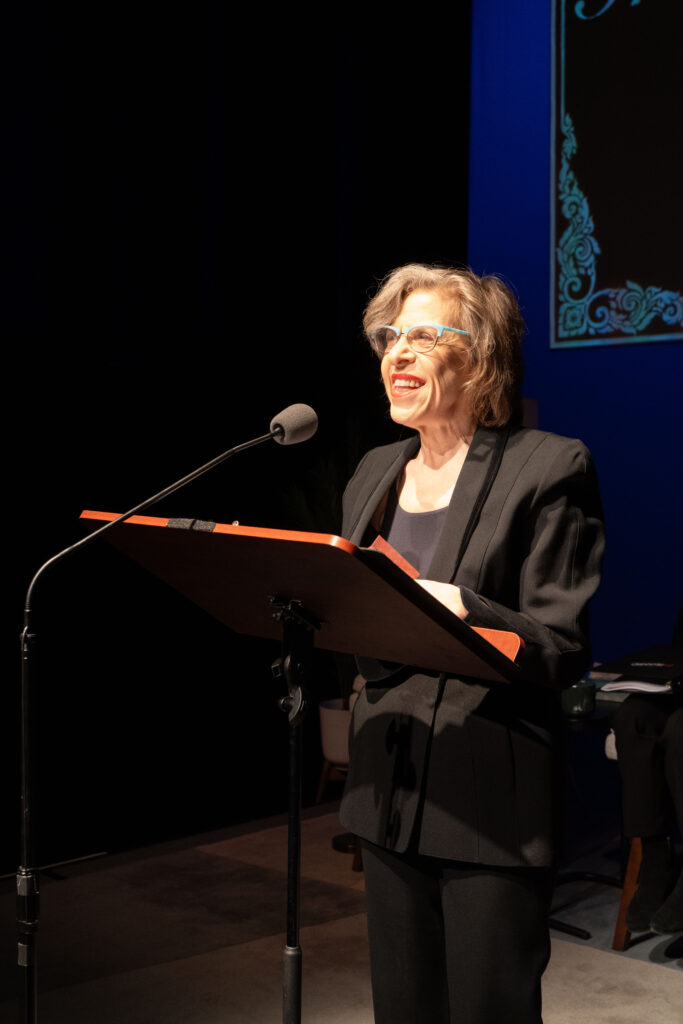
The stage is set like ‘The View,” with four seats set in front of luscious red velvet curtains. “My First Ex-Husband” hangs over the stage, framed like a valentine. The microphone and reading stand host each reader in turn.

“Hello, Boston!” Behar calls as she walks onto the stage. The crowd last Sunday, clearly fans, greets her with adoring applause. “How many of you are divorced?” A sea of hands wave. She pauses with expert timing before following up with, “How many of you would like to be divorced?”

She begins by describing the state of divorce in the U.S. There has been an uptick in divorces of those over 50. “The only people under 50 getting married are gay people,” she jokes. Seriously, she continues, she was intrigued by this statistic. She started interviewing women about why they wanted to get divorced. “Women couldn’t wait to tell me their stories,” she says.

The men, not so much.

All the stories in My First Ex-Husband are true, she explains, adding that her next show will be titled My Next Ex-Husband.

Tonya Pinkins is first to the podium. renowned theater actress, she is a three-time Tony nominee, winning the award in 1992 for her performance as Sweet Anita in Jelly’s Last Jam. The title of each monologue appears above the stage. Hers is “Where You At?” Her delivery is full-throated, emotive, and dramatic.

Next up is Vivien Cox, who has received a Special Drama Desk Award for “Excellence and Significant Contributions to the Theatre” and an Obie Award for “Sustained Excellence.” “Show me a man who loves a plump woman, and I’ll show you a foreigner,” she deadpans. “Walla Walla Bang Bang” features Judy Gold, a stand-up comedian, actor, author, TV writer, and activist who The New York Times dubbed, “an underappreciated gem of the New York comedy scene.”

Lanky, tall, bespeckled and with a head of bouncing blond curls, she is the opposite of Cox’s prim, proper and controlled persona. The personalities and presentations of each actress complement and complement each other visually, stylistically, and delivery-wise, keeping the staging from getting stale.

Gold’s story is about being dragged from her dream of an East Side high-rise in New York City to a farm in upstate New York by a husband whom, unsurprisingly, she later divorces.

Behar, however, is the most effective, her stand-up chops on full display. Each actress gets another bite at the apple, with a total of eight stories. Most are funny, all are unfiltered, and the audience leaves a little lighter than it arrived. Who, after all, can’t use a good laugh these days?

‘My First Ex-Husband’ — Play by Joyce Behar. Directed by Randal Myler. Presented by The Huntington Selects. Produced by Caiola Productions and Cyrena Esposito. At The Huntington Calderwood, 537 Tremont St., Boston, through September 28.

For more information, visit Huntingtontheatre.org

Broadway in Boston’s ‘Mrs. Doubtfire’ Is A Raucous Good Time

Cast of Broadway in Boston’s Mrs. Doubtfire’ Photos: Joan Marcus

By Shelley A. Sackett

Every family has that iconic favorite movie or television show that follows its members throughout childhood, adulthood and parent/grandparent-hood. For mine, it was (and is) “Mrs. Doubtfire,” the 1993 movie that has been with us from Blockbuster rental to VHS to DVD to stream-on-demand. So any live version of this holy grail was going to have a very high bar.

Thankfully, Broadway in Boston and Work Light Production’s musical version of the Broadway hit at the Emerson Colonial Theatre manages to hurdle over that bar more often than knock it over.

Thanks to (some) stand-out acting, strong vocals and lyrics that move the narrative along and give insight into the characters, Mrs. Doubtfire is easy to recommend to even the most die-hard Robin Williams/Harvey Fierstein/Sally Field/Pierce Brosnan fans.

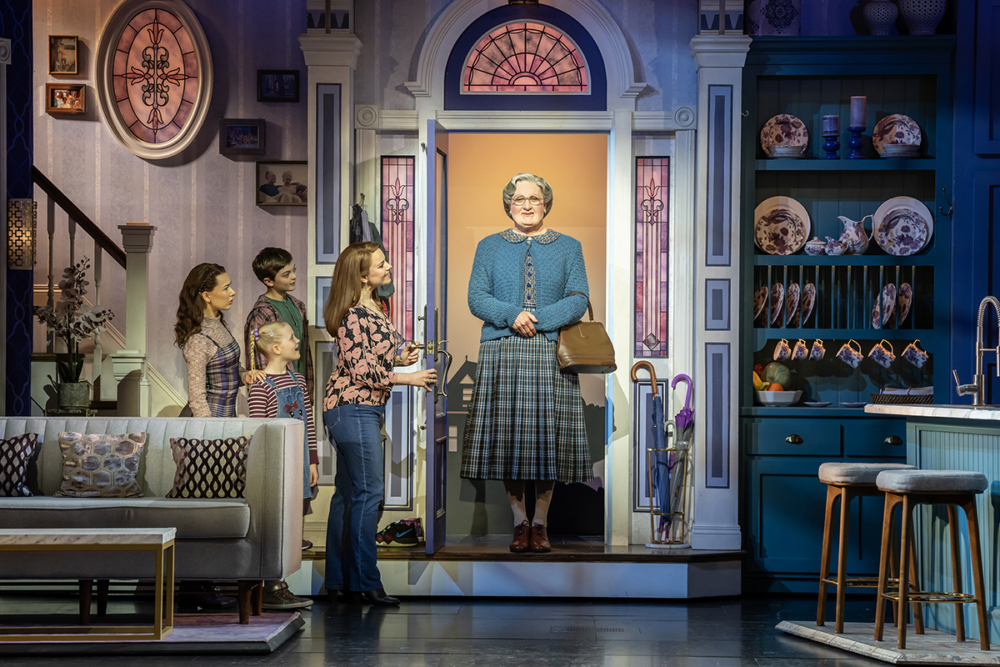
When it falls down, however, it crashes. The choreography drags just often enough and the set designs feel flimsy and lazy (mostly painted backdrop screens). The biggest transgression is Mrs. Doubtfire’s mask, which looks like a combination of Lurch’s waxy forehead and a cross between Howdy Doody’s and Hannibal Lecter’s jaw. Heartbreakingly distracting, it is a constant reminder of why the original film remains safely inimitable.

Nonetheless, the production was fun and fast-paced. The story, for the uninitiated, revolves around Daniel’s efforts to maintain contact with his three kids after a messy divorce from his wife, Miranda. An out-of-work freelance voice actor, Daniel is a loving and devoted father to his three children: 14-year-old Lydia (a show-stopping Alanis Sophia), 12-year-old Chris (Theodore Lowenstein on Wednesday evening), and five-year-old Natalie (Ava Rose Doty). However, his hardworking wife Miranda considers him immature and unreliable.

After quitting a gig following a disagreement over a morally questionable script, Daniel throws Chris a chaotic birthday party, despite Miranda’s objections due to Chris’s poor grades. In the ensuing argument, Miranda says that she wants a divorce. Due to Daniel’s unemployed and homeless status, Miranda is granted sole custody of the children, with Daniel having visitation rights every Saturday; shared custody is contingent on Daniel finding a steady job and suitable residence within the next three months.

In the meantime, he will be under the watchful eye of Wanda Sellner (a marvelous Kennedy V. Jackson), his court-appointed social worker.

He rents a shabby apartment and takes a part-time job as a janitor at a television station. After learning that Miranda seeks a housekeeper, Daniel secretly calls her using his voice acting skills to pose as various undesirable applicants before calling as “Euphegenia Doubtfire,” an elderly Scottish nanny with strong credentials. Impressed, Miranda invites Mrs. Doubtfire for an interview. Daniel’s brother, Frank, a makeup artist, and Frank’s husband, André, help Daniel appear as an old lady through the use of makeup and prosthetics. (Enter the unfortunate mask…)

Credit: Johan Persson

As Mrs. Doubtfire, Daniel excels at parenting, becoming the kind of father he couldn’t be before. The comedy ensues as he attempts to balance his life as Daniel and as Mrs. Doubtfire, particularly when he is on the cusp of landing a terrific new job as the creator/star of a children’s television show and Miranda’s new boyfriend, Stuart Dunmire, becomes a threat as a potential father figure.

We are introduced to Daniel (an enjoyably manic Craig Allen Smith) in the opening number, “That’s Daniel,” where his Peter Pan, slapstick, playful qualities are on full display. “You think you’re being amusing, but you’re just annoying,” his director tells him moments before firing him. The entire cast, and especially wife Miranda (Melissa Campbell, a terrific singer) wholeheartedly agree.

The makeover scenes are hilarious and DeVon Wycovia Buchanan, as André, is a real scene stealer. Having Frank (Brian Kalinowski) yell every time he lies is a cute conceit at first, but ends up hamstringing the actor and turning his character into more of a cardboard, two-dimensional role.

“Easy Peasy,” featuring Mrs. Doubtfire and the entire ensemble, is one of the musical’s most enjoyable. A chorus of tapdancing chefs (Kristin Angelina Henry is a standout) help the lyrical narrative move along, and the famous vacuuming scene (“I’m Rockin’ Now”) will please even the pickiest Robin Williams fan. As Daniel/Mrs. Doubtfire takes his parenting seriously and bonds with his kids in more mature and parental ways, their interactions take on a poignancy that even transcends the distraction of his mood-disrupting mask.

As the plot moves along, it also thickens. Act II brings Daniel’s unmasking (alas, figuratively only) when Chris discovers him peeing standing up. Although Daniel tries to reason with Lydia and Chris (Natalie is left out of the loop), they see it from a different angle. “You get to see your kids,” Lydia complains, “but we don’t get to see our dad. We just see a character.”

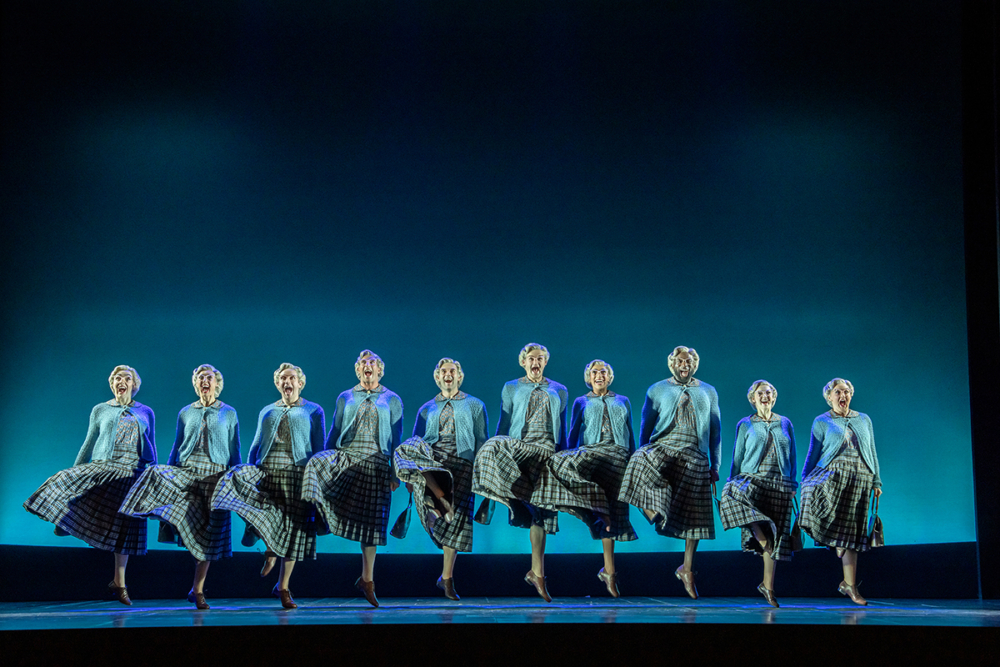
Act II also boasts some of the show’s best musical numbers. “Playing with Fire” has the chorus dressed as dancing Mrs. Doubtfires and “Let Go” spotlights Campbell’s (Miranda) enormous vocal talent. The spectacularly entertaining  “He Lied to Me” features Kristin Angelina Henry, who milks every ounce out of her portrayal of a cuckolded flamenco dancer.

Credit: Johan Persson

The mayhem culminates in a Marx-Brother scene when Daniel is scheduled to appear in the same restaurant as both Mrs. Doubtfire (Miranda’s birthday dinner) and himself (a job interview with Janet Lundy, television executive). He miraculously pulls off this scam thanks to bathroom help by Frank and André, but eventually the cat escapes its bag and everyone is in on the ruse.

The play concludes happily enough, but avoids tying too neat a bow. The best musical number of the show, “Just Pretend,” features Daniel (Smith) and Lydia (Sophia) in a dazzling duet that highlights Sophia’s singing chops. At the end of the day, the message is touching and real: “Even when you’ve lost your way,” Daniel sings to his daughter, “love will lead you home.”

‘Mrs. Doubtfire’ Music and Lyrics by Wayne and Karey Kirkpatrick. Book by Karey Kirkpatrick and John O’Farrell. Based on the Twentieth Century Studios Motion Picture. Arrangements and Orchestrations by Ethan Popp. Tour Direction by Steve Edlund. Tour Choreography by Michaeljon Slinger; Original Choreography by Lorin Latarro; Original Direction by Jerry Zaks. Scenic Design by David Korins; Costume Design by Catherine Zuber; Lighting Design by Philip S. Rosenberg; Sound Design by Keith Caggiano. Presented by Broadway in Boston and Work Lights Productions at the Emerson Colonial Theatre through Sept. 21.

For more information, visit https://boston.broadway.com/

A.R.T.’s Ephemeral ‘Passengers’ Awes with Acrobatics, Music and Dance

Cast of ‘Passengers’ by The 7 Fingers (Les 7 Doigts) at A.R.T.

By Shelley A. Sackett

Train travel has always evoked a magical aura of nostalgia and romanticism, an opportunity to slow down, observe and contemplate while suspended between past and future, between here and there. American Repertory Theater’s production of Passengers, a contemporary circus performance that combines acrobatics, dance, music and a gossamer thread of dramatic narrative, makes a case that train travel (as a metaphor for life) is all about the journey, not the destination.

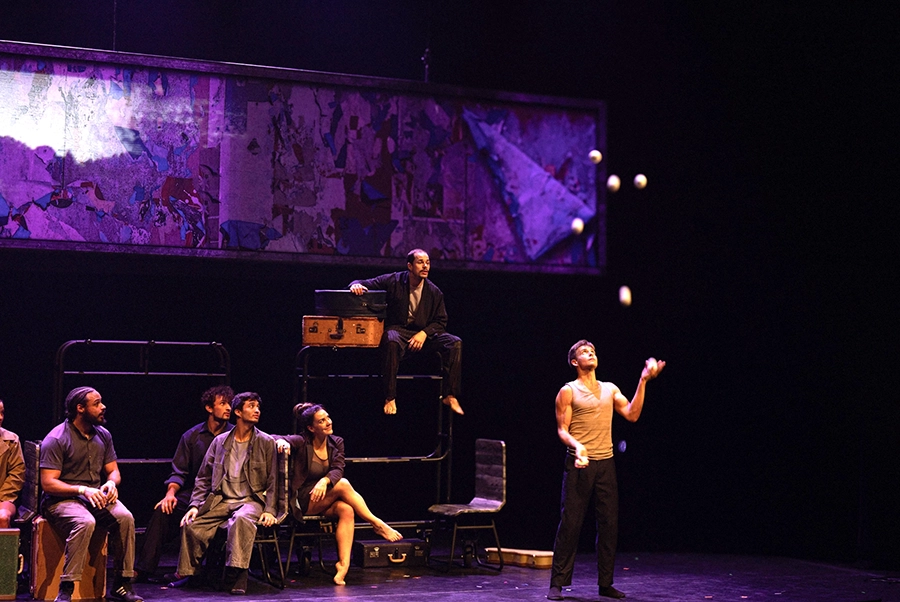
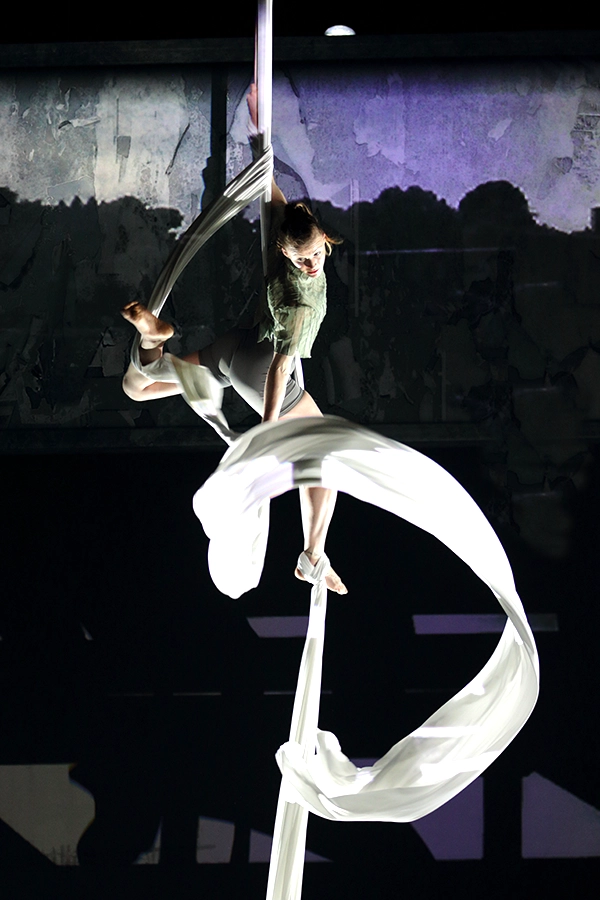
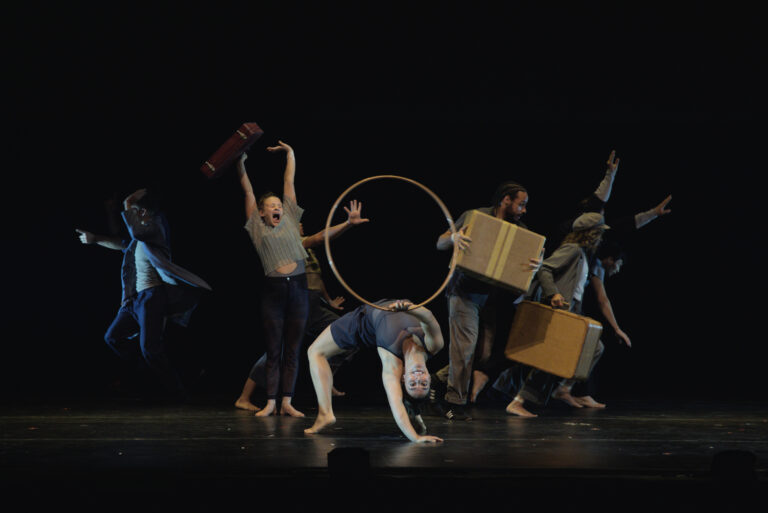
For 90 intermission-less minutes, 10 extraordinarily talented acrobats and circus performers (the cast of Montreal-based circus company, The 7 Fingers) use aerial straps, juggling, contortion, hand-to-hand balancing, hoops, pole climbing and aerial silk hammocks to elicit “oohs,” “aahs” and applause from an audience spellbound by the troupe’s physical strength and artistry. Equally dazzling is the show’s crystal clear sound system and arresting 16-song soundtrack of folk, jazz, Latin hip-hop, electronic trance and soulful chamber music. A simple but elegant set uses luggage racks and molded chairs as both acrobatic props and scene creators. Stunning lighting and effective, pleasing projections are icing on the cake.

As Artistic Director Diane Paulus explains in her program notes, the A.R.T. Engagement team develops the Essential Question to catalyze conversation. For Passengers, those questions are: In what ways does life happen while in transit? Is the journey truly more important than the destination?

Passengers’ strength lies in its ability to conjure feeling rather than thought. It is long on the sensual — from visual to auditory to emotional — but short on narrative and nuance.

The show begins with the performers arranging the chairs into train seats. They breathe in waves, creating the illusion of a train’s wheels as a cello and piano reach a velvety crescendo (“Prologue”). Like a mash-up of Pilobolus and a three-ring circus, the performers break off into couples and triads. The effect is spellbinding and its episodic pace and focus set the tone for the rest of the evening.

Amanda Orozco. Photo by Sébastien Lozé

Next is the upbeat, swinging “Train Is Coming,” featuring Méliejade Tremblay-Bouchard and her amazing hula hoops. “Sabine’s Departure” features a gorgeous cello and the extraordinary Amanda Orozco, who dazzles and mesmerizes with her white silk parachute aerial skills. There is playful, captivating egg juggling (Santiago Rivera Laugerud), fearless high-flying leaping (Marie-Christine Fournier) and a stunning number that ends with a couple entwined on the floor.

The most whimsical story-lined number has a passenger (Isabella Diaz) somberly waiting for and boarding the train, nervous about the future, sad to leave the past, or a little of both. Once aboard, she unleashes her power to freeze frame time and the other passengers with it. She plays with them lightheartedly, repositioning them and gesturing with expressive, elegant hands, before unfreezing them. Her movements are a delight, as balletic as they are spunky and charming.

Most amazing of all is the fact that these performers work without nets, their safety dependent on teamwork and trust. In addition to inviting us to ponder the passage of time, Passengers also forces us to look our own (and the performers’) mortality squarely in the eye.

The show finishes as it began, with the performers seated in a semi-circle. There is no definitive arrival or resolution, but somehow these passengers seem more connected, more intimate. They (and we) have shared something, even if that something lacks narrative cohesion or clarity.

At the end of the day, Passengers is a valentine to physical strength, flexibility and the extraordinary grace inherent in the human body. If you are in the mood to be entertained by a smaller, gentler, more abstract but no less breathtaking Cirque de Soleil, then Passengers may be right up your alley. If, however, you prefer your live theatrical entertainment to have more plot and clearly definable characters than physical stunts and “acts,” then Passengers may not fit your bill.

Photo by Grace Gershenfeld

Whether Passengers is theater or contemporary circus (and whether that matters) is an important conversation for another time. Clearly, A.R.T., by opening its 2025/2026 season with the show, believes it belongs on its revered stage.

Colin Gagné; Lyrics by Colin Gagné and Shana Carrol; Scenic Design by Ana Cappelluto; Costume Design by Camille Thibault-Bédard; Lighting Design by Éric Champoux; Projection Design by Johnny Ranger; Sound Design by Colin Gagné and Jérôme Guilleaume. Presented by American Repertory Theater at Loeb Drama Center, 64 Brattle St., Cambridge, through Sept. 26.

For more information, visit americanrepertorytheater.org/