‘To Kill a Mockingbird’ Is A Welcome Addition to Umbrella Theatre’s Season

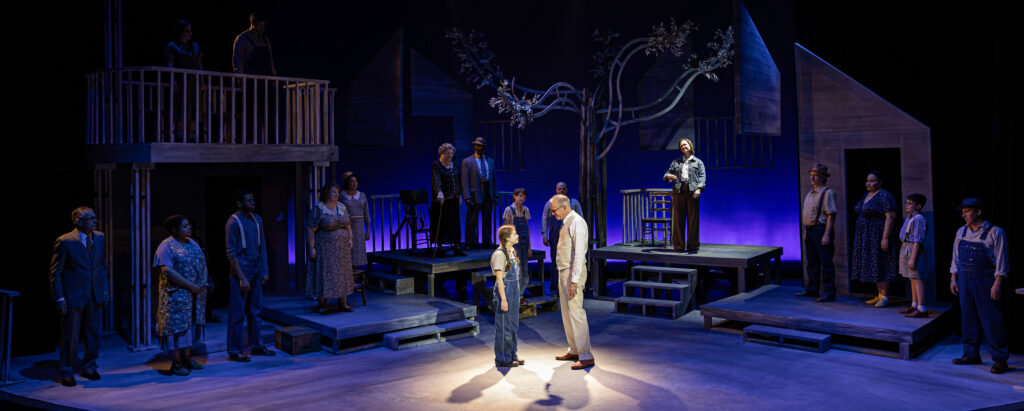
The Cast of ‘To Kill a Mockingbird’ at The Umbrella Arts Center
Photos by Jim Sabitus

By Shelley A. Sackett

To Kill a Mockingbird, the 1960 Pulitzer Prize-winning novel written by Harper Lee and dramatized in 1970 by Christopher Sergel, tells the story of events that take place in the small town of Maycomb, Alabama, during the Depression (1932 to 1935). The plot and characters are based on Lee’s observations of her family, neighbors and an actual event that took place in 1936 near her hometown, Monroeville, Alabama.

Lee was 10 years old at the time, the same age as Scout (Jean Louise), her novel’s narrator and thinly veiled stand-in for the author. In the theatrical version, 10-year-old narrator Scout is replaced by her adult self, Jean Louise, adding a layer of nuance.

The play (145 minutes, one intermission) follows the lives and rich imaginations of the Finch children (Scout and her older brother, Jem) and their friend, Dill, who visits his aunt in Maycomb for the summer. Maycomb is a quiet town with deep-seated social hierarchies based on race, class, socioeconomic status, and how long each family has lived there.

Its residents are closely knit and tightly wound. There are strict lines about gender, class, social standing, finances, and most important of all, race, and those who cross those lines do so at their peril.

Barlow Adamson, Shelly Knight

Atticus Finch, Scout and Jem’s widowed father, is a middle-aged lawyer with a strong sense of right and wrong and a dignified, gentlemanly bearing. He encourages the children to think of Calpurnia, their Black cook and caregiver, as family. He approaches their every question as a teachable moment, and breaks down huge issues into bite-sized morsels they can digest more easily.

Most important of all, he tries to instill in them the ability to feel empathy before criticizing or condemning. “You never really understand a person until you consider things from his point of view […] until you climb into his skin and walk around in it,” he tells Scout and Jem. Everyone is equal in Atticus’s eyes, and the weakest must always be defended against the most powerful.

For the most part, the children busy themselves each summer with convoluted plans to lure their reclusive neighbor, Arthur “Boo” Radley, out of his house. Miss Stephanie, one of the town’s Queen Bee gossips, has filled their heads with tales of Boo as a mysterious and dangerous person who even stabbed his own father with a pair of scissors.

They start to notice small gifts left in the knothole of a tree, and assume they are for them. They also assume they are from Boo, even though they’ve never laid eyes on him.
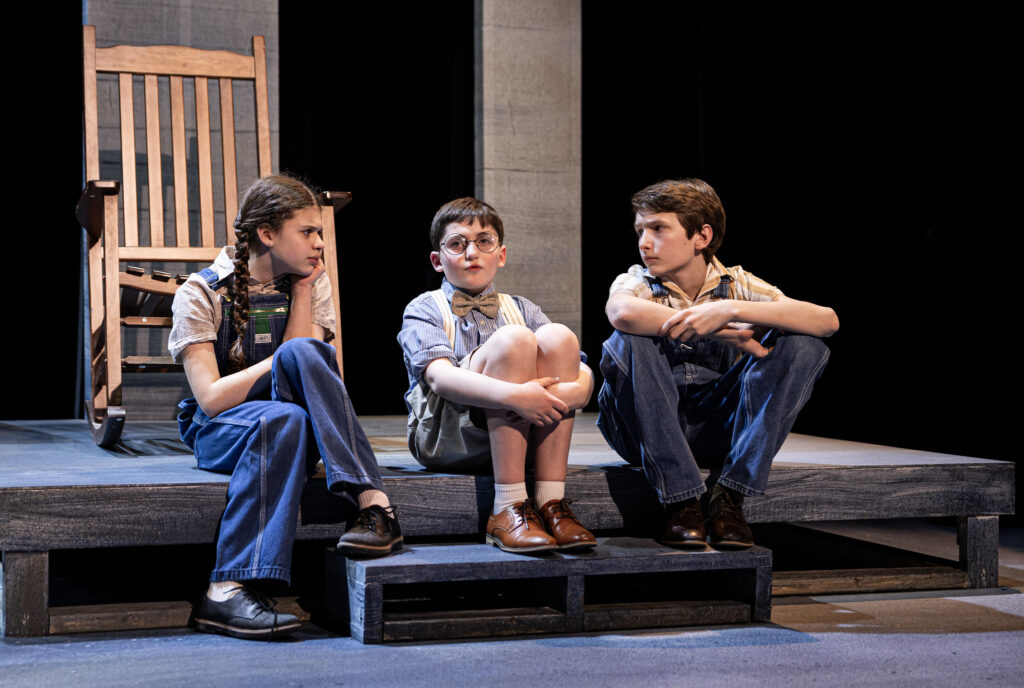
Shelly Knight, Joseph Hobbib, Ryan Spry

Soon after, the atmosphere in Maycomb becomes thick with unbridled prejudice and raw hate. Atticus is appointed to defend Tom Robinson, a Black man falsely accused of raping Mayella Ewell, a White woman. Atticus believes every person deserves a fair defense; he doesn’t just talk this talk, he relishes the opportunity to walk the walk, his back straight and his head held high.

The townspeople aren’t as civic-minded, and both Atticus and his children are soon the targets of mob terror tactics.
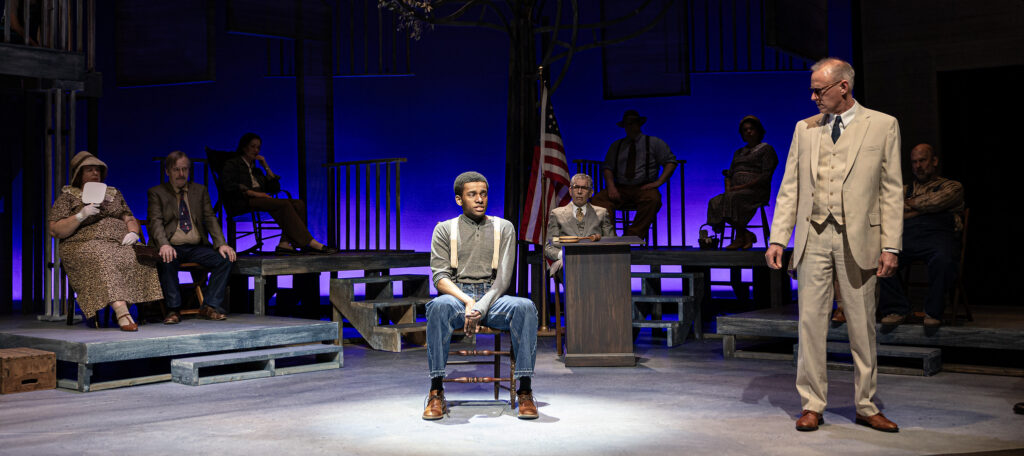
Bryce Mathieu, Adamson

One of the book’s most poignant scenes (well adapted by Sergel) is when Scout outs a masked man who has come with his posse to menace Atticus as he stands guard all night at the jail where Robinson is being held pending trial.

“Hey, Mr. Cunningham,” she says, recognizing his hat. She asks about his family (she knows they have no money as she earlier witnessed him paying Atticus’s fees with turnips and kindling) and asks him to say “hey” to his son, who is in her class at school.

Shamed and embarrassed, Cunningham calls off his pack dogs and heads home.

Things heat up even more after the trial (among the play’s — and book’s — best scenes) and boil over one night when Scout and Jem are attacked in the woods. Despite disappointment and tragedy, all is eventually resolved, and there is a sense of closure and hopefulness by the play’s end.

Director Scott Edmiston uses Janie Howland’s simple but elegant set to his best advantage, and the addition of Valerie Thompson’s emotive solo cello is a stroke of brilliance. In a cast of many, Amelia Broome (adult Jean Louise Finch), Carolyn Saxon (Calpurnia), Bryce Mathieu (Tom Robinson), and Barlow Adamson (Atticus) stand out.
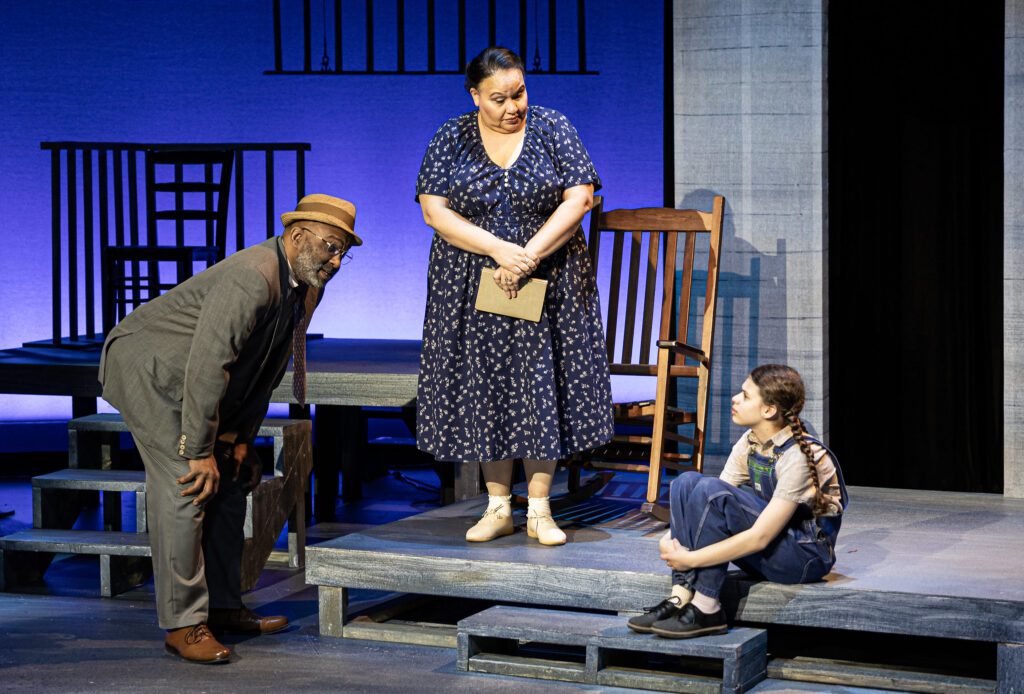
Damon Singletary, Carolyn Saxon, Shelly Knight

As impressive as it was that the three youngsters playing Scout, Jem and Dill learned so many lines, it was sadly impossible to hear and understand their words. Frustrating for the audience; tragic for the actors.

To Kill a Mockingbird, with its themes highlighting racial prejudice, moral courage, and lost innocence, is as relevant today as it was when written. To wit, it is frequently challenged and has been banned or removed from various school districts across the U.S., including in Mississippi, California, and Virginia, often due to its use of the N-word, racial slurs, and uncomfortable themes regarding race. While it is not nationally banned, it consistently appears on the American Library Association’s (ALA) list of most challenged books, frequently ranking in the top ten.

What a shame that the lesson of love and respect at the heart of this work is so feared by those who need to hear (and heed) it most. As Atticus so eloquently explains to his young daughter, “Shoot all the bluejays you want, if you can hit ‘em, but remember it’s a sin to kill a mockingbird.” After all, mockingbirds are delicate, vulnerable creatures who never do anything harmful. All they want to do is to pleasure others with their clear, beautiful singing.

‘To Kill a Mockingbird’ — Dramatized by Christopher Sergel. Based on the Book by Harper Lee. Directed by Scott Edmiston. Scenic Design by Janie Howland; Lighting Design by SeifAllah Salotto-Cristobal; Costumes by Rachel Padula-Shufelt; Sound Design by Chris Brousseau; Original Music on Cello by Valerie Thompson. Presented by The Umbrella Stage Company, 40 Stow St., Concord, MA, through March 22.For more information, visit https://theumbrellaarts.org/
Apollinaire’s Impassioned ‘A View from the Bridge’ Reveals Troubled Waters Below

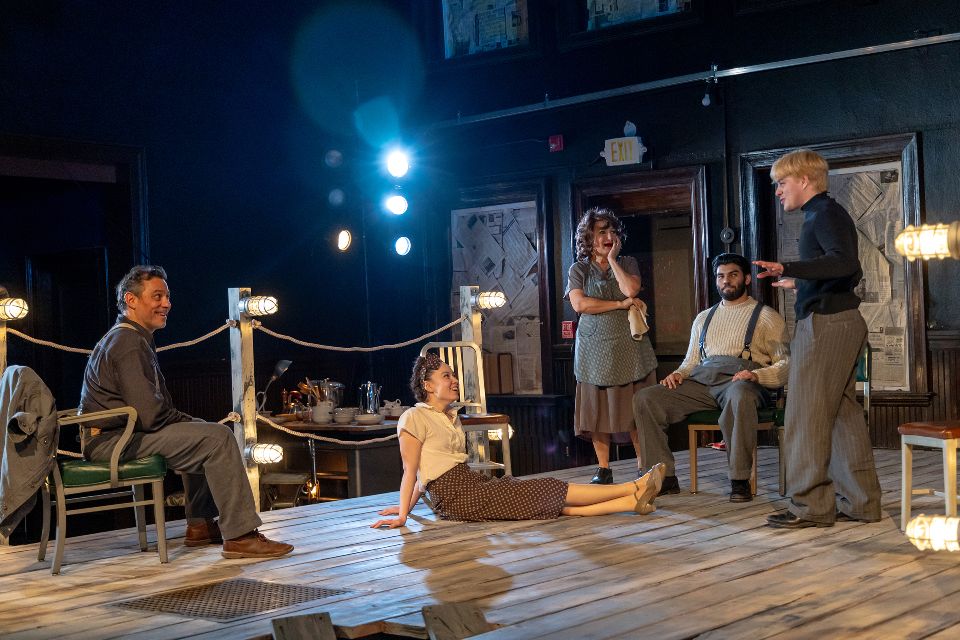
Cast of Apollinaire’s ‘A View from the Bridge’
Photos by Darlene DeVita

‘A View from the Bridge’ — Written by Arthur Miller. Directed by David R. Gammons. Scenic and Sound by Joseph Lark-Riley; Costumes by Elizabeth Rocha; Lighting by Kevin Fulton. Presented by Apollinaire Theatre, 189 Winnisimmet St., Chelsea, through March 22.

By Shelley A. Sackett

Arthur Miller, a prominent 20th century American playwright best known for the classics Death of a Salesman (1949) and The Crucible (1953), penned the two-act A View from the Bridge in 1956 to tackle themes of working-class masculinity; conflicts between natural and bureaucratic law; family dynamics; feminism, and the struggles faced by immigrants (especially when illegal and confronted by anti-immigrant backlash).

He created the Carbones, a 1950s Italian-American household living in Red Hook, Brooklyn, as the vehicle through which to explore these timeless big ticket topics. He also uses their soap opera family dramas to investigate and expose the underbelly of human emotions and the havoc they can wreak.

The play opens on Joseph Lark-Riley’s stark but effective stage that will serve as a dock, a lawyer’s office, an apartment, and a street. The full cast assembles on the large center platform, everyone talking at once in a variety of languages, a Brooklyn version of the Tower of Babel. It doesn’t seem to matter that they can’t understand each other; they speak not to converse, but to express.

This style of flawed, blindered communication will inevitably result in tragic consequences and is at the heart of A View from the Bridge’s real message.

Miller uses the elderly lawyer Alfieri (Dev Luthra) as omniscient narrator and Greek Chorus stand-in to describe Red Hook and the unexciting types of cases he usually deals with. Once in a while, however, one stands out, like Eddie Carbone (Jorge Rubio), a 40-year-old longshoreman. Although this catastrophe was inevitable, its trajectory was unstoppable.

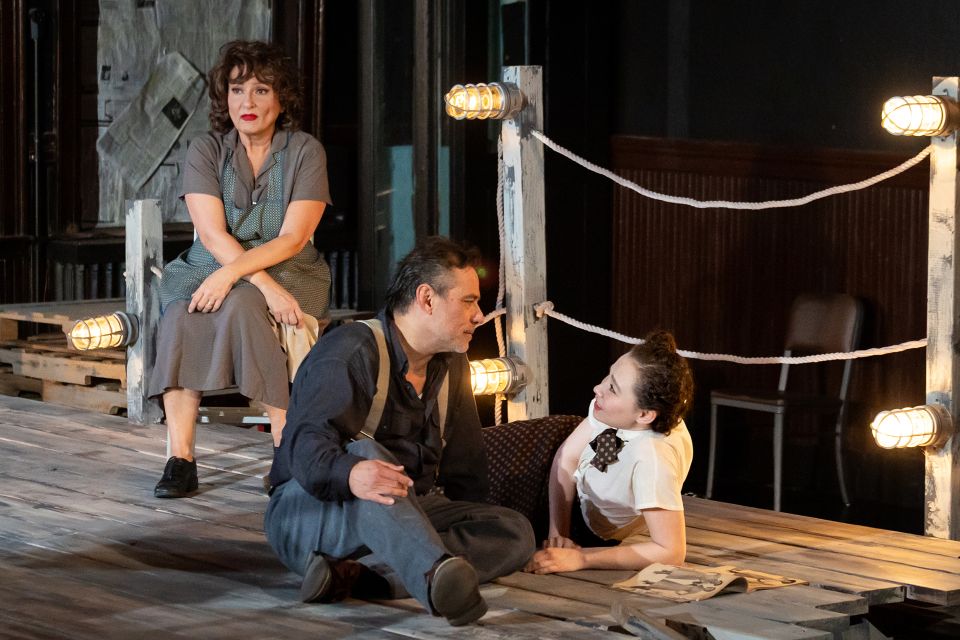
The action seamlessly shifts to the living room of Eddie’s apartment, where he lives with his wife, Beatrice (the marvelous Sehnaz Dirik), and their 17-year-old adopted niece Catherine (Naomi Kim). The second Eddie walks through the door, the conflict that is a recipe for full-blown tragedy is as obvious as it is menacing.

Sehnaz Dirik, Jorge Rubio, Naomi Kim

Eddie makes a beeline for Catherine, flirting with her in a way that is creepy and borderline incestuous. She responds with playful childishness, but it is clear that a part of her understands exactly what he is doing and likes it.

Beatrice just as clearly gets it and unambiguously does NOT like it. Yet, the furthest she will go is to throw quick verbal jabs at Eddie, trying to reason with him and point out the wrongness of his behavior. He predictably rebuffs her. She continues to suffer in silence, unwilling to confront the man she loves, even as he humiliates her to her face.

It’s hard to find much to like, let alone empathize with, in Eddie. Brash, tyrannical, petty and lacking self-awareness, he has channeled his passion into Catherine, pouring his money and soul into raising her to be better than he is. He has kept her locked in a gilded cage, “protecting” her by forbidding her to hang out with contemporaries.

This night, there is big news to share. Beatrice’s cousins are arriving from Sicily, and Catherine has landed a job, even though she still hasn’t graduated from high school. Eddie has granted permission for the cousins to stay in his home, but he is not as amenable to Catherine unfurling her wings and launching into the real world and a life independent of Eddie’s control.

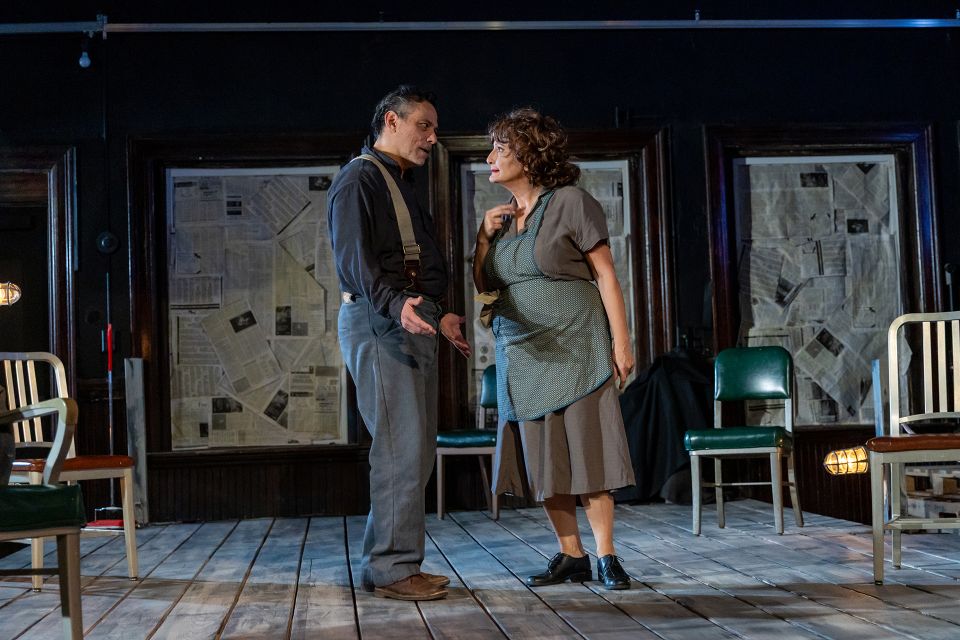
Rubio, Dirik

Beatrice cajoles, begs and tries to reason, but ultimately defers to Eddie’s position as decision-maker. Only after the women refuse to talk to him or even acknowledge his presence does he cave and allow Catherine to take the job she so desperately wants (and deserves).

Things don’t fare as well when the cousins arrive. Although Eddie claims he is honored to be able to help his family, he harbors deep resentment that no one helped his own family when they arrived under similar circumstances. The “submarines” (illegal immigrants) are brothers Marco (Rohan Misra) and Rodolpho (Andres Molano Sotomayor). Marco, married with children he already misses, is anxious to get to work at the docks and send money home. He is serious and sullen.

Younger brother Rodolpho is the opposite. Blond (think Ryan Gosling in “Barbie”), unconventional, and with the soul of an artist (he sings jazz, dances, cooks and jokes), Rodolpho is popular on the docks. He opens Catherine’s eyes and heart to the possibility of a life of her own outside Eddie’s clutch.

Soon, the two are courting, in full view of the increasingly unhinged and rattled Eddie.

His domestic tyranny is threatened for the first time. He panics at the thought of losing his caged bird, increasingly desperate and pathetic. He claims Rodolpho has homosexual tendencies and is only interested in marrying Catherine to gain citizenship. “I want my respect,” he insists, a line that has always worked with the more compliant Beatrice.

Even Beatrice is alarmed by Eddie’s behavior, and she finally tries to intervene directly. She counsels Catherine to do as she says, be independent, and set boundaries (something she is unable to accomplish). To Eddie, she is blunter. “When are you going to leave her alone?” she demands. “You’ve got to stop it.”

In desperate jealousy, Eddie turns to Alfieri, hoping for help from the law. “Too much love sometimes goes where it shouldn’t,” he tells Eddie. “Let it go. Let her live her life.”

When Eddie protests that he can’t do that, Alfieri tells him that the only recourse he has is to report Rodolpho and Marco as undocumented. As in much of the play’s sometimes unsurprising plot, Miller doesn’t hide the ball, foreshadowing the bad seed that will grow into the tragic beanstalk that will poison many lives.

Kim, Rubio

In Act II, Eddie snaps, releasing a boulder that careens with a destructive force that will affect every character and climax in a crisis that brings little catharsis or closure.

David R. Gammon’s directing and Kevin Fulton’slighting create believable illusions of different times and places. The scene with Eddie and his two buddies on the dock is particularly effective, using uplit faces, coordinated head turns, and spine-chilling laughter to craft a sense of camaraderie, hysteria, and threat.

As Beatrice, the always superb Dirik breathes life into Eddie’s drab, brow-beaten, and long-suffering wife. Her facial expression, cadence, and spot-on gestures are impossible to ignore, whether she is center-stage and delivering a crucial speech or silently reacting. Her magnetism on stage is a pleasure to witness.

Although a few characters seem miscast and the last scene is one of overly prolonged top volume agony, Apollinaire Theatre’s two-hour (one intermission) production is particularly timely and a reminder of why this play has won Tony and Drama Critic awards, the Pulitzer Prize, and been adapted for opera, television, film and radio.

For more information and tickets, visit: https://www.apollinairetheatre.com