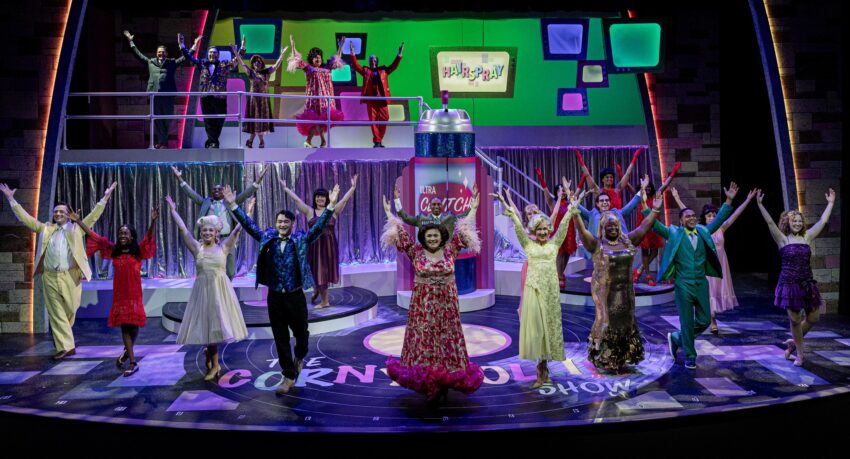
Umbrella Stage Co.’s ‘Hairspray’ Kicks Off Summer with A Rollicking Good Time

By Shelley A. Sackett
 
Hairspray, the musical set in 1962 Baltimore with an offbeat following, features an outcast yet optimistic high schooler who lands a spot on a local TV dance show and campaigns for racial integration. It originated as a cult-classic 1988 John Waters film with Divine, Ricki Lake, John Waters, Jerry Stiller, Deborah Harry and Sonny Bono, evolved into a 2002 Tony Award-winning Broadway musical, and became a blockbuster 2007 movie adaptation (John Travolta, Michelle Pfeiffer, and Christopher Walken).
 
With Umbrella Stage Company’s recent bang-up production, it once again proved that, despite being almost four decades old, it will never lose its staying power for one very important reason — it is FUN.

On its surface, the story is about teenagers who just want to fit in and be accepted by the “in” (as in WASP) crowd. Pleasantly plump, jovial and chatty Baltimore teenager Tracy Turnblad (Nora Sullivan) and best friend Penny Singleton (Maggie Cavanaugh) race home after school every day to watch “The Corny Collins Show,” a local TV danceathon. Tracy yearns to be a dancer on the show, even dreaming of being hand-picked by Corny (Joshua Lapierre) to be on his Council (the super Popular Kids). Some of those kids go to Tracy and Penny’s school.
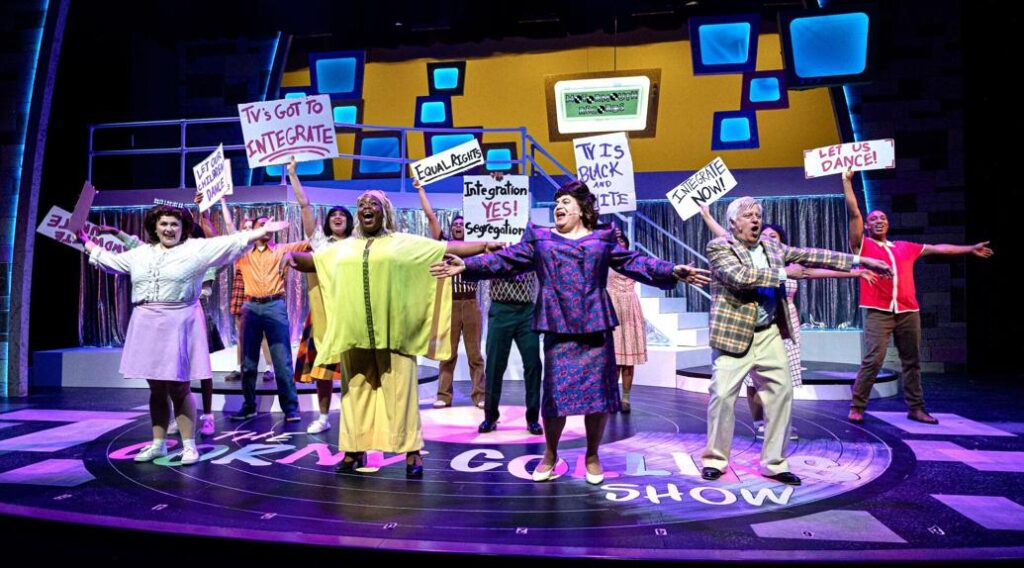

Tracy’s mother, Edna (played in drag, as Waters tradition demands, by an outstanding Robert Saoud), is as oversized and big-hearted as her daughter. She worries Tracy will be crushed if she reaches too high. Dad Wilbur (Chip Phillips) is Tracy’s biggest cheerleader. He encourages her to live large, dream big and go for it.
 
By hook and by crook, she passes the audition and becomes an overnight teen celebrity. The show is produced with an iron fist by stage manager, Velma (Aimee Doherty in a role that finally fits her like a glove), the mother of dancer, Amber, whom she is scheming to get elected to the inner Council.
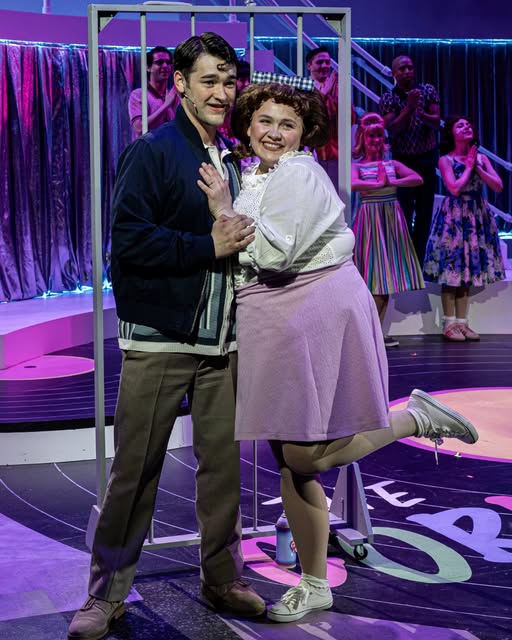
Nick Corsi, Sullivan

Station policy (it is 1962 after all), which Velma cheerfully enforces, dictates the show’s “whites only” policy. The one exception is a monthly Negro Day, hosted by local R&B disc jockey “Motormouth” Maybelle Stubbs (Barbara Pierre, whose singing raises the roof and then sets it on fire).
 
(The “Corny Collins Show” was inspired by the real “Buddy Deane Show,” which ran from 1957 to 1964 and held segregated “Negro Days” rather than integrate its broadcast.)

Tracy is regularly sent to detention (her teased, lacquered hair is also “too big”). There, she meets Black kids who teach her how to dance in a whole new and exciting way. They also teach her about racism, Baltimore style.
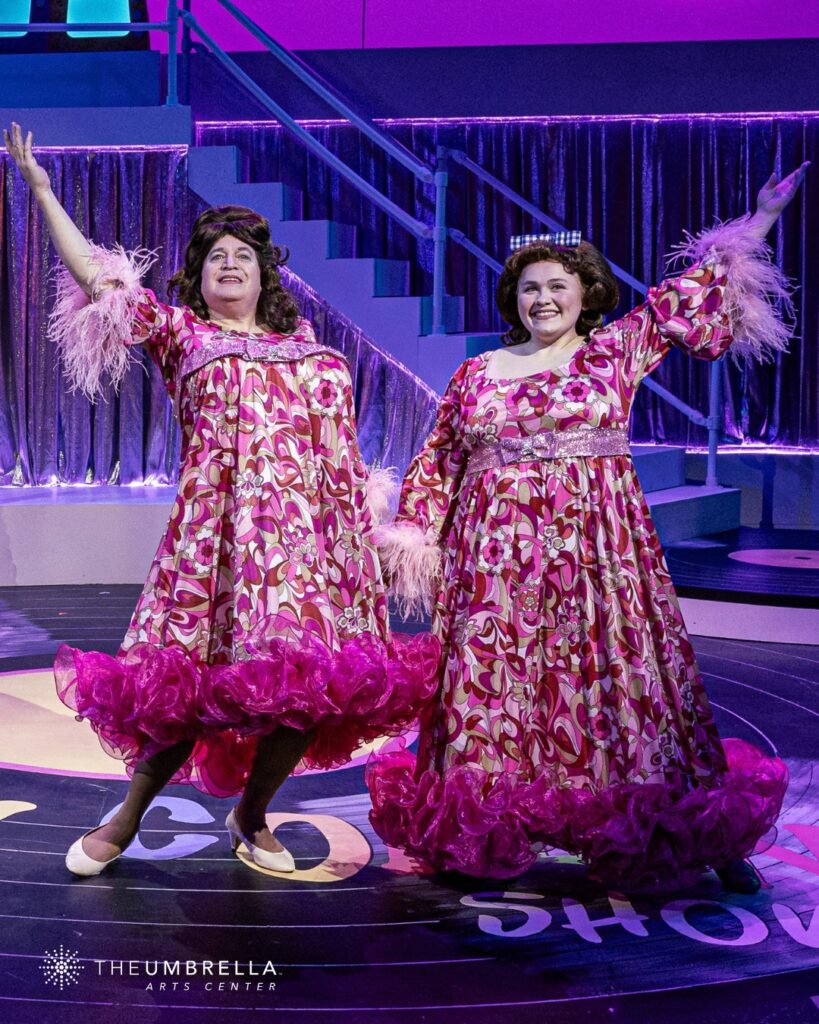
Robert Saoud, Nora Sullivan


Tracy returns to “The Corny Collins Show,” determined to use her newfound fame to advocate for racial integration on the show, win the heart of Amber’s boyfriend, heartthrob Link Larkin (Nick Corsi), and defeat the racist and sizeist Velma. She takes on the daunting task of challenging these social norms by being her bright and breezy plus-sized self, a proud woman on television advocating for what is right.
 
Eventually she succeeds after protests, arrests and a whole lotta music, singing and dancing.
 
Which brings me to the real reason to see Hairspray: the MUSIC, the SINGING and the DANCING.
 
This is one non-stop, high energy extravaganza that runs on the even higher octane of Tracy’s infectious happiness and confidence. From the opening note, the fabulous band (Jordan Oczkowski, conductor), cast and ensemble are in full-throated sync as they frolic, leap, bop and cavort. (Najee A. Brown, director and choreographer). The sound is perfect (Alex Berg), the band audible, the singers comprehensible. Cameron McEachern’s vibrant set with colorful TVs, records, and “Hullabaloo” and “Shindig” era scaffold-like structures transports the audience (and their nostalgic parents and grandparents) back to the glories of glorious sixties culture.
 
Notwithstanding the sheer joy of the production, there are meaty issues acknowledged and addressed head-on. When Motormouth discovers her son, Seaweed, and Penny have fallen in love, she warns them, “So you two better brace yourselves for a whole lot of ugly coming your way on a never-ending train of stupid.”
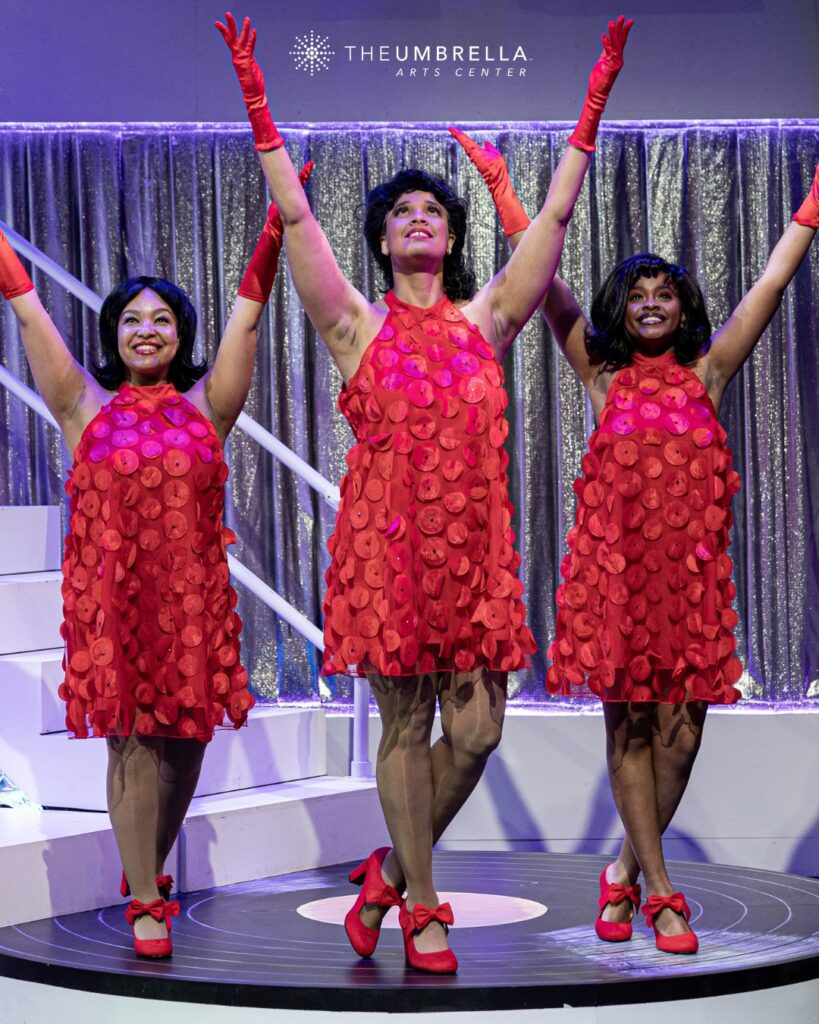


Simone Alyse, Pearl Scott, and Nikita Darosa


Although all ends well enough and the caliber of production is steady to the finish line, this entertainment is neither fluff nor dated. For every laugh and dream that burns bright, there are tears and dreams snuffed out. The 1960s were a time of reckoning, awakening, and wrestling with the disparity between what is and what could and should be. The fight for people of ALL sizes, shapes, politics, races and religions to be accepted does not just lie below the surface of this show.
 
“You can’t get lazy when things get crazy,” Motormouth sings in the showstopping finale, “You Can’t Stop the Beat.” “Fighting for equality, for what is right, is the light that will melt the darkness.”
 
Her words were spot on in 1962 and, 64 years later, are sadly even more so today. 

‘Hairspray’ – Directed by Najee A. Brown. Book by Mark O’Donnell and Thomas Meehan. Choreography by Najee A. Brown; Music Direction by Jordan Oczkowski; Music by Marc Shaiman. Lyrics by Scott Wittman and Marc Shaiman. Scenic Design by Cameron McEachern; Lighting Design by SeifAllah Salotto-Cristobal; Sound Design by Alex Berg; Costumes by Emerald City Theatricals. (The run of this show concluded May 17).
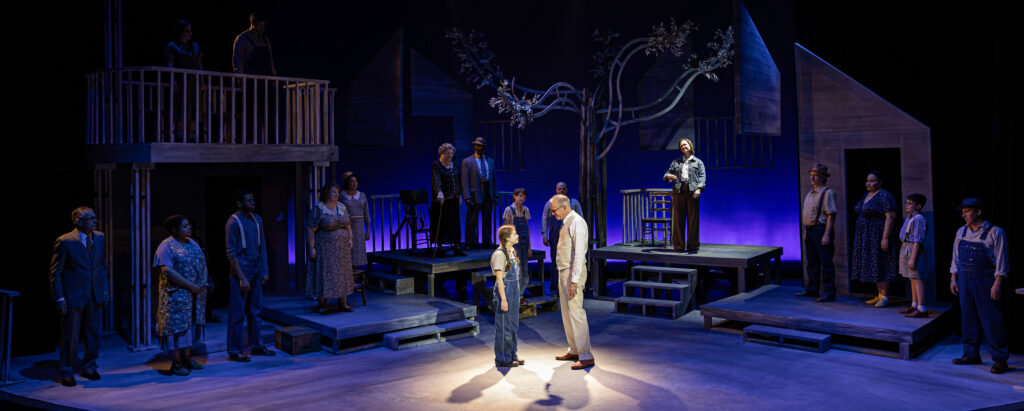
 

‘To Kill a Mockingbird’ Is A Welcome Addition to Umbrella Theatre’s Season

The Cast of ‘To Kill a Mockingbird’ at The Umbrella Arts Center
Photos by Jim Sabitus

By Shelley A. Sackett

To Kill a Mockingbird, the 1960 Pulitzer Prize-winning novel written by Harper Lee and dramatized in 1970 by Christopher Sergel, tells the story of events that take place in the small town of Maycomb, Alabama, during the Depression (1932 to 1935). The plot and characters are based on Lee’s observations of her family, neighbors and an actual event that took place in 1936 near her hometown, Monroeville, Alabama.

Lee was 10 years old at the time, the same age as Scout (Jean Louise), her novel’s narrator and thinly veiled stand-in for the author. In the theatrical version, 10-year-old narrator Scout is replaced by her adult self, Jean Louise, adding a layer of nuance.

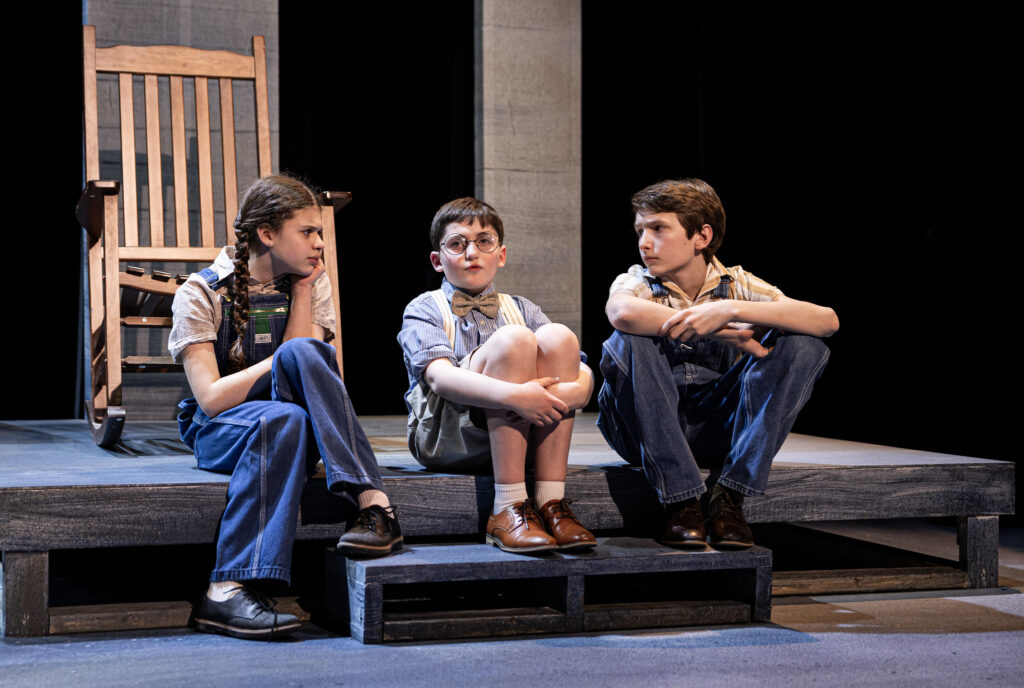
The play (145 minutes, one intermission) follows the lives and rich imaginations of the Finch children (Scout and her older brother, Jem) and their friend, Dill, who visits his aunt in Maycomb for the summer. Maycomb is a quiet town with deep-seated social hierarchies based on race, class, socioeconomic status, and how long each family has lived there.

Its residents are closely knit and tightly wound. There are strict lines about gender, class, social standing, finances, and most important of all, race, and those who cross those lines do so at their peril.

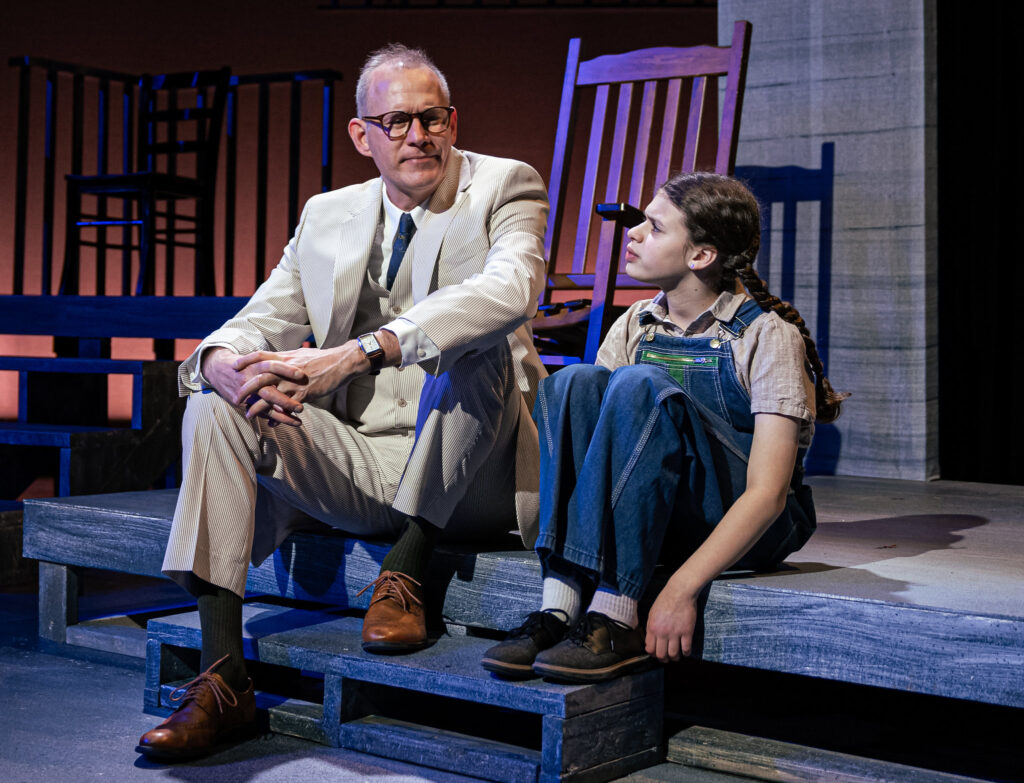
Barlow Adamson, Shelly Knight

Atticus Finch, Scout and Jem’s widowed father, is a middle-aged lawyer with a strong sense of right and wrong and a dignified, gentlemanly bearing. He encourages the children to think of Calpurnia, their Black cook and caregiver, as family. He approaches their every question as a teachable moment, and breaks down huge issues into bite-sized morsels they can digest more easily.

Most important of all, he tries to instill in them the ability to feel empathy before criticizing or condemning. “You never really understand a person until you consider things from his point of view […] until you climb into his skin and walk around in it,” he tells Scout and Jem. Everyone is equal in Atticus’s eyes, and the weakest must always be defended against the most powerful.

For the most part, the children busy themselves each summer with convoluted plans to lure their reclusive neighbor, Arthur “Boo” Radley, out of his house. Miss Stephanie, one of the town’s Queen Bee gossips, has filled their heads with tales of Boo as a mysterious and dangerous person who even stabbed his own father with a pair of scissors.

They start to notice small gifts left in the knothole of a tree, and assume they are for them. They also assume they are from Boo, even though they’ve never laid eyes on him.

Shelly Knight, Joseph Hobbib, Ryan Spry

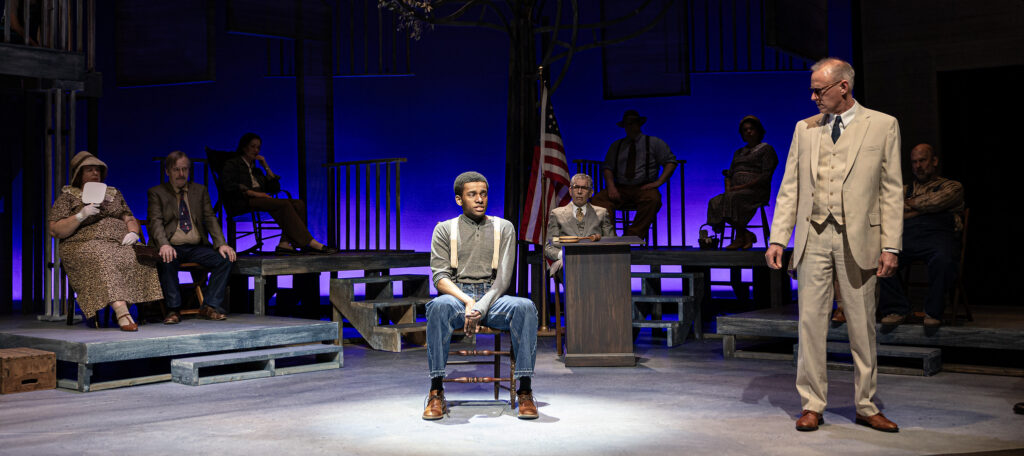
Soon after, the atmosphere in Maycomb becomes thick with unbridled prejudice and raw hate. Atticus is appointed to defend Tom Robinson, a Black man falsely accused of raping Mayella Ewell, a White woman. Atticus believes every person deserves a fair defense; he doesn’t just talk this talk, he relishes the opportunity to walk the walk, his back straight and his head held high.

The townspeople aren’t as civic-minded, and both Atticus and his children are soon the targets of mob terror tactics.

Bryce Mathieu, Adamson

One of the book’s most poignant scenes (well adapted by Sergel) is when Scout outs a masked man who has come with his posse to menace Atticus as he stands guard all night at the jail where Robinson is being held pending trial.

“Hey, Mr. Cunningham,” she says, recognizing his hat. She asks about his family (she knows they have no money as she earlier witnessed him paying Atticus’s fees with turnips and kindling) and asks him to say “hey” to his son, who is in her class at school.

Shamed and embarrassed, Cunningham calls off his pack dogs and heads home.

Things heat up even more after the trial (among the play’s — and book’s — best scenes) and boil over one night when Scout and Jem are attacked in the woods. Despite disappointment and tragedy, all is eventually resolved, and there is a sense of closure and hopefulness by the play’s end.

Director Scott Edmiston uses Janie Howland’s simple but elegant set to his best advantage, and the addition of Valerie Thompson’s emotive solo cello is a stroke of brilliance. In a cast of many, Amelia Broome (adult Jean Louise Finch), Carolyn Saxon (Calpurnia), Bryce Mathieu (Tom Robinson), and Barlow Adamson (Atticus) stand out.

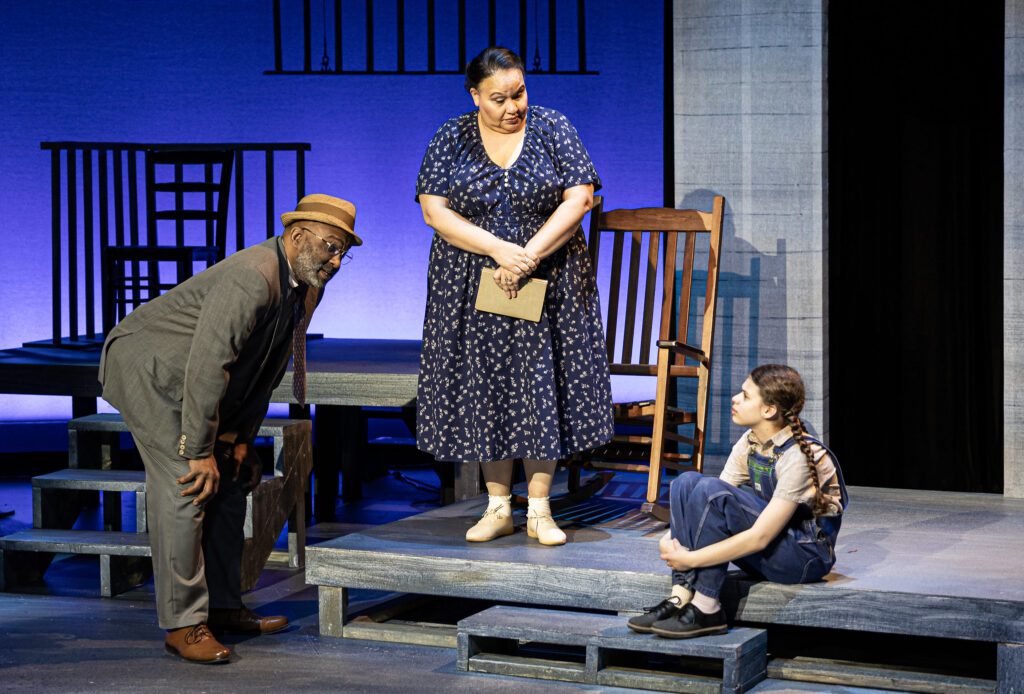
Damon Singletary, Carolyn Saxon, Shelly Knight

As impressive as it was that the three youngsters playing Scout, Jem and Dill learned so many lines, it was sadly impossible to hear and understand their words. Frustrating for the audience; tragic for the actors.

To Kill a Mockingbird, with its themes highlighting racial prejudice, moral courage, and lost innocence, is as relevant today as it was when written. To wit, it is frequently challenged and has been banned or removed from various school districts across the U.S., including in Mississippi, California, and Virginia, often due to its use of the N-word, racial slurs, and uncomfortable themes regarding race. While it is not nationally banned, it consistently appears on the American Library Association’s (ALA) list of most challenged books, frequently ranking in the top ten.

What a shame that the lesson of love and respect at the heart of this work is so feared by those who need to hear (and heed) it most. As Atticus so eloquently explains to his young daughter, “Shoot all the bluejays you want, if you can hit ‘em, but remember it’s a sin to kill a mockingbird.” After all, mockingbirds are delicate, vulnerable creatures who never do anything harmful. All they want to do is to pleasure others with their clear, beautiful singing.

‘To Kill a Mockingbird’ — Dramatized by Christopher Sergel. Based on the Book by Harper Lee. Directed by Scott Edmiston. Scenic Design by Janie Howland; Lighting Design by SeifAllah Salotto-Cristobal; Costumes by Rachel Padula-Shufelt; Sound Design by Chris Brousseau; Original Music on Cello by Valerie Thompson. Presented by The Umbrella Stage Company, 40 Stow St., Concord, MA, through March 22.For more information, visit https://theumbrellaarts.org/