ASP’s Not-to-Be-Missed “How I Learned to Drive” Explores Abuse and Memory in a Tour de Force Production

Dennis Trainor, Jr. and Jennifer Rohn in Actors’ Shakespeare Project’s ‘How I Learned to Drive’
(Photo Credit: Nile Scott Studios)

By Shelley A. Sackett

“You and Driver Education — Safety First,”  a voice announces as the lights dim. A middle-aged woman steps onto a bare set, composing herself. She turns to face the audience, addressing them as though mid-conversation.

“Sometimes, to tell a secret, you first have to teach a lesson,” she says. “We’re going to start our lesson tonight on an early, warm summer evening.”

So begins Paula Vogel’s brilliant Pulitzer Prize Award-winning play, “How I Learned to Drive,” in which she examines the complicated ways in which we process the trauma, shame, and blame associated with pedophilia and family complicity. If the topic sounds heart-wrenching and heavy, that’s because it is.

Yet, thanks to superb acting, Elaine Vaan Hogue’s sensitive direction, and Vogel’s candid and non-judgmental script, we grow to care about the characters — all of them, including the predator, Uncle Peck. Although a testament to Vogel’s ability to create a defective character whose humanness prevents us from dismissing him as pure evil, that is perhaps the most disturbing part of the play.

Set in Maryland in the 1960s and ‘70s, the non-chronological scenes are narrated by Li’l Bit (the spectacular Jennifer Rohn), a woman now in her mid-30s who plumbs her memories of the sexual assault she endured beginning at age 11 and continuing until her 18th birthday. The abuse began as a driving lesson, and Vogel uses titles from a guide to a driving handbook as a device to link the nonlinear episodes.
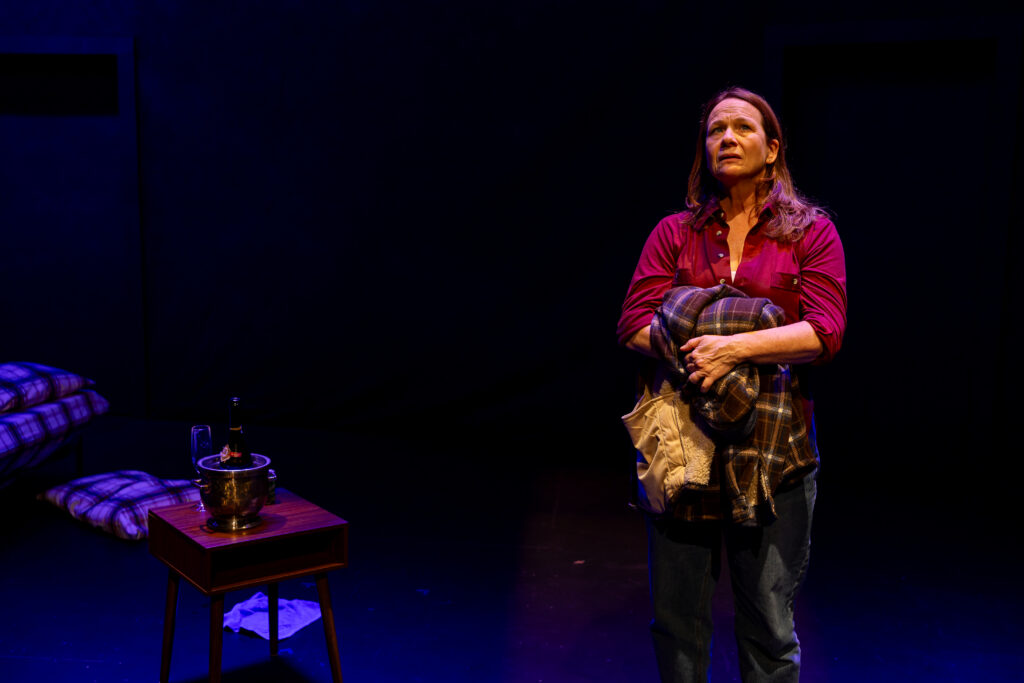
Rohn

As “Drive” moves back in time, from when Li’l Bit was 17 to 15 to 13 and, finally, 11,  the horror and helplessness of the situation hangs heavy. Endowed from a young age with very large breasts, Li’l Bit is ridiculed and bullied at school and at home. Only Uncle Peck (an equally amazing Dennis Trainor, Jr.), whose playful, empathetic, and supportive relationship is a welcome refuge for the isolated and lonely child/woman, seems to understand and care about her. Their relationship forms the backbone of the play.

We watch as Uncle Peck systematically grooms and desensitizes Li’l Bit, nefariously making her his accomplice instead of his victim. “Have I forced you to do anything?” he asks repeatedly as he unlatches her bra with one hand, joking about how boys her own age probably fumble and need her assistance to accomplish the same feat. “Nothing is going to happen between us until you want it to,” he croons. “You just can’t tell anyone.”

Interspersed between the edgy scenes of seduction are narration and a Greek chorus of three (Amy Griffin, Sarah Newhouse, and Tommy Vines, all superb) who deliver monologues and play many roles in family scenes, driving lessons, restaurants, and the schoolyard. In one scene, our hearts ache for 11-year-old Li’l Bit as her family (mother, aunt Mary, Uncle Peck, cousin BB, Grandma and Grandpa) shrieks derisively as they joke about her breasts. No wonder she takes refuge in the kitchen with Uncle Peck as he washes the dishes and converses with her as if she were his peer.

Their weekly driving lessons start shortly after.

As Li’l Bit plumbs her memory, revealing and reliving episodes of these driving lessons and submission to the accompanying sexual abuse, she also reveals how the years of trauma finally caught up with her, leading to her drinking to excess and getting expelled from college. She relives other memories, too, some so painful she can’t deal with them and, continuing the driving metaphor, changes them “like changing stations on the radio.”

Vogel expertly uses humor and slapstick to lighten the emotional load of the unrelenting manipulation and abuse. “A Mother’s Guide to Social Drinking” and “On Men, Sex and Woman” feature bravura performances by Newhouse as Li’l Bit’s mother and make their points while making the audience laugh.

Vogel turns to a monologue by Aunt Mary (also Newhouse) to answer the question of whether Li’l Bit’s family knew what was going on.
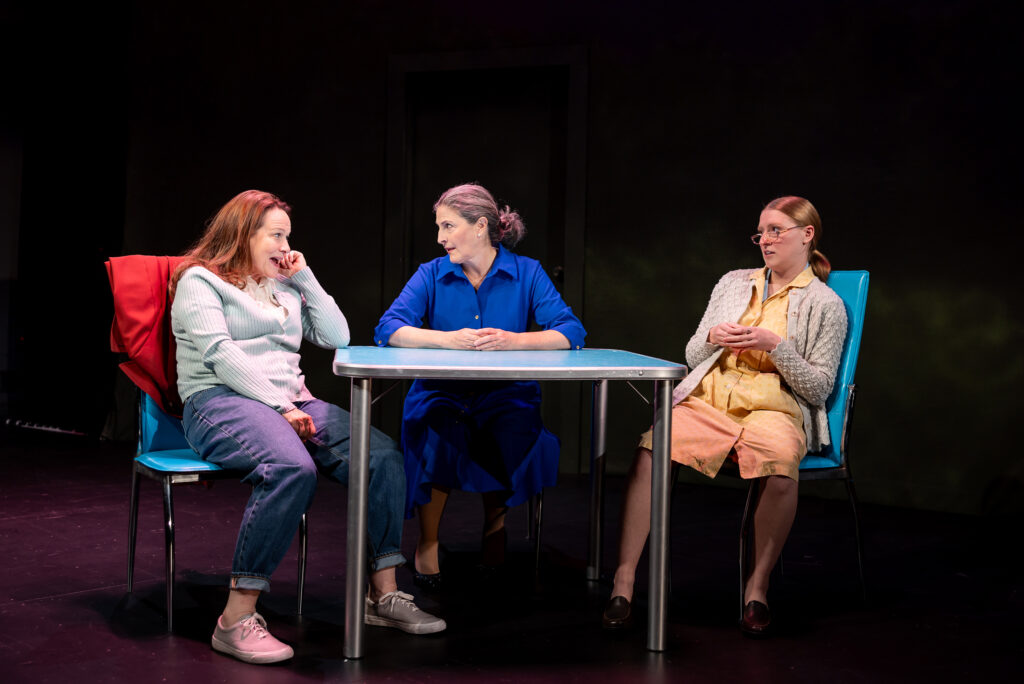
Rohn, Sarah Newhouse, Amy Griffin

Turns out, they did.

Alone on stage, Aunt Mary defends her husband, claiming he is the victim of Li’l Bit’s manipulation. She can’t wait for Li’l Bit to go off to college, so things can go back to normal. “I’m a very patient woman,” she states with more than a whiff of menace. ”But I’d like my husband back.”

Even more chilling, if that is possible, is the scene titled, “Uncle Peck Teaches Cousin Bobby How to Fish,” during which it becomes clear that Uncle Peck also assaulted his young nephew BB after baiting and trapping him with the same kindness, gifts and you-can-trust-me-banter he used on his niece. The ruthless and deliberate nature of the premeditated attack, stripped naked of the frisky banter of his encounters with Li’l Bit, unmasks Uncle Peck for the cold-blooded pedophile he is.

Eventually, Li’l Bit breaks free of Uncle Peck on her 18th birthday in a pivotal scene where Uncle Peck exposes how unhinged he has become, and Li’l Bit finally leaves him and their situation for good. The trouble is, the years of trauma have etched an indelible toll on her, one that leaves her reflecting on why Uncle Peck molested her and what responsibility she bears. She ruefully wonders whether she will ever be able to forgive Uncle Peck and, by extension, herself.

As Li’l Bit and Uncle Peck, Rohn and Trainor are spot-on perfection. Trainor captures Uncle Peck’s crushed spirit and underlying aw-shucks grace, his tortured yet thoughtful self. Rohn brings an incandescence to the complex Li’l Bit and the chasms separating her bone-weary adult sadness and giddy little girl appreciation for adult attention and admiration. It is a fine line, and Rohn navigates it effortlessly. A set bare of all but a few chairs, tables, and a bed places the focus squarely where it should be: on the characters.

At the end of the play, Vogel’s script returns to the present. Li’l Bit thinks about her next steps now that she is 35. “That’s getting up there for a woman. I find myself believing in things that a younger self vowed never to believe in. Things like family and forgiveness,” she says.
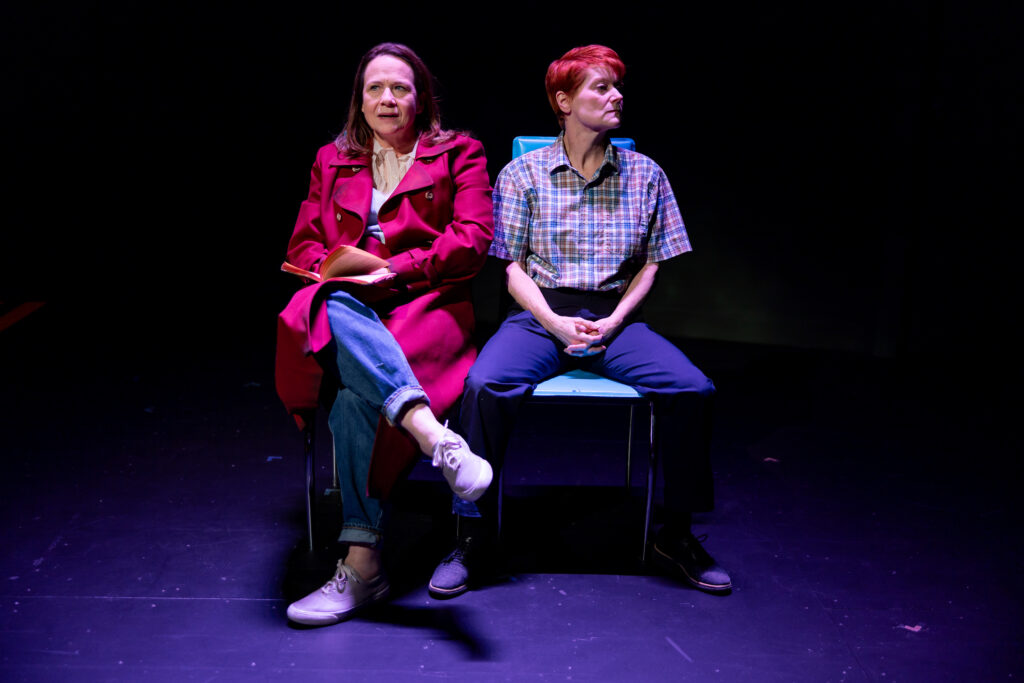
Rohn, Tommy Vines

Despite everything she has been through and the fact that it all began with her sitting in the driver’s seat, she is grateful for the freedom she feels when she drives, the nearest sensation she can muster of “flight in the body.”

As she sits alone in her car, adjusting her rear view mirror, she notices Uncle Peck sitting in the back. After smiling at him, she steps on the gas pedal and drives away.

Although first produced in 1997, it wasn’t until 2020 that Vogel first spoke about the play as autobiographical. “I didn’t go into this concerned with the forgiveness of that person [Peck is based on]. I went into this concerned with the forgiveness of myself. Because the truth is the children always feel culpable. And the structure of this is me getting to a point where I’m like, ‘You know what? You were a kid. That’s all I wanted, to get there and feel that. And to have it be such a basic truth that my childhood self would accept it,” Vogel said in an earlier interview.

‘How I Learned to Drive’ — Written by Paula Vogel. Directed by Elaine Vaan Hogue. Scenic Design by Baron E. Pugh; Lighting Design by Marcella Barbeau; Costume Design by Marissa Wolf; Sound Design by Mackenzie Adamick. Presented by Actors’ Shakespeare Project at the Roberts Studio Theatre, Calderwood Pavilion, 527 Tremont St., Boston through November 25.

For information and tickets, go to https://www.actorsshakespeareproject.org/how-i-learned/
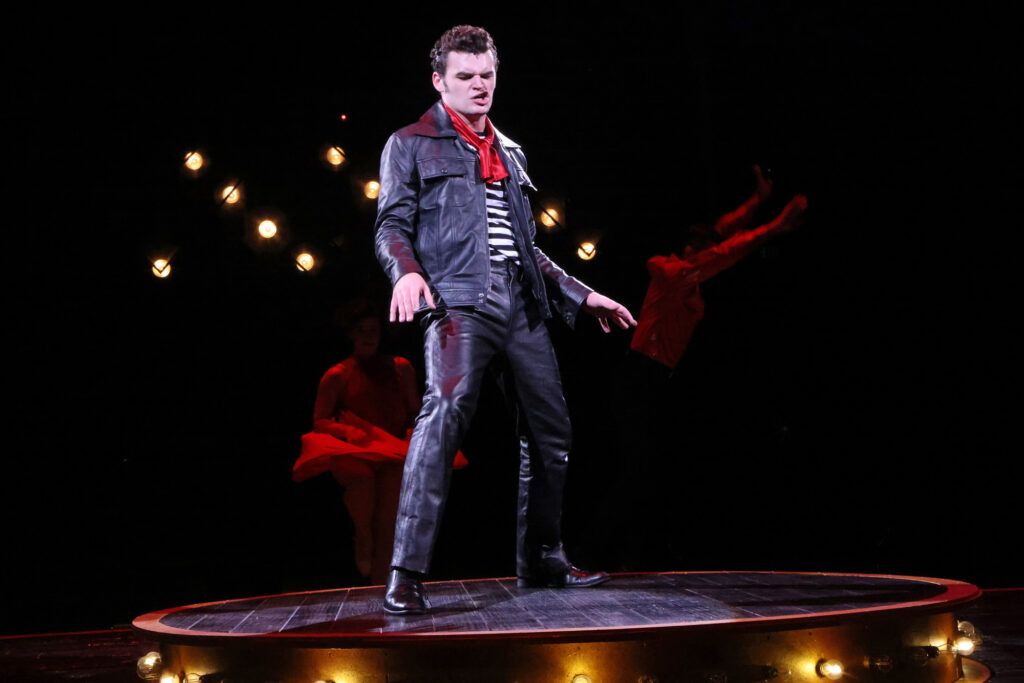
ELVIS Is Another NSMT Crowd Pleaser

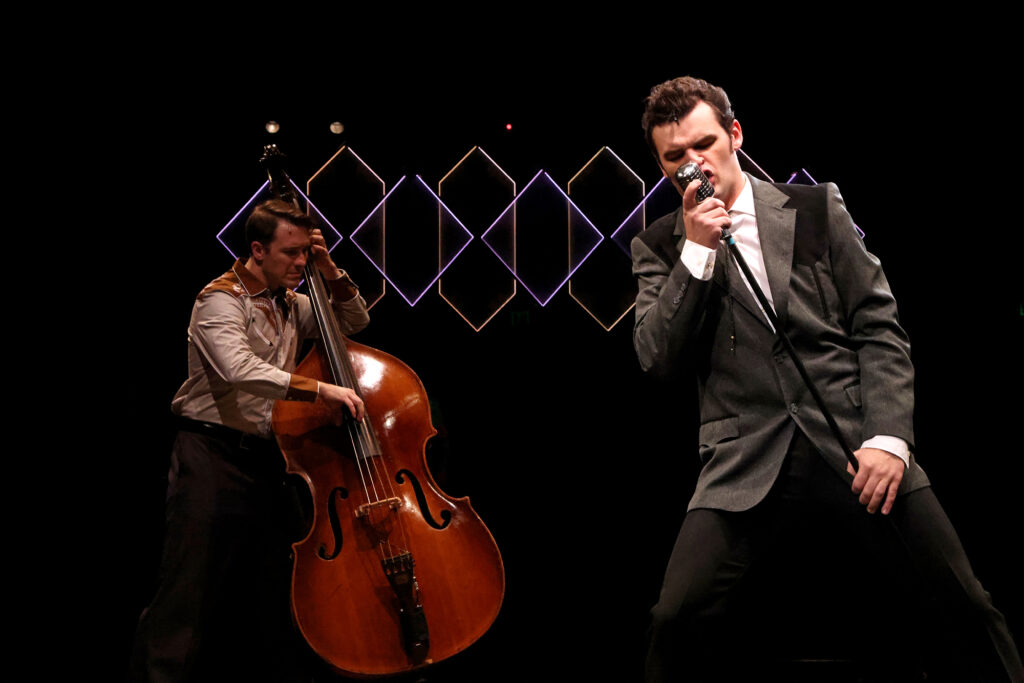
Dan Berry in “Elvis” at the North Shore Music Theatre. Photo © David Costa Photograph

By Shelley A. Sackett

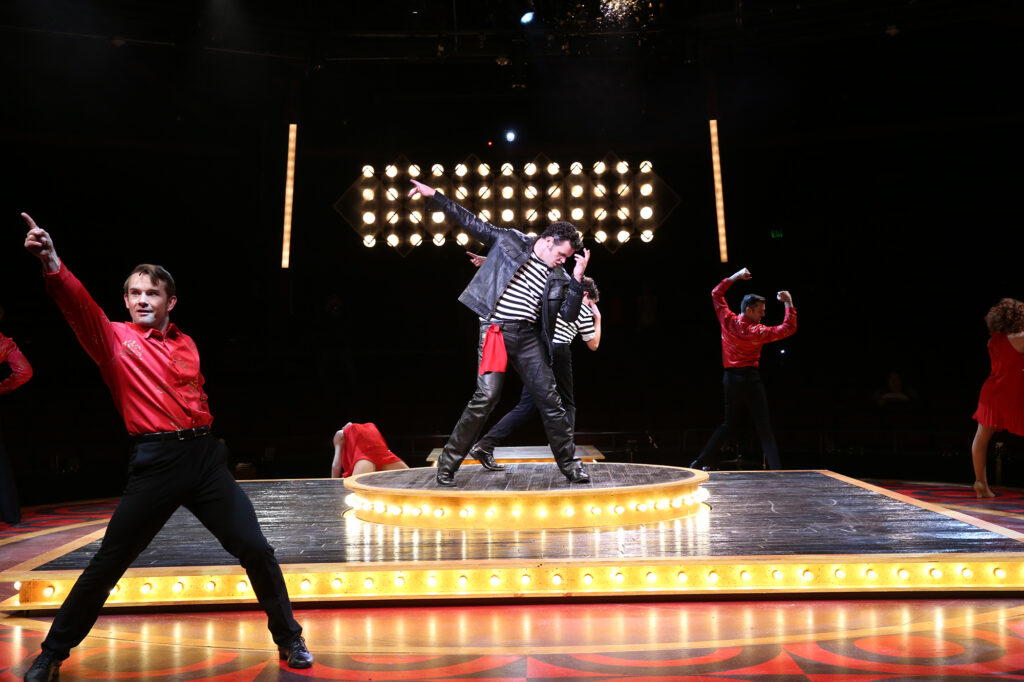
Who can resist the charm, energy and smoldering heat of that hip-swinging, pelvis-grinding consummate crooner and actor known as Elvis? At Bill Hanney’s award-winning North Shore Music Theatre, fans and fans-to-be of the “King of Rock and Roll” can spend a toe-tapping two and one-half hours (one intermission) as over 40 of Elvis’ most famous songs are belted out by talented Dan Berry while a cast of 29 sings and dances their hearts out to a live orchestra of nine.

Throw in the theater-in-the-round setting with its intimacy and excitement, and you’ve got all the ingredients for an evening of sheer entertainment.

The bio-musical picks and chooses pivotal moments of the cultural icon’s life to explore through song, dance, and drama. (For those thinking of taking their children, be forewarned that Elvis and others have a bit of a potty mouth, and the f**k word is frequently bandied about). We learn about Elvis by eavesdropping on those who knew him best, like the kind and maternal record store owner Betty (a standout Altamiece Carolyn Cooper), who teaches 13-year-old Elvis (Asher Stern) about more than Black gospel music. Through her, he gets a hands-on lesson in what a color-blind world might look like and a taste of what it feels like to be taken seriously by an adult.

The loosely woven plot follows Elvis’ ascension from an impoverished but loving childhood in Tupelo, Mississippi to being discovered by recording studio owner Sam Phillips to his having his contract sold to the conniving, heartless Colonel Tom Parker, who treats Elvis like a prized cow to be milked dry and then sold to slaughter. (David Coffee is spot-on perfect as Parker, shedding an even more shameful light on the dreadful miscasting of Tom Hanks in the role in the 2002 movie biopic. Coffee’s Parker is a John Huston-like character, all imposing charm and smarm until he sinks his teeth into your jugular).

Although the song and dance numbers take up a lot of the evening, there is still enough time to weave a Cliff Notes version of the King’s life. We are a fly on the wall when Elvis is drafted and when he first meets Priscilla. We witness the rapid ups and downs of their courtship and marriage and his devastation at the death of his beloved mother. We watch as Elvis’ many appetites spiral out of control and are heartbroken as his career circles the drain with B- films like “Change of Habit.”

Writers Abbinati and Cercone may have sacrificed a smoothly scripted biographical timeline in favor of including a challenging number of musical and dance numbers, but they nonetheless managed to put enough dramatic meat on its bones to flesh out Elvis as a nuanced and complicated individual. That is no small feat.

Kudos to director and choreographer Kevin P. Hill for keeping the ball rolling with a lively pace and varied dance routines. This reviewer’s particular favorite was “You’re the Boss,” the red hot, sizzling Elvis/Ann-Margaret number pas de deux (Alaina Mills is riveting).

Although long and a bit repetitive, “Elvis” fits the bill if you’re looking for an evening of the kind of rocking entertainment NSMT is known for.  

Elvis: A Musical Revolution’ at North Shore Music Theatre. Book by Sean Cercone and David Abbinanti. Based on a concept by Floyd Mutrux. Direction and Choreography by Kevin P. Hill. Co-Music Direction by Milton Granger and Robert L. Ruckinski. Scenic Design by Kyle Dixon. Costume Design by Travis M. Grant. Lighting Design by Jack Mehler. Sound Design by Alex Berg. Wig and Hair Design by Rachel Padula-Shufelt. At the North Shore Music Theatre through November 12.

For tickets and more info, visit: https://www.nsmt.org/

Blue Man Group Presses the Refresh Button while Keeping the Best of Its Core

Blue Man Group

By Shelley A. Sackett

Blue Man Group is a global entertainment phenomenon known for its award-winning theatrical productions, unique characters and multiple creative explorations. With its all-new 2024 show at The Charles Playhouse, it has upped the ante on its high-energy production with new music, two new acts and a finale that feels like a Las Vegas New Year’s Eve celebration, complete with streamers, confetti and bubbles.

Yet, the show remains true to its core, despite the addition of many AI, A/V, and audience participation bells and whistles. Still a euphoric celebration of human connection through art, music, comedy and non-verbal communication, the show features its signature magic of the three bald and blue men who explore today’s cultural norms with wonder, poking fun at the audience’s collective quirks and reminding them how much they all have in common.

The music is infectious, with a great beat that dares the audience to sit still. This show is live and alive, tickling all the senses (especially the ears. The one thing that hasn’t changed is that it is LOUD. You might want to pack earplugs, especially for children).

It is also fun. When the blue men start tossing paintballs into each other’s mouths and spray painting it onto spinning canvases, the veteran attendees breathe a sigh of relief that that old standby routine made the renewal cut.

What hits and misses are the additional tips of the hat to Artificial Intelligence, the Internet, and our relentless and narcissistic obsession with self-documentation. Multi-screens are placed throughout the theater and a camera person shoots video that is broadcast in real-time. There are even ad spoofs for products like “Hope jolt nasal spray” to ease us through our existential crises.

When latecomers are featured on the big screen and called out over the loudspeakers, the gestalt of the experience shifts from funky quirkiness to late-night talk show gimmickry. The same for the segments with audience members, who are solicited and vetted before the show. Some are invited onto the stage to participate in distracting, second-rate skits. One even volunteered to have a camera snake down his throat so he could share his esophageal sphincter with the rest of the audience. On the big screen. In pulsating color.

Yet enough of the original magic and charm remains to satisfy Blue Man Group traditionalists. The modern plumbing musical set, Cap’n Crunch cereal routine, and paint-infused drumming are real crowd-pleasers. Blue Man Group is owned and operated by Cirque du Soleil Entertainment Group, and when that lineage shines through, the show’s underlying charisma does too.

The show remains a family-friendly party with enough content that is over kids’ heads to keep the adults engaged and enough silliness and jaw-dropping effects to keep the kids enchanted. With its excellent music and iconic, charismatic blue men, it is an excellent respite from the dreary onslaught that passes for news and the prospect of 4 p.m. sunsets to come.

Blue Man Group’ – Created, Written and Directed by Matt Goldman, Phil Stanton and Chris Wink. Lighting Design by Matthew McCarthy; Set Design by David Gallo; Video Design by Caryl Glaab. Presented by Blue Man Productions at The Charles Playhouse, 74 Warrenton St., Boston. Ongoing.

For information and tickets, go to www.blueman.com

Exotic “Grupo Corpo” Troupe Combines Exceptional Dancing with Brazilian and African Rhythm for a Spectacular Evening of Excitement and Adventure

“Grupo Corpo” Artistic Director – Paulo Pederneiras; Choreographer – Rodrigo Pederneiras; Presented by Celebrity Series at Boch Center Shubert Theatre. Run has ended.

By Shelley A. Sackett

Founded in 1975 by Paulo and Rodrigo Pederneiras, the Brazilian dance company Grupo Corpo (meaning “Body Group” in Portuguese) is renowned for its unparalleled blend of popular Brazilian culture, African rhythms, and classical technique.

At last Saturday night’s performance, the troupe treated its audience to a mesmerizing evening of ingenious choreography, tireless, virtuoso dancers, inventive lighting and stage design, and pulsating, tribal-tinged music by Bahian songwriter Gilberto Gil and the Brazilian jazz band, Metà Metà.

The concert was as thrilling, riveting and entertaining as it gets.

In the first piece, “Gil Refazendi (Gil Remaking),” a subtly shifting abstract image of unfolding sunflowers is background to a stage lit by simple, single white light spots. (Scenography and lighting by the talented Paulo Pederneiras). The jazzy, infectious beat of ancestral drums, electronic distortions, African percussion gourds, and woodwinds sets the mood.

Known as the godfather of Brazilian music, Gilberto Gil’s compositions are high energy and uplifting, impossible not to sway and toe tap to. Conceived and then, post-pandemic, fully reconceived by choreographer Rodrigo Pederneiras, “Gil Refazendi” contains themes of renewal, rebuilding, and revitalization.

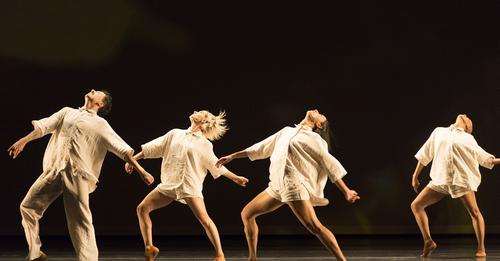
Female dancers explode onto the stage, alighting like beams of Tinkerbell magic clad in oversized white raw linen shirts and scanty shorts. The male dancers follow, dressed in the same breezy material cast as casual shirts over billowing pants (Costumes by Freusa Zechmeister). The effect is smooth, graceful, and playfully sexy.

Under Pederneiras’s mind-boggling choreography, the dancers stretch, pirouette, leap and undulate to the varying strains of samba, bossa nova and rock. They dance solo, as couples and in various groupings.

Although each dancer has their moment in the spotlight, what resonates most is the awe-inspiring synchronicity of the twenty-member troupe. When on stage as an ensemble, they move as a single organic whole. Not one wrist flicks out of tempo; not one back arches higher than another. That degree of skill and discipline is nothing short of astonishing and a rare pleasure to behold.

The second piece, “Gira,” is less abstract and more somber in tone. It is based on the rites of “Umbanda,” one of the most widely practiced Brazil-born religions that pulls on traditions from West African practices, Candomblé, Catholicism and others. In some Umbanda rituals, participants release control of their bodies to the spirits of ancestors or deities in what’s described as an altered state of consciousness.

Pederneiras’s choreography reflects gestures and movements he witnessed during actual ceremonies. There is a hint of menace in the air, particularly during the male/female couplings, which frequently teeter on the edge of violence before withdrawing back to more tender territory.

Male and female dancers are dressed identically, with naked torsos and white skirts of raw linen. Red paint on their necks adds a formal, sacramental touch. Again, the dancers are impossibly lithesome, transitioning from jolts of electric voltage to supple melting seamlessly. That they are dressed identically further blurs the edges between solo and troupe, between the individual and the collective.

Pederneiras started to choreograph in 1978 and has become known for the way in which he constructs sophisticated dialogues between music and dance using the bodies of his dancers as his interpreters. His work is a thrill to behold and one-of-a kind, a genuine reimagining of the ways in which humans can harness, express and appreciate the magic of creative energy.

Huntington’s “Fat Ham” Is A Raucous and Resonant Reinvention of Shakespeare’s Masterpiece, “Hamlet”

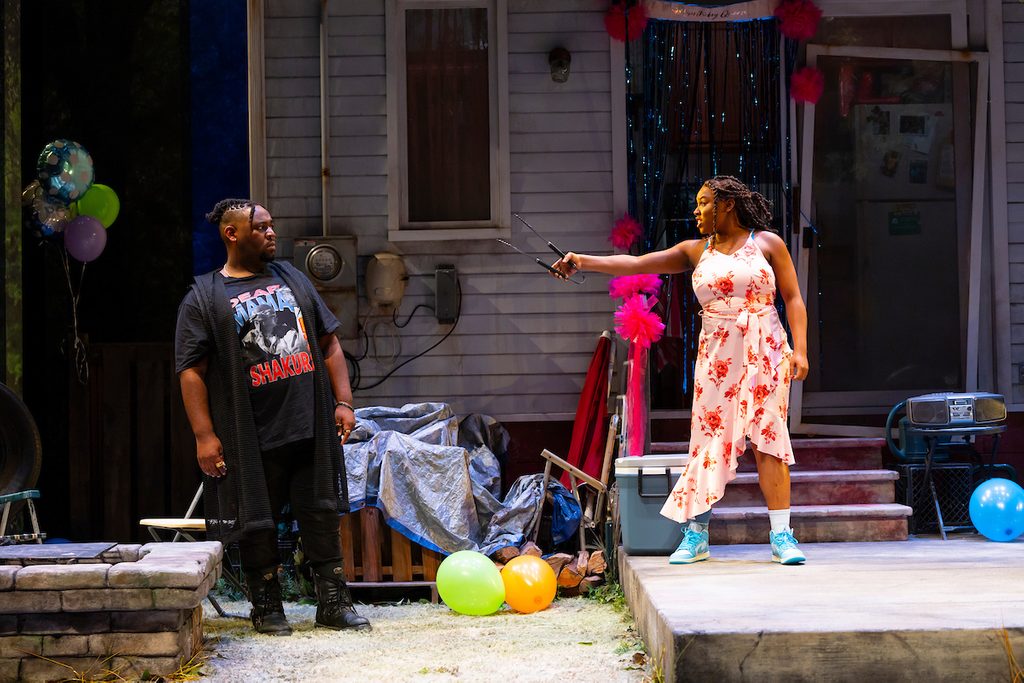
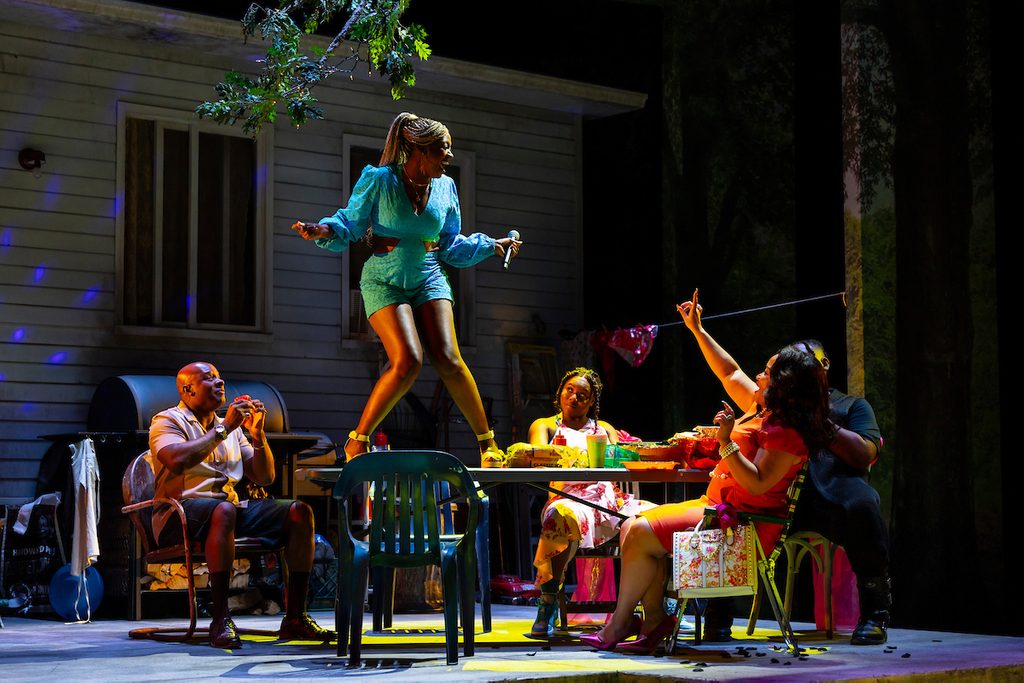
Cast of ‘Fat Ham’ The Huntington Theatre. Photos by T Charles Erickson

By Shelley A. Sackett

“Fat Ham,” winner of the 2022 Pulitzer Prize Award for best drama, is much more than a modern-day riff on “Hamlet,” one of Shakepeare’s most quoted, performed and adapted plays. Using the bones of the Bard’s tragedy as a structural anchor, the exceptionally talented playwright, James Ijames, has fleshed it out with analogous characters whose feet are firmly planted in the here and now and whose modern-day nightmares and dreams reflect both the mundane and the existential.

Like Shakespeare’s “Hamlet,” “Fat Ham” asks the question, “How do we cope in a belligerent world untethered?” and answers it simply: “To thine own self be true.” But instead of engaging in a bloody palace battle over his wearing his father’s coveted crown, this Hamlet wants only to prove his father’s murderer’s guilt and then high tail it to greener, less legacy-laden pastures where he can let down his guard and live an authentic and happy life.

Although full of allusions to the original tragedy about the Danish king (a splendid one-page graphic summary of “Hamlet” by Mya Lixian Gosling is a welcome inclusion in the program), “Fat Ham” stands on its own. Its story is told through the eyes of Juicy/Hamlet (a spot-on Marshall W. Mabry IV), a young, queer Black man marooned in no man’s land with no lifeboat in sight.

The play opens in Juicy’s backyard as Tio/Horatio (the stand-out, gifted Lau’rie Roach), his best friend and greatest advocate, tries to get his buddy to address and snap out of his melancholy. Juicy’s father, Pap, was recently killed in jail, where he was serving time for slitting a man’s throat because he couldn’t stand the smell of his breath.

Tio, more laid back than Juicy, diagnoses Juicy’s problem as more than a reaction to his recent domestic woes. According to Tito (who sees a therapist, so he has cred in this department), Juicy isn’t suffering from individual filial grief. Rather, his is the inescapable condition of Black “inherited trauma.” “Your Pop went to jail; his Pop went to jail. His Pop went to jail. His Pop went to jail, and what’s before that?” he asks. “Slavery.”

As if that weren’t heavy enough, Juicy (like Hamlet) has much more on his plate. His mother, Tedra (a slinky Ebony Marshall-Oliver), married Pap’s brother Rev (James T. Alfred, who also plays Pap) while Pap’s body was still warm. Then, just as the backyard bar-b-q wedding celebration is about to begin, Pap appears to Juicy as a ghost.

Pap is one mean son-of-a-bitch, cursing Juicy for being soft and trying unsuccessfully (he is, after all, a noncorporeal ghost) to beat him to a pulp. Yet, he has a message and directive that Juicy can’t ignore.

Rev was behind Pap’s murder, he tells his son. He insists Juicy man up and avenge his death.

“It’s amazing what fathers think they own just because they share the same name as their son,” Juicy tells Tito, who couldn’t see Pap’s ghost but knows exactly what Juicy means.

Mirroring the relationship he had/has with his father, there is also no love lost between Juicy and Rev, who treats his nephew/son with contempt and one-upmanship, calling him a pansy and stealing his college tuition money to remodel a bathroom worthy of a new man of the house.

What should Juicy do? Be a man, embrace violence and follow in his father’s footsteps? Or take the road advocated by the laidback, don’t-worry-be-happy Tito and reimagine what it means to be a man?

If this sounds solemn and heavy, it is. (Just read the original “Hamlet.”) Yet, in Ijames’ magical hands (and under Stevie Walker-Webb’s razor-sharp direction), such profound topics as: the unending cycle and generational trauma of male violence; sexual and racial inequity, and freedom of identity become manageable because they arrive wrapped in the gift of comedy.

Ijames’s true genius (and no doubt a reason for his well-deserved Pulitzer Prize) is his ability to infuse this story of tragedy and violence with laugh-out-loud jokes, songs, sight gags and such modern props as a karaoke machine. His troupe of lively, original and (other than Rev) compassionate people each literally vibrate to their own rhythm.

Opal/Ophelia (a perfectly cast Victoria Omoregie) is a pouty teenager, chafing at her mother’s heavy-handed directive to be ladylike and wear a dress when all she wants is to join the military and scream at the top of her lungs that she likes girls. Rabby, her rabid liquor-loving, church-lady mother and a stand-in for the equally judgmental Polonious, is played by scene-stealer Thomika Marie Bridwell. Larry/Laertes (the splendid Amar Atkins), Opal’s Marine brother who is also a closet gay, rounds out the cast.

Ijames has many tricks up his sleeve to keep the fast-paced, 90-minute (no intermission) play moving effortlessly. He manages to combine an unlikely list of ingredients (serious soliloquies, characters who break the fourth wall, slapstick, stoner raps, MTV-worthy musical song-and-dance numbers and internal monologues) to create a satisfying, hearty four-course meal.

Luciana Stecconi’s set brings the audience squarely into a lower-middle-class, well-loved, and much-used backyard. Her keen eye and attention to countless details, such as a screen door off its hinge, shows.

The one criticism (and this production is not alone in this department, unfortunately) is that the actors need to have better mics, and their lines frequently need better pacing. Nothing is more frustrating to an audience than when the end of a line is swallowed or a new one begun before laughter from the previous one has died down. Ijames’s writing is too delicious not to savor.

Some have complained that the end is a facile cop-out meant to offer an easy out for the current feel-good streaming culture. Ijames deserves more credit than that. His ending may be upbeat (and a delectable dessert), but it is deliberate and message-laden.

The playwright challenges us to answer Tito’s rhetorical question: What would life be like if we chose pleasure over harm? Judging from the audience’s reaction to the finale, it would be pretty darn good indeed.

Fat Ham’ — Written by James Ijames. Directed by Stevie Walker-Webb, Scenic Design by Luciana Stecconni, Costume Design by Celeste Jennings, Sound Design by Aubrey Dube, Lighting Design by Xiangfu Xiao. Presented by The Huntington Theatre in association with Alliance Theatre and Front Porch Arts Collective at the Calderwood Pavilion at the BCA, 527 Tremont St., through Sunday, October 29, 2023.

For tickets and information, go to: https://www.huntingtontheatre.org/whats-on/fat-ham/

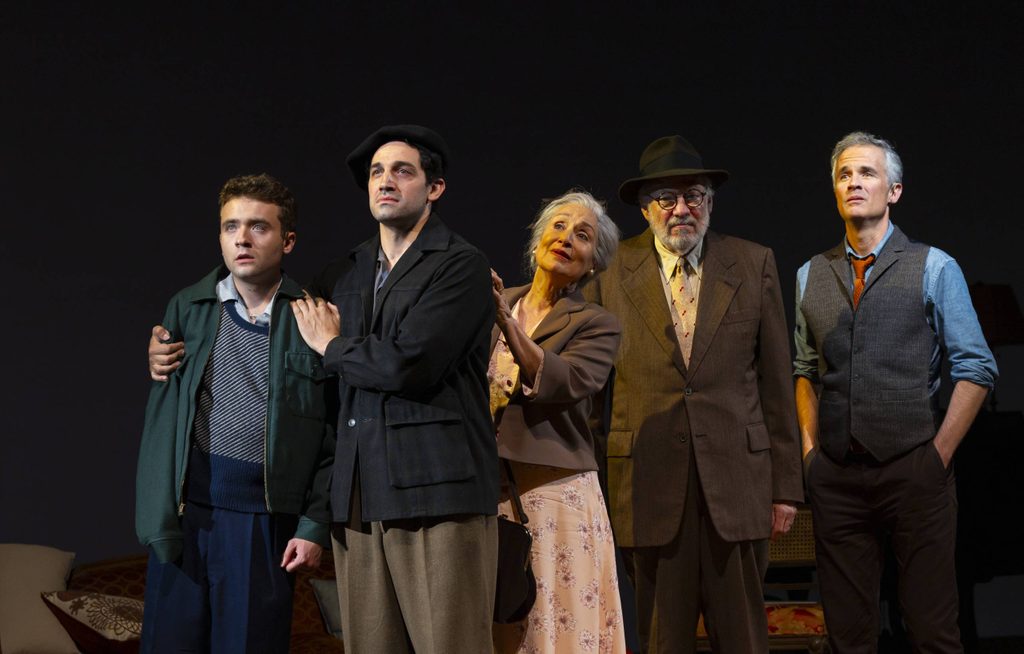
‘Prayer for the French Republic’ chronicles generations of antisemitism

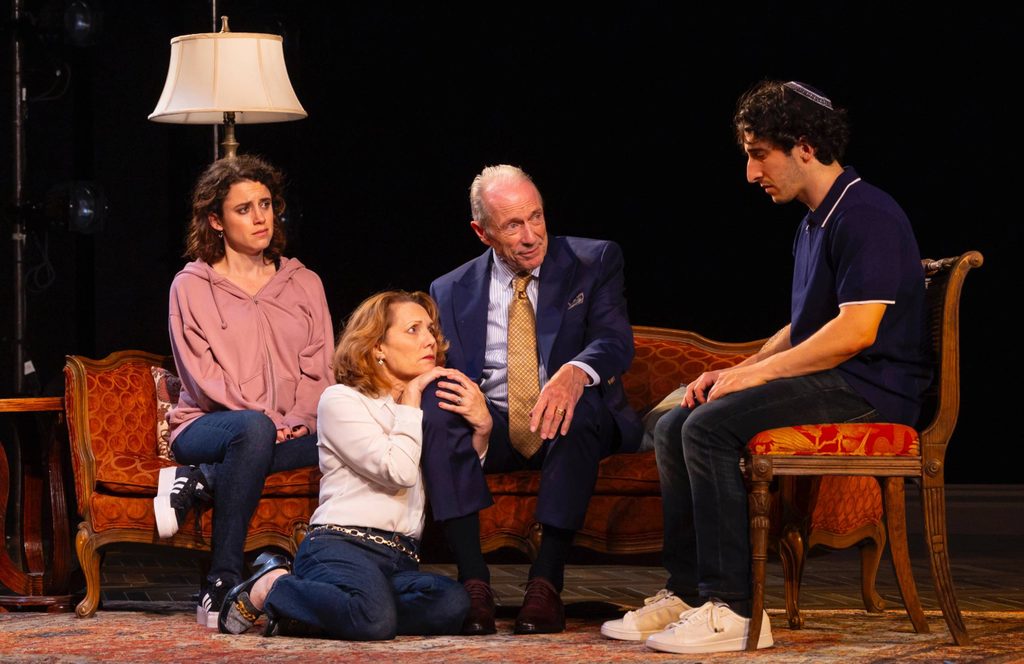
Carly Zien, Amy Resnick, Will Lyman and Joshua Chessin-Yudin. | PHOTO T Charles Erickson

By Shelley A. Sackett

Nothing crystallizes millennia of antisemitism like the Martyrology Service during Yom Kippur afternoon service. “Why are we so hated?” “Can anyplace ever be truly safe?” and “Where will be next on this list?” we can’t help wondering.

As if on cue, the Huntington Theatre’s season opener speaks to these questions and more with Joshua Harmon’s exceptional “Prayer for the French Republic,” winner of the 2022 Drama Desk Outstanding Play Award. Under Loretta Greco’s razor-sharp direction, Harmon’s themes of antisemitism, assimilation, family, freedom, identity, and fear come to life.

Set in Paris in 2016-17 and 1944-46, “Prayer” follows five generations of Jewish piano sellers. Marcelle Salomon Benhamou, the current matriarch, her husband Charles, and their children, Daniel, 26, and Elodie, 28, are the limbs of the original Salomon family tree.
The play opens with house lights up as Patrick, the play’s narrator and Marcelle’s brother, addresses the audience. His eye-contact and hands-in-trousers-pockets ease establish rapport and immediacy. “What is the beginning of a family?” he asks as he strolls across a set that will represent both 1944 and 2016. “And what,” he doesn’t ask but seems about to, “is its end?”

Abruptly, the calm evaporates. We are in the Benhamou apartment, where Marcelle (the sublimely talented Amy Resnick) is mid-sentence, explaining her convoluted genealogy to Molly, an American cousin who has just arrived to spend her junior year abroad. Only one thing seems clear: Marcelle’s Ashkenazi family has been rooted in French soil for centuries.

Just as Molly sort of gets it, Charles (the always amazing Nael Nacer) bursts through the front door with Daniel, who has been attacked by a gang of antisemitic thugs. Daniel’s face is bloodied, but he is nonplussed. His parents are apoplectic.

“How many times have I begged you to wear a baseball cap?” Marcelle pleads. Daniel teaches at a Jewish school and wears a kippah. She urges her son to acknowledge and adapt to the danger he invites by advertising his religion in a world where antisemitism and fascism are on the rise. What she doesn’t do is entertain any thought of leaving France.

Charles’ reaction is more flight and fright than fight. He has walked this walk and knows where it can lead. He and his North African Sephardic Jewish family have lived in diaspora since antisemitism forced them to flee Algeria in the 1960s.

“It’s the suitcase or the coffin,” he says. “I’m scared. Something is happening.” This wandering Jew is tired of living at the whim of host countries. He wants to go “home.” He wants to move to Israel.

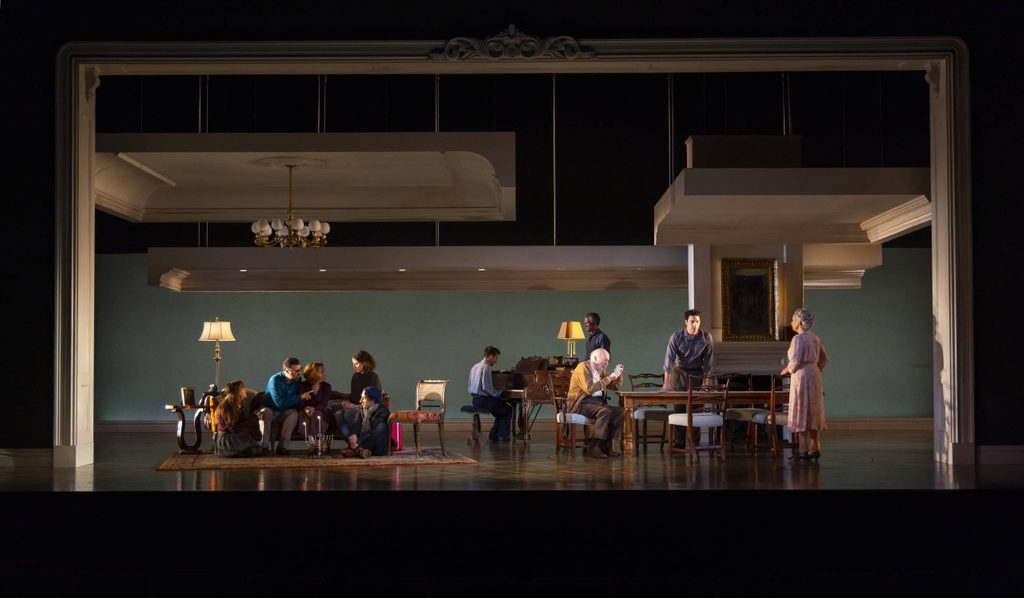
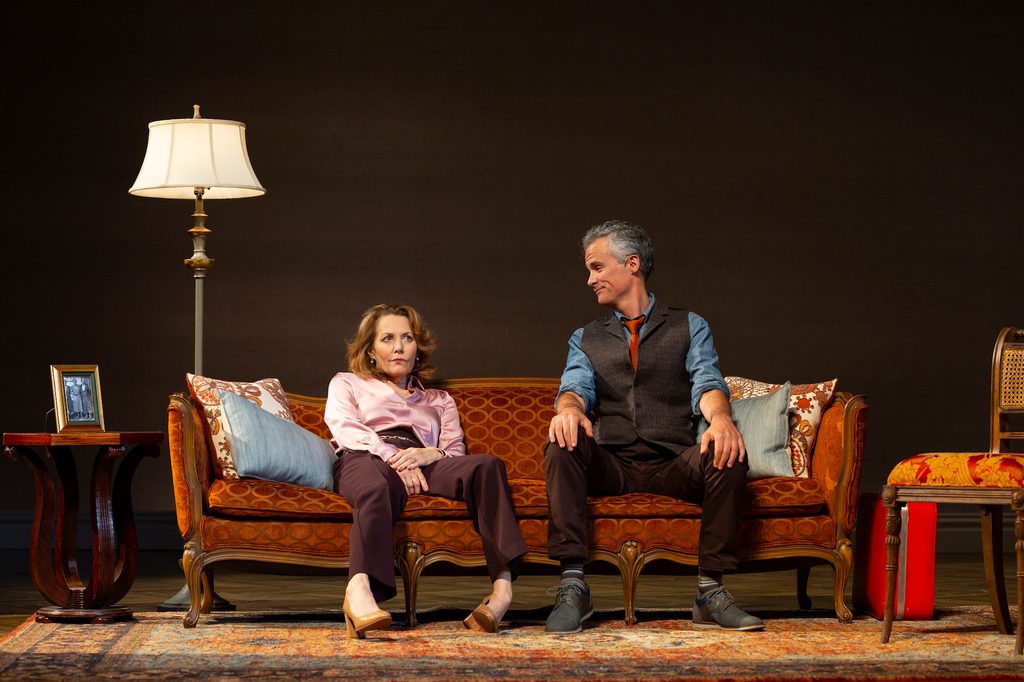
Harmon quietly relocates us to 1944 (Andrew Boyce’s set makes this seamless), where we meet Marcelle and Patrick’s great-grandparents. They sit in their comfortable apartment, wondering what has happened to the rest of their family. Miraculously, they were able to remain in Paris during the war after the Nazi sent to deport them took pity on their age and left them alone. They even kept their piano store.

The rest of the play vaults between these two time periods, connecting them with the overarching question: When is the tipping point between suitcase and coffin? When is it best to leave, even if one’s family has been there for centuries and no other place will ever feel like home?

“You have to trust your instincts,” Charles implores. “It’s all you have.”

Writing cutting, funny, fast-paced, and well-researched dialogue that tackles difficult, uncomfortable topics is one of Harmon’s many attributes. His humor is often dark and our laughter is tainted with discomfort, but he wields his pen judiciously and always hits his introspective mark. He expertly uses Elodie (an electrifying Carly Zien) as his trademark firebrand mouthpiece, and her show-stopping monologue deserves a standing ovation.

Harmon doesn’t ignore the question of whether Israel’s politics have changed our feelings about it being a home for all Jews. Conflating Israel and Judaism has become painfully unavoidable. When Charles expresses his discomfort at reciting “A Prayer for the French Republic” during services, it’s hard not to relate.

Harmon is not pessimistic. We don’t pray to what is, he implies, but for what is not. “What is a prayer but speaking out loud to hope?” a character asks. Yet, can we really call a country whose politics marginalize who we are “home?” By ending “Prayer” with the cast belting out the French anthem, “La Marseillaise,” instead of Israel’s “Hatikvah,” Harmon’s answer, at least for now, seems to be yes.

The play runs through Oct. 8 at the Huntington Theatre, 264 Huntington Ave. Visit huntingtontheatre.org.

SpeakEasy’s “POTUS” Soothes Our Distressed Political Souls With the Balm of Humor

Cast of SpeakEasy Stage’s production of “POTUS” (Courtesy Nile Scott Studios)

“POTUS: Or, Behind Every Great Dumbass are Seven Women Trying to Keep Him Alive” by Selina Fillinger. Directed by Paula Plum. Scenic Design by Jenna McFarland Lord. Sound Design by Aubrey Dube. Lighting Design by Karen Perlow. Costume Design by Rebecca Glick. Fight Choreography by Angie Jepson. Presented by Speakeasy Stage at the Calderwood Pavilion, Boston, through October 15.

By Shelley A. Sackett

Hands down, “POTUS” takes the prize for the most winning opening scene currently on stage in Boston. It is shriek-out-loud funny, clever, pithy, lightning-paced, and uncompromisingly no-nonsense.

The setting is The White House, not exactly the Trump administration, but also not exactly not the Trump administration. Two pantsuit-clad women are in mid-conversation when the audience joins them.

Chief of Staff Harriet (Lisa Yuen) is filling in Press Secretary Jean (Laura Latreille) on the morning’s diplomatic meeting and on what POTUS did that she, as press liaison, will have to spin at the press briefing that is about to start.

The play’s first line sets the tone for the rest of the evening. “Cunt,” says Harriet, lassoing Jean’s and the audience’s attention. Apparently, POTUS excused his wife Margaret’s absence by saying she was having a “cunty” day. Beyond the use of the “C” word, the even bigger trouble is that Margaret was in the room. The whole time. Sitting (obscured) right in front of POTUS.

Not to worry. Jean’s job, after all, is to support and protect POTUS and, despite his worst instincts and basest actions, keep him (and herself) in power. She is used to donning rubber gloves and cleaning up the mess. “That’s not so bad. We can contain that,” she says, brightening. “We all have cunty mornings sometimes. My son has them every week.”

Playwright Selina Fillinger’s “POTUS” is aptly subtitled, “Or, Behind Every Great Dumbass Are Seven Women Trying to Keep Him Alive.” She has populated her farce/satire with seven strong behind-the-scenes women whose sole purpose is to keep a dangerous and inept man in office, not because they believe in him, but because the only way they are allowed near the epicenter of power is by clinging to his coattails.

Catia, Marianna Bassham, and Johanna Carlisle-Zepeda

In addition to Harriet and Jean, the other women in the president’s inner circle are his savvy, earthy, and jaded wife Margaret (Crystin Gilmore) and his neurotic, perfectionist personal secretary Stephanie (Marianna Bassham). Clearly, these women are the only reason he has a job. They are brilliant, dedicated, and gifted at damage control. What they aren’t is respected, acknowledged, or valued by anyone except each other.

“Why isn’t SHE president?” is the common refrain as each rises to the next challenge and douses the next blaze. The answer boils down to one word — patriarchy. “People don’t love him,” one character explains. They’re just afraid of the alternative — US!”

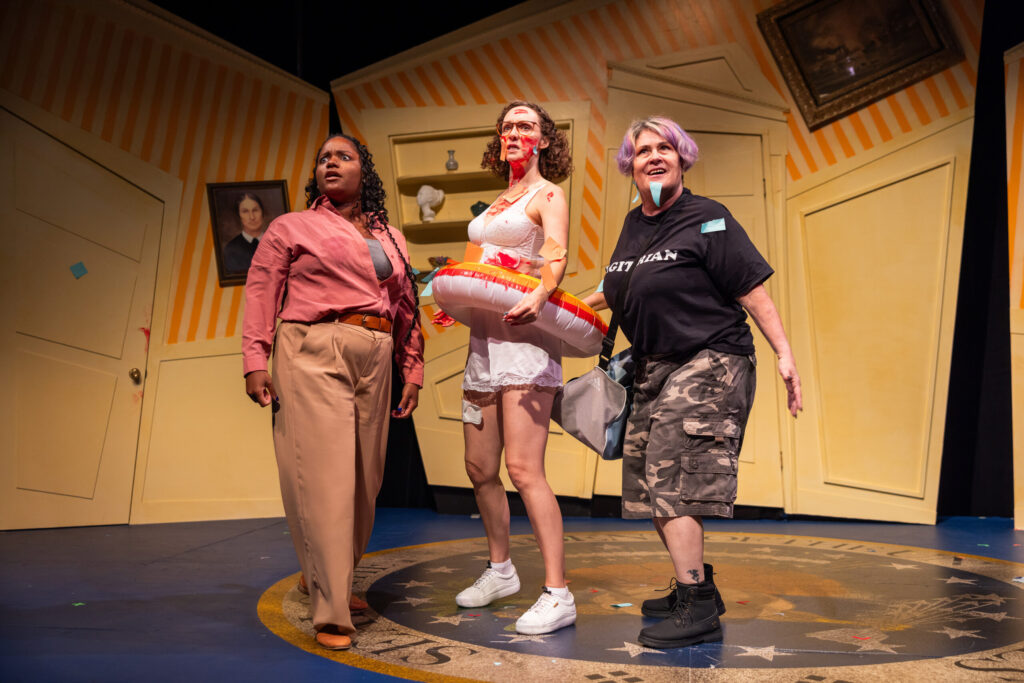
Add to the mix his cocky, queer, convicted-felon sister Bernadette (Johanna Carlisle-Zepeda), Chris, the recently post-partum reporter whose attire includes breast pump attachments (Catia), and the president’s pregnant girlfriend Dusty (the impossibly flexible Monique Ward Lonergan), and you have all the ingredients for a no-holds-barred satirical farce. There is a little of everything, from door slamming, slapstick, sight gags to dramatic anarchy, comic invective, and mistaken identity.

There’s even a bottle of psychedelic tabs masquerading as Tums.

Yet beneath all this droll merriment are serious messages for these serious times. According to Fillinger, those messages may be political, but they are hardly partisan. The pain and rage that underpin the biting humor in her words are aimed squarely at the White Patriarchy that keeps women in their places and men like POTUS in his.

Director Paula Plum has plumbed the sizeable talents of her extraordinary cast to create an ensemble where each individual performer shines, and the whole is even greater than the sum of its parts, no small feat with these remarkably gifted women.

Laura Latreille, Monique Ward Lonergan

Jenna McFarland Lord has created the perfect set, part “Laugh-In,” with lots of doors to open and slam, and part Pee Wee’s Playhouse, where even the pictures are askew. The result is a dizzying, unhinged quasi-reality, mirroring the conditions our heroines face daily.

Despite her use of potty language, piercing wit, and crude jokes (most of which hit their mark), Fillinger has a serious point to make. What would it be like if these skillful, thoughtful women were able to spend their time actually running the world instead of covering and cleaning up after the inept dumbass who was elected to perform that duty but can’t? Is that idea really that scary?

Asked what she hopes audiences take away from seeing “POTUS,” Fillinger said, “I hope they wake up the next day and put their money, time and votes towards equity and freedom for all,” to which we add, “Amen.” For tix and information, go to: https://speakeasystage.com/

“Prayer for the French Republic” Tackles Existential Issues with Humor, Grit and Gravitas

Cast of The Huntington’s ‘Prayer for the French Republic’.  Photo by Nile Hawver.

‘Prayer for the French Republic’ – Written by Joshua Harmon. Directed by Loretta Greco. Scenic Design by Andrew Boyce. Costume Design by Alex Jaeger. Lighting Design by Christopher Akerlind. Sound Design and Composition by Fan Zhang. Presented by Huntington Theatre, 264 Huntington Ave., through October 8.

By Shelley A. Sackett

Playwright Joshua Harmon has a gift for tackling important, profoundly challenging and topical subjects and, through sheer brilliance of characters and dialogue, creating intimate and accessible theater that both rivets his audience and leaves them in a standing ovation of thunderous applause.

He did it with “Bad Jews,” “Admissions,” and “Significant Other,” which Boston theatergoers had the good fortune to see at SpeakEasy Stage Company. Thanks to the Huntington Theatre’s season opener, the 2022 Drama Desk Outstanding Play Award-winning “A Prayer for the French Republic,” they have the opportunity to experience this supremely talented writer’s latest and most ambitious project.

And experience it they should.

Under Loretta Greco’s razor-sharp direction, the 11-member cast masterfully brings Harmon’s themes of antisemitism, assimilation, family, freedom, identity and fear — to name a few — to life. Despite its three-hour running time (one intermission), the fast-paced and sharp-witted dialogue makes the time fly by.

Set in Paris in 2016 and 1945, the play follows five generations of Jewish piano sellers. Marcelle Salomon Benhamou, the current matriarch, her husband Charles and their children, Daniel (26) and Elodie (28), are the contemporary members of the original Salomon family. Hers is a complicated and intricate family tree, full of twists and turns and bent and broken branches.

Jesse Kodama, Jared Troilo, Phyllis Kay, Peter Van Wagner, Tony Estrella

The play opens with house lights up as Patrick (Tony Estrella), the play’s narrator and Marcelle’s brother, addresses the audience. His eye contact and hands-in-trousers-pockets ease establish rapport and immediacy. “What is the beginning of a family?” he asks as he strolls across a set that will represent both 1945 and 2016. “And what,” he doesn’t ask but seems about to, “is its end?”

The calm is broken by a thrust into the Benhamou apartment, where Marcelle (the sublimely talented Amy Resnick) continues Patrick’s train of thought by explaining the family genealogy to a dumbfounded guest, Molly (Talia Sulla), a naïve and distant sort of cousin from America who is spending her junior year abroad in Paris. Molly (like the audience) tries to absorb the details but is thankful when Marcelle repeats the accounting.

Jumping to the present, Marcelle explains that Daniel is their religiously observant son. Daughter Elodie has been struggling with mental health issues and is, well, Elodie. Molly nods in mute agreement.

Just as Molly (and we) sort of get it, Charles (the always amazing Nael Nacer) and Daniel (Joshua Chessin-Yudin) burst through the door. Daniel, who teaches at a Jewish school and wears a kippah (Jewish head covering), has been attacked by a gang of antisemitic thugs. His face is bloody, but he is nonplussed. His parents are apoplectic.

“How many times have I begged you to wear a baseball cap?” Marcelle pleads, comparing his refusal to hide the kippah to painting a target on his back that screams, “Here I Am.” She urges her son to wake up to the danger he invites by advertising his religion in what is France’s current climate, where Holocaust deniers and Nazi sympathizers hold more sway. What she doesn’t do is entertain any thought of fleeing the country where her family of Ashkenazi ancestors has lived for centuries.

Carly Zien, Amy Resnick, Will Lyman, Joshua Chessin-Yudin

Charles’ reaction is different. He has seen this before and knows where it can lead. His North African Sephardic Jewish ancestors have been living in diaspora since they were forced to flee their home in Algeria in the 1960s. 

“It’s the suitcase or the coffin,” he says. He has reached his limit. He wants to go “home.” He wants to move to Israel. It may be unsafe there, too, but at least everyone is unsafe, not just Jews.

The family’s real firebrand and deliverer of Harmon’s celebrated monologues and dialectic analyses is Elodie (an electrifying Carly Zien, who steals every scene she’s in). While she may present as disheveled, her lines of logic and fact-based arguments are sources of encyclopedic knowledge and awe. She is not mentally ill so much as she is reacting in an unhinged way to a world that has come unhinged. (Her interaction with Molly at a bar is worth the price of admission and deserving of a standing ovation).

Harmon then quietly relocates us to 1944 (Andrew Boyce’s set accomplishes this seamlessly and with elegant artistry), where we meet Marcelle and Patrick’s great-grandparents, Irma and Adolphe Salomon (Peter Van Wagner and Phyllis Kay, both charming). They sit in their apartment towards the end of World War II, wondering what has happened to the rest of their family. Miraculously, they were able to remain in Paris during the war after the Nazis sent to deport them took pity on their age and left them alone. They have even managed to hold onto their piano store.

“What do people remember when you’re gone?” narrator Patrick asks the audience, pointing to his forebears. He then tells the story (Estrella really shines here) of how Irma would butter Adolphe’s toast first, and then use what was left to butter her own, in order to make it last longer and hide their dire circumstances from Adolphe. Those tiny, very human details are only one example of Harmon’s many playwriting virtuosities.

Writing cutting, funny, fast-paced and well-researched dialogue is another. The words fly at whiplash speed when the action shifts from 1944 back to 2016, where we pick up where we left off. Daniel and Molly are getting to know each other. (“How did you become religious?” she asks. “I prayed and I liked it, so I kept going,” he replies.)

Amy Resnick, Tony Estrella; photo by T Charles Erickson

Charles makes his case for leaving France before it’s too late (“I’m scared. Something is happening,” he confesses). Marcelle, quintessentially French and clinging to control, argues that Jews are never safe. Anywhere. At any time. Jew hatred, which in 2016, with the 2015 Charlie Hebdo and kosher deli shootings in Paris, the rise of the ultra-right in Europe and the election of Trump in America, has been regaining a foothold globally, is just the way it is.

“What is history but a bunch of stuff other people tell you to get over,” Patrick asks when later, with calm, cynicism and a touch of sadness, he gives a matter-of-fact account of the centuries of persecution suffered by Jews at the hands of the French, starting in 1096 with the Crusades.

And yet, France was the first country in Europe to offer Jews the full rights of citizenship in the hope that they would stop acting like a separate nation and assimilate, identifying more as French than as Jews. Making the case for staying put, he alludes to the fact that even the Holocaust couldn’t uproot the Salomon French family tree. Nor did it force them to convert (although he chose to marry a Catholic). They can withstand this comparative blip.

“Prayer for the French Republic” addresses many deeply troubling topics. Why are people obsessed with Israel? Is it appropriate for Jews to be scared? Is it irresponsible not to be? Now that Israel’s internal politics have so radically shifted, is even Israel still safe? Is it really “home?” Are we at the same tipping point where we were right before the Holocaust? At what point do we acknowledge that our world has hit an iceberg and, like it or not, our choices are to jump overboard or go down with the mother ship?

For this reviewer, the most telling moment was the play’s end. Would Harmon come down on the side of staying put in France or moving to Israel? As the cast belted out the French national anthem, “La Marseillaise” instead of Israel’s “Hatikva,” we had our answer.

For more information and to buy tickets, visit https://www.huntingtontheatre.org/

With “The Half-God of Rainfall,” A.R.T. Once Again Breaks New Production Ground

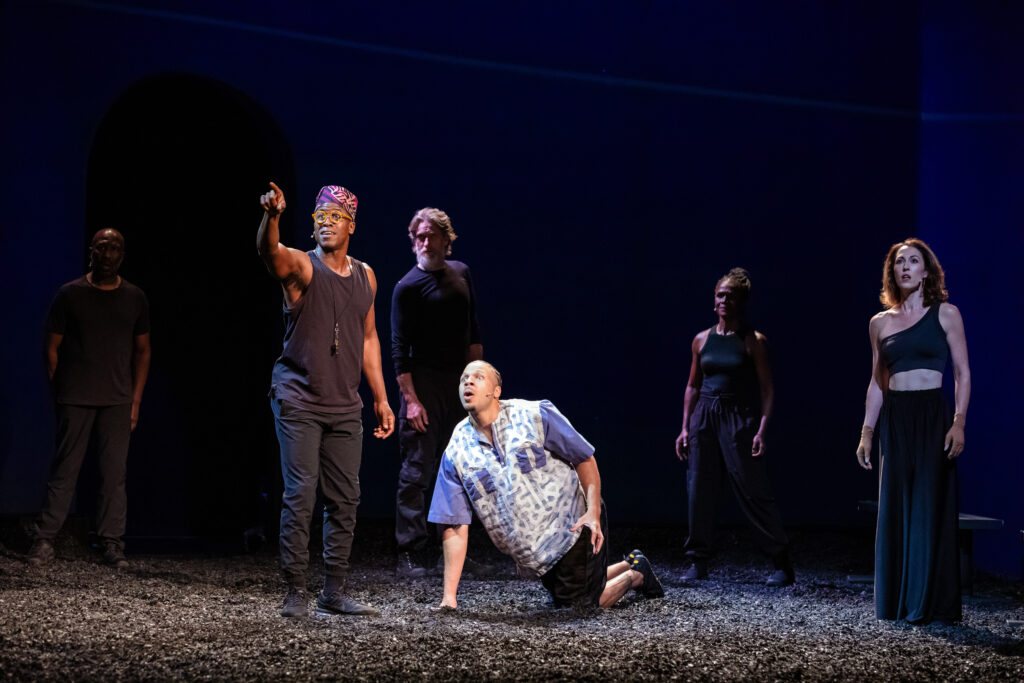
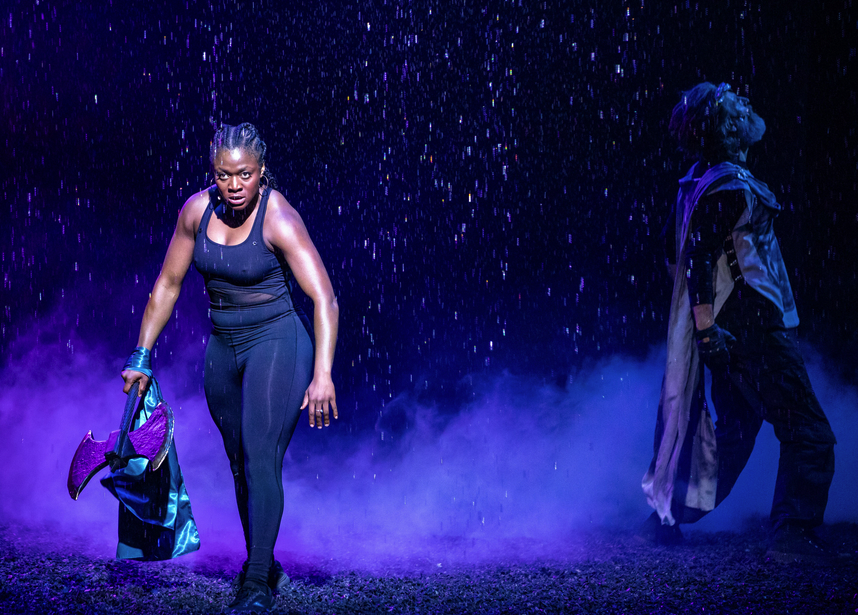
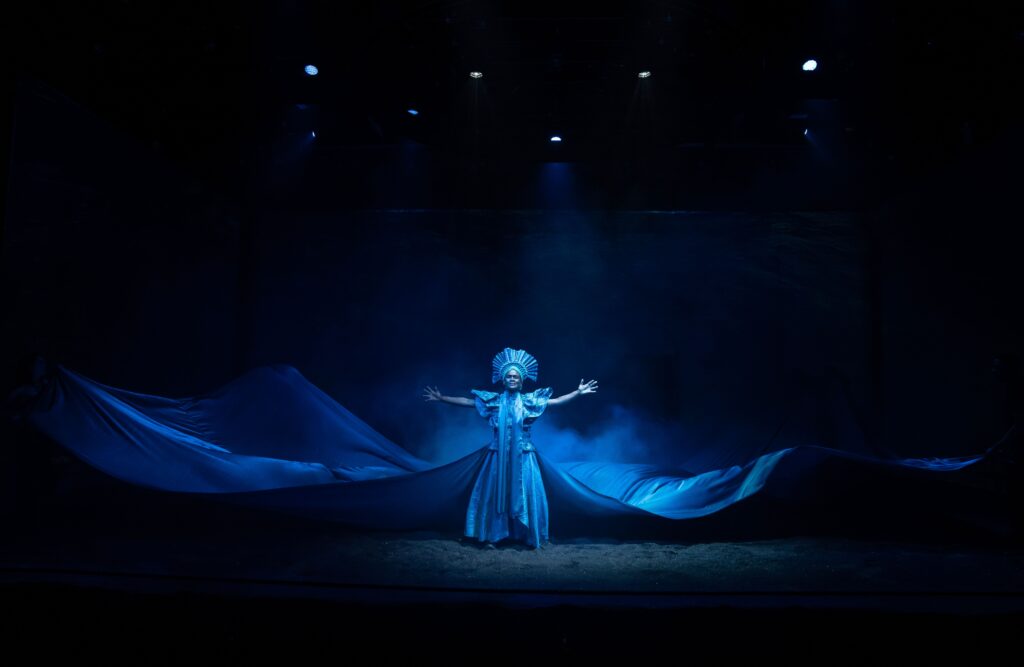
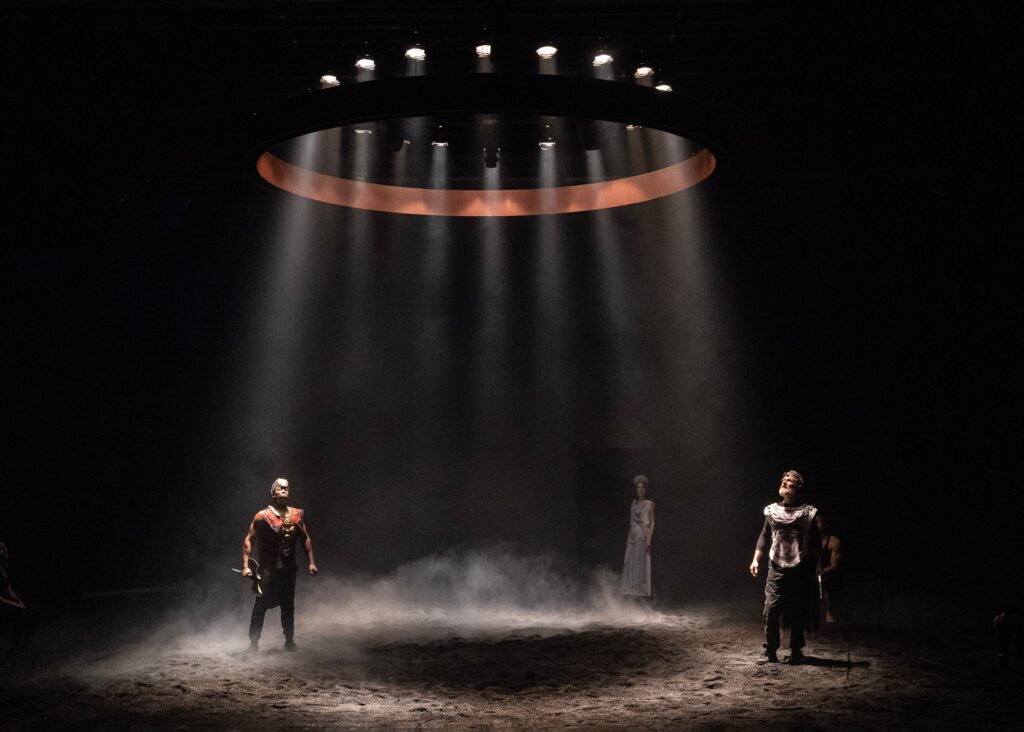
Cast of “The Half-God of Rainfall,” at A.R.T. Credit: Lauren Miller

By Shelley A. Sackett

Will we ever become inured to the other-worldly team at American Repertory Theater and its ability to sprinkle fairy dust on Boston’s theater scene? With “The Half-God of Rainfall,” now in production through September 24, the answer is a resounding “No!”

It helps that Nigerian native Inua Ellams’s sinuous play is a masterful blending of unlikely ingredients: Greek mythology and Nigerian Yoruba spirituality, a war between mortals and gods, basketball, toxic patriarchy, white supremacy, female empowerment, and maternal love. Couple that with a script crafted as an epic poem, a stellar cast that works as a seamless ensemble, and breathtaking choreography, lighting, and sound designs, and well, you have all the makings for a night of unparalleled theatrical pageantry.

The scope and ambition of Ellams’s work is staggering.

It’s hard to describe the multilayered and, at times, opaque plot. Using basketball as both ground zero and allegory, Ellams creates a new myth about the half-god, half-mortal Demi (Mister Fitzgerald), born to human Nigerian high priestess Modúpé (Jennifer Mogbock) after she is brutally raped by the Greek titan god, Zeus (Michael Laurence).

Jennifer Mogbock and Michael Laurence

The genesis of the rape is even more chilling. As stand-ins for superpowers, Zeus and Sango (Jason Bowen), Greek and Yoruba gods of thunder, bet on a race. They agree to “boys-will-be-boys” terms as a settlement. The winner gets to take a member of the loser’s world as a prize.

When Zeus wins, he takes Modúpé as his deserved own, to do with as he pleases.

Demi grows up in a poor Nigerian village, gradually becoming aware of his extraordinary abilities to flood the land with the water from his tears and defy gravity with his basketball wizardry. He learns that basketball is more than a sport when he leaves Nigeria for the Golden State Warriors and superstardom. There, he earns the nickname “rainmaker” and rules the courts with his uncanny proficiency.

Yet all is not quiet on Mt. Olympus, where the gods (and especially Zeus) see all. One of the play’s lighter moments is when Nigerian American player Hakeem Olajuwon (Bowen) visits Demi and explains that all the great sports players are demi-gods but that Zeus forbade them from participating in mortal sports after Michael Jordan almost blew their cover by flying on the court. In defiance, Demi sets his sights on the Olympics, daring Zeus to descend from Olympus and stop him.

Examining sports culture and the way it informs and mirrors the best and worst of human behaviors is not all Ellams has up his sleeve, however. At 90 intermission-less minutes, he has ample time to address other meaty themes such as rape and its resultant PTSD, the burden of being a single mother, free will, female solidarity, Black feminism, and the #MeToo movement. And address them he does, with sensitivity, candor, and gusto.

Rather than hammering polemics, however, Ellams weaves important points into the fabric of the plotline by having his characters humanize and personalize them. “What teaches males to take what isn’t given?” Modúpé asks the river goddess Osún (Patrice Johnson Chevannes). Later, she describes how she was able to love her son Demi, despite the fact that his existence was borne of and is a reminder of such pain and trauma. “My body is my body. But my mind – I can’t control it. He (Zeus) took from me control of myself, but he gave me you,” she tells her son, implying that a mother’s love for and connection to her child supersedes all else.

Ellams pens another intriguing exchange between Zeus and Demi as they discuss who is better off, all-powerful gods or mere mortals. Surprisingly, an introspective Zeus shares that even though he fears he (and all gods) could become insignificant to mankind, he is even more threatened by the fact that humans have free will and can choose how to live. As the last free half-god, Demi has one foot in each world; he is half free but also half stuck in Zeus’ world of rules and obligation.

While the play presents challenges in terms of understanding the actors’ accents, hearing their voices and following the entwined and often confusing stories, the actors’ physicality and sheer force of production pyrotechnics provide ample balm. “Half-God” defies pigeon-holing. Part Magical Mystery Tour, part modern dance concert, part art installation, and all ingenious invention, “Half-God of Rainfall” is a must-see for anyone curious about how far the envelope of theater can be pushed. Once again, A.R.T. positions itself as the undisputed leader of the pack with another groundbreaking and thought-provoking production.

‘The Half-God of Rainfall’ – Written by Inua Ellams. Directed by Taibi Magar. Movement Direction by Orlando Pabotoy. Scenic Design by Riccardo Hernández. Lighting Design by Stacey Derosier. Sound Design and Music Composition by Mikaal Sulaiman. Projection Design by Tal Yarden. Orisha Movement Consulting/Choreography by Beatrice Capote. Costume Design by Linda Cho. Presented by American Repertory Theater in co-production with New York Theatre Workshop. At Loeb Drama Center, 64 Brattle St., Cambridge, through Sept. 24.

For tickets and information, go to: https://americanrepertorytheater.org/

Read all about it: Salem Literary Festival coming September 5-10

Jenna Blum/JANNA GIACOPPO and Hank Phillippi Ryan/IDEN FORD

By Shelley A. Sackett

SALEM – Fans of the Jewish Community Center of the North Shore’s Jewish Book Month speaker series will be thrilled to learn that two favorite authors, Jenna Blum and Hank Phillippi Ryan, will appear at the upcoming Salem Literary Festival.

Presented by The Salem Athenaeum, the Salem Lit Fest will run in virtual and in-person format from Sept. 5 through Sept. 10 with a host of events that range from writing workshops and moderated author panels to a puppet show and a Spanish/English bilingual community read.

On Friday, Sept. 8, Blum will share the stage with Laurie Lico Albanese to speak about, “A Telling Story: Familiar Tales Retold” at Salem Academy Charter School. The free, in-person event will start at 7 p.m. (registration required).

GennaRose Nethercott will bring added value (and her handheld and shadow puppets) to the evening with a presentation of her novel, “Thistlefoot,” a reimagination of the centuries-old character Baba Yaga as a Jewish woman living in a shtetl in 1919 Russia, a time of civil war and pogroms. This charmed exploration of Jewish myth and lyrical prose is a sweeping epic rich in Eastern European folklore, sibling rivalry, and Kyiv magic.

Keynote speaker Blum is the author of three novels: “Those Who Save Us,’’ which won the Ribalow Prize awarded by Hadassah magazine and adjudged by Elie Wiesel; “The Lost Family,” and “The Stormchasers,” and a memoir about her dog, “Woodrow on the Bench.” She is cofounder/CEO of the online author platform A Mighty Blaze. She has taught writing workshops at Grub Street Writers in Boston for over 20 years.

Blum grew up in Montclair, N.J., a town with a robust Jewish population. Her dad was “Jewish in culture – a self-described bagel Jew,’” and her mom, a “recovering Lutheran.”

Her Westchester paternal grandparents introduced her to lox and schmear, kugel, kasha, and Yiddish terms with which she still peppers certain conversations. She always had Jewish friends and identified strongly as a “half-Jewish girl.” Reading “The Diary of Anne Frank” affected her so deeply that she prepared for the Nazis’ inevitable arrival in Montclair by outfitting an attic hiding place with her favorite stuffed animals, books, and Lorna Doones.

In the mid-1990s, after a life-changing post-college trip to Germany with her mother, Blum immersed herself in research about the Third Reich, its causes, victims, and citizens. Of most importance to her were the four years she spent interviewing Jewish survivors in the Minneapolis-Saint Paul area for Steven Spielberg’s Survivors of the Shoah Visual History Foundation (now the USC Shoah Foundation). “It was, and is, the greatest honor of my life,” she said by email.

Almost every survivor told her, “The world should know what we went through so it will never happen again.” As a writer and an activist, she takes the moral responsibility of transmitting the stories of those who no longer can speak for themselves.
“If I spent the rest of my life communicating what they went through, it would never be enough,” Blum said.

The main characters Anna (“Those Who Save Us”) and Peter Rashkin (“The Lost Family”) owe much of their full-fleshed emotional spectrum to Blum’s careful listening and deep-dive exploration. Although she used no actual survivor testimony in writing “Those Who Save Us,” out of respect for the “hallowed ground” those memories occupy, she refracted their anguish and horror through a fictional lens.

“That is another reason I wrote the novel: to pay survivors homage,” she said.

On Saturday, Sept. 9, Hank Phillippi Ryan fans will have the opportunity to hear her moderate an author discussion titled, “Crime Time: Secrets of Suspense.” The in-person event starts at 4 p.m. at the Community Life Center.

An on-air investigative reporter for Boston’s WHDH-TV who has won 37 Emmy Awards, Ryan is also the USA Today bestselling author of 15 psychological thrillers, winning the most prestigious awards in the genre: five Agathas, five Anthonys, and the coveted Mary Clark Higgins Award.

Of growing up as one of the only Jewish kids in rural Indiana more than 55 years ago, Ryan said, “I didn’t know it was strange until it was strange.” At that time, she ascribed her lack of friends, dates, and invitations to garden variety unpopularity. She remembers wondering what she had done wrong until her mother explained that behaviors she took for granted – celebrating Jewish holidays, attending temple, observing Passover – marked her as “different.” Her high school class voted her “Most Individual.”

Ryan always loved reading, and was especially drawn to Nancy Drew books, Sherlock Holmes short stories, Dorothy Sayers, and Agatha Christie. “I fell in love with storytelling, and the architecture of a mystery,” she said. That love blossomed into her first mystery novel, the Agatha Award-winning “Prime Time,” which she wrote in 2007 after she “simply had a good idea” while working at Channel 7 on what was otherwise an ordinary day. Finishing writing that book was encouraging evidence she could succeed as a writer.

Ryan crafts her books with her readers in mind, wanting them to be unable to resist finding out what happens next. She creates compelling characters, an important problem that needs to be solved, life-changing secrets and stakes, and an ending that gets justice and changes the world a little.

“The big key of suspense is to have readers care about what happens,” she said. Her fast-paced thrillers weave intricate plots, but also tackle thought-provoking themes like female empowerment and the power that persuasive words in the wrong hands can have to devastatingly change a person’s life.

Ryan, 72, considers herself the poster child for undertaking new pursuits at midlife and urges others to consider following suit. “I’m proof, as I sit here writing my 16th book, that it’s never too late to follow your dreams,” she said. Θ

For more information and to register for the Salem Literary Festival, visit salemlitfest.org.