ASP’s ‘Macbeth’ Is a Muddled Mashup of Time, Place and Tone

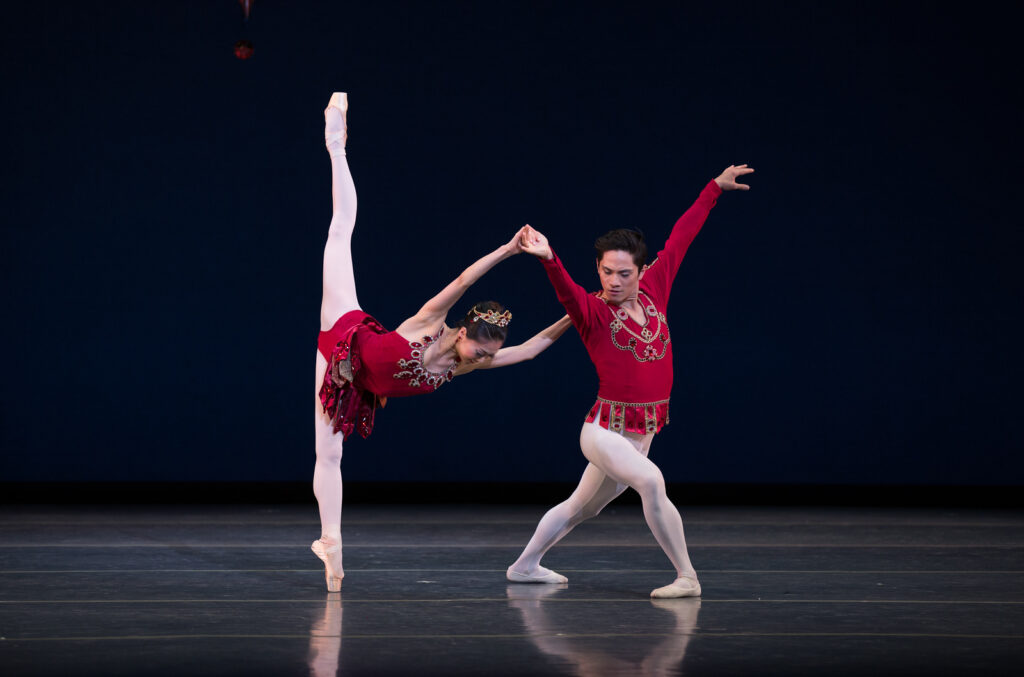
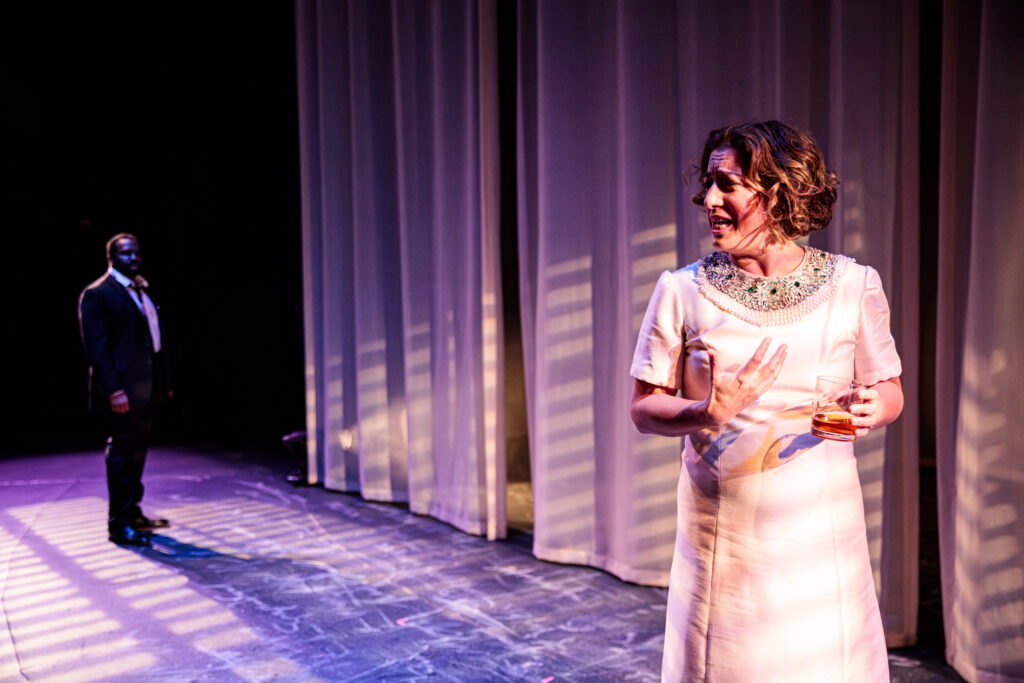
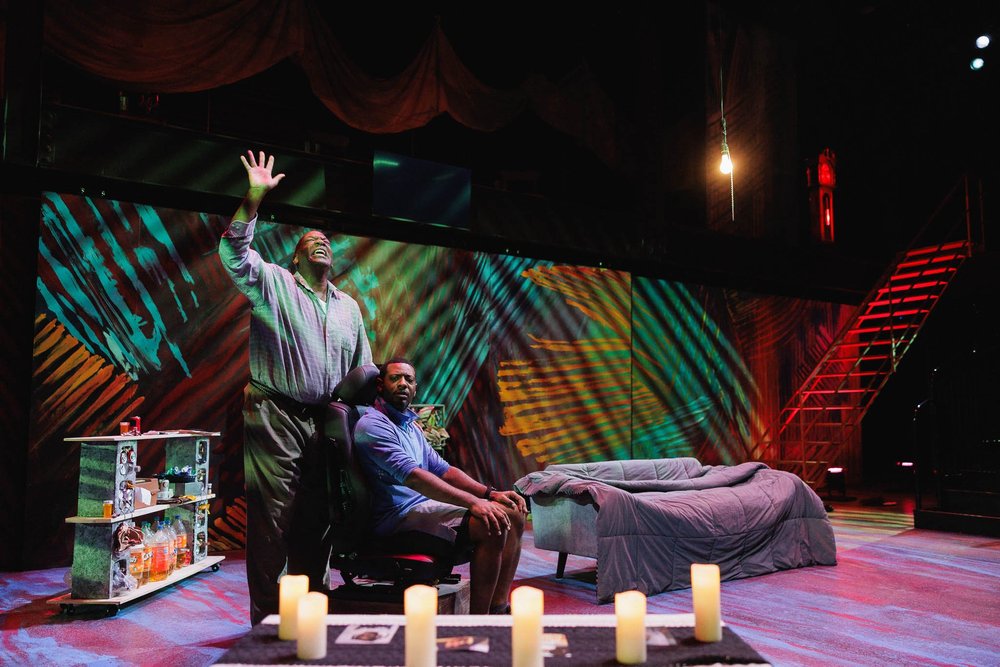
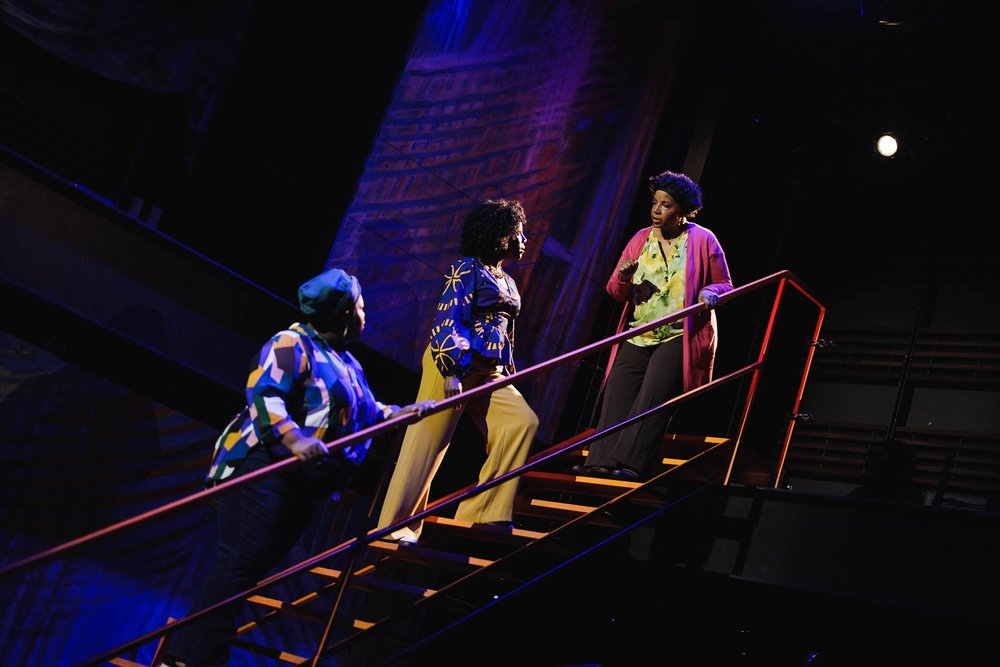
Omar Robinson, Brooke Hardman in Actors’ Shakespeare Project’s ‘Macbeth’
Photos by Benjamin Rose Photography.

‘Macbeth’ — Written by William Shakespeare. Directed by Christopher V. Edwards. Presented by Actors’ Shakespeare Project at Mosesian Center for the Arts, Watertown through October 26.

By Shelley A. Sackett

Ten minutes into ASP’s production of Macbeth, my friend leaned over and whispered, “I thought we were seeing Macbeth.”

He wasn’t being a smart aleck; he was astutely stating the obvious. While it seems au courant (at least in Boston) to catapult timeless Shakespeare into other eras with disco, hip hop, and gratuitous references to current headlines, Actors Shakespeare Project, under the direction of Christopher V. Edwards, proves definitively that it is possible to overreach and completely miss your mark.

One of the Bard’s most quoted and beloved plays (“Fair is foul, and foul is fair,” “Is this a dagger which I see before me?” and “Double, double toil and trouble,” for example), it speaks for itself, elegantly and eloquently. Yet, for some baffling reason, Edwards thinks that contemporary audiences are unable to fully “get” the timelessness of the Elizabethan masterpiece without referencing the Epstein files, ICE, MAGA, the war in Gaza, and AI. Couple that misstep with creative but distracting staging, and you get the fuller picture.

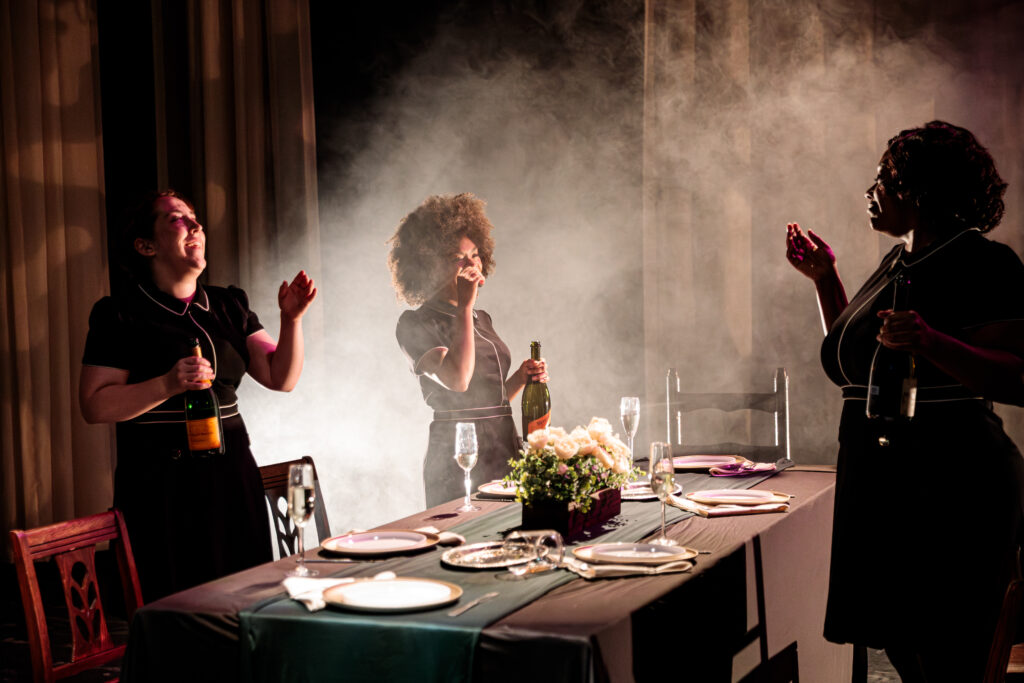
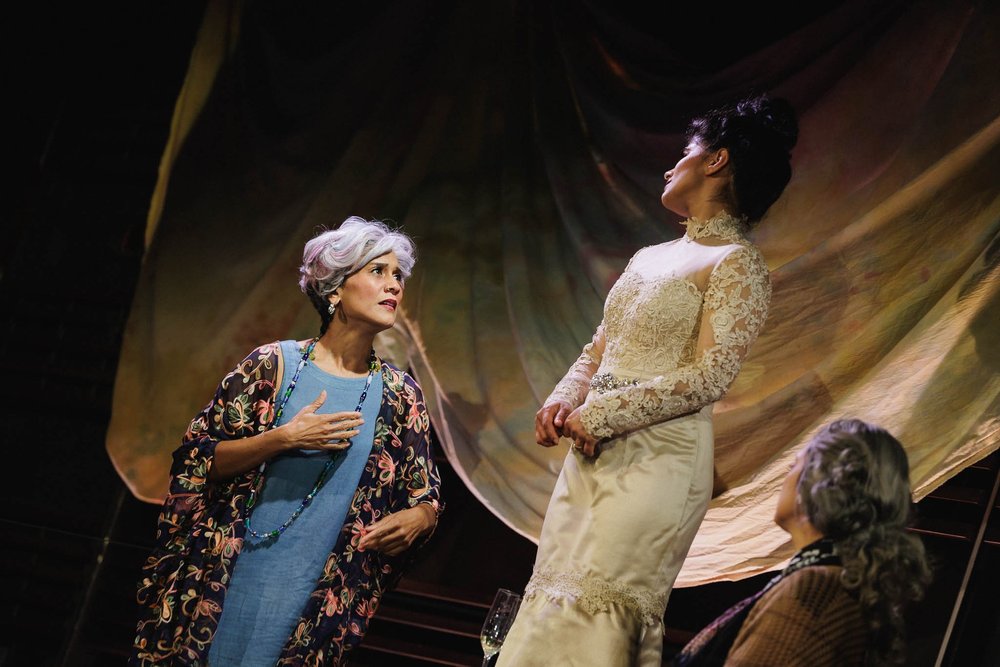
Claire Mitchell, Amanda Esmie Reynolds, and Jade Guerra

To his credit, Edwards doesn’t hide the ball about his intent, which he spells out in the program’s Director’s Notes.

His version of Macbeth (which he nicknamed MK-Beth) reimagines the three witches as architects of state-sponsored psychological manipulation. He sets his version in the thick of a covert 1960s Cold War where Lady Macbeth and her husband are as much test subjects for mind control as they are murderous, power-obsessed co-conspirators.

The central issue, Edwards feels, is “reconsidering ambition, conspiracy and complicity in an era where truth itself could be weaponized.” I don’t know about other audience members, but I was looking forward to a version that was a little more faithful to the original rather than a spin on the contemporary front page political headlines, which take all my psychic energy to avoid.

On its own, Macbeth really does address the issue that Edwards wishes to magnify (the dangers of a budding dictator’s unquenchable thirst for power). Would that he had trusted the audience to “get” that on their own.

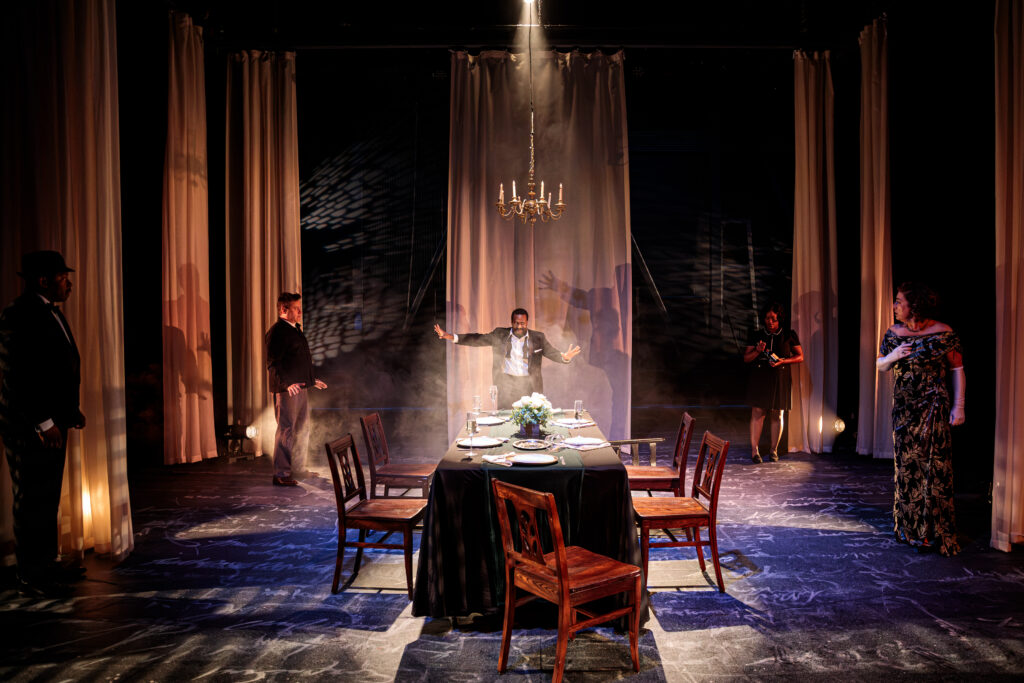
Disagreement with his spin aside, its execution has way more misses than hits. On the positive side, imagining Lady Macbeth as a grieving mother who undergoes electro-convulsive therapy at the hands of the three doctors/witches to cure her depression is an interesting conceit, although a baffling way to open the action. We are supposed to have picked up how devoted (and normal) the Macbeths were from family home videos that include the deceased child projected on stage before the play, but that point is a little too subtle to grasp without context.

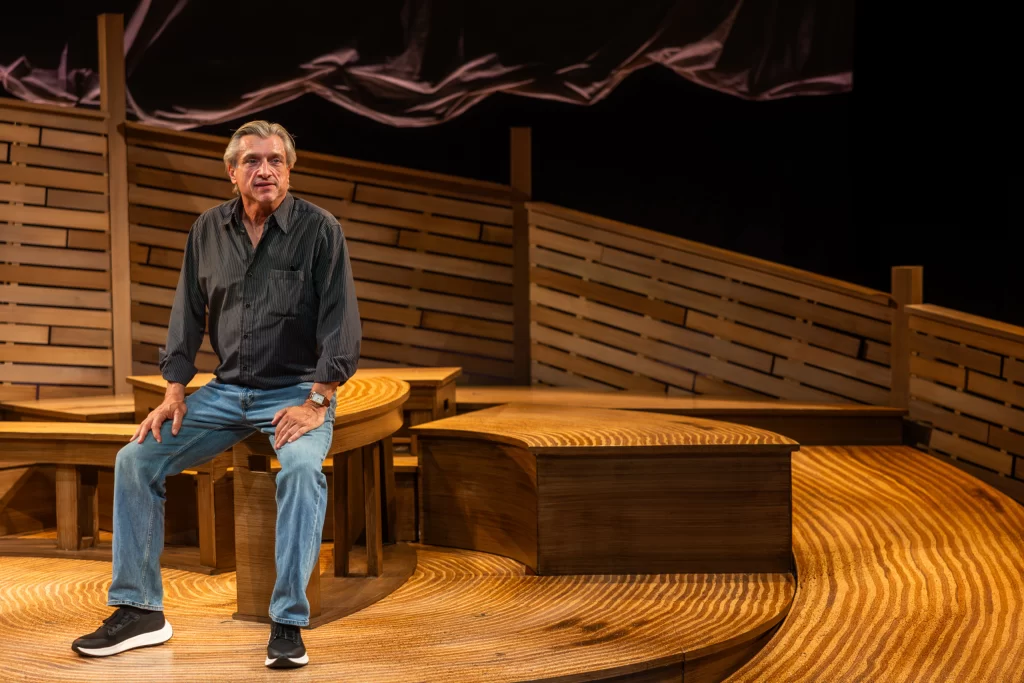
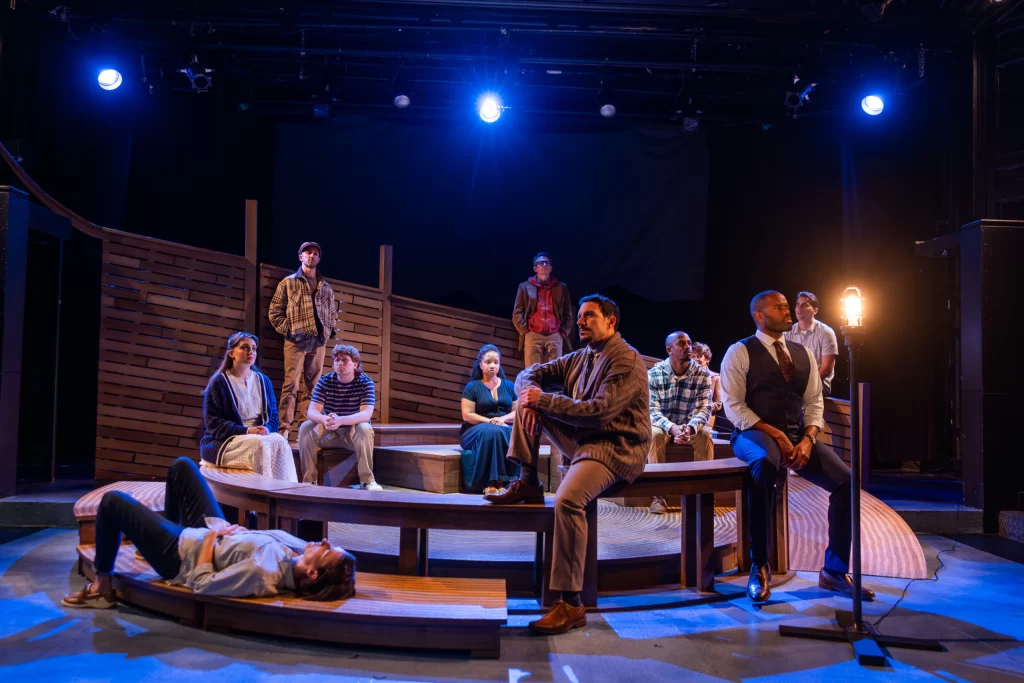
Danielle Ibrahim’s set, however, is marvelous, a gossamer set of white curtains that encircle the stage area and work well with the varying ambiance of the play.

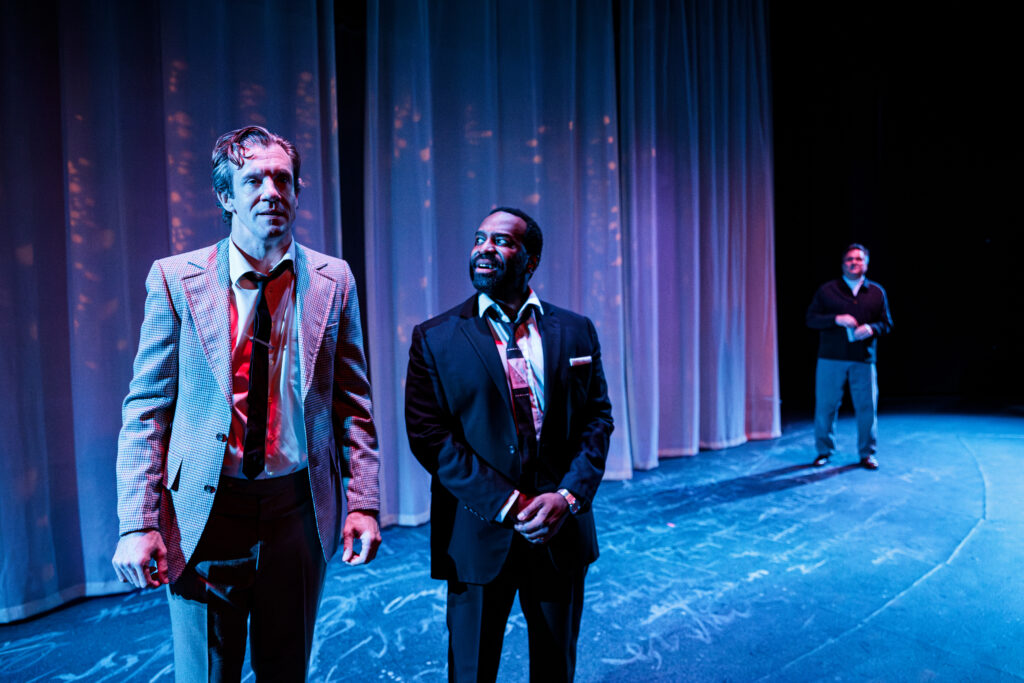
While some of the lesser characters seem to be reciting their lines in a classroom more than delivering them before an audience, there are some noteworthy performances, particularly by Brooke Harman as Lady Macbeth, Dennis Trainor, Jr. as Duncan/Porter, and Chingwe Padraig Sullivan as Malcom.

Jesse Hinson, Omar Robinson, and Dennis Trainor Jr.

Omar Robinson (who collected the 2025 Norton award for outstanding lead performance in The Piano Lesson) breaks out of his singularly militant monomaniacal version of Macbeth to court nuance and pathos, particularly in the famous “Out, out, brief candle! Life’s but a walking shadow, a poor player that struts and frets his hour upon the stage and then is heard no more” speech upon learning of Lady Macbeth’s death.

Perhaps ASP’s parting gift to its audience is a back-handed reminder that Shakespeare can bridge eras, standing on its original two feet. I, for one, took that as an invitation to revisit the Bard’s version and went home, dusted off my college Pelican Text, and had a jolly good read.

For more information, visit https://www.actorsshakespeareproject.org/

Don’t Throw Away Your Shot to See Broadway in Boston’s Spectacular ‘Hamilton’

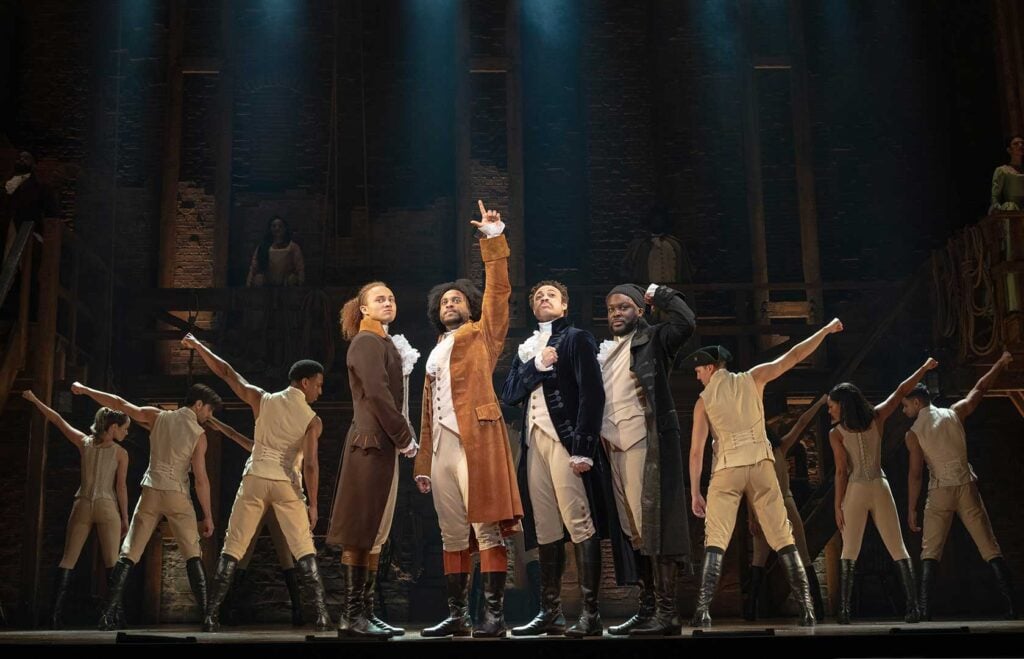
Cast of Broadway in Boston’s ‘Hamilton’. Photos: Joan Marcus
 

By Shelley A. Sackett

How lucky are we that Lin-Manuel Miranda decided to pack Ron Chernow’s biography, “Alexander Hamilton,” when preparing his bag to take on his first vacation in seven years after the Broadway run of his smash hit, In the Heights. He plowed through the 800+ page book and was mesmerized by Hamilton, particularly his story as a poor immigrant rising to power.

“The moment my brain got a moment’s rest, Hamilton walked into it,” he told Ariana Huffington in an interview.

Had he grabbed any of a number of other bestselling books instead, the world would have been deprived of what remains, after ten years, a singular and thrilling theatrical experience. Broadway in Boston’s production now at Citizens Opera House is as good as it gets, even withstanding a distractingly deficient performance by Hamilton standby, Michael Natt, on the evening I saw it.

The set, by David Korins, is magnificent. Huge, with a drawbridge, walkways, and two stories, it accommodates the large cast and encourages easy transformation from scene to scene. A circular rotating insert is put to good use, and Paul Tazewell’s costumes both complement and add spice. The orchestra (Emmanuel Schvartzman, conductor) is stupendous and Andy Blankenbuehler’s choreography is cheeky, contemporary and delightfully slick. Last, but hardly least, Howell Binkley’s lighting is literally spot-on and hosannas to Nevin Steinberg and his sound design (and the cast’s flawless articulation) that ensure the audience hears every syllable (hardly a given on Boston stages).

Nathan Haydel, Tyler Fauntleroy, Jared Howelton, Elvie Ellis

The opening number, “Alexander Hamilton,” firmly establishes that the rest of the talented touring cast is not just up to the challenge but will surpass even the highest expectations of excellence. (Ensemble member Miriam Ali is a standout, and not because of her height.)

The storyline is fairly straightforward. It details the life of American Founding Father Alexander Hamilton, from his humble beginnings as a Caribbean orphan to his crucial role in the American Revolution and the formation of the new nation, culminating in his death in a duel with Aaron Burr. Aaron Burr (an outstanding Deon’te Goodman) opens with the line, “How does a bastard, orphan, son of a whore and a Scotsman, dropped in the middle of a forgotten Spot in the Caribbean by Providence, impoverished in squalor Grow up to be a hero and a scholar?” introducing Hamilton as the remarkable immigrant who, through grit, ambition, intelligence and sheer will, rose to positions of power and influence to have an undeniable and lasting effect on this nation’s history.

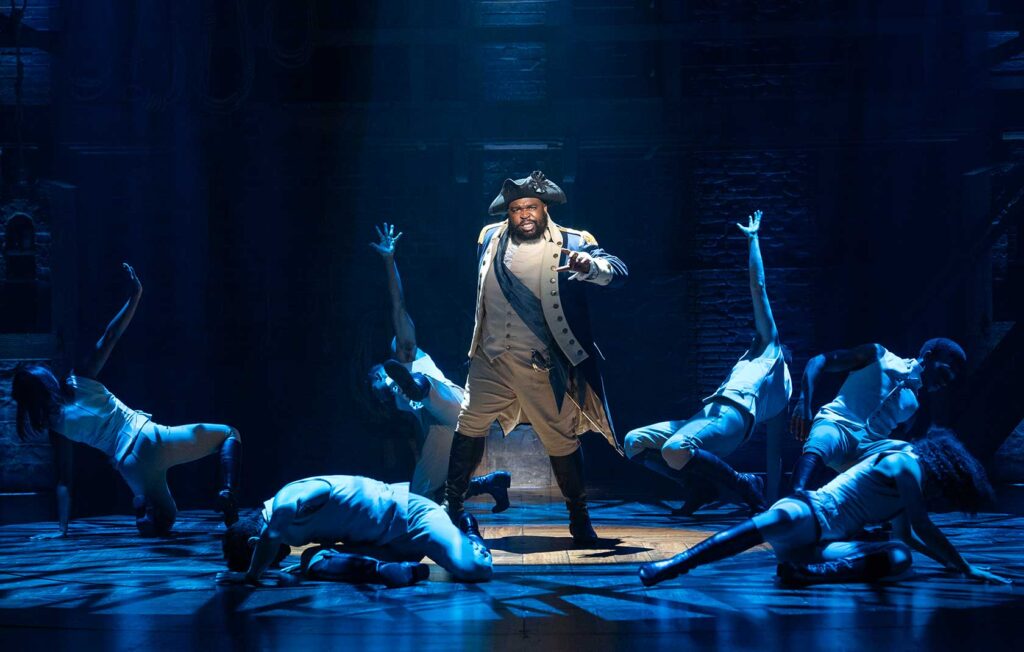
A.D. Weaver

While the actors may be center stage, it’s Miranda’s breathtaking score that is the true star. Over 30 songs tell the story through hip-hop, jazz, R&B, pop, and good old-fashioned ballads. Their narrative quality and melodic power are timeless, awesome in the truest sense of that now hollowed out and trite adjective.

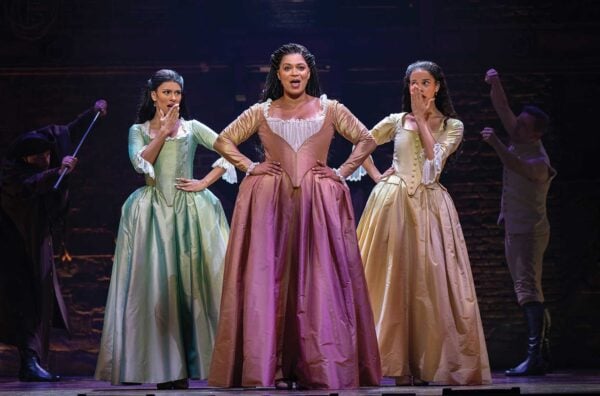
The show features a diverse cast (Miranda broke new ground in many ways, including casting actors of color to play the roles of the Founding Fathers) and highlights Hamilton’s relationships with figures like the Schuyler sisters (despite being a standby, Amanda Simone Lee was splendid as Angelica and Lauren Mariasoosay shone as Eliza), the Marquis de Lafayette and Thomas Jefferson (both played by an excellent Christian Magby), and, of course, George Washington (a powerful A.D. Weaver).

The crowd favorite, however, is always King George III, whose role may be limited but whose songs are among the best in the show. Matt Bittner doesn’t disappoint, chewing up the role and delighting the audience with each brief appearance.

Lauren-Mariasoosay, Marja Harmon, Lily-Soto

Even if you’ve seen “Hamilton” before (and especially if you saw it when it played in Boston on its last disappointing tour), do not hesitate to high-tail it to the Citizens Opera House to see this particular version. I daresay, it is as close as we in Boston can get to the New York experience.

Most highly recommended.

‘Hamilton’ — Book, music and lyrics by Lin-Manuel Miranda. Inspired by Ron Chernow’s “Alexander Hamilton.” Directed by Thomas Kail. Choreography by Andy Blankenbuehler; Music Supervision and Orchestrations by Alex Lacamoire. Presented by Broadway in Boston at Citizens Opera House, Boston through Nov. 2.
For more information, visit bton.broadway.com/shows/hamilton/

‘The Mountaintop’ Is A Gripping Rendering of MLK’s Last Night

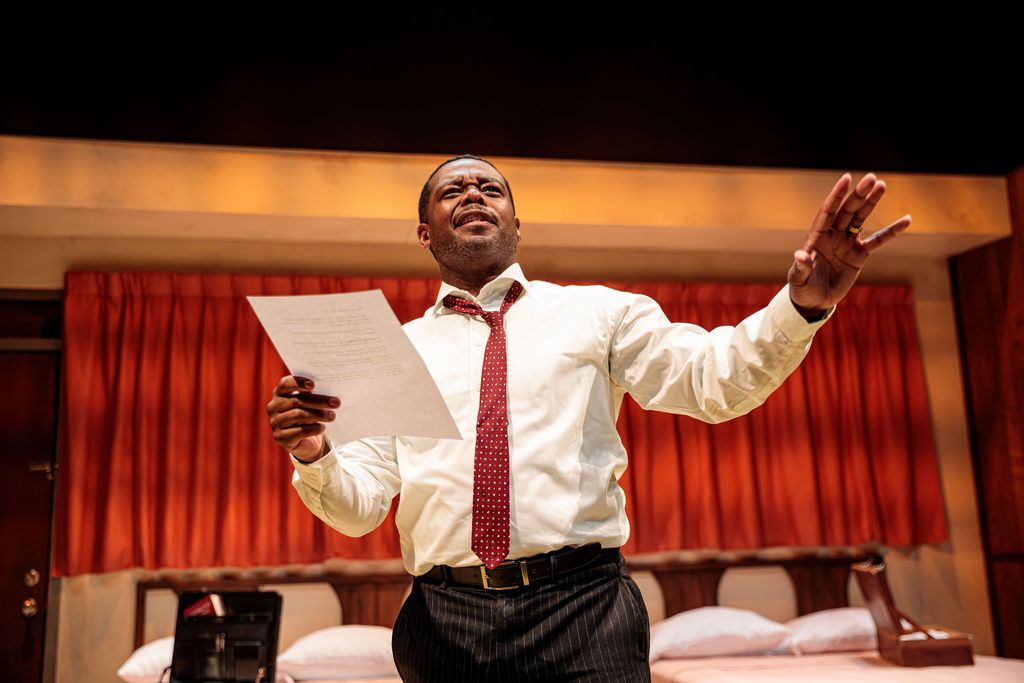
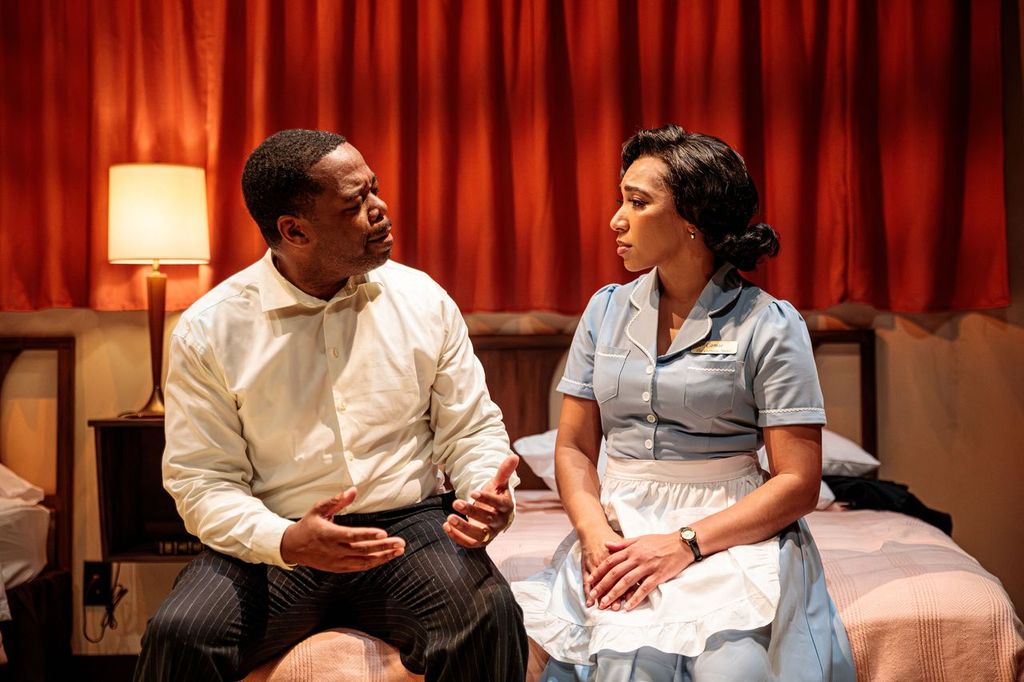
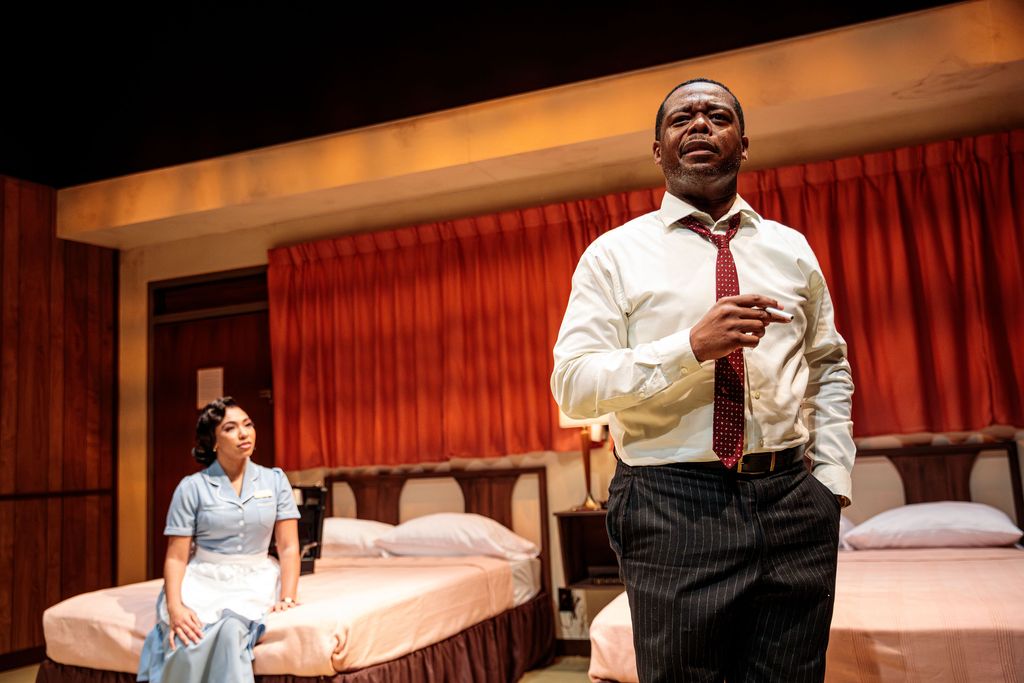
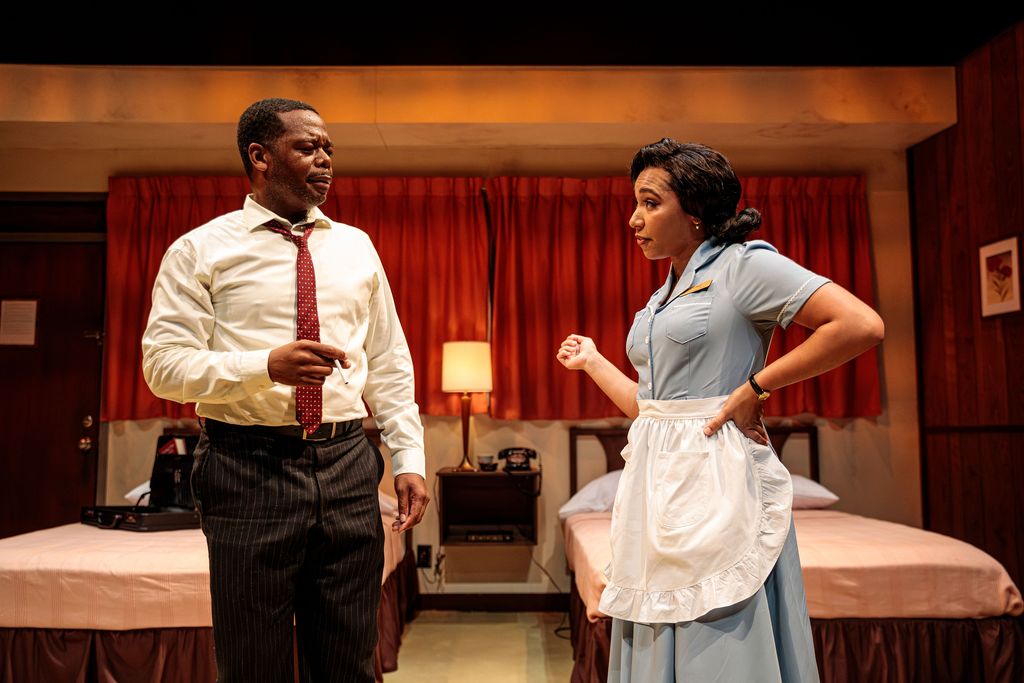
Dominic Carter as MLK in Front Porch Arts Collective‘s ‘The Mountaintop’

By Shelley A. Sackett

Playwright Katori Hall couldn’t have asked for a better production of his Olivier Award-winning play, The Mountaintop, than the one it is receiving at the Modern Theater at Suffolk University. Under Maurice Emmanuel Parent’s pitch-perfect direction, its two stars, Dominic Carter and Kiera Prusmack, deliver impeccable performances as civil rights and social justice leader, Rev. Martin Luther King, Jr. and Camae, a motel employee. Ben Lieberson’s set is straightforward and literal, a classic 1960s era, no frills, wood-paneled motel room.

The time and place are uncomplicated. It is April 3, 1968, and a storm rages outside room 306 of the Lorraine Motel in Memphis. As King, Carter is a commanding presence from the moment he enters the room. He has just delivered his famous “I Have Been to the Mountaintop” speech, in which eerily he proclaims, “I’ve been to the mountaintop… And I’ve seen the promised land. I may not get there with you.”

He was assassinated the next day.

King is exhausted yet wired, spooked by every crack of lightning and suspicious that his room is bugged and his phone tapped (hardly unwarranted since J. Edgar Hoover, FBI director, was known to have targeted King with both).

He is in Memphis to support striking sanitation workers whose nonviolent protests had ended disastrously in rioting and ransacking. All he wants is a cigarette and a cup of coffee. His traveling companion, fellow civil rights activist and Baptist minister, Rev. Ralph Abernathy, has gone to buy the cigarettes. He calls for room service for the coffee.

After some interludes meant to show King’s less saintly and more human side (including smelly feet, petty vanity and annoyance at overhearing a toilet flush in the room next door), he finally settles down to start writing his next speech/sermon. He wants to get more incendiary and provocative, and toys with opening with the line, “Why America Is Going to Hell.”

“They’re really gonna burn me on a cross for this one,” he snickers.

The entire focus and tone of the play shifts with the arrival of a sexy, self-confident young maid named Camae, who delivers more than a pot of coffee. Under the Parent’s kid-glove direction and terrific acting by Carter, the swing from King’s turbulent internal intensity to his slick, external charismatic charm happens with the silent ease of a perfect downshift.

She calls him “Preacher King.” He flirts with her shamelessly, flaunting his male bravado, trying to hide his fear and suspicion. He asks her opinion whether he should shave his moustache. She tells him, “If I was a man, I’d be staring at me, too,” as she runs her hands over her breasts and hips.

Camae just happens to have his favorite cigarettes, Pall Malls, in her apron pocket. She also has a flask, which she offers King before swigging from it directly.

All is light banter (they even have a pillow fight) until the talk turns to the state of race relations in America and what she thinks King should be doing about it. She is his equal, smart, passionate and articulate. “You need something else,” she counsels. “Something other than marching.” He thinks “a new day is coming” and says he will continue preaching “until the day I die.” Her suggestion? “Fuck the white man.”

The tension escalates until the great reveal, which thankfully happens early enough that there is plenty of time left for Pulitzer Prize-winning playwright Hall to spin his magic, culminating in a monologue set against a rapid montage of people, movements and events from 1968 to 2024 (projection design by Pamela Hersch). The effect is as spellbinding as the magical 90 minutes we have just spent in the presence of greatness, from the acting, writing, and direction to witnessing the final hours in the life of a man whose legacy is deservedly legendary. Dr. King, the promised land has never seemed so far away. We sure could use your voice today.

Highly recommended.

The Mountaintop – Written by Katori Hall. Directed by Maurice Emmanuel Parent. Presented by The Front Porch Arts Collective in collaboration with Suffolk University at Modern Theatre, 525 Washington St., Boston, through October 12.

For more information, visit https://www.frontporcharts.org/

The Ceremony’ Revisits and Rewrites the Ufot Legacy

Lumanti Shrestha, Khadaj Bennett in CHUANG Stage’s The Ceremony’
Photos by Ken Yotsukura

By Shelley A. Sackett

Playwright Mfoniso Udofia’s nine-play Ufot Family Cycle follows the various members of the Nigerian Ufot family across three generations, starting with the brutal Nigerian Civil War (also known as the Biafran War) of 1967-1970. With the world premiere of  The Ceremony, the sixth in the series, Udofia brings the family firmly into the present (2023) with all its contemporary social mores and cultural pressures.

The Ufot Family Cycle is an unprecedented two-year city-wide festival where theaters and arts organizations around Greater Boston join to produce the nine plays in partnership with universities, social organizations, non-profits, and a host of community activation partners. The Ceremony is produced by the pay-as-you-are CHUANG Stage. At two plus hours (one intermission), the play focuses on the marriage between 31-year-old Nigerian-American Ekong Ufot (a fine Kadahj Bennett) and 32-year-old Lumanti Shrestha (equally fine Mahima Saigal), a Nepalese-American. Both are first-generation Americans, born in one country and raised by parents anchored in another

Whether the two can intertwine their Nigerian and Nepali heritages, with their different cultural traditions— and, more importantly, whether their families will let them — is the challenge they face as they try to plan a wedding that offends none and pleases most.

Compromise is the goal, but first the affianced couple must circumvent complex family issues, including their equally estranged fathers: Disciple (a powerful and complex Adrian Roberts), Ekong’s father; and Lumanti’s never seen but equally resistant father. How well they circumvent these stealth emotional and psychological IEDs will determine if Ekong and Lumanti make it to the wedding finish line.

Udofia leaves us guessing whether the couple can pull it off until the end, one reason the lengthy play doesn’t feel quite as long as it is.

[Although the nine plays are touted as being discrete stories linked together through lineage and characters, those unfamiliar with the Ufot family history may want to prepare by investing the time to listen to the excellent podcast, runboyrun. (It’s worth it for context). The third play in The Ufot Family Cycle, it focuses on Disciple as a boy in war-torn Nigeria and helps understand his tormented character, his relationship with his ex-wife and Ekong’s mother, Abasiama (the always welcome Cheryl D. Singleton), and the significance of such seemingly innocent props as a clock and a stick in The Ceremony.]

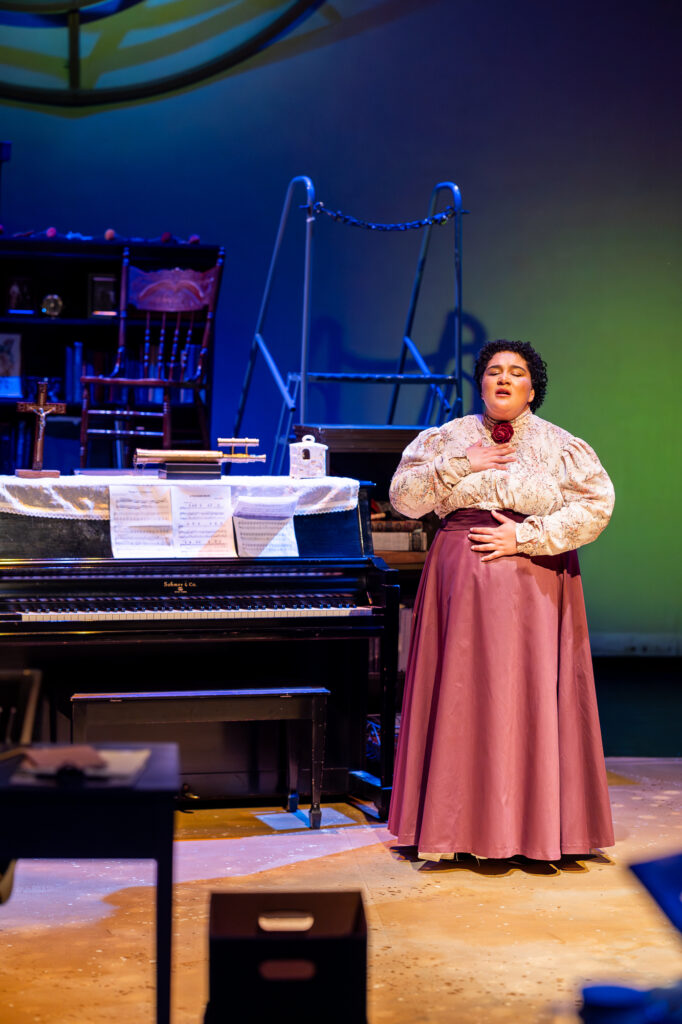
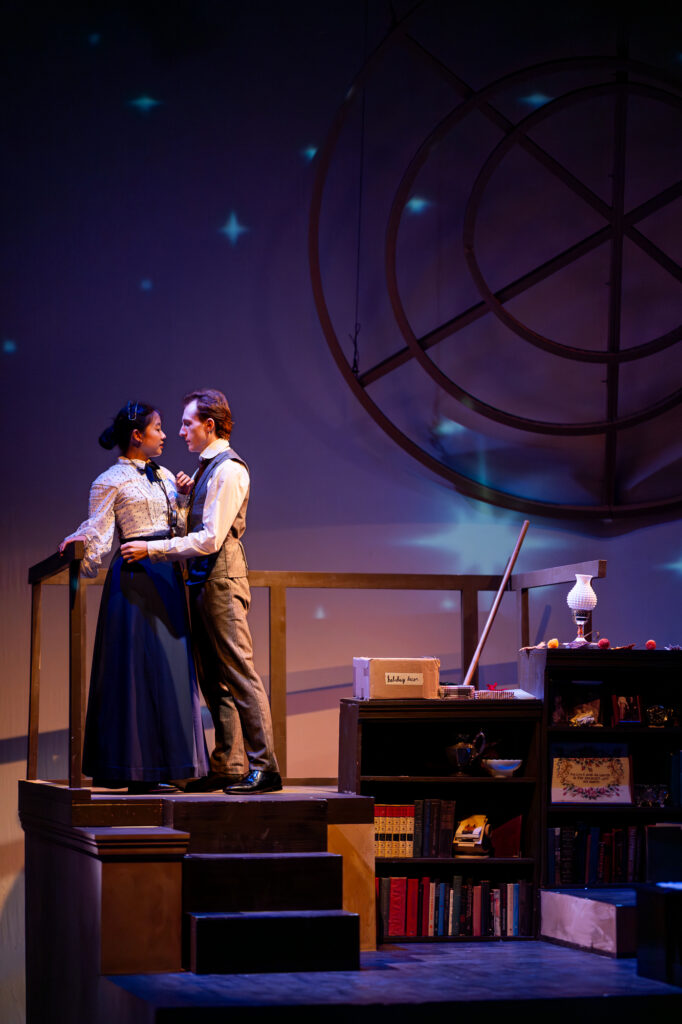
The play opens in Worcester in media res, with Lumanti center stage and the Nigerian women (Ekong’s mother, Abasiama, and sisters, Adiana (Regine Vital) and Toyoima (Natalie Jacobs)) above, on a lightly propped catwalk. Large staircases bookend the stage and are used with a practiced light touch under the spot on direction by Kevin R. Free. Cristina Todesco’s efficient and creative set and Andrea Sala’s restrained but effective lighting create a trifecta of simultaneous activity.

All the women are talking at once. Lumanti speaks into her cell phone in Nepali. Unlike some of Udofia’s previous plays (especially The Grove), the use of long passages of unsubtitled, non-English language is not off-putting. Here, the actors and Udofia offer enough clues so that the audience, instead of being shut out, is treated like special guests, invited for a behind-the-scenes peek at what life is like for this young, second-generation couple.

Lumanti is talking to her father, and we get the gist that she is getting an earful. Upstairs, the Nigerian women, with Abasiama lapsing into her native Ibibio, seem to be okay with the wedding, although the sisters are a little less enthusiastic than their mother.

It seems that white, in Nepalese culture, represents death, yet Lumanti has agreed to wear white for the wedding. “We wanted a western wedding,” she unconvincingly says.

The action swings back to the lower stage, where a table and couch shift the scene to Ekong and Lumanti’s apartment. Ekong is in the midst of a disciplined workout. His eyes are glued to one of three overhead projections showing the same episode of “The Fresh Prince of Bel-Air,” the 1992 iconic Black American television show starring Will Smith (projection and digital content design by Michi Zaya).

Ekong doesn’t just enjoy the show, however. He needs it, and his eyes bulge with the panic of an addict who needs his fix until the set flips on. Only then can he truly relax. His mouth goes lax and he zones out from his outside world to the interior existence he channels, where he can step into a world of what his life could have been like if he had had different parents.

He sets a romantic table, complete with flowers and wine. When Lumanti enters the apartment, he is blindsided when she tells him her father, who had adamantly opposed and boycotted their wedding, has changed his mind. He will make the trip from Kathmandu after all. She is overjoyed.

“And you believe him?” Ekong asks. Ekong had assumed that, because Lumanti’s father was a no-show, his own father’s (Disciple) absence wouldn’t be questioned. Suddenly, Lumanti believes both their fathers are capable of change and she wants him to reach out again to his father with the news that hers will be in attendance.

It turns out Ekong never even spoke to his father. Lumanti, changed by the fact that her father will bear witness to the ceremony, has other news — she wants their wedding to be more traditional and include rituals from their two cultures.

“Why?” Ekong asks. “I’m Nepalese,” she replies. “Since when?” he demands. “Since dad said he’s coming,” she responds in all honesty.

And so the scene is set that will drive the rest of this thought-provoking, entertaining, and well-produced drama.

Udofia weaves together several subplots that show, rather than tell, the backstory of Ekong and his father’s 20-year estrangement. The owner of a successful physical therapy practice, Ekong bonds with Philip (the excellent Roberts), a client whom he equates with the idealized Black father figure in the TV show. He even tries to enlist him as a surrogate father, but Philip wisely declines.

Meanwhile, Lumanti navigates her own journey with her mother, Laxima ‘Amma’ Shrestha (Salma Qamain), and Auntie (Natalya Rathnam, funny and wise), and their reactions to the news that her father will attend. The older matriarchs share relationship and marriage advice and the three dig into the work of turning the secular wedding into more of a cultural celebration.

Act II brings out the dramatic strengths of the action and script, especially the scenes between Disciple, Abasiama and Ekong, and, of course, the wedding ceremony itself. Director Free makes free use of the full stage with multiple, simultaneous locations and conversations that keep up the pace and audience’s interest.

Eventually (no spoiler here-), the wedding takes place and the audience is both invited and delighted by the multi-traditional festivity. Something new and unique to Lumanti and Ekong (and their families) has been born from the blending of two families intent on preserving their heritage while acknowledging contemporary realities. Two parts really can make a new whole, but for the audience, the destination was never the brass ring. The journey, with all its potential derailings lying in wait and complicated intra-familial, was always what it was about.

Director Free brings out the best in his cast (with special shout-outs to Bennett (Ekong), Saigal (Lumanti), and Roberts (Disciple)), and Udofia’s script is crisp and unpreachy with just the right amount of humor and pathos. As an added bonus (like we needed one), we get to ride shotgun as both Ibibio and Nepali wedding traditions are unveiled before our eyes, a lovely touch.

There is a reason the show sold out almost immediately, although last-minute seats may be available. Do yourself a favor and try to be one of the lucky ones who scores one.

The Ceremony’ — Written by Mfoniso Udofia. Directed by Kevin R. Free. Presented by CHUANG Stage at Boston University’s Joan & Edgar Booth Theatre, 820 Commonwealth Ave., Boston through October 5.

For more information, visit https://www.chuangstage.org/the-ceremony

Lyric Stage’s ‘Our Town’ Is A Classy Production of A Timeless Classic

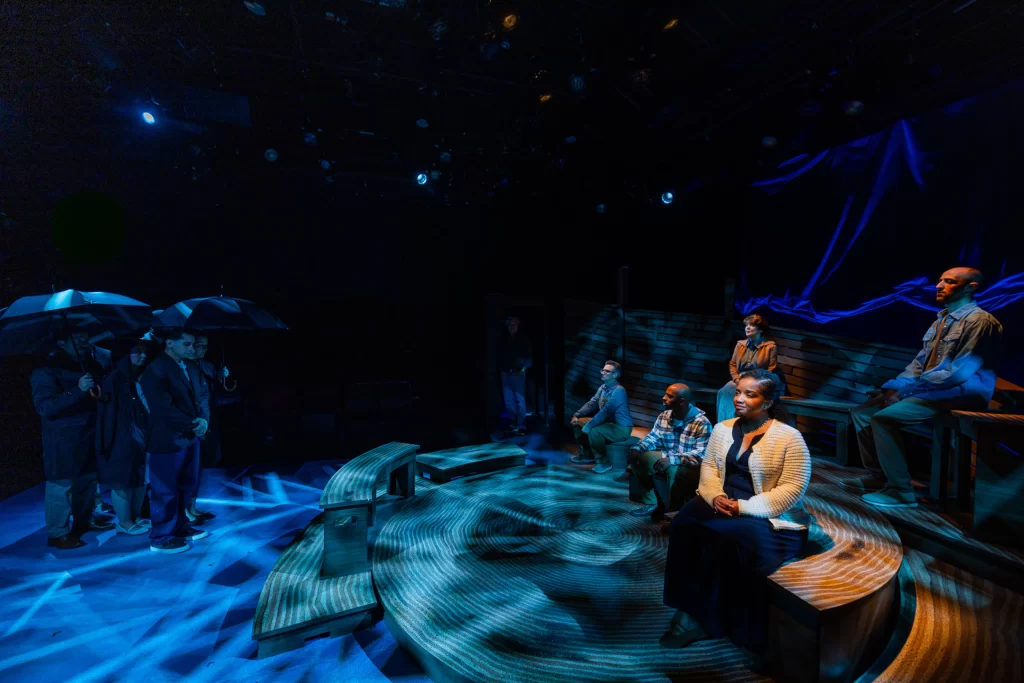
Will McGarrahan as the Stage Manager in Lyric Stages’ “Our Town”
Photos by Nile Hawver

By Shelley A. Sackett

Our Town, Thornton Wilder’s 1938 Pulitzer Prize-winning play, is set in the fictional New Hampshire town of Grover’s Corners. Narrated by a Stage Manager (Will McGarrahan, excellent in the sober yet not dispassionate part), this classic uses a minimal set to explore universal themes of life, love, and death. Described by Edward Albee as “the greatest American play ever written,” it presents the fictional American town of Grover’s Corners, New Hampshire, between 1901 and 1913. Through its citizens, and especially the Webb and Gibbs families, Wilder celebrates our shared humanity and the importance of appreciating the present moment, especially the glimmers of community and connection that keep us grounded and give our lives meaning.

And who couldn’t use a glimmer of light during dark times, whether it’s 1938 or 87 years later?

Act I (“Daily Life”) of the two-hour (one intermission) production opens on a set (Shelley Barish) of movable curved benches, Jenga-like in their flexibility and simplicity. They start as an arc and turn into whatever a scene calls for. Courtney O’Connor directs with a steady hand (especially the pantomiming in the prop-less production). Lighting and costumes subtly supplement.

The Stage Manager then presents each character, each building, and each historical fact, context meant to orient and bond the audience with time, place, and, most importantly, people.

“The play is Our Town. In our town, we like to know the facts about everyone,” he states matter-of-factly.

It is dawn on May 7, 1901. The Stage Manager guides us on a tour of the town, with its six churches, town hall/post office/jail, grocery store, drug store, and the homes of the Gibbs and Webb families. We are introduced to Joe Crowell (Jacob Thomas Less) as he delivers the morning paper, “The Grovers Corner Sentinel,” to Doc Gibbs (Robert Najarian). As Howie Newsome (Jesse Garlick) delivers their milk, we meet the rest of the townspeople, including Editor Webb (the always welcome De’Lon Grant) and the rest of the Webb and Gibbs families.

Mrs. Webb (Amanda Collins) and Mrs. Gibbs (a refreshingly nuanced Thomika Marie Bridwell) ready their children and husbands for their days. Emily and Wally Webb (Josephine Moshiri Elwood, Darren Paul) and George and Rebecca Gibbs (Dan Garcia and the irresistibly magnetic Kathy St. George) attend school together. The romance between Emily and George will become the lens through which the town’s story unfolds.

Professor Willard (John Kuntz, notable as always) and Editor Webb fill in some of the gaps, giving us the skinny on the history of the town and its socioeconomic status and political and religious demographics.

The Stage Manager then gets into the weeds about each character’s relationships and challenges, along the way presenting the town’s more colorful and minor characters. Simon Stimson (Kunz), the church organist and choir director, is also the town drunk. Doc Gibbs chews his son out for not helping his mother with her chores, and George and Rebecca’s eventual romance begins to bud under a full moon.

The Stage Manager dismisses us with a no-nonsense, “That’s the end of Act I, folks. You can go and smoke, now. Those that smoke.”

Act II (“Love and Marriage”) opens three years later. The Stage Manager summarizes the themes of Acts I and II — daily life, love and marriage — adding, “There’s another act coming after this. I reckon you can guess what that’s about.”

Emily and George’s courtship takes center stage, and the delightful ice cream parlor scene in Act II is one of the play’s best.

As Emily and George prepare to marry, the interactions with their families are warm, intimate and funny. Bride and groom are terrified, caught between wanting to remain kids and needing to follow the rules of the natural order of things, at least as they are in Grover’s Corners.

Doubling as wedding officiant, the Stage Manager says plainly, “People were made to live two by two… I’ve married over two hundred couples in my day. Do I believe in it? I don’t know.” The important thing, reminds Mrs. Soames (St. George), is to be happy. “I’m sure they’ll be happy. I always say, ‘Happiness, that’s the great thing!’”

Act III (“Death and Eternity”) takes place nine years later. The Stage Manager paints broad brushstrokes of changes — even the farmers drive cars, people now lock their doors — but quickly circles back to the play’s main themes of the unavoidable passage of time, the importance of paying attention to life’s little moments, and the miracles that are the substance of everyday life and the fabric of eternity.

Focused on those who have passed away in the last nine years, the act takes place in the town cemetery. The Stage Manager describes how each person died before letting us know whose funeral is about to take place. The most thought-provoking of the three acts, playwright Wilder urges that we seize each day and celebrate the “magnificence and magnitude of life.” Asked if anyone truly understands the value of life while they live it, the Stage Manager responds, “No. The saints and poets, maybe —they do some.”

The rest of us? Not so much.

Some might complain that Our Town is dated and question why Lyric Stage has chosen to open its 2025/2026 season with this oft-produced classic. I say kudos to Producing Artistic Director Courtney O’Connor for recognizing an existential need in the current external turmoil to remind us that even in these dark times — especially in these dark times — we must not forget to slow down, breathe deeply and acknowledge that life is — no matter what — the most precious gift we are given.

Recommended.

‘Our Town’ – Written by Thornton Wilder. Directed by Courtney O’Connor; Scenic Design by Shelley Barish; Costume Design by Rachel Padula-Shufelt; Lighting Design by Deb Sullivan; Sound Design by Andrew Duncan Will. Presented by The Lyric Stage Company of Boston, 140 Clarendon Street, Boston, through October 19.

For more information, visit: https://lyricstage.com/

CST’s ‘Silent Sky’ Aims for The Stars But Falls Short

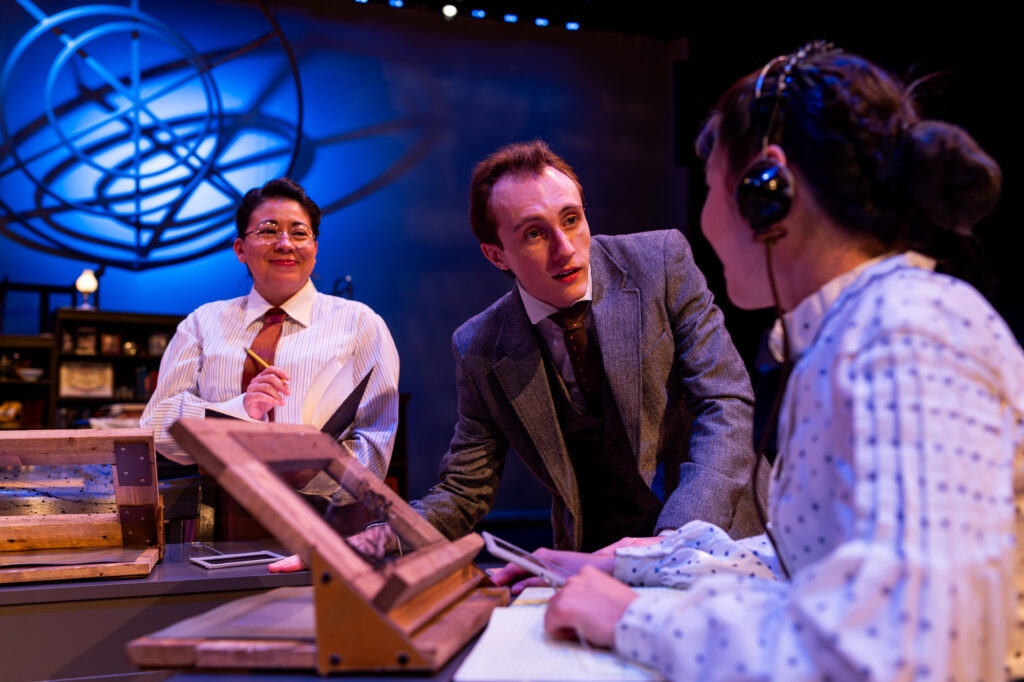
Lee Mikeska Gardner, Jenny S. Lee, Erica Cruz Hernández in Central Square’s ‘Silent Sky’
Photos by Nile Scott Studios

By Shelley A. Sackett

Lauren Gunderson’s career as a playwright (she is also a screenwriter and short story author) has largely focused on stories about iconoclastic women in history, science and literature. She is one of the top 20 most produced playwrights in the country, with over twenty plays produced. (Lyric Stage Boston’s 2022 production of her The Book of Will was a knockout).

With Silent Sky, a Catalyst Collaborative@MIT Production presented by Central Square Theater through October 5, she turns her attention to the story of Henrietta Swan Leavitt, a young astronomer whose scientific brilliance and curiosity led to her discovery of the relationship between luminosity and the period of Cepheid variables (a star that pulsates).

If that sounds wonky and more opaque than incandescent, it is. Yet, thanks to Gunderson’s witty, tightly crafted script and several outstanding performances, the almost two hours almost fly by.

The play starts in 1902 with Henrietta (Jenny S. Lee), the daughter of a rural preacher in Lancaster, Mass., speaking to her sister, Margaret Leavitt (Kandyce Whittingham). Henrietta, a recent Radcliffe College graduate, studied the classics with strong interests in math and astronomy. She considers herself, above all else, to be a scientist.

Margaret, on the other hand, considers herself (and Henrietta) to be unmarried, marriage-aged women whose lives will be unfulfilled until their status changes.

Kandyce Whittingham

Henrietta has just received an invitation to join the Harvard College Observatory. She assumes that she will be working with the college’s “Great Refractor” telescope directly under its greatest faculty member, Dr. Pickering. She is determined to accept their offer, despite Margaret’s trying her best to get her to understand that she will die an old maid if she does.

Ironically, her words fall on deaf ears (Henrietta contracted a disease that led to deafness). “I need to start my life,” Henrietta pleads. “With daddy’s money.”

Dowry in hand, she burns any hope of marrying and heads to Harvard.

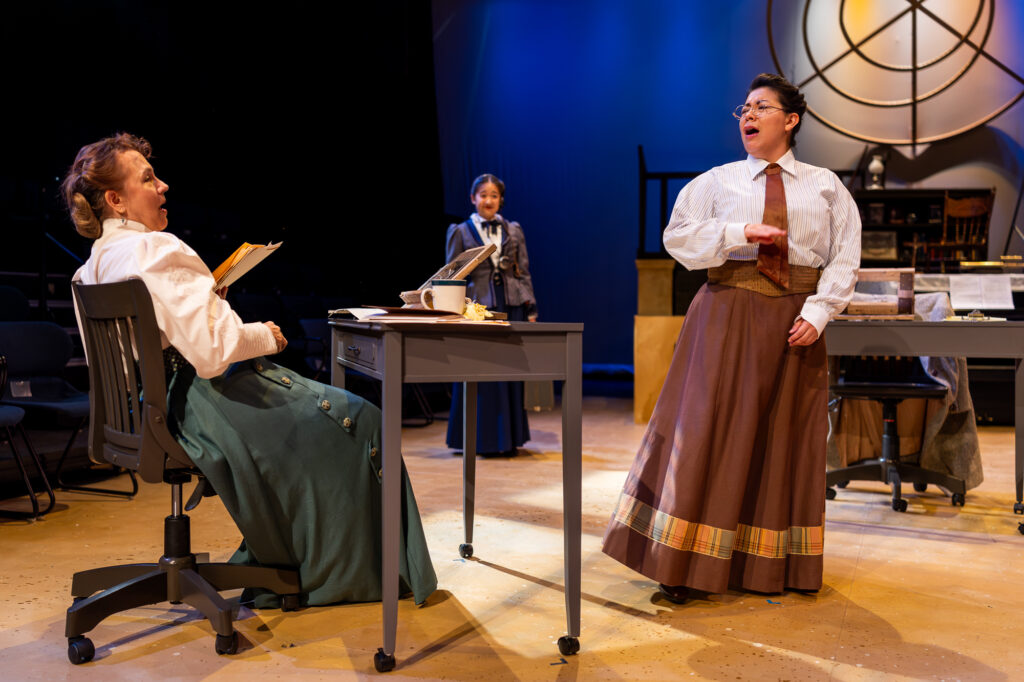
There, she is met by Peter Shaw (an excellent Max Jackson). It is Shaw’s unfortunate duty to inform Henrietta that she has been hired to join The Harvard Computers, a sisterhood of scientists who analyze plates that contain images from the telescope they are not allowed to touch. These women do the necessary mathematical equations for the observatory’s male-only research team, who absorb (code for steal) the women’s work and pass it off as their own.

Lee, Max Jackson

Shaw’s second unfortunate duty is to inform Henrietta that he is her boss and mediator to Dr. Pickering, whom she will also never see. Needless to say, Henrietta goes ballistic in the first of many scenes that are so well written but flatly executed.

As Shaw, the inferior physicist whose father’s connections landed him his job, Jackson turns in a solid performance. He is clearly out of his league professionally and his will, credentials and verbal swordsmanship are no match for Henrietta’s. The two circle the desk as Henrietta puts on her best pit bull persona, furious and determined.

Gunderson’s script is crisp, funny and fast-paced, a gift to both actors and audience. The problem is that Lee doesn’t quite have the tone and touch that the part of Henrietta requires. Strident and droning, she struggles to flesh out Henrietta with the nuance and rhythm she needs.

Her co-workers, thankfully, are another story. As Williamina Fleming, the Scottish housekeeper turned “computer,” Lee Mikeska Gardner is the runaway showstopper. Pitch perfect in every way, she milks her character’s dry sense of humor with straight-faced deliveries in an impeccable (and easily comprehensible!) brogue. She has some of the show’s best lines and delivers them like the consummate (and much regaled) actress she is.

Annie Cannon (Erica Cruz Hernández, also very good) is the no-nonsense, brilliant scientist and head of the computing team. A diva relegated to backup singer, she is at peace with her lot. “I don’t need a title,” she declares. “My life is my work.”

The two convince Henrietta to stay. At least she has access to the world she longs to live in and, with Cannon and Fleming as her colleagues, its best minds.

The play unwinds fairly chronologically with relationships, historical events and family crises moving the story along. Eventually, her discovery allowed astronomers to estimate greater distances up to ten million light-years away, much greater than one hundred light-years. Hubble used the law to estimate the distance of the Andromeda galaxy in light-years. She was nominated for the Nobel Prize in physics, but she had already passed away 4 years earlier.

Gunderson tackles more than just Henrietta’s contribution to science, however, with big-ticket issues and questions. Societal restrictions on women permeated every aspect of her life. It was expected she would be a homemaker and supporter rather than a contributing participant. Her legacy was to be her children, a life well lived, measured in her husband’s accomplishments.

Lee

Henrietta, on the other hand, dared to challenge long-held norms and trumpet the call for women’s independence, unfettered scientific research, and academic gender bias blindness. Thank you, Central Square Theater, for spotlighting this little-explored crusader. Sadly, over a century later, her concerns couldn’t be more relevant.

‘Silent Sky.’ Written by Lauren Gunderson. Directed by Sarah Shin. Scenic Design by Qingan Zhang; Costume Design by Leslie Held; Lighting Design by Eduardo M. Ramirez; Sound Design and Composition by Kai Bohlman. A Catalyst Collaborative@MIT Production. Presented by Central Square Theater, 450 Massachusetts Ave., Cambridge through October 5.

For more information, visit https://www.centralsquaretheater.org/

SpeakEasy’s Outstanding ‘Primary Trust’ Simmers Slowly Until It Boils Over

David J. Castillo, Luis Negrón and Arthur Gomez in Speakeasy’s “Primary Trust”.
Photos by Benjamin Rose

By Shelley A. Sackett

Like homesickness and old age, some things just “creep up” on us. A feeling that might start suddenly and imperceptibly, the sensation gradually builds until reaching a tipping point, after which we are acutely aware of and significantly affected by it.

Such is the case with SpeakEasy’s first production of the 2025/2026 season, Primary Trust, now enjoying a long run through October 11 (so there’s plenty of time to catch this gem).

Winner of the Pulitzer Prize in Drama in 2024, the drama focuses on an emotionally delicate young man (late 30s) named Kenneth (a magnificently understated David J. Castillo). Orphaned at 10 years old, he coped with the traumas of childhood abandonment by creating an imaginary companion named Bert (Arthur Gomez in a pitch-perfect, unfussy performance).

“This is the story of a friendship,” Kenneth says by way of introduction. He then begins to tell his tale.

He lives in Cranberry, New York, an upstate mostly white town (“there are some Cambodians”) of 15,000, where his mother and he had settled. For almost 20 years, Kenneth has spent his days working in a bookstore run by Sam (Luis Negrón, playing a number of roles effectively). He spends his nights at Wally’s, the local Tiki bar where he (and he as Bert) drink 2-for-1 Mai Tais until Kenneth’s pain reaches the tipping point of anesthetization.

It is through his conversations with Bert that we get our first glimpse of Kenneth’s interior world. Robotic and guarded at work, he opens up (after his first handful of drinks) with his best friend, who, though imaginary, isn’t fake. “He’s the realest thing I know,” Kenneth says matter-of-factly.

Gomez, Castillo

Frequent asides to the audience also clue us in to the inner turmoil that Kenneth just manages to keep a lid on. The routine he has established — work, Wally’s, stumble home blackout drunk — gives him the stability and sense of purpose he so desperately craves.

All comes to a grinding halt when Sam announces his intention to sell the bookstore and move to Arizona. That night, Bert barely succeeds in calming him down. Unmoored, Kenneth will, for the first time in his adult life, have to find a job on his own and establish a new routine.

The first indication that this upheaval might have a silver lining is the night he befriends Wally’s bartender, Corinna (Janelle Grace, who plays a number of roles well, especially Corinna). This is a huge step for Kenneth. He has been coming to Wally’s every night for 15 years and, until Corinna sits down at his table, has never said a word to anyone other than Bert.

She suggests he apply for a job at Primary Trust, the aptly named local bank where, coincidentally, his mother had worked. She also manages to draw him out of his shell, sensitive to his skittishness but unwilling to let him retreat. She, too, is lonely, and director Dawn M. Simmons masterfully handles their initial encounter with restraint and grace. “It’s nice to know I’m not alone,” Corinna shares.

Janelle Grace

Kenneth lands the job at the bank and knocks it out of the ballpark, becoming a top producer in short order. His biggest challenge now shifts to keeping his inner demons at bay during the day until he can hightail it to the safety of Wally’s. Bert is no longer the only imaginary part of his life. This unfamiliar veneer of “normalcy” and success is like the skin that forms on a pot of milk right before it boils over.

Slowly, and with Corinna’s help, Kenneth tiptoes out of his comfort zone, sharing and receptive to more. She brings out a playfulness in him. She also earns his trust and she (and we) learn the details of the events that catapulted Kenneth from the harshness of reality to the haven of the imaginary.

Although he is still anxious and searching for his North Star, with Corinna, he starts to understand that there are others in the real world he can connect with and that solitude may be more of a prison than a sanctuary.

Playwright Booth handles Kenneth’s transformative transition with subtlety and precision. She has a knack for economical dialogue that gets the job done (a breath of fresh air). Confident in his craftsmanship, he elevates the pathos by imbuing it with glimmers of optimism and bright sparks of humor.

Shelley Barish’s set is simple, effective and efficient. Wally’s Tiki Bar and Primary Trust bank anchor the left and right sides of the stage, the center fluctuating between Sam’s bookstore, a snowy sidewalk, and a fancy restaurant. Simmons makes some interesting directorial decisions. Booth punctuates his script with asterisks meant to indicate that the actor pauses for a beat. Unlike many playwrights who specify directorial translation, Booth leaves it up to the individual director to decide how to interpret that transition.

Simmons has chosen to mark those beats with the clang of a bell. At first confusing and annoying, they grow on you, eventually making sense. Kudos to Simmons for this creative and bold move.

Castillo, Grace

At 95 minutes (no interruption), Primary Trust has ample time to build an arc of crisis and dénouement that is both satisfying and thought-provoking. By the play’s end, we are as altered as Kenneth. By sharing his intimate experience and ultimate survival, he has reminded us how much we mean to and need others.

As Simmons states in her program notes, “My deepest hope is that Primary Trust offers you something…meaningful — a jolt of hope, a whisper of kindness, or simply a moment to breathe and reflect on what it means to walk through this world together.”

Primary Trust’ — Written by Eboni Booth. Directed by Dawn Simmons. Scenic Design by Shelley Barish; Lighting Design by Karen Perlow; Costume Design by Chelsea Kerl; Sound Design by Anna Drummond. Presented by SpeakEasy Stage Company at Boston Center for the Arts, 527 Tremont St., Boston through October 11.

Recommended.For more information, visit speakeasystage.com/

NSMT’s ‘Rent’ Is Well Produced And Timely Entertainment

The cast of “Rent” at North Shore Music Theatre. Photos by Paul Lyden

By Shelley A. Sackett

North Shore Music Theatre is tailor-made for musicals with its theatre-in-the-round, signature creative set designs and talented casts. With Rent, the Pulitzer Prize and Tony Award-winning musical set in New York City’s East Village from 1989 to 1990, it manages to pay homage to a classic that defined an era while also spotlighting its relevance to today.

Jonathan Larson’s rock opera became a sort of psalm for the era when HIV/AIDS first appeared and quickly steamrolled into a full-blown cultural and health crisis. The musical follows a diverse group of struggling wannabe artists as they navigate love, death, pre-gentrified Alphabet City, and the roller coaster that is always one’s early 20s. Add sex, drugs, performance art and rock and roll to the recipe, and the pot bubbles up and froths over, like a chemistry lab experiment gone rogue.

Yet, all is not doom and gloom. Strength, connection and love see these folks through the dark times of marginalization, false narrative and sickness. These themes reflected reality 30 years ago, and, sadly, they resonate just as powerfully today.

Jeffrey D. Kmiec’s set conjures the gritty area of 11th Street and Avenue B. Metal scaffolding gives the actors platforms and the audience the feeling they, too, are up on a roof, clinging to its rungs for dear life. Simple props evoke a shabby warehouse loft apartment and later a CBGB-esque club, restaurant and others.

The musical spawned many hit songs that became anthems for the era, such as “Rent,” “Tango: Maureen,” “Seasons of Love,” “La Vie Bohème,” “Out Tonight,” and “Take Me or Leave Me.” All receive superior treatment from NSMT’s terrific orchestra (under Robert L. Rucinski’s direction) and a cast of great voices.

A brief primer is in order to make sense of the fast-paced and complex string of scenes and keep track of the huge roster of characters.

Aaron Alcaraz as Mark Cohen

The action opens on Christmas Eve. Two roommates, Mark (Aaron Alcaraz), a filmmaker, and Roger (Austin Turner), a rock musician, struggle to stay warm and keep the electricity going in their “apartment.” Their voice message machine brings the audience up to date. Their rent is not just due; their former roommate, Benny, their new landlord, is reneging on their oral agreement and demanding that, unless they pay last year’s rent in full, he will shut off their electricity and evict them. Mark’s mother leaves an edgy, passive-aggressive message from Mark’s hometown on Long Island.

We also learn in short order that: Mark’s girlfriend, Maureen (Cate Hayman, a knockout talent), dumped him; Roger contracted AIDS from his former girlfriend, who slit her wrists; and their friend, Tom Collins (Aaron Arnell Harrington, great vocals), a gay anarchist professor of computer-age philosophy at NYU, was just mugged outside their apartment.

Roger, a former “pretty boy front man,” longs to write one last, great song before his inevitable death.

Tom is rescued by Angel (Robert Garcia), a cross-dressing street drummer. It’s love at first sight, uncomplicated by the specter of AIDS since they are both already positive. Rounding out the scene are Mimi (gifted singer Didi Romero), Roger and Mark’s neighbor and an exotic dancer and drug addict, and Joanne (Kat Rodriguez, another excellent singer), Maureen’s new girlfriend and a lawyer.

All this within the first few minutes.

At this point, the plot thickens to a dense pea soup. Benny (former roomie, current landlord) shows up at Mark and Roger’s and tries to convince them that, his threats to evict them notwithstanding, he is actually a good guy. He’s trying to raise money from investors so he can buy the building and turn it into a cyber arts studio that will benefit them all. All they have to do is convince Maureen to call off her organized protest against his plans. If they do that, Benny promises, they can officially live as rent-free tenants.

Aaron Arnell Harrington (as Tom Collins) with Isaiah Rose Garcia (as Angel Dumott Schunard)

Roger and Mark refuse.

Mark heads over to the protest to help Maureen with the sound system. Instead, Joanne (the new girlfriend and lawyer) is there, mucking with the equipment. The two circle each other like territorial alpha dogs before uniting in their shared dislike of Maureen’s manipulative, promiscuous nature. They literally join forces in the harmonious and witty duet dance, “Tango: Maureen.”

Despite their non-commutable death sentences (this was the late 80s, early 90s when there was no such thing as hope or a cure for those with AIDS), these neighbors bond to support and help each other. They share from the heart at their weekly support group and talk freely about their dreams for the future. Collins (Harrington) plumbs his soul (and baritone vocal chops) in “Santa Fe,” where he imagines he and Angel opening a restaurant.

One of “Rent’s” strangest numbers is Maureen’s protest performance piece, “Over the Moon.” Hayman is riveting as she writhes, growls, howls and scats her way through the wild number that combines song, dance, poetry and punk. Even when just seated at a table or as a member of the chorus, Haywood would command attention, even if she wasn’t impossible to ignore due to her height. Her physicality and raw talent are magnetic.

Thanks to Larson’s robust score and narrative lyrics, the show doesn’t bog down despite its dramatic morass. “La Vie Bohème” celebrates the group’s love for their lifestyle and priorities while acknowledging its pitfalls and fallout. As Act I ends, Mark and Roger learn that their building has been padlocked, a riot has broken out and Roger and Mimi share their first kiss.

Act II begins with the full cast singing “Seasons of Love,” a reminder that no matter what happens, life is to be measured in love. The plotlines blur frequently, with the musical numbers throwing a lifeline of coherence and entertainment. Maureen and Joanne’s duet, “Take Me or Leave Me,” is hands down the show’s most impressive. Hayman (Maureen) and Rodrigues (Joannne) reach such a high pitch on every level, it’s hard to believe they don’t spontaneously combust. There is always one such number (when we’re lucky) in every musical, and in NSMT’s version of “Rent,” this is it.

The show is one of the longest-running shows on Broadway, closing in 2008 after a 12-year run. Even if you’ve seen the show several times, it’s time to do it again. Its 1990’s messages of perseverance in the face of adversity, community and connection in times of divisiveness, and protesting unfairness and cruelty couldn’t be more contemporary.

‘Rent’ — Book, Music and Lyrics by Jonathan Larson. Musical Arrangements by Steve Skinner. Direction and Choreography by Marcos Santana. Scenic Design by Jeffrey D. Kmiec; Costume Design by Rebecca Glick; Lighting Design by José Santiago; Sound Design by Alex Berg; Video Design by Beth Truax. Presented by North Shore Music Theatre through September 28.

For more information, visit https://www.nsmt.org/

Bearing witness: 85-year-old Holocaust survivor relives her childhood in the docudrama, ‘Hidden: The Kati Preston Story’

By Shelley A. Sackett

Kati Preston being interviewed for the film. | KELLY FAN

On Sept. 20, the 41st Boston Film Festival will host the world premiere of “Hidden: The Kati Preston Story.” The 75-minute film is a powerful docudrama that follows the extraordinary journey of 85-year-old Holocaust survivor Kati Preston. Exceptionally well-edited, directed and produced, it retells the story of one person’s resilience and survival in the face of a society descending into antisemitism, authoritarianism, dictatorship and tyranny.

The film opens on a bucolic country scene with a horse peacefully grazing near a white clapboard house. Smoke spirals invitingly from its chimney. Inside, a woman sits at her desk, turning the pages of a scrapbook of sepia-toned family photos. “Everybody here is dead. I’m the only one left,” says Kati Preston. “It feels so strange because I feel like I’m in exile. The world I come from is gone. When I die, nobody will remember these people because I’m the last person who bears witness.”

Seamlessly, the screen melts into 43 seconds of black-and-white archival footage that shows Jews living openly Jewish lives followed quickly by scenes of them being rounded up, transported, beaten and murdered. The last shot is of crematoria ovens, doors wide open, displaying their interiors of ashen, bony remains. Mercifully short, these devastating images are a reminder of the lightning speed and crusading evil that are the backdrops to Kati’s story.

Based on Kati’s award-winning graphic novel, “HIDDEN: The True Story of the Holocaust,” the film is narrated by Kati and features reenactments of her story. In 1943, her hometown of Nagyárad, Hungary (now Oradea, Romania) boasted a thriving Jewish community with synagogues, a Jewish hospital, Jewish schools and Jewish coffee houses. Despite a diverse society that welcomed religious Jews, Roma and Muslims, Jews remained insulated, not wanting to assimilate.

Kati’s childhood was one of luxury. Her mother ran a dressmaking business with 40 employees and her father was a carp wholesaler. At 5 years old, she was beautifully dressed, wore curlers to bed every night and enjoyed the comforts of maid and governess. Her father was Jewish, her mother a Catholic who converted. Although they were secular Jews, Kati remembers her mother lighting Shabbat candles every Friday night.

She also remembers going to the opera on Sundays with her Catholic grandmother. Those outings routinely ended with the two of them sitting at a bar and her grandmother slugging down shot after shot until she was drunk.

Kati’s father was playful and happy-go-lucky. Her mother, whom Kati feared and loved but “did not like,” was more in control and controlling. To make sure Kati was trained to be a proper young lady, she hired Fraulein, who “terrified children into behaving instead of educating them.” One tool in Fraulein’s toolbox was her book of Grimm’s Fairy Tales, which was used to teach German children the dangers of misbehavior through traumatic stories. These included a child having his thumbs cut off for thumb-sucking and a girl who burns to death for playing with matches.

Interspersed among the narrative reenactments are interviews with Tom White (Holocaust and genocide educator), Dr. Martin Rumscheidt (Christian minister, educator, author and theologian), Annette Tilleman Lantos (Holocaust survivor from Budapest), Rabbi Oberlander Baruch (Chief of the Budapest Orthodox Rabbinate) and Kati’s son Daniel Mator, who directed “Hidden.” His six-year collaboration with filmmaker Jody Glover and determination to trace his family roots are responsible for Kati’s story being brought to life.

Inserting talking heads into a docudrama can be risky. If clumsily done, these can interrupt rather than augment, breaking the mood and boring the audience. Director Mator and his team avoid this common pitfall, masterfully using these commentators to supplement the interviews with eye witness accounts and historical context. In particular, Mator’s on-the-ground guided narration of life and lives in the Jewish ghetto in the 1940s feels more like an immersion experience than a lecture, thanks to his use of animated maps and archives.

Things go from bad to worse for Kati and her mother after Hitler invades Hungary. Her mother sews the mandatory yellow star onto Kati’s coat, which she proudly wears until a man sees it and spits on her. “I couldn’t understand why I had to wear a star that would make someone spit on me,” Kati says of her first encounter with antisemitism.

A Hungarian farmer woman who feels beholden to Kati’s mother agrees to hide Kati in her barn. Miraculously, she avoids detection until she can be reunited with her mother. The defeat of the Nazis brings Russian occupation and a different set of perils, as those soldiers rape, pillage and murder with impunity. Again, Kati’s mother displays fearless ingenuity and chutzpah when she curries favor by offering to make a dress for one of the female Russians. Soon, she is outfitting the entire women’s corps. In exchange, mother and daughter are protected and amply fed.
Their lives under Stalin’s communist regime take an even darker turn, as Kati, “brainwashed,” actually reports her own mother to the police. Mator eventually brings us into the 21st century, focusing on generational trauma and the troubling narrative of Hungary’s revisionist history.

Kati is one of the two (out of 52) kindergarteners in her class who survived the Holocaust. She lost all 28 members of her extended family to Nazi genocide. Believing that her survival has given her “the energy to make my life count,” she pursued careers in journalism, fashion, theater and education before dedicating her life to sharing her story. She speaks in schools, libraries and public institutions, emphasizing survival over victimhood and the urgency of combatting prejudice.

Along with former New Hampshire Gov. Chris Sununu, she succeeded in getting Bill HB115 passed to make Holocaust education compulsory in New Hampshire schools. Her remarkable connection with youth has inspired her graphic novel, and now this film. These are being combined with classroom lesson plans for a worldwide distribution to schools as an initiative towards Holocaust education.

“I loved my childhood,” Kati reminds her audience. “Then things shifted. These things can happen here.”

Paul Melendy Soars in GBSC’s Fabulous ‘Featherbaby’

Gabriel Graetz, Paul Melendy and Liv Dumaine in GBSC’s ‘Featherbaby’

By Shelley A. Sackett

There are not enough words of praise to describe Paul Melendy’s sublime performance as the insightful, unfiltered and outrageously funny trash-talking parrot, Featherbaby, in the eponymous play now running in its co-world premiere through September 28 at Greater Boston Stage Company in Stoneham. If you only see one production this entire season, this is the one that should be at the top of your list.

The set (Katy Monthei) alone is worth the price of admission. A pink wicker peacock chair sits high and center stage, an eye-catching focal point that will double as Featherbaby’s cage. Jigsaw pieces, rainforest motifs painted on cloth panels, strings of lights, and photographs of crime scenes foretell later plot elements, but before the curtain even goes up, all are indicative of the uniquely inventive theatrical event soon to begin. A simple desk and chair stage right and small table stage left bridge Featherbaby’s world and the two humans who will later share their stage.

The play opens with Melendy sashaying on the stage in full regalia. Thankfully, that does NOT include a stuffed-animal-like mascot costume of a green parrot. Rather, Deirdre Gerrard has captured the image of an Amazon parrot while allowing Melendy’s plasticene physicality to strut its stuff by creating an outfit of floral, formal dinner jacket, green vest and matching pants, and luminescent yellow satin shirt and tie. Melendy makes expert use of the long, wide double flaps in the jacket’s back as he manipulates his “tail” to great dramatic effect.

Melendy

“I am adorable,” Featherbaby announces. Melendy casts a magical spell as his facial expressions, neck twitching, and bird-like prancing transform him into a believable version of a bird. “I am also,” he says unnecessarily, “intense.”

Maniacally egotistical, Featherbaby also needs constant attention and will go to great lengths to make sure he is at its center. “I AM HERE!!!!!” is his favorite refrain, seconded only by “poop.”

Melendy goes on, with manic and jaw-dropping physicality, to describe the evolutionary history and modern-day life of the parrot. We learn that parrots are descendants of dinosaurs and that their primary purpose in the wild is as simple as it is singular: avoid getting eaten. We also learn a new vocabulary that includes “crunching” (biting) as in, “I feel a crunch coming on.”

He describes being bagged by poachers and transported from his rainforest Amazonian haven to a cage in America. Melendy is an indescribable delight to watch, as he vamps, pantomimes, and literally inhabits Featherbaby. He even ad-libs at one point, when he tosses Mason’s “heavily scented boxer shorts” into the audience, only to have them thrown back in his face.

“There’s only room for one cheeky parrot in this play,” he says with a menacing, eyebrow-raised sneer.

The loose-limbed plot involves Angie (Liv Dumaine), the unpredictable and effervescent human who saved Featherbaby from an unfortunate shelter, and Mason (Gabriel Graetz), a man she brings into her (and Featherbaby’s) life.

Angie is a working gal who has recently broken up with her former roommate and girlfriend. The parrot now provides her only companionship. As Angie, Dumaine is all hope and toothy smiles when she brings Mason, a fellow jigsaw puzzle fanatic, home for the first time. Featherbaby takes an instant dislike to Mason, and the hostility is returned. Parrots are terrifically territorial, and when Mason begins to threaten Featherbaby’s previously exclusive relationship with Angie, Featherbaby’s tail feathers become ruffled. He crunches Mason relentlessly, hoping to nip the connection in the bud. That tactic fails, and when Mason moves into the apartment, it is all-out war to win back Angie’s full attention.

Graetz, Melendy

Angie (not quite the nice girl she pretends to be) leaves Featherbaby with Mason (more of a marshmallow sap than he realizes) to resume a relationship with Catherine, her former girlfriend. The two abandoned and betrayed former Angie beloveds must figure out a way to coexist. Eventually, after months of humorous and poignant hits and misses, they strike a truce and end up the better for it.

Along the way, Featherbaby’s asides and narrations delve into deeper issues of friendship, loyalty, competition, respect, and the multifaceted nature of relationships in general and love in particular. Most important are the lessons he learns (and shares) involving acceptance, love and trust.

“Who ends up in our bones is not always our choice,” Featherbaby notes. “Sometimes the bones choose.”

“What excites me most about Featherbaby is that it manages to be both laugh-out-loud funny and deeply touching,” said Director and Producing Artistic Director Weylin Symes in the program notes. “It is a play that sneaks up on you. One moment you are doubled over with laughter, and the next you find yourself thinking about the ways we connect with each other, even in the most unlikely circumstances.”

That is certainly true, but what is even truer about this production of Featherbaby is that it firmly establishes Paul Melendy as a one-of-a-kind talent. I, for one, can’t wait to see him next in Lyric Stage’s A Sherlock Carol.

‘Featherbaby’ — Written by David Templeton. Directed by Weylin Symes. Scenic Design by Katy Monthei; Lighting Design by Matt Cost; Costume Design by Deirdre Gerrard; Sound Design by Mackenzie Adamick. 1 hour 45 minutes, one intermission. Presented by Greater Boston Stage Company at 395 Main St, Stoneham, MA, through September 28.

For more information, visit www.greaterbostonstage.org