MFA exhibit highlights a bright time in van Gogh’s life

“Postman Joseph Roulin” (1888)./VINCENT VAN GOGH/MFA, BOSTON. Right, Joseph Roulin, gelatin silver print..SHELLEY A. SACKETT

By Shelley A. Sackett

Mention the name Vincent van Gogh (1853-1890), and most people conjure images of sunflowers, star-filled nights and a severed ear. Few think of him as a portrait artist who channeled his longing for a family of his own into 26 sketches and paintings of a local Arles family. Even fewer realize the string of Jews that helped van Gogh achieve fame, albeit posthumously.

While the stunning MFA exhibit, “Van Gogh: The Roulin Family Portraits,” shines a light on van Gogh’s relationship with the Arles postmaster and his family, uncovering the Jewish connection requires a little digging.

Joseph Isaacson, a Dutchman of Jewish origin, published an article praising the then-unknown van Gogh in 1881, nine years before the artist’s death. Eleven years later, 65 van Gogh works were shown in Paris at the Jewish-owned Bernheim-Jeune Galleries. The German Jewish art dealer, Paul Cassirer, traveled to Paris to see the exhibit after reading an article by Julius-Meier Graefe, a great German Jewish art historian who lived in Paris. Cassirer borrowed five paintings to take back to Germany, where he organized exhibitions of the artist’s work in his Berlin gallery, launching what would become worldwide appreciation. Graefe later expanded his essay into the seminal biography of van Gogh.

Although these Jews opened the world’s eyes to the brilliance of van Gogh’s talent, it was Arles postman Joseph Roulin and his family who unlocked the artist’s heart and painterly soul. The MFA exhibit, a collaboration with the van Gogh Museum in Amsterdam that runs through Sept. 7, does a splendid job of revealing the uplifting effect sunny Provence and the Roulin family had on the tormented Dutchman.

Seven years in the making, the exquisite installation covers the 14 months van Gogh spent in Provence in 1888 and 1889. He had just moved to Arles from Paris in late July when he wandered into a café. There, he spotted Joseph Roulin, the postman whose rosy cheeks, magnificent red beard and enthusiastic energy he would immortalize in a series of signature portraits. He also developed a loving relationship with the entire family, including Roulin’s wife, Augustine, and their three children.

In seven sections, the show traces van Gogh’s friendship with the Roulins against a backdrop of the experiences and outside forces that influenced the artist. He arrived in Arles in his mid-30s after unsatisfying stints as a teacher, preacher and retail clerk. At a turning point in his life and career, he had all but abandoned any personal hope of becoming a husband and father, yet optimistically embraced the new professional possibilities presented by portraiture and landscape painting. Like Dutch predecessors Rembrandt, van Dyk and Hals (represented in the exhibit), he viewed portrait painting as a way to improve his craft and, hopefully, earn a living.

A self-portrait and the iconic “The Yellow House (The Street)” (1888), an affectionate rendition of the house van Gogh rented for studio and residence, greets the visitor and immediately establishes a sense of place. Maps, photographs, letters and a recreation of his studio add context and texture.

“Postman Joseph Roulin” (1888), owned by the MFA, is the first portrait van Gogh painted of the then 47-year-old postman, coincidentally on the day his wife gave birth to their third child. “I hope I’ll get to paint the baby born today,” he wrote in a letter to his sister Willemien. Although he would paint each of the five Roulins, he never painted a formal family portrait.

Between July 1888 and April 1889, van Gogh completed 26 Roulin portraits. These works express the warmth he felt for his subjects and the calming impact sun-drenched Provence, with its bright patterned fabrics and rolling fields and forests, had on his compositions and persona.

“Creating Community through Art” shifts the focus and tone to presage van Gogh’s eventual falling out with fellow artist and friend Paul Gaugin, and his subsequent institutionalization and suicide. Hoping to create a communal studio where artists could gather and work together, he invited Gaugin to join him in late 1888. The two often quarreled, and after a particularly fiery row, van Gogh cut off his own left ear, landing him in the hospital. His art dealer brother, Theo, visited from Paris for an afternoon, but it was the Roulin family who dropped in daily and updated Theo by letter.

When Joseph was transferred to Marseille, he and van Gogh continued corresponding. The MFA exhibit includes a room with 10 of Roulin’s letters (his penmanship is remarkably elegant) under glass. As the viewer approaches, a voice reads them aloud in English.

After his hospital release, van Gogh committed himself to an asylum in St.-Rémy, where he painted landscapes in thick, expressive brushstrokes. “Enduring Legacy,” the last section, ends with works painted from his bedroom, including one of only three self-portraits where he portrayed himself as an artist. Even more poignant, however, are the gelatin silver prints of the Roulin family, with descriptions of their lives and deaths. These were real people, after all, and their impact on van Gogh was profound.

“If I manage to do [paint] this entire family, even better,” he wrote to Theo in December 1888 after painting Joseph’s portrait; “I’ll have done at least one thing to my taste and personal.” Θ

For more information, visit mfa.org.

Peabody Essex Museum showcases centuries-old Flemish art and artifacts

Michaelina Wautier, “Everyone to His Taste,” circa 1650. Oil on canvas. © The Phoebus Foundation, Antwerp.

By Shelley A. Sackett

SALEM – Between the early 1400s and late 1600s, the area in Northern Belgium now known as Flanders was embroiled in war, plagues, and religious upheaval. Ruled by Spain, borders shifted regularly and the reigning Catholic archdukes tried to stem Protestant encroachment. Most Flemish art served religious or political purposes, created for royalty and clergy to hang in palaces and churches.

The Peabody Essex Museum in Salem is showcasing the artistic renaissance of the period in “Saints, Sinners, Lovers and Fools: 300 Years of Flemish Masterworks,” a major exhibition of paintings, sculpture, and decorative arts on view through May 4.

Jewish life during this time was marked by its own history of persecution, expulsion, and ultimately, a muted religious freedom. Jews who had refused conversion to Christianity in Spain were expelled or killed by the Catholic monarchs during the Inquisition of 1492. Some fled to Portugal, where they were able to live as Marranos (also known as crypto-Jews, or Jews who converted to Christianity but secretly practiced Judaism). Many became merchants, trading in Iberian commodities.

Jews were drawn to the port city of Antwerp – then part of Portugal – a hub of international commerce. There, they played a key role in the city’s economy as non-citizens who could practice their trade, if not their religion.


By the 1600s, Flanders was flourishing, awash in the unprecedented wealth that global trade brought through ports such as Antwerp. Other major cosmopolitan cities, including Ghent and Bruges, became influential centers for a new bracket of business and intellectual elites. A modern civil society emerged, where a free market allowed all entrepreneurs to elevate themselves above their station and control their own fate.


Life was good for this rising middle class, and for the first time, Flemish artists and craftsmen had a new market for their works, one fueled by the tastes and appetites of these nouveau consumers rather than by the political needs of reigning royal and religious power.

These Flemish Renaissance painters radically changed European art and generated a booming commercial market, the first in European history. It is in homage to these artists that Peabody Essex Museum hosts this exhibition. Co-organized by the Denver Art Museum and the Phoebus Foundation in Antwerp – now in Belgium – it features rarely exhibited masterpieces by Peter Paul Rubens, Anthony van Dyck, Hans Memling, Jan Gossaert, Jan Brueghel, Clara Peeters, Jacob Jordaens, Frans Francken, and Michaelina Wautier, among many others.

The extensive exhibit is carved into seven sections that break 300 years of tumultuous Flemish tumultuous history into discrete areas of intense focus. Wisely, the exhibit starts with “This Is Flanders,” geographically grounding the viewer. Maps and an introductory video are both helpful.

“God Is in the Details,” the largest section, displays devotional art earmarked for both private and public prayerful use. The Catholic Church was the biggest commissioner – and displayer – of these religious paintings. Pensive religious hymns echo through the gallery, complementing the display.

With “New Perspectives,” the subject matter and style shifts from the rigidly iconic and religious to richer, freer artistic compositions of landscapes, still lifes, and portraits that capture the personality of both subject and artist.

“Everyone to His Taste,” by Michaelina Wautier (circa 1650), is a luminescent painting of a boy trying to take an egg from another. It illustrates the proverb, “To each his fancy, but sharing is best.” Wautier is one of four female artists represented in the exhibit.

Innovations of all sorts are highlighted and heralded. Artistic and scientific inventions, such as oil painting and bird dissection, were invented in Flanders and influenced how artists depicted the body. As new genres emerged in the 1600s, Flanders became a center for experimentation by curious scientists, engineers, physicians, botanists, cartographers, and humanists.

“Fool in the Mirror” is a section full of whimsical, clever scenes that, while humorous and irreverent, caution Flanders’ wealthy citizens that although living a Dionysian life of excess may feel good, they should beware of crossing the ever-present line that would prevent them from getting into heaven. These cautionary messages hint at the importance – and challenge – of maintaining pious and humble lives in the face of such sudden immense wealth.

Jan Massijs, Rebus: The World Feeds Many Fools, about 1530. Oil on panel. © The Phoebus Foundation, Antwerp

“Rebus: The World Feeds Many Fools” by Jan Massijs (circa 1530) is a showstopper in this section. It is also a rebus word puzzle the artist has challenged the viewer to solve. All the rage in the 1500s, a rebus is a device that combines the use of illustrated pictures with individual letters to depict words or phrases. Massijs’s rebus has hints and even the answer displayed beside it.

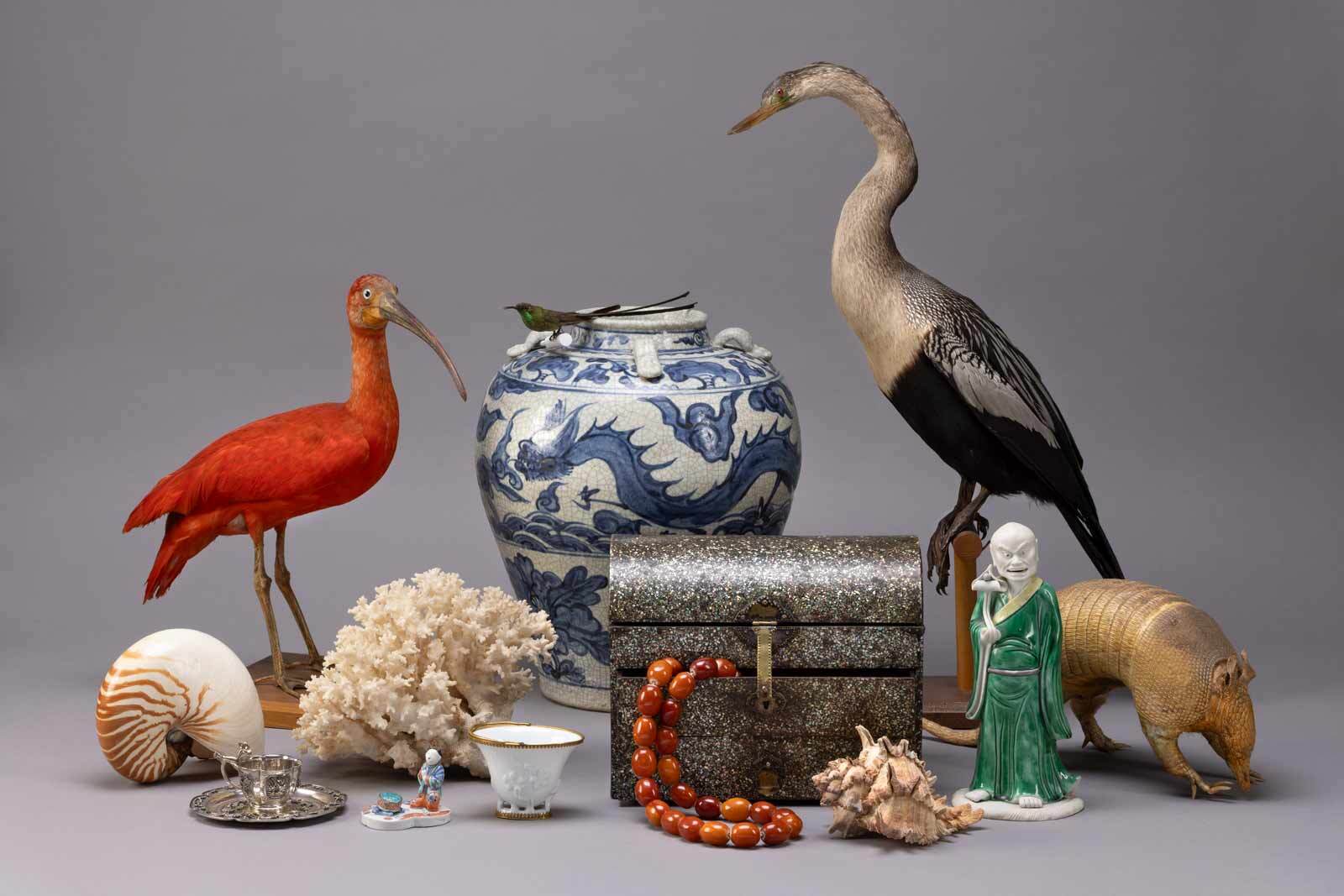
The last section, “Cabinets of Wonder,” pays tribute to the collections of “curiosities” Flanders’s individuals amassed to both reflect their wealth and connections and also possess a microcosm of the world in miniature. PEM’s “Wünderkammer Gallery” evokes these 17th century cabinets, which are full of such seemingly random items as cauliflower coral, a skull-shaped pendant, and a stuffed ostrich. More than 100 objects hail from Africa, Australia, Brazil, China, Indonesia, and Japan.

A selection of natural and man-made wonders in the Saints, Sinners, Lovers, Fools cabinet of wonders at PEM

There are two omissions from the exhibit. One is deliberate and due in part to lack of space. Although Brussels was the principal center for tapestry weaving at the turn of the 15th and 16th centuries, a bias toward painting existed both then and in the collection on display at PEM.

The other omission is any mention of the crypto-Jews who fled the persecutions and expulsions in the Iberian Peninsula and the key roles they played in cultivating Antwerp’s economic preeminence by helping develop the important diamond, pearl, and commodities industries.

Judaism Shares the Spotlight in PEM’s Stunning “Ethiopia at the Crossroads” Exhibit

Artist in Addis Ababa, Ethiopia, Queen of Sheba and King Solomon conceiving King Mǝnǝlik I, 20th century. Tempera paint on cotton canvas. Gift of Charles R. and Elizabeth C. Langmuir, after 1973. Peabody Essex Museum./KATHY TARANTOLA/PEM

By Shelley A. Sackett

SALEM – “Ethiopia at the Crossroads,” the impressive new exhibit at the Peabody Essex Museum through July 7, celebrates the extraordinary artistic traditions of Ethiopia from their origins to the present day.

Co-organized by the Walters Art Museum and the Toledo Museum of Art, the sensory-rich show presents a collection of over 200 objects, ranging from antique painted religious icons, illuminated manuscripts, gospel books, coins, metalwork, and carvings to modern photographic, textile, and multimedia works by contemporary artists.

As the first major touring exhibition to examine Ethiopian art in a global context, its curators wisely added many roadmaps that describe and illuminate this often-overlooked African nation’s contribution to the world.

Artist in the Beta Israel community, Ethiopia Necklace, 20th century. Silver, metal, and string. Minneapolis Institute of Art, The Ethel Morrison Van Derlip Fund./SHELLEY A. SACKETT

Seated in the Horn of Africa between Europe and the Middle East, Ethiopia has played a profound foundational role in the evolution of the region’s history, creativity, and cross-cultural exchanges over two millennia. It has the distinction – despite upheavals – of maintaining its independence as one of the only African nations to resist colonization. Religious art, in particular, emphasizes the outsized role Ethiopia played in the establishment and evolution of the three major Abrahamic religions: Judaism, Christianity, and Islam.

Most striking is the place Judaism played in this mix.

Prior to the arrival of Christianity, many people in Ethiopia practiced Judaism, perhaps linking back to the meeting of the Ethiopian Queen of Sheba and King Solomon of Israel in the 10th century B.C.E. Known as Beta Israel, the Jewish community in Ethiopia has persisted for over 2,000 years.

Most of the Beta Israel community immigrated to Israel in the 1980s and into the 1900s when political destabilization, famine, and religious persecution threatened the country. Operations Moses (1984), Sheba (1985), and Solomon (1991) airlifted over 80,000 Ethiopian Jews to Israel. Nonetheless, the union between Sheba and Solomon yielded a line of Ethiopian kings that lasted until its last emperor, Haile Selassie, was overthrown by a coup d’état in 1974.

In the 20th century, Jewish community members produced objects in diverse media that alluded to Ethiopia’s Jewish origins. Two large panels depict a graphic novel-type chronicle of the Queen of Sheba (known as the Ethopian Queen Makǝdda) and King Solomon conceiving King Mǝnilǝk I, the first ruler in a Solomonic line of Ethiopian kings.

These epic works (vibrant tempera paint on cotton canvas mounted on board) detail Mǝnilǝk’s journey as an adult to Israel in order to meet his father, King Solomon. His envoy returned to Israel two years later, with the Ark of Covenant, a sacred relic containing two stone tablets inscribed with the Ten Commandments. That ark is said to be located in Ethiopia today, at a church in Aksum. Nearby is a silver necklace crafted by a Beta Israel artist.

Aïda Muluneh, “Addis Neger,” from the Mirror of the Soul series, 2019. Inkjet print. Museum purchase by exchange. Peabody Essex Museum. Courtesy of the artist. ©AïdaMuluneh.

A stunning pillow sham, created by Yederesal Abuhay, depicts two rabbis and their students in front of a synagogue. In the 1990s through the 2010s, the North American Conference on Ethiopian Jewry created a work program for Ethiopian Jews living in Addis Ababa. With the support of this program, Jewish Ethiopian artists created basketry and textile objects, like this pillow sham that also can double as a Shabbat challah cover.

PEM is known for its groundbreaking approach to exhibits, and “Ethiopia at the Crossroads” is no exception. An introductory video provides a panorama of the country’s majestic geography and local inhabitants, including a Jewish man wearing tefillinkippah, and praying outdoors. A trio of scratch-and-sniff cards invites the visitor to inhale the scents of berbere, frankincense, and Ge’ez manuscripts representing the history and literature of the Ethiopian Orthodox Church. Audio-visual displays highlight Ethiopia’s unique sights and sounds and showcase members of the local Ethiopian diaspora community, which includes an estimated 12,000 people in the Greater Boston area alone.

Most striking are the contemporary artworks. Multidisciplinary mixed media collages by Helina Metaferia feature women adorned in elaborate headdresses with messages of resistance and change. Six exciting photographs by Aïda Muluneh combine thought-provoking observations on multigenerational traditions and transitions among Ethopia’s women with a keen sense of design, color, and technical acumen. The first African woman to serve as a commissioned artist for the Nobel Peace Prize, Muluneh’s work questions assumptions about spirituality, mortality, divisions, and community. She draws inspiration from folklore, religious icons, and memories of her grandmother.

“These photographs express what it is to be an African woman by encapsulating gender and identity as a celebration of contemporary self-expression. As the first contemporary Ethiopian artist to have her work acquired for PEM’s collection, Muluneh raises awareness of the impact of photography in shaping cultural perceptions,” said Karen Kramer, PEM’s Stuart and Elizabeth F. Pratt curator of Native American and oceanic art and culture. Θ

For more information and tickets, visit pem.org.

Samuel Bak, who paints the past so we will never forget it, to be on display in Beverly

Samuel Bak in his Weston studio. Photo: Pucker Gallery, Boston

by Shelley A. Sackett

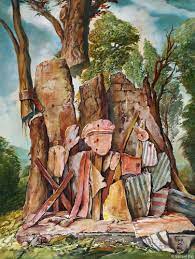
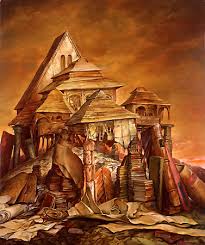
BEVERLY – Samuel Bak, the renowned international artist, speaks in a language of images, dreamscapes, and colors. A child prodigy and Holocaust survivor, Bak tells his life’s stories through canvases rich in symbol, metaphor and reorientation. Recognizable objects and figures appear shattered and reglued; a pear sports a smoke stack, broken teacups become surrealist landscapes, and a ruined house sits atop a mound of books.

Bak’s rich, thought-provoking works will soon be on view in Beverly. “Samuel Bak and the Art of Remembrance,“ an exhibition at Montserrat College of Art Gallery presented in cooperation with Pucker Gallery of Boston, brings together 37 paintings and works on paper created between the 1990s and today. The show runs Jan. 18 to March 4, with an opening reception to commemorate International Holocaust Remembrance Day on Jan. 27.

Persistence of Memory by Samuel Bak

His canvases tell the story of a world destroyed, a destruction he witnessed and survived. His work references Jewish and Holocaust history, challenging historical amnesia with difficult images of those times.

Yet, he does not consider himself a “Holocaust painter,” as he is often described, and despite the fact that what he witnessed during those times is the subject of many of his paintings. “I felt I have a story to tell and I wanted to touch other people. I refer to the Holocaust because it is something I know, but it goes beyond that,” he said over Zoom from his Weston home.

His paintings are meant to make the viewer wonder what happens when the world rejects equality and focuses on dehumanizing “the Other.” “My paintings ask questions. They don’t necessarily give answers because I personally don’t have any,” he said.

Despite scenes of anguish and despair, Bak also paints survivors, imbuing them with glimmers of muted hope and resilience. Rivers still run; painters still paint. The teddy bears and tea cups and humans are put back together again, but they can never be the same as our first memories of them.

Under the trees of Ponari by Samuel Bak

“I wanted to speak about the survivors, who are people who try to rebuild something that is similar to the reality that existed once, but cannot be totally reconstructed,” he said. “Somehow it is out of the bits and pieces of the horrors of the past that we can construct the sense of our being here and learn to prevent such horrors from happening again as much as it is possible.”

An only child, Bak was born in 1933 to an educated, middle-class family in Wilno, Poland. At age 3, he was a recognized child prodigy painter. At age 7, on the day after his first day of school, he and his family were deported to the old Jewish quarter of the city now called Vilna. At 9, he had his first exhibition, inside the Vilna ghetto. When the Russians liberated Vilna, he and his mother were among its 200 survivors from a pre-war community of between 70,000 and 80,000 Jews.

“The major subject of my paintings is: How was it possible such events happened? How is it I am still alive?” he said.

He and his mother spent from 1945 until 1948 in German displaced person camps, immigrating to Israel in 1948 when Bak was 15. After working and living in Tel Aviv, Paris, Rome and Lausanne, he came to America and settled in Weston in 1993.

During his 85-year career, Bak has produced over 9,000 items. Since the 1960s, remembrance and its nuances has been a major theme.

“Memory is not a folder that is downloaded onto your computer and when you want to look at it, you give a click and the folder reopens exactly as it was before,” the 88-year-old said.

Persistence by Samuel Bak

Unlike a computer folder, Bak sees the human memory as unique and individual because it also contends with our failure to remember. “We are blessed that we have the possibility to forget. This is what keeps us alive,” Bak said. It is also why, when we want to remember, we must recreate that memory.

In his paintings, Bak is “recreating the image that I have of the world in which people live today. Images that somehow seem to belong to another world attract viewers and enable me or others who speak about my work to speak of the times they represent,” he said.

His paintings have been used to educate thousands of teachers and students about the Holocaust since 1978. That year, he exhibited in a national museum in Germany that drew large groups of teachers and young students. “It suddenly opened my eyes. I thought, ‘My goodness. My paintings can do that. That’s absolutely wonderful,’” he said.

Since then, the PBS show “Facing History” has used his art for over 40 years to teach about the Holocaust, reaching millions of students in thousands of classrooms. In 2022, the Florida Holocaust Museum in St. Petersburg will mount a yearlong exhibit of his paintings to commemorate its 30th anniversary.

Montserrat will sponsor a virtual artist talk with Bak and – COVID permitting – other school groups plan to visit the exhibit. “What is happening with this exhibition at Montserrat College is not something new, but it is something I know works,” Bak said.

Believe the Hype- ‘Imagine Van Gogh’ at SoWa Power Station Is A Knockout

Photo by Laurence Labat

by Shelley A. Sackett

“Imagine Van Gogh the Original Immersive Exhibition in Image Totale©” has  been advertising its arrival in Boston since last March. At last, the wait is over and, in a nutshell, it was well worth it.

It is hard to overstate the impact of walking into a 24,000 square foot architectural wonder that has been transformed into a blank canvas for multi-projections of 200 of the Dutch artist’s most vibrant and famous paintings. Viewers don’t just enter a gallery; they enter a world, miraculously passing through a magical keyhole that allows us to become part of these masterpieces.

There is no center or periphery. Visitors are indeed, as promised by the introductory panel, “guided by their emotional intelligence, allowing them to imagine their own Vincent Van Gogh.”

The floor is part of the canvas and it pans in and out to coordinate with the images cast above, which also move. The effect is both thrilling and dizzying. We literally enter the artist’s world of dreams (and nightmares), transported on a journey to the heart of his work. Brushstrokes are blown up to the size of unfurled flags, projected in indescribably fine detail that invite us to dive in.

A timed musical loop completes this multisensorial magical mystery tour. Prokofiev, Saint-Saëns, Mozart and especially Délibes’ delicious “Flower Duet” encourage us to move about the room in concert with the tactile brushstrokes that dance around us.

Photo by Laurence Labat

This is not passive viewing; each one of us is free to wander around, exploring and experiencing in their own way and, most importantly, at their own pace. The educational panels that efficiently introduce us to the nuts and bolts behind the technology as well as details of Van Gogh’s life provide both content and effect. Easy-to-read panels hang suspended in a welcoming anteroom, inviting yet not overwhelming.

Van Gogh was born in 1853, in the Netherlands, home to bleak dark winters. From early childhood, he showed signs of a moody and agitated temperament that would torment him throughout his life. His father was a Protestant preacher, and he first chose to follow in his footsteps. He became a preacher in London and returned to the mining town of Boringe to try his hand at evangelizing.

Instead — and lucky for the art world — he turned to painting as a way to express sympathy for the miners’ plight in dark tones and somber moods. By 1886, he was living in Paris with his art dealer brother Theo, hobnobbing with the impressionists and developing his own style of bright colors and bold brushstrokes.

The even brighter sun of the south of France — his “Arles Period” — magnified Van Gogh’s use of primary colors and  brash, swirling  brushstrokes. “Van Gogh’s Greatest Hits” are all here, from Starry Nights to Sunflowers, Irises, Self-Portraits, Portrait of the Postman, Church at Auvers  and more.

The Introductory panel to this astonishing accomplishment is worth taking a moment to digest, no matter how strong the magnetic pull to dive into the exhibit, for it sets the stage and pays homage to its creator, Total Image©. The Boston exhibit is the US Premiere of the first immersive exhibition, presented in 2008 in France and created by Annabelle Mauger. Since then, there have been numerous smaller versions inspired by the original, but make no mistake — this one  is the real deal.

‘Imagine Van Gogh the Original Immersive Exhibition in Image Totale©” is at the SoWa Power Station, Boston, through March 19, 2022. To buy tickets or for more information, go to http://www.imagine-vangogh.com.

Annual JArts Hanukkah celebration at the MFA has a new feminine twist

Yemenite singer and songwriter Tair Haim

By Shelley A. Sackett

BOSTON – Since 2015, Jewish Arts Collaborative has brought the Greater Boston community together to celebrate Hanukkah at the Museum of Fine Arts, Boston. Despite Covid constraints, JArts, the MFA and JCC Association of North America and their JFest program have collaborated to bring an innovative and uplifting Hanukkah program into the homes of celebrants across the country with their virtual event on Wednesday, December 1, “Hanukkah: The Festival of Lights.”

This year, the tradition of partnering with local artists and communities to create an exceptional evening for all ages has a special feminine twist.

The free program will feature eight Hanukkah lamps, including six from the MFA’s Charles and Lynn Schusterman Collection, and eight international women artists for an evening of performance, education, global diversity and artistic engagement. Like an elegant wine pairing where patrons enjoy wine at its fullest potential by pairing it with the perfect food, these performances and lamps elevate and balance each other, bringing out the best in both.

German Rococo Hanukkah Lamp, about 1750 Photograph © Museum of Fine Arts, Boston

Each piece will last approximately five minutes. Slides of the corresponding lamp will appear during the presentations.

The idea behind this year’s theme germinated from brainstorming sessions between Laura Conrad Mandel, JArts Executive Director, and the MFA’s Charles and Lynn Schusterman Curator of Judaica, Simona Di Nepi.

Originally from Rome, Di Nepi studied and worked in London and Tel Aviv for 25 years before coming to the US. She became the first full-time Judaica curator at the MFA (as well as at any other encyclopedic museum in the US) in 2017. Her appointment followed the gift in 2013 of 120 decorative and ritual objects from the Charles and Lynn Shusterman Collection.

Although “Judaica” typically describes ritual objects used in the home or in the synagogue across history, geography and media, Di Nepi stresses that she takes a broader view. “Any kind of MFA material or object that is related to Jewish life, art and history can be considered as Judaica,” she said, adding that as curator, it is also her job to decide what “Judaica” means at the MFA.

Mandel asked Di Nepi to choose an array of Hanukkah lamps. “Some of the lamps are on display, but others are in storage, so this a unique opportunity to hear about them. Each of the lamps represents a different aspect of global Jewry in an effort to spotlight the diversity of Jewish culture,” Mandel said.

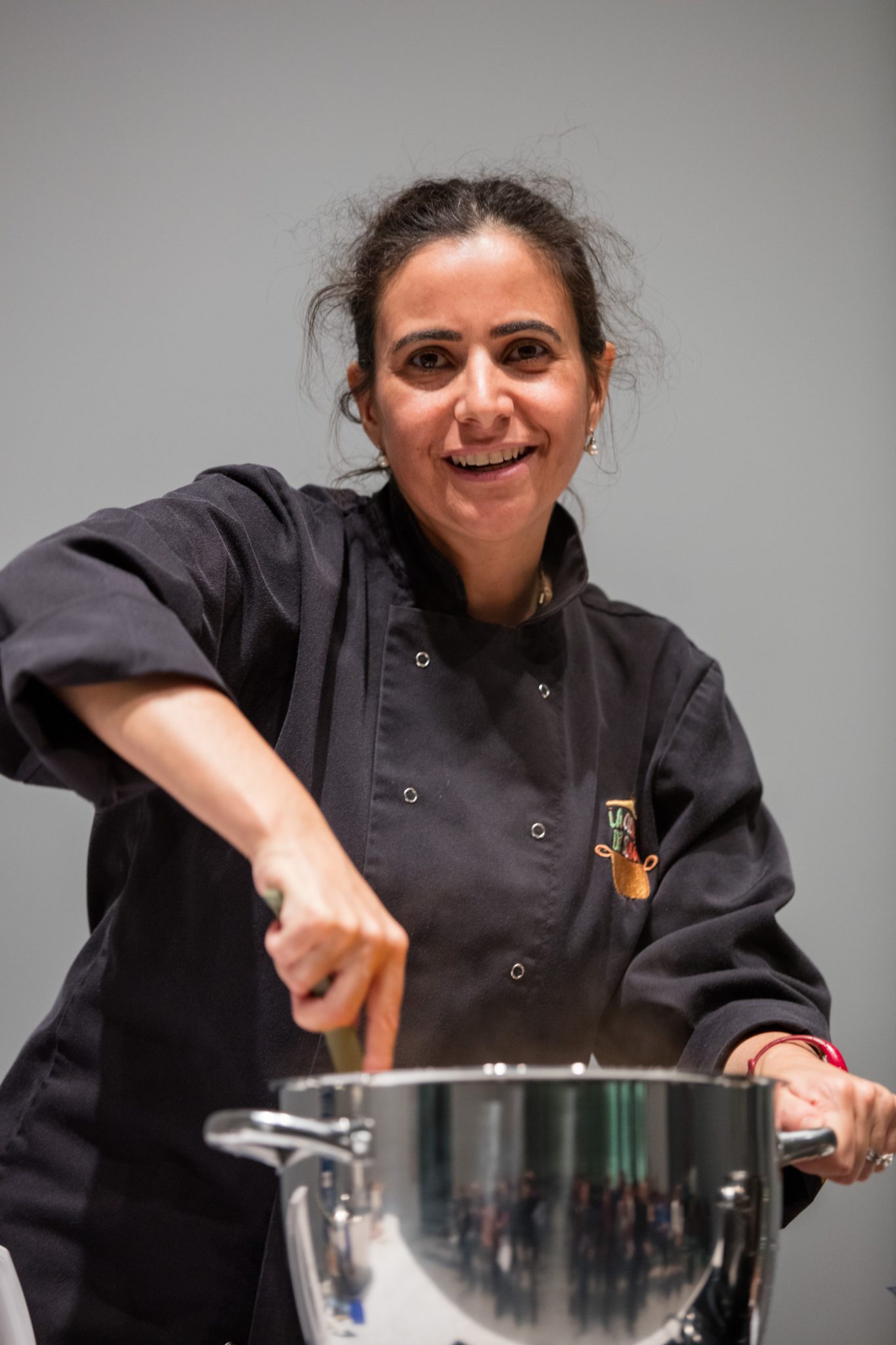
Italian cook Silvia Nacamulli will offer a cooking demo

After they picked the lamps, the team curated artists with connections to the stories behind the Hanukkah lamps. Their hope is that by pairing a lamp with a particular artist, attendees will be inspired to reimagine these beautiful objects of Judaica in ways that capture their imaginations and bring to life each lamp’s contemporary culture.

During the selection process, and purely by coincidence, they realized how many women’s voices they were drawn to. “We suddenly realized we had all women. There’s a theme there as well that adds special value to the evening,” Di Nepi said. “Eight nights of Hanukkah, eight lamps and eight women guests.”

Contemporary dancer Rachel Linsky was inspired by Linda Threadgill’s “Garden of Light Hanukkah lamp.

The full program includes an exciting mix of artforms, including dance, singing and, for the first time, a culinary event. Italian cook Silvia Nacamulli will do a cooking demo. Her presentation is paired with a 16th century Italian bronze lamp.

Tair Haim is a powerhouse Yemenite Israeli singer, songwriter and founder of the internationally acclaimed group A-WA who took the music world by storm with the mega hit ‘Habib Galbi’. Her performance is paired with a 1920s silver Yemeni lamp which features figures of the Maccabees and is one of Di Nepi’s favorites. “I have a weakness for the Yemenite one,” she said with a laugh when pressed to choose.

Hanukkah lamp Yehia Yemini (born In Yemen (Sana), active in Israel, 1897–1983) 1920s Yemenite Hanukkah lamp, 1920s * Photograph © Museum of Fine Arts, Boston

Boston-based contemporary dancer, choreographer and educator Rachel Linsky filmed her original piece at the Gardens at Elm Bank in Dover. It was inspired by American Linda Threadgill’s lithe and charming 1999 silver, bronze and walnut lamp, “Garden of Lights,”.

Indian Israeli singer Liora Isaac has an ardent following in Israel, where she highlights a unique look at Indian-Israeli culture. Her performance will be paired with a 20th century brass lamp from India.

Hanukkah lamp Linda Threadgill (American, born in 1947) 1999 Silver, bronze, walnut * Photograph © Museum of Fine Arts, Boston

Neta Elkayam, another wildly popular Israeli visual artist and singer of North African music, brings a Moroccan flavor to her work, complementing a silver early 20th century Moroccan lamp. The striking American Ladino singer and composer, Sarah Aroeste, will add to  the evening with her feminist Ladino rock. An elegant 17th century bronze lamp joins hr.

Israeli visual artist and singer of North African music Neta Elkayam

Rounding out the Hanukkah lamp selections are a charming 1960 silver American piece (Di Nepi will interview Massachusetts-based jeweler and metalsmith Cynthia Eid) and an ornate 1750 silver German lamp that is embellished with elaborate Rococo ornaments that support figures of Judith and David, two ancient Jewish heroes. American Mizrachi belly dancer Jackie Barzvi’s performance accompanies the lamp. “This lamp reflects the [artistic] language of the time,” Di Nepi explained. “In Germany, that language was Rococo, with its distinctive and precise motifs. Jewish materials spoke that local artistic language too.”

For more information and to register, visit jartsboston.org/event/hanukkah-the-festival-of-lights-2/

Israeli artist breaks gender barrier with ‘A Fringe of Her Own’

By Shelley A. Sackett

MARCH 29, 2018 – Two summers ago, Tamar Paley started thinking about what she wanted to focus on for her senior thesis project at Shenkar College of Engineering and Design in Ramat Gan.

As one whose work is inspired as much by her own life and opinions as by form and materials, she decided to use the thesis platform as a way to bring attention to two matters she cares strongly about – feminism and gender inequality – and the “non-recognition of progressive Judaism from Israeli authorities,” the 26-year-old said by email from Tel Aviv.

Paley came up with the idea to create feminine Jewish ritual items based on but totally different from those traditionally reserved for men, including tefillin, tzitzit, and tallit. Her collection, “A Fringe of Her Own,” calls on her talent for jewelry making with delicate, inventive, and exquisite pieces specifically for women.

Soon after finishing her studies, she ran across an open call for the Hadassah-Brandeis Institute’s artist-in-residence program and submitted her work for consideration. She was selected from 30 applicants, and “A Fringe of Her Own” is now on display at HBI’s Kniznick Gallery at the Women’s Studies Research Center in Waltham through June. This is Paley’s first solo show and the first US exhibition of her work.

Initially, her peers and professors at Shenkar were unenthusiastic about her proposal. “This is not ‘mainstream’ in Israel and more than that, it is a subject of deep controversy that has led to confusion and identity questions,” she said. Once she explained what she wanted to do and why, “they got it. The support was amazing and opened up a new realm of discussion beyond design and into worlds of faith and femininity.”

Growing up in a reform/progressive Jewish community, Paley was part of a group that accepted women as religiously equal to men when it came to participating in what mainstream Israeli Judaism considers exclusively male.

“In Israel, everything is political, so women wearing a tallit or using tefillin feels like a very bold statement, sometimes even scary and uncomfortable,” she said.
Even among other progressive Israeli women, using and seeing tallit and tefillin on women doesn’t always feel natural. “They still feel like they culturally belong to men,” Paley said.

At Brandeis, her bold, innovative work was welcome.

The Hadassah-Brandeis Institute’s mission is to support “fresh ways of thinking about Jews and gender world-wise,” and Lisa Fishbayn Joffe, Shulamit Reinharz director of the institute.

“We are excited by the challenging beauty of her work and by the role that dialogue with women in the progressive movements in Israel played in her design process,” Joffe added, noting Paley will continue that conversation with women in the region through lectures and workshops.

The groundbreaking exhibit builds on Paley’s belief that jewelry can make a strong social statement while reflecting beauty and aesthetics. She deconstructs traditional patriarchal Jewish ritual objects and redesigns them to reflect a feminine consciousness using material such as German silver, handwoven textiles, found objects, gold foil, printed parchment, Lucite, and printed silk.

The results are breathtaking in their symbolism, feminine energy, and exceptional craftsmanship. The combination of graceful silverwork, delicate fringe, and carefully chosen snippets of text against a backdrop of elegant yet bold blue textile creates wearable objects with religious and spiritual significance and beauty.

“A Fringe of Her Own” garnered Paley a prestigious American-Israel Cultural Foundation scholarship. She also presented the collection at the world-renowned Marzee International Graduation Show in the Netherlands.

Joffe hopes visitors take away awareness that Israeli women are part of a vibrant art scene that is exploring contemporary issues of Jewish identity. Paley hopes for something a little deeper.

“I want attendees to leave with the notion that religion is in our hands, literally, and it is our responsibility to design and reflect our needs and beliefs,” she said. “I hope I can be a voice for some women out there, at least hopefully the friends I grew up with, and that this will encourage them to be proud of who they are and to fight for what they believe in.”

The Kniznick Gallery is located on the Brandeis University campus in the Epstein Building, 515 South St., Waltham. The exhibit is free and open to the public Monday through Friday from 9 a.m. to 5 p.m., with special weekend hours April 15 and 22. For more information, visit brandeis.edu/hbi/arts

Georgia O’Keeffe as artist, model, and designer at Peabody Essex Museum

Shelley A. Sackett

DECEMBER 28, 2017 – SALEM – Few people outside academia realize that Georgia O’Keeffe (1887-1986), the iconic artist famous for paintings of enlarged flowers and New Mexico landscapes, was an accomplished seamstress who lavished as much creative juice on her self-presentation as on her work. With the opening of its multi-disciplinary exhibition, “Georgia O’Keeffe: Art, Image, Style,” the Peabody Essex Museum in Salem opens the door to her closet.

O’Keeffe’s paintings are presented alongside her never before exhibited handmade garments and dozens of images of the artist taken by photographers, including her Jewish husband, Alfred Stieglitz. The show, first curated at the Brooklyn Museum by art historian Wanda M. Corn, is the first to explore how the renowned artist deliberately and adeptly shaped her public image and myth, creating her own celebrity fame.

The 125 works expand our understanding of O’Keeffe while underscoring her fierce determination to be in charge of how the world understood her identity and artistic values. The powerful public persona she created through her clothes and the way she posed for the camera unequivocally proclaimed her independence and modern, progressive lifestyle.

“O’Keeffe drew no line between the art she made and the life she lived,” Corn said. “She strove to make her life a complete work of art, each piece contributing to an aesthetic whole.”

Corn discovered O’Keeffe’s cache during a 1980 cross-country stopover in New Mexico on her way to Stanford University, where she taught art history. She visited O’Keeffe’s homes in the Southwest state at Ghost Ranch and Abiquiú, finding closets full of the artist’s clothing preserved in beautiful condition. Because most were without labels, she had to guess which ones the artist created and which she bought. Corn said if she could sit down with O’Keeffe, “My first question would be, ‘Was I right in my attributions?’”

Most of the clothes and desert artifacts now belong to the Georgia O’Keeffe Museum in Santa Fe, founded the year of her death in 1986.

The provocative photographs by Stieglitz (1864-1946) dominate the exhibition’s walls at the Peabody Essex. It’s hard to imagine the different path O’Keeffe’s life might have taken had she not caught his eye in 1916, when he was 52, married, and a world-famous photographer based in New York and she was 28 and still unknown.

Instantly infatuated with O’Keeffe and her art, the son of German-Jewish immigrants wooed and won her. She moved to New York and soon, he began taking nude photographs of her, one of which hangs beside an O’Keeffe painting at the Peabody Essex exhibit. The two married in 1924. For years, Stieglitz photographed O’Keeffe obsessively, teaching her how to pose and helping make her the most photographed artist of the 20th century.

In 1927, O’Keeffe visited New Mexico and fell in love with the desert landscape. Her art and clothing would change in response to it. She lived there part of the year from 1929 on, moving there permanently after Stieglitz’s death in 1946. The younger generation of photographers who visited her in New Mexico cemented her status as a pioneer of modernism and a contemporary style icon.

Sprinkled throughout the rooms of paintings, paired clothing, and photographs at the Peabody Essex exhibit are small screen films, including fascinating home movies of O’Keeffe and Stieglitz in New York and a one-minute 1977 video portrait, the only such interview the artist granted.

One standout in the exhibition’s predominantly black and ivory palette is an orange Andy Warhol diamond-dusted print that introduces the idea of “Saint Georgia,” showing a meditative, mystical, Mother Theresa-like O’Keeffe. Another is a video of the House of Dior’s 2018 O’Keeffe-inspired cruise collection that features her signature gaucho hat.

“O’Keeffe’s aesthetic legacy of organic silhouettes, minimal ornamentation, and restrained color palettes continues to capture the popular imagination and inspire leading designers and tastemakers of today,” said Austen Barron Bailly, organizing PEM curator.

“Georgia O’Keeffe: Art, Image, Style” runs through April 1 at the Peabody Essex Museum, East India Square, 161 Essex St., Salem. For more information, call 978-745-9500 visit pem.org.

Pleasure and Pain: Not All Shoes Are Meant for Walking


If, as Mark Twain said, “Clothes makes the man”, then the Peabody Essex Museum’s newest exhibit is full throttle support for a complementary adage: “Shoes make the woman”.

“Shoes: Pleasure and Pain” showcases 300 pairs of shoes by more than 130 designers and artists that range from the sublime to the ridiculous, from the comfortable to the downright punishing. Although men’s shoes are represented with bling and panache, over 70% of the exhibit is devoted to women’s shoes.

With its recent acquisition of 20th– and 21st-century fashion, PEM has the largest shoe collection in the country. Over 100 are included in the exhibit, many of which have never been displayed before.

“We are in the process of building a fashion presence at PEM,” said Lynda Roscoe Hartigan, PEM’s James B. and Mary Lou Hawkes Deputy Director and coordinating curator for the exhibition. “There is a growing appetite for compelling exhibitions about fashion.”

Organized by the Victoria and Albert Museum, London, the PEM show marks its U.S. debut and will run through March 12, 2017.

Curated by themes, the five-section show (Transformation, Status, Seduction, Creation and Obsession) features shoes worn by high profile celebrities such as David Beckham, Elton John, Queen Elizabeth and Princess Diana. Among the artists and designers represented are Manolo Blahnik (of “Sex and the City” notoriety), Christian Louboutin (with his signature red soles), Christian Dior, Jimmy Choo and Prada. Combat boots and sneakers share center stage with stilettos and seductive boudoir mules.


11rogervivierchristiandior

Beaded evening shoes by Roger Vivier for Christian Dior, 1958-1960.


It is the pairing of designer and consumer that is at the heart of the exhibit. “Shoes are about the personal creativity of the designer and the person who wears that shoe. It’s a partnership between two people who likely never meet. Creation is about communication,” Hartigan said.

The shoes on display aren’t just meant to protect feet and promote locomotion. They are also projections of the mood, identity and status of the wearer. “Shoes are extensions of ourselves,” she added.

Blahnik’s Mondrian-inspired red and yellow “Tendona” shoes would be conversation-stoppers at any gathering as would Louboutin’s impossibly high-heeled “Anemone” design, with its red satin bursts and feathers. The shoes seem molded to fit a Barbie doll’s nonhuman foot, and in fact, Barbie does have her very own accessory line of three Louboutin designs.


Manolo Blahnik , 'Tendona' shoe, 2015. Leather. Courtesy of Manolo Blahnik

“Tedona” by Manolo Blahnik, 2015, made of leather and on loan from the designer..


These shoes aren’t meant for the average consumer (even Barbie’s version retails for $35). With starting prices of $700, they are associated with more than female sexuality and power. “High heels have always been worn by rich people of high society,” said Hartigan, noting that the Egyptians first developed platform shoes in 3500 B.C. so the wealthy could be seen as walking high off the ground.

Historians looking for more than the dazzle of sequins and crystals (yes, there is even a Swarovski Cinderella glass slipper) can linger among the lotus shoes made for bound feet, 16th century chopines and men’s shoes with noisy slap-soles that were worn in Europe in the 17th century.


chopines

Chopines by an artist in Venice, Italy, about 1600 made of punched leather and pine.


Fashionistas will delight in the chance to see Vivienne Westwood’s dramatically exaggerated lace-up blue platform heels that famously caused model Naomi Campbell to stumble on a Paris runway in 1993. A picture of Campbell good-naturedly laughing after her very public tumble is part of the display.


campbell

The Vivienne Westwood blue, platform-heeled “Super Elevated Gillie” shoes that caused Naomi Campbell’s infamous 1993 Paris catwalk show tumble.


The exhibit also has a distinctive local flavor, acknowledging New England’s importance as a shoe manufacturing center and featuring selections from the late Boston style maven Marilyn Riseman and noted North Shore collectors Jimmy Raye and Lillian Montalto Bohlen.

Turning momentarily serious, the section “Seduction” shines a spotlight on the often-blurred lines between objectification and celebration of women’s sexuality. Inspired by bondage and 18th century prostitution, mules and high heels have always represented both passion and exploitation.

Perhaps the most extreme example of this is “Fetish”, an unwearable pair of stilettos created by Louboutin in collaboration with film director David Lynch, whose signature style (“Blue Velvet”, “Twin Peaks”) is darkly twisted sensuality. The only way one can wear these shoes is by crawling. A picture of a woman doing just that is part of the exhibit.


fetish

“Fetish” by Louboutin in collaboration with David Lynch.


Walking through the galleries, it’s evident that while the lion’s share of shoes is designed for women, the designers are predominantly men. Although high heels may empower and literally elevate women, they can do so at a cost of permanent back and foot problems.

Asked whether he has sympathy for women who wear his designer high heels, Louboutin was unambiguous in a 2012 interview with “Grazia” magazine. “High heels are pleasure with pain. If you can’t walk in them, don’t wear them,” he scoffed.

Or, as a shoe designer in ancient Roman times (when high heels were popular with both men and women) might have put it, “caveat emptor”.

Shoes: Pleasure and Pain runs through March 12, 2017 at the Peabody Essex Museum, 161 Essex St., Salem. For more information, visit pem.org.

PEM’s “Asia in Amsterdam” Exhibit is a Feast for the Senses


Shelley A. Sackett


“It started with spices from Asia…” reads the inscription above a display of glass columns of cinnamon, clove and peppercorns that greet the visitor to “Asia in Amsterdam: The Culture of Luxury in the Golden Age”, the latest world-class exhibition at the Peabody Essex Museum. And indeed, the 200 extraordinary examples of paintings, textiles, ceramics, silver, lacquerware, furniture, jewelry and books would never have found their way from their native Asia to 17th century Dutch households were it not for the spice trade that originated in Amsterdam and single-handedly created the Dutch Golden Age.


GoldenBend

The “Golden Bend” in the Herengracht, Amsterdam, 1671-1672. Gerrit Adriansz. Berckheyde.


The exhibit, five years in the making and co-organized by the Rijksmuseum of Amsterdam, runs through June 5. PEM is the exclusive U.S. venue. Founded less than a year apart – in 1798 and 1799 – the Dutch and Salem museums boast world-renowned Asian export art collections inextricably linked to early international trade, and pieces from both collections form the backbone of the exhibit.


Thanks to the painstaking work of a team of 35 talented PEM staff members, “Asia in Amsterdam” navigates the complex story of the transformative influence Asian luxuries had on Dutch art and life in bite-sized chunks. Combining lessons in history, sociology, economics, arts and crafts, the galleries are logically organized to tell a seamless story. The animated maps, interactive digital displays and short films add a deeper access to the material.

cellaret

Cellaret. Batavia (Jakarta, Indonesia), with flasks from Arita, Japan, 1680-1700. Calamander with silver mounts and velvet lining, and porcelain.

It all started with pepper, nutmeg and cloves and the Dutch East India Company (Verenigde Oostindische Compagnie, or VOC) that was set up in 1602 to import them from the Maluku Islands in Indonesia back to the Netherlands. Before long, the VOC was the most powerful and largest trade and shipping company in the world, employing more than 400,000 Dutch and other European and Asian workers. The exhibit minces no words about VOC’s relentless and, at times, ruthless pursuit of profit at the expense of the local people. The toll of human suffering casts a dark shadow over these sparkling jewels.


Soon, in addition to spices and tea, the VOC began importing costly textiles, porcelain, lacquer and silver from China, India, Japan, Indonesia, Sri Lanka and Vietnam. For the austere Dutch Protestants, who were used to eating from heavy stoneware and wearing drab wool and linen clothing, the introduction of gossamer thin brightly colored Indian cotton, feather light and elegant Chinese porcelain and elaborate lacquered coffers inlaid with mother of pearl and other exotic materials suddenly turned their monochromatic world into Technicolor. Amsterdam quickly became the seat of global economy and enormous wealth.

Palampore

Cotton embriodered with silk and metal-wrapped threads. Palampore. Deccan, India, 1710-1750.


“One can only imagine the delight and amazement that these imports must have inspired in the Netherlands,” said Karina Corrigan, PEM’s H.A. Crosby Forbes Curator of Asian Export Art. Gallery after gallery is chockfull of examples of the lavish Asian imports the Dutch consumer suddenly couldn’t live without. Paintings by Dutch artists illustrate how the wealthy incorporated these sensual delights into their everyday lives. Fashionable Dutch men wore silk Japanese robes, Dutch women hosted elaborate Chinese tea parties, and room after room of wealthy Dutch households boasted the items on display. Many built special “porcelain display rooms” to show off their collections. Even Rembrandt van Rijn was “a phenomenal shopper”, collecting Asian objects and Indian miniature painting, which inspired many of his drawings and etchings.


Perhaps the best (and most amusing) example of the new European opulence and swagger is a sumptuous lacquer crate inlaid with mother of pearl that opens to reveal a portable commode, complete with red velvet and gilded mounts. Built in the 17th century and later modified in France, it found a special niche at the Chateau de Versailles.


Youngwoman

Paulus Moreelse. “Portrait of a Young woman”, about 1620.


Another example of the colossal obsession with materiality is Paulus Moreelse’s “Portrait of a Young Woman.” Apparently, his young unknown subject (rumored to be port of the court of the House of Orange-Nassau) couldn’t decide what to wear for this portrait, causing her severe anxiety lest she appear too austere. The diamond brooch from India with its 208 gems hopefully set her young mind at rest.


The array of objects and their sensual allure is at times overwhelming. While the exotic and intriguing imports reflect the VOC’s global reach and the Dutch voracious appetite for its bounty, “Asia in Amsterdam” doesn’t simply admire these objects. It goes one step further, examining their revolutionary impact on the Dutch imagination and way of life in an unobtrusive but instructive way.


As Amsterdam’s status as the epicenter of global trade grew, so did its prosperous population, and innovations that reached into all facets of life both in Europe and throughout the world followed. With so much porcelain in the Netherlands, even common people could afford to use it daily. Asian spices both brightened Dutch palates and revised how Europeans treated illnesses. Amsterdam became the center of the publishing world, growing from one publishing house in 1570 to 129 by the year 1670. Dutch books, sold throughout Europe, fueled curiosity about the wider world, especially Asia.

CoveredBowl.org

Covered Bowl. Jingdezhen, China. Porcelain.


Dutch artists and artisans appropriated the material Asian culture, representing it in still-life paintings, delftware and furniture. Dutch design of textiles, silver and lacquer were not far behind.


The “Thought Leaders” section of the exhibition is particularly interesting. It considers the ramifications of exposure to the worlds of far off places, including their peoples, plants, animals, religions and medical practices, on Dutch scholars. Adding a soothing musical layer is “The Golden Dream: 17th Century Music from the Low Countries,” by the Newberry Consort with Marion Verbruggen and Paul O’Dette, which plays in the background.

cradle

Cradle. Coromandel Coast, India, 1650-1700. Ebony and Ivory.


The exhibit ends as it began, with contemplative words painted on a wall. “At certain times, great achievements in art, science and commerce come together to define a golden age,” it reads. Against a backdrop listing Renaissance Florence, Mughal India, the Tang Dynasty and 1920’s New York City, it asks the visitor to consider where and when the next big movement might come.


To think, it could all start with something as small as spices.

For more information, go to pem.org.